

Early-initiated childhood reading for pleasure: associations with better cognitive performance, mental well-being and brain structure in young adolescence
Open accessThe DOI matches its Crossref record; 99 of the 100 references it cites were found in a registry or an index; 23 of the 63 sources its claims cite were checked for support.
Abstract
BACKGROUND: Childhood is a crucial neurodevelopmental period. We investigated whether childhood reading for pleasure (RfP) was related to young adolescent assessments of cognition, mental health, and brain structure. METHODS: We conducted a cross-sectional and longitudinal study in a large-scale US national cohort (10 000 + young adolescents), using the well-established linear mixed model and structural equation methods for twin study, longitudinal and mediation analyses. A 2-sample Mendelian randomization (MR) analysis for potential causal inference was also performed. Important factors including socio-economic status were controlled. RESULTS: Early-initiated long-standing childhood RfP (early RfP) was highly positively correlated with performance on cognitive tests and significantly negatively correlated with mental health problem scores of young adolescents. These participants with higher early RfP scores exhibited moderately larger total brain cortical areas and volumes, with increased regions including the temporal, frontal, insula, supramarginal; left angular, para-hippocampal; right middle-occipital, anterior-cingulate, orbital areas; and subcortical ventral-diencephalon and thalamus. These brain structures were significantly related to their cognitive and mental health scores, and displayed significant mediation effects. Early RfP was longitudinally associated with higher crystallized cognition and lower attention symptoms at follow-up. Approximately 12 h/week of youth regular RfP was cognitively optimal. We further observed a moderately significant heritability of early RfP, with considerable contribution from environments. MR analysis revealed beneficial causal associations of early RfP with adult cognitive performance and left superior temporal structure. CONCLUSIONS: These findings, for the first time, revealed the important relationships of early RfP with subsequent brain and cognitive development and mental well-being.
Overview
CoChat Summary
TL;DR
In the ABCD cohort, early-initiated long-standing childhood reading for pleasure (RfP) was associated with better cognitive performance, lower mental-health problem scores, and larger cortical/subcortical brain structures in young adolescence. Longitudinal, twin, mediation, and Mendelian randomization analyses suggested 2-year associations, moderate heritability with substantial shared-environment contribution, brain mediation, and possible causal links to adult cognition and left superior temporal structure.
Key findings
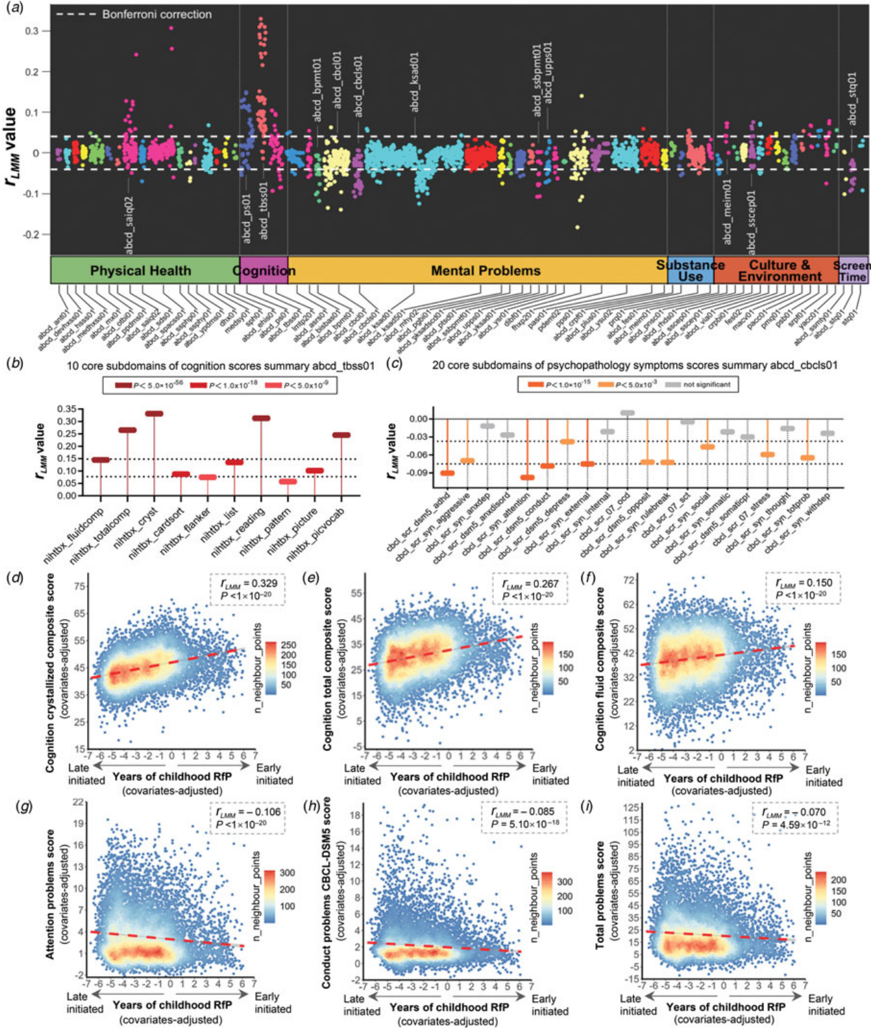
- Among 10,243 participants with complete RfP data, early RfP was positively correlated with NIH-TB cognition scores (rLMM 0.041–0.331), especially crystallized cognition (rLMM = 0.329, p < 0.001), total cognition (rLMM = 0.267, p < 0.001), and fluid cognition (rLMM = 0.150, p < 0.001), and negatively correlated with psychopathology scores, including attention problems (rLMM = −0.106, p < 0.001) and ADHD scores (rLMM = −0.098, p < 0.001).
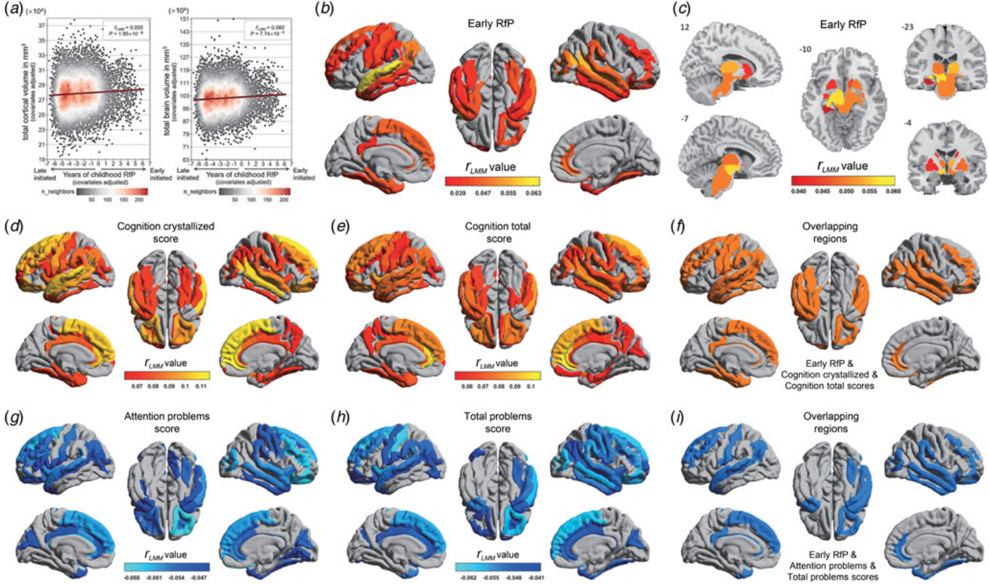
- Early RfP was associated with larger total brain volume (rLMM = 0.060, p < 0.001), intracranial volume (rLMM = 0.061, p < 0.001), total cortical area (rLMM = 0.059, p < 0.001), and total cortical volume (rLMM = 0.055, p < 0.001); after adding ICV as a covariate, left superior temporal cortical region remained significant (rLMM = 0.0374, p = 0.026, FDR-corrected).
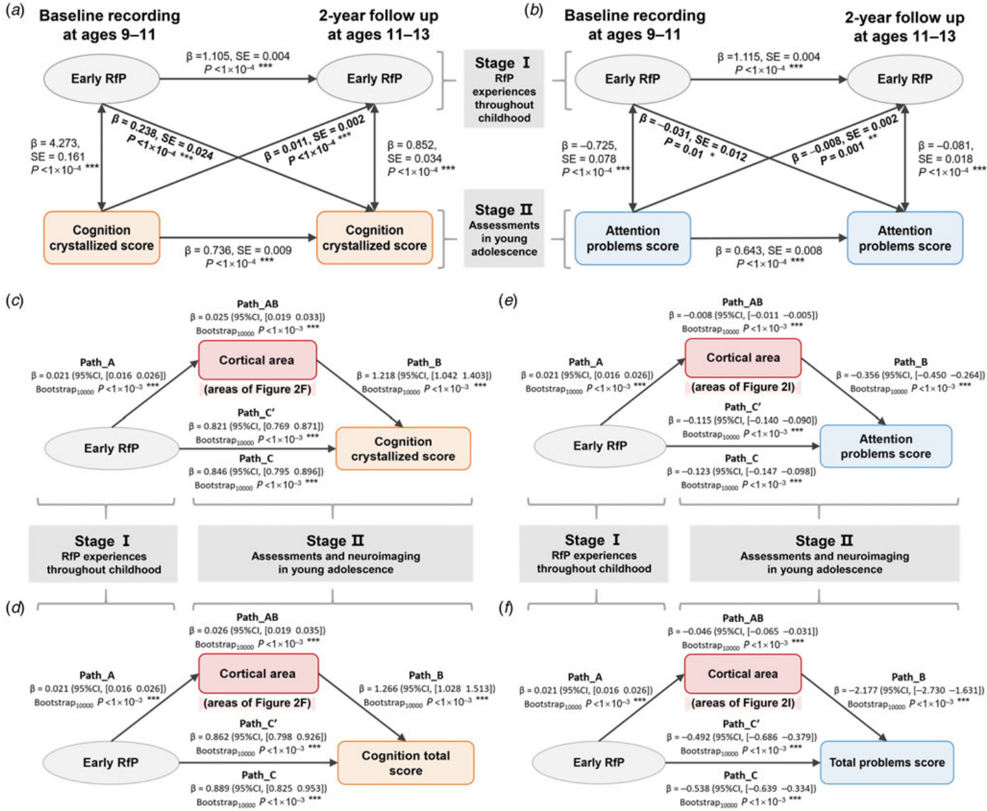
- Longitudinal CLPM showed baseline early RfP predicted higher crystallized cognition (β = 0.238, S.E. = 0.024, p < 0.001) and lower attention problems (β = −0.031, S.E. = 0.012, p = 0.012) 2 years later; mediation by cortical area was significant for cognition (3% of total effect size) and psychopathology (6–8.6% of total effect size).
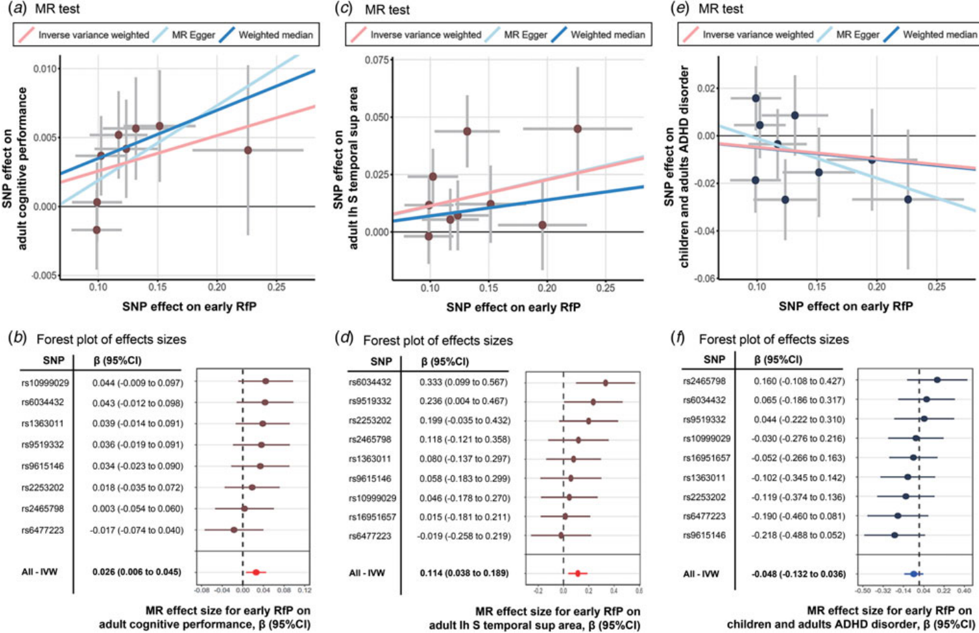
- Approximately 12 h/week of youth regular RfP was cognitively optimal; twin analysis found moderate heritability of early RfP (h² = 0.315, 95% CI 0.272–0.358) with significant shared environment (C = 0.505, 95% CI 0.465–0.545); MR showed beneficial associations with adult cognitive performance (βIVW = 0.026, 95% CI 0.006–0.045, p = 0.009) and adult left superior temporal cortical area (βIVW = 0.114, 95% CI 0.038–0.189, p = 0.003), with a nonsignificant trend for ADHD (βIVW = −0.048, 95% CI −0.132 to 0.036, p = 0.259).
Methods
- Cross-sectional and longitudinal study using ABCD releases 3.0 (baseline ages 9–11) and 4.0 (follow-up ages 11–13), with 10,243 participants who had complete RfP recordings from 21 US research sites.
- RfP was parent/caregiver-reported: years of childhood RfP and weekly RfP hours; outcomes included NIH-TB cognition, CBCL psychopathology, other behavioral/health scales, and FreeSurfer structural MRI measures.
- Main analyses used linear mixed models with covariates (age, sex, BMI, puberty, race/ethnicity, family SES, MRI scanner, family nested within site), plus cross-lagged panel, mediation, twin ACE structural equation, and two-sample MR analyses.
Limitations
- The paper states that future long-term follow-up in later adolescence and young adulthood is needed, and that other early educational experiences should be examined.
- The paper notes that most regional cortical associations were not significant after controlling for total ICV, except the left superior temporal region, and that the MR ADHD result was only a nonsignificant trend.
- Evident from the text: RfP was parent/caregiver-reported, the sample was a US ABCD cohort of mostly typically developing young adolescents, and although MR was used, the main findings are largely observational associations that cannot fully establish causality.
Model-written summary. Check it against the paper before relying on it.
Integrity signals
Registry
Cites
Statistics
Figures
Verification
Claims the paper makes
18 Valid · 1 Not valid · 18 Not checked · 107 Own results and interpretations
The cited sources support only part of this claim — read each source’s verdict below.
In the paper
“genetic factors contributed moderately significantly to brain cortical area (also measured in FreeSurfer.aparc.2009s atlas) (Elliott et al., 2018) including the ROI superior temporal area ( h 2 : 0.261, 95% CI 0.220 -0.301)”
What the sources say
- Partly supportedcites Elliott et al., 2018 matched to “Genome-wide association studies of brain imaging phenotypes in UK Biobank” (2018) sourceExperimental — accuracy not yet measured
The Methods section (page unavailable) says the study measured cortical parcel area using FreeSurfer’s a2009s atlas, and ‘Heritability and genetic correlations of IDPs’ reports significant SNP-heritability for many imaging phenotypes. Our copy does not substantiate the specific superior temporal area estimate of h² = 0.261 or its 95% confidence interval of 0.220–0.301. (LLM, conf=0.85)
plainstates an association- Asserted: passes — The authors put it forward as true.
- Checkable: passes — It can be checked against evidence.
- Load-bearing: unclear — It is unclear whether the paper’s conclusions depend on it.
- Based: passes — The paper gives a reason why it holds.
- Rests on an assumption not shown here.
- Partly supported
The cited sources support only part of this claim — read each source’s verdict below.
In the paper
“an observational study using the UK Millennium cohort has reported a link between RfP frequencies in children at age 7 and lower inattention at age 11 (Mak & Fancourt, 2020).”
What the sources say
- Partly supportedcites Mak & Fancourt, 2020 matched to “Longitudinal associations between reading for pleasure and child maladjustment: Results from a propensity score matching analysis” (2020) sourceExperimental — accuracy not yet measured
The Methods (Participants) identify the UK Millennium Cohort Study and measurements at ages 7 and 11. The Results (Hyperactivity/inattention) report an association between reading for pleasure most days at age 7 and a lower combined hyperactivity/inattention score at age 11; they do not report a separate finding for inattention alone. (LLM, conf=0.83)
plainstates an association- Asserted: passes — The authors put it forward as true.
- Checkable: passes — It can be checked against evidence.
- Load-bearing: unclear — It is unclear whether the paper’s conclusions depend on it.
- Based: passes — The paper gives a reason why it holds.
- Partly supported
The cited sources support only part of this claim — read each source’s verdict below.
In the paper
“Recent studies have indicated that increased screen time is significantly positively associated with multiple psychopathological problems, such as subsequent ADHD symptoms (Ra et al., 2018), internalizing and externalizing problems (Eirich et al., 2022), as well as early developmental problems (Zhao et al., 2022) in young populations.”
What the sources say
- Not matchedcites Ra et al., 2018
This doesn’t read as a citation we can look up.
- Supportedcites Eirich et al., 2022 matched to “Association of Screen Time With Internalizing and Externalizing Behavior Problems in Children 12 Years or Younger: A Systematic Review and Meta-analysis” (2022) source
Split into 2 atoms — 2 confirmed, 0 partially supported, 0 disputed, 0 misattributed, 0 unverifiable. Expand the claim to see per-atom verdicts.
- Supportedcites Zhao et al., 2022 matched to “Association Between Screen Time Trajectory and Early Childhood Development in Children in China” (2022) source
The part of the sentence attached to Zhao et al. (2022) is 'early developmental problems', and our copy states exactly that: the Abstract (Results) reports that, versus the continued-low group, the early increasing screen-time group had lower WISC-IV Full-Scale IQ (β -6.68) and Cognitive Proficiency Index (β -10.56) plus a higher SDQ total difficulties score (β 2.62; 95% CI, 0.49-4.76; P < .05) at age 72 months, concluding that 'excessive screen time in early years was associated with poor cognitive and social-emotional development'. The Key Points and Discussion (social-emotional paragraph) repeat the finding for children aged 6-72 months in a Shanghai cohort. The paper's own hedging about reverse causation and unmeasured hyperactivity/inattention at baseline does not conflict with the claim's associative wording ('associated with'), though the finding rests on a single small cohort (152 dyads), which slightly limits the generalization to 'young populations'. (LLM, conf=0.82)
hedgedstates an association- Asserted: passes — The authors put it forward as true.
- Checkable: passes — It can be checked against evidence.
- Load-bearing: passes — The paper’s conclusions depend on it.
- Based: passes — The paper gives a reason why it holds.
- Not matched
The cited sources support only part of this claim — read each source’s verdict below.
In the paper
“This may partly be due to cognitive enrichment (Mather, 2020; Milgram, Siwak-Tapp, Araujo, & Head, 2006; Oveisgharan, Wilson, Yu, Schneider, & Bennett, 2020)”
What the sources say
- Partly supportedcites Mather, 2020 matched to “How Do Cognitively Stimulating Activities Affect Cognition and the Brain Throughout Life?” (2020) sourceExperimental — accuracy not yet measured
In the opening section, Mather says that cognitively stimulating experiences early in life are associated with later cognitive benefits. The examples are education and bilingualism; the paper does not specifically address reading for pleasure or establish cognitive enrichment as the explanation for its association with cognitive development. (LLM, conf=0.82)
- Not checked — no full text of the sourcecites Milgram, Siwak-Tapp, Araujo, & Head, 2006 matched to “Neuroprotective effects of cognitive enrichment” (2006) source
- Partly supportedcites Oveisgharan, Wilson, Yu, Schneider, & Bennett, 2020 matched to “Association of Early-Life Cognitive Enrichment With Alzheimer Disease Pathological Changes and Cognitive Decline” (2020) sourceExperimental — accuracy not yet measured
The Assessment of ELCE section includes reading books at age 12 among cognitively stimulating activities, and the Discussion says early-life cognitive enrichment is hypothesized to support early-life cognitive development. The paper does not specifically examine reading for pleasure or test whether enrichment explains its association with cognitive development; its measured outcomes concern late-life cognition and Alzheimer disease pathology. (LLM, conf=0.83)
hedgedstates a possible cause- Asserted: passes — The authors put it forward as true.
- Checkable: passes — It can be checked against evidence.
- Load-bearing: unclear — It is unclear whether the paper’s conclusions depend on it.
- Based: passes — The paper gives a reason why it holds.
- Partly supported
A result the paper reports from its own data — it cites no other source for it, so there is none to check. The quote shows it is in the paper.
In the paper
“(4) The total problems ( rLMM = -0.070, p < 0.001) was also negatively correlated with early RfP”
plainstates an association- Asserted: passes — The authors put it forward as true.
- Checkable: passes — It can be checked against evidence.
- Load-bearing: passes — The paper’s conclusions depend on it.
- Based: passes — The paper gives a reason why it holds.
76 more claims
Create a free account to see all 144 claims and to verify the 10 references still open.
- Probably not a substantial claim. 45
- It may state two separate claims as one. 31
- The quote only partly states this claim. 2
Claims other papers make about this one
Each is checked against this paper’s own text: does it say what the citing paper says it does?
The source backs part of the claim, not all of it — or backs it for a different population, condition or comparison.
In the citing paper
“while in the U.S., frequency of reading for pleasure at 9-11-years old has been negatively associated with mental health difficulties at 11-13 years old (Sun et al., 2024).”
From How Does Reading Fiction Support Adolescents’ Wellbeing? A Qualitative Study Examining Positive Affect, Connection and Personal Growth (2025) · cites this paper as Sun et al., 2024
Experimental — accuracy not yet measuredThe cited source says what the claim attributes to it.
In the citing paper
“It considerably extends findings from quantitative studies which suggest a positive, albeit weak, relationship between reading and wellbeing (Clark & Teravainen-Goff, 2018; Kennewell et al., 2022; Sun et al., 2024)”
From How Does Reading Fiction Support Adolescents’ Wellbeing? A Qualitative Study Examining Positive Affect, Connection and Personal Growth (2025) · cites this paper as Sun et al., 2024
Citations
Cites
Correspondence - Tranexamic acid for traumatic brain injury
(2005) · London School of Economics and Political Science Theses Online (London School of Economics and Political Science) · doi:10.1016/s0140-6736 · Cited by 11,894
The MR-Base platform supports systematic causal inference across the human phenome
Hemani, G., Zheng, J., Elsworth, B., Wade, K. H., Haberland, V., Baird, D., Laurin, C., Burgess, S., Bowden, J., Langdon, R., et al. (2018) · eLife · doi:10.7554/elife.34408 · Cited by 7,959
The Lifelong Effects of Early Childhood Adversity and Toxic Stress
Shonkoff, J. P., Garner, A. S., THE COMMITTEE ON PSYCHOSOCIAL ASPECTS OF CHILD AND FAMILY HEALTH, C. O. E. C., Siegel, B. S., Dobbins, M. I., Earls, M. F., Garner, A. S., McGuinn, L., Pascoe, J., & Wood, D. L. (2012) · Pediatrics · doi:10.1542/peds.2011-2663 · Cited by 5,164 · cited 2×
“The critical period for brain development and experience-dependent plasticity in learning is childhood, which helps foster good cognition and well-being throughout life (Black et al., 2017; Klingberg, 2014; Shonkoff et al., 2012).”
BackgroundEarly childhood development coming of age: science through the life course
Black, M. M., Walker, S. P., Fernald, L. C. H., Andersen, C. T., DiGirolamo, A. M., Lu, C., McCoy, D. C., Fink, G., Shawar, Y. R., Shiffman, J., et al. (2017) · The Lancet · doi:10.1016/s0140-6736(16)31389-7 · Cited by 3,014 · cited 1×
“The critical period for brain development and experience-dependent plasticity in learning is childhood, which helps foster good cognition and well-being throughout life (Black et al., 2017; Klingberg, 2014; Shonkoff et al., 2012).”
BackgroundOrienting the causal relationship between imprecisely measured traits using GWAS summary data.
Hemani, G., Tilling, K., & Davey Smith, G. (2017) · PLoS Genetics · doi:10.1371/journal.pgen.1007081 · Cited by 2,607
Foundation literacy acquisition in European orthographies
Seymour, P. H. K., Aro, M., Erskine, J. M., & collaboration with COST Action A8 network (2003) · British Journal of Psychology · doi:10.1348/000712603321661859 · Cited by 2,601 · cited 1×
“…develop language systems even in linguistically deficient environments (Senghas, Kita, & Ozyurek, 2004), reading is a learnt skill requiring step-by-step systematic instructions, and is generally acquired and developed through explicit practice over months/ years (Seymour, Aro, & Erskine, 2003).”
BackgroundUnderstanding adolescence as a period of social–affective engagement and goal flexibility
Crone, E. A., & Dahl, R. E. (2012) · Nature Reviews Neuroscience · doi:10.1038/nrn3313 · Cited by 2,507 · cited 2×
“…maturation (Shonkoff et al., 2012), adolescence is also a continued period of structural and functional brain development, particularly in the brain systems related to social – emotional, cognitive and motivational processes, with mixed influences from pubertal maturation (Crone & Dahl, 2012).”
BackgroundMapping cortical change across the human life span
Sowell, E. R., Peterson, B. S., Thompson, P. M., Welcome, S. E., Henkenius, A. L., & Toga, A. W. (2003) · Nature Neuroscience · doi:10.1038/nn1008 · Cited by 2,328 · cited 1×
“Then they expanded gradually until approximately ages 8 – 12, after which they declined progressively (Gilmore, Knickmeyer, & Gao, 2018; Sowell et al., 2003).”
BackgroundThe expected value of control: an integrative theory of anterior cingulate cortex function
Shenhav, A., Botvinick, M. M., & Cohen, J. D. (2013) · Neuron · doi:10.1016/j.neuron.2013.07.007 · Cited by 2,321
The Adolescent Brain Cognitive Development (ABCD) study: Imaging acquisition across 21 sites
Casey, B. J., Cannonier, T., Conley, M. I., Cohen, A. O., Barch, D. M., Heitzeg, M. M., Soules, M. E., Teslovich, T., Dellarco, D. V., Garavan, H., et al. (2018) · Developmental Cognitive Neuroscience · doi:10.1016/j.dcn.2018.03.001 · Cited by 2,204 · cited 1×
“Both the methods and evaluations of these MRI images have been harmonized and optimized across all ABCD research sites (Casey et al., 2018; Hagler et al., 2019).”
Method
Cited by
Reading for pleasure: scrutinising the evidence base – benefits, tensions and recommendations
Cremin, T., & Scholes, L. (2024) · Language and Education · doi:10.1080/09500782.2024.2324948 · Cited by 59
“A large-scale US national cohort study, with 10,000 plus teenagers, additionally evidences a longitudinal association between early reading for pleasure and better mental health, as well as higher levels of cognitive performance in adolescence (Sun et al. 2023).”
BackgroundCausal Relationships Between Screen Use, Reading, and Brain Development in Early Adolescents
Li, M., Zhao, R., Dang, X., Xu, X., Chen, R., Chen, Y., Zhang, Y., Zhao, Z., & Wu, D. (2024) · Advanced Science · doi:10.1002/advs.202307540 · Cited by 41
Díaz, B., Nussbaum, M., Greiff, S., & Santana, M. (2024) · Computers & Education · doi:10.1016/j.compedu.2024.105014 · Cited by 50
Farrar, J., & Simpson, A. (2023) · Literacy · doi:10.1111/lit.12360 · Cited by 20
Longitudinal Sex-at-Birth and Age Analyses of Cortical Structure in the ABCD Study
Marshall, A. T., Adise, S., Kan, E., & Sowell, E. R. (2025) · Journal of Neuroscience · doi:10.1523/jneurosci.1091-24.2025 · Cited by 15
Currie, N., Webber, C., Wilkinson, K., Clark, C., Moss, G., & McGeown, S. (2025) · Reading Psychology · doi:10.1080/02702711.2025.2504974 · Cited by 12
“In Malaysia, positive reading attitude has been positively associated with adolescent subjective wellbeing (Kaur et al., 2022), while in the U.S., frequency of reading for pleasure at 9–11-years old has been negatively associated with mental health difficulties at 11–13 years old (Sun et al., 2024).”
Prospective Association of Sedentary Behavior With Psychological Distress Among Adolescents
Werneck, A. O., Hallgren, M. Å., & Stubbs, B. (2024) · Journal of Adolescent Health · doi:10.1016/j.jadohealth.2024.10.019 · Cited by 17
Liu, S., Fan, D., He, C., Liu, X., Zhang, H., Zhang, H., Zhang, Z., & Xie, C. (2023) · Psychiatry and Clinical Neurosciences · doi:10.1111/pcn.13603 · Cited by 9
Horowitz‐Kraus, T., Magaliff, L. S., & Schlaggar, B. L. (2023) · Policy Insights from the Behavioral and Brain Sciences · doi:10.1177/23727322231217461 · Cited by 11
“Researchers found that reading for pleasure, even a few hoursa week during childhood, was positively associated with cognition/attention, mental health,and brain volumewhen they reached youngadolescence (Sun et al., 2023).”
BackgroundShared reading interventions to promote psychosocial well-being in older adults: a systematic review
Milani, C., Biagi, C., Palmieri, E., Rosi, C., Buresta, D., Iocca, F., Cabrera, F. W., Zanobini, P., Lorini, C., & Bonaccorsi, G. (2025) · Health Promotion International · doi:10.1093/heapro/daaf036 · Cited by 12
Currie, N. K., Wilkinson, K., & McGeown, S. P. (2025) · Reading Research Quarterly · doi:10.1002/rrq.605 · Cited by 35
“Indeed, while research has demonstrated psychological well-being benefits from reading books (Kennewell et al., 2022; Sun et al., 2023), it is those readers who report greater absorption in, and appreciation of, the books they read that will most benefit (Koopman, 2015a, 2015b; Poe-rio &…”
Reading and Empathy: Qualitative insights into adolescents' experiences with fiction books
Santi, E., Cebula, K., & McGeown, S. (2025) · Literacy · doi:10.1111/lit.70006 · Cited by 7
Aleghfeli, Y. K. (2024) · Education Sciences · doi:10.3390/educsci14111145 · Cited by 9
Funds of courage: advancing social justice in children’s reading for pleasure
Kucirkova, N. I., & Cremin, T. (2024) · Cambridge Journal of Education · doi:10.1080/0305764x.2024.2369576 · Cited by 9
“Reading for Pleasure (RfP hereafter) is positively associated with cognitive development, specific learning outcomes such as vocabulary and mathematics (Sullivan & Brown, 2015), academic achievement more broadly (Smith et al., 2012) and psychological wellbeing (Sun et al., 2023).”
Hendry, H., Cremin, T., & Harrison, A. (2025) · Education Sciences · doi:10.3390/educsci15050588 · Cited by 8
Gallagher, K., Dillon, A. M., Habak, C., Saqr, S., & Alramamneh, Y. (2025) · Languages · doi:10.3390/languages10030039 · Cited by 8
Smith, L. L., Friedman, N. P., Luciana, M. M., & Banich, M. T. (2025) · NeuroImage · doi:10.1016/j.neuroimage.2025.121454 · Cited by 6
Uğurlu, B. S. (2025) · Reading Psychology · doi:10.1080/02702711.2025.2453195 · Cited by 6
“It fosters vocabulary growth, enhances cognitive abilities, and supports mental health, with benefits that extend well beyond the early years (Bus et al., 1995; Logan et al., 2019; Sun et al., 2024).”
Green, M. (. (2025) · Education Sciences · doi:10.3390/educsci15060704 · Cited by 7
Pre-service teachers as readers: moving beyond reading frequency as a marker of engagement
Cremin, T., Mukherjee, S. J., Bearne, E., & Therova, D. (2025) · The Australian Journal of Language and Literacy · doi:10.1007/s44020-025-00085-x · Cited by 8
“), but also with enriched psychological well-being (e.g. Mak & Fancourt, 2020; Sun et al., 2023).”
Kazandjian, N., Harandian, K., Routhier-Guilmette, S., Dufour, M., Archambault, I., & Pagani, L. S. (2025) · Journal of Intelligence · doi:10.3390/jintelligence13060066 · Cited by 5
Informal book talk: digging beneath the surface
Cremin, T., Hendry, H., Leon, L. R., & Hulston, S. J. (2024) · Education 3-13 · doi:10.1080/03004279.2024.2357882 · Cited by 12
The library as a safe space in contemporary schools: An international study
Merga, M. K. (2025) · IFLA Journal · doi:10.1177/03400352251318368 · Cited by 9
“Furthermore, reading for pleasure, a key activity undertaken within the school library, is also associated with promoting well-being (Merga, 2022; Sun et al., 2024).”
Espinoza, A. M., Strasser, K., Kessels, U., & Morales, M. F. (2025) · International Journal of Educational Research · doi:10.1016/j.ijer.2025.102744 · Cited by 3
Amatori, G., & Buccolo, M. (2024) · Advances in psychology, mental health, and behavioral studies (APMHBS) book series · doi:10.4018/979-8-3693-4244-2.ch009 · Cited by 2
Marley, B. (2024) · Education 3-13 · doi:10.1080/03004279.2024.2406415 · Cited by 2
Jordanian Speech Pathology Students’ Beliefs and Attitudes Toward People Who Stutter (PWS)
Alamawi, S., Khamaiseh, Z. A., Qanawati, L., et al. (2024) · Journal of Ecohumanism · doi:10.62754/joe.v3i8.4877 · Cited by 2
Editorial: What is the future of young people’s volitional reading? Exploring diverse perspectives
Loh, C. E., Cremin, T., & Scholes, L. (2024) · Language and Education · doi:10.1080/09500782.2024.2337659 · Cited by 4
“Empirical research has demonstrated the importance of children and adolescents’ choice-led reading for enhanced reading proficiency, self-directed learning and mental wellbeing (e.g. Torppa et al. 2020; Sun et al. 2024).”
BackgroundHernández, H. W. C. (2025) · Frontiers in Education · doi:10.3389/feduc.2025.1658707 · Cited by 1
Liao, C.-Y. (2026) · Humanities and Social Sciences Communications · doi:10.1057/s41599-026-06750-x · Cited by 1
Thompson, E. L., Sawi, O. M., Roy, E. A., Abad, S., Kaiver, C. M., Lehman, S. M., Tay, J., Gonzalez, M. R., Rinsveld, A. M. V., Dowling, G. J., et al. (2026) · Developmental Cognitive Neuroscience · doi:10.1016/j.dcn.2026.101746 · Cited by 2
“…2024; Hackman et al., 2022; *Keyin et al., 2025; *Logan and Lewis-de los Angeles, 2025; *Park et al., 2024; Qiu and Liu, 2023; Thapaliya et al., 2021, 2024; Vargas et al., 2025; *Smith and Stamoulis, 2023; *Sun et al., 2024; *Wallace and Conner, 2025; *Wen et al., 2023; *Yang, Tuy et al., 2025).”
Exploring Cognitive Linguistics
Qin, Y. (2023) · Communications in Humanities Research · doi:10.54254/2753-7064/22/20231765 · Cited by 1
Enhancing Onscreen Picture Books for 2- to 6-Year-Olds: Insights from Multimedia Learning Theory
Bus, A. G. (2025) · Literacy studies · doi:10.1007/978-3-031-87124-5_17 · Cited by 2
Are Digital Books Really Designed for Young Children? A Content Analysis of Turkish Digital Books
Uğurlu, B. S. (2025) · Early Childhood Education Journal · doi:10.1007/s10643-025-01977-w · Cited by 1
Tretow, A., Khanolainen, D. P., Hämäläinen, J. A., Leppänen, P. H. T., & Torppa, M. (2024) · PsyArXiv (OSF Preprints) · doi:10.31234/osf.io/p4qys · Cited by 1
Agarwal, N., & Jha, A. K. (2024) · Springer eBooks · doi:10.1007/978-3-031-38971-9_4-1 · Cited by 1
Reading and associations with brain health, cognition, well-being, and mental health
Sahakian, B. J., Perrin, V., & Langley, C. (2026) · Psychological Medicine · doi:10.1017/s0033291726105625 · Cited by 2
“Specifically, consistent activation was observed in the left ventral occipito-temporal cortex, inferior frontal gyrus, and posterior parietal regions, areas central to visual word recognition, language processing, and attentional control.”
InfluentialSelf-citationPerspective Chapter: Should the Hippocampus be Considered a Key Part of the Reading Network?
Bernard, F. (2024) · IntechOpen eBooks · doi:10.5772/intechopen.1006350
Agarwal, N., & Jha, A. K. (2024) · Springer eBooks · doi:10.1007/978-3-031-38971-9_4-2
Maschio, N. D., Bellini, C., Giannachi, M., Mauro, G. D., & Abutalebi, J. (2025) · Brain Structure and Function · doi:10.1007/s00429-025-02919-3
“Reading ability is positively associated with cognitive performance and mental well-being in young adolescence (e.g., Sun et al. 2024), and directly relates to personal achievement and societal attainment later in life (e.g., Kortteinen, 2021).”
Turning the Page: Reviving Reading Culture in South African Classrooms
Alberts, M., & de Jager, N. (2025) · IGI Global eBooks · doi:10.4018/979-8-3373-0144-0.ch001
Uğurlu, B. S. (2025) · European Early Childhood Education Research Journal · doi:10.1080/1350293x.2025.2529362 · Cited by 3
Li, Q., Wei, Z., Xu, Z., Zhang, S., Li, Y., & Liu, D. (2025) · Reading and Writing · doi:10.1007/s11145-025-10687-z · Cited by 1
Uysal, P. K. (2025) · ODÜ Sosyal Bilimler Araştırmaları Dergisi (ODÜSOBİAD) · doi:10.48146/odusobiad.1731149
Poverty is linked to poorer brain development – but reading can help counteract it
Sahakian, B. J., Langley, C., Feng, J., et al. (2023) · doi:10.64628/ab.94vr4qcrd
Self-citationAnisin, A. (2025) · Springer eBooks · doi:10.1007/978-3-032-02395-7_5
The Role of Family in Primary School Students' Acquisition of Reading Habits
Kaçmaz, E., & Bozan, M. A. (2025) · Hacettepe University Journal of Education · doi:10.16986/hunefd.1706286
Tretow, A., Khanolainen, D. P., Hämäläinen, J. A., Torppa, M., & Leppänen, P. H. T. (2025) · Brain and Language · doi:10.1016/j.bandl.2025.105671
Sahakian, B. J. (2025) · Journal of Psychopharmacology · doi:10.1177/02698811251397329
“In another study, we found that reading for pleasure early in childhood is associated with better brain structure, cognition, educational attainment, and mental health in adolescence (Sun et al., 2024).”
Self-citationHooked on Books: A Deep Dive into the Reading Motivations of ADHD and Non-ADHD Children
Kakoulidou, M., Pavlopoulou, G., Filippi, R., & Hurry, J. (2025) · Neurodiversity · doi:10.1177/27546330251403220
“Reading for pleasure has also been associated with higher cognitive performance (e.g., increased attention, reduced hyperactivity) and better mental health outcomes (e.g., reduced stress and depression) both in childhood and adolescence (Mak & Fancourt, 2020; Sun et al., 2024).”
Health promotion through reading in the first thousand days: a systematic review and meta-analysis
Milani, C., Buresta, D., Iocca, F., Cabrera, F. W., Biagi, C., Rosi, C., Palmieri, E., Zanobini, P., Lorini, C., & Bonaccorsi, G. (2025) · BMJ Paediatrics Open · doi:10.1136/bmjpo-2024-003231 · Cited by 2
Gutiérrez-Ruiz, K. (2025) · Hacia la Promoción de la Salud · doi:10.17151/hpsal.2025.30.1.8
Straker, M., & Morgan, G. (2025) · Educational and Child Psychology · doi:10.53841/bpsecp.2025.42.4.126
Listen Closely: Self-Supervised Phoneme Tracking for Children’s Reading Assessment
Ollmann, P., Sonnleitner, E., Kurz, M., et al. (2026) · Information · doi:10.3390/info17010040
FROM READING INTEREST TO AUTONOMY: HOW LIBRARY ENVIRONMENTS SUPPORT SELF-DIRECTED LEARNING
Laškova, A. (2026) · Education Innovation Diversity · doi:10.17770/eid2025.2.93
Using reading and digital detox to promote social and emotional health
Barrett, C. E., Christy, T., & Reeshemah, J. (2025) · i-manager’s Journal on Educational Psychology · doi:10.26634/jpsy.19.2.22268
Uysal, P. K. (2025) · DergiPark (Istanbul University)
Rodgers, D. B., & Loveall, S. J. (2026) · Journal of Intellectual & Developmental Disability · doi:10.3109/13668250.2026.2614681
Father wellbeing: self-efficacy, positive engagement, and reading with children
Habak, C., Dillon, A. M., Gallagher, K., & Saqr, S. (2026) · Frontiers in Psychology · doi:10.3389/fpsyg.2026.1730393
Maloney, C. M. C., Atkin, A. J., Beaumont, L. C., Dainty, J. R., & Warburton, V. E. (2026) · PLoS ONE · doi:10.1371/journal.pone.0346302
“Reading for pleasure [60] and musical activities [62] have been associated with improved cognitive performance, in the form of memory of picture sequences or sustained attention, respectively, suggestive of a potential mechanism through which these activities may enhance academic attainment.”
Fiction Book Reading and Wellbeing: In‐Depth Insights From Children
Currie, N. K., Wilkinson, K., Clark, C., Moss, G., & McGeown, S. P. (2026) · Journal of Research in Reading · doi:10.1111/1467-9817.70024 · Cited by 1
Panjaitan, D. D. A., Wajdi, M., Laksana, I. P. Y., Ghafar, Z. N., Rouf, M. A., Hazaymeh, O. M.-A. A., Akdemir, A. S., & Issa, M. (2026) · Journal of Language and Pragmatics Studies. · doi:10.58881/jlps.v5i1.73
“Large cohort studies show that children who read for pleasure early on exhibit superior performance on cognitive tests and lower scores on mental health problem scales later in life (Sun et al., 2023).”
How NeuroArts Aid in the Well-Being of People: A Scoping Review
Dy, J. S. H., Regala, J. G. E., Tan, K. C. B., Laya, B. F., & Cuanang, J. R. (2026) · Cureus · doi:10.7759/cureus.109729
Παύλου, Γ., & Σιδηροπούλου, Μ. (2026) · Έρευνα στην Εκπαίδευση · doi:10.12681/hjre.46489
McBreen, M., Bentivegna, F., Sumner, E., & Papachristou, E. (2026) · British Journal of Educational Psychology · doi:10.1111/bjep.70113
Can picking up a book really improve your brain?
van Mulukom, V. (2026) · The Conversation · doi:10.64628/ab.3q5ter5c6
Metadata
- Authors
- Sun, Y.-J., Sahakian, B. J., Langley, C., Yang, A., Jiang, Y., Kang, J., Zhao, X., Li, C., Cheng, W., & Feng, J.
- Affiliations
- Shanghai Medical College of Fudan University (CN)
- Corresponding author
- Sahakian, Barbara J.
- Cheng, Wei
- Feng, Jianfeng
- ORCID
- Venue
- Psychological Medicine
- Publisher
- Cambridge University Press (CUP)
- Published
- 2023-06-28
- Volume
- 54
- Issue
- 2
- Pages
- 359-373
- ISSN
- 0033-2917 (ISSN-L)
- 1469-8978
- OpenAlex
- W4382344827
- Cited by
- 68
- References
- 88
- Citations by year
- 2026: 16 · 2025: 32 · 2024: 15 · 2023: 5
- FWCI
- 50.17
- Type
- journal article
- Language
- en
- Open access
- hybrid
- doi.org
- Locations
- Psychological Medicine (publishedVersion, cc-by)
- PubMed (publishedVersion)
- Warwick Research Archive Portal (University of Warwick) (submittedVersion)
- Apollo (University of Cambridge) (submittedVersion, cc-by)
- Funders
- Natural Science Foundation of Shanghai
- Wellcome Trust (200181/Z/15/Z)
- Shanghai Rising-Star Program
- National Institutes of Health
- NIHR Cambridge Biomedical Research Centre
- Topics
- Social Sciences › Education › Literacy and Educational Practices
- Social Sciences › Psychology › Developmental and Educational Psychology › Reading and Literacy Development
- Social Sciences › Psychology › Experimental and Cognitive Psychology › Cognitive Abilities and Testing
- Keywords
- reading for pleasure, children's reading, cognitive performance, psychological well-being, brain structure, cortical thickness, brain volume, crystallized intelligence, heritability, brain development, adolescents, causal inference
- MeSH terms
- Adolescent, Adult, Brain, Child, Cognition, Cross-Sectional Studies, Humans, Longitudinal Studies, Magnetic Resonance Imaging, Mental Health, Reading, Pleasure
About these checks
Registry, retraction, Cites and statistics results are computed, not judged, with one exception: a printed reference that no index lists is read once by a model before it counts as a citation error. Claims are extracted by a model and kept only when their quote appears verbatim in the text; each cited source is then checked, with a model’s help, for whether it says what the claim relies on. Those verdicts can be wrong — read the claim’s quote and the cited source before relying on one.
The claim verdicts this report counts are experimental: their accuracy is not yet measured.
A language model drew the claims from the paper on 2026-10-10, under version 3 of the claim definition (model deepseek-v4.1-flash, prompt extract-v3).
A second model labelled each claim on 2026-10-10 (model jev-1.13-20260917, definition revision gold-guideline-v0.2).
Cited sources are checked with a language model’s help (gpt-6-sol and qwen3.8-omni-flash).
Statistics and arithmetic are recomputed, not judged.
Confidence bands are shown only for fields calibrated on our annotated test set. None is calibrated yet, so no band is shown.
What counts as a claim ›How we measure confidence ›How we check this ›
Are you an author, or do you see a problem with this page? Request a review
Data sources
Bibliographic data: Semantic Scholar, OpenAlex, Crossref.
Contains information from the Semantic Scholar Academic Graph Datasets, made available under the ODC Attribution License (ODC-BY 1.0).
Semantic Scholar’s data is described in: Kinney, R., et al. (2023). The Semantic Scholar Open Data Platform. arXiv:2301.10140.
