

The Enduring Effects of Parental Alcohol, Tobacco, and Drug Use on Child Well-being: A Multilevel Meta-Analysis
Open accessThe DOI matches its Crossref record; 131 of the 131 references it cites were found in a registry or an index.
Abstract
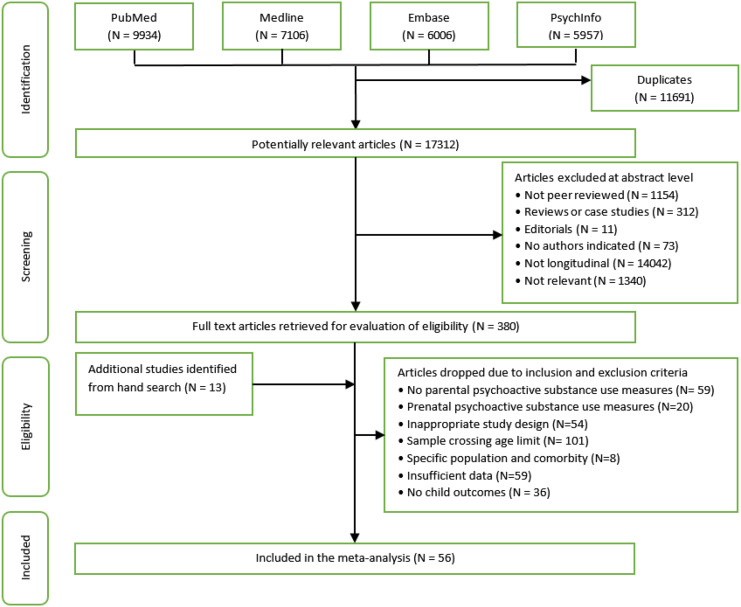
The effects of psychoactive substance abuse are not limited to the user, but extend to the entire family system, with children of substance abusers being particularly at risk. This meta-analysis attempted to quantify the longitudinal relationship between parental alcohol, tobacco, and drug use and child well-being, investigating variation across a range of substance and well-being indices and other potential moderators. We performed a literature search of peer-reviewed, English language, longitudinal observational studies that reported outcomes for children aged 0 to 18 years. In total, 56 studies, yielding 220 dependent effect sizes, met inclusion criteria. A multilevel random-effects model revealed a statistically significant, small detriment to child well-being for parental substance abuse over time ( r = .15). Moderator analyses demonstrated that the effect was more pronounced for parental drug use ( r = .25), compared with alcohol use ( r = .13), tobacco use ( r = .13), and alcohol use disorder ( r = .14). Results highlight a need for future studies that better capture the effect of parental psychoactive substance abuse on the full breadth of childhood well-being outcomes and to integrate substance abuse into models that specify the precise conditions under which parental behavior determines child well-being. Registration : PROSPERO CRD42017076088
Overview
The claims and statistics of this paper haven’t been checked yet.
Free: it reads the open-access text and checks the first 5 claims that cite a source we can check. Create a free account to check every claim.
Integrity signals
Registry
Cites
Statistics
Figures
Verification
Claims the paper makes
The claims and statistics of this paper haven’t been checked yet.
Free: it reads the open-access text and checks the first 5 claims that cite a source we can check. Create a free account to check every claim.
Claims other papers make about this one
Each is checked against this paper’s own text: does it say what the citing paper says it does?
The source backs part of the claim, not all of it — or backs it for a different population, condition or comparison.
In the citing paper
“children in these environments often experience heightened levels of stress and insecurity, which can manifest in emotional dysregulation and a greater susceptibility to mental health issues such as depression and anxiety”
From How Parental Substance Abuse Affects Family Functioning and Child Psychological Health (2024) · cites this paper as Kuppens et al., 2019
Experimental — accuracy not yet measuredThe source backs part of the claim, not all of it — or backs it for a different population, condition or comparison.
In the citing paper
“The lack of adequate parenting in such households also inhibits the development of secure attachments, which are crucial for healthy emotional and social development”
From How Parental Substance Abuse Affects Family Functioning and Child Psychological Health (2024) · cites this paper as Kuppens et al., 2019
Experimental — accuracy not yet measuredThe cited source says what the claim attributes to it.
In the citing paper
“children in such households are at an elevated risk for a variety of psychological, emotional, and social problems”
From How Parental Substance Abuse Affects Family Functioning and Child Psychological Health (2024) · cites this paper as Kuppens et al., 2019
Self-check
Percentages, sums and reported differences re-computed from the paper’s own numbers.
The self-check needs the paper’s full text.
Citations
Cites
Preferred Reporting Items for Systematic Reviews and Meta-Analyses: the PRISMA statement
Moher, D., Liberati, A., Tetzlaff, J., Altman, D. G., & for the PRISMA Group (2009) · BMJ · doi:10.1136/bmj.b2535 · Cited by 83,823
Podsakoff, P. M., MacKenzie, S. B., Lee, J.-Y., & Podsakoff, N. P. (2003) · Journal of Applied Psychology · doi:10.1037/0021-9010.88.5.879 · Cited by 82,194 · cited 1×
“Such inconsistent research findings may reflect method bias related to the specific informant or data collection mode (e.g., socially desirable responding, shared method variance; Kuppens, Grietens, Onghena, & Michiels, 2009a; Podsakoff, MacKenzie, Lee, & Podsakoff, 2003; | Tourangeau & Yan, 2007).”
Preferred Reporting Items for Systematic Reviews and Meta-Analyses: The PRISMA Statement
Moher, D., Liberati, A., Tetzlaff, J., Altman, D. G., & The PRISMA Group (2009) · PLoS Medicine · doi:10.1371/journal.pmed.1000097 · Cited by 64,042
Bias in meta-analysis detected by a simple, graphical test
Egger, M., Smith, G. D., Schneider, M., & Minder, C. (1997) · BMJ · doi:10.1136/bmj.315.7109.629 · Cited by 56,722 · cited 1×
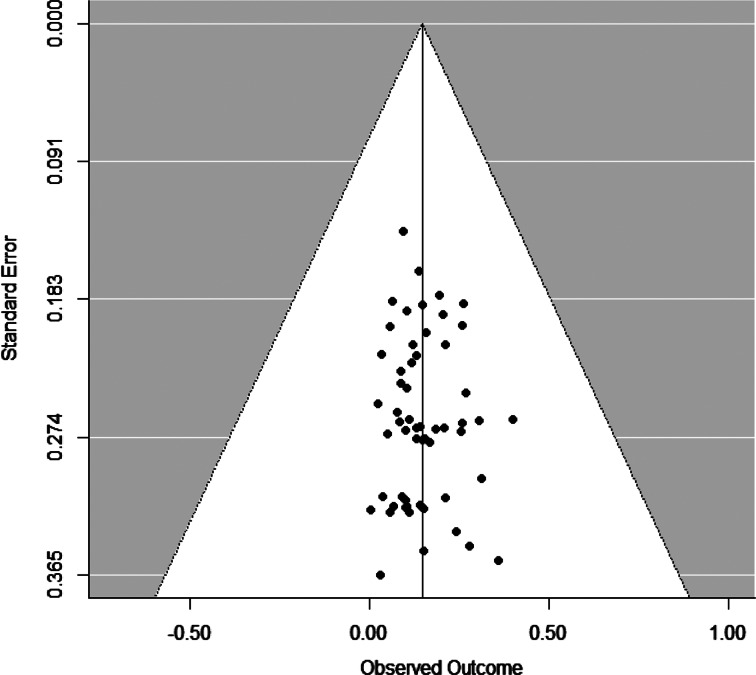
“Next, asymmetry was assessed using Egger ’ s weighted regression test (Egger, Smith, Schneider, & Minder, 1997; Torgerson, 2006).”
Preferred reporting items for systematic reviews and meta-analyses: the PRISMA Statement.
(2009) · PubMed Central · Cited by 44,859
Cochrane Handbook for Systematic Reviews of Interventions: Cochrane Book Series
(2008) · doi:10.1002/9780470712184 · Cited by 25,048 · cited 1×
“…studies (see Siddaway et al., 2019), six criteria were adopted to reflect the methodological rigor of each study (Faragher, Cass, & Cooper, 2005; Higgins & Green, 2011; Wong, Cheung, & Hart, 2008): whether the study sample size provided adequate statistical power (calculated as at least N = 193…”
Dermyshi, E., Wang, Y., Yan, C., Hong, W., Qiu, G., Gong, X., & Zhang, T. (2017) · Neonatology · doi:10.1159/000454668 · Cited by 24,451
Meta-analysis of Observational Studies in Epidemiology<SUBTITLE>A Proposal for Reporting</SUBTITLE>
Stroup, D. F. (2000) · JAMA · doi:10.1001/jama.283.15.2008 · Cited by 20,623
Hierarchical Linear Models: Applications and Data Analysis Methods.
Longford, N. T., Bryk, A. S., & Raudenbush, S. W. (1993) · Contemporary Sociology · doi:10.2307/2075823 · Cited by 18,724
Wang, G., Ma, R., Qiao, G., Wada, K., Aizawa, Y., & Satoh, T. (2015) · Integrative Medicine International · doi:10.1159/000368408 · Cited by 18,657
Research works printed but not linked: 4
- World Health Organization (2004). Promoting mental health: Concepts, emerging evidence, practice. Geneva: World Health Organization.
- Wilson D. B. (2017). Comprehensive Meta-Analysis (Version 3). Englewood, NJ: Biostat.
- McGrath C. E., Watson A. L., & Chassin L. (1999). Academic achievement in adolescent children of alcoholics. Journal of Studies on Alcohol, 60, 18- 26. 10096305 · DOI · Paper page
- European Monitoring Centre for Drugs and Drug Addiction (2008). Drugs and Vulnerable Groups of Young People. Luxembourg: Office for Official Publications of the European Communitie.
Cited by
Socioeconomic status and health behavior in children and adolescents: a systematic literature review
Gautam, N., Dessie, G., Rahman, M. M., & Khanam, R. (2023) · Frontiers in Public Health · doi:10.3389/fpubh.2023.1228632 · Cited by 192
McGovern, R., Bogowicz, P., Meader, N., Kaner, E., Alderson, H., Craig, D., Geijer‐Simpson, E., Jackson, K., Muir, C., Salonen, D., et al. (2023) · Addiction · doi:10.1111/add.16127 · Cited by 75
Adverse childhood experiences and child mental health: an electronic birth cohort study
Lowthian, E., Anthony, R., Evans, A., Daniel, R., Long, S. J., Bandyopadhyay, A., John, A. M., Bellis, M. A., & Paranjothy, S. (2021) · BMC Medicine · doi:10.1186/s12916-021-02045-x · Cited by 49
Self-citationThe Secondary Harms of Parental Substance Use on Children’s Educational Outcomes: A Review
Lowthian, E. (2022) · Journal of Child & Adolescent Trauma · doi:10.1007/s40653-021-00433-2 · Cited by 38
“Parental alcohol and illicit drug use can have deleterious and enduring impacts on their children’s health and well-being (Kuppens et al., 2020; McGovern et al., 2018; Park & Schepp, 2015; Velleman & Templeton, 2016).”
BackgroundInfluentialSelf-citationYoo, P., Duncan, G. J., Magnuson, K., Fox, N. A., Yoshikawa, H., Halpern‐Meekin, S., & Noble, K. G. (2022) · BMC Public Health · doi:10.1186/s12889-022-12989-1 · Cited by 39
Metadata
- Authors
- Kuppens, S., Moore, S. C., Gross, V., Lowthian, E., & Siddaway, A. P.
- Affiliations
- Karel de Grote Hogeschool (BE)
- Cardiff University (GB)
- University of Stirling (GB)
- Corresponding author
- Moore, Simon C.
- Venue
- Development and Psychopathology
- Publisher
- Cambridge University Press (CUP)
- Published
- 2019-07-05
- Volume
- 32
- Issue
- 2
- Pages
- 765-778
- ISSN
- 0954-5794 (ISSN-L)
- 1469-2198
- PMC
- PMC7525110
- OpenAlex
- W2945780970
- Cited by
- 119
- References
- 131
- Citations by year
- 2026: 28 · 2025: 25 · 2024: 18 · 2023: 17 · 2022: 13 · 2021: 15 · 2020: 2 · 2019: 1
- FWCI
- 1.13
- Type
- journal article
- Language
- en
- Open access
- hybrid
- doi.org
- Locations
- Development and Psychopathology (publishedVersion, cc-by)
- PubMed Central (publishedVersion, cc-by)
- PubMed (publishedVersion)
- ORCA Online Research @Cardiff (Cardiff University) (acceptedVersion)
- Lirias (submittedVersion, other-oa)
- Stirling Online Research Repository (University of Stirling) (submittedVersion, cc-by)
- Funders
- Wellcome Trust (WT087640MA)
- United Kingdom Clinical Research Collaboration
- Cancer Research UK
- British Heart Foundation
- Alcohol Research UK
- Cardiff University
- Medical Research Council (WT087640MA)
- Economic and Social Research Council (ES/L015471/1)
- Topics
- Health Sciences › Medicine › Epidemiology › Substance Abuse Treatment and Outcomes
- Health Sciences › Medicine › Pediatrics, Perinatology and Child Health › Prenatal Substance Exposure Effects
- Social Sciences › Psychology › Clinical Psychology › Child and Adolescent Psychosocial and Emotional Development
- Keywords
- parental substance use, child well-being, parental alcohol use, parental tobacco use, parental drug use, alcoholism, intergenerational effects, child development, longitudinal effects
- MeSH terms
- Adolescent, Alcohol Drinking, Child, Child Welfare, Child, Preschool, Humans, Infant, Infant, Newborn, Parents, Nicotiana, Substance-Related Disorders, Tobacco Products
About these checks
Registry, retraction, Cites and statistics results are computed, not judged, with one exception: a printed reference that no index lists is read once by a model before it counts as a citation error. Claims are extracted by a model and kept only when their quote appears verbatim in the text; each cited source is then checked, with a model’s help, for whether it says what the claim relies on. Those verdicts can be wrong — read the claim’s quote and the cited source before relying on one.
Statistics and arithmetic are recomputed, not judged.
Confidence bands are shown only for fields calibrated on our annotated test set. None is calibrated yet, so no band is shown.
What counts as a claim ›How we measure confidence ›How we check this ›
Are you an author, or do you see a problem with this page? Request a review
How to cite
Cite CoChat for the checks on this page, and the paper for its own findings.
- This page
- CoChat. (2026). Citation check: The Enduring Effects of Parental Alcohol, Tobacco, and Drug Use on Child Well-being: A Multilevel Meta-Analysis. https://app.cochat.ai/papers/10.1017/s0954579419000749
- The paper
- Kuppens, S., Moore, S. C., Gross, V., Lowthian, E., & Siddaway, A. P. (2020). The Enduring Effects of Parental Alcohol, Tobacco, and Drug Use on Child Well-being: A Multilevel Meta-Analysis. Development and Psychopathology. https://doi.org/10.1017/s0954579419000749
Data sources
Bibliographic data: Semantic Scholar, OpenAlex, Crossref.
Contains information from the Semantic Scholar Academic Graph Datasets, made available under the ODC Attribution License (ODC-BY 1.0).
Semantic Scholar’s data is described in: Kinney, R., et al. (2023). The Semantic Scholar Open Data Platform. arXiv:2301.10140.
