

The Enduring Effects of Parental Alcohol, Tobacco, and Drug Use on Child Well-being: A Multilevel Meta-Analysis
Open accessThe DOI matches its Crossref record; 131 of the 131 references it cites were found in a registry or an index.
Abstract
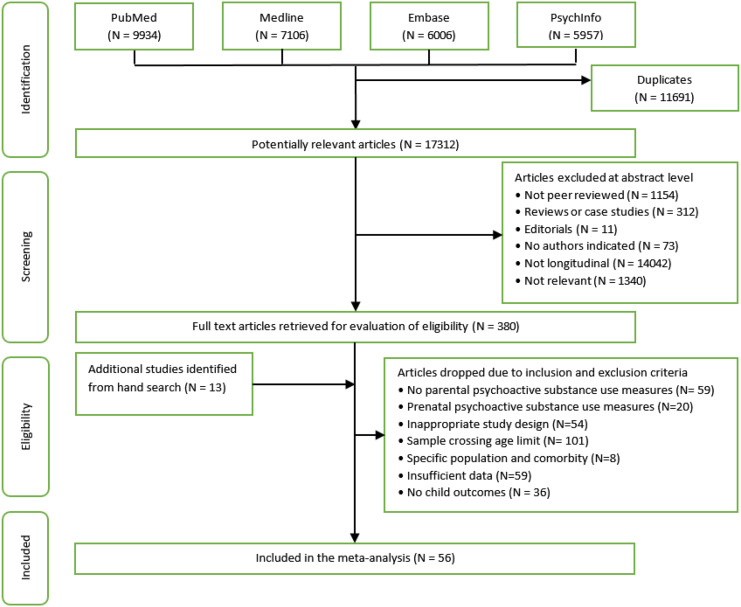
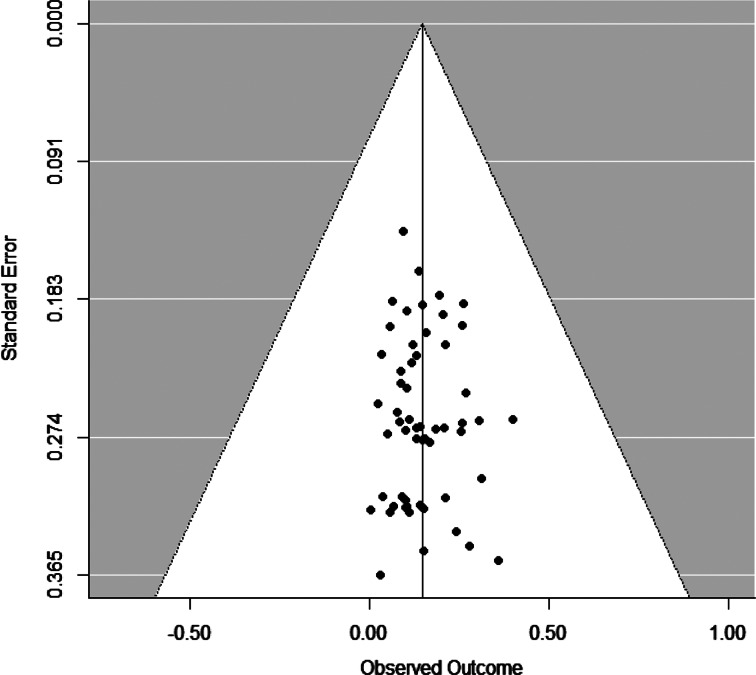
The effects of psychoactive substance abuse are not limited to the user, but extend to the entire family system, with children of substance abusers being particularly at risk. This meta-analysis attempted to quantify the longitudinal relationship between parental alcohol, tobacco, and drug use and child well-being, investigating variation across a range of substance and well-being indices and other potential moderators. We performed a literature search of peer-reviewed, English language, longitudinal observational studies that reported outcomes for children aged 0 to 18 years. In total, 56 studies, yielding 220 dependent effect sizes, met inclusion criteria. A multilevel random-effects model revealed a statistically significant, small detriment to child well-being for parental substance abuse over time ( r = .15). Moderator analyses demonstrated that the effect was more pronounced for parental drug use ( r = .25), compared with alcohol use ( r = .13), tobacco use ( r = .13), and alcohol use disorder ( r = .14). Results highlight a need for future studies that better capture the effect of parental psychoactive substance abuse on the full breadth of childhood well-being outcomes and to integrate substance abuse into models that specify the precise conditions under which parental behavior determines child well-being. Registration : PROSPERO CRD42017076088
Overview
The claims and statistics of this paper haven’t been checked yet.
Free: it reads the open-access text and checks the first 5 claims that cite a source we can check. Create a free account to check every claim.
Integrity signals
Registry
Cites
Statistics
Figures
Verification
Claims the paper makes
The claims and statistics of this paper haven’t been checked yet.
Free: it reads the open-access text and checks the first 5 claims that cite a source we can check. Create a free account to check every claim.
Claims other papers make about this one
Each is checked against this paper’s own text: does it say what the citing paper says it does?
The source backs part of the claim, not all of it — or backs it for a different population, condition or comparison.
In the citing paper
“children in these environments often experience heightened levels of stress and insecurity, which can manifest in emotional dysregulation and a greater susceptibility to mental health issues such as depression and anxiety”
From How Parental Substance Abuse Affects Family Functioning and Child Psychological Health (2024) · cites this paper as Kuppens et al., 2019
Experimental — accuracy not yet measuredThe source backs part of the claim, not all of it — or backs it for a different population, condition or comparison.
In the citing paper
“The lack of adequate parenting in such households also inhibits the development of secure attachments, which are crucial for healthy emotional and social development”
From How Parental Substance Abuse Affects Family Functioning and Child Psychological Health (2024) · cites this paper as Kuppens et al., 2019
Experimental — accuracy not yet measuredThe cited source says what the claim attributes to it.
In the citing paper
“children in such households are at an elevated risk for a variety of psychological, emotional, and social problems”
From How Parental Substance Abuse Affects Family Functioning and Child Psychological Health (2024) · cites this paper as Kuppens et al., 2019
Self-check
Percentages, sums and reported differences re-computed from the paper’s own numbers.
The self-check needs the paper’s full text.
Citations
Cites
Preferred Reporting Items for Systematic Reviews and Meta-Analyses: the PRISMA statement
Moher, D., Liberati, A., Tetzlaff, J., Altman, D. G., & for the PRISMA Group (2009) · BMJ · doi:10.1136/bmj.b2535 · Cited by 83,823
Podsakoff, P. M., MacKenzie, S. B., Lee, J.-Y., & Podsakoff, N. P. (2003) · Journal of Applied Psychology · doi:10.1037/0021-9010.88.5.879 · Cited by 82,194 · cited 1×
“Such inconsistent research findings may reflect method bias related to the specific informant or data collection mode (e.g., socially desirable responding, shared method variance; Kuppens, Grietens, Onghena, & Michiels, 2009a; Podsakoff, MacKenzie, Lee, & Podsakoff, 2003; | Tourangeau & Yan, 2007).”
Preferred Reporting Items for Systematic Reviews and Meta-Analyses: The PRISMA Statement
Moher, D., Liberati, A., Tetzlaff, J., Altman, D. G., & The PRISMA Group (2009) · PLoS Medicine · doi:10.1371/journal.pmed.1000097 · Cited by 64,042
Bias in meta-analysis detected by a simple, graphical test
Egger, M., Smith, G. D., Schneider, M., & Minder, C. (1997) · BMJ · doi:10.1136/bmj.315.7109.629 · Cited by 56,722 · cited 1×
“Next, asymmetry was assessed using Egger ’ s weighted regression test (Egger, Smith, Schneider, & Minder, 1997; Torgerson, 2006).”
Preferred reporting items for systematic reviews and meta-analyses: the PRISMA Statement.
(2009) · PubMed Central · Cited by 44,859
Cochrane Handbook for Systematic Reviews of Interventions: Cochrane Book Series
(2008) · doi:10.1002/9780470712184 · Cited by 25,048 · cited 1×
“…studies (see Siddaway et al., 2019), six criteria were adopted to reflect the methodological rigor of each study (Faragher, Cass, & Cooper, 2005; Higgins & Green, 2011; Wong, Cheung, & Hart, 2008): whether the study sample size provided adequate statistical power (calculated as at least N = 193…”
Dermyshi, E., Wang, Y., Yan, C., Hong, W., Qiu, G., Gong, X., & Zhang, T. (2017) · Neonatology · doi:10.1159/000454668 · Cited by 24,451
Meta-analysis of Observational Studies in Epidemiology<SUBTITLE>A Proposal for Reporting</SUBTITLE>
Stroup, D. F. (2000) · JAMA · doi:10.1001/jama.283.15.2008 · Cited by 20,623
Hierarchical Linear Models: Applications and Data Analysis Methods.
Longford, N. T., Bryk, A. S., & Raudenbush, S. W. (1993) · Contemporary Sociology · doi:10.2307/2075823 · Cited by 18,724
Wang, G., Ma, R., Qiao, G., Wada, K., Aizawa, Y., & Satoh, T. (2015) · Integrative Medicine International · doi:10.1159/000368408 · Cited by 18,657
Research works printed but not linked: 4
- World Health Organization (2004). Promoting mental health: Concepts, emerging evidence, practice. Geneva: World Health Organization.
- Wilson D. B. (2017). Comprehensive Meta-Analysis (Version 3). Englewood, NJ: Biostat.
- McGrath C. E., Watson A. L., & Chassin L. (1999). Academic achievement in adolescent children of alcoholics. Journal of Studies on Alcohol, 60, 18- 26. 10096305 · DOI · Paper page
- European Monitoring Centre for Drugs and Drug Addiction (2008). Drugs and Vulnerable Groups of Young People. Luxembourg: Office for Official Publications of the European Communitie.
Cited by
Items 101–139 of 139
The needs of mothers with an addiction who have had children removed from their care
Russell, L. (2025) · Enlighten: Theses (The University of Glasgow) · doi:10.5525/gla.thesis.85036
Yoo, P., Duncan, G. J., Magnuson, K., Fox, N. A., Yoshikawa, H., Halpern‐Meekin, S., & Noble, K. G. (2022) · Figshare · doi:10.6084/m9.figshare.19719989
Palla, K. (2024) · DSpace repository (University of Tartu) · Cited by 2
Parents’ Perspectives of the Effectiveness of Family Treatment Court
Gretz, S. M. (2023) · ScholarWorks (Walden University)
Miksei kukaan huomaa ja puutu? : vanhempien haitallisen päihteidenkäytön vaikutuksia lapsiin
Jalovaara, H. (2024) · Jyväskylä University Digital Archive (University of Jyväskylä)
Arnbjargardóttir, H. M. (2024) · Skemman
Ouellet, L. (2023) · Corpus Université Laval (Université Laval)
Association Between Parental Smoking Status and Adolescent Mental Health: Population-Based Study
Kwon, S. J., Kim, H., Kim, J.-S., & Kim, B. H. (2026) · Asian/Pacific Island Nursing Journal · doi:10.2196/73588 · Cited by 1
“Parental smoking, particularly maternal smoking, is associated with internalizing and externalizing behavioral problems in children [12-14].”
Saúde mental de filhos de indivíduos com Transtorno por Uso de Substâncias (TUS)
Nascimento, A. (2025) · Anais do Encontro Nacional de Pós Graduação · doi:10.66221/zenodo.17202993
Hørte, C., Vederhus, J., & Abildsnes, E. (2026) · Scandinavian Journal of Public Health · doi:10.1177/14034948251405144
Family Dinner Quality and Adolescent Substance Use: Moderation by Adverse Childhood Experiences
Skeer, M. R., Hajinazarian, G., Sabelli, R. A., & Eliasziw, M. (2026) · Journal of Aggression Maltreatment & Trauma · doi:10.1080/10926771.2025.2611862 · Cited by 1
“…assessed for variables that have been shown to influence the association between family meals and adolescent SU in previous literature (age, gender, race, ethnicity, poverty, and U.S. geographic region) (Goldfarb et al., 2015; Harrison et al., 2015; Hoffmann & Jones, 2022; Kuppens et al., 2020).”
Storvik-Sydänmaa, S. (2025) · Tampere University Institutional Repository (Tampere University)
Treatment Effect Moderation with Small Subgroups: An Incremental Subgroup Analysis Approach
Liu, X., Eddy, J. M., & Martínez, C. R. (2026) · Multivariate Behavioral Research · doi:10.1080/00273171.2026.2634993
“…that preventive interventions for youth behavioral problems (e.g., substance use) are often more effective for children who are at higher risk (e.g., Eddy et al., 2000), and that maternal drinking is a risk factor for adolescent substance use (e.g., Kuppens et al., 2020; Straussner & Fewell, 2011).”
The biopsychosocial model of depersonalisation and derealisation: an updated framework
Dilkes, E. (2026) · Open Access at Essex (University of Essex) · doi:10.5526/err-00042956
Cioffi, C. C., & Conradt, E. D. (2026) · Parenting · doi:10.1080/15295192.2025.2605463
“In replication studies, associations between substance use and parenting are not always consistently identified (Kuppens et al., 2020).”
Chen, P., Li, Y., Cuthbertson, C. C., Clifford, J. S., & Yang, Z. (2026) · Journal of Psychiatric Research · doi:10.1016/j.jpsychires.2026.04.009
Gao, X. (2026) · American journal of student research. · doi:10.70251/hyjr2348.42327335
Loss of Sense of Self in Adult Daughters from Substance-Affected Families in Hungary
Mucsi, G., Békési, T., Belányi, B., Jancsák, C., & Kassai, S. (2026) · Journal of Loss and Trauma · doi:10.1080/15325024.2026.2654721 · Cited by 1
“…circumstances are at heightened risk for a range of physical and mental health problems, as well as behavioral difficulties (Calhoun et al., 2015; Kuppens et al., 2020; McLaughlin et al., 2016; Meulewaeter et al., 2022; Muir et al., 2023; Neger & Prinz, 2015; Omkarappa & Rentala, 2019; Parolin…”
Asamoah, P., Mort, K. S., Frimpong‐Manso, K., & Brempong, P. N. A. (2026) · Journal of Ethnicity in Substance Abuse · doi:10.1080/15332640.2026.2659744
Emotional and behavioral problems among children of Appalachian mothers in substance use treatment
Smith, B. T., Groth, C. P., Gannon, M. A., Davidov, D. M., & Kristjánsson, Á. L. (2026) · Journal of Social Work Practice in the Addictions · doi:10.1080/1533256x.2026.2663776
“…problems, and insecure maternal-child attachment, with some studies finding maternal substance use to have a stronger relationship with children’s poor health outcomes than paternal substance use (Chatterji & Markowitz, 2001; Hyysalo et al., 2022; Kuppens et al., 2020; Powell et al., 2024).”
Hamamra, B. T., Soleiman, N., & Mahamid, F. (2026) · Journal of Ethnicity in Substance Abuse · doi:10.1080/15332640.2026.2663929
Abebe, A. M., Hoque, Z., & Khanam, R. (2026) · BMJ Paediatrics Open · doi:10.1136/bmjpo-2025-003969
Bielecka, A., Burchardt, B., Dolińska-Kaczmarek, K., Linke, J., Nitschke, K., Rzepczyk, S., & Żaba, C. (2026) · Archives of Forensic Medicine and Criminology · doi:10.4467/16891716amsik.26.002.23578
Oldenhof, M., Withers, A., Lapshina, N., & Stewart, S. L. (2026) · Children and Youth Services Review · doi:10.1016/j.childyouth.2026.109073
Adolescent Cannabis Expectancies Are Associated With Parental Drug Use History Via Negative Urgency
Azarmehr, R., Geier, C. F., & Oshri, A. (2026) · Journal of Studies on Alcohol and Drugs · doi:10.15288/jsad.26-00026
Mamukeyani, E., Mashamba, T. J., & Netshapapame, T. S. (2026) · Discover Public Health · doi:10.1186/s12982-026-02451-7
“…campaign in the communities, indicating the significance of the risk behaviour where parents or adults use substances in the presence of children, because they will develop an interest to try the same substances, which poses a massive risk to initiate substance use and abuse among learners [10].”
Sharma, P., Imsande, K. G., Wood, A., Hepp, J., Tommarello, M., II, Hammond, C. J., Brockman, T. A., Hopkins, I., Kelpin, S. S., Bormann, N. L., et al. (2026) · doi:10.2196/preprints.107866
Amédée, L. M., González, A., Andrews, K., Rieder, A. D., Abela, K. R., Georgiades, K., Pires, P., Janus, M., Lipman, E. L., & Bennett, T. A. (2026) · Development and Psychopathology · doi:10.1017/s0954579426101795
Taussig, H. N., Racz, S. J., LeTendre, M. L., & Weiler, L. M. (2026) · Journal of Clinical Child & Adolescent Psychology · doi:10.1080/15374416.2026.2711223
Cajina, J. S. R., & Marín, F. J. M. (2026) · Revista Humanismo y Cambio Social · doi:10.5377/hycs.v28i13.23707
Ten Years On: Views from the Child and Family Support Sector Post-Carmody
Hamley, J., Scott, A., Zuchowski, I., Jordan, L., Kuruvila, A., Udah, H., & Caddies, A. (2026) · Australian Social Work · doi:10.1080/0312407x.2026.2712563
Csákvári, T., Kívés, Z., Vajda, R., Palkovics, K., Karácsony, I., Pakai, A., & Elmer, D. (2026) · Medical Sciences · doi:10.3390/medsci14050591
“Noxious influences transmitted via the placenta or breast milk—notably maternal use of tobacco [10,27–29], alcohol, or drugs of addiction [30,31]—have long been associated with https://doi.org/10.3390/medsci14050591 impaired fetal growth and placental insufficiency.”
InfluentialLongitudinal Data Analysis in Child and Adolescent Mental Health, volume II
(2026) · Frontiers research topics · doi:10.3389/978-2-8325-8751-5
Habimana, S., Lister, Z. D., Biracyaza, E., Kagaba, A., Ndagijimana, A., Jansen, S., Rutembesa, E., & Montgomery, S. (2026) · Advances in Drug and Alcohol Research · doi:10.3389/adar.2026.16156
“Substance use by a family member may affect a child through mechanisms such as increased genetic predisposition or negative role modelling, thereby heightening the child’s susceptibility to substance use [38].”
Rikkonen, H. (2026) · UTUPub (University of Turku)
Children and Families Affected by Parental Substance Use: Clinical Report
Schiff, D. M., Farst, K. J., Kellogg, N. D., Smith, V. C., Laskey, A. L., Asnes, A. G., Benton, S. A., Brown, V., Heavilin, N. D., Kissoon, N. N., et al. (2026) · PEDIATRICS · doi:10.1542/peds.2026-079038
Družinsko okolje otrok in mladostnikov, nameščenih v strokovne centre
Lovrec, K. (2026) · Repository of the University of Primorsk (University of Primorska)
Webber, C., Dover, K., Fiedorowicz, J. G., Simpson, A. N., Vigod, S. N., Barker, L. C., Jin, Y., Gandhi, J., Isenberg, S. R., Clarke, A. E., et al. (2026) · Canadian Medical Association Journal · doi:10.1503/cmaj.260078
“8,9,11,13,43 Evidence also suggests they may be at elevated risk of developing substance use disorders in adulthood.”
Metadata
- Authors
- Kuppens, S., Moore, S. C., Gross, V., Lowthian, E., & Siddaway, A. P.
- Affiliations
- Karel de Grote Hogeschool (BE)
- Cardiff University (GB)
- University of Stirling (GB)
- Corresponding author
- Moore, Simon C.
- Venue
- Development and Psychopathology
- Publisher
- Cambridge University Press (CUP)
- Published
- 2019-07-05
- Volume
- 32
- Issue
- 2
- Pages
- 765-778
- ISSN
- 0954-5794 (ISSN-L)
- 1469-2198
- PMC
- PMC7525110
- OpenAlex
- W2945780970
- Semantic Scholar
- c729c4d1db15f6d4c2853732b1456c1c45437cab
- Cited by
- 119
- References
- 131
- Citations by year
- 2026: 28 · 2025: 25 · 2024: 18 · 2023: 17 · 2022: 13 · 2021: 15 · 2020: 2 · 2019: 1
- FWCI
- 1.13
- Type
- journal article
- Language
- en
- Open access
- hybrid
- doi.org
- Locations
- Development and Psychopathology (publishedVersion, cc-by)
- PubMed Central (publishedVersion, cc-by)
- PubMed (publishedVersion)
- ORCA Online Research @Cardiff (Cardiff University) (acceptedVersion)
- Lirias (submittedVersion, other-oa)
- Stirling Online Research Repository (University of Stirling) (submittedVersion, cc-by)
- Funders
- Wellcome Trust (WT087640MA)
- United Kingdom Clinical Research Collaboration
- Cancer Research UK
- British Heart Foundation
- Alcohol Research UK
- Cardiff University
- Medical Research Council (WT087640MA)
- Economic and Social Research Council (ES/L015471/1)
- Topics
- Health Sciences › Medicine › Epidemiology › Substance Abuse Treatment and Outcomes
- Health Sciences › Medicine › Pediatrics, Perinatology and Child Health › Prenatal Substance Exposure Effects
- Social Sciences › Psychology › Clinical Psychology › Child and Adolescent Psychosocial and Emotional Development
- Keywords
- parental substance use, child well-being, parental alcohol use, parental tobacco use, parental drug use, alcoholism, intergenerational effects, child development, longitudinal effects
- MeSH terms
- Adolescent, Alcohol Drinking, Child, Child Welfare, Child, Preschool, Humans, Infant, Infant, Newborn, Parents, Nicotiana, Substance-Related Disorders, Tobacco Products
About these checks
Registry, retraction, Cites and statistics results are computed, not judged, with one exception: a printed reference that no index lists is read once by a model before it counts as a citation error. Claims are extracted by a model and kept only when their quote appears verbatim in the text; each cited source is then checked, with a model’s help, for whether it says what the claim relies on. Those verdicts can be wrong — read the claim’s quote and the cited source before relying on one.
Statistics and arithmetic are recomputed, not judged.
Confidence bands are shown only for fields calibrated on our annotated test set. None is calibrated yet, so no band is shown.
What counts as a claim ›How we measure confidence ›How we check this ›
Are you an author, or do you see a problem with this page? Request a review
Data sources
Bibliographic data: Semantic Scholar, OpenAlex, Crossref.
Contains information from the Semantic Scholar Academic Graph Datasets, made available under the ODC Attribution License (ODC-BY 1.0).
Semantic Scholar’s data is described in: Kinney, R., et al. (2023). The Semantic Scholar Open Data Platform. arXiv:2301.10140.
