

Managing depressive symptoms in people with mild cognitive impairment and mild dementia with a multicomponent psychotherapy intervention: a randomized controlled trial
Open accessThe DOI matches its Crossref record; 63 of the 63 references it cites were found in a registry or an index.
Abstract
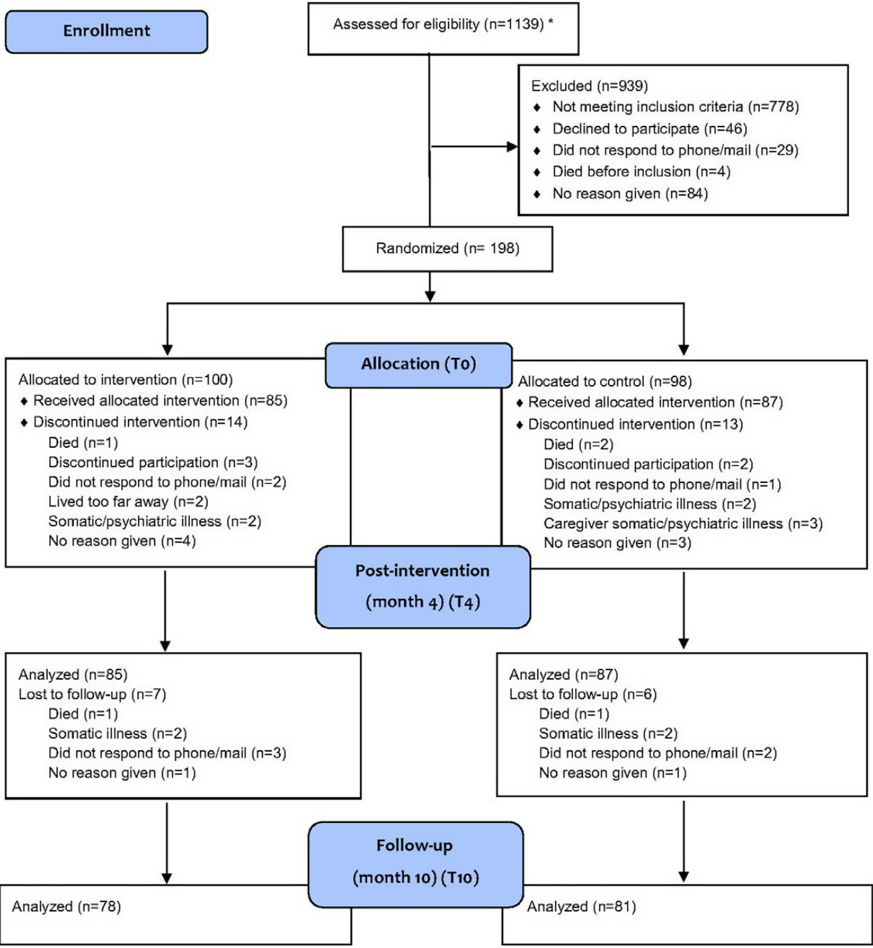
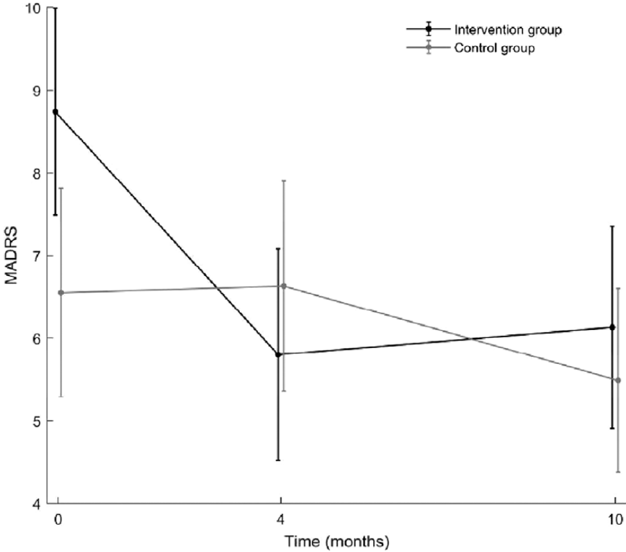
OBJECTIVE: To evaluate the feasibility and effectiveness of the CORDIAL program, a psychosocial intervention consisting of cognitive behavioral therapy (CBT), cognitive rehabilitation, and reminiscence to manage depressive symptoms for people with mild cognitive impairment (MCI) or dementia. DESIGN: We conducted a randomized controlled trial, based on a two-group (intervention and control), pre-/post-intervention design. SETTING: Participants were recruited from five different old age psychiatry and memory clinics at outpatients' hospitals. PARTICIPANTS: Hundred and ninety-eight people with MCI or early-stage dementia were included. INTERVENTION: The intervention group (n = 100) received 11 individual weekly sessions of the CORDIAL program. This intervention includes elements from CBT, cognitive rehabilitation, and reminiscence therapy. The control group (n = 98) received treatment-as-usual. MEASUREMENTS: We assessed Montgomery-Åsberg Depression Rating Scale (MADRS) (main outcome), Neuropsychiatric Inventory Questionnaire, and Quality of Life in Alzheimer's disease (secondary outcomes) over the course of 4 months and at a 10-month follow-up visit. RESULTS: A linear mixed model demonstrated that the depressive symptoms assessed by MADRS were significantly more reduced in the intervention groups as compared to the control group (p < 0.001). The effect persisted for 6 months after the intervention. No significant differences between groups were found in neuropsychiatric symptoms or quality of life. CONCLUSION: Our multicomponent intervention, which comprised 11 individual sessions of CBT, cognitive rehabilitation, and reminiscence therapy, reduced depressive symptoms in people with MCI and dementia.
Overview
The claims and statistics of this paper haven’t been checked yet.
Free: it reads the open-access text and checks the first 5 claims that cite a source we can check. Create a free account to check every claim.
Integrity signals
Registry
Cites
Statistics
Figures
Verification
Claims the paper makes
The claims and statistics of this paper haven’t been checked yet.
Free: it reads the open-access text and checks the first 5 claims that cite a source we can check. Create a free account to check every claim.
Claims other papers make about this one
Each is checked against this paper’s own text: does it say what the citing paper says it does?
The source backs part of the claim, not all of it — or backs it for a different population, condition or comparison.
In the citing paper
“whereas one recently published paper with a larger sample (n = 198) of a randomized-controlled study showed a significant reduction of depressive symptoms in the intervention group (cognitive rehabilitation and cognitive behavioral therapy) as compared to the treatment as usual control group by 6 months post-intervention (p < 0.001) [39].”
From Psychotherapeutic interventions in individuals at risk for Alzheimer’s dementia: a systematic review (2022) · cites this paper as [39]
Experimental — accuracy not yet measuredThe source backs part of the claim, not all of it — or backs it for a different population, condition or comparison.
In the citing paper
“This review depicts that psychotherapeutic and psychoeducational interventions for older adults in pre-dementia stages are feasible and may suggest that the degree of cognitive impairment in the pre-dementia stages may not necessarily influence the ability to learn skills such as psychotherapeutic or mindfulness interventions [39, 42, 46, 47, 62, 63].”
From Psychotherapeutic interventions in individuals at risk for Alzheimer’s dementia: a systematic review (2022) · cites this paper as [39]
Experimental — accuracy not yet measuredThe source backs part of the claim, not all of it — or backs it for a different population, condition or comparison.
In the citing paper
“While a RCT with a large sample (n = 198) of MCI patients showed a significant reduction of depressive symptoms in the intervention group (cognitive rehabilitation and cognitive behavioral therapy) as compared to the treatment as usual control group 6 months post-intervention [39], non-randomized CBT-based trials with smaller sample sizes but longer follow-up assessments of 6–12 months did not”
From Psychotherapeutic interventions in individuals at risk for Alzheimer’s dementia: a systematic review (2022) · cites this paper as [39]
Experimental — accuracy not yet measuredThe cited source says what the claim attributes to it.
In the citing paper
“Long-term follow-up assessments (6 or more months post-intervention) were described in 14 publications [37, 39, 43, 48, 49, 51–53, 59, 60, 62, 63, 68, 69].”
From Psychotherapeutic interventions in individuals at risk for Alzheimer’s dementia: a systematic review (2022) · cites this paper as [39]
The cited source says what the claim attributes to it.
In the citing paper
“Amongst them, 8 papers described manualized psychotherapeutic interventions [36, 37, 39, 42, 43, 62–64] and 18 papers described psychoeducational interventions in addition to cognitive rehabilitation, cognitive training, mindfulness-based stress reduction, behavioral activation, or a recovery model approach [38, 44–54, 57–60, 65, 67].”
From Psychotherapeutic interventions in individuals at risk for Alzheimer’s dementia: a systematic review (2022) · cites this paper as [39]
2 more claims about this paper
Create a free account to see every claim other papers make about this one.
Self-check
Percentages, sums and reported differences re-computed from the paper’s own numbers.
The self-check needs the paper’s full text.
Citations
Cites
Folstein, M. F., Folstein, S. E., & McHugh, P. R. (1975) · Journal of Psychiatric Research · doi:10.1016/0022-3956(75)90026-6 · Cited by 88,282
The Hospital Anxiety and Depression Scale
Zigmond, A. S., & Snaith, R. P. (1983) · Acta Psychiatrica Scandinavica · doi:10.1111/j.1600-0447.1983.tb09716.x · Cited by 47,139 · cited 5×
“High mean scores on the QOL-AD and GSE and low mean scores on the HADS and RSS suggested that caregivers had few symptoms and a high quality of life.”
MethodInfluentialAssessment of Older People: Self-Maintaining and Instrumental Activities of Daily Living
Lawton, M. P., & Brody, E. M. (1969) · The Gerontologist · doi:10.1093/geront/9.3_part_1.179 · Cited by 18,540
(2017) · Cited by 16,319
A new depression scale designed to be sensitive to change
Montgomery, S. A., & Åsberg, M. (1979) · British Journal of Psychiatry · doi:10.1192/bjp.134.4.382 · Cited by 13,962 · cited 1×
“PATIENT VARIABLES Depressive symptoms were measured with the MADRS (Montgomery and Åsberg, 1979), administered by professional health staff, and was the primary outcome of the study.”
MethodAssessing coping strategies: A theoretically based approach.
Carver, C. S., Scheier, M. F., & Weintraub, J. K. (1989) · Journal of Personality and Social Psychology · doi:10.1037/0022-3514.56.2.267 · Cited by 11,507 · cited 2×
“…experience of psychosocial interventions in combinationwithmeasurement scales that grasp the positive aspects of psychosocial interventions, for example, the Coping Orientation to Problems Experienced Inventory (Carver et al., 1989) or the Client Satisfaction Instrument (Attkisson and Zwick, 1982).”
BackgroundThe validity of the Hospital Anxiety and Depression Scale
Bjelland, I., Dahl, A. A., Haug, T. T., & Neckelmann, D. (2002) · Journal of Psychosomatic Research · doi:10.1016/s0022-3999(01)00296-3 · Cited by 9,779 · cited 3×
“A cutoff score >8 indicated substantial anxiety and depressive symptoms (Bjelland et al., 2002).”
BackgroundMethodInfluentialWinblad, B., Palmer, K., Kivipelto, M., Jelic, V., Fratiglioni, L., Wahlund, L. ‐., Nordberg, A., Bäckman, L., Albert, M., Almkvist, O., et al. (2004) · Journal of Internal Medicine · doi:10.1111/j.1365-2796.2004.01380.x · Cited by 4,946 · cited 1×
“Eligible participants had to: • meet the Winblad criteria for MCI due to Alzheimer’s disease (Winblad et al., 2004); or criteria for dementia in Alzheimer’s disease according to the ICD-10 or the National Institute of Neurological and Communicative Disorders and Stroke and the Alzheimer’s Disease…”
MethodResearch criteria for the diagnosis of Alzheimer's disease: revising the NINCDS–ADRDA criteria
Dubois, B., Feldman, H. H., Jacova, C., DeKosky, S. T., Barberger-Gateau, P., Cummings, J., Delacourte, A., Galasko, D., Gauthier, S., Jicha, G., et al. (2007) · The Lancet Neurology · doi:10.1016/s1474-4422(07)70178-3 · Cited by 4,411 · cited 3×
“, 2004); or criteria for dementia in Alzheimer’s disease according to the ICD-10 or the National Institute of Neurological and Communicative Disorders and Stroke and the Alzheimer’s Disease and Related Disorders Association (Dubois et al., 2007); • be in the early stages of MCI or dementia, as indicated by a Mini Ment…”
BackgroundMethodInfluential2013 Alzheimer's disease facts and figures
Alzheimer's Association, Thies, W., & Bleiler, L. (2013) · Alzheimer's & Dementia · doi:10.1016/j.jalz.2013.02.003 · Cited by 3,328
Research works printed but not linked: 5
- 2. Appelhof, B. et al. (2019). Effects of a multidisciplinary intervention on the presence of neuropsychiatric symptoms and psychotropic drug use in nursing home residents with young-onset dementia: Behavior and Evolution of Young ONset Dementia part 2 (BEYOND-II) study. The American Journal of Geriatric Psychiatry, 27, 581-589.
- 9. Brueggen, K. et al. (2017). Cognitive rehabilitation in Alzheimer's disease: a controlled intervention trial. Journal of Alzheimer's Disease, 57, 1315-1324. · DOI
- 10. Brækhus, A., Ulstein, I., Wyller, T. and Engedal, K. (2011). The memory clinic -outpatient assessment when dementia is suspected. Tidsskrift for Norsk Legeforening, 22.
- 59. Thorgrimson, L. et al. (2003). Whose quality of life is it anyway? The validity and reliability of the Quality of Life- Alzheimer's Disease (QoL-AD) scale. Alzheimer Disease & Associated Disorders, 17, 201-208. · DOI · Paper page
- 62. Wimo, A. W. and Winblad, B. (2003). Resource utlization in dementia: RUD Lite. Brain Aging, 3, 48-59.
Cited by
Depression in Alzheimer’s Disease: Epidemiology, Mechanisms, and Treatment
Huang, Y.-Y., Gan, Y.-H., Yang, L., Cheng, W., & Yu, J.-T. (2024) · Biological Psychiatry · doi:10.1016/j.biopsych.2023.10.008 · Cited by 164
Yang, Q., Lyu, X., Lin, Q., Wang, Z., Tang, L., Zhao, Y., & Lyu, Q.-Y. (2021) · International Journal of Nursing Studies · doi:10.1016/j.ijnurstu.2021.104110 · Cited by 59
Psychotherapeutic interventions in individuals at risk for Alzheimer’s dementia: a systematic review
Rostamzadeh, A., Kahlert, A., Kalthegener, F., & Jessen, F. (2022) · Alzheimer's Research & Therapy · doi:10.1186/s13195-021-00956-8 · Cited by 26
“Of the included papers, 13 originated from the USA [42–54], followed by 6 from Canada [55–60], 4 from the Netherlands [61–64], 2 from Germany [37, 38], 2 from Norway [36, 39], and one from each of the following countries: Australia [65], Israel [66], and UK [67].”
BackgroundResultZhang, J., Hu, S., Liu, Y., Lyu, H., Huang, X., Li, X., Chen, J., Hu, Q., Xu, J., & Yu, H. (2022) · Journal of Alzheimer s Disease · doi:10.3233/jad-220592 · Cited by 27
Lin, R. S. Y., Yu, D. S. F., Chau, P. H., & Li, P. W. C. (2022) · International Journal of Nursing Studies · doi:10.1016/j.ijnurstu.2022.104381 · Cited by 23
Robinson, A. L., & Moghaddam, N. G. (2022) · Mental Health Review Journal · doi:10.1108/mhrj-05-2021-0043 · Cited by 24
Lin, R. S. Y., Yu, D. S. F., Li, P. W. C., Chau, P. H., & Lee, J. J. (2021) · Journal of Advanced Nursing · doi:10.1111/jan.15088 · Cited by 18
Yao, X., Zhao, Y., Yin, M., & Li, Z. (2021) · International Journal of Nursing Sciences · doi:10.1016/j.ijnss.2021.08.005 · Cited by 18
“Psychiatric symptoms, such as depression, anxiety, and apathy [2], are often found among patients with MCI, with depressive symptoms being the most commonly identified [3].”
BackgroundGonzález-Martín, A. M., Aibar‐Almazán, A., Rivas-Campo, Y., Sobrino, N. R., & Castellote‐Caballero, Y. (2023) · Frontiers in Aging Neuroscience · doi:10.3389/fnagi.2023.1222197 · Cited by 18
“The articles included in this systematic review and meta-analysis were all randomized controlled clinical trials published in Korea (Yang and Kwak, 2017; Kim, 2020), Norway (Tonga et al., 2021), France (Amieva et al., 2016), Spain (Gaitán et al., 2013; García-Casal et al., 2017), Portugal (Justo-Henriques et al., 2023…”
InfluentialLin, R. S. Y., Yu, D. S. F., Li, P. W. C., & Masika, G. M. (2020) · International Journal of Geriatric Psychiatry · doi:10.1002/gps.5460 · Cited by 15
“The study by Tonga et al.67 was excluded from data pooling due to insufficient data.”
BackgroundMethodInfluentialNeurobiological and therapeutic landmarks of depression associated with Alzheimer’s disease dementia
Untu, I., Davidson, M., Stanciu, G. D., Rabinowitz, J., Dobrin, R., Vieru, D. S., & Tamba, B.-I. (2025) · Frontiers in Aging Neuroscience · doi:10.3389/fnagi.2025.1584607 · Cited by 17
Managing the Behavioral and Psychological Symptoms of Dementia
Mendez, M. F. (2022) · Current Treatment Options in Neurology · doi:10.1007/s11940-022-00715-6 · Cited by 11
Yao, X., Wang, Y., Zhou, Y., & Li, Z. (2023) · International Journal of Geriatric Psychiatry · doi:10.1002/gps.5951 · Cited by 15
“Findings revealed a persistent effect in decreasing depression for 6 months after intervention.(49) Results from this study implies that PPI is helpful in relieving depression among MCI clients in community and possibly such effect is significant with prorogation of time.”
BackgroundChoi, Y., Lim, J., Choi, H., Ryu, Y. H., Seong, E., Park, I., Kang, D. W., Lee, J., & Kang, D. (2025) · Scientific Reports · doi:10.1038/s41598-024-84086-9 · Cited by 14
Zhang, Y.-H., Zhao, P., Gao, H., Zhong, M., & Li, J. (2024) · Journal of Alzheimer s Disease · doi:10.3233/jad-231389 · Cited by 9
Cai, M., Bai, D., Hou, D., You, Q., Wang, W. J., Lu, X., & Gao, J. (2023) · International Journal of Mental Health Nursing · doi:10.1111/inm.13247 · Cited by 10
Mathews, G., Li, X., & Wilkinson, H. A. (2024) · Dementia · doi:10.1177/14713012241233765 · Cited by 8
“The longer-term impacts of counselling people living with dementia were evaluated in six studies (Cornelis et al., 2018; Koivisto et al., 2016; Lykkeslet et al., 2016; Spector et al., 2015; Tonga et al., 2016, 2021).”
BackgroundPlys, E., Szapary, C. L., & Vranceanu, A. (2024) · Seminars in Neurology · doi:10.1055/s-0044-1791568 · Cited by 6
Bartels, C., Abdel‐Hamid, M., Wiltfang, J., Schneider, A., & Belz, M. (2022) · Journal of Alzheimer s Disease · doi:10.3233/jad-220578 · Cited by 5
Non-Pharmacological Treatments of Neuropsychiatric Symptoms in Mild Cognitive Impairment
Thurin, K., Daffner, K. R., Gale, S. A., Donovan, N. J., & Urizar, J. C. (2022) · Seminars in Neurology · doi:10.1055/s-0042-1742486 · Cited by 4
Dominke, C., Fischer, A. M., Grimmer, T., Diehl‐Schmid, J., & Jähn, T. (2022) · Aging Neuropsychology and Cognition · doi:10.1080/13825585.2022.2138255 · Cited by 4
“Besides overlapping cognitive symptoms, appropriate clinical differentiation between DAT and DEP is additionally complicated by the fact that many individuals with DAT also report depressive symptoms (Tetsuka, 2021; Tonga et al., 2021).”
BackgroundConsuegra, B. L., Carnes, A., Torres-Hidalgo, P., & Piñol‐Ripoll, G. (2025) · Frontiers in Psychology · doi:10.3389/fpsyg.2025.1547619 · Cited by 3
Saragih, I. D., Susanto, H., Saragih, I. S., Chen, P., Lee, B., & Lopez, R. P. (2025) · Journal of Clinical Nursing · doi:10.1111/jocn.70005 · Cited by 3
Robinson, A., & Moghaddam, N. G. (2023) · Counselling and Psychotherapy Research · doi:10.1002/capr.12722 · Cited by 2
Treatment of Challenging Behavior in Dementia
Leontjevas, R., Klaver, M., Smalbrugge, M., & Gerritsen, D. L. (2024) · Practical issues in geriatrics · doi:10.1007/978-3-031-58488-6_4 · Cited by 3
Psychotherapeutic Interventions
Cassidy‐Eagle, E. L., & Hitching, R. (2024) · Springer eBooks · doi:10.1007/978-3-031-53976-3_15 · Cited by 3
Re-purposing CORDIAL? Toward an effective treatment for depression in dementia
Woods, B. T. (2021) · International Psychogeriatrics · doi:10.1017/s1041610220001209 · Cited by 2
“In contrast to the other evaluations of the CORDIAL program cited, Tonga et al. (2020) have not focused exclusively on people with dementia in their sample recruitment.”
MethodResultInfluentialStrategies To Reduce Patient Anxiety and Stress Through Reminiscence Therapy
Manurung, N. (2025) · Majalah Kesehatan Indonesia · doi:10.47679/makein.2025242 · Cited by 1
Diagnostik und Behandlung von Demenzsyndromen in der klinischen Neuropsychologie
Werheid, K. (2021) · PiD - Psychotherapie im Dialog · doi:10.1055/a-1215-2324
Self-citationEfektifitas Intervensi Musik untuk Mengurangi Depresi pada Penderita Demensia
Kurniasari, C. I. (2022) · Jurnal Keperawatan Jiwa · doi:10.26714/jkj.10.2.2022.437-446
Effectiveness of psychoeducation interventions on the quality of life among patients with depression
Ali, N. M. K., Shaheen, S. H., Elbeh, K., AbdEl-Aziz, A. M., & El-hameed, N. A. E.-G. A. (2022) · International Journal of Advance Research in Nursing · doi:10.33545/nursing.2022.v5.i1c.251
“, [25] whose study aimed to evaluate the feasibility and effectiveness of a psychosocial intervention to manage depressive symptoms, found that there are no statistically significant differences between the studied and control groups in their quality of life.”
BackgroundKlocek, A., & Řiháček, T. (2023) · Counselling Psychology Quarterly · doi:10.1080/09515070.2023.2292212
“The effects of multicomponent treatment seem to be persistent even after longer period (about 6 months) after the end of treatment in adults with mild cognitive impairment (Tonga et al., 2021).”
Werheid, K., & Thöne-Otto, A. I. T. (2024) · Springer eBooks · doi:10.1007/978-3-662-66957-0_36
Self-citationShah, M. J. (2024) · International Psychogeriatrics · doi:10.1016/j.inpsyc.2024.100026
Drossel, C. (2025) · Cambridge University Press eBooks · doi:10.1017/9781009086264.014
Heinrich, I., Düben, A., & Geschke, K. (2025) · Nervenheilkunde · doi:10.1055/a-2710-6791
Heinrich, I., Düben, A., & Geschke, K. (2025) · PSYCH up2date · doi:10.1055/a-2502-5926
Verhaltenstherapeutische Gruppentherapie bei beginnender Demenz: Eine Pilotstudie
Risch, A. K., Hilbert, T., Buschek, R., & Wilz, G. (2026) · Psychotherapie im Alter · doi:10.30820/1613-2637-2026-1-81
Lewis, F., Stroud, J., Silver, J., & Talbott, T. (2026) · Aging & Mental Health · doi:10.1080/13607863.2026.2636697
“A large, randomised control trial (RCT) combining CBT and cognitive rehabilitation reduced depressive symptoms (Tonga et al., 2021), but smaller studies report inconsistent results (Scheurich et al., 2008).”
Domingo, J., Alves, A., & Sanders, J. (2026) · Health Expectations · doi:10.1111/hex.70736
Chapter 6. Cognitive Dysfunction and Therapy: Information, Modifications, and Recommendations
Isaac, L., & Fullen, C. T. (2025) · American Psychiatric Association Publishing eBooks · doi:10.1176/appi.books.9781615379972.lg06
Chapter 1. Therapeutic Modalities and Their Use in Older Adults
Cassidy‐Eagle, E. L., & Beaudreau, S. A. (2025) · American Psychiatric Association Publishing eBooks · doi:10.1176/appi.books.9781615379972.lg01
Metadata
- Authors
- Tonga, J. B., Šaltytė Benth, J., Arnevik, E. A., Werheid, K., Korsnes, M. S., & Ulstein, I. D.
- Affiliations
- Oslo University Hospital (NO)
- Humboldt-Universität zu Berlin (DE)
- Corresponding author
- Tonga, Johanne B.
- Venue
- International Psychogeriatrics
- Publisher
- Elsevier BV
- Published
- 2021-03
- Volume
- 33
- Issue
- 3
- Pages
- 217-231
- ISSN
- 1041-6102 (ISSN-L)
- OpenAlex
- W3009084572
- Semantic Scholar
- f3ba6075013df605e80492b120bb411a62e33ce9
- Cited by
- 42
- References
- 63
- Citations by year
- 2026: 3 · 2025: 10 · 2024: 7 · 2023: 6 · 2022: 10 · 2021: 5
- FWCI
- 4.01
- Type
- journal article
- Language
- en
- Open access
- gold
- doi.org
- Licence
- cc-by-nc-nd
- www.elsevier.com/tdm/userlicense/1.0/ (tdm)
- www.elsevier.com/legal/tdmrep-license (tdm)
- creativecommons.org/licenses/by-nc-nd/4.0 (vor)
- Locations
- International Psychogeriatrics (publishedVersion, cc-by-nc-nd)
- PubMed (publishedVersion)
- edoc Publication server (Humboldt University of Berlin) (submittedVersion, cc-by-nc-nd)
- Publikationen an der Universität Bielefeld (Universität Bielefeld) (submittedVersion, cc-by-nc-nd)
- NORA - Norwegian Open Research Archives (submittedVersion, cc-by-nc-nd)
- edoc Publication server (Humboldt University of Berlin)
- Funders
- Sykehuset Telemark
- Oslo universitetssykehus HF
- Nasjonalforeningen for Folkehelsen
- Topics
- Health Sciences › Medicine › Psychiatry and Mental health › Dementia and Cognitive Impairment Research
- Social Sciences › Psychology › Experimental and Cognitive Psychology › Anxiety, Depression, Psychometrics, Treatment, Cognitive Processes
- Social Sciences › Psychology › Clinical Psychology › Psychotherapy Techniques and Applications
- Keywords
- depressive symptoms, mild cognitive impairment, dementia, cognitive behavioral therapy, cognitive rehabilitation, reminiscence therapy, psychosocial interventions, neuropsychiatric symptoms, quality of life, early-stage dementia, older adults
- MeSH terms
- Aged, Dementia, Depression, Female, Humans, Male, Psychotherapy, Quality of Life, Cognitive Dysfunction
About these checks
Registry, retraction, Cites and statistics results are computed, not judged, with one exception: a printed reference that no index lists is read once by a model before it counts as a citation error. Claims are extracted by a model and kept only when their quote appears verbatim in the text; each cited source is then checked, with a model’s help, for whether it says what the claim relies on. Those verdicts can be wrong — read the claim’s quote and the cited source before relying on one.
Statistics and arithmetic are recomputed, not judged.
Confidence bands are shown only for fields calibrated on our annotated test set. None is calibrated yet, so no band is shown.
What counts as a claim ›How we measure confidence ›How we check this ›
Are you an author, or do you see a problem with this page? Request a review
Data sources
Bibliographic data: Semantic Scholar, OpenAlex, Crossref.
Contains information from the Semantic Scholar Academic Graph Datasets, made available under the ODC Attribution License (ODC-BY 1.0).
Semantic Scholar’s data is described in: Kinney, R., et al. (2023). The Semantic Scholar Open Data Platform. arXiv:2301.10140.
