

Large-N Qualitative Analysis (LNQA): Causal Generalization in Case Study and Multimethod Research
Open accessThe DOI matches its Crossref record; 74 of the 78 references it cites were found in a registry or an index; 2 of the 68 sources its claims cite were checked for support.
Abstract
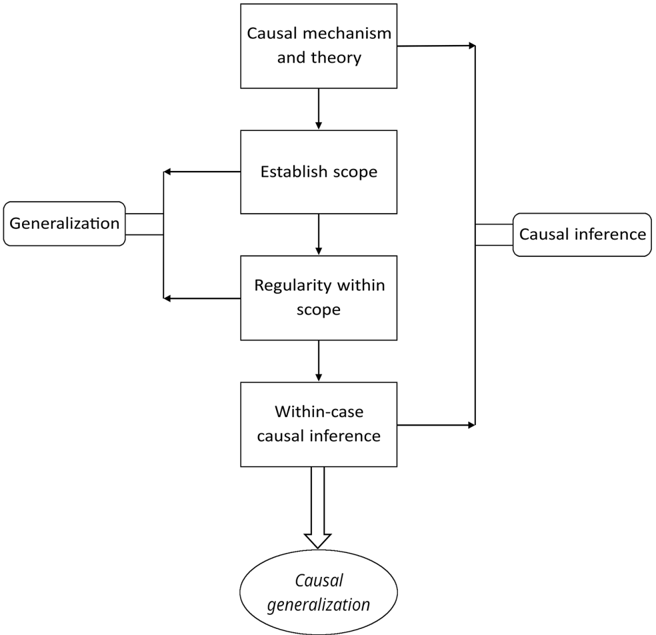
We describe an emerging research practice that we call Large-N Qualitative Analysis (LNQA), outline its core components and codify best practice. LNQA starts with hypothesized regularities and causal mechanisms. Regularities take two basic forms: Y generalizations (if Y then X) or X generalizations (if X then Y), albeit with more complex variants. To establish a causal generalization requires defining its scope. The strength of the regularity is simply the percentage of cases conforming with the causal claim. The causal force of LNQA, however, comes from within-case causal inference, which demonstrates the presence and operation of the postulated mechanisms in all cases in the scope. The method thus partly obviates problems arising from case selection in qualitative and multimethod work. We also identify a multimethod variant (M-LNQA), which combines LNQA with experimental, quasi-experimental, or observational statistical analysis. An appendix introduces over fifty examples of the method.
Overview
CoChat Summary
## TL;DR
The paper defines Large-N Qualitative Analysis (LNQA) as a research practice that combines hypothesized regularities, scope conditions, and within-case causal inference to make causal generalizations. It argues that LNQA—and its multimethod variant, M-LNQA—can strengthen causal claims by examining all or nearly all cases in a bounded population, especially for rare events or treatments.
## Key findings
- LNQA centers on two kinds of regularities: Y generalizations (“if Y then X”) and X generalizations (“if X then Y”), with strength measured as the percentage of cases conforming to the causal claim.
- The method’s causal force comes from within-case causal inference: the paper says that causal generalizations are established only when the proposed mechanism is shown to be present and operating as expected across the cases in scope.
- In the Copeland example, the scope contains 40 great-power conflict cases, and Copeland concludes that in 30 of the 40 case periods, or 75%, economic interdependence played a moderate to strong causal role.
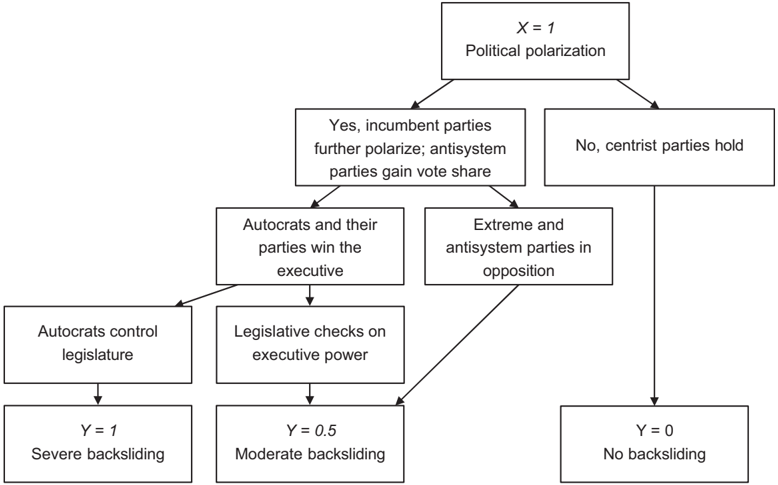
- In the Haggard and Kaufman example, the scope is 16 backsliding cases; 15 of 16 (94%) are relatively polarized, and within-case analysis yields clear causal evidence in 14 cases.
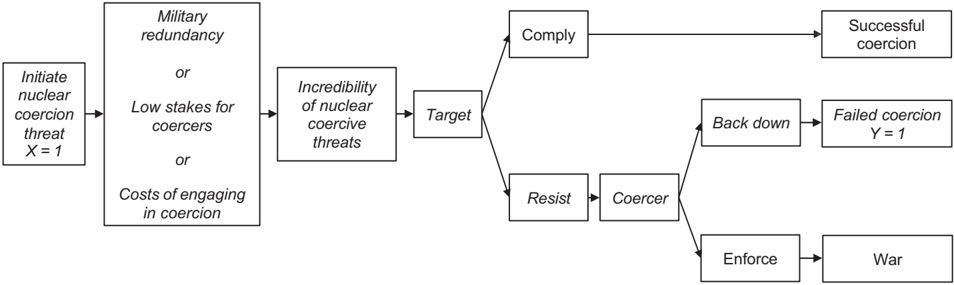
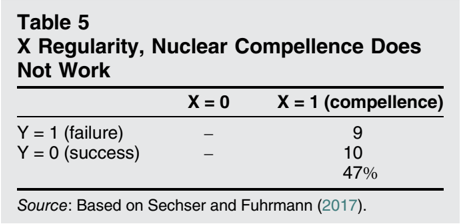
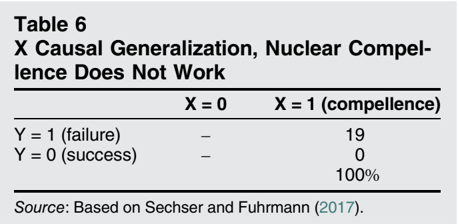
- In Sechser and Fuhrmann’s nuclear compellence example, the scope contains 19 cases; their initial regularity is 9 of 19 (47%) failures, and after within-case analysis they conclude the theory fits all 19 cases.
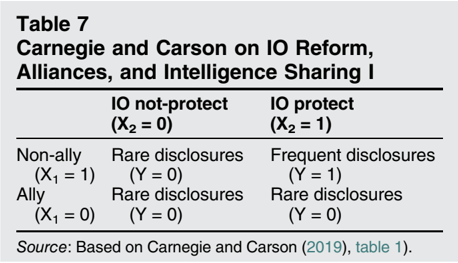
- For Carnegie and Carson, the paper reports an X-generalization strength of 0.83 and a Y=0 generalization strength of 0.87; it also notes there are no nonconforming cases for the table they summarize.
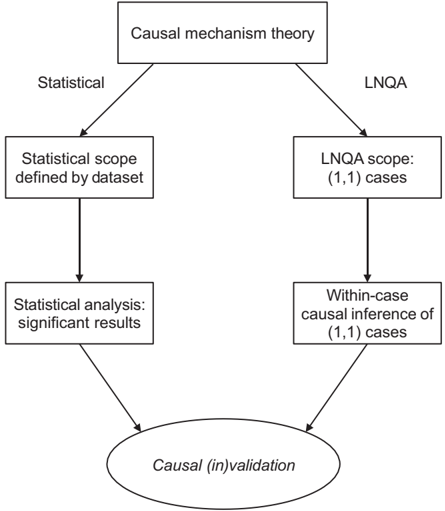
- The paper identifies a multimethod use of LNQA: in M-LNQA, statistical findings are paired with intensive case analysis of the (1,1) cases to either disconfirm or strengthen correlational results.
## Methods
- Conceptual/methodological article that outlines and codifies LNQA, drawing on a structured survey of the literature and more than 50 examples in an appendix.
- The core analytic logic is: define a scope condition (often all X=1 or all Y=1 cases), identify an empirical regularity, and then use within-case process tracing / causal process observation across the cases in scope.
- For M-LNQA, the paper describes a two-part design: a statistical or correlational analysis plus qualitative case analysis of the relevant cells in a 2×2 table, typically the (1,1) cases.
## Limitations
- The paper states that LNQA is not necessarily appropriate for phenomena with a large number of observations best handled by statistical techniques, and that its established norm of attempting all or near-all cases may not scale to much larger populations.
- The paper notes that the norm of examining all cases within scope is often violated in practice; it says many studies do most or many but not all cases.
- Evidence of a limitation implied by the text: the approach depends on the feasibility of intensive within-case work, so it is best suited to rare events or rare treatments and to scopes small enough for serial case analysis.
Model-written summary. Check it against the paper before relying on it.
Integrity signals
Registry
Cites
Statistics
Figures
Verification
Claims the paper makes
1 Valid · 6 Not valid · 62 Not checked · 94 Own results and interpretations
Every source the paper cites for this claim was checked and supports it.
In the paper
“But the mass-violence genocide cases (Y = 1) total only 12.”
What the sources say
- Supportedcites Maat 2020 matched to “Genocidal Consolidation: Final Solutions to Elite Rivalry” (2020) source
In the section 'Elite Rivalry and Genocidal Consolidation Onset' our copy states that the two-stage probit on genocidal consolidation (operationalized as Non-Counter-Guerrilla Mass Violence, i.e. the geno-/politicide-type mass violence) is estimated on a 'sample of 12 genocidal consolidation observations', with onsets only and ongoing spells dropped — matching the claim that the Y = 1 mass-violence/genocide cases total 12. The paper's dependent variable is exactly this category (data section, 'Analyses, data, and selection'; coding described next to Table 2), and it stresses the small number of onsets ('effects are estimated on the basis of a small number of mass indiscriminate violence onsets only'). A separate leader-level figure (Treated = 10 in the propensity-matched leader-fates analysis, footnote 135) is a different unit of analysis and does not contradict the 12 country-year onset observations. (LLM, conf=0.85)
plain- Asserted: passes — The authors put it forward as true.
- Checkable: passes — It can be checked against evidence.
- Load-bearing: passes — The paper’s conclusions depend on it.
- Based: passes — The paper gives a reason why it holds.
- Supported
None of the sources cited for this claim have been checked yet.
In the paper
“Subsequently we fi nd con fi rmatory multimethod LNQA studies in which sophisticated econometric designs and even game theory are coupled with case analysis of an entire population; we walk through examples of both of these combinations in more detail below (Carnegie and Carson 2019; Sechser and Fuhrmann 2017).”
What the sources say
- Not checked — no full text of the sourcecites Carnegie and Carson 2019 matched to “The Disclosure Dilemma: Nuclear Intelligence and International Organizations” (2019) source
- Not matchedcites Sechser and Fuhrmann 2017
An author–year citation the paper’s reference list doesn’t settle. We don’t search these by name.
plain- Asserted: passes — The authors put it forward as true.
- Checkable: passes — It can be checked against evidence.
- Load-bearing: unclear — It is unclear whether the paper’s conclusions depend on it.
- Based: passes — The paper gives a reason why it holds.
In the paper
“Around 2010, a wave of LNQA studies began to appear that were discon fi rmatory in their approach (Goertz 2017, chap. 7).”
What the sources say
- Not checked — no full text of the sourcecites Goertz 2017 matched to “Multimethod Research, Causal Mechanisms, and Case Studies: An Integrated Approach” (2017) source
plain- Asserted: passes — The authors put it forward as true.
- Checkable: passes — It can be checked against evidence.
- Load-bearing: unclear — It is unclear whether the paper’s conclusions depend on it.
- Based: passes — The paper gives a reason why it holds.
A result the paper states — it cites no source for it, so there is none to check. The quote shows it is in the paper.
In the paper
“We fi nd that this norm is the one most likely to be violated.”
hedged- Asserted: passes — The authors put it forward as true.
- Checkable: passes — It can be checked against evidence.
- Load-bearing: passes — The paper’s conclusions depend on it.
- Based: passes — The paper gives a reason why it holds.
A result the paper reports from its own data — it cites no other source for it, so there is none to check. The quote shows it is in the paper.
In the paper
“Y = 1 regularities are the more common of the two in the LNQA work we surveyed.”
plain- Asserted: passes — The authors put it forward as true.
- Checkable: passes — It can be checked against evidence.
- Load-bearing: unclear — It is unclear whether the paper’s conclusions depend on it.
- Based: passes — The paper gives a reason why it holds.
50 more claims
Create a free account to see all 163 claims and to verify the 7 references still open.
- Probably not a substantial claim. 95
- It may state two separate claims as one. 42
Citations
Cites
Some Social Requisites of Democracy: Economic Development and Political Legitimacy
Lipset, S. M. (1959) · American Political Science Review · doi:10.2307/1951731 · Cited by 7,050 · cited 1×
“Some proposed regularities are well known, such as Lipset (1959) on the relationship between level of development and democracy and Drèze and Sen (1991) on democracy and famine.”
BackgroundStates and Social Revolutions: A Comparative Analysis of France, Russia and China
Skocpol, T. (1979) · Cambridge University Press · doi:10.1017/cbo9780511815805 · Cited by 5,408
Case study research: principles and practices
(2007) · Choice Reviews Online · doi:10.5860/choice.45-1530 · Cited by 4,167
Machamer, P., Darden, L., & Craver, C. F. (2000) · Philosophy of Science · doi:10.1086/392759 · Cited by 3,179 · cited 1×
“An in fl uential de fi nition, coming out of an analysis of the biomedical sciences, is that “ mechanisms are entities and activities organized such that they are productive of regular changes from start or set-up to fi nish or termination conditions ” (Machamer, Darden, and Craver 2000, 3).”
BackgroundThe Comparative Method: Moving Beyond Qualitative and Quantitative Strategies.
Smith, H. L., & Ragin, C. C. (1990) · Population and Development Review · doi:10.2307/1972971 · Cited by 2,779
The Book of Why: The New Science of Cause and Effect
Goldberg, L. R. (2019) · Notices of the American Mathematical Society · doi:10.1090/noti1912 · Cited by 1,655
Case Study Research: Principles and Practices
Gerring, J. (2006) · Cambridge University Press eBooks · doi:10.1017/cbo9780511803123 · Cited by 1,033
Rethinking Mechanistic Explanation
Glennan, S. (2002) · Philosophy of Science · doi:10.1086/341857 · Cited by 867 · cited 1×
“For example, Glennan (2002, S344) de fi nes a mechanism for a behavior as “ a complex system that produces that behavior by the interaction of a number of parts, where the interactions between parts can be characterized by direct, invariant, change-relating generalizations ” (see also Crasnow 2017).”
BackgroundThe cement of the universe, a study of causation
Rota, G.-C. (1978) · Advances in Mathematics · doi:10.1016/0001-8708(78)90103-2 · Cited by 688
The legacies of liberalism: path dependence and political regimes in Central America
(2002) · Choice Reviews Online · doi:10.5860/choice.40-0541 · Cited by 585
Interpreting Causality in the Health Sciences
Russo, F., & Williamson, J. (2007) · International Studies in the Philosophy of Science · doi:10.1080/02698590701498084 · Cited by 549 · cited 1×
“…quasi-experimental, or observational designs, can signi fi cantly strengthen causal inference in them, and has already drawn attention from philosophers of social science (building on Russo and Williamson 2007; Williamson 2019; see, for example, Runhardt 2022; Shan and Williamson 2023).”
BackgroundState Building in Latin America
Soifer, H. D. (2015) · Cambridge University Press eBooks · doi:10.1017/cbo9781316257289 · Cited by 493
Luebbert, G. M. (1991) · doi:10.1093/oso/9780195066104.001.0001 · Cited by 491
Backsliding: Democratic Regress in the Contemporary World
Haggard, S., & Kaufman, R. (2021) · doi:10.1017/9781108957809 · Cited by 464 · cited 2×
“We take as our fi rst example a Y generalization from Haggard and Kaufman (2021) on the issue of democratic backsliding, illustrated in fi gure 3, revised from a similar fi gure in their book.”
BackgroundMethodSelf-citationElecting to Fight: Why Emerging Democracies Go to War
Mansfield, E. D., & Snyder, J. (2005) · doi:10.7551/mitpress/2660.001.0001 · Cited by 457
A Problem from Hell: America and the Age of Genocide
Gupta, D. K. (2002) · Political Science Quarterly · doi:10.2307/798157 · Cited by 435
Colonialism and Postcolonial Development: Spanish America in Comparative Perspective
Mahoney, J. (2010) · doi:10.1017/cbo9780511750328 · Cited by 364
Private Wealth and Public Revenue in Latin America: Business Power and Tax Politics
Fairfield, T. (2015) · doi:10.1017/cbo9781316104767 · Cited by 332
Forging Democracy from below: Insurgent Transitions in South Africa and El Salvador
Mozaffar, S., & Wood, E. J. (2001) · The International Journal of African Historical Studies · doi:10.2307/3097586 · Cited by 331
Causal Case Study Methods: Foundations and Guidelines for Comparing, Matching, and Tracing
Beach, D., & Pedersen, R. (2016) · doi:10.3998/mpub.6576809 · Cited by 303
Social Origins of Dictatorship and Democracy: Lord and Peasant in the Making of the Modern World.
Gusfield, J., & Moore, B. (1967) · Social Forces · doi:10.2307/2575331 · Cited by 300
Evidence and Inference in the Comparative Case Study
Dion, D. (1998) · Comparative Politics · doi:10.2307/422284 · Cited by 261 · cited 1×
“Dion (1998), in an award-winning article focusing in particular on necessary conditions, found using a Bayesian analysis that regularities can be established with con fi dence with as few as fi ve or six cases.”
Peace Time: Cease-Fire Agreements and the Durability of Peace
Fortna, V. P. (2004) · Princeton University Press eBooks · doi:10.1515/9780691187952 · Cited by 241
Drèze, J., & Sen, A. (1991) · doi:10.1093/0198283652.001.0001 · Cited by 236
Gerring, J. (2016) · Cambridge University Press eBooks · doi:10.1017/9781316848593 · Cited by 227
Qualitative Comparative Analysis Using R: A Beginner's Guide
Oana, I.-E., Schneider, C. Q., & Thomann, E. (2021) · doi:10.1017/9781009006781 · Cited by 224 · cited 1×
“QCA is a particularly prominent methodology focusing on necessary and su ffi cient conditions (Oana, Schneider, and Thomann 2021; Ragin 1987), although it has not typically pursued the extensive within-case analysis that LNQA requires.”
MethodDictators and Democrats: Masses, Elites, and Regime Change
Snyder, J. (2017) · Political Science Quarterly · doi:10.1002/polq.12724 · Cited by 201 · cited 3×
“Haggard and Kaufman (2016) consider the presence and operation of a relatively spare causal mechanism: distributive grievances, mass mobilization, and the over-throw or departure of incumbents because of such mobilization.”
BackgroundExploding the Powder Keg Myth: Preemptive Wars Almost Never Happen
Reiter, D. (1995) · International Security · doi:10.2307/2539227 · Cited by 200 · cited 2×
“Reiter ’ s (1995) early LNQA contribution on preemptive war considers 67 cases.”
BackgroundEconomic Interdependence and War
Copeland, D. C. (2014) · Princeton University Press eBooks · doi:10.1515/9781400852703 · Cited by 197
(2017) · Project Muse (Johns Hopkins University) · Cited by 193
Self-citationMultimethod Research, Causal Mechanisms, and Case Studies: An Integrated Approach
Goertz, G. (2017) · doi:10.1515/9781400888115 · Cited by 169
Self-citationNuclear Weapons and Coercive Diplomacy
Sechser, T. S., & Fuhrmann, M. (2016) · doi:10.1017/9781316227305 · Cited by 155
Russett, B. M., Layne, C., Spiro, D. E., et al. (1995) · International Security · doi:10.2307/2539124 · Cited by 150
The Oxford handbook of philosophy of social science
(2012) · Oxford University Press eBooks · doi:10.1093/oxfordhb/9780195392753.001.0001 · Cited by 123
The Fates of Political Parties
Cyr, J. (2017) · Cambridge University Press eBooks · doi:10.1017/9781316995723 · Cited by 122 · cited 1×
“Classic examples of scope conditions set by region include James Mahoney ’ s work on democracy in Central America (2001) and development in Latin America as a whole (2010), as well as more recent treatments of the region, such as Soifer (2015) on state building and Cyr (2017) on party collapse.”
BackgroundThe logic of counterfactual analysis in case‐study explanation
Mahoney, J., & Barrenechea, R. (2017) · British Journal of Sociology · doi:10.1111/1468-4446.12340 · Cited by 120 · cited 1×
“But we can imagine accounts based on Bayesian approaches (e.g., Fair fi eld and Charman 2022) as well as within-case counterfactual designs (e.g., Harvey 2011; Mahoney and Barrenechea 2019).”
MethodEstablishing Causal Claims in Medicine
Williamson, J. (2019) · International Studies in the Philosophy of Science · doi:10.1080/02698595.2019.1630927 · Cited by 109 · cited 1×
“…quasi-experimental, or observational designs, can signi fi cantly strengthen causal inference in them, and has already drawn attention from philosophers of social science (building on Russo and Williamson 2007; Williamson 2019; see, for example, Runhardt 2022; Shan and Williamson 2023).”
BackgroundWhen Right Makes Might: Rising Powers and World Order
Goddard, S. E. (2021) · Project Muse (Johns Hopkins University) · doi:10.7298/b8z9-s649 · Cited by 108
The Disclosure Dilemma: Nuclear Intelligence and International Organizations
Carnegie, A., & Carson, A. (2019) · American Journal of Political Science · doi:10.1111/ajps.12426 · Cited by 105 · cited 3×
“An example that we take up in more detail below is Carnegie and Carson ’ s (2019) study of nuclear intelligence sharing, but they are not alone (see Haggard and Kaufman 2016; 2021; Miller 2021; Schenoni et al. 2020).”
BackgroundPower Sharing and Authoritarian Stability: How Rebel Regimes Solve the Guardianship Dilemma
Meng, A., & Paine, J. (2022) · Harvard Dataverse · doi:10.7910/dvn/8lqzw9 · Cited by 103
Who Are These Belligerent Democratizers? Reassessing the Impact of Democratization on War
Narang, V., & Nelson, R. M. (2009) · International Organization · doi:10.1017/s0020818309090122 · Cited by 102 · cited 1×
“An early example of discon fi rming M-LNQA is Narang and Nelson ’ s (2009) critical examination of the claims made by Mans fi eld and Snyder in their 2005 book Electing to Fight: Why Emerging Democracies Go to War.”
BackgroundHow Insurgency Begins: Rebel Group Formation in Uganda and Beyond
Lewis, J. I. (2020) · doi:10.1017/9781108855969 · Cited by 98 · cited 1×
“In a well-crafted study of civil con fl ict in Africa, for example, Lewis (2020) explores all proto-rebel groups in Uganda, an N of 16.”
BackgroundSecrets in Global Governance: Disclosure Dilemmas and the Challenge of International Cooperation
Carnegie, A. S., & Carson, A. (2020) · Cambridge University Press eBooks · doi:10.1017/9781108778114 · Cited by 95 · cited 1×
“Article | Large-N Qualitative Analysis (LNQA) Carnegie and Carson 2020).”
BackgroundTwilight of the Titans: Great Power Decline and Retrenchment
MacDonald, P. K., & Parent, J. M. (2018) · doi:10.7591/9781501717109 · Cited by 83 · cited 1×
“Other LNQA work in this vein has addressed not only the question of war but retrenchment (MacDonald and Parent 2018), accommodation on the part of great powers (Goddard 2018), and on the strategies of rising powers (Shifrinson 2018).”
BackgroundProcess tracing in political science: What's the story?
Crasnow, S. L. (2017) · Studies in History and Philosophy of Science Part A · doi:10.1016/j.shpsa.2017.03.002 · Cited by 80 · cited 2×
“To illustrate the logic of an X causal generalization, we use Sechser and Fuhrmann ’ s Nuclear Weapons and Coercive Diplomacy (2017).”
BackgroundMethodPower Sharing and Authoritarian Stability: How Rebel Regimes Solve the Guardianship Dilemma
Meng, A., & Paine, J. (2022) · American Political Science Review · doi:10.1017/s0003055422000296 · Cited by 72
Six Theses on Mechanisms and Mechanistic Science
Glennan, S. S., Illari, P. K., & Weber, E. (2021) · Journal for General Philosophy of Science · doi:10.1007/s10838-021-09587-x · Cited by 66
Shifrinson, J. R. I. (2018) · Cornell University Press eBooks · doi:10.7591/cornell/9781501725050.001.0001 · Cited by 64
Social Inquiry and Bayesian Inference: Rethinking Qualitative Research
Fairfield, T., & Charman, A. E. (2022) · Cambridge University Press · doi:10.1017/9781108377522 · Cited by 62
Pathways to War in Democratic Transitions
Mansfield, E. D., & Snyder, J. (2009) · International Organization · doi:10.1017/s0020818309090134 · Cited by 53 · cited 1×
“In the response by Mans fi eld and Snyder (2009), they return to the cases, not only to the statistical fi ndings.”
BackgroundEvidential Pluralism in the Social Sciences
Shan, Y., & Williamson, J. (2023) · Routledge eBooks · doi:10.4324/9781003143000 · Cited by 48 · cited 1×
“…quasi-experimental, or observational designs, can signi fi cantly strengthen causal inference in them, and has already drawn attention from philosophers of social science (building on Russo and Williamson 2007; Williamson 2019; see, for example, Runhardt 2022; Shan and Williamson 2023).”
BackgroundDictators and Democrats: Masses, Elites, and Regime Change
Haggard, S., & Kaufman, R. R. (2016) · doi:10.23943/princeton/9780691172149.001.0001 · Cited by 46
Self-citationWaldner, D. (2014) · Process Tracing · doi:10.1017/cbo9781139858472.008 · Cited by 41
Shock to the system: Coups, elections, and war on the road to democratization
Wahman, M. (2022) · Governance · doi:10.1111/gove.12703 · Cited by 41 · cited 1×
“An example that we take up in more detail below is Carnegie and Carson ’ s (2019) study of nuclear intelligence sharing, but they are not alone (see Haggard and Kaufman 2016; 2021; Miller 2021; Schenoni et al. 2020).”
BackgroundEconomic interdependence and war
Cooper, R. N. (2015) · Choice Reviews Online · doi:10.5860/choice.188449 · Cited by 40
Mahoney, J. (2002) · Johns Hopkins University Press eBooks · doi:10.56021/9780801865527 · Cited by 34
Harvey, F. P. (2011) · Cambridge University Press eBooks · doi:10.1017/cbo9781139044226 · Cited by 30 · cited 1×
“But we can imagine accounts based on Bayesian approaches (e.g., Fair fi eld and Charman 2022) as well as within-case counterfactual designs (e.g., Harvey 2011; Mahoney and Barrenechea 2019).”
MethodSettling Resistant Territorial Disputes: The Territorial Boundary Peace in Latin America
Schenoni, L. L., Goertz, G., Owsiak, A. P., & Diehl, P. F. (2020) · International Studies Quarterly · doi:10.1093/isq/sqz091 · Cited by 27 · cited 1×
“An example that we take up in more detail below is Carnegie and Carson ’ s (2019) study of nuclear intelligence sharing, but they are not alone (see Haggard and Kaufman 2016; 2021; Miller 2021; Schenoni et al. 2020).”
BackgroundSelf-citationRising Titans, Falling Giants: How Great Powers Exploit Power Shifts
Shifrinson, J. R. I. (2018) · Project Muse (Johns Hopkins University) · doi:10.7591/9781501725067 · Cited by 21
Trade Expectations and Great Power Conflict—A Review Essay
Snyder, J. (2016) · International Security · doi:10.1162/isec_r_00229 · Cited by 16
Runhardt, R. W. (2022) · Synthese · doi:10.1007/s11229-022-03650-w · Cited by 16 · cited 1×
“…quasi-experimental, or observational designs, can signi fi cantly strengthen causal inference in them, and has already drawn attention from philosophers of social science (building on Russo and Williamson 2007; Williamson 2019; see, for example, Runhardt 2022; Shan and Williamson 2023).”
BackgroundPeacemaking From Above, Peace From Below: Ending Conflict Between Regional Rivals.
Ikenberry, G. J. (2016) · Foreign Affairs · Cited by 15
MacDonald, P. K., & Parent, J. M. (2018) · Cornell University Press eBooks · doi:10.7591/cornell/9781501717093.001.0001 · Cited by 10
Genocidal Consolidation: Final Solutions to Elite Rivalry
van der Maat, E. (2020) · International Organization · doi:10.1017/s0020818320000259 · Cited by 9 · cited 1×
“” (Maat 2020, 795).”
Revolution and Dictatorship: The Violent Origins of Durable Authoritarianism
Levitsky, S., & Way, L. (2022) · doi:10.2307/j.ctv2drhcnf · Cited by 7
Descriptive-Causal Generalizations: “Empirical Laws” in the Social Sciences?
Goertz, G. (2012) · Oxford University Press eBooks · doi:10.1093/oxfordhb/9780195392753.013.0005 · Cited by 6
Self-citationNuclear Weapons and Coercive Diplomacy
Bell, M. S. (2017) · Political Science Quarterly · doi:10.1002/polq.12709 · Cited by 4
(2018) · Cornell University Press eBooks · doi:10.1353/book.65100
De Bruin, E. (2020) · How to Prevent Coups d'État · doi:10.7591/cornell/9781501751912.003.0001
Gerring, J. (n.d.) · Case Study Research · doi:10.1017/cbo9780511803123.001
Multimethod Research, Causal Mechanisms, and Case Studies: An Integrated Approach
GOERTZ, G. (2017) · doi:10.2307/j.ctvc77khf
Self-citationMacDonald, P. K., & Parent, J. M. (2018) · Twilight of the Titans · doi:10.7591/cornell/9781501717093.003.0001
Theory of Economic Interdependence and War
Copeland, D. C. (2014) · Economic Interdependence and War · doi:10.23943/princeton/9780691161587.003.0002
Conclusion: Whither Democracy?
Haggard, S., & Kaufman, R. R. (2016) · Dictators and Democrats · doi:10.23943/princeton/9780691172149.003.0010
Self-citationAllison, G. (2014) · The Next Great War? · doi:10.7551/mitpress/10371.003.0007
Peacemaking between Regional Rivals
Ripsman, N. M. (2016) · Peacemaking from Above, Peace from Below · doi:10.7591/cornell/9781501702471.003.0007
Research works printed but not linked: 1
- De Bruin, Erica. 2020. How to Prevent Coups d ' État: Counterbalancing and Regime Survival . Ithaca, NY: Cornell University Press. DOI: 10.7591/ cornell/9781501751912.001.0001. · doi:10.7591/cornell/9781501751912.001.0001
Cited by
Ampong, R. O., Miezah, K., Banunle, A., Amuah, E. E. Y., & Amoah, E. G. (2024) · Heliyon · doi:10.1016/j.heliyon.2024.e39017 · Cited by 23
Judicial backsliding: a guide to collapsing the separation of powers
Haggard, S. M., & Tiede, L. B. (2024) · Democratization · doi:10.1080/13510347.2024.2381092 · Cited by 20
Self-citationMolina, C. M., Pérez-Macías, N., & Vaca, M. C. (2024) · Discover Sustainability · doi:10.1007/s43621-024-00187-5 · Cited by 12
“…the use of fuzzy-set theory has been suggested as a way to address the uncertainty associated with the use of indicators and rankings [12], process-tracing helps trace the underlying arguments behind the mechanisms that explain how the cause leads to the effect; how the result is produced [39].”
BackgroundStrategies for urban cycling: an analysis through generalized analytic induction
Molina, C. M., Pérez-Macías, N., & Rey-Tienda, S. (2024) · International Review on Public and Nonprofit Marketing · doi:10.1007/s12208-024-00411-y · Cited by 7
“Generalized Analytic Induction begins its analysis with a specific phenomenon or event (qualitative outcome) since much can be learned from exploring the antecedent conditions for positive cases of the outcome (Goertz & Haggard, 2023).”
Charting the Norms–Peace Relationship: Looking Back to Look Ahead
Diehl, P. F. (2024) · Journal of Intervention and Statebuilding · doi:10.1080/17502977.2024.2407192 · Cited by 4
“Large N (whether standard data analyses or new qualitative case comparisons – see Goertz and Haggard 2023 for the latter) studies offer the payoff of detecting patterns across different regional and cultural contexts, as well as the limitations of such generalizations.”
Metadata
- Authors
- Goertz, G., & Haggard, S.
- Venue
- Perspectives on Politics
- Publisher
- Cambridge University Press (CUP)
- Published
- 2023-08-23
- Volume
- 21
- Issue
- 4
- Pages
- 1221-1239
- ISSN
- 1537-5927 (ISSN-L)
- 1541-0986
- OpenAlex
- W4386095902
- Cited by
- 22
- References
- 57
- Citations by year
- 2026: 10 · 2025: 5 · 2024: 7
- FWCI
- 9.49
- Type
- journal article
- Language
- en
- Open access
- hybrid
- doi.org
- Locations
- Perspectives on Politics (publishedVersion, cc-by)
- Topics
- Social Sciences › Sociology and Political Science › Qualitative Comparative Analysis Research
- Social Sciences › Political Science and International Relations › Political Science Research and Education
- Social Sciences › Education › Qualitative Research Methods and Applications
- Keywords
- causal generalization, causal mechanisms, case selection, multi-method research, qualitative research practice, causal regularities
About these checks
Registry, retraction, Cites and statistics results are computed, not judged, with one exception: a printed reference that no index lists is read once by a model before it counts as a citation error. Claims are extracted by a model and kept only when their quote appears verbatim in the text; each cited source is then checked, with a model’s help, for whether it says what the claim relies on. Those verdicts can be wrong — read the claim’s quote and the cited source before relying on one.
The claim verdicts this report counts are experimental: their accuracy is not yet measured.
A language model drew the claims from the paper on 2026-10-10, under version 3 of the claim definition (model deepseek-v4.1-flash, prompt extract-v3).
A second model labelled each claim on 2026-10-10 (model jev-1.13-20260917, definition revision gold-guideline-v0.2).
Cited sources are checked with a language model’s help (qwen3.8-omni-flash).
Statistics and arithmetic are recomputed, not judged.
Confidence bands are shown only for fields calibrated on our annotated test set. None is calibrated yet, so no band is shown.
What counts as a claim ›How we measure confidence ›How we check this ›
Are you an author, or do you see a problem with this page? Request a review
Data sources
Bibliographic data: Semantic Scholar, OpenAlex, Crossref.
Contains information from the Semantic Scholar Academic Graph Datasets, made available under the ODC Attribution License (ODC-BY 1.0).
Semantic Scholar’s data is described in: Kinney, R., et al. (2023). The Semantic Scholar Open Data Platform. arXiv:2301.10140.
