

Towards a model of uncertainty distress in the context of Coronavirus (COVID-19)
Open accessThe DOI matches its Crossref record; 61 of the 61 references it cites were found in a registry or an index.
Abstract
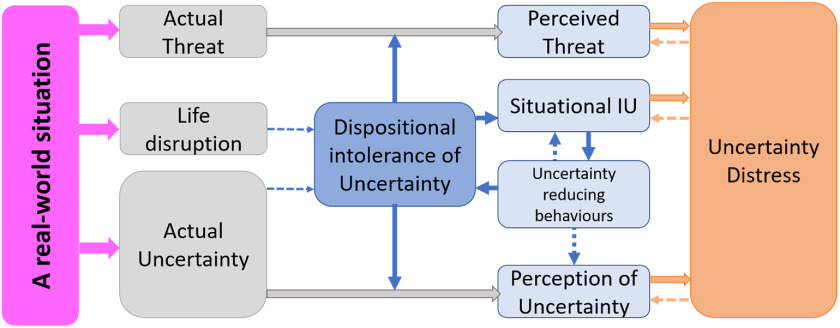
The paper forms part of a series of papers outlining the theoretical framework for a new model of uncertainty distress (this paper), treatment implications arising from the model, and empirical tests of the model. We define uncertainty distress as the subjective negative emotions experienced in response to the as yet unknown aspects of a given situation. In the first paper we draw on a robust body of research on distinct areas including: threat models of anxiety, perceived illness uncertainty and intolerance of uncertainty. We explore how threat and uncertainty are separable in anxiety and how we can understand behaviours in response to uncertainty. Finally, we propose a clinically, theoretically and empirically informed model for uncertainty distress, and outline how this model can be tested. Caveats, clinical applications and practitioner key points are briefly included, although these are more fully outlined in the treatment implications article. While we outline this model in the context of novel coronavirus (COVID-19), the model has broader applications to both mental and physical health care settings. Key learning aims: (1)To define the concept of uncertainty distress. (2)To understand the role of threat, over-estimation of threat, perceived uncertainty, actual uncertainty, and intolerance of uncertainty in distress maintenance. (3)To understand how people may behave in response to uncertainty distress. (4)To describe a model of uncertainty distress.
Overview
The claims and statistics of this paper haven’t been checked yet.
Free: it reads the open-access text and checks the first 5 claims that cite a source we can check. Create a free account to check every claim.
Integrity signals
Registry
Cites
Statistics
Figures
Verification
Claims the paper makes
The claims and statistics of this paper haven’t been checked yet.
Free: it reads the open-access text and checks the first 5 claims that cite a source we can check. Create a free account to check every claim.
Claims other papers make about this one
Each is checked against this paper’s own text: does it say what the citing paper says it does?
The source backs part of the claim, not all of it — or backs it for a different population, condition or comparison.
In the citing paper
“While originally developed for anxiety disorders, CBT-IU has been successfully applied in contexts such as pandemic-related stress, economic instability, and geopolitical crises [38].”
From Impact of Media-Induced Uncertainty on Mental Health: Narrative-Based Perspective. (2025) · cites this paper as [38]
Experimental — accuracy not yet measuredThe cited source says what the claim attributes to it.
In the citing paper
“It may not be the case that such uncertainty is elevated in patients with preexisting anxiety disorders (Rettie & Daniels, 2020) but instead the construct of “uncertainty distress” may be more relevant (Freeston et al., 2020).”
From Fear and Anxiety in COVID-19: Preexisting Anxiety Disorders (2021) · cites this paper as Freeston et al., 2020
The cited source says what the claim attributes to it.
In the citing paper
“Understanding the distinction between these constructs and which, if any, applies to patients will help in the formulation of patients’ difficulties and determine whether treatment focuses on tolerance of uncertainty, overestimation of threat, or a hybrid of the two (Freeston et al., 2020).”
From Fear and Anxiety in COVID-19: Preexisting Anxiety Disorders (2021) · cites this paper as Freeston et al., 2020
The cited source says what the claim attributes to it.
In the citing paper
“Furthermore, subjective feelings of uncertainty, or uncertainty distress [38], may be accompanied by or instigate a host of other mental states, such as helplessness, frustration, anger, guilt, and grief [39].”
From Impact of Media-Induced Uncertainty on Mental Health: Narrative-Based Perspective. (2025) · cites this paper as [38]
The cited source says what the claim attributes to it.
In the citing paper
“IU, as a set of negative cognitive, affective, and behavioral reactions to situational uncertainty [38,85], predicts acute subjective and psychological stress response in humans [33] and defensive responding.”
From Impact of Media-Induced Uncertainty on Mental Health: Narrative-Based Perspective. (2025) · cites this paper as [38]
1 more claim about this paper
Create a free account to see every claim other papers make about this one.
Self-check
Percentages, sums and reported differences re-computed from the paper’s own numbers.
The self-check needs the paper’s full text.
Citations
Cites
Diagnostic and Statistical Manual of Mental Disorders
American Psychiatric Association (2013) · doi:10.1176/appi.books.9780890425596 · Cited by 116,369
Wang, C., Pan, R., Wan, X., Tan, Y., Xu, L., Ho, C. S., & Ho, R. C. (2020) · International Journal of Environmental Research and Public Health · doi:10.3390/ijerph17051729 · Cited by 9,923
(1985) · Cited by 2,882
A cognitive model of social phobia
Adrian Wells, A. (1995) · Research Explorer (The University of Manchester) · Cited by 2,701
Clark, D. M. (1986) · Behaviour Research and Therapy · doi:10.1016/0005-7967(86)90011-2 · Cited by 2,422 · cited 2×
“These are often referred to as the second wave of CBT and include the Clark (1986) model of panic, the Salkovskis (1985) model of obsessive compulsive disorder (OCD) and the Clark and Wells (1995) model of social anxiety.”
Fearing the unknown: A short version of the Intolerance of Uncertainty Scale
Carleton, R. N., Norton, M. A. P. J., & Asmundson, G. J. G. (2007) · Journal of Anxiety Disorders · doi:10.1016/j.janxdis.2006.03.014 · Cited by 2,288 · cited 12×
“More recently, there is an emerging consensus from a series of recent psychometric studies using bi-factor analysis that the IUS-12, the shortened version of the original 27-item IUS (Carleton et al., 2007) is best understood as a univocal or unidimensional measure.”
InfluentialUncertainty and anticipation in anxiety: an integrated neurobiological and psychological perspective
Grupe, D. W., & Nitschke, J. B. (2013) · Nature Reviews Neuroscience · doi:10.1038/nrn3524 · Cited by 2,007 · cited 2×
“Along with Kuang (2017), we emphasise the as yet ‘unknown-ness’ of the uncertain situation.”
Molenaar, P. C. M. (2004) · Measurement: Interdisciplinary Research & Perspective · doi:10.1207/s15366359mea0204_1 · Cited by 1,943 · cited 1×
“Second, there is a long recognised inferential jump that evidence from between-person studies automatically applies to within-person models (see Molenaar, 2004) and within-person or idiographic studies are required (see Wright and Woods, 2020), despite the challenges of defining, operationalising…”
Obsessional-compulsive problems: A cognitive-behavioural analysis
Salkovskis, P. M. (1985) · Behaviour Research and Therapy · doi:10.1016/0005-7967(85)90105-6 · Cited by 1,842 · cited 3×
“Furthermore, reassurance seeking, although common across disorders (Kobori and Salkovskis, 2013), is often recognised as a particular feature of OCD.”
Freeston, M. H., Rhéaume, J., Letarte, H., Dugas, M. J., & Ladouceur, R. (1994) · Personality and Individual Differences · doi:10.1016/0191-8869(94)90048-5 · Cited by 1,731 · cited 2×
“…uncertainty as understood initially in the context of illness (e.g. Mishel, 1981; Zhang, 2017), and intolerance of uncertainty (e.g. Carleton, 2016; Freeston et al ., 1994) and we will consider how their integration has important implications for understanding and potentially mitigating…”
Self-citation
Research works printed but not linked: 7
- Tiplady, A., Askey-Jones, S., Meares, K., Thwaites, R., & Freeston, M. H. (2017). Developing a module to target intolerance of uncertainty in the transdiagnostic treatment of anxiety: design, treatment, and preliminary outcomes. In M. H. Freeston (Chair), Targeting Intolerance of Uncertainty in the Treatment of Anxiety: Rationale, Description, and Preliminary Outcomes. Symposium conducted at 45th Annual Conference and Workshops of the British Association of Behavioural and Cognitive Psychotherapies, Manchester, UK, July 2017.
- Clifford, M. (2014). Intolerance of Uncertainty: A Meta-Analysis and Review of Behaviours in Everyday Life. Unpublished Doctoral Thesis, Newcastle University.
- Mofrad, L. & Tiplady, A. (2019). A ‘Making Friends with Uncertainty’ Group Intervention. In A. Russell (Chair), Developments in CBT for Depression and Anxiety. Symposium conducted at 47th Annual Conference and Workshops of the British Association of Behavioural and Cognitive Psychotherapies, Bath, UK, September 2019.
- Askey-Jones, S., Tiplady, A., Thwaites, R., Meares, K., & Freeston, M. H. (2017). Developing a module to target intolerance of uncertainty in the transdiagnostic treatment of anxiety: conceptual, clinical, and practical challenges. In M. H. Freeston (Chair), Targeting Intolerance of Uncertainty in the Treatment of Anxiety: Rationale, Description, and Preliminary Outcomes. Symposium conducted at 45th Annual Conference and Workshops of the British Association of Behavioural and Cognitive Psychotherapies, Manchester, United Kingdom, July 2017.
- Milne, S., Lomax, C., & Freeston, M. H. (2017). Appraisal of situational threat and situational intolerance of uncertainty in anxiety provoking situations of personal concern: an evidenced-based rationale for targeting IU in treatment? In M. H. Freeston (Chair), Targeting Intolerance of Uncertainty in the Treatment of Anxiety: Rationale, Description, and Preliminary Outcomes. Symposium conducted at 45th Annual Conference and Workshops of the British Association of Behavioural and Cognitive Psychotherapies, Manchester, UK, July 2017.
- Freeston, M. H., Mawn, L, Botessi, G., Tiplady, A., Pan, J., Nogueira-Arjona, R, Romero Sanchiz, P., & Simos, G. (2020). Towards a model of uncertainty distress in the context of Coronavirus (COVID-19) Retrieved from: https://www.researchgate.net/project/Towards-a-model-of-uncertainty-distress-in-the-context-of-Coronavirus-COVID-19 PMC7426588 34191941
- Milne, S., Lomax, C., & Freeston, M. H. (2019) A review of the relationship between intolerance of uncertainty and threat appraisal in anxiety. The Cognitive Behaviour Therapist, 12, E38. doi: 10.1017/S1754470X19000230 · DOI · Paper page
Cited by
Items 201–219 of 219
Lonnen, E., Mackinnon, J., & Paskell, R. (2024) · Psychological Reports · doi:10.1177/00332941241280622
“Individuals may cope with uncertainty via over-engagement to obtain certainty (e.g., repeated questioning), under-engagement to disengage (e.g., procrastination) or ‘ dither ’ behaviours (e.g., inaction) that lead to uncertainty paralysis (Freeston et al., 2020).”
Information Overload and the COVID-19 Vaccine
Hatfield, E. F. (2024) · Risk, systems and decisions · doi:10.1007/978-3-031-74062-6_29
Reginadita, Z. S., Hidajat, H. G., & Farida, I. A. (2025) · Formosa Journal of Multidisciplinary Research · doi:10.55927/fjmr.v4i4.135 · Cited by 2
“The emotional and cognitive responses to uncertainty promote the development and maintenance of intolerance of uncertainty (IU) and ultimately lead to mental health problems (Freeston, 2020).”
Akiyama, N., Kajiwara, S., Adachi, N., & Akiyama, T. (2025) · Cureus · doi:10.7759/cureus.84718
“As suggested in the model of uncertainty distress of Freeston et al. (2020), intolerance of uncertainty comprises dispositional tendencies and situational responses to uncertainty shaped by real-world variables and life disruptions [18].”
Attitudes to Uncertainty and Real-World Outcomes
Bavoľár, J. (2025) · Integrated science · doi:10.1007/978-3-031-88415-3_8
Panzeri, A., Bottesi, G., Vieno, A., Spada, M. M., Ghisi, M., Fin, V., & Marino, C. (2025) · Research Square · doi:10.21203/rs.3.rs-7196510/v1
Self-citationIannattone, S., Toffoli, L., Farina, A., Mento, G., & Bottesi, G. (2025) · Research on Child and Adolescent Psychopathology · doi:10.1007/s10802-025-01355-5
“…when faced with unpredictable or ambiguous situations; indeed, the negative emotions elicited by uncertainty (i.e., uncertainty distress; Freeston et al., 2020 ) may overwhelm their capacity for effective emotion regulation, leading to heightened emo - tional reactivity or challenges in…”
Self-citationMofrad, L., Hall, D., Tiplady, A., & Freeston, M. H. (2025) · The Cognitive Behaviour Therapist · doi:10.1017/s1754470x25100202 · Cited by 3
“Running parallel to the MFWU group intervention has been the development of the Uncertainty Distress Model (Freeston et al ., 2020) which is not specific to anxiety disorders, is trans-situational, and focuses on ‘ the subjective negative emotions experienced in response to the as yet unknown…”
InfluentialSelf-citationChen, X., Lin, W., & Liu, Y. (2025) · Journal of Psychology in Africa · doi:10.32604/jpa.2025.068787 · Cited by 2
“Network analysis reinforced these domains and highlighted central symptoms consistent with Freeston et al.’s (2020) transdiagnostic model of intolerance of uncertainty, which emphasizes the interplay between cognitive disruption and functional impairment.”
Khamis, F. A., Badahdah, A. M., & Aloud, N. (2025) · Journal of Evaluation in Clinical Practice · doi:10.1111/jep.70320 · Cited by 1
Batool, S., & Aslam, N. (2025) · Journal of Education Society & Multiculturalism · doi:10.2478/jesm-2025-0020
Dodiță, E.-D., Macovei, A., & Diaconu‐Gherasim, L. R. (2025) · Psychological Reports · doi:10.1177/00332941251414338 · Cited by 1
The measurement of uncertainty in science communication: A scoping review
Liao, Y. (2026) · Public Understanding of Science · doi:10.1177/09636625251412716 · Cited by 1
“…research, there continues to be considerable heterogeneity in how uncertainty is conceptualized and operationalized in quantitative communication research examining how uncertainty messages are processed and their effects on audiences (Chang, 2015; Freeston et al., 2020; Huang and Yang, 2020).”
At the crossroads: choosing radical action in post-COVID higher education
McCormack, M., Silke, A., McLaren, M.-R., & Scott, C. (2026) · Qualitative Research Journal · doi:10.1108/qrj-10-2025-0389
Kırıkkanat, B., & Vapurlu, S. (2026) · International Journal of Applied Positive Psychology · doi:10.1007/s41042-025-00270-w
Lei, J., Huang, Z., & Deng, Y. (2026) · Science & Education · doi:10.1007/s11191-026-00737-5
Wu, A., Zou, M., Zhu, T., Li, X., Wu, X., Deng, M., & Cui, L. (2026) · The Journal of Genetic Psychology · doi:10.1080/00221325.2026.2667819
Zhang, X., Xu, Q., Li, M., Zhang, Y., Song, J., & Liu, X. (2026) · Frontiers in Public Health · doi:10.3389/fpubh.2026.1876448
СПЕЦИФІКА ПОБУДОВИ ЖИТТЄВИХ СТРАТЕГІЙ МОЛОДДЮ В СИТУАЦІЯХ НЕВИЗНАЧЕНОСТІ ТА ЇХ КОРЕКЦІЇ
Гільфер, К. (2026) · Теоретичні і прикладні проблеми психології · doi:10.33216/2219-2654-2026-69-1-116-130
Metadata
- Authors
- Freeston, M., Tiplady, A., Mawn, L., Bottesi, G., & Thwaites, S.
- Affiliations
- Newcastle University (GB)
- Royal Victoria Infirmary (GB)
- University of Padua (IT)
- Corresponding author
- Freeston, Mark
- Venue
- The Cognitive Behaviour Therapist
- Publisher
- Cambridge University Press (CUP)
- Published
- 2020
- Volume
- 13
- Pages
- e31-e31
- ISSN
- 1754-470X (ISSN-L)
- PMC
- PMC7426588
- OpenAlex
- W3041256719
- Cited by
- 221
- References
- 61
- Citations by year
- 2026: 12 · 2025: 24 · 2024: 34 · 2023: 40 · 2022: 44 · 2021: 54 · 2020: 13
- FWCI
- 2.99
- Type
- journal article
- Language
- en
- Open access
- hybrid
- doi.org
- Locations
- The Cognitive Behaviour Therapist (publishedVersion, cc-by)
- PubMed Central (publishedVersion, cc-by)
- PubMed (publishedVersion)
- Padua Research Archive (University of Padova) (submittedVersion, cc-by)
- Newcastle University ePrints (Newcastle Univesity)
- Topics
- Social Sciences › Psychology › Clinical Psychology › COVID-19 and Mental Health
- Social Sciences › Psychology › Experimental and Cognitive Psychology › Anxiety, Depression, Psychometrics, Treatment, Cognitive Processes
- Health Sciences › Medicine › Public Health, Environmental and Occupational Health › Maternal Mental Health During Pregnancy and Postpartum
- Keywords
- COVID-19 pandemic, intolerance of uncertainty, overestimation of threat, anxiety maintenance, psychological distress
About these checks
Registry, retraction, Cites and statistics results are computed, not judged, with one exception: a printed reference that no index lists is read once by a model before it counts as a citation error. Claims are extracted by a model and kept only when their quote appears verbatim in the text; each cited source is then checked, with a model’s help, for whether it says what the claim relies on. Those verdicts can be wrong — read the claim’s quote and the cited source before relying on one.
Statistics and arithmetic are recomputed, not judged.
Confidence bands are shown only for fields calibrated on our annotated test set. None is calibrated yet, so no band is shown.
What counts as a claim ›How we measure confidence ›How we check this ›
Are you an author, or do you see a problem with this page? Request a review
Data sources
Bibliographic data: Semantic Scholar, OpenAlex, Crossref.
Contains information from the Semantic Scholar Academic Graph Datasets, made available under the ODC Attribution License (ODC-BY 1.0).
Semantic Scholar’s data is described in: Kinney, R., et al. (2023). The Semantic Scholar Open Data Platform. arXiv:2301.10140.
