

Treating social anxiety disorder remotely with cognitive therapy
Open accessThe DOI matches its Crossref record; 21 of the 21 references it cites were found in a registry or an index.
Abstract
Remote delivery of evidence-based psychological therapies via video conference has become particularly relevant following the COVID-19 pandemic, and is likely to be an on-going method of treatment delivery post-COVID. Remotely delivered therapy could be of particular benefit for people with social anxiety disorder (SAD), who tend to avoid or delay seeking face-to-face therapy, often due to anxiety about travelling to appointments and meeting mental health professionals in person. Individual cognitive therapy for SAD (CT-SAD), based on the Clark and Wells (1995) model, is a highly effective treatment that is recommended as a first-line intervention in NICE guidance (NICE, 2013). All of the key features of face-to-face CT-SAD (including video feedback, attention training, behavioural experiments and memory-focused techniques) can be adapted for remote delivery. In this paper, we provide guidance for clinicians on how to deliver CT-SAD remotely, and suggest novel ways for therapists and patients to overcome the challenges of carrying out a range of behavioural experiments during remote treatment delivery. Key learning aims: (1) To learn how to deliver all of the core interventions of CT-SAD remotely. (2) To learn novel ways of carrying out behavioural experiments remotely when some in-person social situations might not be possible.
Overview
The claims and statistics of this paper haven’t been checked yet.
Free: it reads the open-access text and checks the first 5 claims that cite a source we can check. Create a free account to check every claim.
Integrity signals
Registry
Cites
Statistics
Figures
Verification
Claims the paper makes
The claims and statistics of this paper haven’t been checked yet.
Free: it reads the open-access text and checks the first 5 claims that cite a source we can check. Create a free account to check every claim.
Self-check
Percentages, sums and reported differences re-computed from the paper’s own numbers.
The self-check needs the paper’s full text.
Citations
Cites
A cognitive model of social phobia
Adrian Wells, A. (1995) · Research Explorer (The University of Manchester) · Cited by 2,701
Psychosomatic medicine in Germany: more timely than ever
Zipfel, S., Herzog, W., Kruse, J., & Henningsen, P. (2016) · Psychotherapy and Psychosomatics · doi:10.1159/000447701 · Cited by 2,323
Liebowitz, M. R. (2015) · Modern Trends in Pharmacopsychiatry · doi:10.1159/000414022 · Cited by 2,266 · cited 1×
“Symptom measures Liebowitz Social Anxiety Scale (Liebowitz, 1987) Outcome measure of severity of social anxiety with a comprehensive assessment of feared situations Each session”
BackgroundPsychometric properties of the Social Phobia Inventory (SPIN): New self-rating scale
Connor, K. M., Davidson, J. R. T., Churchill, L. E., Sherwood, A., Weisler, R. H., & Foa, E. (2000) · British Journal of Psychiatry · doi:10.1192/bjp.176.4.379 · Cited by 1,624 · cited 1×
“Social Phobia Inventory (Connor et al., 2000) Outcome measure of severity of social anxiety Each session”
Social phobia: Diagnosis, assessment, and treatment
Franklin, M. E. (1996) · Clinical Psychology Review · doi:10.1016/s0272-7358(96)00036-0 · Cited by 1,389
Clark, D. M., Ehlers, A., Hackmann, A., McManus, F., Fennell, M., Grey, N., Waddington, L., & Wild, J. (2006) · Journal of Consulting and Clinical Psychology · doi:10.1037/0022-006x.74.3.568 · Cited by 603 · cited 2×
“This recommendation is based on a series of clinical trials conducted in the UK, Sweden, Norway, Germany and Japan, which have shown that CT-SAD is superior to a wide range of other interventions including exposure therapy (Clark et al., 2006), group cognitive behaviour therapy (Ingul et al.”
BackgroundMethodSelf-citationClark, D. M., Ehlers, A., McManus, F., Hackmann, A., Fennell, M., Campbell, H., Flower, T., Davenport, C., & Louis, B. (2003) · Journal of Consulting and Clinical Psychology · doi:10.1037/0022-006x.71.6.1058 · Cited by 561 · cited 5×
“, 2016), pill placebo (Clark et al., 2003) and psychological placebo (Ingul et al.”
BackgroundMethodInfluentialSelf-citationRecurrent images and early memories in social phobia
Hackmann, A., Clark, D. M., & McManus, F. (2000) · Behaviour Research and Therapy · doi:10.1016/s0005-7967(99)00161-8 · Cited by 489 · cited 1×
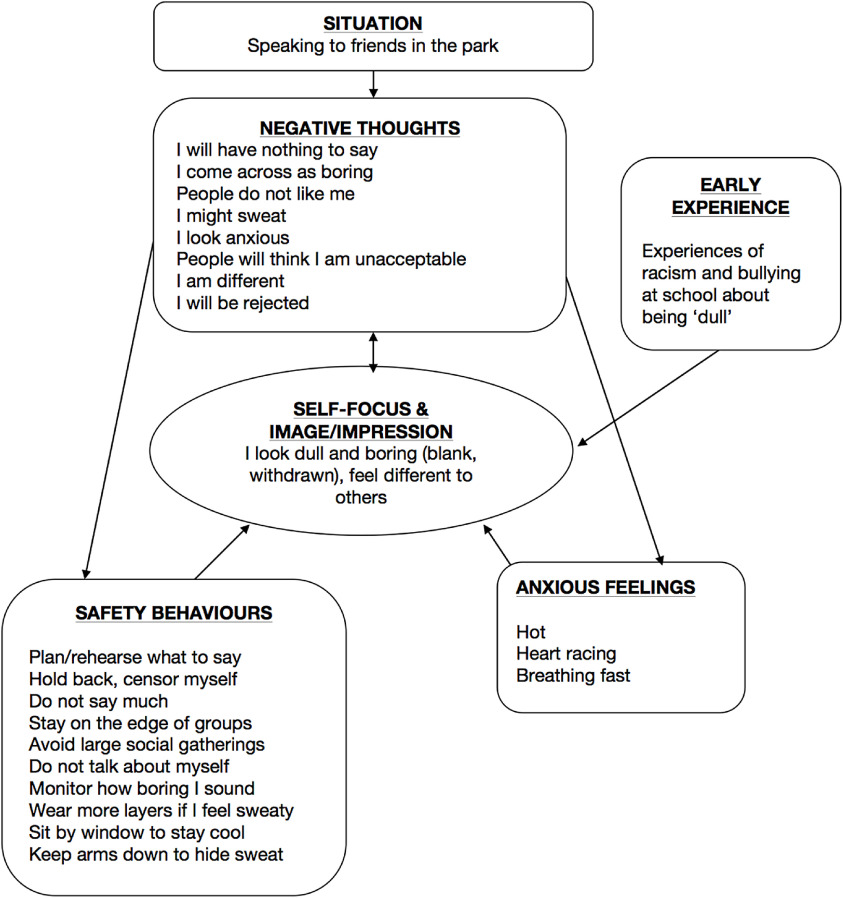
“For example, being ridiculed for blushing when reading aloud in class, linking to a current self-image of looking bright red or repeated school bullying, linking to a negative impression of the self as ‘inferior and vulnerable’ in the present day (Hackmann et al., 2000).”
BackgroundSelf-citationSchema change processes in cognitive therapy
Padesky, C. A. (1994) · Clinical Psychology & Psychotherapy · doi:10.1002/cpp.5640010502 · Cited by 403 · cited 2×
“Patients may also keep a positive data log (Padesky, 1994) alongside their treatment, recording any evidence, however small, which fits with an alternative self-belief they would like to develop (e.g.”
Cognitive therapy for social phobia: individual versus group treatment
Stangier, U., Heidenreich, T., Peitz, M., Lauterbach, W., & Clark, D. M. (2003) · Behaviour Research and Therapy · doi:10.1016/s0005-7967(02)00176-6 · Cited by 326 · cited 2×
“, 2006), group cognitive behaviour therapy (Ingul et al., 2014; Mörtberg et al., 2007; Stangier et al., 2003) interpersonal psychotherapy (Stangier et al.”
BackgroundSelf-citationLeichsenring, F., Salzer, S., Beutel, M. E., Herpertz, S., Hiller, W., Hoyer, J., Huesing, J., Joraschky, P., Nolting, B., Poehlmann, K., et al. (2013) · American Journal of Psychiatry · doi:10.1176/appi.ajp.2013.12081125 · Cited by 298 · cited 1×
“, 2011), psychodynamic psychotherapy (Leichsenring et al., 2013), selective serotonin re-uptake inhibitors (Clark et al.”
Mörtberg, E., Clark, D. M., Sundin, Ö., & Åberg Wistedt, A. (2007) · Acta Psychiatrica Scandinavica · doi:10.1111/j.1600-0447.2006.00839.x · Cited by 213 · cited 2×
“, 2006), group cognitive behaviour therapy (Ingul et al., 2014; Mörtberg et al., 2007; Stangier et al., 2003) interpersonal psychotherapy (Stangier et al.”
Self-citationStangier, U., Schramm, E., Heidenreich, T., Berger, M., & Clark, D. M. (2011) · Archives of General Psychiatry · doi:10.1001/archgenpsychiatry.2011.67 · Cited by 164 · cited 1×
“, 2003) interpersonal psychotherapy (Stangier et al., 2011), psychodynamic psychotherapy (Leichsenring et al.”
Self-citationImagery Rescripting of Early Traumatic Memories in Social Phobia
Wild, J., & Clark, D. M. (2011) · Cognitive and Behavioral Practice · doi:10.1016/j.cbpra.2011.03.002 · Cited by 147 · cited 1×
“The procedure used is outlined in detail by Wild and Clark (2011) and the key steps briefly summarised in Table 4.”
Self-citationIngul, J. M., Aune, T., & Nordahl, H. M. (2014) · Psychotherapy and Psychosomatics · doi:10.1159/000354672 · Cited by 98 · cited 2×
“, 2006), group cognitive behaviour therapy (Ingul et al., 2014; Mörtberg et al., 2007; Stangier et al., 2003) interpersonal psychotherapy (Stangier et al.”
BackgroundPsychophysiological responses to eye contact in a live interaction and in video call
Hietanen, J. O., Peltola, M. J., & Hietanen, J. K. (2020) · Psychophysiology · doi:10.1111/psyp.13587 · Cited by 96 · cited 1×
“For example, as direct eye contact via the webcam can increase autonomic arousal (Hietanen et al ., 2020), therapists should remain warm and accepting, but try not to stare straight into the video camera when asking the patient a question in early sessions.”
A demonstration of the efficacy of two of the components of cognitive therapy for social phobia
McManus, F., Clark, D. M., Grey, N., Wild, J., Hirsch, C., Fennell, M., Hackmann, A., Waddington, L., Liness, S., & Manley, J. (2009) · Journal of Anxiety Disorders · doi:10.1016/j.janxdis.2008.10.010 · Cited by 92
Self-citationSeeing Is Believing: Using Video Feedback in Cognitive Therapy for Social Anxiety Disorder
Warnock-Parkes, E., Wild, J., Stott, R., Grey, N., Ehlers, A., & Clark, D. M. (2017) · Cognitive and Behavioral Practice · doi:10.1016/j.cbpra.2016.03.007 · Cited by 69
Self-citationNordahl, H. M., Vogel, P. A., Morken, G., Stiles, T. C., Sandvik, P., & Wells, A. (2016) · Psychotherapy and Psychosomatics · doi:10.1159/000447013 · Cited by 64 · cited 1×
“, 2013), selective serotonin re-uptake inhibitors (Clark et al., 2003; Nordahl et al., 2016), medication-based treatment as usual (Mörtberg et al.”
Yoshinaga, N., Matsuki, S., Niitsu, T., Sato, Y., Tanaka, M., Ibuki, H., Takanashi, R., Ohshiro, K., Ohshima, F., Asano, K., et al. (2016) · Psychotherapy and Psychosomatics · doi:10.1159/000444221 · Cited by 60
Accessing social media: Help or hindrance for people with social anxiety?
Carruthers, S., Warnock‐Parkes, E., & Clark, D. M. (2019) · Journal of Experimental Psychopathology · doi:10.1177/2043808719837811 · Cited by 60 · cited 2×
“Research suggests that people with social anxiety also experience anxiety and activation of their social cognitions (e.g. people think I am boring or stupid) during online interactions, such as posting or messaging on Facebook (Carruthers et al ., 2019; Warnock-Parkes et al., in preparation).”
Self-citation
Research works printed but not linked: 4
- Clark, D. M. (2005). Three questionnaires for measuring central constructs in the cognitive model of social phobia: preliminary analysis. Available from Professor David Clark, Department of Psychiatry, University of Oxford.
- Warnock-Parkes, E. L., Wild, J., Stott, R., Grey, N., Ehlers, A., & Clark, D. M. (2017). Seeing is believing: using video feedback in cognitive therapy for social anxiety disorder. Cognitive and Behavioural Practice, 24, 245– 255. PMC5627505 29033532 · DOI · Paper page
- National Institute for Health and Care Excellence. (2013). Social Anxiety Disorder: Recognition, Assessment and Treatment of Social Anxiety Disorder Clinical Guideline 159. Available at: https://www.nice.org.uk/guidance/cg159/resources/social-anxiety-disorder-recognition-assessment-and-treatment-pdf-35109639699397 31869048
- Wild, J., & Clark, D. M. (2011). Imagery rescripting of early traumatic memories in social phobia. Cognitive Behavioural Practice, 18, 433– 443. PMC3267018 22298942 · DOI · Paper page
Cited by
Telemental Health Use in the COVID-19 Pandemic: A Scoping Review and Evidence Gap Mapping
Abraham, A., Jithesh, A., Doraiswamy, S., Al-Khawaga, N., Mamtani, R., & Cheema, S. (2021) · Frontiers in Psychiatry · doi:10.3389/fpsyt.2021.748069 · Cited by 148
Effects of mask-wearing on social anxiety: an exploratory review
Saint, S. A., & Moscovitch, D. A. (2021) · Anxiety, Stress, & Coping · doi:10.1080/10615806.2021.1929936 · Cited by 54
“…clinicians should encourage clients with SAD to work hard to confront their fears by adopting creative methods of exposure via video-chat platforms and in-person social interactions that can be conducted safely and in compliance with COVID-related restrictions (see Warnock-Parkes et al., 2020).”
BackgroundOliveira, C., Pacheco, M., Borges, J., Meira, L., & Santos, A. (2023) · Internet Interventions · doi:10.1016/j.invent.2023.100609 · Cited by 42
Fear and Anxiety in COVID-19: Preexisting Anxiety Disorders
Shafran, R., Rachman, S., Whittal, M., Radomsky, A., & Coughtrey, A. (2021) · Cognitive and Behavioral Practice · doi:10.1016/j.cbpra.2021.03.003 · Cited by 33
Thew, G. R., Kwok, A. P. L., Lissillour Chan, M. H., Powell, C. L. Y. M., Wild, J., Leung, P. W. L., & Clark, D. M. (2022) · Internet Interventions · doi:10.1016/j.invent.2022.100539 · Cited by 28
“It aims to replicate the content and procedures of the face-to-face cognitive therapy (CT-SAD) protocol (see Clark et al., 2006; Warnock-Parkes et al., 2020), which in the UK is a primary treatment recommendation for adults with SAD (NICE, 2013).”
BackgroundSelf-citation
Metadata
- Authors
- Warnock-Parkes, E., Wild, J., Thew, G. R., Kerr, A., Grey, N., Stott, R., Ehlers, A., & Clark, D. M.
- Affiliations
- Oxford Health NHS Foundation Trust (GB)
- King's College London (GB)
- University of Sussex (GB)
- Venue
- The Cognitive Behaviour Therapist
- Publisher
- Cambridge University Press (CUP)
- Published
- 2020
- Volume
- 13
- Pages
- e30-e30
- ISSN
- 1754-470X (ISSN-L)
- PMC
- PMC7411446
- OpenAlex
- W3042888910
- Cited by
- 45
- References
- 21
- Citations by year
- 2026: 7 · 2025: 8 · 2024: 5 · 2023: 7 · 2022: 8 · 2021: 10
- FWCI
- 6.05
- Type
- journal article
- Language
- en
- Open access
- hybrid
- doi.org
- Locations
- The Cognitive Behaviour Therapist (publishedVersion, cc-by)
- PubMed Central (publishedVersion, cc-by)
- PubMed (publishedVersion)
- Research Portal (King's College London) (submittedVersion, other-oa)
- Funders
- Wellcome Trust (200796/Z/16/Z, 200796)
- National Institute for Health and Care Research (NF-SI-0617-10052)
- Topics
- Social Sciences › Psychology › Experimental and Cognitive Psychology › Anxiety, Depression, Psychometrics, Treatment, Cognitive Processes
- Social Sciences › Psychology › Applied Psychology › Digital Mental Health Interventions
- Health Sciences › Medicine › Public Health, Environmental and Occupational Health › Telemedicine and Telehealth Implementation
- Keywords
- social anxiety disorder, cognitive therapy, remote therapy, videoconferencing, behavioural experiments, video feedback, attention training, COVID-19 pandemic, treatment delivery
About these checks
Registry, retraction, Cites and statistics results are computed, not judged, with one exception: a printed reference that no index lists is read once by a model before it counts as a citation error. Claims are extracted by a model and kept only when their quote appears verbatim in the text; each cited source is then checked, with a model’s help, for whether it says what the claim relies on. Those verdicts can be wrong — read the claim’s quote and the cited source before relying on one.
Statistics and arithmetic are recomputed, not judged.
Confidence bands are shown only for fields calibrated on our annotated test set. None is calibrated yet, so no band is shown.
What counts as a claim ›How we measure confidence ›How we check this ›
Are you an author, or do you see a problem with this page? Request a review
Data sources
Bibliographic data: Semantic Scholar, OpenAlex, Crossref.
Contains information from the Semantic Scholar Academic Graph Datasets, made available under the ODC Attribution License (ODC-BY 1.0).
Semantic Scholar’s data is described in: Kinney, R., et al. (2023). The Semantic Scholar Open Data Platform. arXiv:2301.10140.
