

Treating social anxiety disorder remotely with cognitive therapy
Open accessThe DOI matches its Crossref record; 21 of the 21 references it cites were found in a registry or an index.
Abstract
Remote delivery of evidence-based psychological therapies via video conference has become particularly relevant following the COVID-19 pandemic, and is likely to be an on-going method of treatment delivery post-COVID. Remotely delivered therapy could be of particular benefit for people with social anxiety disorder (SAD), who tend to avoid or delay seeking face-to-face therapy, often due to anxiety about travelling to appointments and meeting mental health professionals in person. Individual cognitive therapy for SAD (CT-SAD), based on the Clark and Wells (1995) model, is a highly effective treatment that is recommended as a first-line intervention in NICE guidance (NICE, 2013). All of the key features of face-to-face CT-SAD (including video feedback, attention training, behavioural experiments and memory-focused techniques) can be adapted for remote delivery. In this paper, we provide guidance for clinicians on how to deliver CT-SAD remotely, and suggest novel ways for therapists and patients to overcome the challenges of carrying out a range of behavioural experiments during remote treatment delivery. Key learning aims: (1) To learn how to deliver all of the core interventions of CT-SAD remotely. (2) To learn novel ways of carrying out behavioural experiments remotely when some in-person social situations might not be possible.
Overview
The claims and statistics of this paper haven’t been checked yet.
Free: it reads the open-access text and checks the first 5 claims that cite a source we can check. Create a free account to check every claim.
Integrity signals
Registry
Cites
Statistics
Figures
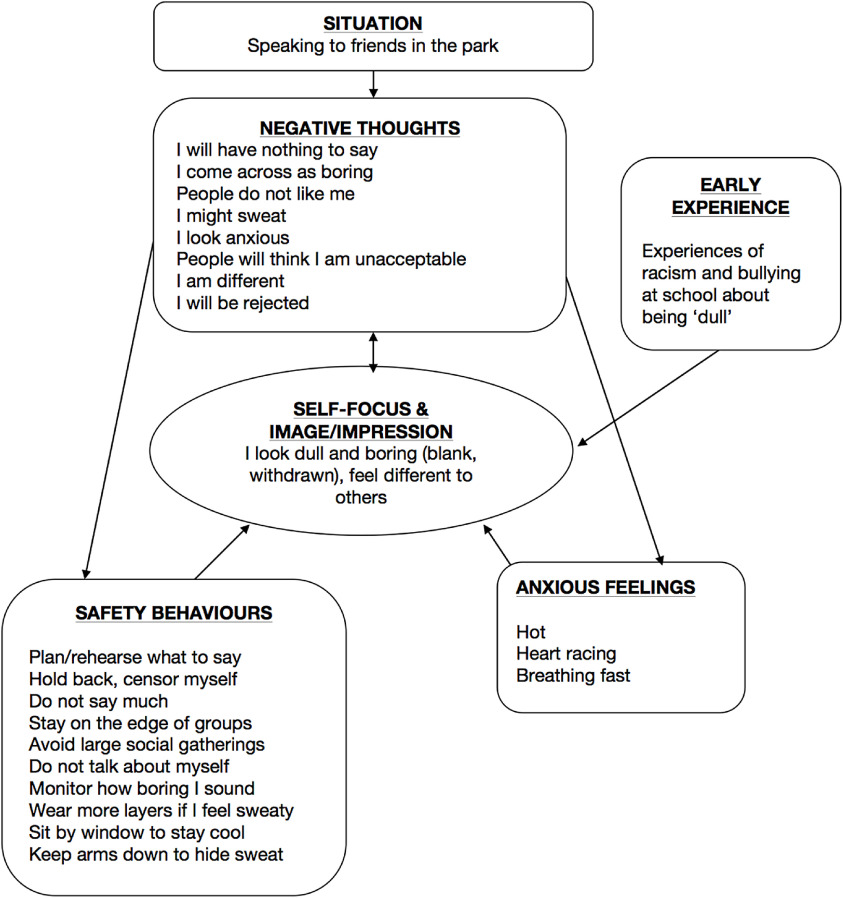
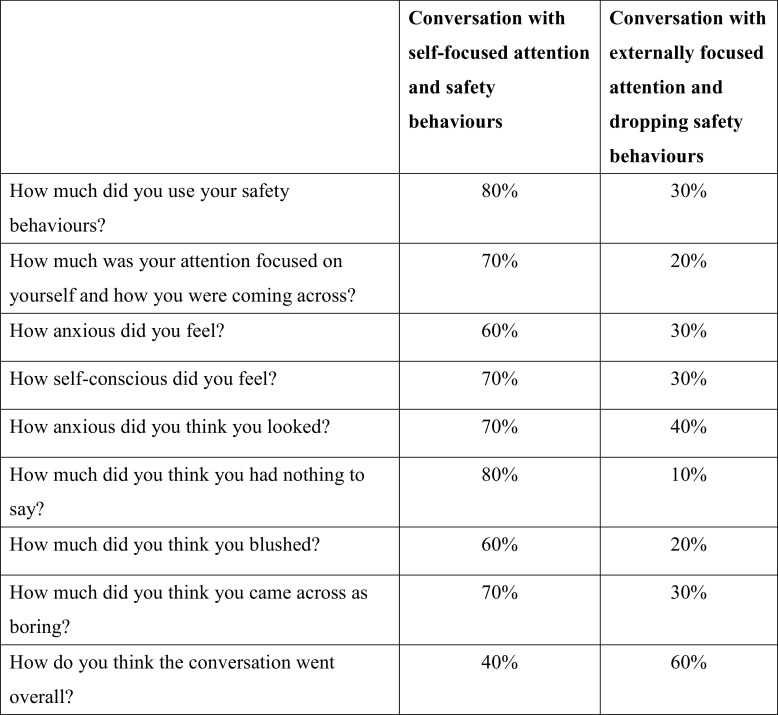
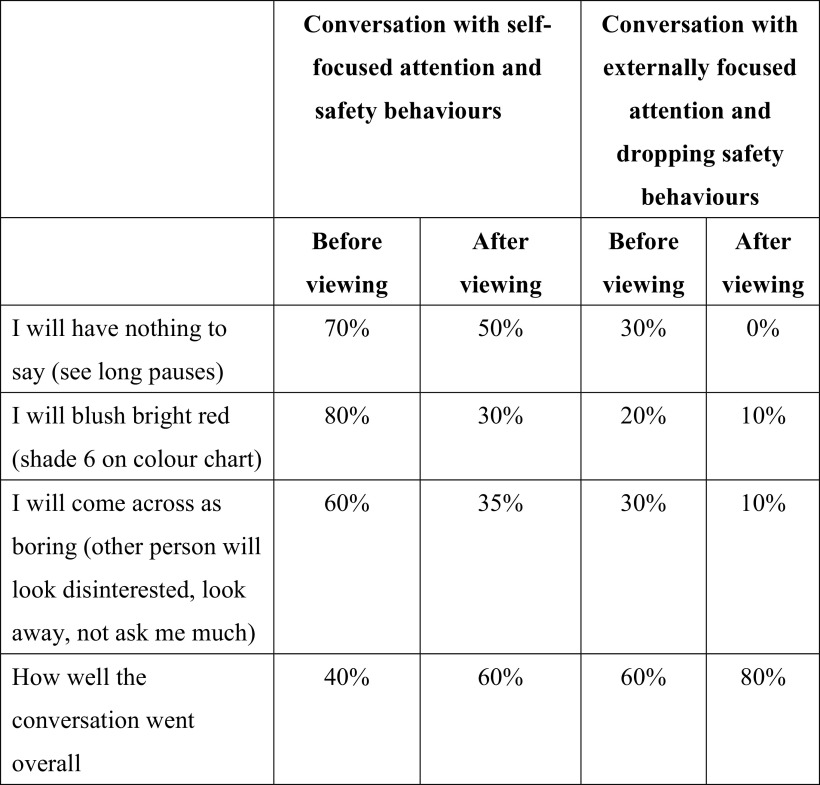
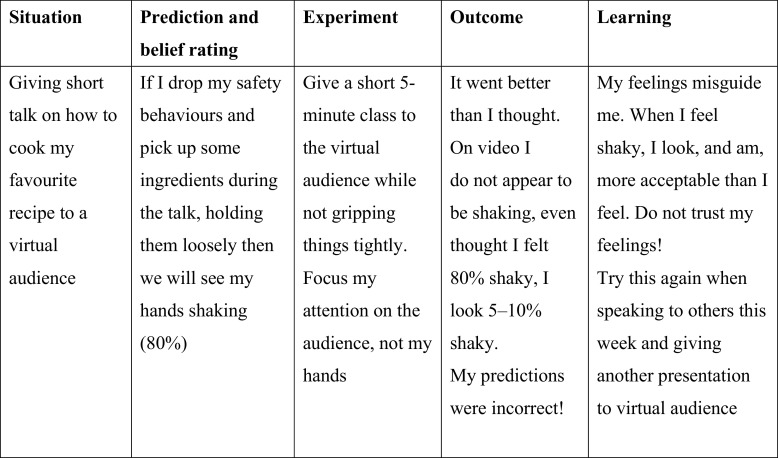
Verification
Claims the paper makes
The claims and statistics of this paper haven’t been checked yet.
Free: it reads the open-access text and checks the first 5 claims that cite a source we can check. Create a free account to check every claim.
Self-check
Percentages, sums and reported differences re-computed from the paper’s own numbers.
The self-check needs the paper’s full text.
Citations
Cites
A cognitive model of social phobia
Adrian Wells, A. (1995) · Research Explorer (The University of Manchester) · Cited by 2,701
Psychosomatic medicine in Germany: more timely than ever
Zipfel, S., Herzog, W., Kruse, J., & Henningsen, P. (2016) · Psychotherapy and Psychosomatics · doi:10.1159/000447701 · Cited by 2,323
Liebowitz, M. R. (2015) · Modern Trends in Pharmacopsychiatry · doi:10.1159/000414022 · Cited by 2,266 · cited 1×
“Symptom measures Liebowitz Social Anxiety Scale (Liebowitz, 1987) Outcome measure of severity of social anxiety with a comprehensive assessment of feared situations Each session”
BackgroundPsychometric properties of the Social Phobia Inventory (SPIN): New self-rating scale
Connor, K. M., Davidson, J. R. T., Churchill, L. E., Sherwood, A., Weisler, R. H., & Foa, E. (2000) · British Journal of Psychiatry · doi:10.1192/bjp.176.4.379 · Cited by 1,624 · cited 1×
“Social Phobia Inventory (Connor et al., 2000) Outcome measure of severity of social anxiety Each session”
Social phobia: Diagnosis, assessment, and treatment
Franklin, M. E. (1996) · Clinical Psychology Review · doi:10.1016/s0272-7358(96)00036-0 · Cited by 1,389
Clark, D. M., Ehlers, A., Hackmann, A., McManus, F., Fennell, M., Grey, N., Waddington, L., & Wild, J. (2006) · Journal of Consulting and Clinical Psychology · doi:10.1037/0022-006x.74.3.568 · Cited by 603 · cited 2×
“This recommendation is based on a series of clinical trials conducted in the UK, Sweden, Norway, Germany and Japan, which have shown that CT-SAD is superior to a wide range of other interventions including exposure therapy (Clark et al., 2006), group cognitive behaviour therapy (Ingul et al.”
BackgroundMethodSelf-citationClark, D. M., Ehlers, A., McManus, F., Hackmann, A., Fennell, M., Campbell, H., Flower, T., Davenport, C., & Louis, B. (2003) · Journal of Consulting and Clinical Psychology · doi:10.1037/0022-006x.71.6.1058 · Cited by 561 · cited 5×
“, 2016), pill placebo (Clark et al., 2003) and psychological placebo (Ingul et al.”
BackgroundMethodInfluentialSelf-citationRecurrent images and early memories in social phobia
Hackmann, A., Clark, D. M., & McManus, F. (2000) · Behaviour Research and Therapy · doi:10.1016/s0005-7967(99)00161-8 · Cited by 489 · cited 1×
“For example, being ridiculed for blushing when reading aloud in class, linking to a current self-image of looking bright red or repeated school bullying, linking to a negative impression of the self as ‘inferior and vulnerable’ in the present day (Hackmann et al., 2000).”
BackgroundSelf-citationSchema change processes in cognitive therapy
Padesky, C. A. (1994) · Clinical Psychology & Psychotherapy · doi:10.1002/cpp.5640010502 · Cited by 403 · cited 2×
“Patients may also keep a positive data log (Padesky, 1994) alongside their treatment, recording any evidence, however small, which fits with an alternative self-belief they would like to develop (e.g.”
Cognitive therapy for social phobia: individual versus group treatment
Stangier, U., Heidenreich, T., Peitz, M., Lauterbach, W., & Clark, D. M. (2003) · Behaviour Research and Therapy · doi:10.1016/s0005-7967(02)00176-6 · Cited by 326 · cited 2×
“, 2006), group cognitive behaviour therapy (Ingul et al., 2014; Mörtberg et al., 2007; Stangier et al., 2003) interpersonal psychotherapy (Stangier et al.”
BackgroundSelf-citation
Research works printed but not linked: 4
- Clark, D. M. (2005). Three questionnaires for measuring central constructs in the cognitive model of social phobia: preliminary analysis. Available from Professor David Clark, Department of Psychiatry, University of Oxford.
- Warnock-Parkes, E. L., Wild, J., Stott, R., Grey, N., Ehlers, A., & Clark, D. M. (2017). Seeing is believing: using video feedback in cognitive therapy for social anxiety disorder. Cognitive and Behavioural Practice, 24, 245– 255. PMC5627505 29033532 · DOI · Paper page
- National Institute for Health and Care Excellence. (2013). Social Anxiety Disorder: Recognition, Assessment and Treatment of Social Anxiety Disorder Clinical Guideline 159. Available at: https://www.nice.org.uk/guidance/cg159/resources/social-anxiety-disorder-recognition-assessment-and-treatment-pdf-35109639699397 31869048
- Wild, J., & Clark, D. M. (2011). Imagery rescripting of early traumatic memories in social phobia. Cognitive Behavioural Practice, 18, 433– 443. PMC3267018 22298942 · DOI · Paper page
Cited by
Telemental Health Use in the COVID-19 Pandemic: A Scoping Review and Evidence Gap Mapping
Abraham, A., Jithesh, A., Doraiswamy, S., Al-Khawaga, N., Mamtani, R., & Cheema, S. (2021) · Frontiers in Psychiatry · doi:10.3389/fpsyt.2021.748069 · Cited by 148
Effects of mask-wearing on social anxiety: an exploratory review
Saint, S. A., & Moscovitch, D. A. (2021) · Anxiety, Stress, & Coping · doi:10.1080/10615806.2021.1929936 · Cited by 54
“…clinicians should encourage clients with SAD to work hard to confront their fears by adopting creative methods of exposure via video-chat platforms and in-person social interactions that can be conducted safely and in compliance with COVID-related restrictions (see Warnock-Parkes et al., 2020).”
BackgroundOliveira, C., Pacheco, M., Borges, J., Meira, L., & Santos, A. (2023) · Internet Interventions · doi:10.1016/j.invent.2023.100609 · Cited by 42
Fear and Anxiety in COVID-19: Preexisting Anxiety Disorders
Shafran, R., Rachman, S., Whittal, M., Radomsky, A., & Coughtrey, A. (2021) · Cognitive and Behavioral Practice · doi:10.1016/j.cbpra.2021.03.003 · Cited by 33
Thew, G. R., Kwok, A. P. L., Lissillour Chan, M. H., Powell, C. L. Y. M., Wild, J., Leung, P. W. L., & Clark, D. M. (2022) · Internet Interventions · doi:10.1016/j.invent.2022.100539 · Cited by 28
“It aims to replicate the content and procedures of the face-to-face cognitive therapy (CT-SAD) protocol (see Clark et al., 2006; Warnock-Parkes et al., 2020), which in the UK is a primary treatment recommendation for adults with SAD (NICE, 2013).”
BackgroundSelf-citationAdvances in digital CBT: where are we now, and where next?
Thew, G. R., Rozental, A., & Hadjistavropoulos, H. D. (2022) · The Cognitive Behaviour Therapist · doi:10.1017/s1754470x22000423 · Cited by 33
“Although some guidance on adapting CBT procedures for remote sessions is available (e.g. Cromarty et al., 2020; Jassi et al., 2020; Murphy et al., 2020; Warnock-Parkes et al., 2020; Wild et al., 2020), there remain gaps, and further work to document and evaluate best practice would be beneficial, including disorder-sp…”
Self-citationDelivering Imagery Rescripting via Telehealth: Clinical Concerns, Benefits, and Recommendations
Paulik, G., Maloney, G. K., Arntz, A. R., Bachrach, N., Koppeschaar, A. M., & McEvoy, P. M. (2021) · Current Psychiatry Reports · doi:10.1007/s11920-021-01238-8 · Cited by 28
Warnock‐Parkes, E., Wild, J., Thew, G. R., Kerr, A., Grey, N., & Clark, D. M. (2022) · The Cognitive Behaviour Therapist · doi:10.1017/s1754470x22000496 · Cited by 22
Self-citationYoshinaga, N., Thew, G. R., Kobori, O., Hayashi, Y., & Clark, D. M. (2021) · Journal of Behavioral and Cognitive Therapy · doi:10.1016/j.jbct.2021.05.004 · Cited by 14
Self-citationImpact of social anxiety on communication skills in face-to-face vs. online contexts
Lacombe, C., Elalouf, K., & Collin, C. A. (2024) · Computers in Human Behavior Reports · doi:10.1016/j.chbr.2024.100458 · Cited by 21
Ganho-Ávila, A., Vieira Figueiredo, D., & Vagos, P. (2022) · Clinical Case Studies · doi:10.1177/15346501221091519 · Cited by 9
Wild, J., Warnock‐Parkes, E., Stott, R. B., Kwok, A. P., Chan, M. H. L., Powell, C. L. Y. M., Leung, P. W. L., Clark, D. M., & Thew, G. R. (2023) · Journal of Affective Disorders · doi:10.1016/j.jad.2023.03.017 · Cited by 10
Self-citationPankey, T. L., Heredia, D., Vencill, J. A., & González, C. A. (2021) · Journal of Health Service Psychology · doi:10.1007/s42843-021-00048-z · Cited by 8
Blending digital therapeutics within the healthcare system
Keller, O. C., Budney, A. J., Struble, C. A., & Teepe, G. W. (2022) · Elsevier eBooks · doi:10.1016/b978-0-323-90045-4.00016-2 · Cited by 14
Ebrahimjee, A., Hodsoll, J. P., Valmaggia, L., Hickling, L. M., & Riches, S. (2024) · The Cognitive Behaviour Therapist · doi:10.1017/s1754470x2400028x · Cited by 10
Yoshinaga, N., Thew, G. R., Hayashi, Y., Matsuoka, J., Tanoue, H., Takanashi, R., Araki, M., Kanai, Y., Smith, A., Grant, S. H. L., et al. (2023) · JMIR Formative Research · doi:10.2196/45136 · Cited by 6
“It is notable that this is not something that they were able to express directly to their therapist and reflects a broader challenge in treating SAD as clients may view the therapist as a phobic object [63] and therefore use safety behaviors such as avoiding sharing their opinions.”
BackgroundSelf-citationDowling, D., Martland, N., King, S., Nguyen, J., Neely, E., Ball, J., Grant, N., Dom, G., & McNulty, N. (2022) · The Cognitive Behaviour Therapist · doi:10.1017/s1754470x22000125 · Cited by 13
“Clients with social anxiety, for example, may find it uncomfortable to see themselves on screen in the videoconferencing session (Warnock-Parkes et al., 2020).”
BackgroundBouwman, V., Mobach, L., Teachman, B. A., & Salemink, E. (2025) · Behaviour Research and Therapy · doi:10.1016/j.brat.2025.104685 · Cited by 6
Multiple group memberships protect against anticipatory anxiety for social situations
Donaldson, J. L., Cruwys, T., Dawel, A., & Chen, J. (2023) · Journal of Community & Applied Social Psychology · doi:10.1002/casp.2713 · Cited by 4
Demystifying resistance: factors influencing users’ reluctance to share images on social media
Mir, U. B., & Shardeo, V. (2024) · Aslib Journal of Information Management · doi:10.1108/ajim-06-2024-0497 · Cited by 4
Gadelha, M. J. N., da Silva, L. R. M., de Oliveira, A. P., Cavalcante, N. A., de Araújo, V. S., Lopes, R. D. C. T., & da Silva, N. G. (2021) · Revista Brasileira de Terapias Cognitivas · doi:10.5935/1808-5687.20210014 · Cited by 3
“…this necessary adaptation also predicts positive impacts in the post-pandemic period, such as the popularization of online psychological treatments and the facilitation of their access by populations previously unreached (Raony et al., 2020; Warnock-Parkes et al., 2020; Simpson et al., 2020).”
BackgroundMethodIntervenções on-line em saúde mental em tempos de COVID-19: Revisão sistemática
Secchi, Á., Dullius, W. R., Garcez, L., & Scortegagna, S. A. (2021) · Revista Brasileira de Psicoterapia · doi:10.5935/2318-0404.20210013 · Cited by 10
Vagos, P., Figueiredo, D. V., Ganho-Ávila, A., Mayr, A. J., & Rijo, D. (2023) · Frontiers in Psychology · doi:10.3389/fpsyg.2022.915677 · Cited by 6
“Given that, to our knowledge, the CT@TeenSAD intervention is the first to rely on video conferencing for adolescent SAD for the complete implementation of the intervention, current findings also add evidence to the previous assumption of the applicability and utility of remote CT (Warnock-Parkes et al., 2020), so long…”
BackgroundMethodTerapi kognitif untuk menurunkan kecemasan mendapat penilaian negatif pada individu dewasa
Rahma, F. T. (2022) · Procedia Studi Kasus dan Intervensi Psikologi · doi:10.22219/procedia.v10i3.19273 · Cited by 9
Schittenhelm, J. M., von Rechenberg, R., Schäfer, L., Weber, L., Schüller, J. S., Stangier, U., & Hoyer, J. (2026) · Behaviour Research and Therapy · doi:10.1016/j.brat.2026.104983 · Cited by 3
Intervenções para ansiedade que podem ser utilizadas por enfermeiros: revisão de escopo
Pereira, C. F., de Vargas, D., Santana, K. D. O., de Araújo, M. P. B., Ueda, N. M., Evangelista, P. A., & Nunes, S. R. (2023) · Acta Paulista de Enfermagem · doi:10.37689/acta-ape/2023ar008232 · Cited by 8
“(39) Esse apoio pode ser realizado de diversas formas, como através de: disseminação de informações verdadeiras acerca da pandemia, apoio econômico, grupos de apoio e apoio emocional.”
Warnock‐Parkes, E., Thew, G. R., Murray, H., Grey, N., Wild, J., Kerr, A., Smith, A., Stott, R. B., Ehlers, A., & Clark, D. M. (2025) · Cognitive Behaviour Therapy · doi:10.1080/16506073.2025.2518427 · Cited by 5
“For examples of behavioural experiments that can be done remotely for SAD and PTSD see Warnock-Parkes et al. (2020) and Wild et al. (2020).”
Self-citationLe terapie on-line: opportunità o ripiego?
Paoli, B., & Procacci, M. (2021) · QUADERNI DI PSICOTERAPIA COGNITIVA · doi:10.3280/qpc47-2020oa11204 · Cited by 3
Personalidade, Ansiedade Social e Adaptação às Medidas de Distanciamento Durante a Pandemia
Vasconcellos, S. J. L., Santanna, R. V., Lucchese, V. C., Schneider, J. T., Ferreira, S. M., & Neco, X. S. (2022) · Psico-USF · doi:10.1590/1413-82712022270414 · Cited by 4
Schmalbach, I., & Petrowski, K. (2025) · BMC Psychology · doi:10.1186/s40359-025-03013-3 · Cited by 2
“Taking into account the characteristics of SAD and its treatment barriers, ICBT integration into participants’ daily routines emerges as a viable and useful treatment modality [59, 61].”
Akkaya, N., & Artan, T. (2025) · Toplum ve sosyal hizmet(Online)/Toplum ve sosyal hizmet · doi:10.33417/tsh.1610165 · Cited by 2
Development and Validation of the Bullied Cognitions Inventory (BCI)
Graham, B., & Ehlers, A. (2023) · Cognitive Therapy and Research · doi:10.1007/s10608-023-10412-6 · Cited by 2
“Changes in these beliefs have been shown to mediate symptom change in both conditions (SAD: Thew et al., 2020; PTSD: Kleim et al., 2013) and frequent assessment of cognitions to guide treatment and monitor progress in cognitive therapy is recommended (Warnock-Parkes et al., 2020; Wild et al., 2020).”
BackgroundSelf-citationThwaites, R., & Naz, S. (2021) · The Cognitive Behaviour Therapist · doi:10.1017/s1754470x21000076
Social anxiety disorder and COVID-19: Treatment with cognitive behavioral therapy
Samantaray, N. N., & Dolly, S. K. (2024) · Elsevier eBooks · doi:10.1016/b978-0-323-95650-5.00040-9
Modul 3: Aufmerksamkeit und Wahrnehmung
Ritter, V., & Stangier, U. (2024) · Psychotherapie: Praxis · doi:10.1007/978-3-662-68379-8_11
Gao, W., Hu, Q., & Xu, Y. (2025) · Behaviour Research and Therapy · doi:10.1016/j.brat.2025.104734
(2025) · Elsevier eBooks · doi:10.1016/b978-3-437-21835-4.00116-5
Bechlem, B., & Gullon-Scott, F. (2025) · The Cognitive Behaviour Therapist · doi:10.1017/s1754470x25100147 · Cited by 1
Investigating the role of mood induction on emotional facial recognition in social anxiety
Lacombe, C., Dubé, K., & Collin, C. A. (2025) · PLoS ONE · doi:10.1371/journal.pone.0332748
“This cycle maintains the disorder over time as it reinforces erroneous beliefs, thoughts (e.g., “I will be rejected”) and behaviours like hypervigilance and excessive monitoring for threat cues [2,20,21].”
Hung, Y.-F. (2026) · Current Psychology · doi:10.1007/s12144-026-09065-x
“These positive experiences led to greater engagement in counseling (Warnock-Parkes et al., 2020 ; Winter et al., 2023).”
Internet Interventions for Social Anxiety Among College Students
Oliveira, C. P. L., Pacheco, M., Meira, L., & Santos, A. (2026) · Springer eBooks · doi:10.1007/978-3-032-08980-9_13
Chen, W., Chen, R., Chen, S., Gong, H., GUO, M. M. S., Xu, Y., Wu, X., & Fu, X. (2026) · ACM/IEEE International Conference on Human-Robot Interaction (HRI) · doi:10.1145/3757279.3788663
“Conversely, digitally mediated delivery can function as a psychological buffer via increasing perceived distance, lowering social pressure, and enabling more comfortable engagement [92, 114, 136].”
Tan, T. C. X., & Ng, J. H. (2026) · International Journal of Education Psychology and Counseling · doi:10.35631/ijepc.1162085
Li, Y., Zhang, Z., He, L.-P., Zhou, X.-Q., Yu, B., Huang, X.-M., Yang, D., Xia, D., & Wang, D. (2026) · Frontiers in Psychiatry · doi:10.3389/fpsyt.2026.1883150
“Cognitive therapy (CT), a speci fi c type of CBT developed by Clark and Wells in 1995, is tailored for SAD (72).”
Examining Anxiety as an Additional Antecedent to Trust and Commitment in Financial Planning
Rollins-Koons, A., Machiz, I., McCoy, M. A., Wu, J., & White, K. (2026) · Financial Planning Research Journal · doi:10.2478/fprj-2026-0013
“This phenomenon has been found in social anxiety where clients who experience anxiety may be less likely to attend therapy (Warnock-Parkes et al.2020).”
Metadata
- Authors
- Warnock-Parkes, E., Wild, J., Thew, G. R., Kerr, A., Grey, N., Stott, R., Ehlers, A., & Clark, D. M.
- Affiliations
- Oxford Health NHS Foundation Trust (GB)
- King's College London (GB)
- University of Sussex (GB)
- Venue
- The Cognitive Behaviour Therapist
- Publisher
- Cambridge University Press (CUP)
- Published
- 2020
- Volume
- 13
- Pages
- e30-e30
- ISSN
- 1754-470X (ISSN-L)
- PMC
- PMC7411446
- OpenAlex
- W3042888910
- Semantic Scholar
- 27a77839c5e377d1129fea640baaa0f5cc0925a6
- Cited by
- 45
- References
- 21
- Citations by year
- 2026: 7 · 2025: 8 · 2024: 5 · 2023: 7 · 2022: 8 · 2021: 10
- FWCI
- 6.05
- Type
- journal article
- Language
- en
- Open access
- hybrid
- doi.org
- Locations
- The Cognitive Behaviour Therapist (publishedVersion, cc-by)
- PubMed Central (publishedVersion, cc-by)
- PubMed (publishedVersion)
- Research Portal (King's College London) (submittedVersion, other-oa)
- Funders
- Wellcome Trust (200796/Z/16/Z, 200796)
- National Institute for Health and Care Research (NF-SI-0617-10052)
- Topics
- Social Sciences › Psychology › Experimental and Cognitive Psychology › Anxiety, Depression, Psychometrics, Treatment, Cognitive Processes
- Social Sciences › Psychology › Applied Psychology › Digital Mental Health Interventions
- Health Sciences › Medicine › Public Health, Environmental and Occupational Health › Telemedicine and Telehealth Implementation
- Keywords
- social anxiety disorder, cognitive therapy, remote therapy, videoconferencing, behavioural experiments, video feedback, attention training, COVID-19 pandemic, treatment delivery
About these checks
Registry, retraction, Cites and statistics results are computed, not judged, with one exception: a printed reference that no index lists is read once by a model before it counts as a citation error. Claims are extracted by a model and kept only when their quote appears verbatim in the text; each cited source is then checked, with a model’s help, for whether it says what the claim relies on. Those verdicts can be wrong — read the claim’s quote and the cited source before relying on one.
Statistics and arithmetic are recomputed, not judged.
Confidence bands are shown only for fields calibrated on our annotated test set. None is calibrated yet, so no band is shown.
What counts as a claim ›How we measure confidence ›How we check this ›
Are you an author, or do you see a problem with this page? Request a review
Data sources
Bibliographic data: Semantic Scholar, OpenAlex, Crossref.
Contains information from the Semantic Scholar Academic Graph Datasets, made available under the ODC Attribution License (ODC-BY 1.0).
Semantic Scholar’s data is described in: Kinney, R., et al. (2023). The Semantic Scholar Open Data Platform. arXiv:2301.10140.
