

Rising incidence of psychiatric disorders before diagnosis of immune-mediated inflammatory disease
Open accessThe DOI matches its Crossref record, with a small difference in title or year; 41 of the 41 references it cites were found in a registry or an index; none of the 19 sources its claims cite is checked for support yet.
Abstract
AIMS: After the diagnosis of immune-mediated inflammatory diseases (IMID) such as inflammatory bowel disease (IBD), multiple sclerosis (MS) and rheumatoid arthritis (RA), the incidence of psychiatric comorbidity is increased relative to the general population. We aimed to determine whether the incidence of psychiatric disorders is increased in the 5 years before the diagnosis of IMID as compared with the general population. METHODS: Using population-based administrative health data from the Canadian province of Manitoba, we identified all persons with incident IBD, MS and RA between 1989 and 2012, and cohorts from the general population matched 5 : 1 on year of birth, sex and region to each disease cohort. We identified members of these groups with at least 5 years of residency before and after the IMID diagnosis date. We applied validated algorithms for depression, anxiety disorders, bipolar disorder, schizophrenia, and any psychiatric disorder to determine the annual incidence of these conditions in the 5-year periods before and after the diagnosis year. RESULTS: We identified 12 141 incident cases of IMID (3766 IBD, 2190 MS, 6350 RA) and 65 424 matched individuals. As early as 5 years before diagnosis, the incidence of depression [incidence rate ratio (IRR) 1.54; 95% CI 1.30-1.84) and anxiety disorders (IRR 1.30; 95% CI 1.12-1.51) were elevated in the IMID cohort as compared with the matched cohort. Similar results were obtained for each of the IBD, MS and RA cohorts. The incidence of bipolar disorder was elevated beginning 3 years before IMID diagnosis (IRR 1.63; 95% CI 1.10-2.40). CONCLUSION: The incidence of psychiatric comorbidity is elevated in the IMID population as compared with a matched population as early as 5 years before diagnosis. Future studies should elucidate whether this reflects shared risk factors for psychiatric disorders and IMID, a shared final common inflammatory pathway or other aetiology.
Overview
CoChat Summary
TL;DR
In a Manitoba population-based retrospective cohort study, psychiatric disorder incidence was higher in people who later developed IBD, MS, or RA than in matched general-population controls, beginning as early as 5 years before IMID diagnosis. The pre-diagnosis signal was clearest for depression and anxiety, with bipolar disorder elevated starting 3 years before diagnosis.
Key findings
- The study identified 12,141 incident IMID cases (3,766 IBD; 2,190 MS; 6,350 RA) and 65,424 matched individuals.
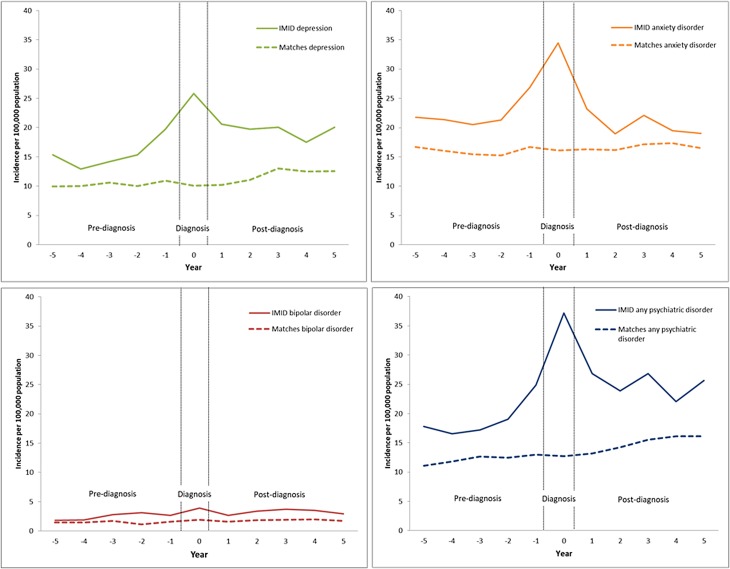
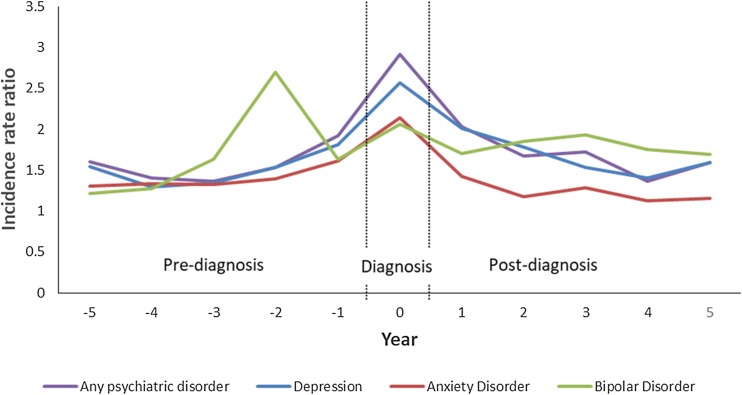
- In the combined IMID cohort, the age- and sex-standardized incidence of any psychiatric disorder was higher than in matched controls as early as 5 years before diagnosis (IRR 1.60; 95% CI 1.36–1.89), and was highest in the diagnosis year.
- Also in the combined IMID cohort, depression was elevated 5 years before diagnosis (IRR 1.54; 95% CI 1.30–1.84) and anxiety disorders were elevated 5 years before diagnosis (IRR 1.30; 95% CI 1.12–1.51).
- Bipolar disorder was elevated beginning 3 years before IMID diagnosis (IRR 1.63; 95% CI 1.10–2.40); findings were generally similar across the IBD, MS, and RA subcohorts, while schizophrenia could not be modeled because of small cell sizes.
Methods
- Retrospective, population-based cohort study using linked administrative health data from Manitoba, Canada.
- Included incident IBD, MS, and RA cases from 1989–2012 (with validated case definitions) and 5:1 matched general-population controls matched on year of birth, sex, and region; analyses were limited to those with at least 5 years of residency before and after the IMID diagnosis date.
- Estimated annual incidence of depression, anxiety disorder, bipolar disorder, schizophrenia, and any psychiatric disorder in the 5-year pre-diagnosis, diagnosis-year, and 5-year post-diagnosis periods, using age- and sex-standardized incidence rates, incidence rate ratios, and multivariable negative binomial regression adjusted for pre-specified covariates.
Limitations
- The paper states the study was limited to a single Canadian province, which may reduce generalisability.
- The authors note administrative data capture only health-system contacts and therefore miss psychiatric disorders diagnosed by non-physician mental health providers or untreated cases; this limitation applies to both IMID and non-IMID groups.
- The paper states that administrative data lacked clinical detail, so the study could not assess associations with IMID severity or determine whether pre-diagnosis psychiatric disorders were prodromal IMID symptoms, shared comorbidity, or a causal risk factor.
Model-written summary. Check it against the paper before relying on it.
Integrity signals
Registry
Cites
Statistics
Figures
Verification
Claims the paper makes
0 Valid · 0 Not valid · 10 Not checked · 34 Own results and interpretations
A result the paper reports from its own data — it cites no other source for it, so there is none to check. The quote shows it is in the paper.
In the paper
“In the analyses of each IMID cohorts (IBD, MS and RA), the findings were generally consistent in magnitude and direction with those of the combined IMID cohort (Supplementary Table S2 and Figs S1–S3).”
§ Rising incidence of psychiatric disorders before diagnosis of immune-mediated inflammatory disease > Results > Incidence of psychiatric disorders in the individual IMID cohorts
hedged- Asserted: passes — The authors put it forward as true.
- Checkable: passes — It can be checked against evidence.
- Load-bearing: unclear — It is unclear whether the paper’s conclusions depend on it.
- Based: passes — The paper gives a reason why it holds.
A result the paper reports from its own data — it cites no other source for it, so there is none to check. The quote shows it is in the paper.
In the paper
“In the diagnosis year, the age- and sex-standardised incidence of any psychiatric disorder, depression and anxiety disorder was higher in each IMID cohort as compared with its matched cohort (Table 2).”
§ Rising incidence of psychiatric disorders before diagnosis of immune-mediated inflammatory disease > Results > Incidence of psychiatric disorders in the individual IMID cohorts
plainstates an association- Asserted: passes — The authors put it forward as true.
- Checkable: passes — It can be checked against evidence.
- Load-bearing: passes — The paper’s conclusions depend on it.
- Based: passes — The paper gives a reason why it holds.
A result the paper reports from its own data — it cites no other source for it, so there is none to check. The quote shows it is in the paper.
In the paper
“The age- and sex-standardised incidence of any psychiatric disorder among the IMID cohort was higher than the matched cohort during all periods, beginning as early as 5 years before IMID diagnosis (IRR 1.60; 95% CI 1.36–1.89), and most prominently in the diagnosis year”
- Also stated in: § Conclusion. · plain
“The incidence of psychiatric comorbidity is elevated in the IMID population as compared with a matched population as early as 5 years before diagnosis.”
- Also stated in: § Discussion · plain
“As compared with age-, sex- and geographically matched cohorts, the incidence of psychiatric comorbidity was increased in the IMID cohorts in the 5–10 years before IMID diagnosis.”
§ Rising incidence of psychiatric disorders before diagnosis of immune-mediated inflammatory disease > Results > Incidence of psychiatric disorders in the combined IMID cohort
plainstates an association- Asserted: passes — The authors put it forward as true.
- Checkable: passes — It can be checked against evidence.
- Load-bearing: passes — The paper’s conclusions depend on it.
- Based: passes — The paper gives a reason why it holds.
- Also stated in: § Conclusion. · plain
A result the paper reports from its own data — it cites no other source for it, so there is none to check. The quote shows it is in the paper.
In the paper
“In the diagnosis year, the age- and sex-standardised incidence of any psychiatric disorder, depression and anxiety disorder was higher in each IMID cohort as compared with its matched cohort (Table 2).”
§ Rising incidence of psychiatric disorders before diagnosis of immune-mediated inflammatory disease > Results > Incidence of psychiatric disorders in the individual IMID cohorts
plainstates an association- Asserted: passes — The authors put it forward as true.
- Checkable: passes — It can be checked against evidence.
- Load-bearing: passes — The paper’s conclusions depend on it.
- Based: passes — The paper gives a reason why it holds.
A result the paper reports from its own data — it cites no other source for it, so there is none to check. The quote shows it is in the paper.
In the paper
“The incidence of bipolar disorder was elevated beginning 3 years before IMID diagnosis (IRR 1.63; 95% CI 1.10–2.40).”
- Also stated in: § Incidence of psychiatric disorders in the combined IMID cohort · plain
“For bipolar disorder, we observed a similar pattern of findings, including an increased incidence in the IMID cohort relative to the matched cohort emerging 3 years before IMID diagnosis (IRR 1.63; 95% CI 1.10–2.40) (Fig. 1, Table 2).”
§ Rising incidence of psychiatric disorders before diagnosis of immune-mediated inflammatory disease > Abstract > Results.
plainstates an association- Asserted: passes — The authors put it forward as true.
- Checkable: passes — It can be checked against evidence.
- Load-bearing: passes — The paper’s conclusions depend on it.
- Based: passes — The paper gives a reason why it holds.
- Also stated in: § Incidence of psychiatric disorders in the combined IMID cohort · plain
14 more claims
Create a free account to see all 44 claims and to verify the 19 references still open.
- It may state two separate claims as one. 16
- Probably not a substantial claim. 11
Claims other papers make about this one
Each is checked against this paper’s own text: does it say what the citing paper says it does?
The cited source says what the claim attributes to it.
In the citing paper
“Interestingly, higher rates of mental disorders relative to matched controls have been found to pre-date an IBD diagnosis by up to five years, suggesting bidirectional vulnerability (16).”
From The 2023 Impact of Inflammatory Bowel Disease in Canada: Mental Health and Inflammatory Bowel Disease (2023) · cites this paper as [16]
Citations
Cites
So depression is an inflammatory disease, but where does the inflammation come from?
Berk, M., Williams, L. J., Jacka, F. N., O’Neil, A., Pasco, J. A., Moylan, S., Allen, N. B., Stuart, A. L., Hayley, A. C., Byrne, M. L., et al. (2013) · BMC Medicine · doi:10.1186/1741-7015-11-200 · Cited by 1,423 · cited 1×
“Emerging evidence suggests that the risk of depression, anxiety disorders and bipolar disorder is influenced by the inflammation and activation of cell-mediated immunity (Vieira et al. 2010; Berk et al. 2013; Rosenblat & McIntyre, 2015).”
BackgroundChronic stress, glucocorticoid receptor resistance, inflammation, and disease risk
Cohen, S., Janicki-Deverts, D., Doyle, W. J., Miller, G. E., Frank, E., Rabin, B. S., & Turner, R. B. (2012) · Proceedings of the National Academy of Sciences · doi:10.1073/pnas.1118355109 · Cited by 1,419 · cited 1×
“As well, environmental factors such as social adversity and chronic stress may induce biological changes which subsequently increase the risk of one or more chronic diseases (Cohen et al. 2012).”
BackgroundStetler, C., & Miller, G. E. (2011) · Psychosomatic Medicine · doi:10.1097/psy.0b013e31820ad12b · Cited by 1,123 · cited 1×
“Depression is known to induce changes in immune function, including immunosuppression and inflammation (Nair et al. 1999; Yeragani et al. 2000; Irwin & Miller, 2007), as well as hyperactivity of the hypothalamic pituitary axis (Stetler & Miller, 2011).”
BackgroundThe prevalence of depression in rheumatoid arthritis: a systematic review and meta-analysis
Matcham, F., Rayner, L., Steer, S., & Hotopf, M. (2013) · Rheumatology · doi:10.1093/rheumatology/ket169 · Cited by 928
Alamanos, Y., Voulgari, P. V., & Drosos, A. A. (2006) · Seminars in Arthritis and Rheumatism · doi:10.1016/j.semarthrit.2006.08.006 · Cited by 782 · cited 2×
“…inflammatory bowel disease (IBD), multiple sclerosis (MS) and rheumatoid arthritis (RA) share several epidemiologic and clinical features (Pugliatti et al. 2002; Health Canada, 2003; Alamanos et al. 2006; Canadian Institute for Health Information, 2007; Logan & Bowlus, 2010; Bernstein et al. 2012).”
BackgroundNeuroinflammation and psychiatric illness
Najjar, S., Pearlman, D. M., Alper, K., Najjar, A., & Devinsky, O. (2013) · Journal of Neuroinflammation · doi:10.1186/1742-2094-10-43 · Cited by 733
Depressive disorders and immunity: 20 years of progress and discovery
Irwin, M. R., & Miller, A. H. (2007) · Brain, Behavior, and Immunity · doi:10.1016/j.bbi.2007.01.010 · Cited by 676 · cited 1×
“Depression is known to induce changes in immune function, including immunosuppression and inflammation (Nair et al. 1999; Yeragani et al. 2000; Irwin & Miller, 2007), as well as hyperactivity of the hypothalamic pituitary axis (Stetler & Miller, 2011).”
BackgroundBernstein, C. N., Blanchard, J. F., Rawsthorne, P., & Wajda, A. (1999) · American Journal of Epidemiology · doi:10.1093/oxfordjournals.aje.a009735 · Cited by 667 · cited 2×
“First, we applied validated case definitions (Bernstein et al. 1999; Marrie et al. 2010; Hitchon et al. 2014) to the administrative dataset to identify all Manitobans aged 18 years and older with IBD, MS and RA from 1984 to 2013 (Supplementary Table S1).”
MethodSelf-citationReview: Inequalities in healthcare provision for people with severe mental illness
Lawrence, D., & Kisely, S. (2010) · Journal of Psychopharmacology · doi:10.1177/1359786810382058 · Cited by 649 · cited 1×
“In addition, psychiatric disorders are associated with adverse health behaviours, while serious psychiatric disorders are associated with inequalities in health care provision that may lead to other health conditions (Lawrence & Kisely, 2010).”
BackgroundMitchell, A. J., Benito-León, J., González, J.-M. M., & Rivera-Navarro, J. (2005) · The Lancet Neurology · doi:10.1016/s1474-4422(05)70166-6 · Cited by 519 · cited 2×
“This psychiatric comorbidity negatively affects outcomes; depression is associated with lower health-related quality of life in IBD, MS and RA (Rupp et al. 2004; Mitchell et al. 2005; Faust et al. 2012; Mok et al. 2012), and with increased mortality in MS and RA (Ang et al.”
Background
Research works printed but not linked: 4
- Canadian Institute for Health Information (2007). The Burden of Neurological Diseases, Disorders and Injuries in Canada. Ottawa.
- Hitchon CA, Khan S, Elias B, El-Gabalawy HS, Katz A, Peschken CA (2014). First Nations persons have an increased risk of developing rheumatoid arthritis with an early onset age but are seen less frequently by rheumatologists: a population based study In ACR/ARHP Annual Meeting. American College of Rheumatology: Boston, MA.
- Health Canada (2003). Arthritis in Canada: An Ongoing Challenge. Health Canada: Ottawa.
- WHO Collaborating Centre for Drug Statistics Methodology (2012). Guidelines for ATC Classification and DDD Assignment 2013. Oslo.
Cited by
Items 101–145 of 145
Yusuf, F. L. A., Karim, M. E., Sutherland, J. M., Zhu, F., Zhao, Y., Marrie, R. A., & Tremlett, H. L. (2025) · Multiple Sclerosis and Related Disorders · doi:10.1016/j.msard.2025.106595 · Cited by 4
Self-citationMarrie, R. A., Maxwell, C. J., Everett, K., Zhu, F., Li, P., McKay, K. A., Zhao, Y., & Tremlett, H. L. (2025) · Multiple Sclerosis Journal · doi:10.1177/13524585251338745 · Cited by 4
“However, the incidence of psychiatric illness is elevated 5–10 years before typical onset of MS in adult cohorts 21,22 and in cohorts with inflammatory bowel disease and rheumatoid arthritis.”
Self-citationTylee, D. S., Sun, J., Hess, J. L., Tahir, M. A., Sharma, E., Malik, R., Worrall, B. B., Levine, A. J., Martinson, J. J., Nejentsev, S., et al. (2016) · bioRxiv (Cold Spring Harbor Laboratory) · doi:10.1101/070730 · Cited by 8
Tse, C. S., Singh, S., & Sandborn, W. J. (2022) · Inflammatory Bowel Diseases · doi:10.1093/ibd/izab153 · Cited by 3
Chang, S., & Luo, Q. (2025) · European Archives of Psychiatry and Clinical Neuroscience · doi:10.1007/s00406-025-02047-3 · Cited by 4
Use of the Emergency Department Before Pediatric-Onset Multiple Sclerosis: A Matched Cohort Study
Amini, F., Everett, K., Zhu, F., Li, P., McKay, K. A., Zhao, Y., Maxwell, C. J., Marrie, R. A., & Tremlett, H. L. (2025) · Neurology Open Access · doi:10.1212/wn9.0000000000000033 · Cited by 3
Self-citationBrown, H. K., Barrett, K., & Scime, N. V. (2021) · Frontiers in Neuroendocrinology · doi:10.1016/j.yfrne.2021.100975 · Cited by 5
Porter, D. R., Jain, S., Qian, E., Morton, F. R., & McInnes, I. B. (2023) · RMD Open · doi:10.1136/rmdopen-2023-003224 · Cited by 3
“24 The observation that an increased risk of psychiatric disease occurs so long before the emergence of RA suggests that the risk may exist even in the asymptomatic phases of pre-RA.”
BackgroundBone Health in Mood Disorders: A Narrative Review about Clinical and Biological Connections
Novellis, A. M. P. D., Ferrazzi, G., Galeazzi, G. M., Marchi, M., Meloni, M., Pingani, L., & Ferrari, S. (2024) · Psychiatry International · doi:10.3390/psychiatryint5010006 · Cited by 4
Polygenic liability for anxiety in association with comorbid anxiety in multiple sclerosis
Kowalec, K., Harder, A., Dolovich, C., Fitzgerald, K. C., Salter, A. R., Lü, Y., Bernstein, C. N., Bolton, J. M., Cutter, G., Fisk, J. D., et al. (2024) · Annals of Clinical and Translational Neurology · doi:10.1002/acn3.52025 · Cited by 3
Self-citationNew insights on depression in multiple sclerosis – a literature review
Schreiner, T. G., & Ignat, B. E. (2020) · Romanian Journal of Neurology · doi:10.37897/rjn.2020.4.4 · Cited by 3
Eltantawy, N., Kassem, A. B., El-Zayyadi, I. A. E.-H., Elberry, A. A., Salah, L. M., & Abdelrahim, M. E. A. (2023) · Bulletin of Pharmaceutical Sciences Assiut · doi:10.21608/bfsa.2023.300952 · Cited by 2
Brenner, P., Askling, J., Hägg, D., Brandt, L., Stang, P., & Reutfors, J. (2024) · General Hospital Psychiatry · doi:10.1016/j.genhosppsych.2024.04.007 · Cited by 2
Jeong, S. H., Kim, S. H., Park, M., Kwon, J., Lee, H. J., & Park, E. (2021) · Journal of Psychosomatic Research · doi:10.1016/j.jpsychores.2021.110662 · Cited by 3
Borisova, A. B., Veltishchev, D. Y., Lisitsyna, T. A., Reshetnyak, T. M., Seravina, O., Kovalevskaya, O. B., Cheldieva, F. A., & Анатольевич, А. А. (2022) · S S Korsakov Journal of Neurology and Psychiatry · doi:10.17116/jnevro202212203165 · Cited by 2
Reyes-Méndez, C., Gómez-Bautista, D., Yáñez-Téllez, G., Rodríguez-Chávez, E., & Moreno-Villagómez, J. (2024) · The Clinical Neuropsychologist · doi:10.1080/13854046.2024.2370963 · Cited by 1
Na, X., Wang, X., Tan, D. S., Tan, Y., Yang, C., Zhang, J., Yang, Y., Ji, J. S., & Zhao, A. (2025) · Journal of Affective Disorders · doi:10.1016/j.jad.2025.119706 · Cited by 1
Manouchehrinia, A., Zhao, Y., Zhu, F., McKay, K. A., Maxwell, C. J., Marrie, R. A., & Tremlett, H. L. (2025) · European Journal of Neurology · doi:10.1111/ene.70464 · Cited by 1
Self-citationIbrahim, E. A., Saleh, N., Mansour, M., Alnounou, A., Mohamed, I., Ghnaimat, A. A., Mahmoud, M. R., Kaelber, D. C., & Almomani, A. (2026) · Baylor University Medical Center Proceedings · doi:10.1080/08998280.2026.2732411 · Cited by 1
Parrish, R. H. (2021) · Gastroenterology Insights · doi:10.3390/gastroent12030026 · Cited by 1
Ali, H., Patel, P., Dhillon, R. A., Sarfraz, S., Poola, S., Smith-Martinez, L. A., Fatakhova, K., & Rajapakse, R. O. (2023) · Exploration of Medicine · doi:10.37349/emed.2023.00122 · Cited by 1
Vandana, V., Arya, H., Dhamija, K., Singh, P., & Kumar, G. (2025) · Research Journal of Pharmacy and Technology · doi:10.52711/0974-360x.2025.00161 · Cited by 1
Editorial: some of the obstacles in managing mood disorders in IBD
Bernstein, C. N., & Ma, C. (2022) · Alimentary Pharmacology & Therapeutics · doi:10.1111/apt.16875 · Cited by 1
Self-citationPre-print supplementary materialPreprint
Jongsma, H. E., Turner, C., Kirkbride, J. B., & Jones, P. B. (2018) · PsyArXiv (OSF Preprints) · doi:10.31234/osf.io/t2n9f
Burns, M. P. (2011) · CLOK (University of Central Lancashire)
Gastrointestinale Erkrankungen
Kapfhammer, H. (2022) · Springer eBooks · doi:10.1007/978-3-662-65873-4_6
Kapfhammer, H. (2022) · Springer eBooks · doi:10.1007/978-3-662-65873-4_10
Sintomas depressivos em pacientes com doença de Crohn e sua relação com o fenótipo da doença
Facanali, C. B. G. (2022) · Digital Library of Theses and Dissertations (Universidade de São Paulo) · doi:10.11606/d.5.2022.tde-19122022-190513
Investigating the Link Between Anxiety and Multiple Sclerosis: A ReviewPreprint
Mohammed, E. M. A. (2023) · Research Square · doi:10.21203/rs.3.rs-3542372/v1
CO-OCCURRENCE OF INFLAMMATORY BOWEL DISEASE AND PSYCHIATRIC DISEASES
Bisgaard, T. H. (2023) · VBN Forskningsportal (Aalborg Universitet) · doi:10.54337/aau614553280 · Cited by 2
Qualification and predictors of the development of affective disorders in multiple sclerosi
Glushchenko, E. I., GUBSKAIA, K. V., Sinitsyna, L. V., & Malygin, Y. V. (2024) · Vestnik nevrologii psihiatrii i nejrohirurgii (Bulletin of Neurology Psychiatry and Neurosurgery) · doi:10.33920/med-01-2401-12
(2024) · Elsevier eBooks · doi:10.1016/b978-0-443-23565-8.09996-8
Illness Comorbidities in Relation to Inflammatory Processes
Anisman, H., Hayley, S. P., & Kusnecov, A. (2024) · Elsevier eBooks · doi:10.1016/b978-0-443-23565-8.00003-x
Anxiety and Depression in Inflammatory Bowel Diseases
Zinger, A., Bedell, A., & Rubin, D. T. (2024) · Springer eBooks · doi:10.1007/978-3-031-32046-0_24-1
Risk factors for incident peripartum mental illness in multiple sclerosis
Marrie, R. A., Bolton, J. M., Ling, V., Bernstein, C. N., Krysko, K. M., Li, P., McKay, K. A., Razaz, N., Rotstein, D., Deakin-Harb, K., et al. (2025) · Multiple Sclerosis Journal · doi:10.1177/13524585251330109
Self-citationHussain, M. G., Ahmad, M. U., Nammi, S., & Younas, H. (2025) · Preprints.org · doi:10.20944/preprints202507.0243.v1
Anxiety and Depression in Inflammatory Bowel Diseases
Zinger, A., Bedell, A., & Rubin, D. T. (2025) · Springer eBooks · doi:10.1007/978-3-031-73363-5_24
Riel, H., Jacobo, F. L., Bernstein, C. N., Bolton, J. M., Fisk, J. D., Graff, L. A., Hitchon, C. A., Mayo, C. D., Patten, S. B., Marrie, R. A., et al. (2026) · Journal of Health Psychology · doi:10.1177/13591053251396478
“The symptoms of IMIDs are diverse but often include persistent fatigue and pain and is associated with a high rate of comorbid mental health issues (Marrie et al., 2019).”
Self-citationA predictive model for depression in Chinese middle-aged and elderly people with arthritis
Yin, L., Pu, K., & Ke, W. (2026) · BMC Psychiatry · doi:10.1186/s12888-026-07864-x
Caminero, A. B., Ginés, M. L. M., Gómez-Gutiérrez, M., & García-Castañón, I. (2026) · Frontiers in Neurology · doi:10.3389/fneur.2026.1812340
Infections as part of the multiple sclerosis prodrome: A systematic review
Tregaskis-Daniels, E., Adan, H. M., Jacobs, B. M., Funston, G., & Dobson, R. (2026) · Multiple Sclerosis and Related Disorders · doi:10.1016/j.msard.2026.107291
Sun, J., Li, L., Chang, Z., Butwicka, A., Bergman, D., Sun, S., Marxer, C. A., Halfvarson, J., Olén, O., & Ludvigsson, J. F. (2026) · Clinical Gastroenterology and Hepatology · doi:10.1016/j.cgh.2026.05.034 · Cited by 1
Marrie, R. A., Bolton, J. M., Ling, V., Bernstein, C. N., Krysko, K. M., Li, P., Rotstein, D., Deakin-Harb, K., & Maxwell, C. J. (2026) · Multiple Sclerosis Journal · doi:10.1177/13524585261486779
Self-citationCortical circuits linking peripheral inflammation to affective states
Jun, D. J., Tang, S., & Favuzzi, E. (2026) · Frontiers in Cellular Neuroscience · doi:10.3389/fncel.2026.1951226
Depressive symptoms and CSF markers of B-cell activation in multiple sclerosis
Sabatino, E. D., Sperandei, S., Cinesi, G., Brachelente, G., Quattrucci, L., Parnetti, L., Emiliano, E., Mancini, A., Coviello, F., Masillo, V., et al. (2026) · Multiple Sclerosis and Related Disorders · doi:10.1016/j.msard.2026.108009
Metadata
- Authors
- Marrie, R. A., Walld, R., Bolton, J. M., Sareen, J., Walker, J. R., Patten, S. B., Singer, A., Lix, L. M., Hitchon, C. A., El-Gabalawy, R., Katz, A., Fisk, J. D., Bernstein, C. N., & for the CIHR Team in Defining the Burden and Managing the Effects of Psychiatric Comorbidity in Chronic Immunoinflammatory Disease
- Affiliations
- University of Manitoba (CA)
- University of Calgary (CA)
- Dalhousie University (CA)
- Corresponding author
- Marrie, R. A.
- ORCID
- Venue
- Epidemiology and Psychiatric Sciences
- Publisher
- Cambridge University Press (CUP)
- Published
- 2017-11-03
- Volume
- 28
- Issue
- 03
- Pages
- 333-342
- ISSN
- 2045-7960 (ISSN-L)
- 2045-7979
- PMC
- PMC6998907
- OpenAlex
- W2765581691
- Cited by
- 144
- References
- 41
- Citations by year
- 2026: 9 · 2025: 15 · 2024: 23 · 2023: 16 · 2022: 18 · 2021: 18 · 2020: 25 · 2019: 11 · 2018: 7
- FWCI
- 3.92
- Type
- journal article
- Language
- en
- Open access
- hybrid
- doi.org
- Locations
- Epidemiology and Psychiatric Sciences (publishedVersion, cc-by)
- PubMed Central (publishedVersion, cc-by)
- PubMed (publishedVersion)
- Funders
- Research Manitoba
- Crohn's and Colitis Canada
- Canadian Institutes of Health Research (135234_1, 333252)
- Topics
- Life Sciences › Neuroscience › Biological Psychiatry › Tryptophan and brain disorders
- Health Sciences › Medicine › Psychiatry and Mental health › Mental Health Treatment and Access
- Health Sciences › Medicine › Rheumatology › Rheumatoid Arthritis Research and Therapies
- Keywords
- immune-mediated inflammatory diseases, psychiatric comorbidity, depression, anxiety disorders, bipolar disorder, schizophrenia, inflammatory bowel disease, multiple sclerosis, rheumatoid arthritis
- MeSH terms
- Adult, Arthritis, Rheumatoid, Mental Disorders, Female, Humans, Male, Manitoba, Middle Aged, Multiple Sclerosis, Risk Factors, Inflammatory Bowel Diseases, Comorbidity, Incidence
About these checks
Registry, retraction, Cites and statistics results are computed, not judged, with one exception: a printed reference that no index lists is read once by a model before it counts as a citation error. Claims are extracted by a model and kept only when their quote appears verbatim in the text; each cited source is then checked, with a model’s help, for whether it says what the claim relies on. Those verdicts can be wrong — read the claim’s quote and the cited source before relying on one.
A language model drew the claims from the paper on 2026-10-11, under version 3 of the claim definition (model deepseek-v4.1-flash, prompt extract-v3).
A second model labelled each claim on 2026-10-11 (model jev-1.13-20260917, definition revision gold-guideline-v0.2).
Statistics and arithmetic are recomputed, not judged.
Confidence bands are shown only for fields calibrated on our annotated test set. None is calibrated yet, so no band is shown.
What counts as a claim ›How we measure confidence ›How we check this ›
Are you an author, or do you see a problem with this page? Request a review
Data sources
Bibliographic data: Semantic Scholar, OpenAlex, Crossref.
Contains information from the Semantic Scholar Academic Graph Datasets, made available under the ODC Attribution License (ODC-BY 1.0).
Semantic Scholar’s data is described in: Kinney, R., et al. (2023). The Semantic Scholar Open Data Platform. arXiv:2301.10140.
