

Rising incidence of psychiatric disorders before diagnosis of immune-mediated inflammatory disease
Open accessThe DOI matches its Crossref record, with a small difference in title or year; 41 of the 41 references it cites were found in a registry or an index; none of the 19 sources its claims cite is checked for support yet.
Abstract
AIMS: After the diagnosis of immune-mediated inflammatory diseases (IMID) such as inflammatory bowel disease (IBD), multiple sclerosis (MS) and rheumatoid arthritis (RA), the incidence of psychiatric comorbidity is increased relative to the general population. We aimed to determine whether the incidence of psychiatric disorders is increased in the 5 years before the diagnosis of IMID as compared with the general population. METHODS: Using population-based administrative health data from the Canadian province of Manitoba, we identified all persons with incident IBD, MS and RA between 1989 and 2012, and cohorts from the general population matched 5 : 1 on year of birth, sex and region to each disease cohort. We identified members of these groups with at least 5 years of residency before and after the IMID diagnosis date. We applied validated algorithms for depression, anxiety disorders, bipolar disorder, schizophrenia, and any psychiatric disorder to determine the annual incidence of these conditions in the 5-year periods before and after the diagnosis year. RESULTS: We identified 12 141 incident cases of IMID (3766 IBD, 2190 MS, 6350 RA) and 65 424 matched individuals. As early as 5 years before diagnosis, the incidence of depression [incidence rate ratio (IRR) 1.54; 95% CI 1.30-1.84) and anxiety disorders (IRR 1.30; 95% CI 1.12-1.51) were elevated in the IMID cohort as compared with the matched cohort. Similar results were obtained for each of the IBD, MS and RA cohorts. The incidence of bipolar disorder was elevated beginning 3 years before IMID diagnosis (IRR 1.63; 95% CI 1.10-2.40). CONCLUSION: The incidence of psychiatric comorbidity is elevated in the IMID population as compared with a matched population as early as 5 years before diagnosis. Future studies should elucidate whether this reflects shared risk factors for psychiatric disorders and IMID, a shared final common inflammatory pathway or other aetiology.
Overview
CoChat Summary
TL;DR
In a Manitoba population-based retrospective cohort study, psychiatric disorder incidence was higher in people who later developed IBD, MS, or RA than in matched general-population controls, beginning as early as 5 years before IMID diagnosis. The pre-diagnosis signal was clearest for depression and anxiety, with bipolar disorder elevated starting 3 years before diagnosis.
Key findings
- The study identified 12,141 incident IMID cases (3,766 IBD; 2,190 MS; 6,350 RA) and 65,424 matched individuals.
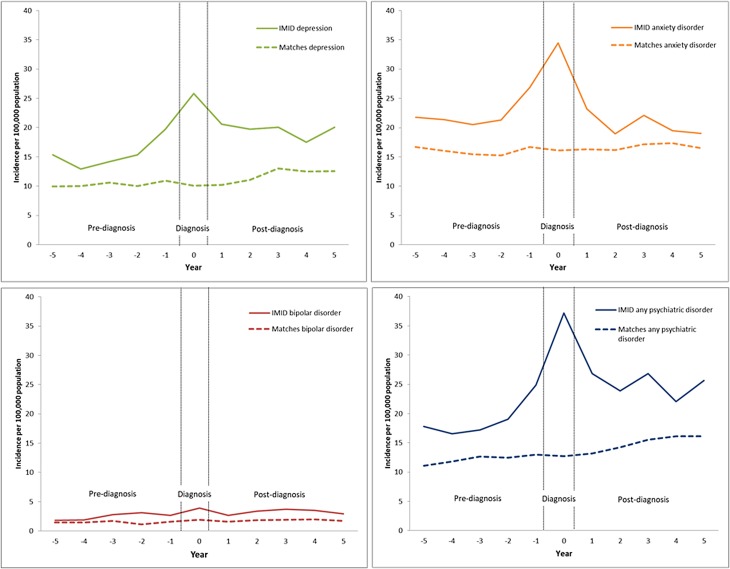
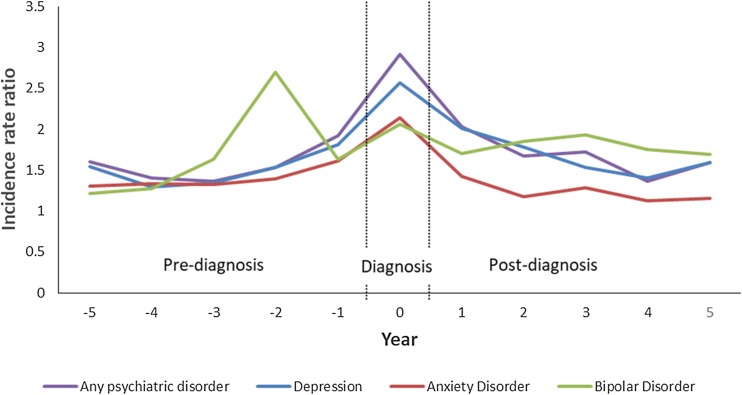
- In the combined IMID cohort, the age- and sex-standardized incidence of any psychiatric disorder was higher than in matched controls as early as 5 years before diagnosis (IRR 1.60; 95% CI 1.36–1.89), and was highest in the diagnosis year.
- Also in the combined IMID cohort, depression was elevated 5 years before diagnosis (IRR 1.54; 95% CI 1.30–1.84) and anxiety disorders were elevated 5 years before diagnosis (IRR 1.30; 95% CI 1.12–1.51).
- Bipolar disorder was elevated beginning 3 years before IMID diagnosis (IRR 1.63; 95% CI 1.10–2.40); findings were generally similar across the IBD, MS, and RA subcohorts, while schizophrenia could not be modeled because of small cell sizes.
Methods
- Retrospective, population-based cohort study using linked administrative health data from Manitoba, Canada.
- Included incident IBD, MS, and RA cases from 1989–2012 (with validated case definitions) and 5:1 matched general-population controls matched on year of birth, sex, and region; analyses were limited to those with at least 5 years of residency before and after the IMID diagnosis date.
- Estimated annual incidence of depression, anxiety disorder, bipolar disorder, schizophrenia, and any psychiatric disorder in the 5-year pre-diagnosis, diagnosis-year, and 5-year post-diagnosis periods, using age- and sex-standardized incidence rates, incidence rate ratios, and multivariable negative binomial regression adjusted for pre-specified covariates.
Limitations
- The paper states the study was limited to a single Canadian province, which may reduce generalisability.
- The authors note administrative data capture only health-system contacts and therefore miss psychiatric disorders diagnosed by non-physician mental health providers or untreated cases; this limitation applies to both IMID and non-IMID groups.
- The paper states that administrative data lacked clinical detail, so the study could not assess associations with IMID severity or determine whether pre-diagnosis psychiatric disorders were prodromal IMID symptoms, shared comorbidity, or a causal risk factor.
Model-written summary. Check it against the paper before relying on it.
Integrity signals
Registry
Cites
Statistics
Figures
Verification
Claims the paper makes
0 Valid · 0 Not valid · 10 Not checked · 34 Own results and interpretations
A result the paper reports from its own data — it cites no other source for it, so there is none to check. The quote shows it is in the paper.
In the paper
“In the analyses of each IMID cohorts (IBD, MS and RA), the findings were generally consistent in magnitude and direction with those of the combined IMID cohort (Supplementary Table S2 and Figs S1–S3).”
§ Rising incidence of psychiatric disorders before diagnosis of immune-mediated inflammatory disease > Results > Incidence of psychiatric disorders in the individual IMID cohorts
hedged- Asserted: passes — The authors put it forward as true.
- Checkable: passes — It can be checked against evidence.
- Load-bearing: unclear — It is unclear whether the paper’s conclusions depend on it.
- Based: passes — The paper gives a reason why it holds.
A result the paper reports from its own data — it cites no other source for it, so there is none to check. The quote shows it is in the paper.
In the paper
“In the diagnosis year, the age- and sex-standardised incidence of any psychiatric disorder, depression and anxiety disorder was higher in each IMID cohort as compared with its matched cohort (Table 2).”
§ Rising incidence of psychiatric disorders before diagnosis of immune-mediated inflammatory disease > Results > Incidence of psychiatric disorders in the individual IMID cohorts
plainstates an association- Asserted: passes — The authors put it forward as true.
- Checkable: passes — It can be checked against evidence.
- Load-bearing: passes — The paper’s conclusions depend on it.
- Based: passes — The paper gives a reason why it holds.
A result the paper reports from its own data — it cites no other source for it, so there is none to check. The quote shows it is in the paper.
In the paper
“The age- and sex-standardised incidence of any psychiatric disorder among the IMID cohort was higher than the matched cohort during all periods, beginning as early as 5 years before IMID diagnosis (IRR 1.60; 95% CI 1.36–1.89), and most prominently in the diagnosis year”
- Also stated in: § Conclusion. · plain
“The incidence of psychiatric comorbidity is elevated in the IMID population as compared with a matched population as early as 5 years before diagnosis.”
- Also stated in: § Discussion · plain
“As compared with age-, sex- and geographically matched cohorts, the incidence of psychiatric comorbidity was increased in the IMID cohorts in the 5–10 years before IMID diagnosis.”
§ Rising incidence of psychiatric disorders before diagnosis of immune-mediated inflammatory disease > Results > Incidence of psychiatric disorders in the combined IMID cohort
plainstates an association- Asserted: passes — The authors put it forward as true.
- Checkable: passes — It can be checked against evidence.
- Load-bearing: passes — The paper’s conclusions depend on it.
- Based: passes — The paper gives a reason why it holds.
- Also stated in: § Conclusion. · plain
A result the paper reports from its own data — it cites no other source for it, so there is none to check. The quote shows it is in the paper.
In the paper
“In the diagnosis year, the age- and sex-standardised incidence of any psychiatric disorder, depression and anxiety disorder was higher in each IMID cohort as compared with its matched cohort (Table 2).”
§ Rising incidence of psychiatric disorders before diagnosis of immune-mediated inflammatory disease > Results > Incidence of psychiatric disorders in the individual IMID cohorts
plainstates an association- Asserted: passes — The authors put it forward as true.
- Checkable: passes — It can be checked against evidence.
- Load-bearing: passes — The paper’s conclusions depend on it.
- Based: passes — The paper gives a reason why it holds.
A result the paper reports from its own data — it cites no other source for it, so there is none to check. The quote shows it is in the paper.
In the paper
“The incidence of bipolar disorder was elevated beginning 3 years before IMID diagnosis (IRR 1.63; 95% CI 1.10–2.40).”
- Also stated in: § Incidence of psychiatric disorders in the combined IMID cohort · plain
“For bipolar disorder, we observed a similar pattern of findings, including an increased incidence in the IMID cohort relative to the matched cohort emerging 3 years before IMID diagnosis (IRR 1.63; 95% CI 1.10–2.40) (Fig. 1, Table 2).”
§ Rising incidence of psychiatric disorders before diagnosis of immune-mediated inflammatory disease > Abstract > Results.
plainstates an association- Asserted: passes — The authors put it forward as true.
- Checkable: passes — It can be checked against evidence.
- Load-bearing: passes — The paper’s conclusions depend on it.
- Based: passes — The paper gives a reason why it holds.
- Also stated in: § Incidence of psychiatric disorders in the combined IMID cohort · plain
14 more claims
Create a free account to see all 44 claims and to verify the 19 references still open.
- It may state two separate claims as one. 16
- Probably not a substantial claim. 11
Claims other papers make about this one
Each is checked against this paper’s own text: does it say what the citing paper says it does?
The cited source says what the claim attributes to it.
In the citing paper
“Interestingly, higher rates of mental disorders relative to matched controls have been found to pre-date an IBD diagnosis by up to five years, suggesting bidirectional vulnerability (16).”
From The 2023 Impact of Inflammatory Bowel Disease in Canada: Mental Health and Inflammatory Bowel Disease (2023) · cites this paper as [16]
Citations
Cites
So depression is an inflammatory disease, but where does the inflammation come from?
Berk, M., Williams, L. J., Jacka, F. N., O’Neil, A., Pasco, J. A., Moylan, S., Allen, N. B., Stuart, A. L., Hayley, A. C., Byrne, M. L., et al. (2013) · BMC Medicine · doi:10.1186/1741-7015-11-200 · Cited by 1,423 · cited 1×
“Emerging evidence suggests that the risk of depression, anxiety disorders and bipolar disorder is influenced by the inflammation and activation of cell-mediated immunity (Vieira et al. 2010; Berk et al. 2013; Rosenblat & McIntyre, 2015).”
BackgroundChronic stress, glucocorticoid receptor resistance, inflammation, and disease risk
Cohen, S., Janicki-Deverts, D., Doyle, W. J., Miller, G. E., Frank, E., Rabin, B. S., & Turner, R. B. (2012) · Proceedings of the National Academy of Sciences · doi:10.1073/pnas.1118355109 · Cited by 1,419 · cited 1×
“As well, environmental factors such as social adversity and chronic stress may induce biological changes which subsequently increase the risk of one or more chronic diseases (Cohen et al. 2012).”
BackgroundStetler, C., & Miller, G. E. (2011) · Psychosomatic Medicine · doi:10.1097/psy.0b013e31820ad12b · Cited by 1,123 · cited 1×
“Depression is known to induce changes in immune function, including immunosuppression and inflammation (Nair et al. 1999; Yeragani et al. 2000; Irwin & Miller, 2007), as well as hyperactivity of the hypothalamic pituitary axis (Stetler & Miller, 2011).”
BackgroundThe prevalence of depression in rheumatoid arthritis: a systematic review and meta-analysis
Matcham, F., Rayner, L., Steer, S., & Hotopf, M. (2013) · Rheumatology · doi:10.1093/rheumatology/ket169 · Cited by 928
Alamanos, Y., Voulgari, P. V., & Drosos, A. A. (2006) · Seminars in Arthritis and Rheumatism · doi:10.1016/j.semarthrit.2006.08.006 · Cited by 782 · cited 2×
“…inflammatory bowel disease (IBD), multiple sclerosis (MS) and rheumatoid arthritis (RA) share several epidemiologic and clinical features (Pugliatti et al. 2002; Health Canada, 2003; Alamanos et al. 2006; Canadian Institute for Health Information, 2007; Logan & Bowlus, 2010; Bernstein et al. 2012).”
BackgroundNeuroinflammation and psychiatric illness
Najjar, S., Pearlman, D. M., Alper, K., Najjar, A., & Devinsky, O. (2013) · Journal of Neuroinflammation · doi:10.1186/1742-2094-10-43 · Cited by 733
Depressive disorders and immunity: 20 years of progress and discovery
Irwin, M. R., & Miller, A. H. (2007) · Brain, Behavior, and Immunity · doi:10.1016/j.bbi.2007.01.010 · Cited by 676 · cited 1×
“Depression is known to induce changes in immune function, including immunosuppression and inflammation (Nair et al. 1999; Yeragani et al. 2000; Irwin & Miller, 2007), as well as hyperactivity of the hypothalamic pituitary axis (Stetler & Miller, 2011).”
BackgroundBernstein, C. N., Blanchard, J. F., Rawsthorne, P., & Wajda, A. (1999) · American Journal of Epidemiology · doi:10.1093/oxfordjournals.aje.a009735 · Cited by 667 · cited 2×
“First, we applied validated case definitions (Bernstein et al. 1999; Marrie et al. 2010; Hitchon et al. 2014) to the administrative dataset to identify all Manitobans aged 18 years and older with IBD, MS and RA from 1984 to 2013 (Supplementary Table S1).”
MethodSelf-citationReview: Inequalities in healthcare provision for people with severe mental illness
Lawrence, D., & Kisely, S. (2010) · Journal of Psychopharmacology · doi:10.1177/1359786810382058 · Cited by 649 · cited 1×
“In addition, psychiatric disorders are associated with adverse health behaviours, while serious psychiatric disorders are associated with inequalities in health care provision that may lead to other health conditions (Lawrence & Kisely, 2010).”
BackgroundMitchell, A. J., Benito-León, J., González, J.-M. M., & Rivera-Navarro, J. (2005) · The Lancet Neurology · doi:10.1016/s1474-4422(05)70166-6 · Cited by 519 · cited 2×
“This psychiatric comorbidity negatively affects outcomes; depression is associated with lower health-related quality of life in IBD, MS and RA (Rupp et al. 2004; Mitchell et al. 2005; Faust et al. 2012; Mok et al. 2012), and with increased mortality in MS and RA (Ang et al.”
BackgroundWalker, J. R., Ediger, J. P., Graff, L. A., Greenfeld, J. M., Clara, I., Lix, L., Rawsthorne, P., Miller, N., Rogala, L., McPhail, C. M., et al. (2008) · The American Journal of Gastroenterology · doi:10.1111/j.1572-0241.2008.01980.x · Cited by 437 · cited 5×
“In one study of 187 individuals with IBD and a lifetime history of any mood or anxiety disorder, 18% had onset of these disorders within 2 years preceding IBD diagnosis and an additional 16% had onset 2–9 years before diagnosis (Walker et al. 2008).”
BackgroundResultSelf-citationThe worldwide prevalence of multiple sclerosis
Pugliatti, M., Sotgiu, S., & Rosati, G. (2002) · Clinical Neurology and Neurosurgery · doi:10.1016/s0303-8467(02)00036-7 · Cited by 370 · cited 2×
“…(IMID), inflammatory bowel disease (IBD), multiple sclerosis (MS) and rheumatoid arthritis (RA) share several epidemiologic and clinical features (Pugliatti et al. 2002; Health Canada, 2003; Alamanos et al. 2006; Canadian Institute for Health Information, 2007; Logan & Bowlus, 2010; Bernstein et…”
BackgroundDepression and anxiety in people with inflammatory bowel disease
Kurina, L. M., Goldacre, M. J., Yeates, D., & Gill, L. E. (2001) · Journal of Epidemiology and Community Health · doi:10.1136/jech.55.10.716 · Cited by 347 · cited 4×
“…number of prior studies that have suggested higher than expected incidence or prevalence of depression and anxiety before the diagnosis of IBD or MS (Kurina et al. 2001; Walker et al. 2008; Byatt et al. 2011; Hoang et al. 2016); we were unable to identify comparable studies for bipolar disorder.”
BackgroundResultInfluentialThe rising prevalence and changing age distribution of multiple sclerosis in Manitoba
Marrie, R. A., Yu, N., Blanchard, J., Leung, S., & Elliott, L. (2010) · Neurology · doi:10.1212/wnl.0b013e3181cf6ec0 · Cited by 307 · cited 2×
“First, we applied validated case definitions (Bernstein et al. 1999; Marrie et al. 2010; Hitchon et al. 2014) to the administrative dataset to identify all Manitobans aged 18 years and older with IBD, MS and RA from 1984 to 2013 (Supplementary Table S1).”
MethodSelf-citationJanssens, A. C. J. W., van Doorn, P. A., de Boer, J. B., van der Meché, F. G. A., Passchier, J., & Hintzen, R. Q. (2003) · Acta Neurologica Scandinavica · doi:10.1034/j.1600-0404.2003.00166.x · Cited by 294 · cited 1×
“In MS, nearly half of newly diagnosed individuals report high levels of anxiety or depressive symptoms (Janssens et al. 2003).”
BackgroundAng, D. C., Choi, H. K., Kroenke, K., & Wolfe, F. (2005) · PubMed · Cited by 265
Autoimmune diseases, bipolar disorder, and non-affective psychosis
Eaton, W. W., Pedersen, M. G., Nielsen, P. R., & Mortensen, P. B. (2010) · Bipolar Disorders · doi:10.1111/j.1399-5618.2010.00853.x · Cited by 262 · cited 1×
“In a large Danish study using health claims data, several autoimmune diseases were associated with an increased risk of bipolar disorder within the first 4 years after diagnosis (thyrotoxicosis, MS, IBD, psoriasis, RA), or 5 or more years after diagnosis (autoimmune hepatitis) (Eaton et al. 2010).”
BackgroundEffect of comorbidity on mortality in multiple sclerosis
Marrie, R. A., Elliott, L., Marriott, J., Cossoy, M., Blanchard, J., Leung, S., & Yu, N. (2015) · Neurology · doi:10.1212/wnl.0000000000001718 · Cited by 229 · cited 4×
“2012), and with increased mortality in MS and RA (Ang et al. 2005; Marrie et al. 2015a).”
BackgroundResultSelf-citationfor the CIHR Team in the Epidemiology and Impact of Comorbidity on Multiple Sclerosis, Marrie, R. A., Fisk, J. D., Yu, B. N., Leung, S., Elliott, L., Caetano, P., Warren, S., Evans, C., Wolfson, C., et al. (2013) · BMC Neurology · doi:10.1186/1471-2377-13-16 · Cited by 163 · cited 3×
“Using case definitions developed and validated in MS and IBD populations (Marrie et al. 2013; Marrie et al. 2016), we identified individuals in each cohort with depression, anxiety disorder, bipolar disorder, schizophrenia and any psychiatric disorder (51 of depression, anxiety disorder, bipolar disorder, schizophreni…”
MethodSelf-citationHäuser, W., Janke, K.-H., Klump, B., & Hinz, A. (2011) · Inflammatory Bowel Diseases · doi:10.1002/ibd.21346 · Cited by 163 · cited 2×
“including depression, anxiety, bipolar disorder and schizophrenia, are increased in individuals with these IMID (Hauser et al. 2011; Matcham et al. 2013; Marrie et al. 2015b).”
BackgroundDifferences in the burden of psychiatric comorbidity in MS vs the general population
Marrie, R. A., Fisk, J. D., Tremlett, H., Wolfson, C., Warren, S., Tennakoon, A., Leung, S., & Patten, S. B. (2015) · Neurology · doi:10.1212/wnl.0000000000002174 · Cited by 150 · cited 4×
“including depression, anxiety, bipolar disorder and schizophrenia, are increased in individuals with these IMID (Hauser et al. 2011; Matcham et al. 2013; Marrie et al. 2015b).”
BackgroundResultSelf-citationIncreased QT variability in patients with panic disorder and depression
Yeragani, V. K., Pohl, R. B., Jampala, V. C., Balon, R., Ramesh, C., & Srinivasan, K. (2000) · Psychiatry Research · doi:10.1016/s0165-1781(00)00119-0 · Cited by 131 · cited 1×
“Depression is known to induce changes in immune function, including immunosuppression and inflammation (Nair et al. 1999; Yeragani et al. 2000; Irwin & Miller, 2007), as well as hyperactivity of the hypothalamic pituitary axis (Stetler & Miller, 2011).”
BackgroundChateau, D. G., Metge, C. J., Prior, H. J., & Soodeen, R. (2012) · Canadian Journal of Public Health · doi:10.1007/bf03403825 · Cited by 131 · cited 3×
“For SES we used the Socioeconomic Factor Index version 2 (SEFI-2), derived by linking postal code to census data.”
BackgroundPearlman, D. M., & Najjar, S. (2014) · Schizophrenia Research · doi:10.1016/j.schres.2014.05.001 · Cited by 124 · cited 1×
“…context of IMID using brain imaging and serological and tissue biomarker studies will also be needed to discern the pathogenesis of psychiatric disorders in IMID (Najjar et al. 2013; Pearlman & Najjar, 2014) This study was limited to a single Canadian province potentially reducing generalisability.”
MethodEnhanced Th17 phenotype in individuals with generalized anxiety disorder
Vieira, M. M. M., Ferreira, T. B., Pacheco, P. A. F., Barros, P. O., Almeida, C. R. M., Araújo-Lima, C. F., Silva-Filho, R. G., Hygino, J., Andrade, R. M., Linhares, U. C., et al. (2010) · Journal of Neuroimmunology · doi:10.1016/j.jneuroim.2010.07.018 · Cited by 118 · cited 2×
“Emerging evidence suggests that the risk of depression, anxiety disorders and bipolar disorder is influenced by the inflammation and activation of cell-mediated immunity (Vieira et al. 2010; Berk et al. 2013; Rosenblat & McIntyre, 2015).”
BackgroundThe geoepidemiology of autoimmune intestinal diseases
Logan, I., & Bowlus, C. L. (2009) · Autoimmunity Reviews · doi:10.1016/j.autrev.2009.11.008 · Cited by 115 · cited 1×
“…inflammatory bowel disease (IBD), multiple sclerosis (MS) and rheumatoid arthritis (RA) share several epidemiologic and clinical features (Pugliatti et al. 2002; Health Canada, 2003; Alamanos et al. 2006; Canadian Institute for Health Information, 2007; Logan & Bowlus, 2010; Bernstein et al. 2012).”
BackgroundIncreased QT variability in patients with panic disorder and depression
Yeragani, V. K., Pohl, R. B., Jampala, V. C., Balon, R., Ramesh, C., & Srinivasan, K. (2000) · Biological Psychiatry · doi:10.1016/s0006-3223(00)00503-5 · Cited by 112
Are medical comorbid conditions of bipolar disorder due to immune dysfunction?
Rosenblat, J. D., & McIntyre, R. S. (2015) · Acta Psychiatrica Scandinavica · doi:10.1111/acps.12414 · Cited by 97 · cited 1×
“Emerging evidence suggests that the risk of depression, anxiety disorders and bipolar disorder is influenced by the inflammation and activation of cell-mediated immunity (Vieira et al. 2010; Berk et al. 2013; Rosenblat & McIntyre, 2015).”
BackgroundFaust, A. H., Halpern, L. F., Danoff‐Burg, S., & Cross, R. K. (2012) · Europe PMC (PubMed Central) · Cited by 94
Direct Medical Cost of Managing IBD Patients: A Canadian Population-based Study
Bernstein, C. N., Longobardi, T., Finlayson, G., & Blanchard, J. F. (2012) · Inflammatory Bowel Diseases · doi:10.1002/ibd.21878 · Cited by 87 · cited 2×
“…inflammatory bowel disease (IBD), multiple sclerosis (MS) and rheumatoid arthritis (RA) share several epidemiologic and clinical features (Pugliatti et al. 2002; Health Canada, 2003; Alamanos et al. 2006; Canadian Institute for Health Information, 2007; Logan & Bowlus, 2010; Bernstein et al. 2012).”
BackgroundSelf-citationHoang, H., Laursen, B., Stenager, E. N., & Stenager, E. (2016) · Multiple Sclerosis Journal · doi:10.1177/1352458515588973 · Cited by 86 · cited 4×
“A Danish study of 5084 persons with MS and 24 771 age- and sex-matched controls reported increased odds of a diagnosis of depression or anxiety in the 2 years before MS diagnosis but did not evaluate other psychiatric disorders (Hoang et al. 2016).”
BackgroundResultInfluentialWang, Q., Yang, C., Gelernter, J., & Zhao, H. (2015) · Human Genetics · doi:10.1007/s00439-015-1596-8 · Cited by 83 · cited 1×
“Some genetic loci are associated with the risk of both psychiatric and immune-mediated disorders (Wang et al. 2015).”
BackgroundMarrie, R. A., Walker, J. R., Graff, L. A., Lix, L. M., Bolton, J. M., Nugent, Z. J., Targownik, L. E., & Bernstein, C. N. (2016) · Journal of Psychosomatic Research · doi:10.1016/j.jpsychores.2016.08.014 · Cited by 79 · cited 3×
“Using case definitions developed and validated in MS and IBD populations (Marrie et al. 2013; Marrie et al. 2016), we identified individuals in each cohort with depression, anxiety disorder, bipolar disorder, schizophrenia and any psychiatric disorder (51 of depression, anxiety disorder, bipolar disorder, schizophreni…”
MethodSelf-citationFatigue heralding multiple sclerosis
Berger, J. R., Pocoski, J., Preblick, R., & Boklage, S. (2013) · Multiple Sclerosis Journal · doi:10.1177/1352458513477924 · Cited by 77 · cited 2×
“9% had seen a physician for fatigue, as based on billing codes, during the 3-year period before MS diagnosis; comparative data in individuals without MS were not available (Berger et al. 2013).”
BackgroundInfluentialComorbidity in patients with rheumatoid arthritis: effect on health-related quality of life.
Rupp, I., Boshuizen, H. C., Jacobi, C. E., Dinant, H. J., & van den Bos, G. A. M. (2004) · PubMed · Cited by 68
Nair, G. V., Gurbel, P. A., O’Connor, C. M., Gattis, W. A., Murugesan, S. R., & Serebruany, V. L. (1999) · The American Journal of Cardiology · doi:10.1016/s0002-9149(99)00284-2 · Cited by 64 · cited 1×
“Depression is known to induce changes in immune function, including immunosuppression and inflammation (Nair et al. 1999; Yeragani et al. 2000; Irwin & Miller, 2007), as well as hyperactivity of the hypothalamic pituitary axis (Stetler & Miller, 2011).”
BackgroundWang, S., Chang, C., Hu, L., Tsai, S., Yang, A. C., & You, Z.-H. (2014) · PLoS ONE · doi:10.1371/journal.pone.0107791 · Cited by 52 · cited 1×
“In RA, over one-third of individuals report high levels of emotional distress at diagnosis (Persson et al. 2005), and 80% of depressive disorders are diagnosed within 5 years (Wang et al. 2014).”
BackgroundMok, C., Lok, E., & Cheung, E. (2012) · Scandinavian Journal of Rheumatology · doi:10.3109/03009742.2012.664648 · Cited by 52 · cited 2×
“This psychiatric comorbidity negatively affects outcomes; depression is associated with lower health-related quality of life in IBD, MS and RA (Rupp et al. 2004; Mitchell et al. 2005; Faust et al. 2012; Mok et al. 2012), and with increased mortality in MS and RA (Ang et al.”
BackgroundRelationships Between Multiple Sclerosis and Depression
Byatt, N., Rothschild, A. J., Riskind, P., Ionete, C., & Hunt, A. T. (2011) · The Journal of Neuropsychiatry and Clinical Neurosciences · doi:10.1176/jnp.23.2.jnp198 · Cited by 51 · cited 3×
“…number of prior studies that have suggested higher than expected incidence or prevalence of depression and anxiety before the diagnosis of IBD or MS (Kurina et al. 2001; Walker et al. 2008; Byatt et al. 2011; Hoang et al. 2016); we were unable to identify comparable studies for bipolar disorder.”
BackgroundResultPersson, L., Larsson, B., Nived, K., & Eberhardt, K. (2005) · Scandinavian Journal of Rheumatology · doi:10.1080/03009740510017698 · Cited by 26 · cited 2×
“In RA, over one-third of individuals report high levels of emotional distress at diagnosis (Persson et al. 2005), and 80% of depressive disorders are diagnosed within 5 years (Wang et al. 2014).”
BackgroundChiu, C., Hsu, Y.-C., & Tseng, S.-P. (2016) · International Psychogeriatrics · doi:10.1017/s1041610216001630 · Cited by 19
Research works printed but not linked: 4
- Canadian Institute for Health Information (2007). The Burden of Neurological Diseases, Disorders and Injuries in Canada. Ottawa.
- Hitchon CA, Khan S, Elias B, El-Gabalawy HS, Katz A, Peschken CA (2014). First Nations persons have an increased risk of developing rheumatoid arthritis with an early onset age but are seen less frequently by rheumatologists: a population based study In ACR/ARHP Annual Meeting. American College of Rheumatology: Boston, MA.
- Health Canada (2003). Arthritis in Canada: An Ongoing Challenge. Health Canada: Ottawa.
- WHO Collaborating Centre for Drug Statistics Methodology (2012). Guidelines for ATC Classification and DDD Assignment 2013. Oslo.
Cited by
Kobayashi, T., Siegmund, B., Le Berre, C., Wei, S. C., Ferrante, M., Shen, B., Bernstein, C. N., Danese, S., Peyrin-Biroulet, L., & Hibi, T. (2020) · Nature Reviews Disease Primers · doi:10.1038/s41572-020-0205-x · Cited by 1,649
Self-citationThe Role of Inflammation in Depression and Fatigue
Lee, C.-H., & Giuliani, F. (2019) · Frontiers in Immunology · doi:10.3389/fimmu.2019.01696 · Cited by 640
“An increase in the incidence and prevalence of depression, along with an increase in the rate of prescriptions for antidepressant, occur as early as 2 years before MS diagnosis (80, 81).”
BackgroundDepression and anxiety in inflammatory bowel disease: epidemiology, mechanisms and treatment
Bisgaard, T. H., Allin, K. H., Keefer, L., Ananthakrishnan, A. N., & Jess, T. (2022) · Nature Reviews Gastroenterology & Hepatology · doi:10.1038/s41575-022-00634-6 · Cited by 572
Rheumatoid Arthritis Pathogenesis, Prediction, and Prevention: An Emerging Paradigm Shift
Deane, K. D., & Holers, V. M. (2021) · Arthritis & Rheumatology · doi:10.1002/art.41417 · Cited by 255
Environmental risk factors for inflammatory bowel disease
Singh, N., & Bernstein, C. N. (2022) · United European Gastroenterology Journal · doi:10.1002/ueg2.12319 · Cited by 223
“These findings are inconsistent with the study by Racine et al. that found that there was no association of consuming “high sugar and soft drinks” and “animal fats, seafood, potatoes and alcohol” with CD risk with the relative risks of 1.48 (95% CI: 0.60–3.61) and 0.71, (95% CI: 0.29–1.73), respectively.38 On the cont…”
BackgroundSelf-citation
Metadata
- Authors
- Marrie, R. A., Walld, R., Bolton, J. M., Sareen, J., Walker, J. R., Patten, S. B., Singer, A., Lix, L. M., Hitchon, C. A., El-Gabalawy, R., Katz, A., Fisk, J. D., Bernstein, C. N., & for the CIHR Team in Defining the Burden and Managing the Effects of Psychiatric Comorbidity in Chronic Immunoinflammatory Disease
- Affiliations
- University of Manitoba (CA)
- University of Calgary (CA)
- Dalhousie University (CA)
- Corresponding author
- Marrie, R. A.
- ORCID
- Venue
- Epidemiology and Psychiatric Sciences
- Publisher
- Cambridge University Press (CUP)
- Published
- 2017-11-03
- Volume
- 28
- Issue
- 03
- Pages
- 333-342
- ISSN
- 2045-7960 (ISSN-L)
- 2045-7979
- PMC
- PMC6998907
- OpenAlex
- W2765581691
- Cited by
- 144
- References
- 41
- Citations by year
- 2026: 9 · 2025: 15 · 2024: 23 · 2023: 16 · 2022: 18 · 2021: 18 · 2020: 25 · 2019: 11 · 2018: 7
- FWCI
- 3.92
- Type
- journal article
- Language
- en
- Open access
- hybrid
- doi.org
- Locations
- Epidemiology and Psychiatric Sciences (publishedVersion, cc-by)
- PubMed Central (publishedVersion, cc-by)
- PubMed (publishedVersion)
- Funders
- Research Manitoba
- Crohn's and Colitis Canada
- Canadian Institutes of Health Research (135234_1, 333252)
- Topics
- Life Sciences › Neuroscience › Biological Psychiatry › Tryptophan and brain disorders
- Health Sciences › Medicine › Psychiatry and Mental health › Mental Health Treatment and Access
- Health Sciences › Medicine › Rheumatology › Rheumatoid Arthritis Research and Therapies
- Keywords
- immune-mediated inflammatory diseases, psychiatric comorbidity, depression, anxiety disorders, bipolar disorder, schizophrenia, inflammatory bowel disease, multiple sclerosis, rheumatoid arthritis
- MeSH terms
- Adult, Arthritis, Rheumatoid, Mental Disorders, Female, Humans, Male, Manitoba, Middle Aged, Multiple Sclerosis, Risk Factors, Inflammatory Bowel Diseases, Comorbidity, Incidence
About these checks
Registry, retraction, Cites and statistics results are computed, not judged, with one exception: a printed reference that no index lists is read once by a model before it counts as a citation error. Claims are extracted by a model and kept only when their quote appears verbatim in the text; each cited source is then checked, with a model’s help, for whether it says what the claim relies on. Those verdicts can be wrong — read the claim’s quote and the cited source before relying on one.
A language model drew the claims from the paper on 2026-10-11, under version 3 of the claim definition (model deepseek-v4.1-flash, prompt extract-v3).
A second model labelled each claim on 2026-10-11 (model jev-1.13-20260917, definition revision gold-guideline-v0.2).
Statistics and arithmetic are recomputed, not judged.
Confidence bands are shown only for fields calibrated on our annotated test set. None is calibrated yet, so no band is shown.
What counts as a claim ›How we measure confidence ›How we check this ›
Are you an author, or do you see a problem with this page? Request a review
Data sources
Bibliographic data: Semantic Scholar, OpenAlex, Crossref.
Contains information from the Semantic Scholar Academic Graph Datasets, made available under the ODC Attribution License (ODC-BY 1.0).
Semantic Scholar’s data is described in: Kinney, R., et al. (2023). The Semantic Scholar Open Data Platform. arXiv:2301.10140.
