

Increase in prevalence of current mental disorders in the context of COVID-19: analysis of repeated nationwide cross-sectional surveys.
Open accessThe DOI matches its Crossref record; 48 of the 48 references it cites were found in a registry or an index.
Abstract
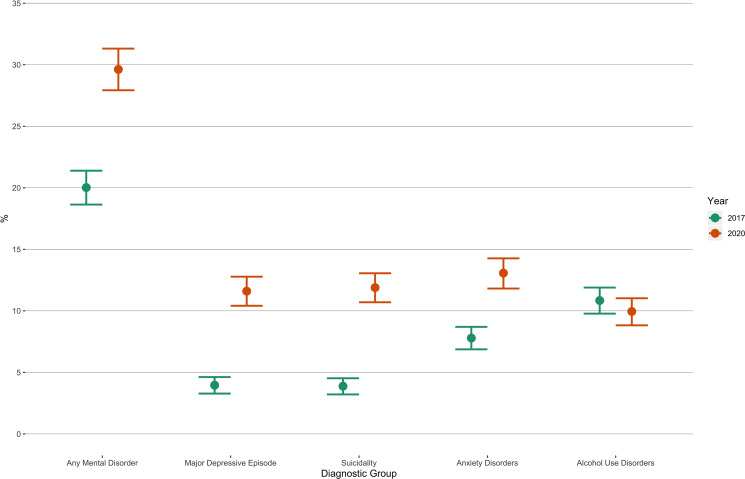
Aims: The United Nations warned of COVID-19-related mental health crisis; however, it is unknown whether there is an increase in the prevalence of mental disorders as existing studies lack a reliable baseline analysis or they did not use a diagnostic measure. We aimed to analyse trends in the prevalence of mental disorders prior to and during the COVID-19 pandemic. Methods: We analysed data from repeated cross-sectional surveys on a representative sample of non-institutionalised Czech adults (18+ years) from both November 2017 ( n = 3306; 54% females) and May 2020 ( n = 3021; 52% females). We used Mini International Neuropsychiatric Interview (MINI) as the main screening instrument. We calculated descriptive statistics and compared the prevalence of current mood and anxiety disorders, suicide risk and alcohol-related disorders at baseline and right after the first peak of COVID-19 when related lockdown was still in place in CZ. In addition, using logistic regression, we assessed the association between COVID-19-related worries and the presence of mental disorders. Results: The prevalence of those experiencing symptoms of at least one current mental disorder rose from a baseline of 20.02 (95% CI = 18.64; 21.39) in 2017 to 29.63 (95% CI = 27.9; 31.37) in 2020 during the COVID-19 pandemic. The prevalence of both major depressive disorder (3.96, 95% CI = 3.28; 4.62 v. 11.77, 95% CI = 10.56; 12.99); and suicide risk (3.88, 95% CI = 3.21; 4.52 v. 11.88, 95% CI = 10.64; 13.07) tripled and current anxiety disorders almost doubled (7.79, 95% CI = 6.87; 8.7 v. 12.84, 95% CI = 11.6; 14.05). The prevalence of alcohol use disorders in 2020 was approximately the same as in 2017 (10.84, 95% CI = 9.78; 11.89 v. 9.88, 95% CI = 8.74; 10.98); however, there was a significant increase in weekly binge drinking behaviours (4.07% v. 6.39%). Strong worries about both, health or economic consequences of COVID-19, were associated with an increased odds of having a mental disorder (1.63, 95% CI = 1.4; 1.89 and 1.42, 95% CI = 1.23; 1.63 respectively). Conclusions: This study provides evidence matching concerns that COVID-19-related mental health problems pose a major threat to populations, particularly considering the barriers in service provision posed during lockdown. This finding emphasises an urgent need to scale up mental health promotion and prevention globally.
Overview
The claims and statistics of this paper haven’t been checked yet.
Free: it reads the open-access text and checks the first 5 claims that cite a source we can check. Create a free account to check every claim.
Integrity signals
Registry
Cites
Statistics
Figures
Verification
Claims the paper makes
The claims and statistics of this paper haven’t been checked yet.
Free: it reads the open-access text and checks the first 5 claims that cite a source we can check. Create a free account to check every claim.
Claims other papers make about this one
Each is checked against this paper’s own text: does it say what the citing paper says it does?
The cited source says what the claim attributes to it.
In the citing paper
“Similarly, Winkler et al. (2020) reported on a repeated, robustly-sampled, nationally representative survey in the Czech Republic using baseline data from 2017 and found that suicide risk, as measured by the Mini International Neuropsychiatric Interview, increased from 3.9% in November 2017 to 11.9% in May 2020.”
From The impact of the COVID-19 pandemic on self-harm and suicidal behaviour: update of living systematic review (2021) · cites this paper as Winkler et al. (2020)
The cited source says what the claim attributes to it.
In the citing paper
“Two robustly sampled general population, nationally representative cross-sectional surveys with pre pandemic baseline data from 2017/18 reported a three to four fold increase in suicide risk ( Winkler et al., 2020) and suicidal thoughts in low-income households ( Raifman et al., 2020), but differences in data collection approaches (i.e. face-to-face vs. on-line) may bias comparisons.”
From The impact of the COVID-19 pandemic on self-harm and suicidal behaviour: update of living systematic review (2021) · cites this paper as Winkler et al., 2020
Self-check
Percentages, sums and reported differences re-computed from the paper’s own numbers.
The self-check needs the paper’s full text.
Citations
Cites
1 retracted
RETRACTED: Chinese mental health burden during the COVID-19 pandemic
Huang, Y., & Zhao, N. (2020) · Asian Journal of Psychiatry · doi:10.1016/j.ajp.2020.102052 · Cited by 185
Retracted(1998) · The Journal of Clinical Psychiatry · Cited by 19,139
The Psychological Impact of Quarantine and How to Reduce It: Rapid Review of the Evidence
Brooks, S. K., Webster, R. K., Smith, L. E., Woodland, L., Wessely, S., Greenberg, N., & Rubin, G. J. (2020) · doi:10.2139/ssrn.3532534 · Cited by 16,394
The psychological impact of quarantine and how to reduce it: Rapid review of the evidence
Brooks, S. K., Webster, R. K., Smith, L. E., Woodland, L., Wessely, S., Greenberg, N., & Rubin, G. J. (2020) · The Lancet · doi:10.1016/s0140-6736(20)30460-8 · Cited by 16,378
(1998) · PubMed · Cited by 10,216
Holmes, E. A., O'Connor, R. C., Perry, V. H., Tracey, I., Wessely, S., Arseneault, L., Ballard, C., Christensen, H., Cohen Silver, R., Everall, I., et al. (2020) · The Lancet Psychiatry · doi:10.1016/s2215-0366(20)30168-1 · Cited by 5,715
Qiu, J., Shen, B., Zhao, M., Wang, Z., Xie, B., & Xu, Y. (2020) · General Psychiatry · doi:10.1136/gpsych-2020-100213 · Cited by 4,307
The Lancet Commission on global mental health and sustainable development
Patel, V., Saxena, S., Lund, C., Thornicroft, G., Baingana, F., Bolton, P., Chisholm, D., Collins, P. Y., Cooper, J. L., Eaton, J., et al. (2018) · The Lancet · doi:10.1016/s0140-6736(18)31612-x · Cited by 3,692
Hammen, C. (2005) · Annual Review of Clinical Psychology · doi:10.1146/annurev.clinpsy.1.102803.143938 · Cited by 2,979
Mental health problems and social media exposure during COVID-19 outbreak
Gao, J., Zheng, P., Jia, Y., Chen, H., Mao, Y., Chen, S., Wang, Y., Fu, H., & Dai, J. (2020) · PLoS ONE · doi:10.1371/journal.pone.0231924 · Cited by 2,830
Research works printed but not linked: 1
- CZSO (2019) Demographic Yearbook of the Czech Republic 2018. Prague: Czech Statistical Office.
Cited by
Items 101–200 of 238
Tietz, S., Wagner‐Skacel, J., Angel, H., Ratzenhofer, M., Fellendorf, F. T., Fleischmann, E., Körner, C., Reininghaus, E. Z., Seitz, R. J., & Dalkner, N. (2022) · World Journal of Psychiatry · doi:10.5498/wjp.v12.i7.929 · Cited by 9
Mikoška, P., Novák, L., Pilárik, Ľ., Bok, T., Fülep, M., & Kořínek, R. (2022) · BMC Psychiatry · doi:10.1186/s12888-022-04365-5 · Cited by 9
Wong, W. L. E., Sually, D. S., Hidalgo‐Mazzei, D., Quoidbach, V., Simon, J., Boyer, P., Strawbridge, R., & Young, A. H. (2023) · European Psychiatry · doi:10.1192/j.eurpsy.2023.2407 · Cited by 9
Mueller‐Stierlin, A. S., Meixner, F., Lehle, J., Kohlmann, A., Schumacher, M., Wöhler, S., Hänsel, A., Reuter, S., Herder, K., Bias, N., et al. (2022) · PLoS ONE · doi:10.1371/journal.pone.0276123 · Cited by 9
The social evolution of COVID-19: pandemics as total social facts
González, J. J. L., & Vilas, E. F. (2024) · Frontiers in Sociology · doi:10.3389/fsoc.2024.1397826 · Cited by 14
Sculco, C., Bano, B., Prina, E., Tedeschi, F., Bartucz, M. B., Barbui, C., Purgato, M., & Albanese, E. (2025) · BMJ Open · doi:10.1136/bmjopen-2024-091342 · Cited by 9
Greenwell-Barnden, J. N., Clarke, P., & Notebaert, L. (2025) · Anxiety Stress & Coping · doi:10.1080/10615806.2025.2554829 · Cited by 8
“Studies have examined negative life events’ impact on mental health experiences of students after COVID (Li et al., 2021; Winkler et al., 2020) and students in specific Asian countries such as India (Chhetri et al., 2021) and China (Chi et al., 2020).”
Zvolská, K., Tichopád, A., Štěpánková, L., Pánková, A., Adamcekova, Z., Donin, G., Ráfl, J., & Králíková, E. (2023) · BMC Psychiatry · doi:10.1186/s12888-023-05115-x · Cited by 8
“In the general Czech population, almost 30% have some mental disorder [16].”
BackgroundJoshanloo, M. (2024) · The Open Psychology Journal · doi:10.2174/0118743501298966240516055209 · Cited by 8
Zhang, T., Zhang, X., Meng, X., Huang, Y., Zhang, W., Gong, H.-H., Chan, S. K. W., Chen, X.-C., Gao, R., Lewis‐Fernández, R., et al. (2023) · Frontiers in Psychiatry · doi:10.3389/fpsyt.2023.1170540 · Cited by 8
“The prevalence of mental disorders has increased by 10% in the Czech Republic and by 20% in India since the COVID-19 outbreak (16).”
BackgroundZhu, K. Y., Bobak, L., Dorney, I., Breslin, M. A., Hendrickson, S. B., & Vallier, H. A. (2024) · Journal of Orthopaedic Trauma · doi:10.1097/bot.0000000000002755 · Cited by 7
Zeid, B. A., Farouki, L., Khoury, T. E., Sibai, A. M., de Leon, C. F. M., Alawieh, M. F., Ramadan, Z., Abdulrahim, S., Ghattas, H., & McCall, S. J. (2024) · BMJ Global Health · doi:10.1136/bmjgh-2024-015069 · Cited by 7
Kuznetsova, S. Y., Basova, A. Y., Zalmanova, S. L., & Хломов, К. Д. (2023) · Clinical Psychology and Special Education · doi:10.17759/cpse.2023120207 · Cited by 7
Jeremić, J., Mihaljević, J., Radosavljević, I., Jurišić, M., Suđecki, B. J., Stojičić, M., Jovanovic, M. D., Pavlović, Z., Radenović, K., Milic, N., et al. (2024) · Frontiers in Public Health · doi:10.3389/fpubh.2024.1234584 · Cited by 7
Shongwe, M. C., & Huang, S. (2021) · International Journal of Environmental Research and Public Health · doi:10.3390/ijerph18136700 · Cited by 10
“[60] found that strong worries about the health and/or economic consequences of COVID-19 were associated with increased odds of having a mental disorder.”
BackgroundResultMarić, N. P., Lazarević, L. B., Mihić, L., Pejovic-Milovancevic, M. M., Terzić-Šupić, Z., Tošković, O., Todorović, J., Vuković, O., & Knežević, G. (2021) · BMJ Open · doi:10.1136/bmjopen-2021-053835 · Cited by 7
Mental health issues assessment using tools during COVID-19 pandemic
Rao, H., Gupta, M., Agarwal, P., Bhatia, S., & Bhardwaj, R. (2022) · Innovations in Systems and Software Engineering · doi:10.1007/s11334-022-00510-1 · Cited by 11
“The propensity for isolation, as well as personality factors from the Big Five, was significantly predicted the same 8 [22] They calculated descriptive statistics and logistic regression The goal of this study was to find the occurrence of psychological health problems before and during the COVID-19…”
Rachidi, M., Hatem, G., Hatem, M. G., Zein, S., Rachidi, S., & Awada, S. (2023) · The Journal of Medicine Access · doi:10.1177/27550834231163706 · Cited by 10
Liu, G.-Y., Chang, Y., Hwang, I., Shaw, F. F., Hsu, W., Hsu, C., Gunnell, D., & Chang, S. (2022) · Archives of Suicide Research · doi:10.1080/13811118.2022.2114867 · Cited by 6
“…survey data (Chen, Wu, & Gau, 2021; Czeisler et al., 2020; Daly et al., 2021; Niederkrotenthaler et al., 2022; O ’ Connor et al., 2021; Winkler et al., 2020; Wu et al., 2022), and trends in hospital admissions for suicide attempts/self-harm using service utilization data (Bergmans &…”
MethodIncreasing Mental Disorders or Social Psychiatrization: Excluding Options?
Félix Cova, S., Fernández, D., & Inostroza, C. (2023) · Human Arenas · doi:10.1007/s42087-023-00357-3 · Cited by 6
“The COVID-19 pandemic and the effects acutely accentuated these concerns given the deleterious impact of this pandemic and associated implications on people’s mental health (Winkler et al., 2020).”
COVID-19-Associated Acute Psychotic Disorder—Longitudinal Case Report and Brief Review of Literature
Puiu, M. G., Dionisie, V., Dobrin, A. I., & Manea, M. (2023) · Medicina · doi:10.3390/medicina59020408 · Cited by 7
“Concerns regarding the onset of stress related psychiatric symptoms have been raised since the beginning of the pandemic and, later on, were supported by research that showed high levels of distress, anxiety, and depression in the general population during the COVID-19 pandemic in general [13] but also during specific…”
Mental health and COVID-19 pandemic: The literature review
Marić, N. P. (2021) · Medicinski podmladak · doi:10.5937/mp72-32877 · Cited by 6
Höhn, A. M., Ascone, L., Lohse, L., Kugler, D., Lambert, M., Wege, N., Wittmann, F., Riedel-Heller, S. G., Luppa, M., Elsayed, M., et al. (2025) · International Journal of Environmental Research and Public Health · doi:10.3390/ijerph22040478 · Cited by 5
“The prevalence of PTSD increased from 1% to 3%, while the prevalence of agoraphobia increased from 5% to 9% [33] and overall anxiety disorders increased from 8 to 13% by the end of 2020 [47,48].”
Guillen-Burgos, H. F., Galvez-Florez, J. F., Miranda, J., Hincapié-Porras, C., Perez-Olivo, J. L., Piraquive-Caicedo, J. P., Mojica, C. H. B., Parra‐Ardila, S. X., & Parra-Saavedra, M. A. (2023) · Journal of Affective Disorders Reports · doi:10.1016/j.jadr.2023.100488 · Cited by 6
Pandemic-induced increase in adjustment disorders among postpartum women in Germany
Tsoneva, K., Chechko, N., Losse, E. M., Nehls, S., Habel, U., & Shymanskaya, A. (2023) · BMC Women s Health · doi:10.1186/s12905-023-02638-z · Cited by 6
“Studies from across the world suggested increased odds for psychiatric morbidity during the pandemic [3–7], especially given that the pandemic amplified some risk factors such as financial insecurity [8, 9], unemployment [10], and social isolation [11, 12].”
BackgroundNeuropsychiatric features of current COVID-19 pandemic (analysis of foreign publications in 2020)
Мадонов, П. Г., Khidirova, L. D., & Derisheva, D. (2021) · Medical alphabet · doi:10.33667/2078-5631-2020-33-58-61 · Cited by 4
Poenaru, L. (2021) · In Analysis · doi:10.1016/j.inan.2021.06.002 · Cited by 4
Srinivasan, K. K., & Jiang, J. (2023) · ACM Transactions on Management Information Systems · doi:10.1145/3564274 · Cited by 6
“In concurrence with clinical findings that mental disorders have risen during the COVID-19 pandemic due to lockdowns and societal distress [ 40 ], we find that multimorbidity related to mental disorders has risen and peaked during 2020-02 with a 34.26% increase over pre-pandemic period.”
BackgroundInfluentialA hazai borfogyasztás változása az utóbbi években
Harsányi, D., Hlédik, E., & Vámosi, K. Z. (2023) · Marketing & Menedzsment · doi:10.15170/mm.2023.57.ksz.03.04 · Cited by 4
“A mértéktelen alkoholfogyasz-tás megnövekedett arányáról írnak tanulmányukban Winkler et al .”
Mental health stigma, help-seeking behaviours, and spirituality in rural North Carolina churches
Blake, J., & Bailey, E. S. (2024) · Mental Health Religion & Culture · doi:10.1080/13674676.2024.2414294 · Cited by 3
“After the COVID-19 pandemic, the prevalence of major depressive disorder, suicide, and anxiety disorders increased substantially (Winkler et al., 2020).”
Social determinants of mental health: The role of proximal and distal factors
Marković, M. V., Živanović, M., Dimoski, J., & Gvozden, M. (2025) · International Journal of Social Psychiatry · doi:10.1177/00207640251347675 · Cited by 3
“…the results of other large studies which have relied on representative samples and online/computer-assisted methods of data collection (Alonso et al., 2004; Winkler et al., 2020) and which show that between 25% and 35% of individuals demonstrate clinically indicative symptoms of mental disorders.”
Vaculíková, J., & Hanková, M. (2021) · Journal of Gerontological Social Work · doi:10.1080/01634372.2021.1939219 · Cited by 3
YALÇIN, M., ÖZDEMİR, D., Çakıroğlu, S., & Arpacıoğlu, S. (2022) · Çukurova medical journal (Online)/Çukurova medical journal · doi:10.17826/cumj.1022808 · Cited by 4
Vaculíková, J., & Hanková, M. (2023) · Gerontology and Geriatric Medicine · doi:10.1177/23337214231174129 · Cited by 3
“…distancing measures during the early (2020) and late (2021) stages of the pandemic (see Ministry of Health of the Czech Republic, 2023; WHO, 2021), and reported higher rates of stress, anxiety, or loneliness during the 2020 COVID19 restrictions (Vaculíková & Hanková, 2021; Winkler et al., 2020).”
BackgroundCovelli, V., Camisasca, E., Manzoni, G. M., Crescenzo, P., Marelli, A., Visco, M. A., Cafagna, D., Marsicovetere, V., Pesce, M., & Cantoia, M. E. A. (2023) · Frontiers in Psychology · doi:10.3389/fpsyg.2023.1172456 · Cited by 3
Protection and Risk Factors for Attempted Suicide in Mexican Students Majoring in Psychology
Campas, M. A. S., Valdés‐García, K. P., Aranda, M. L. S., Velasco, L. E. D. L., & González, Ó. U. R. (2024) · Salud Mental · doi:10.17711/sm.0185-3325.2024.010 · Cited by 3
“This objective assumed that during lockdown and social isolation, mental health problems, particularly depression, anxiety, and suicide risk, increased (Winkler et al., 2020).”
InfluentialValidation of the Overall Depression Severity and Impairment Scale (ODSIS) in the Czech Republic
Mikoška, P., Novák, L., Bok, T., Ladmanová, M., Fülep, M., Kořínek, R., & Pilárik, Ľ. (2024) · Ceskoslovenska psychologie · doi:10.51561/cspsych.68.2.135 · Cited by 3
Thielmann, B., Böckelmann, I., & Schumann, H. (2022) · Notfall + Rettungsmedizin · doi:10.1007/s10049-022-01031-x · Cited by 3
Sharma, P., Nguyen, Q. A., Kurani, S. S., Holland, A., Kremers, H. M., Pazdernik, V., Sauver, J. L. S., Croarkin, P. E., Kamath, C. C., Geske, J. R., et al. (2022) · Journal of Public Health · doi:10.1093/pubmed/fdac099 · Cited by 3
Pařízek, A., Janků, P., Kameníková, M., Pařízková, P., Javornická, D., Benešová, D., Rogalewicz, V., Laštůvka, Z., & Barták, M. (2023) · International Journal of Environmental Research and Public Health · doi:10.3390/ijerph20032614 · Cited by 3
“Research to date has shown that this period was associated with negative outcomes on physical and psychological health, as well as changes in the use of health care, including fear of visiting medical facilities among the population [11].”
BackgroundKučera, M., Šeblová, D., Bosmans, J. E., Broulíková, H. M., & Kearns, P. B. (2025) · European Journal of Public Health · doi:10.1093/eurpub/ckaf112 · Cited by 2
Therapist-Informed Design Directions for Mobile Assistive Technologies for Anxiety
Senaratne, H., Melvin, G. A., Oviatt, S. L., & Ellis, K. (2022) · Lecture notes of the Institute for Computer Sciences, Social Informatics and Telecommunications Engineering · doi:10.1007/978-3-030-99194-4_12 · Cited by 2
Suizidales Erleben und Verhalten im Rahmen der COVID-19-Pandemie
Teismann, T., Lewitzka, U., & Brieger, P. (2022) · Nervenheilkunde · doi:10.1055/a-1755-1648 · Cited by 3
Changes in ambulance departures for assault calls during COVID‐19 pandemic restrictions
Pišl, V., Vevera, J., Štěpánek, L., & Volavka, J. (2022) · Aggressive Behavior · doi:10.1002/ab.22055 · Cited by 2
“In Czech Republic, the consumption of alcohol was reported to decrease only moderately during the pandemic (Kilian et al., 2021), remain stable (Csémy et al., 2021), or even increase (Winkler et al., 2020).”
BackgroundUse of anxiolytics and hypnotic drugs during COVID-19 pandemic: The literature review
Trajkovski, T., & Marić, N. P. (2022) · Medicinski podmladak · doi:10.5937/mp73-35916 · Cited by 2
“in the prevalence of mental disorders in the general population (27), especially the anxiety spectrum disorders (28), and this occasion may affect the psychotropic medication utilization during the current pandemic.”
BackgroundPankowski, D., Wytrychiewicz‐Pankowska, K., Kiedik, D., & Fal, A. (2023) · Medical Science Monitor · doi:10.12659/msm.940768 · Cited by 3
“Research conducted in the Czech Republic, in turn, indicates that despite the lack of changes in alcohol use disorders between the data collected in 2020 and 2017, a significant increase in weekly binge drinking behaviors was observed [24].”
BackgroundRegistered nurses’ management of depression in general wards
Mpetshu, M., & Maritz, J. (2023) · Health SA Gesondheid · doi:10.4102/hsag.v28i0.2328 · Cited by 2
“Winkler et al. (2020:e173) suggested that a rise in mental health problems creates an additional weight for mental health stability and causes difficulty in closing existing intervals in managing patients with mental health challenges.”
BackgroundWijk, C. H. V. (2023) · SAGE Open · doi:10.1177/21582440231218576 · Cited by 2
“…mental disorder prevalence in the first 6 months of the pandemic, compared to pre-pandemic levels (Knudsen et al, 2021; Van der Velden et al., 2020), while others (Daly et al., 2022; Ettman et al., 2020; Winkler et al., 2020), as well as earlier cited SA studies, reported often dramatic increases.”
ResultZurlo, M. C., & Vallone, F. (2024) · Advances in experimental medicine and biology · doi:10.1007/978-3-031-61943-4_19 · Cited by 2
Koutek, J., & Kocourková, J. (2021) · Psychiatrie pro praxi · doi:10.36290/psy.2021.023 · Cited by 2
Fleischmann, E., Fellendorf, F. T., Ortner, J., Bengesser, S., Ratzenhofer, M., Pilz, R., Lenger, M., Birner, A., Queissner, R., Platzer, M., et al. (2022) · Psychiatry International · doi:10.3390/psychiatryint3030019 · Cited by 4
Laufer, N., Zilber, N., Jeczmien, P., Gilad, R., Gur, S., & Munitz, H. (2023) · Israel Journal of Health Policy Research · doi:10.1186/s13584-023-00553-0 · Cited by 2
“Further, the Covid pandemic has resulted in increased psychosocial risk factors and associated psychiatric morbidity [4] and decreased access to psychiatric services, which might necessitate more treatment of mental disorders by GPs [5].”
BackgroundThe effects of COVID-19 on sleep and general health of Czech patients with epilepsy
Slonková, J., Chudy, M., Togtokhjargal, A., Tomášková, H., Vacovská, H., Rytířová, G., & Doležalová, I. (2023) · Heliyon · doi:10.1016/j.heliyon.2023.e13413 · Cited by 2
Neuroimaging studies of mental disorders
Merenstein, J. L., & Bennett, I. J. (2022) · Elsevier eBooks · doi:10.1016/b978-0-323-91497-0.00030-8 · Cited by 2
South Africa’s Psychiatric training capacity in 2008 and in 2018. Has training capacity improved?
Beath, N., Subramaney, U., Zingela, Z., Chiliza, B., Joska, J. A., Kotzé, C., Ramlall, S., & Seedat, S. (2023) · South African Journal of Psychiatry · doi:10.4102/sajpsychiatry.v29i0.1988 · Cited by 1
Piccoli, E., Vanzetto, S., Cerolini, L., Conti, D., Celebre, L., & Dell’Osso, B. M. (2024) · Cambridge University Press eBooks · doi:10.1017/9781009067287.019 · Cited by 2
The West: An autoimmune disease?
Poenaru, L. (2024) · In Analysis · doi:10.1016/j.inan.2024.100469 · Cited by 1
Living alone and 12-month major depressive episode in men and women from 2005 to 2021
Husky, M. M., Amieva, H., Bergua, V., Pérès, K., Pic, O., Beck, F., Léon, C., Gillaizeau, I., & Vasiliadis, H. (2025) · Journal of Affective Disorders Reports · doi:10.1016/j.jadr.2025.100971 · Cited by 1
Zhao, Z., Zheng, Q., Eaglesham, G. K., Wang, Z., Li, J., Patterson, B., O'Brien, J. W., & Thai, P. K. (2025) · Microchemical Journal · doi:10.1016/j.microc.2025.116620 · Cited by 2
Bidirectional Association Between COVID-19 and Mental Health Disorders: A Narrative Review
Talaie, H., Hosseini, S. M., Nazari, M., & Nazemi, F. (2021) · International Journal of Medical Toxicology and Forensic Medicine · doi:10.32598/ijmtfm.v11i3.34104 · Cited by 2
Suicide attempts as a cause of pelvic injuries during the COVID-19 pandemic
REZEK, J., SIDLO, K., DZUPA, V., HORACEK, J., & Hulín, I. (2022) · Bratislavské lekárske listy/Bratislava medical journal · doi:10.4149/bll_2022_037 · Cited by 1
Šípová, I., Máčel, M., Zubková, A., & Tušl, M. (2022) · International Journal of Environmental Health Research · doi:10.1080/09603123.2022.2098260 · Cited by 1
“In the Czech Republic, the prevalence of common mental disorders, such as anxiety and depressive disorders doubled, and in some cases even tripled (e.g. panic disorder) in 2020 compared to the prevalence in 2017 (Winkler et al. 2020).”
BackgroundMetodika videokonferenčního kontaktu pro oblast sociálních služeb
Sluková, P. Z., Jochmannová, L., Gergely, O., Palová, K., Petrová, E., Rumlerová, T., Charvát, M., & Valentová, I. (2022) · doi:10.5507/ff.22.24461359 · Cited by 1
Ansiedade e consumo de álcool nos adultos durante a pandemia de COVID-19: revisão integrativa
Santos, A. E. A., Mota, H. G. T. D., Martins, M. D. M., Silva, F. F., de Oliveira, N. F., & de Sena, K. G. (2023) · Journal Archives of Health · doi:10.46919/archv4n2-028 · Cited by 1
Prasetyo, Y. B., Velinda, C., & Dewi, Y. S. (2024) · Health Problems of Civilization · doi:10.5114/hpc.2024.134772 · Cited by 1
Online interventions for individuals with symptoms of depression
Ocisková, M., Praško, J. P., & Holomany, J. (2024) · Psychiatrie pro praxi · doi:10.36290/psy.2024.003 · Cited by 1
PSIKOEDUKASI DETEKSI DINI GANGGUAN JIWA SEBAGAI UPAYA PENINGKATAN PENGETAHUAN GANGGUAN JIWA
Nurrohmah, F. I., & Rinaldi, M. R. (2024) · Journal of Social Outreach · doi:10.15548/jso.v3i1.8329 · Cited by 1
“Peningkatan kasus gangguan jiwa selama beberapa dekade terakhir mencerminkan kompleksitas tantangan kesehatan mental yang dihadapi oleh masyarakat global [16][18].”
BackgroundQi, C., Yu, Y., Lv, H., Ju, X., Ji, X., Li, P., & He, K. (2024) · PubMed Central · doi:10.5152/alphapsychiatry.2024.241560 · Cited by 3
“16 Schizophrenia, a complex psychiatric disorder affecting millions worldwide, is characterized by an 83% disability rate and a lifetime suicide risk of 5%-10% among patients, predominantly occurring during adolescence or early adulthood.”
BackgroundEnhancing Psychiatric Diagnosis with Machine Learning Models for Blood Biomarker Analysis
Lee, A., Okhiria, B. I., & Ghoreishi, S. F. (2024) · IEEE MIT Undergraduate Research Technology Conference (URTC) · doi:10.1109/urtc65039.2024.10937586 · Cited by 1
“The prevalence of mental disorders has risen in recent years, especially with the onset of the COVID-19 pandemic [1].”
Alcohol use and COVID-19: three-year impact for the Czech Republic
Rogalewicz, V., Petruželka, B., Vacek, J., Miovský, M., Rossow, I. M., Kilian, C., Manthey, J., & Barták, M. (2025) · Central European Journal of Public Health · doi:10.21101/cejph.a8410 · Cited by 1
Wettstein, A., Tlali, M., Joska, J. A., Cornell, M., Skrivankova, V. W., Seedat, S., Mouton, J. P., van den Heuvel, L. L., Maxwell, N., Davies, M., et al. (2022) · medRxiv · doi:10.1101/2022.04.07.22273561 · Cited by 1
Singh, N., & Patel, G. (2021) · Journal of Reproductive Healthcare and Medicine · doi:10.25259/jrhm_56_2020
Introduction: An overview of NIMH (Klecany, CZ) scientific activities
Höschl, C. (2021) · Neuroscience Letters · doi:10.1016/j.neulet.2021.135790
P.230 Effects of online behavioural activation on depression during covid-19
Ruzickova, T., Carson, J., Murphy, S., & Harmer, C. J. (2021) · European Neuropsychopharmacology · doi:10.1016/j.euroneuro.2021.01.059
“[1] Costello, EJ, Egger, H, Angold, A.”
BackgroundTaxonomy of policy responses and impact assessment mapping (PERISCOPE Deliverable No. 1.1)
Bellazzi, R., Büthe, T., Castro, R., Cheng, C. I.-F., Czypionka, T., Giudici, P., Gros, D., Messerschmidt, L., Osika, W., Pöllänen, E., et al. (2021) · Institutional Repository (IHS Vienna)
Fanta, M., & Barták, M. (2022) · Balkans Journal of Emerging Trends in Social Sciences · doi:10.31410/balkans.jetss.2022.5.1.15-23
“A repeated nationwide cross-sectional study by Winkler et al. (2020) showed, that the prevalence of alcohol use disorders in May 2020 was approximately on the same level compared to 2017, but there was a significant increase in the prevalence of weekly binge drinking behaviours from 4.07% in 2017…”
BackgroundInfluentialO choque da Covid-19: Teremos um transtorno da década?
de Santana, A. N., & Roazzi, A. (2022) · Psicologia - Teoria e Prática · doi:10.5935/1980-6906/eptpcp13893.pt
Covid-19 shock: Will we have a disorder of the decade?
de Santana, A. N., & Roazzi, A. (2022) · Psicologia - Teoria e Prática · doi:10.5935/1980-6906/eptpcp13893.en
“Besides PTSD, other anxiety and mood disorders, depression, and disorders related to alcohol use can also be triggered in the pandemic period, as some recent empirical research already points out (e.g., Hyland et al., 2020; Maia & Dias, 2020, Winkler et al., 2020).”
Analysis of Manifestations of Aggression in the Intervention of the Emergency Medical Service
Otřísal, P., Ralbovská, D. R., & Cmorej, P. C. (2022) · Challenges to national defence in a contemporary geopolitical situation · doi:10.47459/cndcgs.2022.11
Linking COVID-19 and Firearm Violence
Sakae, C., Rockne, W. Y., Donnelly, M., Clark, S., Swentek, L., & Nahmias, J. T. (2022) · Springer eBooks · doi:10.1007/978-3-030-98711-4_153-1
Nutrición enteral y síndrome de realimentación en paciente con anorexia nervosa y COVID-19
Alva-Arroyo, N. V., Hernández-Sánchez, N., Gasca-Aldama, J. C., & de Alba, M. A. V. (2022) · Acta Médica Colombiana · doi:10.36104/amc.2023.2626
Racial differences in attenuated psychotic symptoms during the COVID‐19 pandemic
James, S. H., & Strauss, G. P. (2023) · Early Intervention in Psychiatry · doi:10.1111/eip.13451
“The coronavirus has led to millions of infections and deaths world-wide (World Health Organization, 2022), produced widespread economic disruption (Maital & Barzani, 2020), and had a detrimental impact on mental health (e.g., mood and anxiety disorders) (Cullen et al., 2020; Winkler et al., 2020).”
BackgroundPsykiske plager under COVID-19-pandemien i Norge: Kjønns-, alders- og sosioøkonomiske forskjeller
Nilsson, H. S. W., Haga, E., & Mehlum, L. I. (2022) · Suicidologi/Nytt i suicidologi · doi:10.5617/suicidologi.10028
Cuidando la salud mental en pandemia desde la teoría de la marea: una experiencia de cuidado
Suárez, E. F. A., Rios, M. M. M., Valencia, D. M., Moreno, K. Y. S., & Pérez, M. C. (2023) · CES Enfermería · doi:10.21615/cesenferm.7109
Ramírez, J. C., & Vargas, A. R. (2023) · Innovaciones educativas · doi:10.22458/ie.v25i39.4804
Sokół-Szawłowska, M., & Mierzejewski, P. (2023) · Psychiatria Polska · doi:10.12740/pp/147260
“In other studies it was found that the intensification of anxiety (worrying about one’s future) is significantly more common in people with depression [50, 55].”
InfluentialKinder „böser“ Eltern: Eine Einführung
Jenull, B. B., & Hanfstingl, B. (2023) · Psychotherapie: Praxis · doi:10.1007/978-3-662-66914-3_1
Linking COVID-19 and Firearm Violence
Sakae, C., Rockne, W. Y., Donnelly, M., Clark, S., Swentek, L., & Nahmias, J. T. (2023) · Springer eBooks · doi:10.1007/978-3-031-31547-3_153
The Impact of the COVID-19 Pandemic on the Mental Health of Individually-Owned Businesses in China
Wang, Z., Mei, F., Yu, P., & Wang, C. (2023) · Open Journal of Social Sciences · doi:10.4236/jss.2023.119005 · Cited by 1
Liu, H., Sun, W., Chen, Q., Chen, B., & Bi, H.-Y. (2023) · PubMed Central · doi:10.7499/j.issn.1008-8830.2302153
Specifika metody Schultzova autogenního tréninku – možné příčiny jejího nevyužitého potenciálu
Pedagogická fakulta Univerzity Karlovy, P., & Zvírotský, M. (2023) · Ceskoslovenska psychologie · doi:10.51561/cspsych.67.3-4.230
Future challenges and opportunities for cancer screening in the COVID-19 era
Nouhi, M., Bijlmakers, L. A., Goudarzi, Z., Alipour, S., Hakimzadeh, S. M., Nazari, P., Jahangiri, R., & Heydari, M. (2023) · Health Policy and Technology · doi:10.1016/j.hlpt.2023.100808
Epidemiología sociocultural de la crisis del COVID-19
Plaza, R. G. (2023) · Gredos (University of Salamanca) · doi:10.14201/gredos.153227
Krupchanka, D., Winkler, P., Germanavičius, A., Pfeiffer, J., Höschl, C., Plevachuk, O. Y., & Suvalo, O. (2023) · Oxford University Press eBooks · doi:10.1093/med/9780198735588.003.0015
Self-citationDepression and cardiovascular disorders
Kamarádová, D. (2023) · Vnitřní lékařství · doi:10.36290/vnl.2023.101
Ďurechová, A. B., & Kaliská, L. (2023) · The New Educational Review · doi:10.15804/tner.23.74.4.02
“Other authors (MNFORCE, 2022, Watson et al., 2021; Winkler et al., 2020; WHO, 2020) also refer to an increase in emotional disorders in secondary school students during the COVID-19 pandemic.”
BackgroundYu, B. C. L., Mak, W. W. S., Fashi, C. L., Wong, V. P. Y., Lam, I. C. C., Lee, J., & Chan, K. K. Y. (2024) · doi:10.2196/preprints.30009
Study of tumor endothelial marker 1 in patients with colorectal cancer
Eissa, A. N., Zamzam, Y. A., Mohamed, H. A.-H., & Elsorogy, H. A. (2024) · International Journal of Clinical and Diagnostic Pathology · doi:10.33545/pathol.2024.v7.i1a.552
Erkılıç, T. O., ERKILIÇ, A. O., & Bayraktar, B. (2024) · Gümüşhane Üniversitesi Sağlık Bilimleri Dergisi · doi:10.37989/gumussagbil.1370434 · Cited by 1
Pešout, O., Tomášková, H., Juríková, L., Šimsa, B., & Kågström, A. (2024) · International Journal of School & Educational Psychology · doi:10.1080/21683603.2024.2376228
“Unsurprisingly, the COVID-19 pandemic caused a significant environmental change which ultimately increased adolescents’ experienced stress and worsened their overall well-being (Akpınar, 2021; Loades et al., 2020; Winkler et al., 2020).”
Metadata
- Authors
- Winkler, P., Formanek, T., Mlada, K., Kagstrom, A., Mohrova, Z., Mohr, P., & Csemy, L.
- Affiliations
- King's College London (GB)
- Charles University (CZ)
- Corresponding author
- Winkler, P.
- Venue
- Epidemiology and Psychiatric Sciences
- Publisher
- Cambridge University Press (CUP)
- Published
- 2020
- Volume
- 29
- Pages
- e173-e173
- ISSN
- 2045-7960 (ISSN-L)
- 2045-7979
- PMC
- PMC7573458
- OpenAlex
- W3090340480
- Cited by
- 223
- References
- 47
- Citations by year
- 2026: 4 · 2025: 22 · 2024: 28 · 2023: 56 · 2022: 60 · 2021: 53
- FWCI
- 16.91
- Type
- journal article
- Language
- en
- Open access
- gold
- doi.org
- Locations
- Epidemiology and Psychiatric Sciences (publishedVersion, cc-by)
- PubMed Central (publishedVersion, cc-by)
- PubMed (publishedVersion)
- Funders
- National Institute of Mental Health (LO1611)
- Topics
- Social Sciences › Psychology › Clinical Psychology › COVID-19 and Mental Health
- Health Sciences › Medicine › Psychiatry and Mental health › Mental Health Treatment and Access
- Health Sciences › Medicine › Public Health, Environmental and Occupational Health › Maternal Mental Health During Pregnancy and Postpartum
- Keywords
- COVID-19 pandemic, mental illness, prevalence trends, mood disorders, anxiety disorders, major depressive disorder, suicide risk, alcoholism, COVID-19-related worry, lockdown, Czech adults, mental health crisis
- MeSH terms
- Betacoronavirus, COVID-19, SARS-CoV-2, Adult, Anxiety Disorders, Mental Disorders, Cross-Sectional Studies, Depressive Disorder, Major, Major Depressive Disorder, Female, Humans, Male, Mental Health, Middle Aged, Pneumonia, Viral, Psychiatric Status Rating Scales, Surveys and Questionnaires, Suicide, Prevalence, Czech Republic, Coronavirus Infections, Mood Disorders, Alcohol-Related Disorders, Pandemics
About these checks
Registry, retraction, Cites and statistics results are computed, not judged, with one exception: a printed reference that no index lists is read once by a model before it counts as a citation error. Claims are extracted by a model and kept only when their quote appears verbatim in the text; each cited source is then checked, with a model’s help, for whether it says what the claim relies on. Those verdicts can be wrong — read the claim’s quote and the cited source before relying on one.
Statistics and arithmetic are recomputed, not judged.
Confidence bands are shown only for fields calibrated on our annotated test set. None is calibrated yet, so no band is shown.
What counts as a claim ›How we measure confidence ›How we check this ›
Are you an author, or do you see a problem with this page? Request a review
Data sources
Bibliographic data: Semantic Scholar, OpenAlex, Crossref.
Contains information from the Semantic Scholar Academic Graph Datasets, made available under the ODC Attribution License (ODC-BY 1.0).
Semantic Scholar’s data is described in: Kinney, R., et al. (2023). The Semantic Scholar Open Data Platform. arXiv:2301.10140.
