

Increase in prevalence of current mental disorders in the context of COVID-19: analysis of repeated nationwide cross-sectional surveys.
Open accessThe DOI matches its Crossref record; 48 of the 48 references it cites were found in a registry or an index.
Abstract
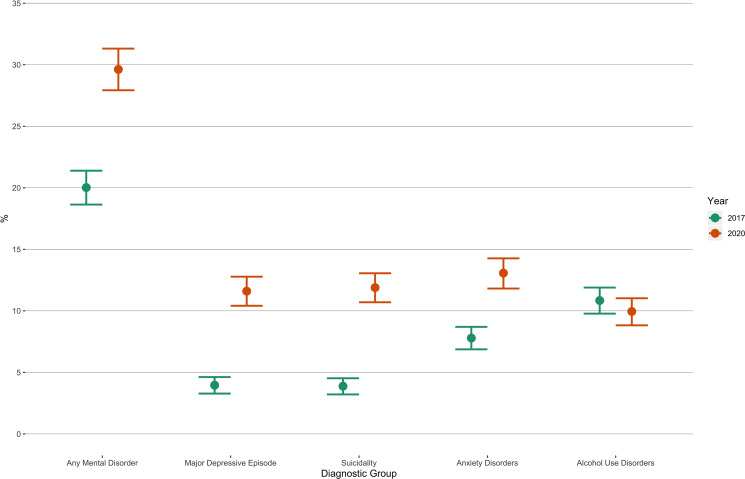
Aims: The United Nations warned of COVID-19-related mental health crisis; however, it is unknown whether there is an increase in the prevalence of mental disorders as existing studies lack a reliable baseline analysis or they did not use a diagnostic measure. We aimed to analyse trends in the prevalence of mental disorders prior to and during the COVID-19 pandemic. Methods: We analysed data from repeated cross-sectional surveys on a representative sample of non-institutionalised Czech adults (18+ years) from both November 2017 ( n = 3306; 54% females) and May 2020 ( n = 3021; 52% females). We used Mini International Neuropsychiatric Interview (MINI) as the main screening instrument. We calculated descriptive statistics and compared the prevalence of current mood and anxiety disorders, suicide risk and alcohol-related disorders at baseline and right after the first peak of COVID-19 when related lockdown was still in place in CZ. In addition, using logistic regression, we assessed the association between COVID-19-related worries and the presence of mental disorders. Results: The prevalence of those experiencing symptoms of at least one current mental disorder rose from a baseline of 20.02 (95% CI = 18.64; 21.39) in 2017 to 29.63 (95% CI = 27.9; 31.37) in 2020 during the COVID-19 pandemic. The prevalence of both major depressive disorder (3.96, 95% CI = 3.28; 4.62 v. 11.77, 95% CI = 10.56; 12.99); and suicide risk (3.88, 95% CI = 3.21; 4.52 v. 11.88, 95% CI = 10.64; 13.07) tripled and current anxiety disorders almost doubled (7.79, 95% CI = 6.87; 8.7 v. 12.84, 95% CI = 11.6; 14.05). The prevalence of alcohol use disorders in 2020 was approximately the same as in 2017 (10.84, 95% CI = 9.78; 11.89 v. 9.88, 95% CI = 8.74; 10.98); however, there was a significant increase in weekly binge drinking behaviours (4.07% v. 6.39%). Strong worries about both, health or economic consequences of COVID-19, were associated with an increased odds of having a mental disorder (1.63, 95% CI = 1.4; 1.89 and 1.42, 95% CI = 1.23; 1.63 respectively). Conclusions: This study provides evidence matching concerns that COVID-19-related mental health problems pose a major threat to populations, particularly considering the barriers in service provision posed during lockdown. This finding emphasises an urgent need to scale up mental health promotion and prevention globally.
Overview
The claims and statistics of this paper haven’t been checked yet.
Free: it reads the open-access text and checks the first 5 claims that cite a source we can check. Create a free account to check every claim.
Integrity signals
Registry
Cites
Statistics
Figures
Verification
Claims the paper makes
The claims and statistics of this paper haven’t been checked yet.
Free: it reads the open-access text and checks the first 5 claims that cite a source we can check. Create a free account to check every claim.
Claims other papers make about this one
Each is checked against this paper’s own text: does it say what the citing paper says it does?
The cited source says what the claim attributes to it.
In the citing paper
“Similarly, Winkler et al. (2020) reported on a repeated, robustly-sampled, nationally representative survey in the Czech Republic using baseline data from 2017 and found that suicide risk, as measured by the Mini International Neuropsychiatric Interview, increased from 3.9% in November 2017 to 11.9% in May 2020.”
From The impact of the COVID-19 pandemic on self-harm and suicidal behaviour: update of living systematic review (2021) · cites this paper as Winkler et al. (2020)
The cited source says what the claim attributes to it.
In the citing paper
“Two robustly sampled general population, nationally representative cross-sectional surveys with pre pandemic baseline data from 2017/18 reported a three to four fold increase in suicide risk ( Winkler et al., 2020) and suicidal thoughts in low-income households ( Raifman et al., 2020), but differences in data collection approaches (i.e. face-to-face vs. on-line) may bias comparisons.”
From The impact of the COVID-19 pandemic on self-harm and suicidal behaviour: update of living systematic review (2021) · cites this paper as Winkler et al., 2020
Self-check
Percentages, sums and reported differences re-computed from the paper’s own numbers.
The self-check needs the paper’s full text.
Citations
Cites
1 retracted
RETRACTED: Chinese mental health burden during the COVID-19 pandemic
Huang, Y., & Zhao, N. (2020) · Asian Journal of Psychiatry · doi:10.1016/j.ajp.2020.102052 · Cited by 185
Retracted(1998) · The Journal of Clinical Psychiatry · Cited by 19,139
The Psychological Impact of Quarantine and How to Reduce It: Rapid Review of the Evidence
Brooks, S. K., Webster, R. K., Smith, L. E., Woodland, L., Wessely, S., Greenberg, N., & Rubin, G. J. (2020) · doi:10.2139/ssrn.3532534 · Cited by 16,394
The psychological impact of quarantine and how to reduce it: Rapid review of the evidence
Brooks, S. K., Webster, R. K., Smith, L. E., Woodland, L., Wessely, S., Greenberg, N., & Rubin, G. J. (2020) · The Lancet · doi:10.1016/s0140-6736(20)30460-8 · Cited by 16,378
(1998) · PubMed · Cited by 10,216
Holmes, E. A., O'Connor, R. C., Perry, V. H., Tracey, I., Wessely, S., Arseneault, L., Ballard, C., Christensen, H., Cohen Silver, R., Everall, I., et al. (2020) · The Lancet Psychiatry · doi:10.1016/s2215-0366(20)30168-1 · Cited by 5,715
Qiu, J., Shen, B., Zhao, M., Wang, Z., Xie, B., & Xu, Y. (2020) · General Psychiatry · doi:10.1136/gpsych-2020-100213 · Cited by 4,307
The Lancet Commission on global mental health and sustainable development
Patel, V., Saxena, S., Lund, C., Thornicroft, G., Baingana, F., Bolton, P., Chisholm, D., Collins, P. Y., Cooper, J. L., Eaton, J., et al. (2018) · The Lancet · doi:10.1016/s0140-6736(18)31612-x · Cited by 3,692
Hammen, C. (2005) · Annual Review of Clinical Psychology · doi:10.1146/annurev.clinpsy.1.102803.143938 · Cited by 2,979
Mental health problems and social media exposure during COVID-19 outbreak
Gao, J., Zheng, P., Jia, Y., Chen, H., Mao, Y., Chen, S., Wang, Y., Fu, H., & Dai, J. (2020) · PLoS ONE · doi:10.1371/journal.pone.0231924 · Cited by 2,830
Research works printed but not linked: 1
- CZSO (2019) Demographic Yearbook of the Czech Republic 2018. Prague: Czech Statistical Office.
Cited by
Items 201–238 of 238
Voderholzer, U., & Schramm, E. (2024) · Verhaltenstherapie · doi:10.1159/000539373
“Eine Studie aus dem Jahr 2020 [Winkler et al., 2020] zeigte, dass die Prävalenz schwerer depressiver Störungen während der Corona-pandemie verdreifachte und dass sich die Prävalenz der Angststörungen in diesem Zeitraum fast verdoppelte.”
Art Mental Care Simulation Design Using ETC Technique
Han, I., Kim, J. W., Kim, S. K., Yoon, Y. C., & Yang, D. H. (2024) · International Conference on Ubiquitous and Future Networks · doi:10.1109/icufn61752.2024.10625159
“[1] There are a variety of mental management services, including psychological counseling, for the growing number of people with mental illness, but they are reluctant to disclose the name of their illness due to concerns about social stigma and discrimination.”
BackgroundSuicide during the global COVID-19 pandemic
Wasserman, D., Iosue, M., & Carli, V. (2024) · Oxford University Press eBooks · doi:10.1093/med/9780198843405.003.0021
Giordano, F., Guidotti, S., Scategni, F. C., Cuzzola, D., & Pruneti, C. A. (2024) · European Journal of Investigation in Health Psychology and Education · doi:10.3390/ejihpe14100183
“The prevalence of PDs among cocaine addicts has likely increased following the COVID-19 pandemic, which exacerbated several other mental disorders [32,33].”
BackgroundWijk, C. H. V. (2024) · South African Journal of Psychology · doi:10.1177/00812463241291972
“The longitudinal trajectory suggests relatively low prevalence and temporal stability of CMD compared to local (Bantjes et al., 2023; Craig et al., 2022) and international (Daly et al., 2020; Ettman et al., 2020; Pierce et al., 2020; Winkler et al., 2020) studies.”
Building Bridges to Wellbeing: Using Trauma-Informed Practices to Promote Student Wellbeing
Bunten, M. G. (2025) · IGI Global eBooks · doi:10.4018/979-8-3693-9466-3.ch007
Ralbovská, D. R., Otřísal, P., Argayová, I., & Čermáková, D. C. (2025) · Studies in systems, decision and control · doi:10.1007/978-3-031-43506-5_32
Candra, R., & Risnawaty, W. (2023) · Jurnal Muara Ilmu Sosial Humaniora dan Seni · doi:10.24912/jmishumsen.v6i3.18724.2022 · Cited by 1
“Hasil penelitian yang dilakukan oleh Winkler et al. (2020) mengenai peningkatan mental disorder pada masa pandemi covid-19 menunjukkan bahwa terjadi peningkatan prevalensi Major Depressive Disorder (MDD) sebesar 7.81% dalam jangka waktu 3 tahun, yaitu dari November 2017 (3.96, 95% CI = 3.28; 4.62)…”
InfluentialPandemics and Suicidal Behaviour
Menon, V., Varadharajan, N., & Ganesh, R. (2025) · Springer eBooks · doi:10.1007/978-981-96-4028-7_9
Vazio Existencial e o Sentido da Vida: Um Ensaio Teórico acerca da Aplicação Clínica da Logoterapia
Lima, A. D. S., & Evangelista, N. M. (2025) · ID on line REVISTA DE PSICOLOGIA · doi:10.14295/idonline.v19i75.4107
Ipatyuk, O. V., & Kozunova, G. L. (2025) · S S Korsakov Journal of Neurology and Psychiatry · doi:10.17116/jnevro20251250517
Chadha, M., Rani, N., & Singh, T. G. (2025) · Current Behavioral Neuroscience Reports · doi:10.1007/s40473-025-00303-3
“Comparing this with the prevalence of other mental health diseases, such as bipolar or schizophrenia, depression appears to be rising more uniformly and broadly; heralding an emerging public health problem that requires improved mental health care and services [21–23]Fig.”
Sosa, M. Z. P., Vega, D., Sanz‐Gómez, S., Alacreu‐Crespo, A., Moreno-Gea, P., Sáiz, P. A., Rey, J., Giner, J., & Giner, L. (2025) · Behavioral Sciences · doi:10.3390/bs15070868 · Cited by 1
“…pandemic’s psychological impact is well documented: there has been a marked increase in the prevalence of mental disorders (Santomauro et al., 2021; Winkler et al., 2020), worsened outcomes for individuals with pre-existing psychiatric conditions (Neelam et al., 2021), and heightened suicide risk…”
Epidemiology of psychiatric disorders in Texas prisons from 2016 to 2023
Zhong, R., Serna, M. K., Farroni, J. S., Digbeu, B. D. E., Baillargeon, G. M., Pulvino, J. S., Penn, J. V., Murray, O. J., & Baillargeon, J. (2025) · Epidemiology and Psychiatric Sciences · doi:10.1017/s2045796025100267
Hu, R., Xie, Z., Li, J., Luo, H., Guo, Y., Tan, J., & Luo, Q. (2025) · BMC Psychiatry · doi:10.1186/s12888-025-07321-1
“Additionally, the COVID-19 pandemic has further increased the healthcare burden [33].”
The COVID Stress Scale in a Malaysian population: Psychometric properties
Kadir, N. B. A., Mohd, R. H., Manaf, M. R. A., Malik, N. A., & Rafiq, M. (2025) · Jurnal e-Bangi/e-Bangi · doi:10.17576/ebangi.2025.2204.04
Riepenhausen, A. (2023) · Refubium (Universitätsbibliothek der Freien Universität Berlin) · doi:10.17169/refubium-40578
Miskovic‐Wheatley, J., Koreshe, E., Kim, M., Simeone, R., & Maguire, S. (2022) · Figshare · doi:10.6084/m9.figshare.18585636
Miskovic‐Wheatley, J., Koreshe, E., Kim, M., Simeone, R., & Maguire, S. (2022) · Figshare · doi:10.6084/m9.figshare.18585639
Petersen, M. W., Dantoft, T. M., Jensen, J. S., Pedersen, H. F., Frostholm, L., Benros, M. E., Carstensen, T. B. W., Ørnbøl, E., & Fink, P. (2021) · Figshare · doi:10.6084/m9.figshare.15001252
Miskovic‐Wheatley, J., Koreshe, E., Kim, M., Simeone, R., & Maguire, S. (2022) · Figshare · doi:10.6084/m9.figshare.18585642
Miskovic‐Wheatley, J., Koreshe, E., Kim, M., Simeone, R., & Maguire, S. (2022) · Figshare · doi:10.6084/m9.figshare.18585633
Diaz, H. M. (2023) · DSPACE System - Metalibrary (University of the Coast)
La Experiencia arquitectónica: Un enfoque biológico-cognitivo
Toscuento, E. T. (2022) · Tesis Doctorals en Xarxa (Consorci de Serveis Universitaris de Catalunya)
Bercum, F. M. (2023) · CU Scholar (University of Colorado Boulder)
Boily, M., Turbide, C., Héon, N., Nazaire, M., & Lord, V. (2024) · Sémaphore (Université du Québec à Rimouski)
Gabarrell‐Pascuet, A. (2024) · Dipòsit Digital de la Universitat de Barcelona (Universitat de Barcelona)
Mikoška, P., Pilárik, Ľ., Novák, L., Ladmanová, M., Bok, T., Fülep, M., & Timulák, L. (2026) · Counselling and Psychotherapy Research · doi:10.1002/capr.70234
Recognizing diversity in Czech classrooms: Teachers’ perceptions and (un)certainty
Pitoňák, M., Fric, K., & Smetáčková, I. (2025) · Moravian Geographical Reports · doi:10.2478/mgr-2025-0021
“Experiences during the COVID-19 pandemic further highlighted the urgency of addressing mental health in schools, yet our findings indicate that educators' uncertainty remains in the medium range, suggesting these challenges are far from resolved (Ma et al., 2021; Winkler et al., 2020).”
Bartholmae, M. M., & Gunawardena, T. (2026) · International Journal of Environmental Research and Public Health · doi:10.3390/ijerph23010129
Cui, Z. (2026) · Molecular Psychiatry · doi:10.1038/s41380-026-03643-y
“The prediction of brain-barrier concordance using just 34 risk factors underscores the substantial in fl uence of the environment on brain-barrier interactions, and offers a foundation for generating hypotheses for further investigation in individual-level studies.”
Impact of different public policies agains Covid-19 on mental health outcomes
Rocha, L. H. D. P. (2022) · doi:10.11606/003127531
The in vitro study of the susceptibility of Bifidobacteria to antidepressantsPreprint
Mahayri, T. M., Killer, J., Jakob, L., Hakenova, K., Mrázek, J., Sechovcová, H., & Fliegerova, K. O. (2026) · Research Square · doi:10.21203/rs.3.rs-10521979/v1
Peña, S., Palet, D., Salazar-Fernández, C., & Mella, F. R. (2026) · Drug and Alcohol Review · doi:10.1111/dar.70229
Jacobs, K., & Vandepoel, I. (2026) · Journal of Educational Health and Community Psychology · doi:10.12928/jehcp.vi.32353
Production and evaluation of a novel GABA-producing almond yogurt: dietary modulation of stress
Anagha, M., Ramachandran, R., Divyashri, G., & Murthy, T. P. K. (2026) · Frontiers in Veterinary Science · doi:10.3389/fvets.2026.1949462
Walkden, S. M., & Jefferson, R. (2026) · Mental Health and Social Inclusion · doi:10.1108/mhsi-10-2026-0434
Metadata
- Authors
- Winkler, P., Formanek, T., Mlada, K., Kagstrom, A., Mohrova, Z., Mohr, P., & Csemy, L.
- Affiliations
- King's College London (GB)
- Charles University (CZ)
- Corresponding author
- Winkler, P.
- Venue
- Epidemiology and Psychiatric Sciences
- Publisher
- Cambridge University Press (CUP)
- Published
- 2020
- Volume
- 29
- Pages
- e173-e173
- ISSN
- 2045-7960 (ISSN-L)
- 2045-7979
- PMC
- PMC7573458
- OpenAlex
- W3090340480
- Cited by
- 223
- References
- 47
- Citations by year
- 2026: 4 · 2025: 22 · 2024: 28 · 2023: 56 · 2022: 60 · 2021: 53
- FWCI
- 16.91
- Type
- journal article
- Language
- en
- Open access
- gold
- doi.org
- Locations
- Epidemiology and Psychiatric Sciences (publishedVersion, cc-by)
- PubMed Central (publishedVersion, cc-by)
- PubMed (publishedVersion)
- Funders
- National Institute of Mental Health (LO1611)
- Topics
- Social Sciences › Psychology › Clinical Psychology › COVID-19 and Mental Health
- Health Sciences › Medicine › Psychiatry and Mental health › Mental Health Treatment and Access
- Health Sciences › Medicine › Public Health, Environmental and Occupational Health › Maternal Mental Health During Pregnancy and Postpartum
- Keywords
- COVID-19 pandemic, mental illness, prevalence trends, mood disorders, anxiety disorders, major depressive disorder, suicide risk, alcoholism, COVID-19-related worry, lockdown, Czech adults, mental health crisis
- MeSH terms
- Betacoronavirus, COVID-19, SARS-CoV-2, Adult, Anxiety Disorders, Mental Disorders, Cross-Sectional Studies, Depressive Disorder, Major, Major Depressive Disorder, Female, Humans, Male, Mental Health, Middle Aged, Pneumonia, Viral, Psychiatric Status Rating Scales, Surveys and Questionnaires, Suicide, Prevalence, Czech Republic, Coronavirus Infections, Mood Disorders, Alcohol-Related Disorders, Pandemics
About these checks
Registry, retraction, Cites and statistics results are computed, not judged, with one exception: a printed reference that no index lists is read once by a model before it counts as a citation error. Claims are extracted by a model and kept only when their quote appears verbatim in the text; each cited source is then checked, with a model’s help, for whether it says what the claim relies on. Those verdicts can be wrong — read the claim’s quote and the cited source before relying on one.
Statistics and arithmetic are recomputed, not judged.
Confidence bands are shown only for fields calibrated on our annotated test set. None is calibrated yet, so no band is shown.
What counts as a claim ›How we measure confidence ›How we check this ›
Are you an author, or do you see a problem with this page? Request a review
Data sources
Bibliographic data: Semantic Scholar, OpenAlex, Crossref.
Contains information from the Semantic Scholar Academic Graph Datasets, made available under the ODC Attribution License (ODC-BY 1.0).
Semantic Scholar’s data is described in: Kinney, R., et al. (2023). The Semantic Scholar Open Data Platform. arXiv:2301.10140.
