

Increase in prevalence of current mental disorders in the context of COVID-19: analysis of repeated nationwide cross-sectional surveys.
Open accessThe DOI matches its Crossref record; 48 of the 48 references it cites were found in a registry or an index.
Abstract
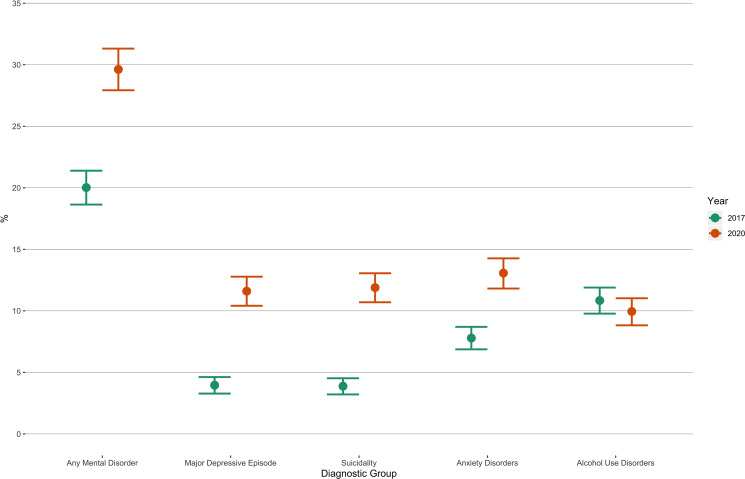
Aims: The United Nations warned of COVID-19-related mental health crisis; however, it is unknown whether there is an increase in the prevalence of mental disorders as existing studies lack a reliable baseline analysis or they did not use a diagnostic measure. We aimed to analyse trends in the prevalence of mental disorders prior to and during the COVID-19 pandemic. Methods: We analysed data from repeated cross-sectional surveys on a representative sample of non-institutionalised Czech adults (18+ years) from both November 2017 ( n = 3306; 54% females) and May 2020 ( n = 3021; 52% females). We used Mini International Neuropsychiatric Interview (MINI) as the main screening instrument. We calculated descriptive statistics and compared the prevalence of current mood and anxiety disorders, suicide risk and alcohol-related disorders at baseline and right after the first peak of COVID-19 when related lockdown was still in place in CZ. In addition, using logistic regression, we assessed the association between COVID-19-related worries and the presence of mental disorders. Results: The prevalence of those experiencing symptoms of at least one current mental disorder rose from a baseline of 20.02 (95% CI = 18.64; 21.39) in 2017 to 29.63 (95% CI = 27.9; 31.37) in 2020 during the COVID-19 pandemic. The prevalence of both major depressive disorder (3.96, 95% CI = 3.28; 4.62 v. 11.77, 95% CI = 10.56; 12.99); and suicide risk (3.88, 95% CI = 3.21; 4.52 v. 11.88, 95% CI = 10.64; 13.07) tripled and current anxiety disorders almost doubled (7.79, 95% CI = 6.87; 8.7 v. 12.84, 95% CI = 11.6; 14.05). The prevalence of alcohol use disorders in 2020 was approximately the same as in 2017 (10.84, 95% CI = 9.78; 11.89 v. 9.88, 95% CI = 8.74; 10.98); however, there was a significant increase in weekly binge drinking behaviours (4.07% v. 6.39%). Strong worries about both, health or economic consequences of COVID-19, were associated with an increased odds of having a mental disorder (1.63, 95% CI = 1.4; 1.89 and 1.42, 95% CI = 1.23; 1.63 respectively). Conclusions: This study provides evidence matching concerns that COVID-19-related mental health problems pose a major threat to populations, particularly considering the barriers in service provision posed during lockdown. This finding emphasises an urgent need to scale up mental health promotion and prevention globally.
Overview
The claims and statistics of this paper haven’t been checked yet.
Free: it reads the open-access text and checks the first 5 claims that cite a source we can check. Create a free account to check every claim.
Integrity signals
Registry
Cites
Statistics
Figures
Verification
Claims the paper makes
The claims and statistics of this paper haven’t been checked yet.
Free: it reads the open-access text and checks the first 5 claims that cite a source we can check. Create a free account to check every claim.
Claims other papers make about this one
Each is checked against this paper’s own text: does it say what the citing paper says it does?
The cited source says what the claim attributes to it.
In the citing paper
“Similarly, Winkler et al. (2020) reported on a repeated, robustly-sampled, nationally representative survey in the Czech Republic using baseline data from 2017 and found that suicide risk, as measured by the Mini International Neuropsychiatric Interview, increased from 3.9% in November 2017 to 11.9% in May 2020.”
From The impact of the COVID-19 pandemic on self-harm and suicidal behaviour: update of living systematic review (2021) · cites this paper as Winkler et al. (2020)
The cited source says what the claim attributes to it.
In the citing paper
“Two robustly sampled general population, nationally representative cross-sectional surveys with pre pandemic baseline data from 2017/18 reported a three to four fold increase in suicide risk ( Winkler et al., 2020) and suicidal thoughts in low-income households ( Raifman et al., 2020), but differences in data collection approaches (i.e. face-to-face vs. on-line) may bias comparisons.”
From The impact of the COVID-19 pandemic on self-harm and suicidal behaviour: update of living systematic review (2021) · cites this paper as Winkler et al., 2020
Self-check
Percentages, sums and reported differences re-computed from the paper’s own numbers.
The self-check needs the paper’s full text.
Citations
Cites
1 retracted
RETRACTED: Chinese mental health burden during the COVID-19 pandemic
Huang, Y., & Zhao, N. (2020) · Asian Journal of Psychiatry · doi:10.1016/j.ajp.2020.102052 · Cited by 185
Retracted(1998) · The Journal of Clinical Psychiatry · Cited by 19,139
The Psychological Impact of Quarantine and How to Reduce It: Rapid Review of the Evidence
Brooks, S. K., Webster, R. K., Smith, L. E., Woodland, L., Wessely, S., Greenberg, N., & Rubin, G. J. (2020) · doi:10.2139/ssrn.3532534 · Cited by 16,394
The psychological impact of quarantine and how to reduce it: Rapid review of the evidence
Brooks, S. K., Webster, R. K., Smith, L. E., Woodland, L., Wessely, S., Greenberg, N., & Rubin, G. J. (2020) · The Lancet · doi:10.1016/s0140-6736(20)30460-8 · Cited by 16,378
(1998) · PubMed · Cited by 10,216
Holmes, E. A., O'Connor, R. C., Perry, V. H., Tracey, I., Wessely, S., Arseneault, L., Ballard, C., Christensen, H., Cohen Silver, R., Everall, I., et al. (2020) · The Lancet Psychiatry · doi:10.1016/s2215-0366(20)30168-1 · Cited by 5,715
Qiu, J., Shen, B., Zhao, M., Wang, Z., Xie, B., & Xu, Y. (2020) · General Psychiatry · doi:10.1136/gpsych-2020-100213 · Cited by 4,307
The Lancet Commission on global mental health and sustainable development
Patel, V., Saxena, S., Lund, C., Thornicroft, G., Baingana, F., Bolton, P., Chisholm, D., Collins, P. Y., Cooper, J. L., Eaton, J., et al. (2018) · The Lancet · doi:10.1016/s0140-6736(18)31612-x · Cited by 3,692
Hammen, C. (2005) · Annual Review of Clinical Psychology · doi:10.1146/annurev.clinpsy.1.102803.143938 · Cited by 2,979
Mental health problems and social media exposure during COVID-19 outbreak
Gao, J., Zheng, P., Jia, Y., Chen, H., Mao, Y., Chen, S., Wang, Y., Fu, H., & Dai, J. (2020) · PLoS ONE · doi:10.1371/journal.pone.0231924 · Cited by 2,830
Research works printed but not linked: 1
- CZSO (2019) Demographic Yearbook of the Czech Republic 2018. Prague: Czech Statistical Office.
Cited by
Santomauro, D. F., Mantilla Herrera, A. M., Shadid, J., Zheng, P., Ashbaugh, C., Pigott, D. M., Abbafati, C., Adolph, C., Amlag, J. O., Aravkin, A. Y., et al. (2021) · The Lancet · doi:10.1016/s0140-6736(21)02143-7 · Cited by 5,444
“39,40 The study that did not report an increased prevalence was conducted in one specific city in Norway (Trondheim) using very small cross-sectional samples.”
OECD (2021) · OECD Health Policy Studies · doi:10.1787/4ed890f6-en · Cited by 407
Suicide behaviors during the COVID-19 pandemic: A meta-analysis of 54 studies
Dubé, J. P., Smith, M. M., Sherry, S. B., Hewitt, P. L., & Stewart, S. H. (2021) · Psychiatry Research · doi:10.1016/j.psychres.2021.113998 · Cited by 291
John, A., Eyles, E., Webb, R. T., Okolie, C., Schmidt, L., Arensman, E., Hawton, K., O'Connor, R. C., Kapur, N., Moran, P., et al. (2021) · F1000Research · doi:10.12688/f1000research.25522.2 · Cited by 189
The impact of the COVID-19 pandemic on self-harm and suicidal behaviour: a living systematic review
John, A., Okolie, C., Eyles, E., Webb, R. T., Schmidt, L., McGuinness, L. A., Olorisade, B. K., Arensman, E., Hawton, K., Kapur, N., et al. (2020) · F1000Research · doi:10.12688/f1000research.25522.1 · Cited by 178
Mental disorders following COVID-19 and other epidemics: a systematic review and meta-analysis
Leung, C. M. C., Ho, M. K., Bharwani, A. A., Cogo-Moreira, H., Wang, Y., Chow, M. S. C., Fan, X., Galea, S., Leung, G. M., & Ni, M. Y. (2022) · Translational Psychiatry · doi:10.1038/s41398-022-01946-6 · Cited by 174
“Perception Higher perceived susceptibility [62, 70, 74, 75, 98,165]”
BackgroundSchmidt, R. A., Genois, R., Jin, J., Vigo, D., Rehm, J., & Rush, B. (2021) · Drug and Alcohol Dependence · doi:10.1016/j.drugalcdep.2021.109065 · Cited by 169
Mental health in Europe during the COVID-19 pandemic: a systematic review
Ahmed, N., Barnett, P., Greenburgh, A., Pemovska, T., Stefanidou, T., Lyons, N., Ikhtabi, S., Talwar, S., Francis, E. R., Harris, S. M., et al. (2023) · The Lancet Psychiatry · doi:10.1016/s2215-0366(23)00113-x · Cited by 162
Effects of the COVID-19 pandemic and lockdown on alcohol use disorders and complications
Murthy, P., & Narasimha, V. L. (2021) · Current Opinion in Psychiatry · doi:10.1097/yco.0000000000000720 · Cited by 148
“A repeat nationwide survey from the Czech Republic showed no change in alcohol use in 2020, as compared to 2017 [34].”
BackgroundIncreasing Cybercrime Since the Pandemic: Concerns for Psychiatry
Monteith, S., Bauer, M., Alda, M., Geddes, J. R., Whybrow, P. C., & Glenn, T. (2021) · Current Psychiatry Reports · doi:10.1007/s11920-021-01228-w · Cited by 151
Knudsen, A. K. S., Stene-Larsen, K., Gustavson, K., Hotopf, M., Kessler, R. C., Krokstad, S., Skogen, J. C., Øverland, S., & Reneflot, A. (2021) · The Lancet Regional Health - Europe · doi:10.1016/j.lanepe.2021.100071 · Cited by 116
“Like other studies comparing mental health before and during the COVID-19 pandemic [3-7] respondents were recruited from a panel of previous survey participants, and as is commonly the case in epidemiological surveys, response rates varied with gender, age and”
BackgroundMethodResultDaly, M., & Robinson, E. (2021) · Journal of Affective Disorders · doi:10.1016/j.jad.2021.02.054 · Cited by 94
“Further, given high levels of anxiety were observed in a range of countries at the onset of the pandemic (Vindegaard et al., 2020; Winkler et al., 2020) testing whether anxiety symptoms declined in a similar fashion in other nations and the role of the COVID-19 situation in shaping trajectories of anxiety will now be…”
BackgroundHajek, A., Sabat, I., Neumann‐Böhme, S., Schreyögg, J., Barros, P. P., Stargardt, T., & König, H. (2021) · Journal of Affective Disorders · doi:10.1016/j.jad.2021.12.029 · Cited by 103
Meta-analytic evidence of depression and anxiety in Eastern Europe during the COVID-19 pandemic
Zhang, S. X., Miller, S., Xu, W., Yin, A., Chen, B. Z., Delios, A., Dong, R. K., Chen, R. Z., McIntyre, R. S., Wan, X., et al. (2022) · European Journal of Psychotraumatology · doi:10.1080/20008198.2021.2000132 · Cited by 95
McCullock, S. P., & Scrivano, R. M. (2022) · Clinical Psychology Review · doi:10.1016/j.cpr.2022.102242 · Cited by 88
Wang, Z., Dou, Y., Yang, X. C., Guo, X., Ma, X., Zhou, B., & Zhang, W. (2025) · Translational Psychiatry · doi:10.1038/s41398-025-03623-w · Cited by 91
Winkler, P., Mohrova, Z., Mlada, K., Kuklova, M., Kagstrom, A., Mohr, P., & Formanek, T. (2021) · Journal of Psychiatric Research · doi:10.1016/j.jpsychires.2021.05.032 · Cited by 74
“In Czechia alone, the proportion of the population scoring positively for at least one current mental disorder increased from 20% to almost 30%, when compared to pre-pandemic baseline levels (Formanek et al., 2019; Winkler et al., 2020).”
BackgroundSelf-citationRogers, J. P., Chesney, E., Oliver, D., Begum, N., Saini, A., Wang, S., McGuire, P., Fusar-Poli, P., Lewis, G., & David, A. S. (2021) · Epidemiology and Psychiatric Sciences · doi:10.1017/s2045796021000214 · Cited by 68
Jollant, F., Roussot, A., Corruble, E., Chauvet‐Gélinier, J., Falissard, B., Mikaeloff, Y., & Quantin, C. (2021) · The Lancet Regional Health - Europe · doi:10.1016/j.lanepe.2021.100102 · Cited by 85
“Some studies also showed increases in suicidal ideation [3,4], notably in conditions of confinement [5].”
BackgroundSuicide Risk and Prevention During the COVID-19 Pandemic: One Year On
Sinyor, M., Knipe, D., Borges, G., Ueda, M., Pirkis, J., Phillips, M. R., Gunnell, D., & the International COVID-19 Suicide Prevention Research Collaboration (2022) · Archives of Suicide Research · doi:10.1080/13811118.2021.1955784 · Cited by 73
“Evidence has emerged of substantial negative mental health consequences, including possible increasing rates of suicidal thoughts (O’Connor et al., 2021; Winkler et al., 2020).”
BackgroundEbrahimi, O. V., Burger, J., Hoffart, A., & Johnson, S. U. (2021) · BMC Medicine · doi:10.1186/s12916-021-02179-y · Cited by 57
Gavurová, B., Ivanková, V., Rigelský, M., Mudarri, T., & Miovský, M. (2022) · Frontiers in Public Health · doi:10.3389/fpubh.2022.859107 · Cited by 67
Ayuso-Mateos, J. L., Morillo, D., Haro, J. M., Olaya, B., Lara, E., & Miret, M. (2021) · Epidemiology and Psychiatric Sciences · doi:10.1017/s2045796021000408 · Cited by 53
“…and suicidal ideation (Daly et al ., 2020; Niedzwiedz et al ., 2021; Novotny et al ., 2020; Pierce et al ., 2020; Planchuelo-Gomez et al ., 2020; Winkler et al ., 2020; McGinty et al ., 2020 b ) whereas others did not report differences above pre-pandemic levels (Kwong et al ., 2020; van der…”
BackgroundRetractedNiederkrotenthaler, T., Laido, Z., Kirchner, S., Braun, M., Metzler, H., Waldhoer, T., Strauss, M. J., García, D., & Till, B. (2021) · Journal of Affective Disorders · doi:10.1016/j.jad.2021.08.153 · Cited by 56
“, 2020), individuals with pre-existing mental disorders (Czeisler et al., 2020; Vindegaard and Benros, 2020; Winkler et al., 2020; Xiong et al., 2020; Pan et al., 2021), and medical personnel working at the frontlines to treat patients (Kreh et al.”
InfluentialBorkel, L. F., Rojas‐Hernández, J., Henríquez‐Hernández, L. A., Santana, Á., & Hernández, D. J. Q. (2023) · Expert Review of Clinical Pharmacology · doi:10.1080/17512433.2023.2295997 · Cited by 58
Gavurová, B., Khouri, S., Ivanková, V., Rigelský, M., & Mudarri, T. (2022) · Frontiers in Public Health · doi:10.3389/fpubh.2022.893845 · Cited by 55
Zimmerman, M., Ward, M., D’Avanzato, C., & Wilner, J. G. (2021) · Journal of Personality Disorders · doi:10.1521/pedi_2021_35_539 · Cited by 51
Plazas, E., & Faraone, N. (2023) · Biomedicines · doi:10.3390/biomedicines11020461 · Cited by 47
Mortier, P., Vilagut, G., Ferrer, M., Alayo, I., Bruffaerts, R., Cristóbal-Narváez, P., del Cura-González, I., Domènech‐Abella, J., Félez-Nóbrega, M., Olaya, B., et al. (2021) · Epidemiology and Psychiatric Sciences · doi:10.1017/s2045796021000093 · Cited by 53
“, 2014), even though lower than in representative population-based studies in other countries conducted during the COVID-19 pandemic: the Czech Republic (11.9%; Winkler et al., 2020), the UK (8.”
InfluentialMiskovic‐Wheatley, J., Koreshe, E., Kim, M., Simeone, R., & Maguire, S. (2022) · Journal of Eating Disorders · doi:10.1186/s40337-021-00527-0 · Cited by 49
“Following early warnings from the United Nations about a pandemic-associated mental health crisis [6], population-wide mental health concerns have been reported including a twofold increase in anxiety disorders, a threefold increase in major depressive disorders and suicide risk, and significant increases in binge dri…”
BackgroundInfluentialValente, J. Y., Sohi, I., García-Cerde, R., Monteiro, M. G., & Sanchez, Z. M. (2021) · Drug and Alcohol Dependence · doi:10.1016/j.drugalcdep.2021.108621 · Cited by 44
Asmundson, G. J. G., Rachor, G. S., Drakes, D. H., Boehme, B. A. E., Paluszek, M. M., & Taylor, S. J. (2022) · Journal of Anxiety Disorders · doi:10.1016/j.janxdis.2022.102554 · Cited by 44
Fleischmann, E., Dalkner, N., Fellendorf, F. T., & Reininghaus, E. Z. (2021) · World Journal of Psychiatry · doi:10.5498/wjp.v11.i12.1387 · Cited by 48
Petersen, M. W., Dantoft, T. M., Jensen, J. S., Pedersen, H. F., Frostholm, L., Benros, M. E., Carstensen, T. B. W., Ørnbøl, E., & Fink, P. (2021) · BMC Public Health · doi:10.1186/s12889-021-11472-7 · Cited by 42
“Other general population-based studies have indicated higher levels of depression [11, 12, 14, 22, 39, 40], emotional distress [13, 41, 42], anxiety [11, 14, 22, 39, 40], and somatic symptom load [11] during the Covid-19 pandemic.”
BackgroundSweeney, C., Ennis, E., Mulvenna, M. D., Bond, R., & O’Neill, S. M. (2024) · JMIR Mental Health · doi:10.2196/55747 · Cited by 42
“With the increasing prevalence of mental health issues since the COVID-19 pandemic [31] and the need for effective suicide prevention strategies, using data analysis and machine learning techniques in textual digital media data research has demonstrated that the COVID-19 pandemic and its associated…”
BackgroundZurlo, M. C., Volta, M. F. C. D., & Vallone, F. (2022) · Frontiers in Psychology · doi:10.3389/fpsyg.2021.741332 · Cited by 36
“These findings were consistent with research examining mental health among the general population before and during the pandemic (Winkler et al., 2020; Becerra-García et al., 2021; Daly et al., 2021) and supported – also among the student population – the detrimental psychological impact of the COVID-19 outbreak.”
ResultInvestigating psychotherapists’ attitudes towards artificial intelligence in psychotherapy
Wagner, J., & Schwind, A.-S. (2025) · BMC Psychology · doi:10.1186/s40359-025-03071-7 · Cited by 35
Riepenhausen, A., Veer, I. M., Wackerhagen, C., Reppmann, Z. C., Köber, G., Ayuso‐Mateos, J. L., Bögemann, S. A., Corrao, G., Félez-Nóbrega, M., Haro, J. M., et al. (2022) · Psychological Medicine · doi:10.1017/s0033291722000563 · Cited by 37
“…pandemic compared to pre-pandemic symptom levels (Daly, Sutin, & Robinson, 2021; Dawel et al., 2020; Ettman et al., 2020; Peters, Rospleszcz, Greiser, Dallavalle, & Berger, 2020; Pieh, Budimir, & Probst, 2020; Pierce et al., 2020; Sibley et al., 2020; Twenge & Joiner, 2020; Winkler et al., 2020).”
The Role of Developmental Assets in Gender Differences in Anxiety in Spanish Youth
Gómez‐Baya, D., Salinas-Pérez, J. A., Sánchez-López, Á., Paíno-Quesada, S., & Berjano, R. M. (2022) · Frontiers in Psychiatry · doi:10.3389/fpsyt.2022.810326 · Cited by 35
Marić, N. P., Lazarević, L. B., Priebe, S., Mihić, L., Pejovic-Milovancevic, M. M., Terzić-Šupić, Z., Tošković, O., Vuković, O., Todorović, J., & Knežević, G. (2022) · Epidemiology and Psychiatric Sciences · doi:10.1017/s2045796022000117 · Cited by 32
“The prevalence of mental disorders in Serbia during 2021 was very similar to those in Norway during 2019–20 (Knudsen et al., 2021), but substantially lower than those reported in the Czech Republic during 2020 (Winkler et al., 2020).”
BackgroundResultBabicki, M., Szewczykowska, I., & Mastalerz–Migas, A. (2021) · International Journal of Environmental Research and Public Health · doi:10.3390/ijerph18052522 · Cited by 27
“63%, showing the impact of the COVID-19 pandemic and the numerous restrictions associated with it [28].”
BackgroundAI-Based Prediction and Prevention of Psychological and Behavioral Changes in Ex-COVID-19 Patients
Ćosić, K., Popović, S., Šarlija, M., Kesedžić, I., Gambiraža, M., Dropuljić, B., Mijić, I., Henigsberg, N., & Jovanović, T. (2021) · Frontiers in Psychology · doi:10.3389/fpsyg.2021.782866 · Cited by 29
“…patients, it might be more appropriate to use: (a) relevant modules of shorter structured clinical interviews, like M.I.N.I. (Sheehan et al., 1998; Winkler et al., 2020); (b) semi-structured interviews on COVID-19 experiences, which have been applied in qualitative research during the pandemic…”
MethodOsváth, P. (2021) · Orvosi Hetilap · doi:10.1556/650.2021.31141 · Cited by 34
“[30] Winkler P, Formanek T, Mlada K, et al.”
Schäfer, A. A., Santos, L. P., Manosso, L. M., Quadra, M. R., & Meller, F. D. O. (2022) · Journal of Psychosomatic Research · doi:10.1016/j.jpsychores.2022.110910 · Cited by 27
Jollant, F., Blanc-Brisset, I., Cellier, M., Akkaoui, M. A., Tran, V. C., Hamel, J., Piot, M., Nourredine, M., Nisse, P., Hawton, K. E., et al. (2022) · European Journal of Epidemiology · doi:10.1007/s10654-022-00907-z · Cited by 27
Donker, T., Fehribach, J. R., van Klaveren, C., Cornelisz, I., Toffolo, M. B. J., van Straten, A., & van Gelder, J. (2022) · Psychological Medicine · doi:10.1017/s0033291722003531 · Cited by 31
“…the coronavirus disease 2019 (COVID-19) pandemic has further exacerbated this already challenging state of affairs as the prevalence of mental health problems has increased dramatically (Winkler et al., 2020), while access to evidence-based treatment has declined (World Health Organization, 2020).”
Wright-Berryman, J. L., Cohen, J., Haq, A., Black, D. P., & Pease, J. L. (2023) · Frontiers in Psychiatry · doi:10.3389/fpsyt.2023.1143175 · Cited by 26
“This may be of particular importance to the medical and mental health field as the rise in prevalence of mental health disorders (33) warrants screening tools that are both portable and efficient.”
BackgroundEbrahimi, O. V., Bauer, D. J., Hoffart, A., & Johnson, S. U. (2022) · Journal of Psychopathology and Clinical Science · doi:10.1037/abn0000786 · Cited by 25
State of the Science in Behavior Therapy: Taking Stock and Looking Forward
Comer, J. S. (2024) · Behavior Therapy · doi:10.1016/j.beth.2024.07.007 · Cited by 25
Wolfschlag, M., Grudet, C., & Håkansson, A. (2021) · Frontiers in Psychiatry · doi:10.3389/fpsyt.2021.731297 · Cited by 24
Wettstein, A., Tlali, M., Joska, J. A., Cornell, M., Skrivankova, V. W., Seedat, S., Mouton, J. P., van den Heuvel, L. L., Maxwell, N., Davies, M., et al. (2022) · Epidemiology and Psychiatric Sciences · doi:10.1017/s2045796022000270 · Cited by 25
“The COVID-19 pandemic and lockdowns negatively impact the mental health and well-being of the general population (Brooks et al., 2020; Winkler et al., 2020; Xiong et al., 2020; Liao et al., 2021).”
BackgroundPoor Mental Health during the COVD-19 Pandemic: Effect Modification by Age
Bulloch, A. G. M., Zulyniak, S., Williams, J. V. A., Bajgai, J., Bhattarai, A., Dores, A. K., Lukmanji, A., Pham, T., Wiens, K., & Patten, S. B. (2021) · The Canadian Journal of Psychiatry · doi:10.1177/0706743721994408 · Cited by 23
“A recent report of Czech adults indicates increased levels of mental disorders, including anxiety and major depression, during the COVID-19 pandemic.(3) We used data from the Statistics Canada’s probabilitybased survey known as Canadian Perspectives Survey Series 2 (CPSS 2)—Monitoring the effects of COVID-19, 2020 (N…”
MethodAyuso‐Mateos, J. L., Morillo, D., Haro, J. M., Olaya, B., Lara, E., & Miret, M. (2023) · Epidemiology and Psychiatric Sciences · doi:10.1017/s2045796023000677 · Cited by 25
“…(Daly et al. , 2022; McGinty et al. , 2020b; Niedzwiedz et al., 2021 ; Novotny et al. , 2020; Pierce et al. , 2020; Planchuelo-Gomez et al. , 2020; Winkler et al. , 2020), while others did not report differences above pre-pandemic levels (Kwong et al. , 2021; van der Velden et al. , 2020) or even…”
BackgroundLok, V., Sjöqvist, H., Sidorchuk, A., Flodin, P., Osika, W., Daly, M., Hyland, P., Andersen, L. H., Fallesen, P., Cardona, M., et al. (2023) · European Psychiatry · doi:10.1192/j.eurpsy.2023.2467 · Cited by 23
“…early pandemic data were from Spain [25], the United Kingdom [10, 26 – 30], Ireland [28, 29, 31], Denmark [32 – 34], and Austria [35, 36], and those with pre-pandemic data were from the Netherlands [37], the United Kingdom [24, 38 – 41], Ireland [42], Norway [43], and the Czech Republic [44, 45].”
BackgroundZhao, H., Han, X., Zhang, X., Li, L., Li, Y., Wang, W., McIntyre, R. S., Teopiz, K. M., Guo, L., & Lu, C. (2023) · Antioxidants · doi:10.3390/antiox12010162 · Cited by 23
“levels of established mental health risk factors, including social isolation [2], stress [3], and anticipated economic hardship [4], and the issue of mental disorders is amplified, with increasing public health concerns [5].”
BackgroundVega, D., Irigoyen-Otiñano, M., Carballo, J. J., Guija, J. A., & Giner, L. (2023) · Psychiatry Research · doi:10.1016/j.psychres.2023.115057 · Cited by 24
Public discourse on mental health: a critical view
MALLA, A. K., & Gold, I. (2024) · Journal of Psychiatry and Neuroscience · doi:10.1503/jpn.230161 · Cited by 23
Anxiety and Depression Treatment in Primary Care Pediatrics
Lester, T. R., Herrmann, J. E., Bannett, Y., Gardner, R. M., Feldman, H. M., & Huffman, L. C. (2023) · PEDIATRICS · doi:10.1542/peds.2022-058846 · Cited by 21
Chan, J. K., Marzuki, A. A., Vafa, S., Thanaraju, A., Yap, J., Chan, X. W., Harris, H. A., Todi, K., & Schaefer, A. (2024) · BMC Psychology · doi:10.1186/s40359-024-01715-8 · Cited by 21
Naqvi, D., Perera, B., Mitchell, S., Sheehan, R., & Shankar, R. (2021) · BJPsych Open · doi:10.1192/bjo.2021.1064 · Cited by 21
Hajek, A., & König, H. (2021) · International Journal of Environmental Research and Public Health · doi:10.3390/ijerph182312302 · Cited by 20
Kasal, A., Kuklová, M., Kågström, A., Winkler, P., & Formánek, T. (2022) · Archives of Suicide Research · doi:10.1080/13811118.2022.2051653 · Cited by 20
“The datasets are described in-depth elsewhere (Winkler, Form anek, Mlad a, & Cermakova, 2018; Winkler et al., 2020; Winkler et al., 2021).”
BackgroundMethodSelf-citationConverging public health crises: substance use during the coronavirus disease 2019 pandemic
Striley, C. W., & Hoeflich, C. C. (2021) · Current Opinion in Psychiatry · doi:10.1097/yco.0000000000000722 · Cited by 21
Habu, H., Takao, S., Fujimoto, R., Naito, H., Nakao, A., & Yorifuji, T. (2021) · Journal of Epidemiology · doi:10.2188/jea.je20210066 · Cited by 20
Suicidal Behavior in the First Wave of the COVID-19 Pandemic
Giner, L., Vera-Varela, C., Vega, D., Zelada, G. M., & Guija, J. A. (2022) · Current Psychiatry Reports · doi:10.1007/s11920-022-01312-9 · Cited by 24
Mortier, P., Vilagut, G., Alayo, I., Ferrer, M., Amigo, F., Aragonès, E., Peña, A. A., del Barco, A. A., Campos, M. T., Espuga, M., et al. (2022) · Journal of Psychiatric Research · doi:10.1016/j.jpsychires.2022.02.009 · Cited by 20
“…2020), while population estimates range from 4.5% in Spain (Mortier et al., 2021b) to 4.6 – 18.0% in other countries (Ammerman et al., 2021; Bryan et al., 2020; Czeisler et al., 2020; Fitzpatrick et al., 2020; Gratz et al., 2020; Iob et al., 2020; O ’ Connor et al., 2020; Winkler et al., 2020).”
InfluentialSuicidal Behaviours During Covid-19 Pandemic: A Review.
Barberis, N., Cannavò, M., Cuzzocrea, F., & Verrastro, V. (2022) · PubMed Central · doi:10.36131/cnfioritieditore20220202 · Cited by 21
“…the general population, financial problems were the most frequently described risk factor (Elbogen et al., 2021; Fitzpatrick et al., 2020; Gratz et al., 2020; Knowles et al., 2021; McIntyre et al., 2020; O’Connor et al., 2020; Shi et al., 2021; Tanaka & Okamoto, 2021; Winkler et al., 2020).”
BackgroundInfluentialRůžičková, T., Carson, J., Argabright, S. T., Gillespie, A. L., Guinea, C., Pearse, A., Barwick, R., Murphy, S. E., & Harmer, C. J. (2021) · Psychological Medicine · doi:10.1017/s0033291721002142 · Cited by 19
Yang, X., Yang, L., Zhang, T., Zhang, H., Chen, H., & Zuo, X. (2023) · Frontiers in Immunology · doi:10.3389/fimmu.2023.1267834 · Cited by 19
Young, K. N., Yeates, E. O., Grigorian, A., Schellenberg, M. A., Owattanapanich, N., Barmparas, G., Margulies, D. R., Juillard, C. J., Garber, K. D., Cryer, H., et al. (2021) · The American Journal of Drug and Alcohol Abuse · doi:10.1080/00952990.2021.1904967 · Cited by 20
Ramirez, D., Rufino, K. A., Rech, M., Poa, E., & Patriquin, M. A. (2022) · Psychiatry Research · doi:10.1016/j.psychres.2022.114758 · Cited by 18
Ebrahimi, O. V., Burger, J., Hoffart, A., & Johnson, S. U. (2021) · PsyArXiv (OSF Preprints) · doi:10.31234/osf.io/af5dh · Cited by 18
Santos, L. P., Schäfer, A. A., Meller, F. O., Crochemore‐Silva, I., Nunes, B. P., Harter, J., Pellegrini, D. D. C. P., & de Mola, C. L. (2021) · Public Health Nutrition · doi:10.1017/s1368980021004626 · Cited by 18
“But different from our study, other published papers have reported an increase inmental health disorders during the pandemic in other countries(15,16,50).”
ResultEssadek, A., Gressier, F., Krebs, T., Corruble, E., Falissard, B., & Rabeyron, T. (2022) · European Journal of Psychotraumatology · doi:10.1080/20008066.2022.2141510 · Cited by 17
Da, X., Yue, L., Li, X., Chen, J., Yuan, N., & Chen, J. (2021) · The Anatomical Record · doi:10.1002/ar.24758 · Cited by 17
“The public health events could leave a long-term traumatic effect on patient's mental health, highlighting the urgent need to improve mental health worldwide (Twenge & Joiner, 2020; Winkler et al., 2020).”
Stickley, A., Shirama, A., Inagawa, T., & Sumiyoshi, T. (2022) · Drug and Alcohol Dependence · doi:10.1016/j.drugalcdep.2022.109415 · Cited by 18
“, 2020), and other research reported an increase in BD in the early pandemic period (April to June 2020) (Barbosa et al., 2021; Niedzwiedz et al., 2021; Pollard et al., 2020; Winkler et al., 2020), other studies showed a”
Szyszkowska, J., & Bala, A. (2023) · International Journal of Psychophysiology · doi:10.1016/j.ijpsycho.2023.05.351 · Cited by 17
What twitter can tell us about user experiences of crisis text lines: A qualitative study
Coady, A., Lainchbury, K., Godard, R., & Holtzman, S. (2022) · Internet Interventions · doi:10.1016/j.invent.2022.100526 · Cited by 16
Javakhishvili, J. D., Makhashvili, N., Winkler, P., Votruba, N., & van Voren, R. (2023) · The Lancet Psychiatry · doi:10.1016/s2215-0366(23)00120-7 · Cited by 15
Self-citationLin, C. Y., & Fu, X. (2022) · International Journal of Public Health · doi:10.3389/ijph.2022.1604723 · Cited by 14
Borges, G. L. G., Orozco, R., Gunnell, D., Gutiérrez–García, R. A., Albor, Y., Chávez, G. E. Q., Uribe, P. C. H., Hernández, S. C., Couder, M. A. C. D., Alonso, J., et al. (2023) · Archives of Suicide Research · doi:10.1080/13811118.2023.2176270 · Cited by 16
“…those without a preexisting mental disorder had an increased incidence of suicide planning if they showed “ poor coping, ” but a prior study reported comparable results when a compositive measure of suicidality (that included suicidal ideation, plan and attempt) was used (Winkler et al., 2020).”
ResultDepression in healthcare workers during COVID-19 pandemic: results from Czech arm of HEROES Study
Čermáková, P., Fryčová, B., Novák, D., Kuklová, M., Wolfová, K., Kučera, M., Janoušková, M., Pekara, J., Šeblová, J., & Šeblová, D. (2023) · Scientific Reports · doi:10.1038/s41598-023-39735-w · Cited by 14
Husky, M. M., Léon, C., du Roscoät, E., & Vasiliadis, H. (2023) · Journal of Affective Disorders · doi:10.1016/j.jad.2023.09.019 · Cited by 15
Mohamed, N. F., Ting, T. J., Manan, N. A., Senari, I. F. M., Chan, M. F. M. F., Rahmatullah, B., Govindasamy, P., & Abdulla, K. (2024) · Clinical Child Psychology and Psychiatry · doi:10.1177/13591045231206967 · Cited by 13
“The outbreak of coronavirus disease 2019 (COVID-19) pandemic is associated with adverse mental health outcomes (Khraisat et al., 2022; Winkler et al., 2020).”
Health literacy and chronic disease: a comparison of somatic and mental illness
Griese, L., & Schaeffer, D. (2025) · Frontiers in Public Health · doi:10.3389/fpubh.2025.1523723 · Cited by 14
Relationship between COVID-19 Pandemic Confinement and Worsening or Onset of Depressive Disorders
Camargo, D. R., Navarro‐Tapia, E., Pérez‐Tur, J., & Cardona, F. (2023) · Brain Sciences · doi:10.3390/brainsci13060899 · Cited by 13
“[36] The prevalence of affective disorders increased by 12.”
BackgroundPopulation Mental Health and COVID-19: Why Do We Know So Little?
Patten, S. B., Kutcher, S., Streiner, D. L., Gratzer, D., Kurdyak, P. A., & Yatham, L. N. (2021) · The Canadian Journal of Psychiatry · doi:10.1177/07067437211010523 · Cited by 12
“Increases of 2 to 3 fold in the point prevalence of anxiety disorders and depressive disorders, respectively, were reported.(5)”
BackgroundJacob, L., Koyanagi, A., Smith, L., Bohlken, J., Haro, J. M., & Kostev, K. (2022) · Journal of Psychiatric Research · doi:10.1016/j.jpsychires.2022.01.013 · Cited by 12
Lyu, Y., Wei, X.-J., Yang, X. L., Li, J., Wan, G., Wang, Y., Hao, Z., Lu, Y., Guo, J., & Shi, J. (2023) · Phytotherapy Research · doi:10.1002/ptr.7876 · Cited by 11
Potočár, L., Mladá, K., Kučera, M., Mohr, P., Winkler, P., & Formánek, T. (2023) · Psychiatry Research · doi:10.1016/j.psychres.2023.115641 · Cited by 11
“…from 2017 that utilized household sampling and paper and pencil interviewing (PAPI), we found that the prevalence of mental disorders increased from 20.02 % to 29.63 % and 32.94 % during the first and second data collection, respectively (Form ´ anek et al., 2019; Winkler et al., 2020, 2021).”
BackgroundInfluentialSelf-citationPedruzo, B., Catalán, A., Aymerich, C., Bordenave, M., Estévez, O., Gómez, D. A., Herrero, J., Laborda, M., Mancebo, G., Martínez, A., et al. (2022) · Revista de Psiquiatría y Salud Mental · doi:10.1016/j.rpsm.2022.04.004 · Cited by 11
Guerrero, Z., Aliev, A. A., Kondrátová, L., Jozefiaková, B., Nesázalová, N., Saňáková, J. G., & Winkler, P. (2021) · Psychiatric Quarterly · doi:10.1007/s11126-021-09912-z · Cited by 11
Self-citationDomènech-Abella, J., Gabarrell-Pascuet, A., García-Mieres, H., Mortier, P., Felez-Nobrega, M., Cristóbal-Narváez, P., Vilagut, G., Olaya, B., Alonso, J., & Haro, J. M. (2023) · Psychiatry Research · doi:10.1016/j.psychres.2023.115327 · Cited by 10
Winkler, P., Kunc, B., Guerrero, Z., Mohr, P., Schomerus, G., & Mladá, K. (2024) · SSM - Mental Health · doi:10.1016/j.ssmmh.2024.100369 · Cited by 10
Self-citationHeller, I., Bolliger, C., Holmer, P., Dimech, A. S., Raguindin, P. F., & Michel, G. (2025) · BMC Psychology · doi:10.1186/s40359-025-02495-5 · Cited by 10
“In a time of rising healthcare costs and the number of young adults with mental disorders increasing, these findings may be a small but valuable contribution to improving existing treatments [35].”
Clinical, laboratory and instrumental indicators in patients who have undergone COVID-19
Urinov, M., Alikulova, N., Zukhritdinova, D., Usmonov, M., & Urinov, R. (2021) · International Journal of Health Sciences · doi:10.53730/ijhs.v5n3.1719 · Cited by 10
“Coronavirus disease 2019 (COVID-19), with the severe acute respiratory syndrome, triggers a full-blown global pandemic in 2020 (Polushkin et al., 2020; Winkler et al., 2020).”
BackgroundPsychosocial impact of COVID-19 2 years after outbreak on mental health of medical workers in Iran
Kolivand, P., Hosseindoost, S., Kolivand, Z., & Gharaylou, Z. (2023) · Middle East Current Psychiatry · doi:10.1186/s43045-022-00276-z · Cited by 10
“8%) among responders may influence the result of the study’s analysis [14, 32].”
BackgroundCruz-Valdiviano, C. D. L., Bazán-Ramírez, A., Henostroza-Mota, C., Cossío-Reynaga, M., & Prado, R. Y. T. (2023) · Sustainability · doi:10.3390/su15043197 · Cited by 10
Guidotti, S., Coscioni, G., & Pruneti, C. A. (2022) · Mediterranean Journal of Clinical Psychology · doi:10.13129/2282-1619/mjcp-3549 · Cited by 15
MacNabb, K., Blades, S., Thompson, K., Dutton, D. J., Liu, T., & Asbridge, M. (2021) · Drug and Alcohol Review · doi:10.1111/dar.13423 · Cited by 9
Metadata
- Authors
- Winkler, P., Formanek, T., Mlada, K., Kagstrom, A., Mohrova, Z., Mohr, P., & Csemy, L.
- Affiliations
- King's College London (GB)
- Charles University (CZ)
- Corresponding author
- Winkler, P.
- Venue
- Epidemiology and Psychiatric Sciences
- Publisher
- Cambridge University Press (CUP)
- Published
- 2020
- Volume
- 29
- Pages
- e173-e173
- ISSN
- 2045-7960 (ISSN-L)
- 2045-7979
- PMC
- PMC7573458
- OpenAlex
- W3090340480
- Cited by
- 223
- References
- 47
- Citations by year
- 2026: 4 · 2025: 22 · 2024: 28 · 2023: 56 · 2022: 60 · 2021: 53
- FWCI
- 16.91
- Type
- journal article
- Language
- en
- Open access
- gold
- doi.org
- Locations
- Epidemiology and Psychiatric Sciences (publishedVersion, cc-by)
- PubMed Central (publishedVersion, cc-by)
- PubMed (publishedVersion)
- Funders
- National Institute of Mental Health (LO1611)
- Topics
- Social Sciences › Psychology › Clinical Psychology › COVID-19 and Mental Health
- Health Sciences › Medicine › Psychiatry and Mental health › Mental Health Treatment and Access
- Health Sciences › Medicine › Public Health, Environmental and Occupational Health › Maternal Mental Health During Pregnancy and Postpartum
- Keywords
- COVID-19 pandemic, mental illness, prevalence trends, mood disorders, anxiety disorders, major depressive disorder, suicide risk, alcoholism, COVID-19-related worry, lockdown, Czech adults, mental health crisis
- MeSH terms
- Betacoronavirus, COVID-19, SARS-CoV-2, Adult, Anxiety Disorders, Mental Disorders, Cross-Sectional Studies, Depressive Disorder, Major, Major Depressive Disorder, Female, Humans, Male, Mental Health, Middle Aged, Pneumonia, Viral, Psychiatric Status Rating Scales, Surveys and Questionnaires, Suicide, Prevalence, Czech Republic, Coronavirus Infections, Mood Disorders, Alcohol-Related Disorders, Pandemics
About these checks
Registry, retraction, Cites and statistics results are computed, not judged, with one exception: a printed reference that no index lists is read once by a model before it counts as a citation error. Claims are extracted by a model and kept only when their quote appears verbatim in the text; each cited source is then checked, with a model’s help, for whether it says what the claim relies on. Those verdicts can be wrong — read the claim’s quote and the cited source before relying on one.
Statistics and arithmetic are recomputed, not judged.
Confidence bands are shown only for fields calibrated on our annotated test set. None is calibrated yet, so no band is shown.
What counts as a claim ›How we measure confidence ›How we check this ›
Are you an author, or do you see a problem with this page? Request a review
Data sources
Bibliographic data: Semantic Scholar, OpenAlex, Crossref.
Contains information from the Semantic Scholar Academic Graph Datasets, made available under the ODC Attribution License (ODC-BY 1.0).
Semantic Scholar’s data is described in: Kinney, R., et al. (2023). The Semantic Scholar Open Data Platform. arXiv:2301.10140.
