

Increase in prevalence of current mental disorders in the context of COVID-19: analysis of repeated nationwide cross-sectional surveys.
Open accessThe DOI matches its Crossref record; 48 of the 48 references it cites were found in a registry or an index.
Abstract
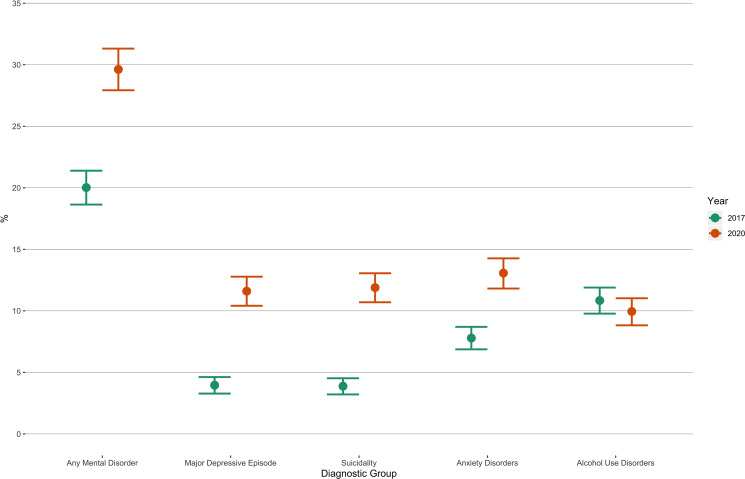
Aims: The United Nations warned of COVID-19-related mental health crisis; however, it is unknown whether there is an increase in the prevalence of mental disorders as existing studies lack a reliable baseline analysis or they did not use a diagnostic measure. We aimed to analyse trends in the prevalence of mental disorders prior to and during the COVID-19 pandemic. Methods: We analysed data from repeated cross-sectional surveys on a representative sample of non-institutionalised Czech adults (18+ years) from both November 2017 ( n = 3306; 54% females) and May 2020 ( n = 3021; 52% females). We used Mini International Neuropsychiatric Interview (MINI) as the main screening instrument. We calculated descriptive statistics and compared the prevalence of current mood and anxiety disorders, suicide risk and alcohol-related disorders at baseline and right after the first peak of COVID-19 when related lockdown was still in place in CZ. In addition, using logistic regression, we assessed the association between COVID-19-related worries and the presence of mental disorders. Results: The prevalence of those experiencing symptoms of at least one current mental disorder rose from a baseline of 20.02 (95% CI = 18.64; 21.39) in 2017 to 29.63 (95% CI = 27.9; 31.37) in 2020 during the COVID-19 pandemic. The prevalence of both major depressive disorder (3.96, 95% CI = 3.28; 4.62 v. 11.77, 95% CI = 10.56; 12.99); and suicide risk (3.88, 95% CI = 3.21; 4.52 v. 11.88, 95% CI = 10.64; 13.07) tripled and current anxiety disorders almost doubled (7.79, 95% CI = 6.87; 8.7 v. 12.84, 95% CI = 11.6; 14.05). The prevalence of alcohol use disorders in 2020 was approximately the same as in 2017 (10.84, 95% CI = 9.78; 11.89 v. 9.88, 95% CI = 8.74; 10.98); however, there was a significant increase in weekly binge drinking behaviours (4.07% v. 6.39%). Strong worries about both, health or economic consequences of COVID-19, were associated with an increased odds of having a mental disorder (1.63, 95% CI = 1.4; 1.89 and 1.42, 95% CI = 1.23; 1.63 respectively). Conclusions: This study provides evidence matching concerns that COVID-19-related mental health problems pose a major threat to populations, particularly considering the barriers in service provision posed during lockdown. This finding emphasises an urgent need to scale up mental health promotion and prevention globally.
Overview
The claims and statistics of this paper haven’t been checked yet.
Free: it reads the open-access text and checks the first 5 claims that cite a source we can check. Create a free account to check every claim.
Integrity signals
Registry
Cites
Statistics
Figures
Verification
Claims the paper makes
The claims and statistics of this paper haven’t been checked yet.
Free: it reads the open-access text and checks the first 5 claims that cite a source we can check. Create a free account to check every claim.
Claims other papers make about this one
Each is checked against this paper’s own text: does it say what the citing paper says it does?
The cited source says what the claim attributes to it.
In the citing paper
“Similarly, Winkler et al. (2020) reported on a repeated, robustly-sampled, nationally representative survey in the Czech Republic using baseline data from 2017 and found that suicide risk, as measured by the Mini International Neuropsychiatric Interview, increased from 3.9% in November 2017 to 11.9% in May 2020.”
From The impact of the COVID-19 pandemic on self-harm and suicidal behaviour: update of living systematic review (2021) · cites this paper as Winkler et al. (2020)
The cited source says what the claim attributes to it.
In the citing paper
“Two robustly sampled general population, nationally representative cross-sectional surveys with pre pandemic baseline data from 2017/18 reported a three to four fold increase in suicide risk ( Winkler et al., 2020) and suicidal thoughts in low-income households ( Raifman et al., 2020), but differences in data collection approaches (i.e. face-to-face vs. on-line) may bias comparisons.”
From The impact of the COVID-19 pandemic on self-harm and suicidal behaviour: update of living systematic review (2021) · cites this paper as Winkler et al., 2020
Self-check
Percentages, sums and reported differences re-computed from the paper’s own numbers.
The self-check needs the paper’s full text.
Citations
Cites
1 retracted
RETRACTED: Chinese mental health burden during the COVID-19 pandemic
Huang, Y., & Zhao, N. (2020) · Asian Journal of Psychiatry · doi:10.1016/j.ajp.2020.102052 · Cited by 185
Retracted(1998) · The Journal of Clinical Psychiatry · Cited by 19,139
The Psychological Impact of Quarantine and How to Reduce It: Rapid Review of the Evidence
Brooks, S. K., Webster, R. K., Smith, L. E., Woodland, L., Wessely, S., Greenberg, N., & Rubin, G. J. (2020) · doi:10.2139/ssrn.3532534 · Cited by 16,394
The psychological impact of quarantine and how to reduce it: Rapid review of the evidence
Brooks, S. K., Webster, R. K., Smith, L. E., Woodland, L., Wessely, S., Greenberg, N., & Rubin, G. J. (2020) · The Lancet · doi:10.1016/s0140-6736(20)30460-8 · Cited by 16,378
(1998) · PubMed · Cited by 10,216
Holmes, E. A., O'Connor, R. C., Perry, V. H., Tracey, I., Wessely, S., Arseneault, L., Ballard, C., Christensen, H., Cohen Silver, R., Everall, I., et al. (2020) · The Lancet Psychiatry · doi:10.1016/s2215-0366(20)30168-1 · Cited by 5,715
Qiu, J., Shen, B., Zhao, M., Wang, Z., Xie, B., & Xu, Y. (2020) · General Psychiatry · doi:10.1136/gpsych-2020-100213 · Cited by 4,307
The Lancet Commission on global mental health and sustainable development
Patel, V., Saxena, S., Lund, C., Thornicroft, G., Baingana, F., Bolton, P., Chisholm, D., Collins, P. Y., Cooper, J. L., Eaton, J., et al. (2018) · The Lancet · doi:10.1016/s0140-6736(18)31612-x · Cited by 3,692
Hammen, C. (2005) · Annual Review of Clinical Psychology · doi:10.1146/annurev.clinpsy.1.102803.143938 · Cited by 2,979
Mental health problems and social media exposure during COVID-19 outbreak
Gao, J., Zheng, P., Jia, Y., Chen, H., Mao, Y., Chen, S., Wang, Y., Fu, H., & Dai, J. (2020) · PLoS ONE · doi:10.1371/journal.pone.0231924 · Cited by 2,830
Mental Health Problems and Social Media Exposure During COVID-19 Outbreak
Gao, J., Zheng, P., Jia, Y., Chen, H., Mao, Y., Chen, S., Wang, Y., Fu, H., & Dai, J. (2020) · SSRN Electronic Journal · doi:10.2139/ssrn.3541120 · Cited by 2,830
Czeisler, M. É., Lane, R. I., Petrosky, E., Wiley, J. F., Christensen, A., Njai, R., Weaver, M. D., Robbins, R., Facer-Childs, E. R., Barger, L. K., et al. (2020) · MMWR. Morbidity and Mortality Weekly Report · doi:10.15585/mmwr.mm6932a1 · Cited by 2,686
Pierce, M., Hope, H., Ford, T., Hatch, S., Hotopf, M., John, A., Kontopantelis, E., Webb, R., Wessely, S., McManus, S., et al. (2020) · The Lancet Psychiatry · doi:10.1016/s2215-0366(20)30308-4 · Cited by 2,621
Wang, C., Pan, R., Wan, X., Tan, Y., Xu, L., McIntyre, R. S., Choo, F. N., Tran, B., Ho, R., Sharma, V. K., et al. (2020) · Brain, Behavior, and Immunity · doi:10.1016/j.bbi.2020.04.028 · Cited by 2,571
Sheehan, D., Lecrubier, Y., Harnett Sheehan, K., Janavs, J., Weiller, E., Keskiner, A., Schinka, J., Knapp, E., Sheehan, M., & Dunbar, G. (1997) · European Psychiatry · doi:10.1016/s0924-9338(97)83297-x · Cited by 2,149
Monroe, S. M., & Simons, A. D. (1991) · Psychological Bulletin · doi:10.1037/0033-2909.110.3.406 · Cited by 2,143
Galea, S., Merchant, R. M., & Lurie, N. (2020) · JAMA Internal Medicine · doi:10.1001/jamainternmed.2020.1562 · Cited by 2,089
How mental health care should change as a consequence of the COVID-19 pandemic
Moreno, C., Wykes, T., Galderisi, S., Nordentoft, M., Crossley, N., Jones, N., Cannon, M., Correll, C. U., Byrne, L., Carr, S., et al. (2020) · The Lancet Psychiatry · doi:10.1016/s2215-0366(20)30307-2 · Cited by 1,840
Kang, L., Ma, S., Chen, M., Yang, J., Wang, Y., Li, R., Yao, L., Bai, H., Cai, Z., Xiang Yang, B., et al. (2020) · Brain, Behavior, and Immunity · doi:10.1016/j.bbi.2020.03.028 · Cited by 1,516
Özdin, S., & Bayrak Özdin, Ş. (2020) · International Journal of Social Psychiatry · doi:10.1177/0020764020927051 · Cited by 1,405
Patients with mental health disorders in the COVID-19 epidemic
Yao, H., Chen, J.-H., & Xu, Y.-F. (2020) · The Lancet Psychiatry · doi:10.1016/s2215-0366(20)30090-0 · Cited by 1,393
González-Sanguino, C., Ausín, B., Castellanos, M. Á., Saiz, J., López-Gómez, A., Ugidos, C., & Muñoz, M. (2020) · Brain, Behavior, and Immunity · doi:10.1016/j.bbi.2020.05.040 · Cited by 1,373
Psychological status of medical workforce during the COVID-19 pandemic: A cross-sectional study
Lu, W., Wang, H., Lin, Y., & Li, L. (2020) · Psychiatry Research · doi:10.1016/j.psychres.2020.112936 · Cited by 1,257
Hao, F., Tan, W., Jiang, L., Zhang, L., Zhao, X., Zou, Y., Hu, Y., Luo, X., Jiang, X., McIntyre, R. S., et al. (2020) · Brain, Behavior, and Immunity · doi:10.1016/j.bbi.2020.04.069 · Cited by 968
Zhang, S. X., Wang, Y., Rauch, A., & Wei, F. (2020) · Psychiatry Research · doi:10.1016/j.psychres.2020.112958 · Cited by 828
The COVID-19 pandemic: the ‘black swan’for mental health care and a turning point for e-health
Wind, T. R., Rijkeboer, M., Andersson, G., & Riper, H. (2020) · Internet Interventions · doi:10.1016/j.invent.2020.100317 · Cited by 782
The differential psychological distress of populations affected by the COVID-19 pandemic
Zhang, J., Lu, H., Zeng, H., Zhang, S., Du, Q., Jiang, T., & Du, B. (2020) · Brain, Behavior, and Immunity · doi:10.1016/j.bbi.2020.04.031 · Cited by 704
Moccia, L., Janiri, D., Pepe, M., Dattoli, L., Molinaro, M., De Martin, V., Chieffo, D., Janiri, L., Fiorillo, A., Sani, G., et al. (2020) · Brain, Behavior, and Immunity · doi:10.1016/j.bbi.2020.04.048 · Cited by 605
Life stressors as risk factors in depression.
Mazure, C. M. (1998) · Clinical Psychology: Science and Practice · doi:10.1111/j.1468-2850.1998.tb00151.x · Cited by 535
Social isolation, loneliness and depression in young adulthood: a behavioural genetic analysis
Matthews, T., Danese, A., Wertz, J., Odgers, C. L., Ambler, A., Moffitt, T. E., & Arseneault, L. (2016) · Social Psychiatry and Psychiatric Epidemiology · doi:10.1007/s00127-016-1178-7 · Cited by 534
The depressive state of Denmark during the COVID-19 pandemic
Sønderskov, K. M., Dinesen, P. T., Santini, Z. I., & Østergaard, S. D. (2020) · Acta Neuropsychiatrica · doi:10.1017/neu.2020.15 · Cited by 468
Mamun, M. A., & Ullah, I. (2020) · Brain, Behavior, and Immunity · doi:10.1016/j.bbi.2020.05.028 · Cited by 358
Epidemiology of mental health problems among patients with cancer during COVID-19 pandemic
Wang, Y., Duan, Z., Ma, Z., Mao, Y., Li, X., Wilson, A., Qin, H., Ou, J., Peng, K., Zhou, F., et al. (2020) · Translational Psychiatry · doi:10.1038/s41398-020-00950-y · Cited by 304
Banna, M. H. A., Sayeed, A., Kundu, S., Christopher, E., Hasan, M. T., Begum, M. R., Kormoker, T., Dola, S. T. I., Hassan, M. M., Chowdhury, S., et al. (2022) · International Journal of Environmental Health Research · doi:10.1080/09603123.2020.1802409 · Cited by 252
Winkler, P., Krupchanka, D., Roberts, T., Kondratova, L., Machů, V., Höschl, C., Sartorius, N., Van Voren, R., Aizberg, O., Bitter, I., et al. (2017) · The Lancet Psychiatry · doi:10.1016/s2215-0366(17)30135-9 · Cited by 171
Self-citationLessons learned from 9/11: Mental health perspectives on the COVID-19 pandemic
DePierro, J., Lowe, S., & Katz, C. (2020) · Psychiatry Research · doi:10.1016/j.psychres.2020.113024 · Cited by 135
Relationship of suicide rates to economic variables in Europe: 2000–2011
Fountoulakis, K. N., Kawohl, W., Theodorakis, P. N., Kerkhof, A. J. F. M., Navickas, A., Höschl, C., Lecic-Tosevski, D., Sorel, E., Rancans, E., Palova, E., et al. (2014) · British Journal of Psychiatry · doi:10.1192/bjp.bp.114.147454 · Cited by 124
Self-citationAnxiety symptoms and preventive measures during the COVID-19 outbreak in Taiwan
Wong, L. P., Hung, C., Alias, H., & Lee, T. S. (2020) · BMC Psychiatry · doi:10.1186/s12888-020-02786-8 · Cited by 111
Herbolsheimer, F., Ungar, N., & Peter, R. (2018) · International Journal of Behavioral Medicine · doi:10.1007/s12529-018-9752-x · Cited by 90
Ahnquist, J., & Wamala, S. P. (2011) · BMC Public Health · doi:10.1186/1471-2458-11-788 · Cited by 80
Formánek, T., Kågström, A., Čermáková, P., Csémy, L., Mladá, K., & Winkler, P. (2019) · European Psychiatry · doi:10.1016/j.eurpsy.2019.05.001 · Cited by 55
Self-citationThe treatment gap for mental disorders and associated factors in the Czech Republic
Kågström, A., Alexová, A., Tušková, E., Csajbók, Z., Schomerus, G., Formánek, T., Mladá, K., Winkler, P., & Čermáková, P. (2019) · European Psychiatry · doi:10.1016/j.eurpsy.2019.04.003 · Cited by 54
Self-citationBanna, H. A., Sayeed, A., Kundu, S., et al. (2020) · doi:10.31234/osf.io/chw5d · Cited by 46
Winkler, P., Koeser, L., Kondrátová, L., Broulíková, H. M., Páv, M., Kališová, L., Barrett, B. M., & McCrone, P. (2018) · The Lancet Psychiatry · doi:10.1016/s2215-0366(18)30388-2 · Cited by 40
Self-citationAn association of economic hardship with depression and suicidality in times of recession in Greece
Economou, M. P., Peppou, L. Ε., Souliotis, K. N., Konstantakopoulos, G., Papaslanis, T., Kontoangelos, K. A., Nikolaidi, S., & Stefanis, N. C. (2019) · Psychiatry Research · doi:10.1016/j.psychres.2019.02.058 · Cited by 39
The CZEch Mental health Study (CZEMS): Study rationale, design, and methods
Winkler, P., Formánek, T., Mladá, K., & Čermáková, P. (2018) · International Journal of Methods in Psychiatric Research · doi:10.1002/mpr.1728 · Cited by 29
Self-citationMental health of orthopaedic trauma patients during the 2020 COVID-19 pandemic
Ohliger, E., Umpierrez, E., Buehler, L. A., Ohliger, A., Magister, S. J., Vallier, H. A., & Hirschfeld, A. G. (2020) · International Orthopaedics · doi:10.1007/s00264-020-04711-w · Cited by 29
Risk and protective factors for chronic pain following inguinal hernia repair: a retrospective study
Liu, Y., Zhou, M., Zhu, X., Gu, X., Ma, Z., & Zhang, W. (2020) · Journal of Anesthesia · doi:10.1007/s00540-020-02743-5 · Cited by 16
Research works printed but not linked: 1
- CZSO (2019) Demographic Yearbook of the Czech Republic 2018. Prague: Czech Statistical Office.
Cited by
Santomauro, D. F., Mantilla Herrera, A. M., Shadid, J., Zheng, P., Ashbaugh, C., Pigott, D. M., Abbafati, C., Adolph, C., Amlag, J. O., Aravkin, A. Y., et al. (2021) · The Lancet · doi:10.1016/s0140-6736(21)02143-7 · Cited by 5,444
“39,40 The study that did not report an increased prevalence was conducted in one specific city in Norway (Trondheim) using very small cross-sectional samples.”
OECD (2021) · OECD Health Policy Studies · doi:10.1787/4ed890f6-en · Cited by 407
Suicide behaviors during the COVID-19 pandemic: A meta-analysis of 54 studies
Dubé, J. P., Smith, M. M., Sherry, S. B., Hewitt, P. L., & Stewart, S. H. (2021) · Psychiatry Research · doi:10.1016/j.psychres.2021.113998 · Cited by 291
John, A., Eyles, E., Webb, R. T., Okolie, C., Schmidt, L., Arensman, E., Hawton, K., O'Connor, R. C., Kapur, N., Moran, P., et al. (2021) · F1000Research · doi:10.12688/f1000research.25522.2 · Cited by 189
The impact of the COVID-19 pandemic on self-harm and suicidal behaviour: a living systematic review
John, A., Okolie, C., Eyles, E., Webb, R. T., Schmidt, L., McGuinness, L. A., Olorisade, B. K., Arensman, E., Hawton, K., Kapur, N., et al. (2020) · F1000Research · doi:10.12688/f1000research.25522.1 · Cited by 178
Metadata
- Authors
- Winkler, P., Formanek, T., Mlada, K., Kagstrom, A., Mohrova, Z., Mohr, P., & Csemy, L.
- Affiliations
- King's College London (GB)
- Charles University (CZ)
- Corresponding author
- Winkler, P.
- Venue
- Epidemiology and Psychiatric Sciences
- Publisher
- Cambridge University Press (CUP)
- Published
- 2020
- Volume
- 29
- Pages
- e173-e173
- ISSN
- 2045-7960 (ISSN-L)
- 2045-7979
- PMC
- PMC7573458
- OpenAlex
- W3090340480
- Cited by
- 223
- References
- 47
- Citations by year
- 2026: 4 · 2025: 22 · 2024: 28 · 2023: 56 · 2022: 60 · 2021: 53
- FWCI
- 16.91
- Type
- journal article
- Language
- en
- Open access
- gold
- doi.org
- Locations
- Epidemiology and Psychiatric Sciences (publishedVersion, cc-by)
- PubMed Central (publishedVersion, cc-by)
- PubMed (publishedVersion)
- Funders
- National Institute of Mental Health (LO1611)
- Topics
- Social Sciences › Psychology › Clinical Psychology › COVID-19 and Mental Health
- Health Sciences › Medicine › Psychiatry and Mental health › Mental Health Treatment and Access
- Health Sciences › Medicine › Public Health, Environmental and Occupational Health › Maternal Mental Health During Pregnancy and Postpartum
- Keywords
- COVID-19 pandemic, mental illness, prevalence trends, mood disorders, anxiety disorders, major depressive disorder, suicide risk, alcoholism, COVID-19-related worry, lockdown, Czech adults, mental health crisis
- MeSH terms
- Betacoronavirus, COVID-19, SARS-CoV-2, Adult, Anxiety Disorders, Mental Disorders, Cross-Sectional Studies, Depressive Disorder, Major, Major Depressive Disorder, Female, Humans, Male, Mental Health, Middle Aged, Pneumonia, Viral, Psychiatric Status Rating Scales, Surveys and Questionnaires, Suicide, Prevalence, Czech Republic, Coronavirus Infections, Mood Disorders, Alcohol-Related Disorders, Pandemics
About these checks
Registry, retraction, Cites and statistics results are computed, not judged, with one exception: a printed reference that no index lists is read once by a model before it counts as a citation error. Claims are extracted by a model and kept only when their quote appears verbatim in the text; each cited source is then checked, with a model’s help, for whether it says what the claim relies on. Those verdicts can be wrong — read the claim’s quote and the cited source before relying on one.
Statistics and arithmetic are recomputed, not judged.
Confidence bands are shown only for fields calibrated on our annotated test set. None is calibrated yet, so no band is shown.
What counts as a claim ›How we measure confidence ›How we check this ›
Are you an author, or do you see a problem with this page? Request a review
Data sources
Bibliographic data: Semantic Scholar, OpenAlex, Crossref.
Contains information from the Semantic Scholar Academic Graph Datasets, made available under the ODC Attribution License (ODC-BY 1.0).
Semantic Scholar’s data is described in: Kinney, R., et al. (2023). The Semantic Scholar Open Data Platform. arXiv:2301.10140.
