

Mental health problems and correlates among 746 217 college students during the coronavirus disease 2019 outbreak in China
Open accessThe DOI matches its Crossref record; 51 of the 55 references it cites were found in a registry or an index; 2 of the 42 sources its claims cite were checked for support.
Abstract
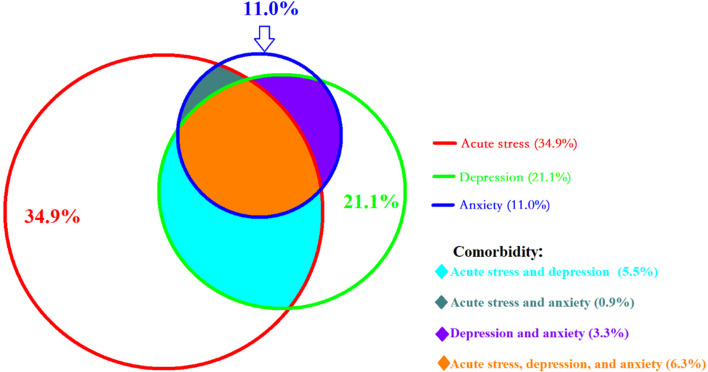
Aims: Coronavirus disease 2019 (COVID-19) pandemic is a major public health concern all over the world. Little is known about the impact of COVID-19 pandemic on mental health in the general population. This study aimed to assess the mental health problems and associated factors among a large sample of college students during the COVID-19 outbreak in China. Methods: This cross-sectional and nation-wide survey of college students was conducted in China from 3 to 10 February 2020. A self-administered questionnaire was used to assess psychosocial factors, COVID-19 epidemic related factors and mental health problems. Acute stress, depressive and anxiety symptoms were measured by the Chinese versions of the impact of event scale-6, Patient Health Questionnaire-9 and Generalized Anxiety Disorder-7, respectively. Univariate and hierarchical logistic regression analyses were performed to examine factors associated with mental health problems. Results: Among 821 218 students who participated in the survey, 746 217 (90.9%) were included for the analysis. In total, 414 604 (55.6%) of the students were female. About 45% of the participants had mental health problems. The prevalence rates of probable acute stress, depressive and anxiety symptoms were 34.9%, 21.1% and 11.0%, respectively. COVID-19 epidemic factors that were associated with increased risk of mental health problems were having relatives or friends being infected (adjusted odds ratio = 1.72–2.33). Students with exposure to media coverage of the COVID-19 ≥3 h/day were 2.13 times more likely than students with media exposure <1 h/day to have acute stress symptoms. Individuals with low perceived social support were 4.84–5.98 times more likely than individuals with high perceived social support to have anxiety and depressive symptoms. In addition, senior year and prior mental health problems were also significantly associated with anxiety or/and depressive symptoms. Conclusions: In this large-scale survey of college students in China, acute stress, anxiety and depressive symptoms are prevalent during the COVID-19 pandemic. Multiple epidemic and psychosocial factors, such as family members being infected, massive media exposure, low social support, senior year and prior mental health problems were associated with increased risk of mental health problems. Psychosocial support and mental health services should be provided to those students at risk.
Overview
CoChat Summary
TL;DR
In a nationwide web survey of 746,217 Chinese college students during the early COVID-19 outbreak, about 45% screened positive for probable acute stress, depressive, or anxiety symptoms. Infection among relatives/friends, heavy media exposure, low perceived social support, senior year, and prior mental health problems were associated with higher odds of mental health problems.
Key findings
- Among 746,217 analyzed students (90.9% of 821,218 participants; 55.6% female), 45% had probable acute stress, depressive, or anxiety symptoms; prevalence rates were 34.9% for acute stress, 21.1% for depressive symptoms, and 11.0% for anxiety symptoms.
- Having relatives or friends infected with COVID-19 was associated with increased odds of all three outcomes (adjusted odds ratio [AOR] = 1.72–2.33).
- Students exposed to COVID-19 media coverage ≥3 h/day were 2.13 times more likely than those exposed <1 h/day to have probable acute stress.
- Low perceived social support was associated with 4.84–5.98 times higher odds of anxiety and depressive symptoms compared with high perceived social support; senior year and prior mental health problems were also associated with anxiety and/or depressive symptoms.
Methods
- Cross-sectional, web-based nationwide survey conducted in China from 3 to 10 February 2020 among college students from 108 colleges and universities in Guangdong and Jiangxi provinces.
- Self-administered questionnaire measured psychosocial factors, COVID-19 epidemic-related factors, and mental health problems using the Chinese versions of the Impact of Event Scale-6 (cutoff ≥9), Patient Health Questionnaire-9 (cutoff ≥7), and Generalized Anxiety Disorder-7 (cutoff ≥7).
- Univariate and hierarchical logistic regression analyses examined factors associated with mental health problems; significance was set at p < 0.001 and OR/AOR >1.5.
Limitations
- The paper states that all students were originally sampled from 108 colleges and universities in Guangdong and Jiangxi provinces; about 80% lived in those two provinces, with only a small proportion in Wuhan, so generalizability to all students nationwide, especially those in Wuhan, is uncertain.
- The paper states that because it was an online survey, the exact response rate could not be determined beyond the valid questionnaire rate, as some students may have missed the survey.
- The paper states that the cross-sectional design precludes causality, and the measures were self-report screening tools rather than clinical diagnoses.
Model-written summary. Check it against the paper before relying on it.
Integrity signals
Registry
Cites
Statistics
Figures
Verification
Claims the paper makes
1 Valid · 1 Not valid · 22 Not checked · 59 Own results and interpretations
At least one cited source doesn’t support this claim or points to a different paper, and none confirmed it — see the verdicts below.
In the paper
“However, existing studies on the psychosocial impacts of COVID-19 epidemic have limitations, such as small sample sizes (Cao et al., 2020; Chang et al., 2020; Lai et al., 2020; Liu et al., 2020; Yang et al., 2020), assessing single symptoms (Cao et al., 2020; Liu et al., 2020; Qiu et al., 2020; Wang et al., 2020d), unstandardised psychological measures used (Qiu et al., 2020) and limiting factors”
§ Mental health problems and correlates among 746 217 college students during the coronavirus disease 2019 outbreak in China > Introduction
What the sources say
- Not checked yetcites Cao et al., 2020
- Not checked yetcites Liu et al., 2020
- Disputedcites Qiu et al., 2020 matched to “A nationwide survey of psychological distress among Chinese people in the COVID-19 epidemic: implications and policy recommendations.” (2020) sourceExperimental — accuracy not yet measured
Our copy of Qiu et al. (Abstract, p.1) describes the COVID-19 Peritraumatic Distress Index as a 0-100 instrument inquiring about the frequency of anxiety, depression, specific phobias, cognitive change, avoidance and compulsive behaviour, physical symptoms and loss of social functioning, i.e. a deliberately multidimensional measure of peritraumatic psychological distress, not a single-symptom assessment. The paper also frames its aim as measuring the prevalence and severity of 'a wide variety of psychological problems' across the general population (Abstract, p.1), and its own limitations concern the self-developed, non-standardised CPDI and self-report sampling — the point the same citing sentence separately credits to Qiu et al. under 'unstandardised psychological measures used'. Unless 'single symptoms' is meant as 'symptom-level rather than formal diagnosis', the cited characterisation runs contrary to what this source reports. (LLM, conf=0.78)
Checked by a reasoning model — may be wrong.
plain- Asserted: passes — The authors put it forward as true.
- Checkable: passes — It can be checked against evidence.
- Load-bearing: passes — The paper’s conclusions depend on it.
- Based: passes — The paper gives a reason why it holds.
Every source the paper cites for this claim was checked and supports it.
In the paper
“However, existing studies on the psychosocial impacts of COVID-19 epidemic have limitations, such as small sample sizes (Cao et al., 2020; Chang et al., 2020; Lai et al., 2020; Liu et al., 2020; Yang et al., 2020), assessing single symptoms (Cao et al., 2020; Liu et al., 2020; Qiu et al., 2020; Wang et al., 2020d), unstandardised psychological measures used (Qiu et al., 2020) and limiting factors”
§ Mental health problems and correlates among 746 217 college students during the coronavirus disease 2019 outbreak in China > Introduction
What the sources say
- Supportedcites Qiu et al., 2020 matched to “A nationwide survey of psychological distress among Chinese people in the COVID-19 epidemic: implications and policy recommendations.” (2020) source
The study’s Abstract (page not available in our copy) says the authors designed a self-report questionnaire for the epidemic and used the resulting COVID-19 Peritraumatic Distress Index, supporting the citation as an example of a study using a newly devised rather than an established psychological measure. The paper also reports content-validity review and internal-consistency testing; the claim should not be read as saying the measure had no validation. (LLM, conf=0.82)
plain- Asserted: passes — The authors put it forward as true.
- Checkable: passes — It can be checked against evidence.
- Load-bearing: passes — The paper’s conclusions depend on it.
- Based: passes — The paper gives a reason why it holds.
- Supported
A result the paper reports from its own data — it cites no other source for it, so there is none to check. The quote shows it is in the paper.
In the paper
“The prevalence rates of probable acute stress, depressive and anxiety symptoms were 34.9%, 21.1% and 11.0%, respectively.”
§ Mental health problems and correlates among 746 217 college students during the coronavirus disease 2019 outbreak in China > Abstract > Results
plain- Asserted: passes — The authors put it forward as true.
- Checkable: passes — It can be checked against evidence.
- Load-bearing: passes — The paper’s conclusions depend on it.
- Based: passes — The paper gives a reason why it holds.
A result the paper reports from its own data — it cites no other source for it, so there is none to check. The quote shows it is in the paper.
In the paper
“Yes | 1.27 (1.25–1.29)*** | 1.38 (1.35–1.40)*** | 1.57 (1.53–1.60)***”
§ Mental health problems and correlates among 746 217 college students during the coronavirus disease 2019 outbreak in China > Results > Factors associated with probable acute stress, anxiety and depressive symptoms
plainstates an association- Asserted: passes — The authors put it forward as true.
- Checkable: passes — It can be checked against evidence.
- Load-bearing: unclear — It is unclear whether the paper’s conclusions depend on it.
- Based: passes — The paper gives a reason why it holds.
A result the paper reports from its own data — it cites no other source for it, so there is none to check. The quote shows it is in the paper.
In the paper
“Yes | 1.12 (1.09–1.15)*** | 2.26 (2.20–2.31)*** | 2.38 (2.31–2.45)***”
§ Mental health problems and correlates among 746 217 college students during the coronavirus disease 2019 outbreak in China > Results > Factors associated with probable acute stress, anxiety and depressive symptoms
plainstates an association- Asserted: passes — The authors put it forward as true.
- Checkable: passes — It can be checked against evidence.
- Load-bearing: passes — The paper’s conclusions depend on it.
- Based: passes — The paper gives a reason why it holds.
- Rests on an assumption not shown here.
51 more claims
Create a free account to see all 83 claims and to verify the 40 references still open.
- It may state two separate claims as one. 13
- Probably not a substantial claim. 20
Claims other papers make about this one
Each is checked against this paper’s own text: does it say what the citing paper says it does?
The cited source doesn’t support the claim as written.
In the citing paper
“other research has identified that almost 45% of students faced mental health issues, with anxiety being the most frequent symptom (3).”
From Mental health status and coping strategies during COVID-19 pandemic among university students in Central Serbia (2023) · cites this paper as [3]
Checked by a reasoning model — may be wrong.
Experimental — accuracy not yet measuredThe source backs part of the claim, not all of it — or backs it for a different population, condition or comparison.
In the citing paper
“Gender differences are significant, as research consistently shows that female adolescents report higher rates of mental health challenges, such as anxiety and depression, compared to their male counterparts [20, 21].”
From Parental expectation and psychological distress of Chinese youth: the chain mediating effects of core self-worth and perceived stress (2025) · cites this paper as [20]
Experimental — accuracy not yet measured
Self-check
Percentages, sums and reported differences re-computed from the paper’s own numbers.
Each contradiction between two passages listed here was confirmed by an independent check.
Rated major: it would touch a result — a value a result rests on, reported and recomputed p-values on opposite sides of the significance level, two passages that conflict with no sign which is right, or a cited work retracted before this paper was published.
In the paper
§ Mental health problems and correlates among 746 217 college students during the coronavirus disease 2019 outbreak in China > Results > Factors associated with probable acute stress, anxiety and depressive symptoms
“In layer 3 of multivariate and hierarchical logistic regression, the potential interactions among the key factors were not statistically significant.”
§ Mental health problems and correlates among 746 217 college students during the coronavirus disease 2019 outbreak in China > Results > Factors associated with probable acute stress, anxiety and depressive symptoms
“| Yes × Low | – | – | | 1.22 (1.12–1.35)*** | – | 1.01 (0.89–1.13) |”
Rated minor: it would not touch a result — a value no result rests on, a p-value that stays on the same side of the significance level, or a conflict that is clerical, resolved elsewhere in the paper, or outside its own findings.
In the paper
§ Mental health problems and correlates among 746 217 college students during the coronavirus disease 2019 outbreak in China > Results > Descriptive characteristics
“high, score ⩾ 72 (> Mean + 1 s.d.).”
§ Mental health problems and correlates among 746 217 college students during the coronavirus disease 2019 outbreak in China > Results > Factors associated with probable acute stress, anxiety and depressive symptoms
“medium, score = 49–71 (Mean ± 1s.d.); high, score ⩾ 71 (> Mean + 1 s.d.).”
Rated minor: it would not touch a result — a value no result rests on, a p-value that stays on the same side of the significance level, or a conflict that is clerical, resolved elsewhere in the paper, or outside its own findings.
In the paper
§ Mental health problems and correlates among 746 217 college students during the coronavirus disease 2019 outbreak in China > Results > Factors associated with probable acute stress, anxiety and depressive symptoms
“Students with >3 h exposure to media coverage of the COVID-19 each day were 2.13 times more likely than students with less media exposure (<1 h/day) to have probable acute stress.”
§ Mental health problems and correlates among 746 217 college students during the coronavirus disease 2019 outbreak in China > Results > Factors associated with probable acute stress, anxiety and depressive symptoms
“| ⩾3 h/day | 2.13 (2.10–2.16)*** | 1.09 (1.07–1.10)*** | 1.32 (1.29–1.34)*** |”
Citations
Cites
Clinical features of patients infected with 2019 novel coronavirus in Wuhan, China
Huang, C., Wang, Y., Li, X., Ren, L., Zhao, J., Hu, Y., Zhang, L., Fan, G., Xu, J., Gu, X., et al. (2020) · The Lancet · doi:10.1016/s0140-6736(20)30183-5 · Cited by 48,884
Self-citationThe PHQ-9: Validity of a brief depression severity measure
Kroenke, K., Spitzer, R. L., & Williams, J. B. W. (2001) · Journal of General Internal Medicine · doi:10.1046/j.1525-1497.2001.016009606.x · Cited by 44,910 · cited 2×
“Depressive symptoms The 9-item Patient Health Questionnaire (PHQ-9) was used to measure students’ depressive symptoms within two weeks (Kroenke et al., 2001).”
MethodA Brief Measure for Assessing Generalized Anxiety Disorder: The GAD-7
Spitzer, R. L., Kroenke, K., Williams, J. B. W., & Löwe, B. (2006) · Archives of Internal Medicine · doi:10.1001/archinte.166.10.1092 · Cited by 31,765 · cited 1×
“Each item is rated on a 4-point scale from 0 (not at all) to 3 (nearly every day) (Spitzer et al., 2006).”
BackgroundThe Multidimensional Scale of Perceived Social Support
Zimet, G. D., Dahlem, N. W., Zimet, S. G., & Farley, G. K. (1988) · Journal of Personality Assessment · doi:10.1207/s15327752jpa5201_2 · Cited by 13,339
Wang, C., Pan, R., Wan, X., Tan, Y., Xu, L., Ho, C. S., & Ho, R. C. (2020) · International Journal of Environmental Research and Public Health · doi:10.3390/ijerph17051729 · Cited by 9,923 · cited 4×
“…the COVID-19 epidemic on mental health, such as stress-related symptoms, depression and anxiety among small samples of medical staff and community residents in China (Cao et al ., 2020; Chang et al ., 2020; Lai et al ., 2020; Liu et al ., 2020; Qiu et al ., 2020; Wang et al ., 2020b, 2020c, 2020d).”
InfluentialLai, J., Ma, S., Wang, Y., Cai, Z., Hu, J., Wei, N., Wu, J., Du, H., Chen, T., Li, R., et al. (2020) · JAMA Network Open · doi:10.1001/jamanetworkopen.2020.3976 · Cited by 8,015 · cited 15×
“Since 24 January 2020, 31 provinces and autonomous regions in mainland China have activated the level 1 public health emergency responses to prevent the spread of COVID-19 (Bao et al ., 2020).”
InfluentialA novel coronavirus outbreak of global health concern
Wang, C., Horby, P. W., Hayden, F. G., & Gao, G. F. (2020) · The Lancet · doi:10.1016/s0140-6736(20)30185-9 · Cited by 7,700 · cited 7×
“The above studies found that some influencing factors, including demographic information such as female gender (Chang et al., 2020; Wang et al., 2020b) and younger age (Chang et al., 2020); COVID-19 epidemic related factors such as living in the middle region of China (near the centre of the…”
BackgroundResultInfluentialThe psychological impact of the COVID-19 epidemic on college students in China
Cao, W., Fang, Z., Hou, G., Han, M., Xu, X., Dong, J., & Zheng, J. (2020) · Psychiatry Research · doi:10.1016/j.psychres.2020.112934 · Cited by 5,843 · cited 9×
“, 2020), having relatives or acquaintances infected with COVID-19 (Cao et al., 2020), having contacted with an individual with suspected COVID-19 or infected materials (Wang et al.”
InfluentialPsychometric Characteristics of the Multidimensional Scale of Perceived Social Support
Zimet, G. D., Powell, S. S., Farley, G. K., Werkman, S., & Berkoff, K. A. (1990) · Journal of Personality Assessment · doi:10.1080/00223891.1990.9674095 · Cited by 4,855
Psychometric Characteristics of the Multidimensional Scale of Perceived Social Support
Zimet, G., Powell, S., Farley, G., Werkman, S., & Berkoff, K. (1990) · Journal of Personality Assessment · doi:10.1207/s15327752jpa5503&4_17 · Cited by 4,854
Research works printed but not linked: 1
- 10.1002/1097-4679(199111)47:6 · doi:10.1002/1097-4679(199111)47:6
Cited by
Items 401–437 of 437
Xu, L. (2025) · Applied Mathematics and Nonlinear Sciences · doi:10.2478/amns-2025-0082 · Cited by 1
Saúde mental do estudante universitário no primeiro ano da pandemia de COVID-19: revisão de escopo
Dias, F. A., Pereira, E. R., Silva, R. M. C. R. A., de Medeiros, A. Y. B. B. V., & Fabri, J. M. G. (2025) · Revista Brasileira de Enfermagem · doi:10.1590/0034-7167-2024-0032pt
Relationship between the COVID-19 pandemic and the level of stress among college students in Poland
Krzystyniak, E., Nawrot, P., Jonik, S., Borowiak, E., Krajewska, N., Maksym, J., Studzińska, A., & Mazurek, T. (2025) · Discover Public Health · doi:10.1186/s12982-025-00480-2
He, L., Su, M., Bie, L., Ha, Y., Wu, F., Mu, W., & Ma, X. (2025) · Psychology Health & Medicine · doi:10.1080/13548506.2025.2496996 · Cited by 2
“A review of previous studies indicates that a study involving over 700,000 university students found that individuals with low perceived social support were 4.8 times more likely to experience anxiety after significant events compared to those with high perceived social support (Ma et al., 2020).”
InfluentialUse of intelligent algorithm recommendation for college students healthy social mentality in China
Wang, X., Zhang, L., & Rasool, Z. (2025) · Current Psychology · doi:10.1007/s12144-025-07851-7
Zanini, G. D. S., Campanhã, L. M. F., Biazus, E. L., Cardoso, H. F., & Verardi, C. E. L. (2025) · COVID · doi:10.3390/covid5080127
Badellino, H., Gobbo, M. E., Torres, E., Aschieri, M. E., Biotti, M., Alvarez, V., Gigante, C., & Cachiarelli, M. (2025) · Revista Colombiana de Psiquiatría (English ed ) · doi:10.1016/j.rcpeng.2023.10.003
Dutta, B. (2023) · ShodhKosh Journal of Visual and Performing Arts · doi:10.29121/shodhkosh.v4.i1.2023.6208
Prevalência de depressão, ansiedade e estresse entre estudantes de odontologia: revisão integrativa
Viana, A. G., & Lins-Kusterer, L. (2025) · Caderno Pedagógico · doi:10.54033/cadpedv22n11-322 · Cited by 1
Higher Education Leading the Midst of It All
Alexander, S. N. (2025) · Emerald Group Publishing Limited eBooks · doi:10.1108/978-1-80592-345-920251026
Am I Welcome Here? Coping Strategies of International Students and Scholars
Wu, H.-P. (2025) · Emerald Group Publishing Limited eBooks · doi:10.1108/978-1-80592-345-920251019
Ru, X., Chen, L., Chen, Z., Huang, Y., Liu, R., & Ye, Q. (2025) · Medicine Advances · doi:10.1002/med4.70040 · Cited by 1
Self-citationDuong, C. B., Van Tran, N., Nguyen, A. H., Le, T. N., Ha, B. H., Do, C. N. P., Huynh, K., Le, T. M., Nguyen, T. P., & Nguyen, H. T. T. (2023) · Figshare · doi:10.6084/m9.figshare.22619459
Kurz, D., Braig, S., Genuneit, J., & Rothenbacher, D. (2024) · Figshare · doi:10.6084/m9.figshare.26574127
Gao, D., Xiang, Q., Lu, G., Tong, J., Jiang, W., Yu, X., Wang, R., Lv, Z., & Li, D. (2022) · Figshare · doi:10.6084/m9.figshare.21256812
Xiao, J., Liu, Y., Li, B., Zhang, L., Junyan, H., & Zhao, H. (2022) · Figshare · doi:10.6084/m9.figshare.21581945
Russell, M. A., Reavley, N. J., Williams, I., Li, W., Tarzia, L., Chondros, P., & Sanci, L. (2023) · Figshare · doi:10.6084/m9.figshare.22608754
Duong, C. B., Van Tran, N., Nguyen, A. H., Le, T. N., Ha, B. H., Do, C. N. P., Huynh, K., Le, T. M., Nguyen, T. P., & Nguyen, H. T. T. (2023) · Figshare · doi:10.6084/m9.figshare.22619456
Liu, L., Chen, J., Liang, S., Yang, W., Peng, X., Cai, C., Huang, A., Wang, X., & Zhao, J. (2023) · Figshare · doi:10.6084/m9.figshare.22624132
Self-citationKurz, D., Braig, S., Genuneit, J., & Rothenbacher, D. (2024) · Figshare · doi:10.6084/m9.figshare.26574124
Hong-Tao, S. O. N. G. (2026) · Education and human development · doi:10.5772/intechopen.1014023 · Cited by 1
Cui, Y., Yang, L., Yang, W., Wang, X., Liu, J., Wang, Y., Liu, J., Leng, D., Yang, B., Zhao, N., et al. (2026) · BMC Psychology · doi:10.1186/s40359-025-03944-x
How to Predict the Onset of Anxiety and Depression in Pediatric Residents? -- A Survey From China
Liu, X., Song, C., Li, H. Q., Jiang, Z., & Feng, L. (2026) · Neuropsychiatric Disease and Treatment · doi:10.2147/ndt.s573146
“14 Individuals with low social support are at significantly higher risk for anxiety and depressive symptoms than those with high social support; 15 4) Resilience is a set of intrinsic psychological and adaptive traits that protect individuals in adverse, stressful and difficult environments.”
Self-citationThe Innovation and Development of College Students' Mental Health Education Model in the New Era
Gao, T., Yang, S., & Yu, S. (2025) · Journal of medicine and health science. · doi:10.62517/jmhs.202505201
Li, H. Q., Liu, J., Wang, H., & Tan, L. (2026) · Frontiers in Medicine · doi:10.3389/fmed.2026.1696233
“Social support refers to the tangible or perceived material, emotional, and psychological assistance an individual receives from their external environment (11).”
Prevalence and burden of migraine in university students in Ireland: a cross-sectional study
Flynn, O. M. J., Fullen, B. M., Tamulevicius, N., & Blake, C. M. (2026) · Physical Therapy Reviews · doi:10.1080/10833196.2026.2626891
“Migraine is also associated with mental health conditions [17], which are highly prevalent among students [18–20], with depression being a leading cause of YLD in young people [2].”
He, G., (49484), X. Z., Fu, G., Bao, X., Huang, W., & Ren, J. (2026) · BMC Public Health · doi:10.1186/s12889-026-28038-0
“Studies conducted during and after the COVID-19 pandemic document elevated rates of psychological distress among Chinese college students [12, 13], yet population-level data on fatigue specifically, including its prevalence, severity distribution, and modifiable determinants, remain limited.”
Zhumagulova, N., Mireeva, A., Akhelova, S., Koshkimbayeva, G., Askarova, A., Taipova, M., Amirkhanova, A., Kartbayeva, E., Kudaibergenova, B., Кошербеков, Е. Т., et al. (2026) · Healthcare · doi:10.3390/healthcare14121708 · Cited by 1
“…uncertainty, and emotional dysregulation were repeatedly linked to anxiety, depression, and distress, including high symptom burdens in large student cohorts [68–70], whereas reduced emotional regulatory self-efficacy was associated with depressive symptoms in a very large Chinese sample [71].”
InfluentialMudrenko, I., Kotkova, O., Sotnikov, D. D., Potapov, O. O., Kobyletskaya, A. K., Mudrenko, V., & Hetmanska, V. (2026) · Eastern Ukrainian Medical Journal · doi:10.21272/eumj.2026;14(2);443-452
Tang, Y., Liu, C., Lei, P., Zhang, H., Xu, X., Ning, X., Li, J., & Fan, W. (2026) · Behavioral Sciences · doi:10.3390/bs16071171
“On the other hand, a substantial body of research based on college student samples indicates that depression and anxiety are the most prevalent emotional problems and show high comorbidity (Li et al., 2022; Chang et al., 2021; McKenney et al., 2025; Zhou et al., 2020; Ma et al., 2020).”
Méndez, R. M. Y., Escobar-Agreda, S., Villarreal‐Zegarra, D., Flores, W. M. T., Sánchez-Broncano, J., Cordova, J. H. O., Alvarez-Yslado, C., & Rojas-Mezarina, L. (2026) · F1000Research · doi:10.12688/f1000research.169745.1
Grabowski, J., Stępień, J., Waszak, P. M., Michalski, T., Meloni, R., Grabkowska, M., Macul-Sanewska, A., Rojek, J. J., Lorettu, L., Sagan, I., et al. (2026) · Medicina · doi:10.3390/medicina62081564
“The higher risk of high perceived stress observed among younger respondents and students is consistent with previous research indicating that young adults and university students experienced substantial psychological burden during the COVID-19 pandemic [20,29–33].”
de León, M. D. C. E. P., Ruiz, E. J. C., & Luna, B. S. C. (2026) · Revista Mexicana de Trastornos Alimentarios/Mexican Journal of Eating Disorders · doi:10.22201/fesi.20071523e.2026.2.918
Recovery-phase symptoms after COVID-19 infection and anxiety levels among college students
Guo, D., Liu, T., Xu, Y., & Xie, L. (2026) · Frontiers in Psychiatry · doi:10.3389/fpsyt.2026.1921410
Li, Z., Tao, Y., Cui, Z., You, Q., Liu, Y., & Yang, C. (2026) · Personality and Individual Differences · doi:10.1016/j.paid.2026.114117
Metadata
- Authors
- Ma, Z., Zhao, J., Li, Y., Chen, D., Wang, T., Zhang, Z., Chen, Z., Yu, Q., Jiang, J., Fan, F., & Liu, X.
- Affiliations
- South China Normal University (CN)
- Southern Medical University (CN)
- University of Pennsylvania (US)
- Corresponding author
- Fan, F.
- Venue
- Epidemiology and Psychiatric Sciences
- Publisher
- Cambridge University Press (CUP)
- Published
- 2020
- Volume
- 29
- Pages
- e181-e181
- ISSN
- 2045-7960 (ISSN-L)
- 2045-7979
- PMC
- PMC7681173
- OpenAlex
- W3099913278
- Semantic Scholar
- 51ed5f602f14606ed0192c7a29f165f91d3c6a91
- Cited by
- 437
- References
- 55
- Citations by year
- 2026: 16 · 2025: 40 · 2024: 62 · 2023: 115 · 2022: 131 · 2021: 71 · 2020: 1
- FWCI
- 31.83
- Type
- journal article
- Language
- en
- Open access
- gold
- doi.org
- Licence
- Locations
- Epidemiology and Psychiatric Sciences (publishedVersion, cc-by-nc-sa)
- PubMed Central (publishedVersion, cc-by-nc-sa)
- PubMed (publishedVersion)
- Funders
- National Natural Science Foundation of China (31871129, 31671165, 31271096)
- China Postdoctoral Science Foundation (31271096, 2017 T100638, 31671165, 2016 M590793)
- Ministry of Education, India
- Topics
- Social Sciences › Psychology › Clinical Psychology › COVID-19 and Mental Health
- Social Sciences › Psychology › Developmental and Educational Psychology › Student Stress and Coping
- Health Sciences › Medicine › Psychiatry and Mental health › Mental Health Treatment and Access
- Keywords
- COVID-19 pandemic, university students, mental health, acute stress, depressive symptoms, anxiety symptoms, perceived social support, media exposure, family infection, risk factors, China, psychosocial support, mental health services, mental health prevalence
- MeSH terms
- Patient Health Questionnaire, Betacoronavirus, COVID-19, SARS-CoV-2, Adolescent, Adult, Anxiety, China, Cross-Sectional Studies, Depression, Disease Outbreaks, Female, Humans, Male, Mental Health, Pneumonia, Viral, Surveys and Questionnaires, Stress, Psychological, Students, Prevalence, Coronavirus, Coronavirus Infections, Young Adult, Pandemics
About these checks
Registry, retraction, Cites and statistics results are computed, not judged, with one exception: a printed reference that no index lists is read once by a model before it counts as a citation error. Claims are extracted by a model and kept only when their quote appears verbatim in the text; each cited source is then checked, with a model’s help, for whether it says what the claim relies on. Those verdicts can be wrong — read the claim’s quote and the cited source before relying on one.
The claim verdicts this report counts are experimental: their accuracy is not yet measured.
A language model drew the claims from the paper on 2026-10-07, under version 3 of the claim definition (model deepseek-v4.1-flash, prompt extract-v3).
A second model labelled each claim on 2026-10-07 (model jev-1.13-20260917, definition revision gold-guideline-v0.2).
Cited sources are checked with a language model’s help (qwen3.8-omni-flash and gpt-6-sol).
Statistics and arithmetic are recomputed, not judged.
Confidence bands are shown only for fields calibrated on our annotated test set. None is calibrated yet, so no band is shown.
What counts as a claim ›How we measure confidence ›How we check this ›
Are you an author, or do you see a problem with this page? Request a review
Data sources
Bibliographic data: Semantic Scholar, OpenAlex, Crossref.
Contains information from the Semantic Scholar Academic Graph Datasets, made available under the ODC Attribution License (ODC-BY 1.0).
Semantic Scholar’s data is described in: Kinney, R., et al. (2023). The Semantic Scholar Open Data Platform. arXiv:2301.10140.
