

The DOI matches its Crossref record; 166 of the 166 references it cites were found in a registry or an index.
Small-Molecule Trk Agonists: Where Do We Go from Here?
Open accessAbstract
About two decades ago, there were no validated, agonistic small-molecule modulators of Trk (tropomyosin receptor kinase). High-throughput screening of commercial libraries seemed an attractive way to identify starting structures when the research community became aware of their potential for treatment of neurodegeneration and traumatic injuries (e.g., stroke) because this strategy avoids high-level chemical expertise for molecular design and synthesis. Cost and effort constraints arising from library acquisition and assays imposed limitations on numbers of compounds tested, so filtering to reduce library sizes before screening was routine. One of the criteria was to prioritize existing pharmaceuticals because these had known toxicity profiles and side effects, at least in some delivery and dosing regimens, and many cases had proven blood brain barrier (BBB) permeabilities. This review gives our perspective on how these efforts transpired, lessons learned, and constraints which hold back development in this area at the present time.
Overview
The claims and statistics of this paper haven’t been checked yet.
Free: it reads the open-access text and checks the first 5 claims that cite a source we can check. Create a free account to check every claim.
Integrity signals
Registry
Cites
Statistics
Figures


Verification
Claims the paper makes
The claims and statistics of this paper haven’t been checked yet.
Free: it reads the open-access text and checks the first 5 claims that cite a source we can check. Create a free account to check every claim.
Self-check
Percentages, sums and reported differences re-computed from the paper’s own numbers.
The self-check needs the paper’s full text.
Citations
Cites
Impact of high-throughput screening in biomedical research
Macarron, R., Banks, M. N., Bojanic, D., Burns, D. J., Cirovic, D. A., Garyantes, T., Green, D. V. S., Hertzberg, R. P., Janzen, W. P., Paslay, J. W., et al. (2011) · Nature Reviews Drug Discovery · doi:10.1038/nrd3368 · Cited by 1,364
EGF Activates Its Receptor by Removing Interactions that Autoinhibit Ectodomain Dimerization
Ferguson, K. M., Berger, M. B., Mendrola, J. M., Cho, H.-S., Leahy, D. J., & Lemmon, M. A. (2003) · Molecular Cell · doi:10.1016/s1097-2765(03)00047-9 · Cited by 801
Death of oligodendrocytes mediated by the interaction of nerve growth factor with its receptor p75
Casaccia-Bonnefil, P., Carter, B. D., Dobrowsky, R. T., & Chao, M. V. (1996) · Nature · doi:10.1038/383716a0 · Cited by 764
Postsynaptic BDNF‐TrkB signaling in synapse maturation, plasticity, and disease
Yoshii, A., & Constantine‐Paton, M. (2010) · Developmental Neurobiology · doi:10.1002/dneu.20765 · Cited by 744 · cited 1×
“172 Alterations in synaptic plasticity has long been linked to psychiatric disorders, including PTSD, major depressive disorder (MDD), and substance abuse, among others.”
Induction of cell death by endogenous nerve growth factor through its p75 receptor
María Frade, J., Rodríguez-Tébar, A., & Barde, Y.-A. (1996) · Nature · doi:10.1038/383166a0 · Cited by 743
Pelay‐Gimeno, M., Glas, A., Koch, O., & Grossmann, T. N. (2015) · Angewandte Chemie International Edition · doi:10.1002/anie.201412070 · Cited by 717
A selective TrkB agonist with potent neurotrophic activities by 7,8-dihydroxyflavone
Jang, S.-W., Liu, X., Yepes, M., Shepherd, K. R., Miller, G. W., Liu, Y., Wilson, W. D., Xiao, G., Blanchi, B., Sun, Y. E., et al. (2010) · Proceedings of the National Academy of Sciences · doi:10.1073/pnas.0913572107 · Cited by 686 · cited 3×
“56 Small-molecule Trk modulators discovered by other groups include DMAQ-B1 and deprenyl.”
InfluentialAntidepressant drugs act by directly binding to TRKB neurotrophin receptors
Casarotto, P. C., Girych, M., Fred, S. M., Kovaleva, V., Moliner, R., Enkavi, G., Biojone, C., Cannarozzo, C., Sahu, M. P., Kaurinkoski, K., et al. (2021) · Cell · doi:10.1016/j.cell.2021.01.034 · Cited by 663
Selective Activation of NF-κB by Nerve Growth Factor Through the Neurotrophin Receptor p75
Carter, B. D., Kaltschmidt, C., Kaltschmidt, B., Offenhäuser, N., Böhm-Matthaei, R., Baeuerle, P. A., & Barde, Y.-A. (1996) · Science · doi:10.1126/science.272.5261.542 · Cited by 658
Erythropoietin Receptor Activation by a Ligand-Induced Conformation Change
Remy, I., Wilson, I. A., & Michnick, S. W. (1999) · Science · doi:10.1126/science.283.5404.990 · Cited by 634 · cited 1×
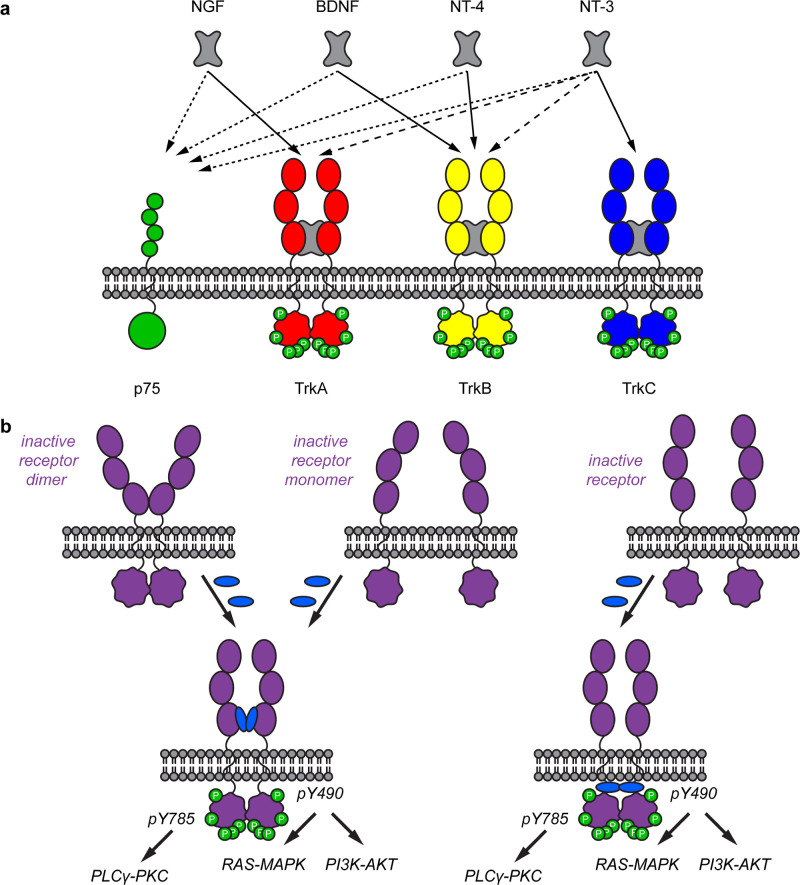
“37 Epidermal growth factor (EGF) is unlike the NTs insofar as two EGF molecules bind outside EGFR dimers giving receptor activation; 38 furthermore, binding triggers a conformational shift in the extracellular region, allowing the monomeric receptor to dimerize and activate (1b, center).”
Research works printed but not linked: 4
- Frade, 1998, Nerve growth factor: two receptors, multiple functions, BioEssays, 20, 137, 10.1002/(SICI)1521-1878(199802)20:2<137::AID-BIES6>3.0.CO;2-Q · doi:10.1002/(sici)1521-1878(199802)20:2<137::aid-bies6>3.0.co;2-q
- Ibáñez, 1994, Structure–function relationships in the neurotrophin family, J. NeuroBiol., 25, 1349, 10.1002/neu.480251104 · DOI
- von Zastrow, 2024, Drug Receptors & Pharmacodynamics
- Pattarawarapan, 2003, Molecular Basis of Neurotrophin–Receptor Interactions, J. Med. Chem., 46, 5277, 10.1021/jm030221q · DOI
Cited by
Peripheral nerve repair: innovations and future directions
Aldali, F., 唐莉, Yang, Y., Huang, Y., Li, Y., Deng, C., & Chen, H. (2026) · Journal of Translational Medicine · doi:10.1186/s12967-025-07567-z · Cited by 8
“These small molecules offer key pharmacokinetic and practical advantages over recombinant proteins, including improved tissue penetration, oral bio-availability, and reduced cost, while avoiding the intrinsic limitations of GFs such as short half-life and manufacturing complexity [102–106].”
Khzem, A. H. A., & Gomaa, M. S. (2026) · Drug Design Development and Therapy · doi:10.2147/dddt.s597087 · Cited by 5
Pandi, A. V., Malakar, V. K., Jeyabalan, J. B., Sanjai, M., Shevate, K. S., Rajagopal, K., Kumar, B. R. J., & Justin, A. (2026) · Frontiers in Bioinformatics · doi:10.3389/fbinf.2026.1779769 · Cited by 3
“Additionally, small molecules can be optimized for specific pharmacokinetic and pharmacodynamic properties through medicinal chemistry approaches, allowing for enhanced target specificity and reduced off-target effects (Skaper, 2008; Skaper, 2011; Haller et al., 2007; Malakar et al., 2025).”
Li, H., Zhang, K., Liu, C., Tian, X., Zhou, G., Liu, W., Li, Y., Zhao, L., Wang, L., & Yang, P. (2025) · FASEB BioAdvances · doi:10.1096/fba.2025-00201 · Cited by 2
“…occurs indirectly via TrkA receptor stimulation, leading to tyrosine phosphorylation and downstream ERK/MAPK signaling [43], it has been shown to reduce infarct volume in neurodegeneration models, supporting its utility in validating pathway reactivation despite potential off-target effects [44].”
Sanjai, M., Jeyabalan, J. B., Pandi, A. V., Saravanan, S. L., Clement, J. P., & Justin, A. (2026) · Experimental Brain Research · doi:10.1007/s00221-026-07327-5 · Cited by 2
“Collectively, these advances aim to maximize neuroprotective efficacy while minimizing systemic toxicity, addressing critical hurdles in translating neurotrophin biology into safe and effective therapies for neurodegenerative disorders (Ahlawat et al. 2020; Thompson et al. 2025 ).”
Metadata
- Authors
- Thompson, T. S., Sefiani, A., & Burgess, K.
- Affiliations
- Texas A&M University (US)
- Texas A&M Health Science Center (US)
- Corresponding author
- Burgess, Kevin
- Venue
- Journal of Medicinal Chemistry
- Publisher
- American Chemical Society (ACS)
- Published
- 2025-07-18
- Volume
- 68
- Issue
- 15
- Pages
- 15233-15259
- ISSN
- 0022-2623 (ISSN-L)
- 1520-4804
- PMC
- PMC12362621
- OpenAlex
- W4412491351
- Cited by
- 13
- References
- 162
- Citations by year
- 2026: 11 · 2025: 2
- FWCI
- 1.57
- Type
- journal article
- Language
- en
- Open access
- hybrid
- doi.org
- Licence
- Locations
- Journal of Medicinal Chemistry (publishedVersion, cc-by)
- PubMed Central (publishedVersion, cc-by)
- PubMed (publishedVersion)
- Funders
- National Institute of Neurological Disorders and Stroke (1R21NS13834-01A1, R21NS130471)
- Welch Foundation (AU-2182-20240404)
- National Eye Institute (R01EY029645)
- Texas A and M University (246292-00000)
- Topics
- Life Sciences › Neuroscience › Cellular and Molecular Neuroscience › Nerve injury and regeneration
- Life Sciences › Pharmacology, Toxicology and Pharmaceutics › Drug Discovery › Computational Drug Discovery Methods
- Life Sciences › Neuroscience › Cellular and Molecular Neuroscience › Alzheimer's disease research and treatments
- Keywords
- small molecule modulators, Trk receptors, high-throughput screening, blood-brain barrier permeability, neurodegeneration, stroke
- MeSH terms
- Animals, Blood-Brain Barrier, Humans, Receptor, trkA, Small Molecule Libraries
About these checks
Registry, retraction, Cites and statistics results are computed, not judged, with one exception: a printed reference that no index lists is read once by a model before it counts as a citation error. Claims are extracted by a model and kept only when their quote appears verbatim in the text; each cited source is then checked, with a model’s help, for whether it says what the claim relies on. Those verdicts can be wrong — read the claim’s quote and the cited source before relying on one.
Statistics and arithmetic are recomputed, not judged.
Confidence bands are shown only for fields calibrated on our annotated test set. None is calibrated yet, so no band is shown.
What counts as a claim ›How we measure confidence ›How we check this ›
Are you an author, or do you see a problem with this page? Request a review
How to cite
Cite CoChat for the checks on this page, and the paper for its own findings.
- This page
- CoChat. (2026). Citation check: Small-Molecule Trk Agonists: Where Do We Go from Here? https://app.cochat.ai/papers/10.1021/acs.jmedchem.4c02365
- The paper
- Thompson, T. S., Sefiani, A., & Burgess, K. (2025). Small-Molecule Trk Agonists: Where Do We Go from Here? Journal of Medicinal Chemistry. https://doi.org/10.1021/acs.jmedchem.4c02365
Data sources
Bibliographic data: Semantic Scholar, OpenAlex, Crossref.
Contains information from the Semantic Scholar Academic Graph Datasets, made available under the ODC Attribution License (ODC-BY 1.0).
Semantic Scholar’s data is described in: Kinney, R., et al. (2023). The Semantic Scholar Open Data Platform. arXiv:2301.10140.
