

Toward Reconciling Radiocarbon Production Rates With Carbon Cycle Changes of the Last 55,000 Years
Open accessThe DOI matches its Crossref record; 113 of the 113 references it cites were found in a registry or an index; none of the 66 sources its claims cite is checked for support yet.
Abstract
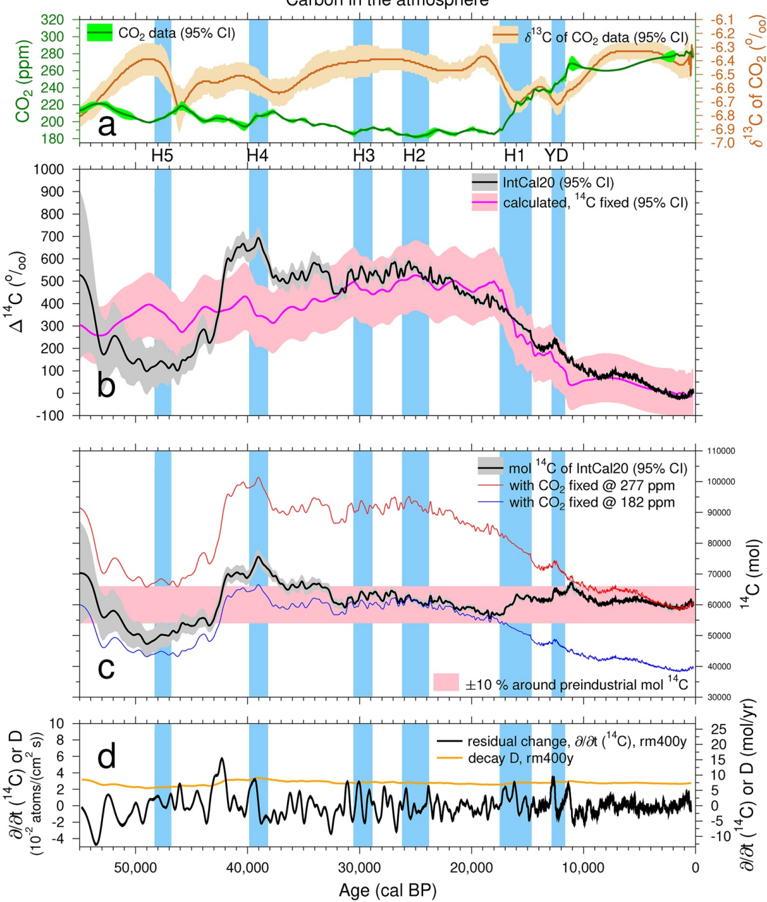
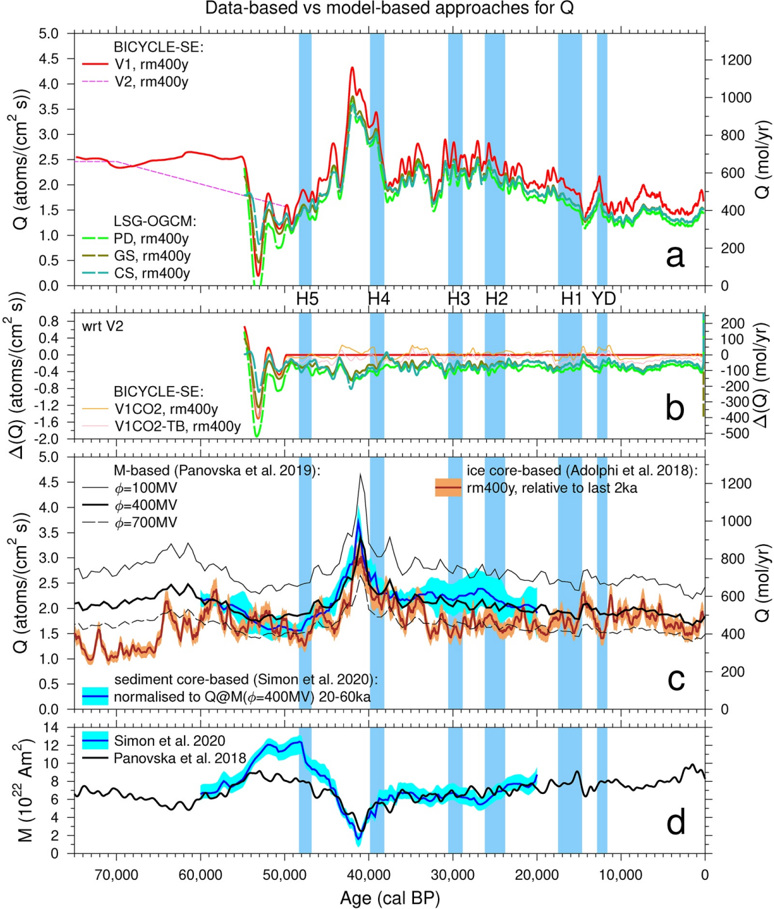
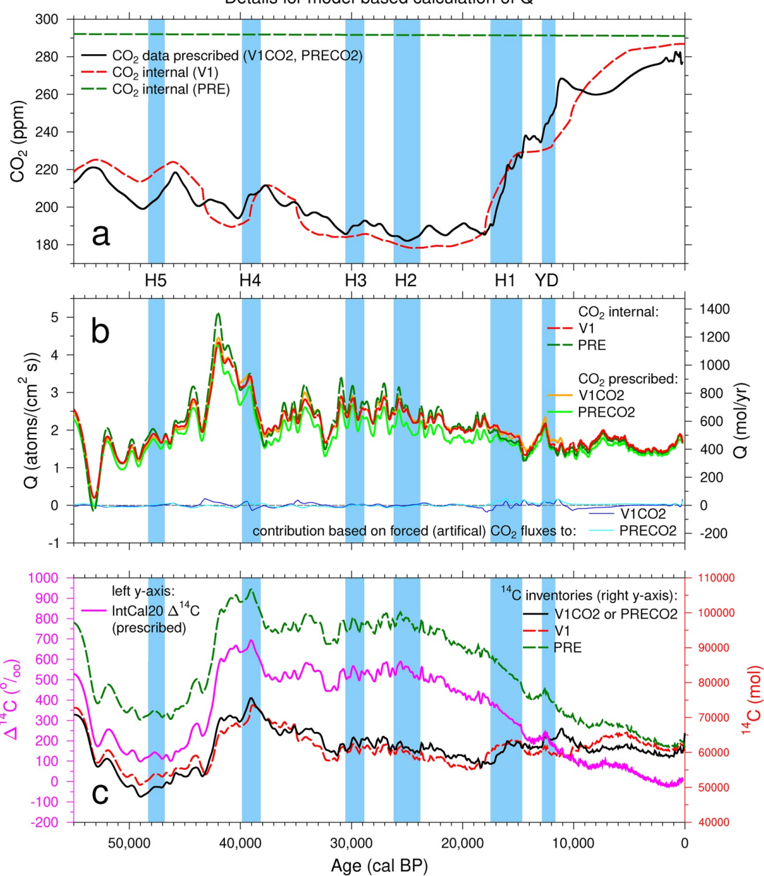
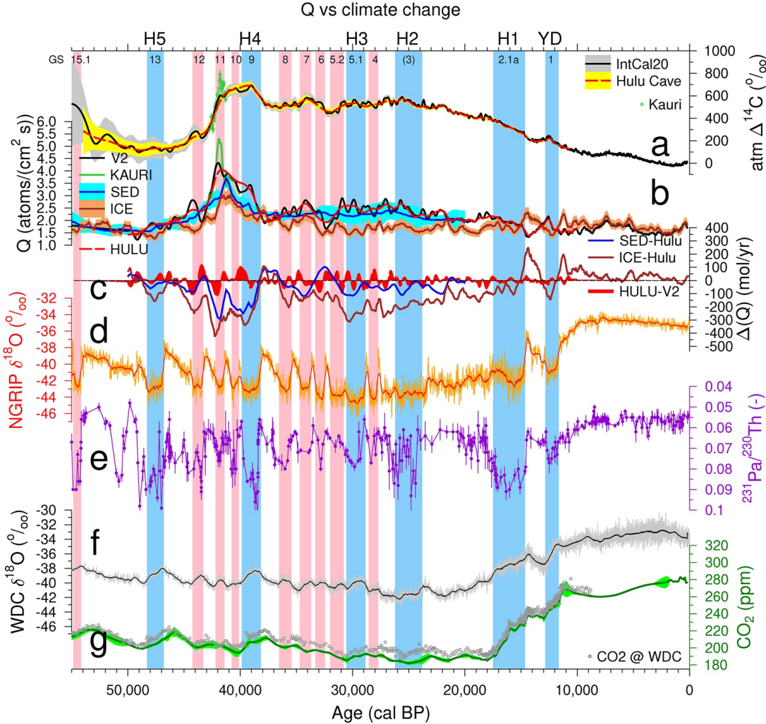
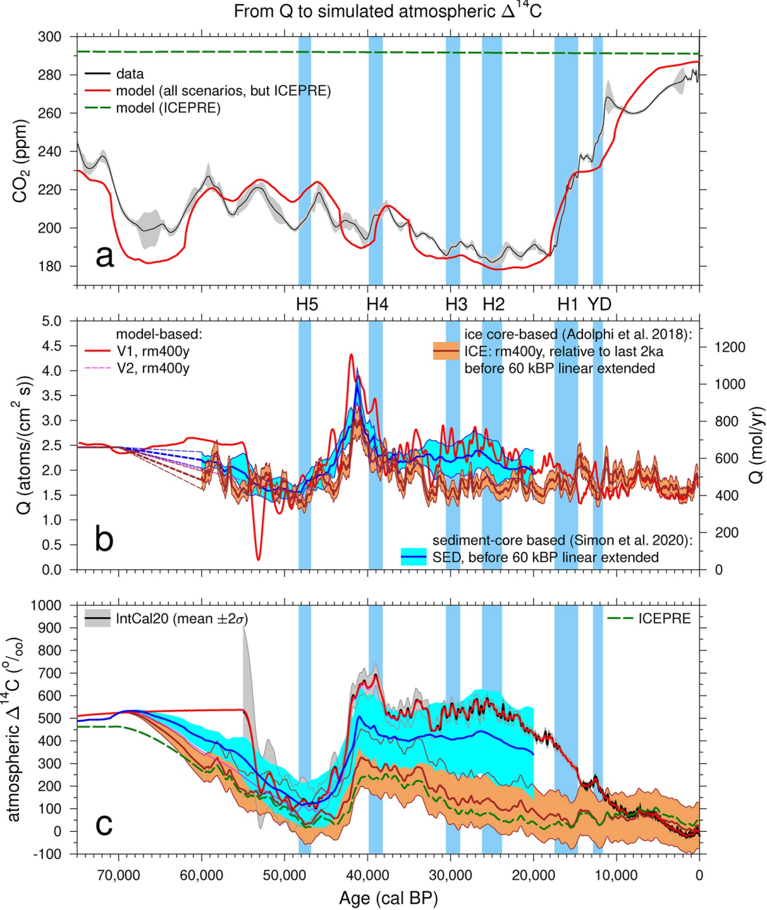
Since it is currently not understood how changes in 14 C production rate ( Q ), and in the carbon cycle, can be combined to explain the reconstructed atmospheric Δ 14 C record, we discuss possible reasons for this knowledge gap. Reviewing the literature, we exclude that changes in the content of atoms in the atmosphere, which produce cosmogenic 14 C after being hit by galactic cosmic rays, might be responsible for parts of the observed differences. When combining Q with carbon cycle changes, one needs to understand the changes in the atmospheric 14 C inventory, which are partially counterintuitive. For example, during the Last Glacial Maximum, Δ 14 C was ∼400‰ higher compared with preindustrial times, but the 14 C inventory was 10% smaller. Some pronounced changes in atmospheric Δ 14 C do not correspond to any significant changes in the atmospheric 14 C inventory, since CO 2 was changing simultaneously. Using two conceptually different models (BICYCLE‐SE and LSG‐OGCM), we derive hypothetical Q s by forcing the models with identical atmospheric CO 2 and Δ 14 C data. Results are compared with the most recent data‐based estimates of Q derived from cosmogenic isotopes. Millennial‐scale climate change connected to the bipolar seesaw is missing in the applied models, which might explain some, but probably not all, of the apparent model‐data disagreement in Q . Furthermore, Q based on either data from marine sediments or ice cores contains offsets, suggesting an interpretation deficit in the current data‐based approaches.
Overview
CoChat Summary
TL;DR
Köhler et al. review why independent ¹⁴C production rates (Q) and carbon-cycle changes cannot jointly reproduce atmospheric Δ¹⁴C over the last 55 kyr, and use two carbon-cycle models to invert Q from CO₂ and Δ¹⁴C data. They rule out precursor-material changes, highlight CO₂’s control on the ¹⁴C inventory, and attribute remaining model–data disagreement partly to missing AMOC/bipolar-seesaw variability and offsets among data-based Q estimates.
Key findings
- Changes in precursor material for cosmogenic ¹⁴C are negligible: atmospheric N₂ changed by <0.3‰ over the last 55 kyr, other GCR-target changes are <1‰, and their overall impact on Q is <0.05‰, so they cannot explain higher glacial Δ¹⁴C.
- The atmospheric ¹⁴C inventory behaves counterintuitively: at the LGM, Δ¹⁴C was ∼400‰ higher than preindustrial, but the ¹⁴C inventory was 10% smaller; most of the last 55 kyr stays within ±10% of the preindustrial 60 kmol, while fixing CO₂ at LGM or preindustrial levels makes the inventory decrease by ∼30% over the last 25 kyr. Increasing CO₂ from glacial 190 ppm to preindustrial 278 ppm decreases atmospheric Δ¹⁴C by >30‰.
- Model-based Q from BICYCLE-SE and LSG-OGCM share fine structure, with LSG-OGCM Q 50–100 mol/yr smaller; the terrestrial carbon cycle accounts for about 50 mol/yr, or up to half the overall difference. In scenario V2, Q is held constant at 660 mol/yr before 70 kcal BP and then decreases linearly to V1 values at 50 kcal BP.
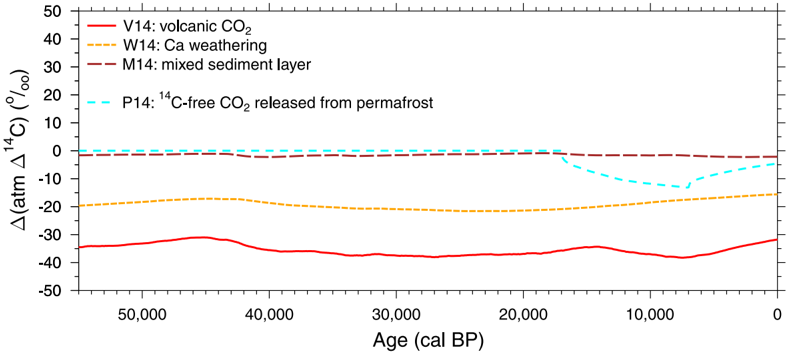
- Data-based Q estimates disagree: ice-core-based Q is consistently lower than sediment-core-based Q, and both point to smaller Q across the Laschamps geomagnetic excursion than model-based estimates. Solid Earth and permafrost processes contribute little to Δ¹⁴C changes: CaCO₃ dissolution <−5‰, carbonate weathering ∼−20‰, ¹⁴C-free volcanic emissions ∼−35‰, and permafrost release <−15‰.
Methods
- Literature review and data compilation of recent Q estimates from ¹⁰Be/³⁶Cl ice cores, marine sediment ¹⁰Be, and geomagnetic dipole moment reconstructions, compared with model-derived Q.
- Two conceptually different models are forced with identical atmospheric CO₂ and Δ¹⁴C data to invert Q: BICYCLE-SE, a carbon-cycle box model with 10 ocean boxes, atmosphere, terrestrial biosphere, and solid Earth processes, run transiently over 210 kyr; and LSG-OGCM, the Hamburg Large Scale Geostrophic ocean general circulation model at 3.5° horizontal resolution and 22 vertical levels, with preindustrial, glacial, and stadial climate scenarios.
- Main analysis calculates atmospheric ¹⁴C inventory from Δ¹⁴C, CO₂, and δ¹³C of CO₂, derives Q via model equations, and runs sensitivity scenarios for prescribed versus internal CO₂, terrestrial biosphere on/off, fixed preindustrial climate, prescribed Q from ice/sediment data, altered ¹⁴C signatures of solid Earth fluxes, and permafrost carbon release.
Limitations
- The paper states that millennial-scale climate change connected to the bipolar seesaw and abrupt AMOC changes are missing from the applied models, which might explain some but probably not all of the apparent model–data disagreement in Q; the carbon-cycle response to such changes is highly model dependent.
- The paper states that Q based on marine sediments or ice cores contains offsets, suggesting an interpretation deficit in current data-based approaches; ice-core ¹⁰Be flux records inherit accumulation-rate uncertainties of up to 30% (2σ) on long timescales, and marine ¹⁰Be/⁹Be records can have climate-driven biases up to 15%.
- The paper states that focusing on atmospheric ¹⁴C is prone to uncertainty because its change is mainly the difference of two large, insufficiently constrained fluxes—source Q and carbon-cycle-related sinks. Evident from the text: prescribing CO₂ violates carbon mass conservation, preindustrial-CO₂ setups produce a different ¹⁴C cycle, and the authors do not apply age corrections of up to 500 years to GICC05.
Model-written summary. Check it against the paper before relying on it.
Integrity signals
Registry
Cites
Statistics
Figures


Verification
Claims the paper makes
0 Valid · 2 Not valid · 51 Not checked · 76 Own results and interpretations
The paper states this without a source or data behind it here, so there is nothing to check it against. The quote shows it is in the paper.
In the paper
“Reviewing the literature, we exclude that changes in the content of atoms in the atmosphere, which produce cosmogenic 14 C after being hit by galactic cosmic rays, might be responsible for parts of the observed differences.”
§ Toward Reconciling Radiocarbon Production Rates With Carbon Cycle Changes of the Last 55,000 Years > Abstract
hedged- Asserted: passes — The authors put it forward as true.
- Checkable: passes — It can be checked against evidence.
- Load-bearing: passes — The paper’s conclusions depend on it.
- Based: unclear — It is unclear why the paper says it holds.
A result the paper states — it cites no source for it, so there is none to check. The quote shows it is in the paper.
In the paper
“Some pronounced changes in atmospheric Δ 14 C do not correspond to any significant changes in the atmospheric 14 C inventory, since CO 2 was changing simultaneously.”
§ Toward Reconciling Radiocarbon Production Rates With Carbon Cycle Changes of the Last 55,000 Years > Abstract
plainstates a cause- Asserted: passes — The authors put it forward as true.
- Checkable: passes — It can be checked against evidence.
- Load-bearing: passes — The paper’s conclusions depend on it.
- Based: passes — The paper gives a reason why it holds.
A result the paper states — it cites no source for it, so there is none to check. The quote shows it is in the paper.
In the paper
“Gas-exchange considerations show that increasing CO 2 by about one half from its glacial 190 ppm to its preindustrial 278 ppm decreases atmospheric Δ 14 C by >30‰”
§ Toward Reconciling Radiocarbon Production Rates With Carbon Cycle Changes of the Last 55,000 Years > Abstract
plainstates a cause- Asserted: passes — The authors put it forward as true.
- Checkable: passes — It can be checked against evidence.
- Load-bearing: passes — The paper’s conclusions depend on it.
- Based: passes — The paper gives a reason why it holds.
A result the paper states — it cites no source for it, so there is none to check. The quote shows it is in the paper.
In the paper
“Both IntCal20 and the hypothesized Δ 14 C agree within their uncertainties after 37 kcal BP.”
§ Toward Reconciling Radiocarbon Production Rates With Carbon Cycle Changes of the Last 55,000 Years > 2.2. Radiocarbon Inventory in the Atmosphere
plain- Asserted: passes — The authors put it forward as true.
- Checkable: passes — It can be checked against evidence.
- Load-bearing: passes — The paper’s conclusions depend on it.
- Based: passes — The paper gives a reason why it holds.
In the paper
“Using the BICYCLE-SE carbon cycle model (Köhler & Munhoven, 2020), we estimate that the glacial ocean stored 70 Pmol less O 2 than the preindustrial ocean.”
§ Toward Reconciling Radiocarbon Production Rates With Carbon Cycle Changes of the Last 55,000 Years > 2.1. The Process of 14 C Production and Potential Changes in the Precursor Material for Radiocarbon
What the sources say
- Not checked yetcites Köhler & Munhoven, 2020 matched to “Late Pleistocene Carbon Cycle Revisited by Considering Solid Earth Processes” (2020) source
hedged- Asserted: passes — The authors put it forward as true.
- Checkable: passes — It can be checked against evidence.
- Load-bearing: unclear — It is unclear whether the paper’s conclusions depend on it.
- Based: passes — The paper gives a reason why it holds.
81 more claims
Create a free account to see all 129 claims and to verify the 62 references still open.
- It may state two separate claims as one. 29
- Probably not a substantial claim. 21
Self-check
Percentages, sums and reported differences re-computed from the paper’s own numbers.
Each contradiction between two passages listed here was confirmed by an independent check.
Rated minor: it would not touch a result — a value no result rests on, a p-value that stays on the same side of the significance level, or a conflict that is clerical, resolved elsewhere in the paper, or outside its own findings.
In the paper
§ Toward Reconciling Radiocarbon Production Rates With Carbon Cycle Changes of the Last 55,000 Years > 5. Conclusions
“| N 2 O ( 14 N) | 48 Pmol | -14 Pmol | -0.1‰ b | Schilt et al. (2010) |”
§ Toward Reconciling Radiocarbon Production Rates With Carbon Cycle Changes of the Last 55,000 Years > 2.1. The Process of 14 C Production and Potential Changes in the Precursor Material for Radiocarbon
“The atmospheric concentration of N 2 O was 190 ppb at LGM and rose to 270 ppb at preindustrial times (Schilt et al., 2010).”
Rated minor: it would not touch a result — a value no result rests on, a p-value that stays on the same side of the significance level, or a conflict that is clerical, resolved elsewhere in the paper, or outside its own findings.
In the paper
§ Toward Reconciling Radiocarbon Production Rates With Carbon Cycle Changes of the Last 55,000 Years > 2.1. The Process of 14 C Production and Potential Changes in the Precursor Material for Radiocarbon
“Other relative changes in the amount of the GCRs' target material over glacial timescales are smaller than 1‰.”
§ Toward Reconciling Radiocarbon Production Rates With Carbon Cycle Changes of the Last 55,000 Years > 2.1. The Process of 14 C Production and Potential Changes in the Precursor Material for Radiocarbon
“This would have reduced atmospheric Ar-which contains, at ∼1,650 Pmol, two orders of magnitude more Ar than the 21 Pmol Ar in the ocean (Sarmiento & Gruber, 2006)-by the relative fraction of 2‰.”
Citations
Cites
The IntCal20 Northern Hemisphere Radiocarbon Age Calibration Curve (0–55 cal kBP)
Reimer, P. J., Austin, W. E. N., Bard, E., Bayliss, A., Blackwell, P. G., Bronk Ramsey, C., Butzin, M., Cheng, H., Edwards, R. L., Friedrich, M., et al. (2020) · Radiocarbon · doi:10.1017/rdc.2020.41 · Cited by 7,900 · cited 6×
“(b) IntCal20 Δ 14 C (Reimer et al., 2020).”
BackgroundMethodInfluentialSelf-citationDiscussion Reporting of 14 C Data
Stuiver, M., & Polach, H. A. (1977) · Radiocarbon · doi:10.1017/s0033822200003672 · Cited by 5,640
INTCAL98 Radiocarbon Age Calibration, 24,000–0 cal BP
Stuiver, M., Reimer, P. J., Bard, E., Beck, J. W., Burr, G. S., Hughen, K. A., Kromer, B., McCormac, G., Van Der Plicht, J., & Spurk, M. (1998) · Radiocarbon · doi:10.1017/s0033822200019123 · Cited by 4,421
Total carbon and nitrogen in the soils of the world
BATJES, N. H. (1996) · European Journal of Soil Science · doi:10.1111/j.1365-2389.1996.tb01386.x · Cited by 3,213
High-resolution record of Northern Hemisphere climate extending into the last interglacial period
North Greenland Ice Core Project members (2004) · Nature · doi:10.1038/nature02805 · Cited by 3,170
Collapse and rapid resumption of Atlantic meridional circulation linked to deglacial climate changes
McManus, J. F., Francois, R., Gherardi, J.-M., Keigwin, L. D., & Brown-Leger, S. (2004) · Nature · doi:10.1038/nature02494 · Cited by 2,234
Rasmussen, S. O., Bigler, M., Blockley, S. P., Blunier, T., Buchardt, S. L., Clausen, H. B., Cvijanovic, I., Dahl-Jensen, D., Johnsen, S. J., Fischer, H., et al. (2014) · Quaternary Science Reviews · doi:10.1016/j.quascirev.2014.09.007 · Cited by 2,219
Marine20—The Marine Radiocarbon Age Calibration Curve (0–55,000 cal BP)
Heaton, T. J., Köhler, P., Butzin, M., Bard, E., Reimer, R. W., Austin, W. E. N., Bronk Ramsey, C., Grootes, P. M., Hughen, K. A., Kromer, B., et al. (2020) · Radiocarbon · doi:10.1017/rdc.2020.68 · Cited by 1,988
Self-citationThe solubility of nitrogen, oxygen and argon in water and seawater
Weiss, R. F. (1970) · Deep Sea Research and Oceanographic Abstracts · doi:10.1016/0011-7471(70)90037-9 · Cited by 1,960
SHCal20 Southern Hemisphere calibration, 0–55,000 years cal BP
Hogg, A. G., Heaton, T. J., Hua, Q., Palmer, J. G., Turney, C. S., Southon, J., Bayliss, A., Blackwell, P. G., Boswijk, G., Bronk Ramsey, C., et al. (2020) · Radiocarbon · doi:10.1017/rdc.2020.59 · Cited by 1,530 · cited 1×
“…for chronological purposes, as for example, in the most recent international calibration efforts of IntCal20, Marine20, and SHCal20 (e.g., Heaton et al., 2020; Hogg et al., 2020; Reimer et al., 2020), and provides the main method to determine the age of carbon-bearing samples over the last ∼55 kyr.”
MethodSarmiento, J. L. (2006) · Princeton University Press eBooks · doi:10.1515/9781400849079 · Cited by 1,370
The Nubase evaluation of nuclear and decay properties
Audi, G., Bersillon, O., Blachot, J., & Wapstra, A. H. (2003) · Nuclear Physics A · doi:10.1016/j.nuclphysa.2003.11.001 · Cited by 1,338
High-Precision Radiocarbon Age Calibration for Terrestrial and Marine Samples
Stuiver, M., Reimer, P. J., & Braziunas, T. F. (1998) · Radiocarbon · doi:10.1017/s0033822200019172 · Cited by 1,136 · cited 1×
“…in international calibration efforts since the IntCal project began in 1998, originally only for the Holocene (Stuiver, Reimer, Bard, et al., 1998, Stuiver, Reimer, & Braziunas, 1998) but now, with the 2020 curve updates, for the whole time window, which is reachable with 14 C (Butzin et al.,…”
BackgroundModeling Atmospheric 14C Influences and 14C Ages of Marine Samples to 10,000 BC
Stuiver, M., & Braziunas, T. F. (1993) · Radiocarbon · doi:10.1017/s0033822200013874 · Cited by 1,076
The Greenland Ice Core Chronology 2005, 15–42ka. Part 1: constructing the time scale
Andersen, K. K., Svensson, A., Johnsen, S. J., Rasmussen, S. O., Bigler, M., Röthlisberger, R., Ruth, U., Siggaard-Andersen, M.-L., Peder Steffensen, J., & Dahl-Jensen, D. (2006) · Quaternary Science Reviews · doi:10.1016/j.quascirev.2006.08.002 · Cited by 801
9,400 years of cosmic radiation and solar activity from ice cores and tree rings
Steinhilber, F., Abreu, J. A., Beer, J., Brunner, I., Christl, M., Fischer, H., Heikkilä, U., Kubik, P. W., Mann, M., McCracken, K. G., et al. (2012) · Proceedings of the National Academy of Sciences · doi:10.1073/pnas.1118965109 · Cited by 774
Simulation of particle fluxes and cosmogenic nuclide production in the Earth's atmosphere
Masarik, J., & Beer, J. (1999) · Journal of Geophysical Research: Atmospheres · doi:10.1029/1998jd200091 · Cited by 652
Strong and deep Atlantic meridional overturning circulation during the last glacial cycle
Böhm, E., Lippold, J., Gutjahr, M., Frank, M., Blaser, P., Antz, B., Fohlmeister, J., Frank, N., Andersen, M. B., & Deininger, M. (2015) · Nature · doi:10.1038/nature14059 · Cited by 633
Centennial-scale changes in the global carbon cycle during the last deglaciation
Marcott, S. A., Bauska, T. K., Buizert, C., Steig, E. J., Rosen, J. L., Cuffey, K. M., Fudge, T. J., Severinghaus, J. P., Ahn, J., Kalk, M. L., et al. (2014) · Nature · doi:10.1038/nature13799 · Cited by 580 · cited 1×
“The large and abrupt drop in Δ 14 C by 40‰ in 200 years at the end of Heinrich stadial 1 is clearly associated with the simultaneous rise in atmospheric CO 2 at the onset of the Bølling/Allerød around 14.7 kcal BP (Marcott et al., 2014)—we see hardly any changes in the atmospheric 14 C inventory.”
BackgroundInfluentialNorth Atlantic ocean circulation and abrupt climate change during the last glaciation
Henry, L. G., McManus, J. F., Curry, W. B., Roberts, N. L., Piotrowski, A. M., & Keigwin, L. D. (2016) · Science · doi:10.1126/science.aaf5529 · Cited by 521
Constraining global air‐sea gas exchange for CO2 with recent bomb 14C measurements
Sweeney, C., Gloor, E., Jacobson, A. R., Key, R. M., McKinley, G., Sarmiento, J. L., & Wanninkhof, R. (2007) · Global Biogeochemical Cycles · doi:10.1029/2006gb002784 · Cited by 520
Precise interpolar phasing of abrupt climate change during the last ice age
WAIS Divide Project Members (2015) · Nature · doi:10.1038/nature14401 · Cited by 446
The Greenland Ice Core Chronology 2005, 15–42ka. Part 2: comparison to other records
Svensson, A., Andersen, K. K., Bigler, M., Clausen, H. B., Dahl-Jensen, D., Davies, S. M., Johnsen, S. J., Muscheler, R., Rasmussen, S. O., & Röthlisberger, R. (2006) · Quaternary Science Reviews · doi:10.1016/j.quascirev.2006.08.003 · Cited by 445
Self-citationConsistently dated Atlantic sediment cores over the last 40 thousand years
Waelbroeck, C., Lougheed, B. C., Vazquez Riveiros, N., Missiaen, L., Pedro, J., Dokken, T., Hajdas, I., Wacker, L., Abbott, P., Dumoulin, J.-P., et al. (2019) · Scientific Data · doi:10.1038/s41597-019-0173-8 · Cited by 400
The North Atlantic atmosphere-sea surface 14C gradient during the Younger Dryas climatic event
Bard, E., Arnold, M., Mangerud, J., Paterne, M., Labeyrie, L., Duprat, J., Mélières, M.-A., Sønstegaard, E., & Duplessy, J.-C. (1994) · Earth and Planetary Science Letters · doi:10.1016/0012-821x(94)90112-0 · Cited by 382 · cited 1×
“Carbon cycle models, initially restricted to box models, have a long history of helping in the interpretation of 14 C data (e.g., Bard et al., 1994; Broecker et al., 1990).”
BackgroundSolar activity during the last 1000 yr inferred from radionuclide records
Muscheler, R., Joos, F., Beer, J., Müller, S. A., Vonmoos, M., & Snowball, I. (2007) · Quaternary Science Reviews · doi:10.1016/j.quascirev.2006.07.012 · Cited by 373
Self-citationMean Circulation of the Hamburg LSG OGCM and Its Sensitivity to the Thermohaline Surface Forcing
Maier-Reimer, E., Mikolajewicz, U., & Hasselmann, K. (1993) · Journal of Physical Oceanography · doi:10.1175/1520-0485(1993)023<0731:mcothl>2.0.co;2 · Cited by 352
Muscheler, R., Beer, J., Kubik, P. W., & Synal, H.-A. (2005) · Quaternary Science Reviews · doi:10.1016/j.quascirev.2005.01.012 · Cited by 330
Self-citationSchlitzer, R. (2002) · Deep Sea Research Part II: Topical Studies in Oceanography · doi:10.1016/s0967-0645(02)00004-8 · Cited by 322
Gruber, N. (2008) · Nitrogen in the Marine Environment · doi:10.1016/b978-0-12-372522-6.00001-3 · Cited by 321
Köhler, P., Nehrbass-Ahles, C., Schmitt, J., Stocker, T. F., & Fischer, H. (2017) · Earth System Science Data · doi:10.5194/essd-9-363-2017 · Cited by 319 · cited 2×
“Both models can be forced similarly—with data-reconstructed changes in atmospheric CO 2 (Köhler et al., 2017) and in atmospheric Δ 14 C (Reimer et al., 2020).”
BackgroundSelf-citationGeochemical and geophysical implications of the radiocarbon calibration
Bard, E. (1998) · Geochimica et Cosmochimica Acta · doi:10.1016/s0016-7037(98)00130-6 · Cited by 283
A first chronology for the North Greenland Eemian Ice Drilling (NEEM) ice core
Rasmussen, S. O., Abbott, P. M., Blunier, T., Bourne, A. J., Brook, E., Buchardt, S. L., Buizert, C., Chappellaz, J., Clausen, H. B., Cook, E., et al. (2013) · Climate of the Past · doi:10.5194/cp-9-2713-2013 · Cited by 249
CARBON-14 IN HYDROGEOLOGICAL STUDIES
Mook, W. G. (1980) · Elsevier eBooks · doi:10.1016/b978-0-444-41780-0.50008-0 · Cited by 242
An 800-kyr record of global surface ocean δ18O and implications for ice volume-temperature coupling
Shakun, J. D., Lea, D. W., Lisiecki, L. E., & Raymo, M. E. (2015) · Earth and Planetary Science Letters · doi:10.1016/j.epsl.2015.05.042 · Cited by 239
Atmospheric nitrous oxide during the last 140,000years
Schilt, A., Baumgartner, M., Schwander, J., Buiron, D., Capron, E., Chappellaz, J., Loulergue, L., Schüpbach, S., Spahni, R., Fischer, H., et al. (2010) · Earth and Planetary Science Letters · doi:10.1016/j.epsl.2010.09.027 · Cited by 238
Muscheler, R., Beer, J., Wagner, G., Laj, C., Kissel, C., Raisbeck, G. M., Yiou, F., & Kubik, P. W. (2004) · Earth and Planetary Science Letters · doi:10.1016/s0012-821x(03)00722-2 · Cited by 219
Self-citationTree rings and ice cores reveal 14C calibration uncertainties during the Younger Dryas
Muscheler, R., Kromer, B., Björck, S., Svensson, A., Friedrich, M., Kaiser, K. F., & Southon, J. (2008) · Nature Geoscience · doi:10.1038/ngeo128 · Cited by 214
Self-citationEleven-year solar cycles over the last millennium revealed by radiocarbon in tree rings
Brehm, N., Bayliss, A., Christl, M., Synal, H.-A., Adolphi, F., Beer, J., Kromer, B., Muscheler, R., Solanki, S. K., Usoskin, I., et al. (2021) · Nature Geoscience · doi:10.1038/s41561-020-00674-0 · Cited by 213
Self-citationCO2 storage and release in the deep Southern Ocean on millennial to centennial timescales
Rae, J. W. B., Burke, A., Robinson, L. F., Adkins, J. F., Chen, T., Cole, C., Greenop, R., Li, T., Littley, E. F. M., Nita, D. C., et al. (2018) · Nature · doi:10.1038/s41586-018-0614-0 · Cited by 211
BUTZIN, M., PRANGE, M., & LOHMANN, G. (2005) · Earth and Planetary Science Letters · doi:10.1016/j.epsl.2005.03.003 · Cited by 201
Self-citationGkinis, V., Simonsen, S. B., Buchardt, S. L., White, J. W. C., & Vinther, B. M. (2014) · Earth and Planetary Science Letters · doi:10.1016/j.epsl.2014.08.022 · Cited by 199
Oxygen-18 of O 2 Records the Impact of Abrupt Climate Change on the Terrestrial Biosphere
Severinghaus, J. P., Beaudette, R., Headly, M. A., Taylor, K., & Brook, E. J. (2009) · Science · doi:10.1126/science.1169473 · Cited by 199
A new estimate of the CaCO3 to organic carbon export ratio
Sarmiento, J. L., Dunne, J., Gnanadesikan, A., Key, R. M., Matsumoto, K., & Slater, R. (2002) · Global Biogeochemical Cycles · doi:10.1029/2002gb001919 · Cited by 198
High Resolution Global Paleointensity Stack Since 75 kyr (GLOPIS-75) Calibrated to Absolute Values
Laj, C., Kissel, C., & Beer, J. (2013) · Geophysical Monograph Series · doi:10.1029/145gm19 · Cited by 190
Large inert carbon pool in the terrestrial biosphere during the Last Glacial Maximum
Ciais, P., Tagliabue, A., Cuntz, M., Bopp, L., Scholze, M., Hoffmann, G., Lourantou, A., Harrison, S. P., Prentice, I. C., Kelley, D. I., et al. (2012) · Nature Geoscience · doi:10.1038/ngeo1324 · Cited by 186
Poluianov, S., Kovaltsov, G. A., Mishev, A., & USOSKIN, I. G. (2016) · Journal of Geophysical Research Atmospheres · doi:10.1002/2016jd025034 · Cited by 182
Bauska, T. K., Baggenstos, D., Brook, E. J., Mix, A. C., Marcott, S. A., Petrenko, V. V., Schaefer, H., Severinghaus, J. P., & Lee, J. E. (2016) · Proceedings of the National Academy of Sciences · doi:10.1073/pnas.1513868113 · Cited by 180
Radiocarbon constraints on the glacial ocean circulation and its impact on atmospheric CO2
Skinner, L. C., Primeau, F., Freeman, E., de la Fuente, M., Goodwin, P. A., Gottschalk, J., Huang, E., McCave, I. N., Noble, T. L., & Scrivner, A. E. (2017) · Nature Communications · doi:10.1038/ncomms16010 · Cited by 178 · cited 2×
“…a global mean deep ocean reservoir age of 644 ± 101 14 C years in the model is in agreement with 689 ± 53 14 C years derived from 256 deep ocean 14 C samples (Skinner et al., 2017); and basin-wide deep ocean 𝐴𝐴 CO 2−3 changes agree with reconstructions (Köhler & Munhoven, 2020; Yu et al., 2013).”
ResultA high-resolution record of atmospheric 14C based on Hulu Cave speleothem H82
Southon, J., Noronha, A. L., Cheng, H., Edwards, R. L., & Wang, Y. (2012) · Quaternary Science Reviews · doi:10.1016/j.quascirev.2011.11.022 · Cited by 175 · cited 2×
“We also show a smoothed Δ 14 C estimate obtained from Hulu Cave alone (Cheng et al., 2018; Southon et al., 2012).”
MethodGreenland records of aerosol source and atmospheric lifetime changes from the Eemian to the Holocene
Schüpbach, S., Fischer, H., Bigler, M., Erhardt, T., Gfeller, G., Leuenberger, D., Mini, O., Mulvaney, R., Abram, N. J., Fleet, L., et al. (2018) · Nature Communications · doi:10.1038/s41467-018-03924-3 · Cited by 175
Self-citationRevision of the global carbon budget due to changing air‐sea oxygen fluxes
Plattner, G., Joos, F., & Stocker, T. F. (2002) · Global Biogeochemical Cycles · doi:10.1029/2001gb001746 · Cited by 166
Evolution of the stable carbon isotope composition of atmospheric CO2 over the last glacial cycle
Eggleston, S., Schmitt, J. H. M. M., Bereiter, B., Schneider, R., & Fischer, H. (2016) · Paleoceanography · doi:10.1002/2015pa002874 · Cited by 166
Abrupt Climate and Weather Changes Across Time Scales
Lohmann, G., Butzin, M., Eissner, N., Shi, X., & Stepanek, C. (2020) · Paleoceanography and Paleoclimatology · doi:10.1029/2019pa003782 · Cited by 163
Self-citationAbrupt changes in the global carbon cycle during the last glacial period
Bauska, T., Marcott, S. A., & Brook, E. J. (2021) · Nature Geoscience · doi:10.1038/s41561-020-00680-2 · Cited by 162
Alley, R. B., Finkel, R. C., Nishiizumi, K., Anandakrishnan, S., Shuman, C. A., Mershon, G., Zielinski, G. A., & Mayewski, P. A. (1995) · Journal of Glaciology · doi:10.3189/s0022143000034845 · Cited by 159
A new model of cosmogenic production of radiocarbon 14C in the atmosphere
Kovaltsov, G. A., Mishev, A., & Usoskin, I. G. (2012) · Earth and Planetary Science Letters · doi:10.1016/j.epsl.2012.05.036 · Cited by 158
A global environmental crisis 42,000 years ago
Cooper, A., TURNEY, C. S. M., Palmer, J., Hogg, A. G., McGlone, M. S., Wilmshurst, J. M., Lorrey, A. M., Heaton, T., Russell, J. M., McCracken, K. G., et al. (2021) · Science · doi:10.1126/science.abb8677 · Cited by 154
Self-citationQuantitative interpretation of atmospheric carbon records over the last glacial termination
Köhler, P., Fischer, H., Munhoven, G., & Zeebe, R. E. (2005) · Global Biogeochemical Cycles · doi:10.1029/2004gb002345 · Cited by 153
Self-citationRoth, R., & Joos, F. (2013) · Climate of the Past · doi:10.5194/cp-9-1879-2013 · Cited by 136
Atmospheric 14 C/ 12 C changes during the last glacial period from Hulu Cave
Cheng, H., Edwards, R. L., Southon, J., Matsumoto, K., Feinberg, J. M., Sinha, A., Zhou, W., Li, H., Li, X., Xu, Y., et al. (2018) · Science · doi:10.1126/science.aau0747 · Cited by 135 · cited 3×
“We also show a smoothed Δ 14 C estimate obtained from Hulu Cave alone (Cheng et al., 2018; Southon et al., 2012).”
BackgroundMethodChanges in deep-water formation during the Younger Dryas event inferred from 10Be and 14C records
Muscheler, R., Beer, J., Wagner, G., & Finkel, R. C. (2000) · Nature · doi:10.1038/35046041 · Cited by 133
Self-citationAdolphi, F., Bronk Ramsey, C., Erhardt, T., Edwards, R. L., Cheng, H., Turney, C. S. M., Cooper, A., Svensson, A., Rasmussen, S. O., Fischer, H., et al. (2018) · Climate of the Past · doi:10.5194/cp-14-1755-2018 · Cited by 126
Self-citationPanovska, S., Constable, C. G., & Korte, M. (2018) · Geochemistry Geophysics Geosystems · doi:10.1029/2018gc007966 · Cited by 123
Extreme deepening of the Atlantic overturning circulation during deglaciation
Barker, S., Knorr, G., Vautravers, M. J., Diz, P., & Skinner, L. C. (2010) · Nature Geoscience · doi:10.1038/ngeo921 · Cited by 122
Marine radiocarbon reservoir age simulations for the past 50,000 years
Butzin, M., Köhler, P., & Lohmann, G. (2017) · Geophysical Research Letters · doi:10.1002/2017gl074688 · Cited by 119
Self-citationRadiocarbon constraints on the extent and evolution of the South Pacific glacial carbon pool
Ronge, T. A., Tiedemann, R., Lamy, F., Köhler, P., Alloway, B. V., Pol-Holz, R. H. D., Pahnke, K., Southon, J. R., & Wacker, L. (2016) · Nature Communications · doi:10.1038/ncomms11487 · Cited by 117
Self-citationConstraining the Variability of the Atlantic Meridional Overturning Circulation During the Holocene
Lippold, J. A., Pöppelmeier, F., Süfke, F., Gutjahr, M., Goepfert, T. J., Blaser, P., Friedrich, O., Link, J. M., Wacker, L., Rheinberger, S., et al. (2019) · Geophysical Research Letters · doi:10.1029/2019gl084988 · Cited by 116
One Hundred Thousand Years of Geomagnetic Field Evolution
Panovska, S., Korte, M., & Constable, C. G. (2019) · Reviews of Geophysics · doi:10.1029/2019rg000656 · Cited by 116
Deep‐Sea Oxygen Depletion and Ocean Carbon Sequestration During the Last Ice Age
Anderson, R. F., Sachs, J. P., Fleisher, M. Q., Allen, K. A., Yu, J., Koutavas, A., & Jaccard, S. L. (2019) · Global Biogeochemical Cycles · doi:10.1029/2018gb006049 · Cited by 116
Influence of Vertical Mixing on the Thermohaline Hysteresis: Analyses of an OGCM
Prange, M., Lohmann, G., & Paul, A. (2003) · Journal of Physical Oceanography · doi:10.1175/1520-0485(2003)033<1707:iovmot>2.0.co;2 · Cited by 109
Yu, J., Anderson, R. F., Jin, Z., Rae, J. W. B., Opdyke, B. N., & Eggins, S. M. (2013) · Quaternary Science Reviews · doi:10.1016/j.quascirev.2013.06.020 · Cited by 105
Long‐term changes in the cosmic ray intensity at Earth, 1428–2005
McCracken, K. G., & Beer, J. (2007) · Journal of Geophysical Research: Space Physics · doi:10.1029/2006ja012117 · Cited by 104
Deglacial mobilization of pre-aged terrestrial carbon from degrading permafrost
Winterfeld, M., Mollenhauer, G., Dummann, W., Köhler, P., Lembke‐Jene, L., Meyer, V. D., Hefter, J., McIntyre, C. P., Wacker, L., Kokfelt, U., et al. (2018) · Nature Communications · doi:10.1038/s41467-018-06080-w · Cited by 104
Self-citationPersistent link between solar activity and Greenland climate during the Last Glacial Maximum
Adolphi, F., Muscheler, R., Svensson, A., Aldahan, A., Possnert, G., Beer, J., Sjolte, J., Björck, S., Matthes, K., & Thiéblemont, R. (2014) · Nature Geoscience · doi:10.1038/ngeo2225 · Cited by 103
Self-citationMuscheler, R., Adolphi, F., Herbst, K., & Nilsson, A. (2016) · Solar Physics · doi:10.1007/s11207-016-0969-z · Cited by 101
Self-citationTrumbore, S. E., Sierra, C. A., & Pries, C. H. (2016) · Springer eBooks · doi:10.1007/978-3-319-25643-6_3 · Cited by 92
The impact of atmospheric p CO2 on carbon isotope ratios of the atmosphere and ocean
Galbraith, E. D., Kwon, E. Y., Bianchi, D., Hain, M. P., & Sarmiento, J. L. (2015) · Global Biogeochemical Cycles · doi:10.1002/2014gb004929 · Cited by 91
A model‐data comparison of δ13C in the glacial Atlantic Ocean
Hesse, T., Martin Butzin, A., Bickert, T., & Lohmann, G. (2011) · Paleoceanography · doi:10.1029/2010pa002085 · Cited by 89
Adolphi, F., Muscheler, R., Friedrich, M., Güttler, D., Wacker, L., Talamo, S., & Kromer, B. (2017) · Quaternary Science Reviews · doi:10.1016/j.quascirev.2017.06.026 · Cited by 73 · cited 1×
“However, at the same time, the high-resolution 10 Be record (Adolphi et al., 2017) indicates a drop in Q (albeit at the end of a long-term rise, Figure 2c).”
BackgroundSelf-citationAn oceanic origin for the increase of atmospheric radiocarbon during the Younger Dryas
Singarayer, J. S., Richards, D. A., Ridgwell, A., Valdes, P. J., Austin, W. E. N., & Beck, J. W. (2008) · Geophysical Research Letters · doi:10.1029/2008gl034074 · Cited by 72
Herbst, K., Muscheler, R., & Heber, B. (2017) · Journal of Geophysical Research: Space Physics · doi:10.1002/2016ja023207 · Cited by 69
Self-citationOn the hydrological cycle under paleoclimatic conditions as derived from AGCM simulations
Lohmann, G., & Lorenz, S. J. (2000) · Journal of Geophysical Research Atmospheres · doi:10.1029/2000jd900189 · Cited by 68
A short note on marine reservoir age simulations used in IntCal20
Butzin, M., Heaton, T. J., Köhler, P., & Lohmann, G. (2020) · Radiocarbon · doi:10.1017/rdc.2020.9 · Cited by 67 · cited 12×
“…efforts since the IntCal project began in 1998, originally only for the Holocene (Stuiver, Reimer, Bard, et al., 1998, Stuiver, Reimer, & Braziunas, 1998) but now, with the 2020 curve updates, for the whole time window, which is reachable with 14 C (Butzin et al., 2020; Heaton et al., 2020).”
BackgroundMethodResultInfluentialSelf-citationHain, M. P., Sigman, D. M., & Haug, G. H. (2014) · Earth and Planetary Science Letters · doi:10.1016/j.epsl.2014.03.020 · Cited by 67
Mechanisms of millennial-scale atmospheric CO2 change in numerical model simulations
Gottschalk, J., Battaglia, G., Fischer, H., Frölicher, T. L., Jaccard, S. L., Jeltsch-Thömmes, A., Joos, F., Köhler, P., Meissner, K. J., Menviel, L., et al. (2019) · Quaternary Science Reviews · doi:10.1016/j.quascirev.2019.05.013 · Cited by 64
Self-citationMeyer, V. D., Hefter, J., Köhler, P., Tiedemann, R., Gersonde, R., Wacker, L., & Mollenhauer, G. (2019) · Environmental Research Letters · doi:10.1088/1748-9326/ab2653 · Cited by 63
Self-citationKöhler, P., Muscheler, R., & Fischer, H. (2006) · Geochemistry, Geophysics, Geosystems · doi:10.1029/2005gc001228 · Cited by 62
Self-citationAtmospheric Δ14C reduction in simulations of Atlantic overturning circulation shutdown
Matsumoto, K., & Yokoyama, Y. (2013) · Global Biogeochemical Cycles · doi:10.1002/gbc.20035 · Cited by 54
Headly, M. A., & Severinghaus, J. P. (2007) · Journal of Geophysical Research: Atmospheres · doi:10.1029/2006jd008317 · Cited by 54
Lohmann, G. (1998) · Journal of Physical Oceanography · doi:10.1175/1520-0485(1998)028<2095:tioanb>2.0.co;2 · Cited by 45
Modeling the effect of abrupt ocean circulation change on marine reservoir age
Ritz, S. P., Stocker, T. F., & Müller, S. A. (2008) · Earth and Planetary Science Letters · doi:10.1016/j.epsl.2008.01.024 · Cited by 43
Modelling tempo-spatial signatures of Heinrich Events: influence of the climatic background state
Prange, M. (2004) · Quaternary Science Reviews · doi:10.1016/j.quascirev.2003.11.004 · Cited by 42
Ritz, S. P., Stocker, T. F., & Severinghaus, J. P. (2011) · Quaternary Science Reviews · doi:10.1016/j.quascirev.2011.09.021 · Cited by 42
Low terrestrial carbon storage at the Last Glacial Maximum: constraints from multi-proxy data
Jeltsch-Thömmes, A., Battaglia, G., Cartapanis, O., Jaccard, S. L., & Joos, F. (2019) · Climate of the Past · doi:10.5194/cp-15-849-2019 · Cited by 40
Sea level fall during glaciation stabilized atmospheric CO2 by enhanced volcanic degassing
Hasenclever, J., Knorr, G., Rüpke, L. H., Köhler, P., Morgan, J. P., Garofalo, K., Barker, S., Lohmann, G., & Hall, I. R. (2017) · Nature Communications · doi:10.1038/ncomms15867 · Cited by 40
Self-citationSimon, Q., Thouveny, N., Bourlès, D. L., Valet, J.-P., & Bassinot, F. (2020) · Earth and Planetary Science Letters · doi:10.1016/j.epsl.2020.116547 · Cited by 39
Atlantic Ocean Ventilation Changes Across the Last Deglaciation and Their Carbon Cycle Implications
Skinner, L. C., Freeman, E., Hodell, D., Waelbroeck, C., Vazquez Riveiros, N., & Scrivner, A. E. (2021) · Paleoceanography and Paleoclimatology · doi:10.1029/2020pa004074 · Cited by 39
Martin Butzin, A., Prange, M., & Lohmann, G. (2011) · Earth and Planetary Science Letters · doi:10.1016/j.epsl.2011.11.046 · Cited by 37
Younger Dryas: A data to model comparison to constrain the strength of the overturning circulation
Meißner, K. J. (2007) · Geophysical Research Letters · doi:10.1029/2007gl031304 · Cited by 36
Circulation of the Glacial Atlantic: ASynthesis of Global and Regional Modeling
Schäfer‐Neth, C., & Paul, A. (2001) · Springer eBooks · doi:10.1007/978-3-642-56876-3_24 · Cited by 35
Late Pleistocene Carbon Cycle Revisited by Considering Solid Earth Processes
Köhler, P., & Munhoven, G. (2020) · Paleoceanography and Paleoclimatology · doi:10.1029/2020pa004020 · Cited by 28
Self-citationClimate change and the middle atmosphere: 5. Paleostratosphere in cold and warm climates
Rind, D., Chandler, M., Lonergan, P., & Lerner, J. (2001) · Journal of Geophysical Research: Atmospheres · doi:10.1029/2000jd900548 · Cited by 28
Glacial deep ocean deoxygenation driven by biologically mediated air–sea disequilibrium
Cliff, E., Khatiwala, S., & Schmittner, A. (2021) · Nature Geoscience · doi:10.1038/s41561-020-00667-z · Cited by 25
Cyclic variations of the heliospheric tilt angle and cosmic ray modulation
Alanko, K., USOSKIN, I. G., Mursula, K., & Kovaltsov, G. A. (2007) · Advances in Space Research · doi:10.1016/j.asr.2007.02.007 · Cited by 24
The Brewer‐Dobson Circulation During the Last Glacial Maximum
Fu, Q., White, R. H., Wang, M., Alexander, B., Solomon, S., Gettelman, A., Battisti, D. S., & Lin, P. (2020) · Geophysical Research Letters · doi:10.1029/2019gl086271 · Cited by 22
Stott, L., Harazin, K. M., & Quintana-Krupinski, N. (2019) · Environmental Research Letters · doi:10.1088/1748-9326/aafe28 · Cited by 22
Zheng, M., Sturevik-Storm, A., Nilsson, A., Adolphi, F., Aldahan, A., Possnert, G., & Muscheler, R. (2021) · Quaternary Science Reviews · doi:10.1016/j.quascirev.2021.106881 · Cited by 22
Self-citationDisentangling magnetic and environmental signatures of sedimentary 10Be/9Be records
Savranskaia, T., Egli, R., Valet, J., Bassinot, F., Meynadier, L., Bourlès, D. L., Simon, Q., & Thouveny, N. (2021) · Quaternary Science Reviews · doi:10.1016/j.quascirev.2021.106809 · Cited by 15
Dinauer, A., Adolphi, F., & Joos, F. (2020) · Climate of the Past · doi:10.5194/cp-16-1159-2020 · Cited by 14
Self-citationHeikkilä, U., Shi, X., Phipps, S. J., & Smith, A. M. (2014) · Climate of the Past · doi:10.5194/cp-10-687-2014 · Cited by 4
On the atmospheric transport and deposition of the cosmogenic radionuclides (10Be): A review
Heikkilä (2011) · doi:10.1007/s11214-011-9838-0
(1990) · doi:10.1029/gb004i001p00103
Research works printed but not linked: 2
- 10.1175/2389.1 · doi:10.1175/2389.1
- Schlesinger W. H., 1997, Biogeochemistry
Cited by
Skinner, L. C., Primeau, F., Jeltsch‐Thömmes, A., Joos, F., Köhler, P., & Bard, É. (2023) · Climate of the past · doi:10.5194/cp-19-2177-2023 · Cited by 29
Self-citationOn the Polar Bias in Ice Core 10Be Data
Adolphi, F., Herbst, K., Nilsson, A., & Panovska, S. (2023) · Journal of Geophysical Research Atmospheres · doi:10.1029/2022jd038203 · Cited by 24
Self-citationHolocene solar activity inferred from global and hemispherical cosmic-ray proxy records
Nilsson, A., Nguyen, L., Panovska, S., Herbst, K., Zheng, M., Suttie, N., & Muscheler, R. (2024) · Nature Geoscience · doi:10.1038/s41561-024-01467-5 · Cited by 22
Self-citationPanovska, S., Poluianov, S., Gao, J., Korte, M., Mishev, A., Shprits, Y., & USOSKIN, I. G. (2023) · Journal of Geophysical Research Space Physics · doi:10.1029/2022ja031158 · Cited by 16
Sinnl, G., Adolphi, F., Christl, M., Welten, K. C., Woodruff, T., Caffee, M., Svensson, A., Muscheler, R., & Rasmussen, S. O. (2023) · Climate of the Past · doi:10.5194/cp-19-1153-2023 · Cited by 15
Self-citation
Metadata
- Authors
- Köhler, P., Adolphi, F., Butzin, M., & Muscheler, R.
- Affiliations
- Alfred-Wegener-Institut Helmholtz-Zentrum für Polar- und Meeresforschung (DE)
- Lund University (SE)
- Corresponding author
- Köhler, Peter
- Venue
- Paleoceanography and Paleoclimatology
- Publisher
- American Geophysical Union (AGU)
- Published
- 2022-02
- Volume
- 37
- Issue
- 2
- Pages
- e2021PA004314
- ISSN
- 2572-4525 (ISSN-L)
- 2572-4517
- OpenAlex
- W4210448232
- Cited by
- 28
- References
- 113
- Citations by year
- 2026: 3 · 2025: 4 · 2024: 8 · 2023: 11 · 2022: 2
- FWCI
- 2.12
- Type
- journal article
- Language
- en
- Open access
- hybrid
- doi.org
- Licence
- Locations
- Paleoceanography and Paleoclimatology (publishedVersion, cc-by)
- Helmholtz Centre for Ocean Research Kiel (GEOMAR) (acceptedVersion)
- Geo-Leo e-docs (Deutsche Initiative für Netzwerkinformation) (submittedVersion, cc-by-nd)
- Helmholtz-Zentrum für Polar-und Meeresforschung (Alfred-Wegener-Institut) (submittedVersion)
- Lund University Publications (Lund University) (submittedVersion)
- Funders
- Bundesministerium für Bildung und Forschung (01LP1919 A)
- Helmholtz Association (NH‐NG‐1501)
- Topics
- Physical Sciences › Earth and Planetary Sciences › Atmospheric Science › Geology and Paleoclimatology Research
- Social Sciences › Archeology › Archaeology and ancient environmental studies
- Physical Sciences › Environmental Science › Global and Planetary Change › Climate variability and models
- Keywords
- Last Glacial Maximum, galactic cosmic rays, atmospheric CO2, bipolar seesaw, millennial-scale climate change, marine sediment, ice cores, cosmogenic nuclides
About these checks
Registry, retraction, Cites and statistics results are computed, not judged, with one exception: a printed reference that no index lists is read once by a model before it counts as a citation error. Claims are extracted by a model and kept only when their quote appears verbatim in the text; each cited source is then checked, with a model’s help, for whether it says what the claim relies on. Those verdicts can be wrong — read the claim’s quote and the cited source before relying on one.
A language model drew the claims from the paper on 2026-11-23, under version 3 of the claim definition (model deepseek-v4.1-flash, prompt extract-v3).
A second model labelled each claim on 2026-11-23 (model jev-1.13-20260917, definition revision gold-guideline-v0.2).
Statistics and arithmetic are recomputed, not judged.
Confidence bands are shown only for fields calibrated on our annotated test set. None is calibrated yet, so no band is shown.
What counts as a claim ›How we measure confidence ›How we check this ›
Are you an author, or do you see a problem with this page? Request a review
Data sources
Bibliographic data: Semantic Scholar, OpenAlex, Crossref.
Contains information from the Semantic Scholar Academic Graph Datasets, made available under the ODC Attribution License (ODC-BY 1.0).
Semantic Scholar’s data is described in: Kinney, R., et al. (2023). The Semantic Scholar Open Data Platform. arXiv:2301.10140.
