

A review and meta-analysis of age-based stereotype threat: negative stereotypes, not facts, do the damage
Open accessThe DOI matches its Crossref record; 81 of the 83 references it cites were found in a registry or an index.
Abstract
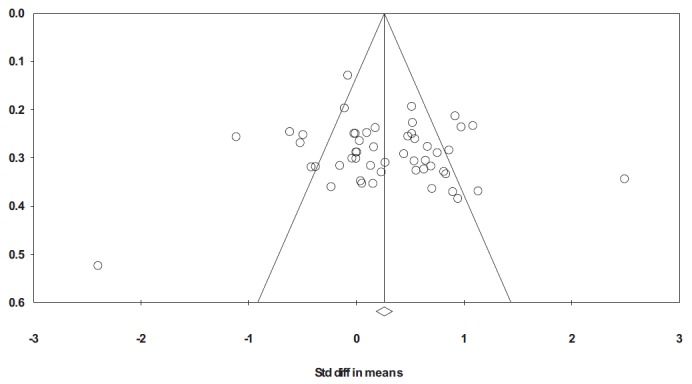
Stereotype threat effects arise when an individual feels at risk of confirming a negative stereotype about their group and consequently underperforms on stereotype relevant tasks (Steele, 2010). Among older people, underperformance across cognitive and physical tasks is hypothesized to result from age-based stereotype threat (ABST) because of negative age-stereotypes regarding older adults' competence. The present review and meta-analyses examine 22 published and 10 unpublished articles, including 82 effect sizes (N = 3882) investigating ABST on older people's (Mage = 69.5) performance. The analysis revealed a significant small-to-medium effect of ABST (d = .28) and important moderators of the effect size. Specifically, older adults are more vulnerable to ABST when (a) stereotype-based rather than fact-based manipulations are used (d = .52); (b) when performance is tested using cognitive measures (d = .36); and (c) occurs reliably when the dependent variable is measured proximally to the manipulation. The review raises important theoretical and methodological issues, and areas for future research.
Overview
The claims and statistics of this paper haven’t been checked yet.
Free: it reads the open-access text and checks the first 5 claims that cite a source we can check. Create a free account to check every claim.
Integrity signals
Registry
Cites
Statistics
Figures
Verification
Claims the paper makes
The claims and statistics of this paper haven’t been checked yet.
Free: it reads the open-access text and checks the first 5 claims that cite a source we can check. Create a free account to check every claim.
Claims other papers make about this one
Each is checked against this paper’s own text: does it say what the citing paper says it does?
The source backs part of the claim, not all of it — or backs it for a different population, condition or comparison.
In the citing paper
“five meta-analyses that showed negative age beliefs can adversely affect the health of older persons [11–15]”
From Global reach of ageism on older persons' health: a systematic review (2020) · cites this paper as [14]
Experimental — accuracy not yet measuredThe source backs part of the claim, not all of it — or backs it for a different population, condition or comparison.
In the citing paper
“previous systematic reviews have not examined how both levels simultaneously influence health”
From Global reach of ageism on older persons' health: a systematic review (2020) · cites this paper as [14]
Experimental — accuracy not yet measured
Self-check
Percentages, sums and reported differences re-computed from the paper’s own numbers.
The self-check needs the paper’s full text.
Citations
Cites
Statistical Power Analysis for the Behavioral Sciences
Muller, K. (1989) · Technometrics · doi:10.1080/00401706.1989.10488618 · Cited by 99,167
Statistical power analysis for the behavioral sciences
(1990) · Computers, Environment and Urban Systems · doi:10.1016/0198-9715(90)90050-4 · Cited by 65,269
A Coefficient of Agreement for Nominal Scales
Cohen, J. (1960) · Educational and Psychological Measurement · doi:10.1177/001316446002000104 · Cited by 42,398 · cited 1×
“All variables coded showed high interrater agreement (Cohen’s kappa or (cid:5) ; Cohen, 1960; Mean (cid:5) (cid:2) .95).”
Statistical Power Analysis for the Behavioral Sciences (2nd ed.).
Lachenbruch, P. A., & Cohen, J. (1989) · Journal of the American Statistical Association · doi:10.2307/2290095 · Cited by 37,395
Statistical Methods for Meta-Analysis
Wasserman, S., Hedges, L. V., & Olkin, I. (1988) · Journal of Educational Statistics · doi:10.2307/1164953 · Cited by 10,326
(2000) · Cited by 9,198
The file drawer problem and tolerance for null results.
Rosenthal, R. (1979) · Psychological Bulletin · doi:10.1037/0033-2909.86.3.638 · Cited by 9,068 · cited 1×
“As identified by Rosenthal (1979), unattained unpublished studies may exist that represent a bias against the publication of nonsignificant results.”
Stereotype threat and the intellectual test performance of African Americans.
Steele, C. M., & Aronson, J. (1995) · Journal of Personality and Social Psychology · doi:10.1037/0022-3514.69.5.797 · Cited by 9,020 · cited 6×
“…as blatant) led participants to behave contrary to expectations defined by the stereotype, in line with “stereotype reac-tance” theory (Brehm, 1966); whereas stereotype-based cues (defined as subtle) led to behavioral assimilation, as predicted by stereotype threat theory (Steele & Aronson, 1995).”
Influential(1999) · Cited by 6,104
Pettigrew, T. F. (1998) · Annual Review of Psychology · doi:10.1146/annurev.psych.49.1.65 · Cited by 6,001 · cited 1×
“This appears to work through familiar mechanisms of intergroup contact (Pettigrew, 1998), which can counteract stereotypes and mean that intergroup comparisons do not give rise to anxiety.”
Research works printed but not linked: 6
- Bensadon B. A. (2010). Memory self-efficacy and memory effects in aging (Unpublished doctoral dissertation). University of Florida, Gainesville, Florida.
- * Lambert A. E. (2011). On attentional control and the elderly driving stereotype (Unpublished doctoral thesis). University of Utah, Salt Lake City, Utah.
- * Lamont R. A. (2011). Stereotype threat and physical performance among the elderly: Exploration of mechanisms and after-effects. Unpublished master’s dissertation.
- Moldoff M. A. (2010). The joke’s on you: The effects of disparaging political humor on young citizens’ attitudes and behaviours (Unpublished doctoral thesis). University of North Carolina, Chapel Hill.
- Nelson T. D. (2002). Ageism: Stereotyping and prejudice against older persons. Cambridge, MA: MIT Press.
- Tajfel H., & Turner J. C. (1979). An integrative theory of social conflict In Austin W. G. & Worchel S. (Eds.), The social psychology of intergroup relations (pp. 33– 47). Monterey, CA: Brooks/Cole.
Cited by
Spencer, S. J., Logel, C., & Davies, P. G. (2016) · Annual Review of Psychology · doi:10.1146/annurev-psych-073115-103235 · Cited by 920
“These researchers also discovered that age-based stereotype-threat effects were larger when the stereotype-threat manipulations were based on stereotypes rather than based on actual facts (Lamont et al. 2015).”
Global reach of ageism on older persons' health: a systematic review
Chang, E.-S., Kannoth, S., Levy, S., Wang, S.-Y., Lee, J. E., & Levy, B. R. (2020) · PLOS ONE · doi:10.1371/journal.pone.0220857 · Cited by 912
“These cognitive-impairment studies, conducted in China, Germany, Ireland, and the United States [85–89], complement the numerous experimental studies that found ageism predicted the cognitive performance of older persons [90, 91], a conclusion supported by two meta-analyses [12,14].”
Interventions to Reduce Ageism Against Older Adults: A Systematic Review and Meta-Analysis
Burnes, D., Sheppard, C., Henderson, C. R., Wassel, M., Cope, R., Barber, C., & Pillemer, K. (2019) · American Journal of Public Health · doi:10.2105/ajph.2019.305123 · Cited by 723
“Furthermore, compelling findings have emerged demonstrating that negative attitudes toward aging pose a significant risk to health andwell-being in the later years.(3,4) Adoption of widespread negative attitudes toward aging contributes to mortality risk, poor functional health, and slower recovery from illness.”
BackgroundContemporary Perspectives on Ageism
(2018) · International Perspectives on Aging · doi:10.1007/978-3-319-73820-8 · Cited by 593
Ageism Amplifies Cost and Prevalence of Health Conditions
Levy, B. R., Slade, M. D., Chang, E.-S., Kannoth, S., & Wang, S.-Y. (2020) · The Gerontologist · doi:10.1093/geront/gny131 · Cited by 412
Metadata
- Authors
- Lamont, R. A., Swift, H. J., & Abrams, D.
- Affiliations
- University of Kent (GB)
- Corresponding author
- Abrams, Dominic
- Venue
- Psychology and Aging
- Published
- 2015-03
- Volume
- 30
- Issue
- 1
- Pages
- 180-193
- ISSN
- 0882-7974 (ISSN-L)
- 1939-1498
- PMC
- PMC4360754
- OpenAlex
- W2135485953
- Cited by
- 583
- References
- 83
- Citations by year
- 2026: 25 · 2025: 46 · 2024: 48 · 2023: 40 · 2022: 58 · 2021: 74 · 2020: 120 · 2019: 49 · 2018: 51 · 2017: 32 · 2016: 29 · 2015: 11
- FWCI
- 11.55
- Type
- journal article
- Language
- en
- Update notices
- correction (2018-08-09)
- Open access
- hybrid
- doi.org
- Licence
- Locations
- Psychology and Aging (publishedVersion, other-oa)
- PubMed Central (publishedVersion, cc-by)
- PubMed (publishedVersion)
- Kent Academic Repository (University of Kent) (acceptedVersion)
- Funders
- UK Economic and Social Research Council (ES/I012141/1)
- Topics
- Social Sciences › Psychology › Developmental and Educational Psychology › Aging and Gerontology Research
- Social Sciences › Sociology and Political Science › Social and Intergroup Psychology
- Social Sciences › Demography › Retirement, Disability, and Employment
- Keywords
- age stereotypes, older adults, underperformance, stereotype threat, cognitive performance, physical performance, moderators of effect size, aging
- MeSH terms
- Aged, Aged, 80 and over, Aging, Cognition, Female, Humans, Male, Stereotyping
About these checks
Registry, retraction, Cites and statistics results are computed, not judged, with one exception: a printed reference that no index lists is read once by a model before it counts as a citation error. Claims are extracted by a model and kept only when their quote appears verbatim in the text; each cited source is then checked, with a model’s help, for whether it says what the claim relies on. Those verdicts can be wrong — read the claim’s quote and the cited source before relying on one.
Statistics and arithmetic are recomputed, not judged.
Confidence bands are shown only for fields calibrated on our annotated test set. None is calibrated yet, so no band is shown.
What counts as a claim ›How we measure confidence ›How we check this ›
Are you an author, or do you see a problem with this page? Request a review
How to cite
Cite CoChat for the checks on this page, and the paper for its own findings.
- This page
- CoChat. (2026). Citation check: A review and meta-analysis of age-based stereotype threat: negative stereotypes, not facts, do the damage. https://app.cochat.ai/papers/10.1037/a0038586
- The paper
- Lamont, R. A., Swift, H. J., & Abrams, D. (2015). A review and meta-analysis of age-based stereotype threat: negative stereotypes, not facts, do the damage. Psychology and Aging. https://doi.org/10.1037/a0038586
Data sources
Bibliographic data: Semantic Scholar, OpenAlex, Crossref.
Contains information from the Semantic Scholar Academic Graph Datasets, made available under the ODC Attribution License (ODC-BY 1.0).
Semantic Scholar’s data is described in: Kinney, R., et al. (2023). The Semantic Scholar Open Data Platform. arXiv:2301.10140.
