

The DOI matches its Crossref record; 48 of the 48 references it cites were found in a registry or an index.
Disrupted autophagy after spinal cord injury is associated with ER stress and neuronal cell death
Open accessAbstract
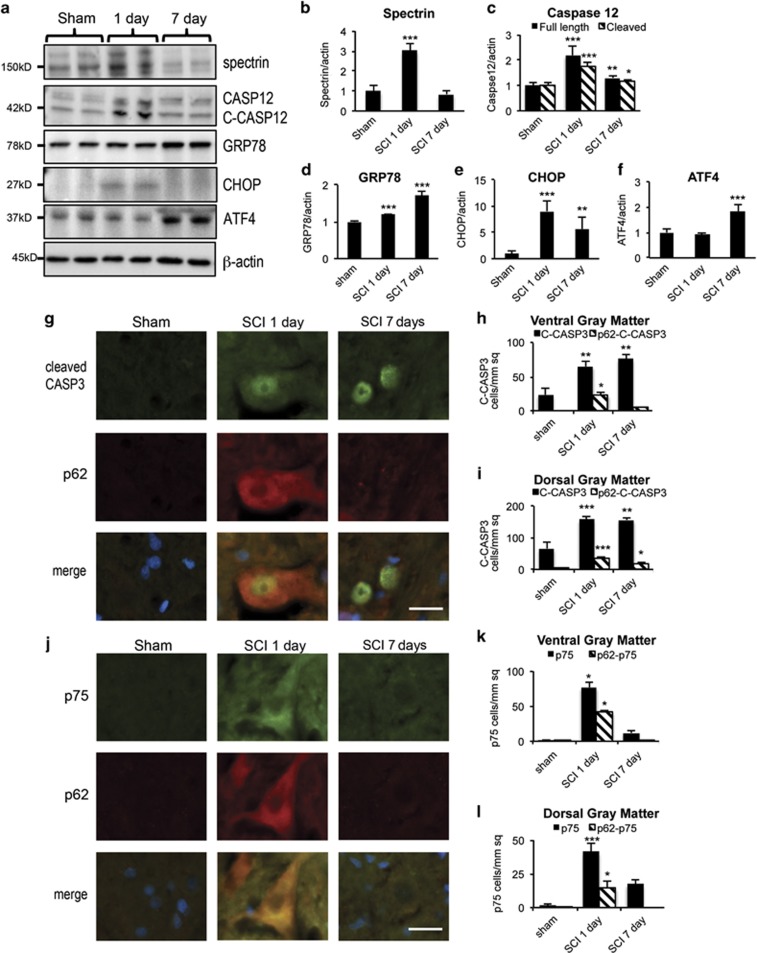
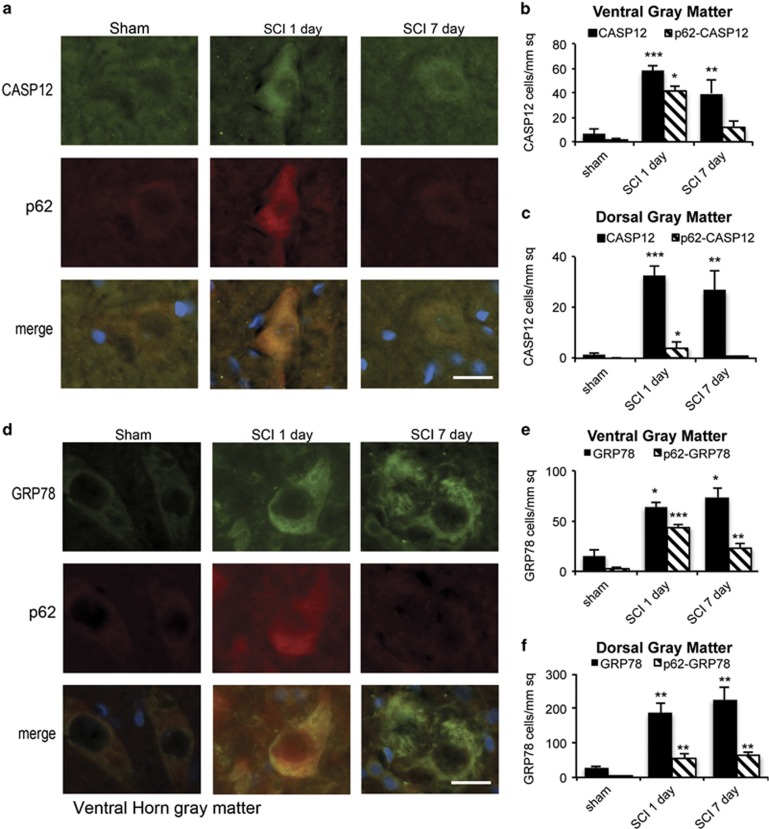
Autophagy is a catabolic mechanism facilitating degradation of cytoplasmic proteins and organelles in a lysosome-dependent manner. Autophagy flux is necessary for normal neuronal homeostasis and its dysfunction contributes to neuronal cell death in several neurodegenerative diseases. Elevated autophagy has been reported after spinal cord injury (SCI); however, its mechanism, cell type specificity and relationship to cell death are unknown. Using a rat model of contusive SCI, we observed accumulation of LC3-II-positive autophagosomes starting at posttrauma day 1. This was accompanied by a pronounced accumulation of autophagy substrate protein p62, indicating that early elevation of autophagy markers reflected disrupted autophagosome degradation. Levels of lysosomal protease cathepsin D and numbers of cathepsin-D-positive lysosomes were also decreased at this time, suggesting that lysosomal damage may contribute to the observed defect in autophagy flux. Normalization of p62 levels started by day 7 after SCI, and was associated with increased cathepsin D levels. At day 1 after SCI, accumulation of autophagosomes was pronounced in ventral horn motor neurons and dorsal column oligodendrocytes and microglia. In motor neurons, disruption of autophagy strongly correlated with evidence of endoplasmic reticulum (ER) stress. As autophagy is thought to protect against ER stress, its disruption after SCI could contribute to ER-stress-induced neuronal apoptosis. Consistently, motor neurons showing disrupted autophagy co-expressed ER-stress-associated initiator caspase 12 and cleaved executioner caspase 3. Together, these findings indicate that SCI causes lysosomal dysfunction that contributes to autophagy disruption and associated ER-stress-induced neuronal apoptosis.
Overview
The claims and statistics of this paper haven’t been checked yet.
Run the check — free, no account needed. It reads the open-access text and checks the sources it cites.
Integrity signals
Registry
Cites
Statistics
Figures
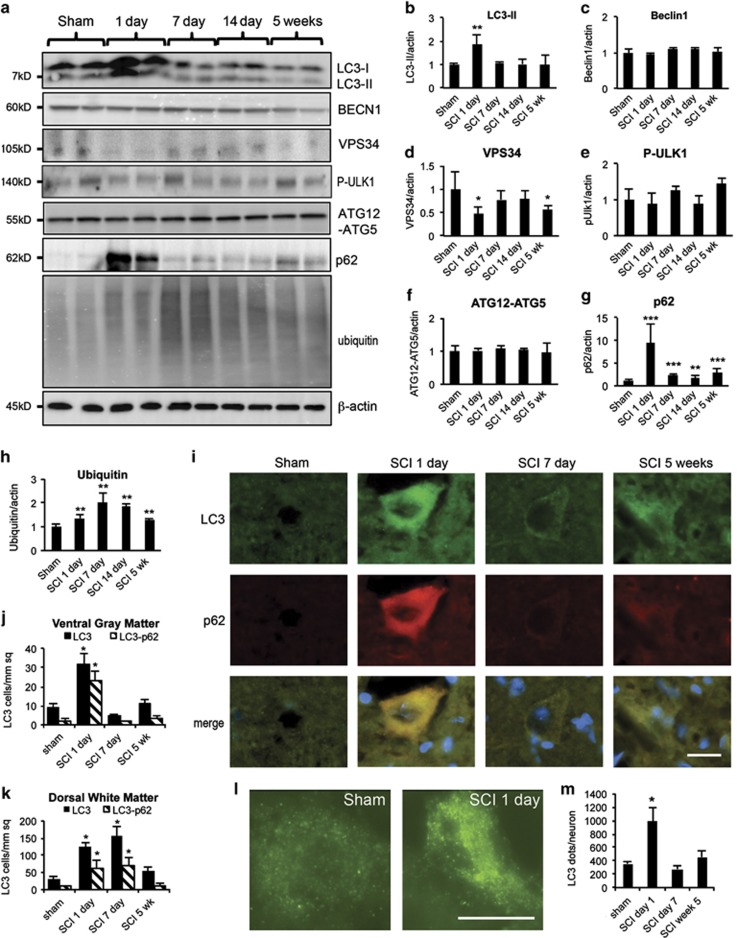
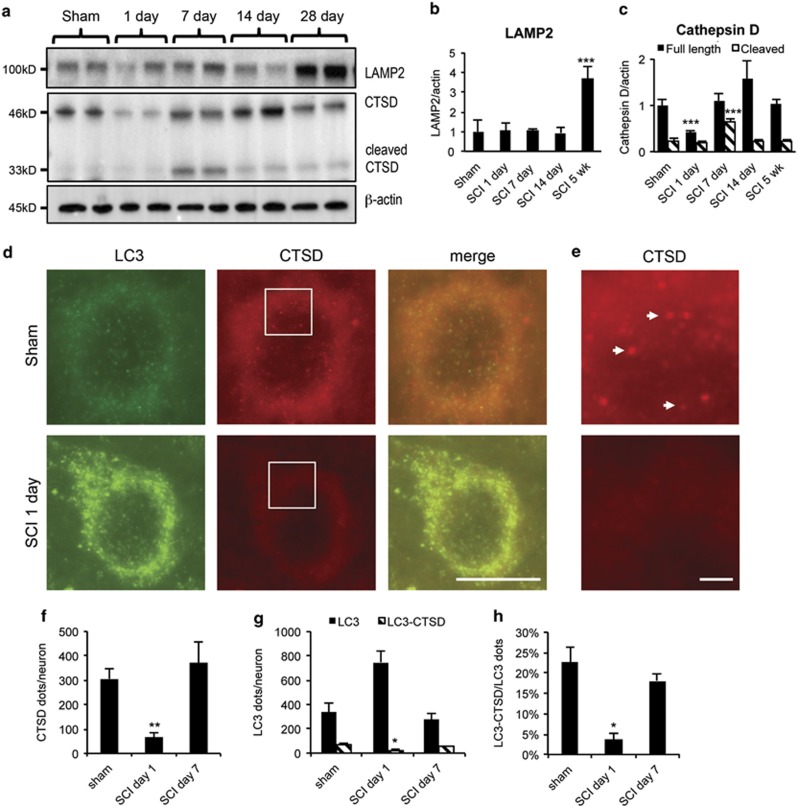
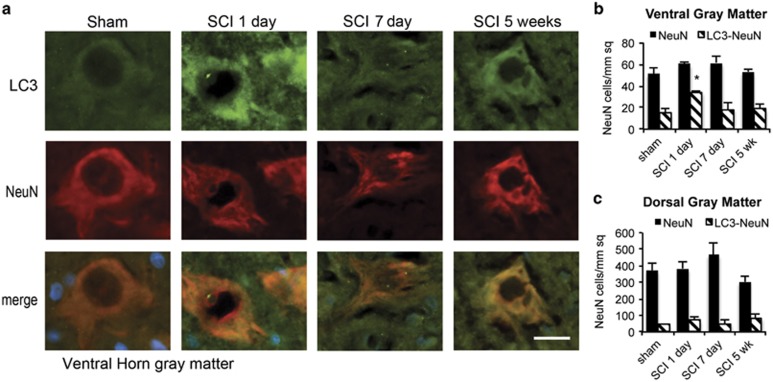
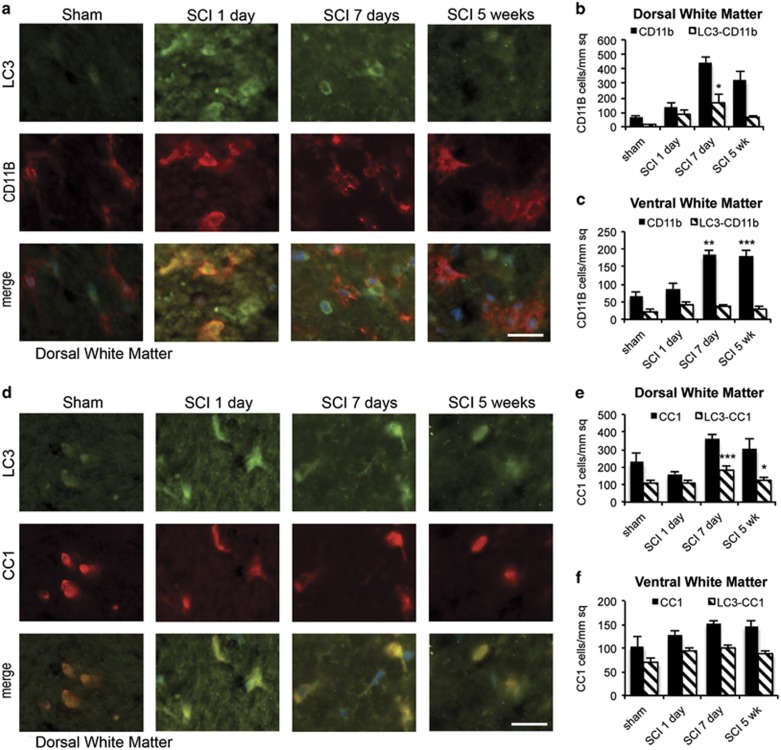
Verification
Claims the paper makes
The claims and statistics of this paper haven’t been checked yet.
Run the check — free, no account needed. It reads the open-access text and checks the sources it cites.
Claims other papers make about this one
Each is checked against this paper’s own text: does it say what the citing paper says it does?
In the citing paper
“These observations suggest that oligodendrocyte autophagy may play a necessary but insufficient role in post-injury repair of the spinal cord [453],”
From Autophagy and ALS: mechanistic insights and therapeutic implications (2022) · cites this paper as [453]
In the citing paper
“but excessive autophagy in oligodendrocytes may lead to neuronal toxicity in a non-cell autonomous manner.”
From Autophagy and ALS: mechanistic insights and therapeutic implications (2022) · cites this paper as [453]
Self-check
Percentages, sums and reported differences re-computed from the paper’s own numbers.
The self-check needs the paper’s full text.
Citations
Cites
Repertoires of Autophagy in the Pathogenesis of Ocular Diseases
Li, Y., Jiang, Q. L., Cao, G.-F., Yao, J., & Yan, B. (2015) · Cellular Physiology and Biochemistry · doi:10.1159/000373980 · Cited by 16,351
Autophagy: Renovation of Cells and Tissues
Mizushima, N., & Komatsu, M. (2011) · Cell · doi:10.1016/j.cell.2011.10.026 · Cited by 6,615
Autophagy fights disease through cellular self-digestion
Mizushima, N., Levine, B., Cuervo, A. M., & Klionsky, D. J. (2008) · Nature · doi:10.1038/nature06639 · Cited by 6,452
Control of inositol 1,4,5-trisphosphate-induced Ca2+ release by cytosolic Ca2+
Bootman, M. D., Missiaen, L., Parys, J. B., SMEDT, H. D., & Casteels, R. (1995) · Biochemical Journal · doi:10.1042/bj3060445 · Cited by 5,131
Suppression of basal autophagy in neural cells causes neurodegenerative disease in mice
Hara, T., Nakamura, K., Matsui, M., Yamamoto, A., Nakahara, Y., Suzuki-Migishima, R., Yokoyama, M., Mishima, K., Saito, I., Okano, H., et al. (2006) · Nature · doi:10.1038/nature04724 · Cited by 3,882
Mutation of the mouse klotho gene leads to a syndrome resembling ageing
Kuro-o, M., Matsumura, Y., Aizawa, H., Kawaguchi, H., Suga, T., Utsugi, T., Ohyama, Y., Kurabayashi, M., Kaname, T., Kume, E., et al. (1997) · Nature · doi:10.1038/36285 · Cited by 3,837
Levine, B., & Klionsky, D. J. (2004) · Developmental Cell · doi:10.1016/s1534-5807(04)00099-1 · Cited by 3,728
Autophagy as a Regulated Pathway of Cellular Degradation
Klionsky, D. J., & Emr, S. D. (2000) · Science · doi:10.1126/science.290.5497.1717 · Cited by 3,630
Loss of autophagy in the central nervous system causes neurodegeneration in mice
Komatsu, M., Waguri, S., Chiba, T., Murata, S., Iwata, J.-I., Tanida, I., Ueno, T., Koike, M., Uchiyama, Y., Kominami, E., et al. (2006) · Nature · doi:10.1038/nature04723 · Cited by 3,500
Caspase-12 mediates endoplasmic-reticulum-specific apoptosis and cytotoxicity by amyloid-β
Nakagawa, T., Zhu, H., Morishima, N., Li, E., Xu, J., Yankner, B. A., & Yuan, J. (2000) · Nature · doi:10.1038/47513 · Cited by 3,292
Cited by
Sorted by citations
Rong, Y., Liu, W., Wang, J., Fan, J., Luo, Y., Li, L., Kong, F., Chen, J., Tang, P., & Cai, W. (2019) · Cell Death & Disease · doi:10.1038/s41419-019-1571-8 · Cited by 333
Liu, W. Y., Wang, Y., Gong, F., Rong, Y., Luo, Y., Tang, P., Zhou, Z., Zhou, Z., Xu, T., Jiang, T., et al. (2018) · Journal of Neurotrauma · doi:10.1089/neu.2018.5835 · Cited by 330
Programmed cell death in spinal cord injury pathogenesis and therapy
Shi, Z., Yuan, S., Shi, L., Li, J., Ning, G., Kong, X., & Feng, S. (2021) · Cell Proliferation · doi:10.1111/cpr.12992 · Cited by 299
Blood–Spinal Cord Barrier in Spinal Cord Injury: A Review
Jin, L., Li, J., Wang, K., Xia, W., Zhu, Z., Wang, C., Li, X., & Liu, H. (2020) · Journal of Neurotrauma · doi:10.1089/neu.2020.7413 · Cited by 301
Autophagy in acute brain injury
Galluzzi, L., Bravo-San Pedro, J. M., Blomgren, K., & Kroemer, G. (2016) · Nature Reviews Neuroscience · doi:10.1038/nrn.2016.51 · Cited by 234
Metadata
- Authors
- Liu, S., Sarkar, C., Dinizo, M., Faden, A. I., Koh, E. Y., Lipinski, M. M., & Wu, J.
- Affiliations
- University of Maryland, Baltimore (US)
- Corresponding author
- Lipinski, M M
- Venue
- Cell Death & Disease
- Published
- 2015-01-08
- Volume
- 6
- Issue
- 1
- Pages
- e1582-e1582
- ISSN
- 2041-4889 (ISSN-L)
- PMC
- PMC4669738
- OpenAlex
- W2095421072
- Cited by
- 209
- References
- 48
- Citations by year
- 2026: 9 · 2025: 14 · 2024: 15 · 2023: 18 · 2022: 23 · 2021: 22 · 2020: 21 · 2019: 22 · 2018: 17 · 2017: 18 · 2016: 22 · 2015: 8
- FWCI
- 16.92
- Type
- journal article
- Language
- en
- Open access
- gold
- doi.org
- Locations
- Cell Death and Disease (publishedVersion, cc-by)
- PubMed Central (publishedVersion, cc-by)
- PubMed (publishedVersion)
- Funders
- National Institutes of Health
- National Institute of Nursing Research (R01NR013601)
- National Institute of Neurological Disorders and Stroke (R01NS091218, R01NS054221)
- Topics
- Life Sciences › Biochemistry, Genetics and Molecular Biology › Cell Biology › Autophagy in Disease and Therapy
- Health Sciences › Medicine › Clinical Neurology › Spinal Cord Injury Research
- Life Sciences › Biochemistry, Genetics and Molecular Biology › Cell Biology › Endoplasmic Reticulum Stress and Disease
- Keywords
- spinal cord injury, autophagy, endoplasmic reticulum stress, neuronal apoptosis, lysosomal dysfunction, cathepsin D, p62, autophagosomes, motor neurons, oligodendrocytes, microglia, caspase-12, caspase-3, contusive injury
- MeSH terms
- Animals, Autophagy, Lysosomes, Male, Neurons, Oligodendroglia, Phagosomes, Spinal Cord Injuries, Rats, Sprague-Dawley, Apoptosis, Microglia, Endoplasmic Reticulum Stress, White Matter, Gray Matter
About these checks
Registry, retraction, Cites and statistics results are computed, not judged, with one exception: a printed reference that no index lists is read once by a model before it counts as a citation error. Claims are extracted by a model and kept only when their quote appears verbatim in the text; each cited source is then checked, with a model’s help, for whether it says what the claim relies on. Those verdicts can be wrong — read the claim’s quote and the cited source before relying on one.
Statistics and arithmetic are recomputed, not judged.
Confidence bands are shown only for fields calibrated on our annotated test set. None is calibrated yet, so no band is shown.
What counts as a claim ›How we measure confidence ›How we check this ›
Are you an author, or do you see a problem with this page? Request a review
