

The DOI matches its Crossref record; 36 of the 36 references it cites were found in a registry or an index.
The Rap–RapGAP complex: GTP hydrolysis without catalytic glutamine and arginine residues
Open accessAbstract
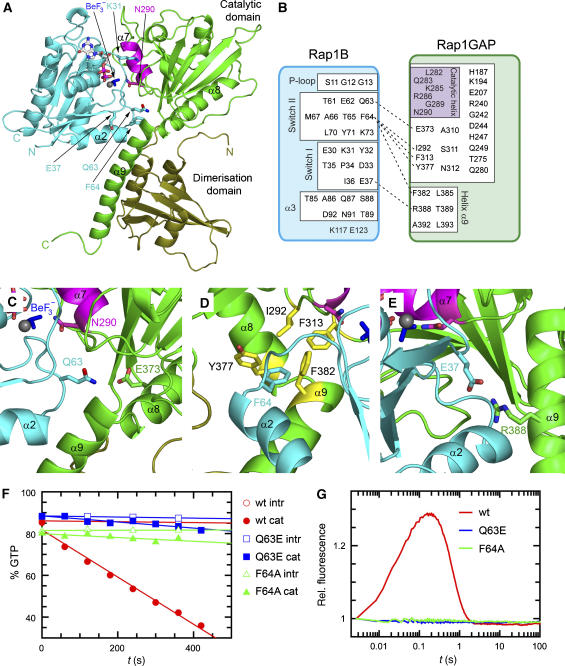
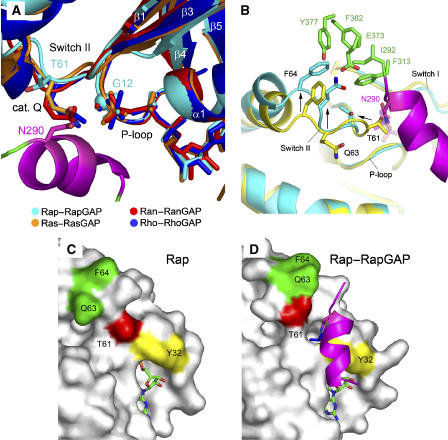
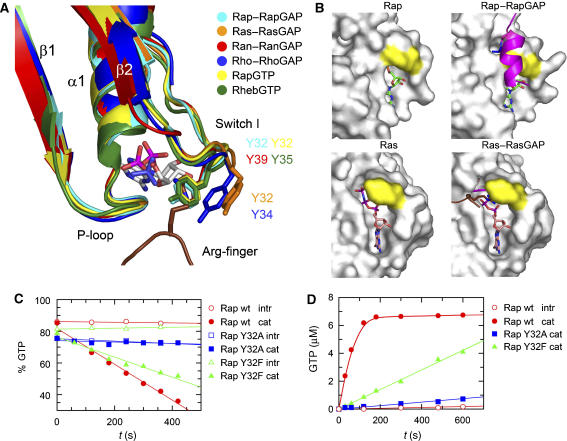
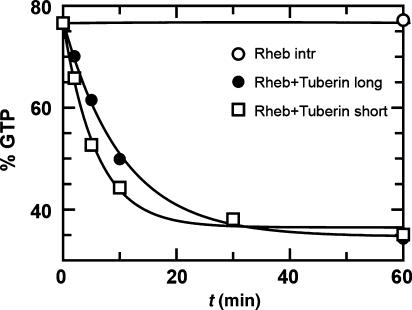
The GTP-binding protein Rap1 regulates integrin-mediated and other cell adhesion processes. Unlike most other Ras-related proteins, it contains a threonine in switch II instead of a glutamine (Gln61 in Ras), a residue crucial for the GTPase reaction of most G proteins. Furthermore, unlike most other GTPase-activating proteins (GAPs) for small G proteins, which supply a catalytically important Arg-finger, no arginine residue of RapGAP makes a significant contribution to the GTPase reaction of Rap1. For a detailed understanding of the reaction mechanism, we have solved the structure of Rap1 in complex with Rap1GAP. It shows that the Thr61 of Rap is away from the active site and that an invariant asparagine of RapGAPs, the Asn-thumb, takes over the role of the cis-glutamine of Ras, Rho or Ran. The structure and biochemical data allow to further explain the mechanism and to define the important role of a conserved tyrosine. The structure and biochemical data furthermore show that the RapGAP homologous region of the tumour suppressor Tuberin is sufficient for catalysis on Rheb.
Overview
The claims and statistics of this paper haven’t been checked yet.
Run the check — free, no account needed. It reads the open-access text and checks the sources it cites.
Integrity signals
Registry
Cites
Statistics
Figures
Verification
Claims the paper makes
The claims and statistics of this paper haven’t been checked yet.
Run the check — free, no account needed. It reads the open-access text and checks the sources it cites.
Claims other papers make about this one
Each is checked against this paper’s own text: does it say what the citing paper says it does?
In the citing paper
“It is known that the TSC2 GAP domain utilizes an “asparagine-thumb” mechanism for the activation of Rheb GTPase activity, similar to that of the Rap GTPase and its GAP (Marshall et al., 2009; Scrima et al., 2008)”
From Signal integration in the (m)TORC1 growth pathway (2018) · cites this paper as Scrima et al., 2008
Self-check
Percentages, sums and reported differences re-computed from the paper’s own numbers.
The self-check needs the paper’s full text.
Citations
Cites
Crystallography & NMR System: A New Software Suite for Macromolecular Structure Determination
Brünger, A. T., Adams, P. D., Clore, G. M., DeLano, W. L., Gros, P., Grosse‐Kunstleve, R. W., Jiang, J., Kuszewski, J. J., Nilges, M., Pannu, N., et al. (1998) · Acta Crystallographica Section D Biological Crystallography · doi:10.1107/s0907444998003254 · Cited by 15,723
Refinement of Macromolecular Structures by the Maximum-Likelihood Method
Murshudov, G. N., Vagin, A. A., & Dodson, E. J. (1997) · Acta Crystallographica Section D Biological Crystallography · doi:10.1107/s0907444996012255 · Cited by 14,796
MOLREP : an Automated Program for Molecular Replacement
Vagin, A. A., & Teplyakov, A. (1997) · Journal of Applied Crystallography · doi:10.1107/s0021889897006766 · Cited by 4,756
Kabsch, W. (1993) · Journal of Applied Crystallography · doi:10.1107/s0021889893005588 · Cited by 3,562
XtalView/Xfit—A Versatile Program for Manipulating Atomic Coordinates and Electron Density
McRee, D. E. (1999) · Journal of Structural Biology · doi:10.1006/jsbi.1999.4094 · Cited by 2,096
Rheb GTPase is a direct target of TSC2 GAP activity and regulates mTOR signaling
Inoki, K., Li, Y., Xu, T., & Guan, K.-L. (2003) · Genes & Development · doi:10.1101/gad.1110003 · Cited by 1,911
GEFs and GAPs: Critical Elements in the Control of Small G Proteins
Bos, J. L., Rehmann, H., & Wittinghofer, A. (2007) · Cell · doi:10.1016/j.cell.2007.05.018 · Cited by 1,903
Self-citationThe Guanine Nucleotide-Binding Switch in Three Dimensions
Vetter, I. R., & Wittinghofer, A. (2001) · Science · doi:10.1126/science.1062023 · Cited by 1,875
Self-citationThe Ras-RasGAP Complex: Structural Basis for GTPase Activation and Its Loss in Oncogenic Ras Mutants
Scheffzek, K., Ahmadian, M. R., Kabsch, W., Wiesmüller, L., Lautwein, A., Schmitz, F., & Wittinghofer, A. (1997) · Science · doi:10.1126/science.277.5324.333 · Cited by 1,543
Self-citationTee, A. R., Manning, B. D., Roux, P. P., Cantley, L. C., & Blenis, J. (2003) · Current Biology · doi:10.1016/s0960-9822(03)00506-2 · Cited by 1,080
Cited by
Sorted by citations
Regulation of Small GTPases by GEFs, GAPs, and GDIs
Cherfils, J., & Zeghouf, M. (2013) · Physiological Reviews · doi:10.1152/physrev.00003.2012 · Cited by 1,245
Barr, F. A., & Lambright, D. G. (2010) · Current Opinion in Cell Biology · doi:10.1016/j.ceb.2010.04.007 · Cited by 434
Why nature really chose phosphate
Kamerlin, S. C. L., Sharma, P. K., Prasad, R. B., & Warshel, A. (2013) · Quarterly Reviews of Biophysics · doi:10.1017/s0033583512000157 · Cited by 403
It takes two to tango: regulation of G proteins by dimerization
Gasper, R., Meyer, S., Gotthardt, K., Sirajuddin, M., & Wittinghofer, A. (2009) · Nature Reviews Molecular Cell Biology · doi:10.1038/nrm2689 · Cited by 285
Self-citationSato, T., Nakashima, A., Guo, L., & Tamanoi, F. (2009) · Journal of Biological Chemistry · doi:10.1074/jbc.m809207200 · Cited by 196
Metadata
- Authors
- Scrima, A., Thomas, C., Deaconescu, D., & Wittinghofer, A.
- Affiliations
- Max Planck Institute of Molecular Physiology (DE)
- Max Planck Society (DE)
- Corresponding author
- Wittinghofer, Alfred
- Venue
- The EMBO Journal
- Published
- 2008-02-28
- Volume
- 27
- Issue
- 7
- Pages
- 1145-1153
- ISSN
- 0261-4189 (ISSN-L)
- 1460-2075
- PMC
- PMC2265111
- OpenAlex
- W2104235973
- Cited by
- 127
- References
- 36
- Citations by year
- 2026: 3 · 2025: 6 · 2024: 4 · 2023: 5 · 2022: 3 · 2021: 7 · 2020: 6 · 2019: 2 · 2018: 8 · 2017: 6 · 2016: 8 · 2015: 4 · 2014: 8 · 2013: 8 · 2012: 19
- FWCI
- 4.11
- Type
- journal article
- Language
- en
- Open access
- hybrid
- doi.org
- Licence
- Locations
- The EMBO Journal (publishedVersion, cc-by)
- PubMed Central (publishedVersion, cc-by-nc-nd)
- PubMed (publishedVersion)
- DORA PSI (Paul Scherrer Institute) (submittedVersion, cc-by)
- Max Planck Institute for Plasma Physics (submittedVersion)
- MPG.PuRe (Max Planck Society) (submittedVersion)
- Funders
- Paul Scherrer Institut
- Topics
- Life Sciences › Biochemistry, Genetics and Molecular Biology › Molecular Biology › Protein Kinase Regulation and GTPase Signaling
- Life Sciences › Biochemistry, Genetics and Molecular Biology › Cell Biology › Cellular transport and secretion
- Life Sciences › Biochemistry, Genetics and Molecular Biology › Molecular Biology › Receptor Mechanisms and Signaling
- Keywords
- Rap1, Rap1GAP, GTPase-activating protein, arginine finger, integrin-mediated adhesion, tuberin, Rheb
- MeSH terms
- Tuberous Sclerosis Complex 2 Protein, Amino Acid Sequence, Arginine, Binding Sites, Catalysis, Glutamine, Guanosine Triphosphate, Hydrolysis, Models, Molecular, Molecular Sequence Data, Protein Binding, Protein Structure, Secondary, Crystallography, X-Ray, GTPase-Activating Proteins, rap1 GTP-Binding Proteins, Tumor Suppressor Proteins, Mutant Proteins
About these checks
Registry, retraction, Cites and statistics results are computed, not judged, with one exception: a printed reference that no index lists is read once by a model before it counts as a citation error. Claims are extracted by a model and kept only when their quote appears verbatim in the text; each cited source is then checked, with a model’s help, for whether it says what the claim relies on. Those verdicts can be wrong — read the claim’s quote and the cited source before relying on one.
Statistics and arithmetic are recomputed, not judged.
Confidence bands are shown only for fields calibrated on our annotated test set. None is calibrated yet, so no band is shown.
What counts as a claim ›How we measure confidence ›How we check this ›
Are you an author, or do you see a problem with this page? Request a review
