

Two-dimensional gas of massless Dirac fermions in graphene
Open accessThe DOI matches its Crossref record; 32 of the 32 references it cites were found in a registry or an index; 12 of the 52 sources its claims cite were checked for support.
Abstract
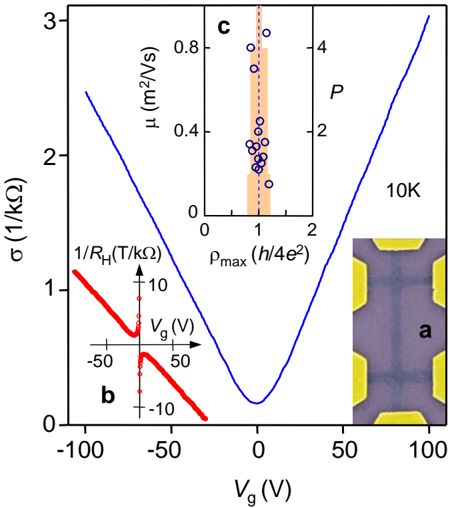
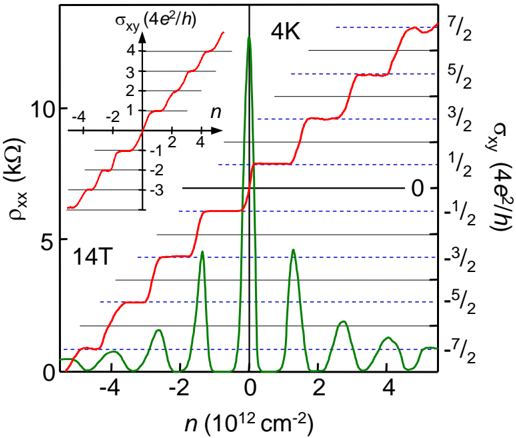
Quantum electrodynamics (resulting from the merger of quantum mechanics and relativity theory) has provided a clear understanding of phenomena ranging from particle physics to cosmology and from astrophysics to quantum chemistry. The ideas underlying quantum electrodynamics also influence the theory of condensed matter, but quantum relativistic effects are usually minute in the known experimental systems that can be described accurately by the non-relativistic Schrödinger equation. Here we report an experimental study of a condensed-matter system (graphene, a single atomic layer of carbon) in which electron transport is essentially governed by Dirac's (relativistic) equation. The charge carriers in graphene mimic relativistic particles with zero rest mass and have an effective ‘speed of light’ c* ≈ 106 m s-1. Our study reveals a variety of unusual phenomena that are characteristic of two-dimensional Dirac fermions. In particular we have observed the following: first, graphene's conductivity never falls below a minimum value corresponding to the quantum unit of conductance, even when concentrations of charge carriers tend to zero; second, the integer quantum Hall effect in graphene is anomalous in that it occurs at half-integer filling factors; and third, the cyclotron mass mc of massless carriers in graphene is described by E = mcc*2. This two-dimensional system is not only interesting in itself but also allows access to the subtle and rich physics of quantum electrodynamics in a bench-top experiment.
Overview
CoChat Summary
TL;DR
Graphene is a two-dimensional gas of massless Dirac fermions with linear dispersion and an effective speed of light \(c^* \approx 10^6\) m/s. Transport measurements reveal an anomalous half-integer quantum Hall effect, a minimum conductivity, cyclotron mass \(m_c = E/c^{*2}\), and a \(\pi\) Berry-phase shift in Shubnikov–de Haas oscillations.
Key findings
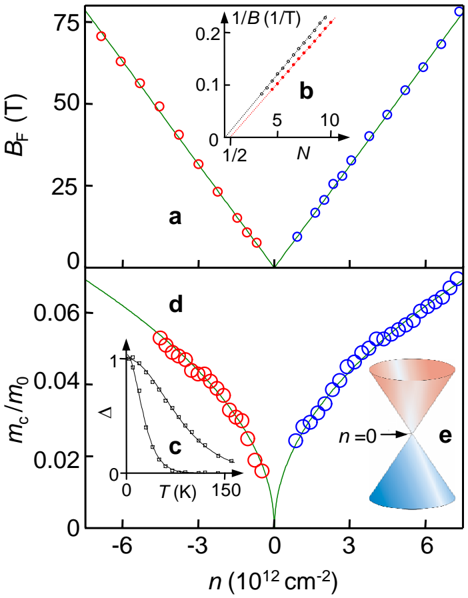
- Graphene’s charge carriers behave as massless Dirac fermions: the data imply \(E = \hbar k c^*\) for both electrons and holes, with \(c^* \approx 1 \times 10^6\) m/s; the cyclotron mass varies between \(\approx 0.02\) and \(0.07\,m_0\) and follows \(m_c \propto n^{1/2}\).
- The integer quantum Hall effect is anomalous: plateaux occur at half-integer \(\nu\), with sequence \((4e^2/h)(N+\tfrac12)\) and the first plateau at \(2e^2/h\); two-layer graphene returns to the normal integer sequence.
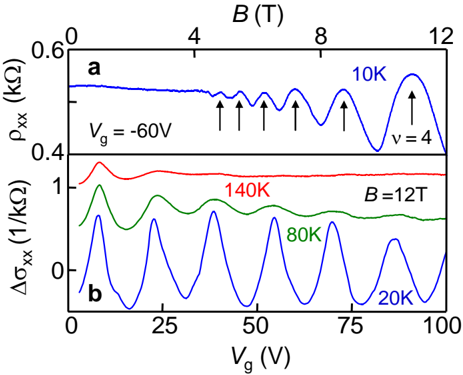
- Shubnikov–de Haas oscillations show a single set for electrons and holes, with \(B_F = \beta n\), \(\beta \approx 1.04 \times 10^{-15}\) T·m\(^2\) (\(\pm 2\%\)), yielding degeneracy \(f=4\); the oscillations exhibit a phase shift of \(\pi\) attributed to Berry’s phase.
- Conductivity never falls below a minimum: \(\rho_{\max} \approx 6.5\) k\(\Omega\) in 15 devices (experimental error \(\approx 15\%\)), associated with \(h/fe^2 = 6.45\) k\(\Omega\), independent of mobility (which varied by a factor of 10) and of temperature between 4 and 100 K.
Methods
- Graphene samples were obtained by micromechanical cleavage of graphite, followed by identification and selection of monolayers using optical, scanning-electron, and atomic-force microscopies; selected films were processed into multi-terminal devices, with some devices made from 2 or 3 layers.
- Transport measurements included the electric field effect, Hall coefficient, Shubnikov–de Haas oscillations, and quantum Hall effect in magnetic fields; mobility was measured between 10 and 100 K, minimum conductivity between 4 and 100 K, and SdHO up to 140 K and room temperature.
- Analysis used fan diagrams to determine \(B_F\), fits of SdHO amplitude to \(T/\sinh(2\pi^2 k_B T m_c / h eB)\), and semiclassical expressions \(B_F = (h/2\pi e)S(E)\) and \(m_c = (h^2/2\pi)\partial S(E)/\partial E\) to infer \(E \propto k\).
Limitations
- The paper has no dedicated limitations section; stated caveats include that mobility was “probably still limited by defects in parent graphite,” that the two-layer finite-mass result is “to be published elsewhere,” and that most theories suggest a minimum conductivity of \(\approx e^2/\pi h\), in disagreement with the experiment.
- Evident from the text: devices are unprotected from the environment (though stable under ambient conditions), some measured devices consisted of 2 or 3 graphene layers, and the transition region was often shifted from zero \(V_g\) due to chemical doping, although annealing normally eliminated the shift.
- The inference of linear dispersion relies on a semiclassical model that the paper says is justified by recent theory, so the experimental conclusion depends on that theoretical framework.
Model-written summary. Check it against the paper before relying on it.
Integrity signals
Registry
Cites
Statistics
Figures
Verification
Claims the paper makes
3 Valid · 5 Not valid · 11 Not checked · 51 Own results and interpretations
The cited sources support only part of this claim — read each source’s verdict below.
In the paper
“d) Shubnikov-de Haas oscillations in graphene exhibit a phase shift of π due to Berry's phase”
- Also stated in: § Two-Dimensional Gas of Massless Dirac Fermions in Graphene · plain
“The shift is due to Berry's phase [9,15].”
What the sources say
- Partly supportedcites [9] Berger, C. et al. Ultrathin epitaxial graphite: 2D electron gas properties and a route toward graphene-based nanoelectronics. J. Phys. Chem. B 108, 19912–19916 (2004) sourceExperimental — accuracy not yet measured
The Figure 2 caption (p. 3) reports Shubnikov–de Haas oscillations in an epitaxial graphene sample. The discussion on pp. 3–4 addresses their occurrence and period, but does not report a π phase shift or attribute one to Berry’s phase. (LLM, conf=0.85)
- Partly supportedcites [15] Gusynin, V. P. & Sharapov, S. G. Unconventional integer quantum Hall effect in grapheme. Preprint at http://xxx.lanl.gov/abs/cond-mat/0506575 (2005). sourceExperimental — accuracy not yet measured
Our copy (Introduction, p. 1) does state that 'the phase of de Haas van Alphen and Shubnikov de Haas oscillations for Dirac quasiparticles is shifted ... compared to the phase of non-relativistic quasiparticles' (citing Refs. 7-10), so the existence of a phase shift in graphene is supported; the magnitude symbol itself is lost in our copy's undecoded formulas. What is NOT supported is the causal attribution to Berry's phase: no passage of our copy mentions Berry's phase at all (searched: 'Berry phase pseudospin topological phase π', 'oscillation phase factor'). Instead the paper explains the unconventional magneto-transport phenomena by the quantum anomaly of the n = 0 Landau level — its halved degeneracy and B-independent energy (p. 1 and p. 3) — and relates the oscillation minima to fillings ν_B = 2n+1 (p. 3). (LLM, conf=0.75)
plainstates a cause- Asserted: passes — The authors put it forward as true.
- Checkable: passes — It can be checked against evidence.
- Load-bearing: passes — The paper’s conclusions depend on it.
- Based: passes — The paper gives a reason why it holds.
- Also stated in: § Two-Dimensional Gas of Massless Dirac Fermions in Graphene · plain
The cited sources that could be checked couldn’t confirm or dispute this claim.
In the paper
“we invoke the formal expression [9-12] for the energy of massless relativistic fermions in quantized fields, EN =[2 e h c ∗ 2 B ( N +½ ± ½)] 1/2”
What the sources say
- Could not verifycites [9] Berger, C. et al. Ultrathin epitaxial graphite: 2D electron gas properties and a route toward graphene-based nanoelectronics. J. Phys. Chem. B 108, 19912–19916 (2004) sourceExperimental — accuracy not yet measured
The discussion of magnetoconductance (p. 3) says Shubnikov–de Haas oscillations indicate quantization of the electron energy spectrum, but it gives no energy formula. Searches for massless relativistic fermions, Landau levels, and the N + 1/2 ± 1/2 term found no passage stating the claimed expression. (LLM, conf=0.76)
- Not checked — no full text of the sourcecites [10] Bunch, J. S., Yaish, Y., Brink, M., Bolotin, K. & McEuen, P. L. Coulomb oscillations and Hall effect in quasi-2D graphite quantum dots. Nano Lett. 5, 287–290 (2005) source
- Not checked — no full text of the sourcecites [11] Dresselhaus, M. S. & Dresselhaus, G. Intercalation compounds of graphite. Adv. In Phys. 51, 1–186 (2002) source
- Not matchedcites [12] Brandt, N. B., Chudinov, S. M. & Ponomarev, Y. G. Semimetals 1: Graphite and Its Compounds (North-Holland, Amsterdam, 1988)
We searched by its title and found no matching paper.
plain- Asserted: passes — The authors put it forward as true.
- Checkable: passes — It can be checked against evidence.
- Load-bearing: passes — The paper’s conclusions depend on it.
- Based: passes — The paper gives a reason why it holds.
- Could not verify
The cited sources that could be checked couldn’t confirm or dispute this claim.
In the paper
“The employed semiclassical model is fully justified by a recent theory for graphene [9], which shows that SdHO's amplitude can indeed be described by the above expression T /sinh(2 π 2 k B Tm c / h eB ) with m c = E / c ∗ 2 .”
What the sources say
- Could not verifycites [9] Berger, C. et al. Ultrathin epitaxial graphite: 2D electron gas properties and a route toward graphene-based nanoelectronics. J. Phys. Chem. B 108, 19912–19916 (2004) sourceExperimental — accuracy not yet measured
The discussion of magnetoconductance (pp. 3–4) reports observed Shubnikov–de Haas oscillations, but does not give a theory for their amplitude. Searches for the temperature-dependent amplitude expression and m_c = E/c*² found no passage addressing either, so our copy cannot verify the attributed claim. (LLM, conf=0.76)
boostedstates a cause- Asserted: passes — The authors put it forward as true.
- Checkable: passes — It can be checked against evidence.
- Load-bearing: passes — The paper’s conclusions depend on it.
- Based: passes — The paper gives a reason why it holds.
- Could not verify
The cited sources that could be checked couldn’t confirm or dispute this claim.
In the paper
“The latter can be viewed as a direct consequence of the Atiyah-Singer index theorem that plays an important role in quantum field theory and the theory of superstrings [13,14].”
What the sources say
- Not checked — no full text of the sourcecites [13] Vonsovsky, S. V. & Katsnelson, M. I. Quantum Solid State Physics (Springer, New York, 1989) source
- Could not verifycites [14] Gusynin, V. P. & Sharapov, S. G. Magnetic oscillations in planar systems with the Dirac-like spectrum of quasiparticle excitations. Phys. Rev. B 71, 125124 (2005) sourceExperimental — accuracy not yet measured
Our copy of Gusynin & Sharapov II gives the relativistic Landau-level spectrum with n = 0, 1, ... in the Introduction (p. 1) and discusses the lowest level E_1 and its crossing of the Fermi surface (Discussion, p. 6; Sect. II.B, p. 6), but it never invokes or discusses the Atiyah-Singer index theorem, topology, or zero-mode counting as the reason for a level pinned at E = 0. Searches on 'Atiyah-Singer index theorem zero-energy Landau level', 'index theorem topological zero modes chiral anomaly', and 'zero-energy Landau level n=0 degeneracy independent of field strength' returned only the spectrum/quantization-condition passages. Since the index-theorem grounding is simply not addressed in our copy (and no alternative work is credited for it there), the attribution can be neither confirmed nor contradicted. (LLM, conf=0.68)
plainstates a cause- Asserted: passes — The authors put it forward as true.
- Checkable: passes — It can be checked against evidence.
- Load-bearing: unclear — It is unclear whether the paper’s conclusions depend on it.
- Based: passes — The paper gives a reason why it holds.
The cited sources that could be checked couldn’t confirm or dispute this claim.
In the paper
“in agreement with band structure calculations [6,7]”
What the sources say
- Could not verifycites [6] Novoselov, K. S. et al. Two dimensional atomic crystals. Proc. Natl Acad. Sci. USA 102, 10451–10453 (2005) sourceExperimental — accuracy not yet measured
The discussion of graphene transport in “Two Dimensional Atomic Crystals” (p. 3) reports carrier concentrations and mobilities, but not a fitted c* or a comparison with band-structure calculations. Searches for the velocity, its approximate value, and band-structure calculations found no passage addressing that comparison. (LLM, conf=0.76)
- Could not verifycites [7] Novoselov, K. S. et al. Electric field effect in atomically thin carbon films. Science 306, 666–669 (2004) sourceExperimental — accuracy not yet measured
The discussion on p. 2 says graphene is expected to have linear energy dispersion and massless carriers, but gives no calculated velocity to compare with c* ≈ 1·10^6 m/s. Searches for the velocity and band-structure comparison found no passage in our copy establishing the claimed agreement. (LLM, conf=0.73)
plainstates an association- Asserted: passes — The authors put it forward as true.
- Checkable: passes — It can be checked against evidence.
- Load-bearing: passes — The paper’s conclusions depend on it.
- Based: passes — The paper gives a reason why it holds.
- Could not verify
34 more claims
Create a free account to see all 70 claims and to verify the 10 references still open.
- It may state two separate claims as one. 27
- Probably not a substantial claim. 8
Claims other papers make about this one
Each is checked against this paper’s own text: does it say what the citing paper says it does?
The source backs part of the claim, not all of it — or backs it for a different population, condition or comparison.
In the citing paper
“Recently, the non-relativistic electrons in graphene monolayer were found to obey the massless relativistic dispersion known as the Dirac cone, leading to the realization of analogies to Zitterbewegung and Klein tunneling in low-energy condensed-matter physics and atom optics 4 -19 .”
From Observation of interaction-induced phenomena of relativistic quantum mechanics (2021) · cites this paper as [4]
Experimental — accuracy not yet measuredThe source backs part of the claim, not all of it — or backs it for a different population, condition or comparison.
In the citing paper
“Dirac points in graphene1–3 or photonic graphene12 belong to the first type, which occur in lattices with unbroken T. These occur in pairs and are stabilized by a symmetry of the underlying lattice.”
From Observation of an unpaired photonic Dirac point (2020) · cites this paper as [1]
Experimental — accuracy not yet measuredThe cited source says what the claim attributes to it.
In the citing paper
“The energy spectrum of ˆ H 1 is E n = sgn( n ) ℏ Ω √ | n | , where n = 0 , ± 1 , . . . , see Fig. 1.”
From Theory of electron Zitterbewegung in graphene probed by femtosecond laser pulses (2009) · cites this paper as [36]
The cited source says what the claim attributes to it.
In the citing paper
“Around Dirac cones, conduction and valence bands intersect linearly at a degenerate point resulting in the linear energy band and massless relativistic transport of electrons as quasiparticles [4].”
From Observing movement of Dirac cones from single-photon dynamics (2021) · cites this paper as [4]
The check wasn’t confident either way, so it gives no verdict — never disputed.
In the citing paper
“photonic Dirac points are known to occur in pairs in “photonic graphene” and other similar photonic crystals”
From Observation of an unpaired photonic Dirac point (2020) · cites this paper as [1]
Experimental — accuracy not yet measured
3 more claims about this paper
Create a free account to see every claim other papers make about this one.
Citations
Cites
Electric Field Effect in Atomically Thin Carbon Films
Novoselov, K. S., Geim, A. K., Morozov, S. V., Jiang, D., Zhang, Y., Dubonos, S. V., Grigorieva, I. V., & Firsov, A. A. (2004) · Science · doi:10.1126/science.1102896 · Cited by 66,834
Self-citationTwo-dimensional atomic crystals
Novoselov, K. S., Jiang, D., Schedin, F., Booth, T. J., Khotkevich, V. V., Morozov, S. V., & Geim, A. K. (2005) · Proceedings of the National Academy of Sciences · doi:10.1073/pnas.0502848102 · Cited by 11,788
Self-citationScaling Theory of Localization: Absence of Quantum Diffusion in Two Dimensions
Abrahams, E., Anderson, P. W., Licciardello, D. C., & Ramakrishnan, T. V. (1979) · Physical Review Letters · doi:10.1103/physrevlett.42.673 · Cited by 6,134
Berger, C., Song, Z., Li, T., Li, X., Ogbazghi, A. Y., Feng, R., Dai, Z., Marchenkov, A. N., Conrad, E. H., First, P. N., et al. (2004) · The Journal of Physical Chemistry B · doi:10.1021/jp040650f · Cited by 3,548
The Universe in a Helium Droplet
Volovik, G. E. (2009) · doi:10.1093/acprof:oso/9780199564842.001.0001 · Cited by 2,632
Intercalation compounds of graphite
Dresselhaus, M. S., & Dresselhaus, G. (2002) · Advances in Physics · doi:10.1080/00018730110113644 · Cited by 2,139
Geometry, Topology and Physics
Nakahara, M. (1990) · doi:10.1887/0750306068 · Cited by 1,620
Geometry, Topology and Physics
Nakahara, M. (2018) · CRC Press eBooks · doi:10.1201/9781315275826 · Cited by 1,505
Unconventional Integer Quantum Hall Effect in Graphene
Gusynin, V. P., & Sharapov, S. G. (2005) · Physical Review Letters · doi:10.1103/physrevlett.95.146801 · Cited by 1,374
Field Theories of Condensed Matter Systems
Fradkin, E. (2007) · Medical Entomology and Zoology · Cited by 1,118
Research works printed but not linked: 1
- Mott, N.F. & Davis, E.A. Electron Processes in Non-Crystalline Materials (Clarendon Press, Oxford, 1979).
Cited by
Items 20,201–20,300 of 21,614
Khodabakhsh, M., & Ünal, U. (2025) · SSRN Electronic Journal · doi:10.2139/ssrn.5251959
Insulator-metal transition and magnetic crossover in bilayer graphene
Chakraborty, A., Rodin, A. S., Adam, S., & Vignale, G. (2025) · Physical review. B./Physical review. B · doi:10.1103/physrevb.111.125130
Beier, B. G., Beier, E. S., Arneth, J., et al. (2025) · Physical review. B./Physical review. B · doi:10.1103/zf74-j18j
Chaos Phase Induced Mass-producible Monolayer Two-dimensional MaterialPreprint
Wang, J., Yang, P., Jiang, J., Yan, Y. W., Ma, J., Yang, S., Yang, L., Liu, Q., & Chen, Y. (2019) · arXiv (Cornell University) · doi:10.48550/arxiv.1912.07244
On pseudomagnetoresistance in graphene junctions
Kumar, S. B., & Guo, J. H. (2013) · Journal of Computational Electronics · doi:10.1007/s10825-013-0448-9
Near-Field Scanning Optical Microscopy Characterization of Metastructures
Wintz, D. T. (2017) · Digital Access to Scholarship at Harvard (DASH) (Harvard University)
The energy-loss tensor in the bilayer and monolayer graphene: the role of many-body effects
Rostampour, E. (2024) · Journal of Computational Electronics · doi:10.1007/s10825-024-02182-5
“The fabrication of ultra-thin films of graphite [13] and measurements of Hall plateaus was also performed [14–16].”
Supercurrent through Graphene: Effects of Vanishing Density of States
Hayashi, M., Yoshioka, H., & Kanda, A. (2012) · Journal of Physics Conference Series · doi:10.1088/1742-6596/400/2/022024
Guinea, F. J. E., & Bartolomé, F. (2010) · Revista española de física
Ma, X., Ni, Z., Li, T., et al. (2025) · Modern Physics Letters B · doi:10.1142/s0217984926500119
Electronic Mach-Zehnder Interference in a Bipolar Hybrid Monolayer-Bilayer Graphene JunctionPreprint
Mirzakhani, M., Myoung, N., Peeters, F. M., et al. (2022) · SSRN Electronic Journal · doi:10.2139/ssrn.4139905
Spontaneous transverse field in impurity graphene
Belonenko, M. B., Lebedev, N. G., Pak, A. V., et al. (2011) · Technical Physics · doi:10.1134/s1063784211080068
Huczko, A. (2016) · Wydawnictwa Uniwersytetu Warszawskiego eBooks · doi:10.31338/uw.9788323523147.pp.41-134
Jiang, C.-H., Yao, C. B., Wang, Z.-M., et al. (2021) · SSRN Electronic Journal · doi:10.2139/ssrn.3987634
Hayrapetyan, M., Sargsyan, M. L., Karakhanyan, D. A., et al. (2026) · Advanced Optical Materials · doi:10.1002/adom.71754
Self-citationCao, L., Li, C., Li, A., et al. (2026) · Applied Surface Science · doi:10.1016/j.apsusc.2026.167946
Magnetic bilayer qubits: A bipartite quantum system
Saragih, C. S., Pham, D. V., Lin, J., et al. (2024) · Materials Today Advances · doi:10.1016/j.mtadv.2024.100525
Carbon Material Growth, Characterization, and Device Fabrication
Mikael, S. (2015)
Katsnelson, M. I. (2020) · Cambridge University Press eBooks · doi:10.1017/9781108617567.002
Self-citationTorres, L. E. F. F., Roche, S., & Charlier, J. (2020) · Cambridge University Press eBooks · doi:10.1017/9781108664462.002
Strain Effect on Transmission in Graphene Laser BarrierPreprint
Jellal, A., Chnafa, H., Mekkaoui, M., & Bahaoui, A. (2021) · SSRN Electronic Journal · doi:10.2139/ssrn.3991819
Manipulation of Dirac Cones and Edge states in Polariton Honeycomb Lattices
Milićević, M. (2018) · theses.fr (ABES) · doi:10.70675/9bfe39e7zd3f1z4315z8bdczf23432399566 · Cited by 2
Xie, Y., He, C.-P., Dong, Z.-Y., & Li, J.-X. (2022) · Physics Letters A · doi:10.1016/j.physleta.2022.128273
“Introduction Dirac Semimetals have been widely studied in recent years because of their unique electronic properties [1, 2].”
BackgroundThe coupled electromagnetic field effects on quantum magnetic oscillations of graphene
Lu, Y., & Ning, M. (2016) · Acta Physica Sinica · doi:10.7498/aps.65.027502
REVIEW OF GRAPHENE PROPERTIES IN VIEW OF ITS USE AS A SUBSTRATE FOR MATRIX-FREE MASS SPECTROMETRY
Gabovich, V. A., & Pokrovskiy, V. A. (2010) · The scientific electronic library of periodicals of the National Academy of Sciences of Ukraine (National Academy of Sciences of Ukraine)
Metal Contacts on Low-Dimensional Materials
Yuan, H. (2014) · doi:10.13021/mars/4472
The effects of adsorbed impurities on the electronic structure and gap opening in graphene
Song, S., Gao, J., & Li, W. (2026) · Physica Scripta · doi:10.1088/1402-4896/ae4dcc
Zheng, Y., Zhang, G., Jiang, X., Jiang, Z., & Oh, S. (2026) · ENGINEERING Information Technology & Electronic Engineering · doi:10.1631/eng.itee.2026.0055
Electronic Structure and Persistent Current in Graphene Rings
缪, 晶. (2017) · Applied Physics · doi:10.12677/app.2017.73010
Rani, J. R., & Jang, J. (2019) · Handbook of Graphene · doi:10.1002/9781119468455.ch61
Koyama, T., & Kishida, H. (2026) · Journal of Physics Condensed Matter · doi:10.1088/1361-648x/ae649c
Oveshnikov, L. N., Риль, А. И., Mekhiya, A. B., & Davydov, A. B. (2025) · Materialia · doi:10.1016/j.mtla.2025.102397
Tunable band gap in functionalized epitaxial graphene
Sapkota, I. P. (2013) · Atlanta University Center Robert W. Woodruff Library (Atlanta University Center Robert W. Woodruff Library)
Emergent quasi-two-dimensional metallic state derived from the Mott-insulator framework
Chiang, P.-C., Lin, S., Chiang, C., et al. (2023) · Physical review. B./Physical review. B · doi:10.1103/physrevb.107.075104
“[1-7] Parallel efforts on the interface engineering of complex oxides have generated wonders in several cases.”
BackgroundGraphene-based terahertz metamaterials with enhanced modulation depth
Xia, R., Almond, N. W., Beere, H. E., et al. (2024) · International Conference on Infrared, Millimeter, and Terahertz Waves (IRMMW-THz) · doi:10.1109/irmmw-thz60956.2024.10697758
Thermal management of FET devices using graphene heat spreader
Islam, S. M. R., Saquib, N., & Subrina, S. (2014) · International Conference on Electrical and Computer Engineering (ICECE) · doi:10.1109/icece.2014.7027021
Twisted 2D Materials – A New Era in Condensed Matter Physics
Andrei, E. Y. (2024) · Europhysics news · doi:10.1051/epn/2024405
Filho, J. C. S. (2020) · Digital Library of Theses and Dissertations (Universidade de São Paulo) · doi:10.11606/d.85.2020.tde-18082021-143557 · Cited by 1
Theoretical study on Cs-activation mechanism of two-dimensional GaN photocathode
Ren, H., Tian, J., & Liu, L. (2023) · Computational and Theoretical Chemistry · doi:10.1016/j.comptc.2023.114167
Fukidome, H. (2018) · Elsevier eBooks · doi:10.1016/b978-0-12-814160-1.00007-1
Unravelling the optoelectronic properties of two-dimensional heterostructures
Sommers, D. (2023) · Queensland University of Technology · doi:10.5204/thesis.eprints.239054
Raza, A., & Farrukh, S. (2021) · Springer eBooks · doi:10.1007/978-3-030-10614-0_81-1
Jiang, J., Liang, Q., Sun, X. Y., et al. (2016) · International Conference on Electronic Packaging Technology (ICEPT) · doi:10.1109/icept.2016.7583235
Electron-hole Hybridization in Bilayer GraphenePreprint
Wang, S., Lin, X., Zhao, M., et al. (2019) · arXiv (Cornell University) · doi:10.48550/arxiv.1910.14126
“Moreover, in an electronic system, changes in the potential profile shift the electron sub-bands and hole sub-bands relative to the Fermi level, causing charge doping [28].”
BackgroundPlasmonic induced transparency in graphene oxide quantum dots
Neogi, A., Rostovtsev, Y. V., Mahat, M., et al. (2018) · doi:10.1117/12.2291084
INTRODUCTION. NOBEL PRIZE LAUREATES AND AWARD JUSTIFICATION
(2024) · Elsevier eBooks · doi:10.1016/b978-1-77467-036-1.50004-3
Katsnelson, M. I. (2020) · Cambridge University Press eBooks · doi:10.1017/9781108617567.010
Self-citationStructural, Electronic and Catalytic Properties of Graphene-supported Platinum Nanoclusters
Fampiou, I. (2014) · Scholarworks (University of Massachusetts Amherst) · doi:10.7275/5979991.0 · Cited by 1
New two-dimensional flat band materials: B 3 C 11 O 6 and B 3 C 15 O 6
Dong, J., Zhou, P., Hu, Y., et al. (2023) · Physical Chemistry Chemical Physics · doi:10.1039/d3cp04002j
Dipole representation of composite fermions in graphene quantum Hall systems
Predin, S. (2025) · Physical review. B./Physical review. B · doi:10.1103/physrevb.111.045132
“The model Graphene exhibits unique electronic properties, including a ”relativistic” quantum Hall effect due to its charge carriers, which behave as massless Dirac fermions [20, 21].”
Li, T. S. (2014) · The Philosophical Magazine A Journal of Theoretical Experimental and Applied Physics · doi:10.1080/14786435.2014.889326
Predication of topological states in the allotropes of group-IV elements
Zhong, C. (2021) · Frontiers of Physics · doi:10.1007/s11467-021-1075-8
Intense terahertz-field-induced nonlinearity in graphene
Hafez, H. A., Al-Naib, I. A. I., Sharma, G., et al. (2013) · International Conference on Infrared, Millimeter, and Terahertz Waves (IRMMW-THz) · doi:10.1109/irmmw-thz.2013.6665850
Sansaloni, S. E. (2014) · theses.fr (ABES) · doi:10.70675/1ea1ae9bzeb39z4864za4d3z831427584681
Mahdavifar, Z., Zamanian, F., & Abyaz, B. (2023) · SSRN Electronic Journal · doi:10.2139/ssrn.4505146
Novel topological phases in gyromagnetic photonic crystals
Liu, G.-G. (2023) · DR-NTU (Nanyang Technological University) · doi:10.32657/10356/165931
Yu, D., & Zhao-Hui, Z. (2011) · Acta Physica Sinica · doi:10.7498/aps.60.036104
Introduction to Nanoscale-Confined Propagating Polaritons
Pérez, G. Á. (2024) · Springer theses · doi:10.1007/978-3-031-75767-9_1
Voltage controlled switches with ultrahigh GOn/GOff ratio on single layer graphene
Xu, H., Feng, S., & Zhang, Y. (2018) · Journal of Magnetism and Magnetic Materials · doi:10.1016/j.jmmm.2018.10.097
Carbon based Nanomaterials: Synthesis and Applications (A Review)
Kumar, A., Khan, S., Husain, S., & Husain, M. (2018) · Indian Journal of Industrial and Applied Mathematics · doi:10.5958/1945-919x.2018.00012.9
Microwave Imaging of Edge Conductivity in Graphene at Charge Neutrality and Quantum Hall States
Yan, H., Tseng, C.-C., Li, A., et al. (2026) · Physical Review Letters · doi:10.1103/q8hg-pwbf
Electrical conductivity of double-layer systems at finite temperature
Vyas, H. T., Patel, D. K., Ambavale, S. K., & Shah, T. R. (2026) · Journal of Computational Electronics · doi:10.1007/s10825-026-02514-7
“Graphene with a zero-bandgap electronic band structure results in exceptional properties such as massless Dirac fermion [1–3] physics and the anomalous quantum Hall effect [4–7].”
Hergert, W., & Geilhufe, R. M. (2018) · Wiley eBooks · doi:10.1002/9783527695799.refs
P-N Junction Formation in Electron-beam Irradiated Graphene Step
Wang, X., Wang, C., & Xu, J. (2012) · MRS Proceedings · doi:10.1557/opl.2012.777
Bouafia, Z., & Mansour, M. (2025) · Springer proceedings in physics · doi:10.1007/978-3-031-88933-2_42
Guerra, P., Duda, H., & Takimi, A. (2026) · Research Square · doi:10.21203/rs.3.rs-9801875/v1
Étude ab initio des phonons du graphène sur substrats métalliques
Allard, A. (2011) · theses.fr (ABES) · doi:10.70675/3ded24c9ze433z4679z9223z00b80736ed8c · Cited by 3
Quantum transport in disordered graphene-based materials
Torres, L. E. F. F., Roche, S., & Charlier, J. (2014) · Cambridge University Press eBooks · doi:10.1017/cbo9781139344364.006
Measuring of Electric Parameters of Graphene in Presence of Temperature Gradient
Inglot, M., Trybus, M., Wos, B., et al. (2015) · Acta Physica Polonica A · doi:10.12693/aphyspola.128.166
Graphene: Preparation and Applications
Song, M., Cai, C., Li, X., Chen, Z., & Cai, X. (2020) · Royal Society of Chemistry eBooks · doi:10.1039/9781788019279-00100
Long, L. N. (2026) · SSRN Electronic Journal · doi:10.2139/ssrn.6963943
Three-dimensional photonic quantum Hall effect of Fermi arcs
Wu, Z., Cheng, M., Wang, Z., Xu, S., Chen, J., Meng, Y., Xi, X., Sun, X., Shum, P. P., Lu, H., et al. (2026) · National Science Review · doi:10.1093/nsr/nwag251 · Cited by 4
“…chiral hinge states of Fermi arcs (red and blue arrows), exhibiting a higher-order topological phase of matter that contrasts with all previous QHE systems [35 ,41 ,45 –50 ] and their classical analogues [51 –53 ], which usually support first-order chiral edge (surface) states in 2D (3D) systems.”
Interdimensional effects in systems with quasirelativistic fermions
Zulkoskey, A. C., Dick, R., & Tanaka, K. (2017) · Physical Review A · doi:10.1103/physreva.96.012118
Ali, M., Zhang, B., Chen, W.-J., et al. (2024) · Chemistry of Materials · doi:10.1021/acs.chemmater.4c01162
Low intrinsic thermal conductivity in sp 2 -hybrid two-dimensional carbon sheets
Pan, H., Zhang, Z., Xie, Y., et al. (2026) · Nanoscale · doi:10.1039/d6nr00454g
Experimental Results: Surface Phonons
Benedek, G., & Toennies, J. P. (2018) · Springer series in surface sciences · doi:10.1007/978-3-662-56443-1_11
Electrical and thermal transport in 2D materials: Role of environment and imperfections
Serov, A. Y. (2014) · Illinois Digital Environment for Access to Learning and Scholarship (University of Illinois at Urbana-Champaign)
Tunable electronic and optical properties of layered 2D materials
Рубин (2018) · Digital Repository Service (Northeastern University) · doi:10.17760/d20287404
Surface potential measurements of reconfigurable p-n junctions in graphene
Wang, Y. (2012) · Scholars Archive - University at Albany (University at Albany, State University of New York) · doi:10.54014/6mq6-ygn4
CONTROL OF THE COPPER SURFACE EMISSIVITY VIA A GRAPHENE COATINGPreprint
Boyko, E., Smovzh, D. V., Sorokin, D. V., et al. (2026) · SSRN Electronic Journal · doi:10.2139/ssrn.6637707
Li, Z., Zhang, Z., Liang, S., Wang, X., & Han, J. (2026) · ACS Omega · doi:10.1021/acsomega.5c10358
Velluire-Pellat, Z. (2023) · theses.fr (ABES) · doi:10.70675/7567030bzf5cfz492fza997z4de06e0710de · Cited by 1
Spin electronic manipulation based on zigzag-edgegraphene nanojunction with a line defect
Li, H., Zheng, L., & Li, R. (2017) · IOP Conference Series Materials Science and Engineering · doi:10.1088/1757-899x/167/1/012040
Weis, J. (2023) · Elsevier eBooks · doi:10.1016/b978-0-323-90800-9.00030-5
Practical and Fundamental Impact of Epitaxial Graphene on Quantum Metrology
Janssen, T. J. B. M., Tzalenchuk, A. Y., Lara‐Avila, S., et al. (2013) · MAPAN · doi:10.1007/s12647-013-0064-y
Hydrogen Isotope Separation by Quantum Tunneling of Hydrons through Graphene
YASUDA, S., Diño, W. A., & FUKUTANI, K. (2023) · Vacuum and Surface Science · doi:10.1380/vss.66.514
Tsutsui, T. T., Silva, E. O., de Castro, A. S. M., et al. (2025) · European Journal of Physics · doi:10.1088/1361-6404/adf9a5
Self-Powered Infrared Detection in Low-Dimensional Carbon Assemblies
Zhang, M. (2019) · UWSpace (University of Waterloo)
Quantum Dipole Effects in a Silicon Transistor under High Electric Fields
Saito, S., Li, Z., Yoshimoto, H., Tomita, I., Tsuchiya, Y., Sasago, Y., Arimoto, H., Liu, F., Husain, M. K., Hisamoto, D., et al. (2018) · Journal of the Physical Society of Japan · doi:10.7566/jpsj.87.094801
Functionalization of Graphene and Factors Affecting Catalytic Performance
Avashthi, G., & Singh, M. (2023) · BENTHAM SCIENCE PUBLISHERS eBooks · doi:10.2174/9789815050899123010009
Fabrication et optimisation d'une biocathode abiotique pour une biopile à glucose implantable
Menassol, G. (2020) · theses.fr (ABES) · doi:10.70675/16f1d9bbza9ddz421dza01bz5d4a095d5e9e · Cited by 1
Tuning quantum tunneling in WSe2 via strain engineering
Aitouni, R. E., Chnafa, H., Cortes, C., Laroze, D., & Jellal, A. (2026) · Physica E Low-dimensional Systems and Nanostructures · doi:10.1016/j.physe.2026.116582
Probing Atomic-Scale Properties of Magnetic and Optoelectronic Nanostructures
Zhang, X. (2012) · eScholarship (California Digital Library)
Nair, S. S., Isaac, B. R., Alwarappa, S., et al. (2023) · SSRN Electronic Journal · doi:10.2139/ssrn.4479358
Fujita, S., & Suzuki, A. (2013) · Wiley eBooks · doi:10.1002/9783527676668.ch11
Dirac cones in artificial structures of 3d transitional-metals doped Mg-Al spinels
Lu, Y., Feng, M., Shao, B., & Zuo, X. (2014) · Journal of Applied Physics · doi:10.1063/1.4862944
Selvakumar, N., Jamdar, S., Irekpam, H., et al. (2023) · SSRN Electronic Journal · doi:10.2139/ssrn.4668430
Metadata
- Authors
- Novoselov, K. S., Geim, A. K., Morozov, S. V., Jiang, D., Katsnelson, M. I., Grigorieva, I. V., Dubonos, S. V., & Firsov, A. A.
- Affiliations
- University of Manchester (GB)
- Institute of Microelectronics Technology and High Purity Materials (RU)
- Radboud University Nijmegen (NL)
- Corresponding author
- Novoselov, K. S.
- Geim, A. K.
- Venue
- Nature
- Published
- 2005-11
- Volume
- 438
- Issue
- 7065
- Pages
- 197-200
- ISSN
- 0028-0836 (ISSN-L)
- 1476-4687
- OpenAlex
- W2125284466
- Semantic Scholar
- 228e604ea7c1333a99663b6b547cf47b98e721e7
- Cited by
- 21,611
- References
- 32
- Citations by year
- 2026: 442 · 2025: 677 · 2024: 798 · 2023: 924 · 2022: 992 · 2021: 1082 · 2020: 1230 · 2019: 1268 · 2018: 1350 · 2017: 1395 · 2016: 1501 · 2015: 1473 · 2014: 1387 · 2013: 1382 · 2012: 1375
- FWCI
- 217.72
- Type
- journal article
- Language
- en
- Open access
- green
- arxiv.org
- Licence
- www.springer.com/tdm (tdm)
- Locations
- Nature (publishedVersion)
- PubMed (publishedVersion)
- arXiv (Cornell University) (submittedVersion)
- RePEc: Research Papers in Economics (submittedVersion)
- Research Explorer (The University of Manchester) (submittedVersion)
- Radboud Repository (Radboud University) (submittedVersion)
- arXiv (Cornell University)
- Topics
- Physical Sciences › Materials Science › Materials Chemistry › Graphene research and applications
- Physical Sciences › Physics and Astronomy › Condensed Matter Physics › Topological Materials and Phenomena
- Physical Sciences › Physics and Astronomy › Atomic and Molecular Physics, and Optics › Quantum Electrodynamics and Casimir Effect
- Keywords
- graphene, massless Dirac fermions, two-dimensional Dirac fermions, quantum Hall effect, cyclotron mass, electron transport, relativistic electrons
About these checks
Registry, retraction, Cites and statistics results are computed, not judged, with one exception: a printed reference that no index lists is read once by a model before it counts as a citation error. Claims are extracted by a model and kept only when their quote appears verbatim in the text; each cited source is then checked, with a model’s help, for whether it says what the claim relies on. Those verdicts can be wrong — read the claim’s quote and the cited source before relying on one.
The claim verdicts this report counts are experimental: their accuracy is not yet measured.
A language model drew the claims from the paper on 2026-10-10, under version 3 of the claim definition (model deepseek-v4.1-flash, prompt extract-v3).
A second model labelled each claim on 2026-10-10 (model jev-1.13-20260917, definition revision gold-guideline-v0.2).
Cited sources are checked with a language model’s help (gpt-6-sol and qwen3.8-omni-flash).
Statistics and arithmetic are recomputed, not judged.
Confidence bands are shown only for fields calibrated on our annotated test set. None is calibrated yet, so no band is shown.
What counts as a claim ›How we measure confidence ›How we check this ›
Are you an author, or do you see a problem with this page? Request a review
Data sources
Bibliographic data: Semantic Scholar, OpenAlex, Crossref.
Contains information from the Semantic Scholar Academic Graph Datasets, made available under the ODC Attribution License (ODC-BY 1.0).
Semantic Scholar’s data is described in: Kinney, R., et al. (2023). The Semantic Scholar Open Data Platform. arXiv:2301.10140.
