

The links between ecosystem multifunctionality and above- and belowground biodiversity are mediated by climate
Open accessThe DOI matches its Crossref record; 72 of the 72 references it cites were found in a registry or an index; 4 of the 24 sources its claims cite were checked for support.
Abstract
Plant biodiversity is often correlated with ecosystem functioning in terrestrial ecosystems. However, we know little about the relative and combined effects of above- and belowground biodiversity on multiple ecosystem functions (for example, ecosystem multifunctionality, EMF) or how climate might mediate those relationships. Here we tease apart the effects of biotic and abiotic factors, both above- and belowground, on EMF on the Tibetan Plateau, China. We found that a suite of biotic and abiotic variables account for up to 86% of the variation in EMF, with the combined effects of above- and belowground biodiversity accounting for 45% of the variation in EMF. Our results have two important implications: first, including belowground biodiversity in models can improve the ability to explain and predict EMF. Second, regional-scale variation in climate, and perhaps climate change, can determine, or at least modify, the effects of biodiversity on EMF in natural ecosystems.
Overview
CoChat Summary
TL;DR
Across 60 Tibetan Plateau alpine grassland sites, above- and belowground biodiversity together explained 45% of variation in ecosystem multifunctionality (EMF), while models including climate and soil factors explained up to 86%. Climate and soil variables mediated biodiversity–EMF relationships, with soil moisture the strongest driver.
Key findings
- Plant species richness and belowground biodiversity were positively correlated with EMF; plant richness explained 42% of EMF variation versus 32% for soil biodiversity in OLS regressions. Among belowground groups, bacteria and fauna were positively related to EMF, whereas archaea and arbuscular mycorrhizal fungi were not.
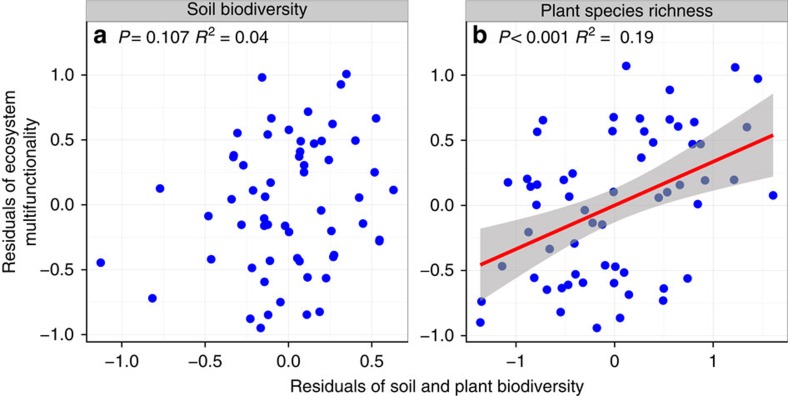
- Combined above- and belowground biodiversity accounted for 45% of EMF variation. In partial linear regression, plant species richness accounted for 19%, soil biodiversity 4% (not statistically significant, P=0.107), and their combined effects 22%.
- A full model with seven PCA components accounted for 86% of EMF variation; the best-fit two-component model accounted for 84%. Soil moisture was the most important single driver, accounting for 65% of EMF variation; MAP explained 43%, soil pH 30%, and soil CaCO3 33%. MAT had no isolated relationship with EMF but improved models when combined with other factors.
- Piecewise SEM showed soil moisture had the strongest influence on EMF (β=0.62), MAP was strongly related to belowground biodiversity (β=0.79), MAT directly affected EMF (β=0.16) and indirectly through soil pH (β=−0.27), and soil pH was negatively related to EMF (β=−0.11).
Methods
- Observational survey of 60 sites spanning >1,000,000 km² in Tibetan Plateau alpine grasslands during July–August 2011; 180 soil samples/plots were collected across alpine meadow, alpine steppe, and desert steppe vegetation types.
- Biodiversity measures included plant species richness, bacterial and archaeal OTUs, AM fungal virtual taxa, and soil faunal richness at order level. EMF was calculated as an averaging index from Z-scores of eight ecosystem functions: aboveground biomass, root biomass, soil organic carbon, soil nitrogen, soil available nitrogen, soil phosphorus, plant nitrogen, and plant phosphorus.
- Analyses used site means (n=60) and included OLS regressions, general linear models, partial linear regression, PCA, and piecewise structural equation modeling; climate data were compiled from 1951–2010 records from 716 stations.
Limitations
- Stated: belowground biodiversity is only a rough estimate because sequencing methods did not detect all taxa; future studies should use higher-resolution sequencing and target active communities. Soil moisture came from a single measurement and was not integrated across the season. The EMF index is not a single best metric of multifunctionality, and the measured functions were often correlated.
- Stated: the observational design cannot fully disentangle causal factors; the authors note that experimental work is needed to further disentangle these relationships.
- Evident: the study is correlational and relies on SEM for inferred direct and indirect effects, so causal claims about climate mediation remain model-based rather than experimentally tested.
Model-written summary. Check it against the paper before relying on it.
Integrity signals
Registry
Cites
Statistics
Figures


Verification
Claims the paper makes
2 Valid · 0 Not valid · 16 Not checked · 60 Own results and interpretations
A result the paper reports from its own data — it cites no other source for it, so there is none to check. The quote shows it is in the paper.
In the paper
“We found that a suite of biotic and abiotic variables account for up to 86% of the variation in EMF”
- Also stated in: § The effects of biodiversity and abiotic factors on EMF · plain
“The full model, with the seven components, accounted for 86% of the variation in EMF”
- Also stated in: § Discussion · plain
“The best-fitting models accounted for 86% of the variation in EMF and included soil moisture, soil pH, above- and belowground biodiversity as well as climatic variables (MAT).”
§ The links between ecosystem multifunctionality and above- and belowground biodiversity are mediated by climate > Abstract
plainstates an association- Asserted: passes — The authors put it forward as true.
- Checkable: passes — It can be checked against evidence.
- Load-bearing: passes — The paper’s conclusions depend on it.
- Based: passes — The paper gives a reason why it holds.
- Also stated in: § The effects of biodiversity and abiotic factors on EMF · plain
A result the paper reports from its own data — it cites no other source for it, so there is none to check. The quote shows it is in the paper.
In the paper
“Plant species richness accounted for 19% of the variation in EMF.”
§ The links between ecosystem multifunctionality and above- and belowground biodiversity are mediated by climate > Results > The effects of above- and belowground biodiversity on EMF
plainstates an association- Asserted: passes — The authors put it forward as true.
- Checkable: passes — It can be checked against evidence.
- Load-bearing: passes — The paper’s conclusions depend on it.
- Based: passes — The paper gives a reason why it holds.
A result the paper reports from its own data — it cites no other source for it, so there is none to check. The quote shows it is in the paper.
In the paper
“We found that soil moisture was the most important driver, accounting for 65% of the variation in EMF (Supplementary Fig. 9).”
§ The links between ecosystem multifunctionality and above- and belowground biodiversity are mediated by climate > Results > The effects of biodiversity and abiotic factors on EMF
plainstates a cause- Asserted: passes — The authors put it forward as true.
- Checkable: passes — It can be checked against evidence.
- Load-bearing: passes — The paper’s conclusions depend on it.
- Based: passes — The paper gives a reason why it holds.
A result the paper reports from its own data — it cites no other source for it, so there is none to check. The quote shows it is in the paper.
In the paper
“the best-fit model with two components (PC1 and PC4) accounted for 84% of the variation in EMF.”
§ The links between ecosystem multifunctionality and above- and belowground biodiversity are mediated by climate > Results > The effects of biodiversity and abiotic factors on EMF
plainstates an association- Asserted: passes — The authors put it forward as true.
- Checkable: passes — It can be checked against evidence.
- Load-bearing: passes — The paper’s conclusions depend on it.
- Based: passes — The paper gives a reason why it holds.
A result the paper reports from its own data — it cites no other source for it, so there is none to check. The quote shows it is in the paper.
In the paper
“PC4 represented MAT, soil moisture and soil CaCO3 (Supplementary Fig. 11).”
§ The links between ecosystem multifunctionality and above- and belowground biodiversity are mediated by climate > Results > The effects of biodiversity and abiotic factors on EMF
plain- Asserted: passes — The authors put it forward as true.
- Checkable: passes — It can be checked against evidence.
- Load-bearing: passes — The paper’s conclusions depend on it.
- Based: passes — The paper gives a reason why it holds.
27 more claims
Create a free account to see all 78 claims and to verify the 20 references still open.
- Probably not a substantial claim. 28
- It may state two separate claims as one. 29
Claims other papers make about this one
Each is checked against this paper’s own text: does it say what the citing paper says it does?
The source backs part of the claim, not all of it — or backs it for a different population, condition or comparison.
In the citing paper
“diversity effects of plants and microbes are complementary, maximising rates of nutrient cycling 11”
From Biodiversity at multiple trophic levels is needed for ecosystem multifunctionality (2016) · cites this paper as [11]
Experimental — accuracy not yet measuredThe cited source says what the claim attributes to it.
In the citing paper
“Consequently, we know very little about the relative effect of changes in the diversity of different trophic groups on the provision of individual 2,5,6,9,13,14 or multiple (multifunctionality) 11,15 ecosystem services.”
From Biodiversity at multiple trophic levels is needed for ecosystem multifunctionality (2016) · cites this paper as [11]
The cited source says what the claim attributes to it.
In the citing paper
“These results agree with other studies that have identified plants and soil microorganisms as key drivers of ecosystem functioning 11,14,15,29 , extending these findings to the richness and abundance of different trophic groups, including primary producers and consumers both above-and belowground.”
From Biodiversity at multiple trophic levels is needed for ecosystem multifunctionality (2016) · cites this paper as [11]
Self-check
Percentages, sums and reported differences re-computed from the paper’s own numbers.
Each contradiction between two passages listed here was confirmed by an independent check.
Rated major: it would touch a result — a value a result rests on, reported and recomputed p-values on opposite sides of the significance level, two passages that conflict with no sign which is right, or a cited work retracted before this paper was published.
In the paper
§ The links between ecosystem multifunctionality and above- and belowground biodiversity are mediated by climate > Results > The effects of biodiversity and abiotic factors on EMF
“the best-fit model with two components (PC1 and PC4) accounted for 84% of the variation in EMF.”
§ The links between ecosystem multifunctionality and above- and belowground biodiversity are mediated by climate > Methods > Statistical analyses
“the other one is a reduced model with two components (PC1 and PC2) (Supplementary Fig. 11).”
Citations
Cites
QIIME allows analysis of high-throughput community sequencing data
Caporaso, J. G., Kuczynski, J., Stombaugh, J., Bittinger, K., Bushman, F. D., Costello, E. K., Fierer, N., Peña, A. G., Goodrich, J. K., Gordon, J. I., et al. (2010) · Nature Methods · doi:10.1038/nmeth.f.303 · Cited by 34,887
Search and clustering orders of magnitude faster than BLAST
Edgar, R. C. (2010) · Bioinformatics · doi:10.1093/bioinformatics/btq461 · Cited by 20,826
Schloss, P. D., Westcott, S. L., Ryabin, T., Hall, J. R., Hartmann, M., Hollister, E. B., Lesniewski, R. A., Oakley, B. B., Parks, D. H., Robinson, C. J., et al. (2009) · Applied and Environmental Microbiology · doi:10.1128/aem.01541-09 · Cited by 19,549
UCHIME improves sensitivity and speed of chimera detection
Edgar, R. C., Haas, B. J., Clemente, J. C., Quince, C., & Knight, R. (2011) · Bioinformatics · doi:10.1093/bioinformatics/btr381 · Cited by 15,114
Experimental Design and Data Analysis for Biologists
Quinn, G. P., & Keough, M. J. (2002) · doi:10.1017/cbo9780511806384 · Cited by 10,674
Global patterns of 16S rRNA diversity at a depth of millions of sequences per sample
Caporaso, J. G., Lauber, C. L., Walters, W. A., Berg-Lyons, D., Lozupone, C. A., Turnbaugh, P. J., Fierer, N., & Knight, R. (2011) · Proceedings of the National Academy of Sciences · doi:10.1073/pnas.1000080107 · Cited by 9,711
EFFECTS OF BIODIVERSITY ON ECOSYSTEM FUNCTIONING: A CONSENSUS OF CURRENT KNOWLEDGE
Hooper, D. U., Chapin, F. S., Ewel, J. J., Hector, A., Inchausti, P., Lavorel, S., Lawton, J. H., Lodge, D. M., Loreau, M., Naeem, S., et al. (2005) · Ecological Monographs · doi:10.1890/04-0922 · Cited by 8,046
Biodiversity loss and its impact on humanity
Cardinale, B. J., Duffy, J. E., Gonzalez, A., Hooper, D. U., Perrings, C., Venail, P., Narwani, A., Mace, G. M., Tilman, D., Wardle, D. A., et al. (2012) · Nature · doi:10.1038/nature11148 · Cited by 7,457
Pruesse, E., Quast, C., Knittel, K., Fuchs, B. M., Ludwig, W., Peplies, J., & Glockner, F. O. (2007) · Nucleic Acids Research · doi:10.1093/nar/gkm864 · Cited by 6,668
The diversity and biogeography of soil bacterial communities
Fierer, N., & Jackson, R. B. (2006) · Proceedings of the National Academy of Sciences · doi:10.1073/pnas.0507535103 · Cited by 5,711
Research works printed but not linked: 1
- Smith, S. E. & Read, D. J. Mycorrhizal Symbiosis Academic Press (2010).
Cited by
Items 501–600 of 894
Zhang, Z., Zhu, X., Wang, S., Duan, J., Chang, X., Luo, C., He, J.-S., & Wilkes, A. (2017) · Agricultural and Forest Meteorology · doi:10.1016/j.agrformet.2017.06.013 · Cited by 10
Self-citationZhang, M., Shi, Z., Xu, X., & Wang, X. (2022) · Diversity · doi:10.3390/d14080587 · Cited by 9
“play a role in predicting the evolution and succession of ecosystems [12].”
BackgroundQiqige, B., Wei, B., Wei, Y., Liu, M., Bi, Y., Xu, R., Liu, N., Yang, G., & Zhang, Y. (2023) · Frontiers in Plant Science · doi:10.3389/fpls.2023.1238077 · Cited by 12
“Anthropogenic disturbances such as grazing and fire, connected with global climate change, may have complex effects on grasslands (Jing et al., 2015).”
BackgroundDrought responses and carbon allocation strategies of poplar with different leaf maturity
Yao, Y., Xia, L., Yang, L., Liu, R., & Zhang, S. (2024) · Physiologia Plantarum · doi:10.1111/ppl.14224 · Cited by 9
Cui, Y., Xu, D., Luo, W., Zhai, Y., Dai, Y., Ji, C., Li, X., & Chen, J. (2024) · Environmental Research · doi:10.1016/j.envres.2024.120262 · Cited by 9
Wang, R., Liu, C., Bie, X., Dai, Y., Xu, F., Wang, R., Wang, M., Shu, X., & Chen, Y. (2024) · Chemical and Biological Technologies in Agriculture · doi:10.1186/s40538-024-00693-8 · Cited by 9
“Table 1 supports this idea, with the elevations of the activities of S-UE and S-NR under intercropping patterns, which are crucial enzymes involved in the nitrogen cycle [37, 38].”
Liu, M., Chen, X., Zhang, Y., Zhang, X., & Chen, Y. (2025) · Journal of Environmental Management · doi:10.1016/j.jenvman.2025.124374 · Cited by 10
Plant diversity drives ecosystem multifunctionality under grazing management in temperate grasslands
Yao, C., Feng, J., Zhang, Y., Dang, Z., & Ma, L. (2025) · Journal of Plant Ecology · doi:10.1093/jpe/rtaf093 · Cited by 14
Kaushal, M., Tumuhairwe, J. B., Kaingo, J., Malingumu, R., Nakamanya, F., Taulya, G., & Coyne, D. (2022) · Biology · doi:10.3390/biology11050756 · Cited by 9
Chang, C., Lee, J., Chiang, J., Wang, H.-C., Huang, J., Tseng, C.-W., Wang, C.-H., & Fu, S.-W. (2022) · Ecological Indicators · doi:10.1016/j.ecolind.2022.109650 · Cited by 9
Zhu, Y., Sun, L., Fu, Q., Guo, B., Lin, Y., & Liu, X. (2023) · Soil Use and Management · doi:10.1111/sum.12918 · Cited by 10
“…including nutrient cycling, decomposition, primary production and climate regulation) would increase our ability to understand the services that the soils provide and how such service respond to land management changes (Hector & Bagchi., 2007; Jing et al., 2015; Ma et al., 2022).”
BackgroundKačergius, A., Sivojienė, D., Gudiukaitė, R., Bakšienė, E., Masevičienė, A., & Žičkienė, L. (2023) · Soil Systems · doi:10.3390/soilsystems7030070 · Cited by 10
Zhang, Z., Tang, G., Chai, X., Liu, B., Gao, X., Zeng, F., Wang, Y., & Zhang, B. (2023) · Microorganisms · doi:10.3390/microorganisms11102471 · Cited by 10
“This trend is also confirmed by the previous research [64].”
ResultWang, Y., Lin, Y., Zhang, L., Liu, S., Wang, J., Tian, Y., Campbell, D. E., Lin, R., Ren, H., & Lu, H. (2023) · Journal of Applied Ecology · doi:10.1111/1365-2664.14558 · Cited by 10
Linking microbial diversity with ecosystem functioning through a trait framework
Wang, J., Egidi, E., Li, J., & Singh, B. K. (2019) · Journal of Biosciences · doi:10.1007/s12038-019-9928-9 · Cited by 10
Li, P., Zhang, J., Wang, S., Zhang, P., Chen, W., Ding, S., & Xi, J. (2022) · Frontiers in Microbiology · doi:10.3389/fmicb.2022.923346 · Cited by 9
Plantation rhizosphere soil microbes promote soil‒plant phosphorus feedback on the Tibetan Plateau
Liu, R., Yao, Y., Guo, Z., Li, Q., & Zhang, S. (2023) · Plant and Soil · doi:10.1007/s11104-023-05939-2 · Cited by 9
“This result was similar to those of recent studies showing that microbial diversity could positively influence multifunctionality in the natural environment (Delgado-Baquerizo et al. 2016b, 2017; Jing et al. 2015).”
Yin, Y. (2005) · Biodiversity Science · doi:10.1360/biodiv.050018 · Cited by 9
Indirect effects of water availability in driving and predicting productivity in the Gobi desert
Xu, K., He, L., Hu, H., Wang, Z., Lin, M., Liu, S., Du, Y., Li, Y., & Wang, G. (2019) · The Science of The Total Environment · doi:10.1016/j.scitotenv.2019.133952 · Cited by 11
Chen, L., Ding, M., Zhang, H., Wang, N., Zhang, Y., Wan, J., & Xie, K. (2023) · Journal of Cleaner Production · doi:10.1016/j.jclepro.2023.139888 · Cited by 7
Self-citationImpact of socioeconomic factors on soil-borne animal pathogenic fungi in urban greenspaces
Luo, S., Han, J., Chen, R., Delgado‐Baquerizo, M., Zhang, W., & Feng, Y. (2024) · Nature Cities · doi:10.1038/s44284-024-00073-1 · Cited by 8
“…selected this metric for our study because it provides a robust and informative estimation of taxonomic diversity for microbial communities 28 , and the Shannon index encompasses both species richness and evenness and has been widely used to characterize the diversity of microbial communities 29 .”
Response of soil microbial diversity and functionality to snow removal in a cool-temperate forest
Ji, X., Xu, 杨. Y., Liu, H., Cai, T., & Feng, F. (2024) · Soil Biology and Biochemistry · doi:10.1016/j.soilbio.2024.109515 · Cited by 8
Bacteriophage–Bacteria Interactions Promote Ecological Multifunctionality in Compost‐Applied Soils
Wu, S., Zhang, W., Wang, D., Balcázar, J. L., Wang, G., Ye, M., Chao, H., Sun, M., & Hu, F. (2025) · Environmental Microbiology · doi:10.1111/1462-2920.70074 · Cited by 8
Yusuf, A., Lei, D., Sun, Y., Duan, S., & Zhang, Y. (2025) · Limnologica · doi:10.1016/j.limno.2025.126252 · Cited by 8
Wan, L., Liu, G., & Su, X. (2025) · Ecological Frontiers · doi:10.1016/j.ecofro.2025.04.011 · Cited by 9
Li, J., Cheng, F., Hao, M., Fan, C., Wang, J., von Gadow, K., Cheng, Y., Zhang, C., & Zhao, X. (2025) · Journal of Ecology · doi:10.1111/1365-2745.70140 · Cited by 10
“processes by environmental filtering and competition, thus regulat - ing diversity patterns across forest strata (Hakkenberg et al., 2020; Zhang et al., 2020 ), and EMF (Jing et al., 2015 ; Martinez-Almoyna et al., 2019 ).”
Shang, Z., Wang, Y., An, M., Chen, X., Kulyar, M. F., Tan, Z., Liu, S., & Li, K. (2022) · Frontiers in Microbiology · doi:10.3389/fmicb.2022.1016852 · Cited by 9
“However, interference from fecal deposition excrement caused by extensive grazing may disrupt this context dependence throughout complex and harmoniously balanced ecosystems (Jing et al., 2015; DelgadoBaquerizo et al., 2016).”
BackgroundZhao, S., Qin, M., Xia, Y., Bai, W., Yao, Y., & Wang, J. (2023) · Sustainability · doi:10.3390/su15020928 · Cited by 8
Ye, C., Wang, S., Wang, Y., Zhou, T., & Li, R. (2023) · Frontiers in Plant Science · doi:10.3389/fpls.2023.1106035 · Cited by 9
“Although numerous studies have been conducted on the interaction between biodiversity and ecosystem functioning (Soliveres et al., 2014; Jing et al., 2015; Meyer et al., 2018; Delgado-Baquerizo et al., 2020; Hu et al., 2021), these studies have largely focused on the”
BackgroundInfluentialNitrogen enrichment decrease green roof multifunctionality
Hao, G., Yang, N., Chen, X., Du, Z., Li, M., Chen, L., & Li, H. (2024) · Urban forestry & urban greening · doi:10.1016/j.ufug.2024.128233 · Cited by 8
Self-citationYin, B., Li, J., Zhang, Q., Zhang, S., Liu, Z., Zhou, X., Wu, N., & Zhang, Y. (2024) · Applied Soil Ecology · doi:10.1016/j.apsoil.2024.105420 · Cited by 9
Li, Z., Guan, X., Nong, X., Li, R., Chen, L., & Wei, J. (2024) · Journal of Hydrology Regional Studies · doi:10.1016/j.ejrh.2024.102050 · Cited by 10
Self-citationResponses of ecosystem multifunctionality to global change: progress, problem and prospect
ZHANG, H.-J., & Wei, W. (2021) · Chinese Journal of Plant Ecology · doi:10.17521/cjpe.2020.0074 · Cited by 7
Zhang, H., Ye, C., & Wang, S. (2022) · Global Ecology and Conservation · doi:10.1016/j.gecco.2022.e02066 · Cited by 10
Di, C., Han, Z., Chai, C., Sun, J., Wu, F., & Pan, K. (2023) · Agronomy · doi:10.3390/agronomy13071688 · Cited by 8
“The bacterial and fungal communities were analyzed by sequencing of the V4–V5 regions of bacterial 16S rRNA genes and fungal ITS1 region, using the primer set 515F/907R [52] and ITS1F/ITS2 [53].”
MethodBiodiversity drives ecosystem multifunctionality in sandy grasslands?
Huang, W., Zhu, Y., Yu, H., He, Y., Zhao, X. Q., Wang, H., & Shi, S. (2024) · The Science of The Total Environment · doi:10.1016/j.scitotenv.2024.171765 · Cited by 8
Shi, Z., Yongming, W. A. N. G., Xu, S., Zhijian, L. A. N., Mickan, B. S., Zhang, X., & Wang, F. (2017) · Notulae Botanicae Horti Agrobotanici Cluj-Napoca · doi:10.15835/nbha45110766 · Cited by 8
“Several studies have found that ecosystem processes such as primary productivity are linked to species diversity (Tilman et al., 1996, 1997; Klironomos et al., 2000; Jing et al., 2015; Fessel et al., 2016).”
InfluentialJia, Y., Qin, W., Zhang, T., & Feng, G. (2023) · Chinese Science Bulletin (Chinese Version) · doi:10.1360/tb-2023-0057 · Cited by 8
Pan, F., Li, Z., Xie, H., Xu, X., & Duan, L. (2024) · The Science of The Total Environment · doi:10.1016/j.scitotenv.2024.171486 · Cited by 7
Qu, Q., Wang, S., Hu, X., & Li, M. (2024) · The Science of The Total Environment · doi:10.1016/j.scitotenv.2024.175293 · Cited by 7
Seasonal effects of long-term warming on ecosystem function and bacterial diversity
Shinfuku, M. S., Domeignoz‐Horta, L. A., Choudoir, M. J., Frey, S. D., Mitchell, M. F., Ranjan, R., & DeAngelis, K. M. (2024) · PLoS ONE · doi:10.1371/journal.pone.0311364 · Cited by 7
“…between EMF and diversity, where at larger scales, like continental or global scales, diversity and ecosystem function tend to be positively correlated, but at smaller scales, like plot level or regional scales, diversity and ecosystem function tend to be neutrally or negatively correlated [82].”
Shen, Y., Luo, Y., Du, L., Tian, R., Shao, W., Zhang, J., Li, N., Zhang, J., Wang, S., Mahmood, M., et al. (2024) · Applied Soil Ecology · doi:10.1016/j.apsoil.2024.105727 · Cited by 8
Nguyen, T. V., Kim, N. K., Lee, S., Trinh, H. P., & Park, H. (2024) · Chemosphere · doi:10.1016/j.chemosphere.2024.144028 · Cited by 8
Wang, Y., Peng, L., Huang, Z., Lu, P., Zhang, J., & Qian, Y. (2025) · Rangeland Ecology & Management · doi:10.1016/j.rama.2025.04.005 · Cited by 6
Does pollinator conservation promote environmental co-benefits?
Cappellari, A., Ortis, G., Mei, M., Paniccia, D., Carrossa, E., Eccheli, C., Facchetti, S., Lorenzon, G., & Marini, L. (2023) · Agriculture Ecosystems & Environment · doi:10.1016/j.agee.2023.108615 · Cited by 8
Li, X., Wang, C., Song, J., Hou, Y., Shi, R., Zheng, R., Hu, Y., & Wu, J. (2022) · Applied Soil Ecology · doi:10.1016/j.apsoil.2023.105062 · Cited by 7
Qiu, M., Wang, Y., Sun, C., & Gao, X. (2023) · Environmental Science and Pollution Research · doi:10.1007/s11356-023-30637-y · Cited by 7
“The Z -score was calculated as follows (Jing et al. 2015; Delgado-Baquerizo et al. 2016; Jiao et al. 2019): where Z ij is the Z -score of the j th functional index of the inundation zone i , X ij is the value of the j th functional index of the inundation zone i , μ j is the average value of the j…”
MethodShi, J. L., Zhang, Z., Wang, Z., Peng, Y., & Wang, X. (2024) · Soil Use and Management · doi:10.1111/sum.13067 · Cited by 8
“A multifunctionality index, comprising TN, TDN, mineral N, NO − 3 − N , NH + 4 − N , DON, soil gravimetric water contents and soil pH in a 0-to 100-cm soil profile, was calculated to evaluate the erosional and depositional effects on soil N pools (Jing et al., 2015).”
MethodCui, A., Lü, H., Hou, J., Xu, D., Fan, B., & Ji, K. (2024) · Palaeogeography Palaeoclimatology Palaeoecology · doi:10.1016/j.palaeo.2024.112343 · Cited by 7
Pre-existing global change legacies regulate the responses of multifunctionality to warming
Cui, H., Ochoa‐Hueso, R., Sun, W. B., Piñeiro, J., Power, S. A., Wang, J., Singh, B. K., & Delgado‐Baquerizo, M. (2024) · Applied Soil Ecology · doi:10.1016/j.apsoil.2024.105679 · Cited by 7
A Comprehensive Review on Bioactive Molecules and Advanced Microorganism Management Technologies
Wali, A. F., Talath, S., Sridhar, S. B., Shareef, J., Goud, M., Rangraze, I. R., Ani, N. N. A., & Mohamed, O. I. (2024) · Current Issues in Molecular Biology · doi:10.3390/cimb46110789 · Cited by 7
Ren, Y., Zhu, L., Deng, Z., Xie, Y., Zhang, C., Xiao, F., Chen, X., Li, F., Zou, Y., Sheng, R., et al. (2020) · Atmosphere · doi:10.3390/atmos11090997 · Cited by 7
“Compared with the traditional variance–covariance-based SEM, the piecewise SEM could (1) piece multiple separate (generalized) linear models together to a single causal network, (2) use Shipley’s test of d-separation to test whether any paths are missing from the model, and (3) use Akaike information criterion (AIC) t…”
MethodZhou, Q., Li, D., Xia, S., Chen, Z., Wang, B., & Wu, J. (2021) · Forest Ecosystems · doi:10.1186/s40663-021-00310-2 · Cited by 7
“in plant diversity increased soil microbial biomass (Jing et al. 2015; Lange et al. 2015).”
BackgroundResultKang, X., Qi, W., Knops, J. M. H., Luo, S., Jia, P., Du, G., Zhang, A., Li, W., & Chen, H. (2023) · Landscape Ecology · doi:10.1007/s10980-022-01525-6 · Cited by 7
Effects of Land Use Changes on Soil Biodiversity Conservation
Bustamante, M., Calaça, F. J. S., Pompermaier, V. T., da Silva, M. R. S. S., & Silveira, R. (2023) · Environment & policy · doi:10.1007/978-3-031-29853-0_7 · Cited by 9
A review on the relationships between plant genetic diversity and ecosystem functioning
ZHANG, L.-W., & Han, G. (2018) · Chinese Journal of Plant Ecology · doi:10.17521/cjpe.2018.0013 · Cited by 7
“Hughes AR, Stachowicz JJ (2011).”
InfluentialJagadesh, M., Selvi, D. T., Thiyageshwari, S., Kalaiselvi, T., Allan, V., Dash, M., Keisar, L. D., Kumaraperumal, R., Raja, P., & Surendran, U. P. (2023) · Applied Soil Ecology · doi:10.1016/j.apsoil.2023.105176 · Cited by 6
Coupling soil bacterial and fungal community traits to multifunctionality in grassland ecosystem
Ding, C., Liu, Y., Hernández, M., Sun, H., Jiao, S., Pan, H., Ge, T., Zhao, K., Zhang, Q., Xu, J. M., et al. (2025) · Agriculture Ecosystems & Environment · doi:10.1016/j.agee.2025.109648 · Cited by 9
Self-citationBiodiversity and Soil Jointly Drive Ecosystem Multifunctionality in Larch Forests
Zhang, Y., Wang, R., Liu, C., Liu, Q., Li, M., & Zhang, Z. (2025) · Forests · doi:10.3390/f16050745 · Cited by 6
Chen, J., Huang, M., Zeng, Y., Sui, Y., Gao, Y., Ochoa‐Hueso, R., Nielsen, U. N., Gao, W., Wu, X., Yang, T., et al. (2025) · Agriculture Ecosystems & Environment · doi:10.1016/j.agee.2025.109954 · Cited by 6
Yang, J. Y., Li, Z., Jeppesen, E., Moi, D. A., Liu, Y., Mo, Y., Bai, X., Wang, F., Xie, Z., & Zhang, J. (2025) · Limnology and Oceanography · doi:10.1002/lno.70221 · Cited by 7
“Second, rare species enhance EMF through complex indirect interactions (Jing et al. 2015; Dee et al. 2019).”
Luo, M., Jia, X., Zhao, Y., Ren, K., Zhang, L., Mu, Q., & Yang, S. (2025) · CATENA · doi:10.1016/j.catena.2025.109688 · Cited by 8
Shi, G., Zhang, Z., Ma, L., Liu, Y., Wang, Y., Uwamungu, J. Y., Feng, H., Dong, S., Yao, B., & Zhou, H. (2023) · Fungal ecology · doi:10.1016/j.funeco.2023.101303 · Cited by 6
Qi, X., Chen, X., Zhou, X., Qian, Z., Zhou, H., Zhuang, G., & Ma, A. (2024) · Land Degradation and Development · doi:10.1002/ldr.5059 · Cited by 7
“To address grassland degradation and promote rehabilitation, the government has implemented interventions such as gazing exclusion (Jing et al., 2015; Wang et al., 2020).”
Zhao, M., Liu, S., Sun, Y., & Chen, Y. (2024) · Plant and Soil · doi:10.1007/s11104-024-06558-1 · Cited by 6
“A quantitative multifunctionality index can be calculated from multiple indices, such as primary productivity, plant diversity, microbial diversity, soil enzyme activities, and soil nutrients using the multiple threshold approach or the averaging approach (Jing et al. 2015).”
Zhu, R., Yan, W., Wang, Y., Li, Y., Zheng, R., Dong, W., Yao, T., & Duan, T. (2024) · Grassland Research · doi:10.1002/glr2.12081 · Cited by 9
Yi, C., Gao, L., Liu, Y., Yang, N., Lyu, X., Zhang, Y., & Guan, Q. (2024) · Cities · doi:10.1016/j.cities.2024.105320 · Cited by 6
Kim, A.-Y., Lee, W., & Son, Y. (2024) · Diversity · doi:10.3390/d16080506 · Cited by 15
Zhang, Z., Jiao, Y., Dong, X., Ma, Y., & Zhang, S. (2024) · Journal of Mountain Science · doi:10.1007/s11629-024-8853-z · Cited by 6
“We implemented a three-year litter decomposition experiment in an alpine meadow ecosystem on the QTP to investigate the decomposition processes of dominant plant litter.”
InfluentialMing-xu, Z., Hu, J., Li, J., Che, Z., Li, L., Lü, Z., Dong, W., Zhang, J., Yao, T., Duan, T., et al. (2024) · Land Degradation and Development · doi:10.1002/ldr.5369 · Cited by 7
“N, AP, ALP and ACP levels (Guo et al. 2021; Jing et al. 2015).”
Zhang, L., Lei, S., Qian, R., Ochoa‐Hueso, R., Wang, X., Wang, J., Liao, L., Liu, G., Li, Q., & Zhang, C. (2024) · Plant and Soil · doi:10.1007/s11104-024-07093-9 · Cited by 8
“Spatial distance and climatic factors have been reported to be the predominant drivers for the relationship between biodiversity and ecosystem functions (Broadbent et al. 2021; Jing et al. 2015).”
Liu, Z.-K., Zhang, L., Jin, S., Yu, H., He, J., & Shen, J. (2025) · Frontiers in Microbiology · doi:10.3389/fmicb.2025.1592901 · Cited by 6
“The average of the Z-scores for the measured variables was used as EMF for each sample for the first method (Jing et al., 2015).”
Self-citationLv, L., Zhang, J., Bourque, C. P. ‐., Xiang, Q., Zhang, J., Yang, X., Zhu, J., & Ma, J. (2025) · European Journal of Soil Biology · doi:10.1016/j.ejsobi.2025.103747 · Cited by 6
Structure and impact of root-associated fungi in treatment wetland mesocosms
Tondera, K., Chazarenc, F., Brisson, J., & Chagnon, P. (2022) · The Science of The Total Environment · doi:10.1016/j.scitotenv.2022.159958 · Cited by 6
Liang, Y., Ri, A., & Wang, N. (2022) · Frontiers in Environmental Science · doi:10.3389/fenvs.2022.1015821 · Cited by 6
Huang, X., Li, S., Su, J., Liu, W., & Lang, X. (2017) · Biodiversity Science · doi:10.17520/biods.2017167 · Cited by 6
Pavement Overrides the Effects of Tree Species on Soil Bacterial Communities
Hu, Y., Yu, W., Cui, B., Chen, Y., Zheng, H., & Wang, X. (2021) · International Journal of Environmental Research and Public Health · doi:10.3390/ijerph18042168 · Cited by 6
“In turn, plant species are a critical factor in determining soil microbial biomass and function diversity [15].”
BackgroundWang, Q., Pan, J., Ke, Y., Yu, S., Murray, P. J., Luo, T., Zhang, L., & Liu, W. (2022) · Forests · doi:10.3390/f13122100 · Cited by 6
Szabó, I., Al-Omari, J., Dąbrowska, A., Szerdahelyi, S. G., Sebők, R., Szabó, G., Micsinai, A., Kaszab, E., Szoboszlay, S., & Kriszt, B. (2023) · Journal of Molecular Liquids · doi:10.1016/j.molliq.2023.123637 · Cited by 5
Qin, Y. F., Zhang, X., & Fu, G. (2024) · Agriculture Ecosystems & Environment · doi:10.1016/j.agee.2024.109442 · Cited by 5
Kang, Y., Wu, H., Guan, Q., Zhang, Z., & Wang, W. (2024) · Journal of Environmental Management · doi:10.1016/j.jenvman.2024.123881 · Cited by 6
Ferreira, L. C., Moura, V. A. S., Resende, M. F. R., & Xavier, K. V. (2025) · Phytobiomes Journal · doi:10.1094/pbiomes-12-24-0118-r · Cited by 6
Wang, P.-Y., Zhao, Z., Xiong, X., Tao, H., Guo, J., Hao, M., Ding, F., Ashraf, M., Fan, X., Yang, C., et al. (2025) · Land Degradation and Development · doi:10.1002/ldr.70117 · Cited by 5
“However, archaea and fungi belong to relatively narrow taxonomic groups (Jing et al. 2015), and thus their contributions to SEMf may be relatively limited.”
Fungal diversity drives soil multifunctionality after new tree species mixed into monoculture forest
Wang, D., Li, S., Lv, D., Fan, Z., Song, H., Zhong, M., Miao, Y., Liu, Y., Shi, Y., Yang, Z., et al. (2025) · Applied Soil Ecology · doi:10.1016/j.apsoil.2025.106365 · Cited by 5
Self-citationWan, L., Liu, G., Fu, B., Hu, Y., & Su, X. (2025) · Journal of Applied Ecology · doi:10.1111/1365-2664.70221 · Cited by 14
Zhang, K., Liu, X., Yang, L., Qin, J., Jinkui, N., & Zang, H. (2025) · Ecological Indicators · doi:10.1016/j.ecolind.2025.114358 · Cited by 6
Grazing intensity shifts biodiversity drivers of ecosystem multifunctionality in a desert steppe
Ju, X., Han, G., Chen, X., Wang, Z., Li, Z., Bisseling, T., Gordon, I. J., & Wu, Q. (2026) · Agriculture Ecosystems & Environment · doi:10.1016/j.agee.2026.110255 · Cited by 6
Effects of habitat fragmentation on multiple ecosystem functions in urban remnant forests
He, M., Yang, J., Zhang, B., Guo, M., Zhou, L., & Yin, J. (2026) · Forest Ecosystems · doi:10.1016/j.fecs.2026.100432 · Cited by 6
Lu, L., Zeng, F., Zeng, Z., Hu, D. U., Sun, W., He, X., & Zhang, H. (2026) · Ecological Engineering · doi:10.1016/j.ecoleng.2026.107915 · Cited by 6
Intensifying Aridity Undermines the Role of Soil Biodiversity in Supporting Ecosystem Stability
Qi, J., Liang, C., Zhang, C., Wang, M., Wei, G., & Jiao, S. (2026) · Global Change Biology · doi:10.1111/gcb.70903 · Cited by 7
“We obtained a soil biodiversity index by averaging the standardized richness of bacteria, fungi, and protists (Jing et al. 2015; Wang, Delgado-Baquerizo, et al. 2019).”
Hao, G., Chen, X., Du, Z., Yang, N., Li, M., Gao, Y., Liang, J., Chen, L., & Li, H. (2024) · Ecological Engineering · doi:10.1016/j.ecoleng.2024.107499 · Cited by 6
Self-citationGu, H., Liu, Z., Yao, Q., Feng, J., Liu, J., Jin, J., Liu, X., & Wang, G. (2025) · Soil Ecology Letters · doi:10.1007/s42832-024-0289-4 · Cited by 6
“4.2 Rare microbial taxa play a more crucial role in maintaining ecosystem multifunctionality than the abundant taxa The positive correlation between soil microbial diversity and ecosystem multifunctionality has been extensively documented (Jing et al., 2015; Delgado-Baquerizo et al., 2016).”
InfluentialZhang, H., Wang, Y., Yang, J., He, H., Huangfu, S., Wang, J., Li, H., Zhang, B., Wang, X., Zhang, X., et al. (2025) · Plant Cell & Environment · doi:10.1111/pce.15595 · Cited by 5
Snow mediates climatic impacts on Arctic herbivore populations
Duncan, R. J., Andrew, M. E., & Forchhammer, M. C. (2021) · Polar Biology · doi:10.1007/s00300-021-02871-y · Cited by 9
The Nitrogen Removal Ability of Salt Marsh Improved After Grazing Prohibition
Li, N., Nie, M., Wu, M. Y., & Wu, J. (2022) · Frontiers in Marine Science · doi:10.3389/fmars.2022.958803 · Cited by 7
Sun, C., Lu, X., Wang, Y., & Qiu, M. (2024) · Journal of Plant Nutrition and Soil Science · doi:10.1002/jpln.202300372 · Cited by 5
Li, Y., Li, R., Li, Q., Zhao, X., Zhao, P., PingMei, Y., Zhang, S., Gu, L., & Xue, J. (2025) · The Science of The Total Environment · doi:10.1016/j.scitotenv.2025.178563 · Cited by 6
Sun, Y., Silvestro, D., Mathes, G., van der Heijden, M. G. A., & Müller‐Schärer, H. (2025) · Global Change Biology · doi:10.1111/gcb.70110 · Cited by 5
“The observed pattern is also in line with a large body of work demonstrating that moderate herbivory greatly increased soil bacterial richness and Shannon diversity (Jing et al. 2015; Wang and Tang 2019; Zhan et al. 2020).”
Yongming, W. A. N. G., Ji, C., Shi, Z., Yin, X., & Liu, C. (2019) · Notulae Botanicae Horti Agrobotanici Cluj-Napoca · doi:10.15835/nbha47411621 · Cited by 5
Cai, M., Xing, S., Cheng, X., Liu, L., Peng, X., Shang, T., & Han, H. (2021) · Forests · doi:10.3390/f12060684 · Cited by 5
Metadata
- Authors
- Jing, X., Sanders, N. J., Shi, Y., Chu, H., Classen, A. T., Zhao, K., Chen, L., Shi, Y., Jiang, Y., & He, J.-S.
- Affiliations
- Peking University (CN)
- University of Copenhagen (DK)
- Chinese Academy of Sciences (CN)
- Northwest Institute of Plateau Biology (CN)
- Chinese Academy of Forestry (CN)
- Corresponding author
- He, Jin-Sheng
- Venue
- Nature Communications
- Published
- 2015-09-02
- Volume
- 6
- Issue
- 1
- Pages
- 8159-8159
- ISSN
- 2041-1723 (ISSN-L)
- PMC
- PMC4569729
- OpenAlex
- W2263248977
- Cited by
- 895
- References
- 72
- Citations by year
- 2026: 122 · 2025: 142 · 2024: 145 · 2023: 124 · 2022: 87 · 2021: 87 · 2020: 57 · 2019: 45 · 2018: 37 · 2017: 29 · 2016: 15 · 2015: 3
- FWCI
- 29.02
- Type
- journal article
- Language
- en
- Open access
- gold
- doi.org
- Licence
- cc-by
- creativecommons.org/licenses/by/4.0 (tdm)
- creativecommons.org/licenses/by/4.0 (vor)
- Locations
- Nature Communications (publishedVersion, cc-by)
- Europe PMC (PubMed Central) (publishedVersion, cc-by)
- PubMed Central (publishedVersion, cc-by)
- PubMed (publishedVersion)
- Research at the University of Copenhagen (University of Copenhagen) (publishedVersion, cc-by)
- OSTI OAI (U.S. Department of Energy Office of Scientific and Technical Information) (submittedVersion)
- RePEc: Research Papers in Economics (submittedVersion)
- Institute of Botany, CAS Institutional Repository (submittedVersion)
- Greater South Information System
- Funders
- National Science Foundation (1136703)
- U.S. Department of Energy (DESC0010562)
- National Research Foundation
- Danmarks Grundforskningsfond
- National Natural Science Foundation of China (31321061, 111 Project, XDB03030403, 41071167, 2014CB954004, 31025005)
- Chinese Academy of Sciences (XDA05050404, 31321061, XDB03030403)
- Higher Education Discipline Innovation Project
- Office of Science (DESC0010562)
- Center for Makroøkologi, Evolution og Klima
- National Key Research and Development Program of China (2014CB954004, #2014CB954002, 111 project)
- Biological and Environmental Research (DE-SC0010562)
- Topics
- Physical Sciences › Environmental Science › Nature and Landscape Conservation › Ecology and Vegetation Dynamics Studies
- Life Sciences › Agricultural and Biological Sciences › Soil Science › Soil Carbon and Nitrogen Dynamics
- Physical Sciences › Environmental Science › Global and Planetary Change › Land Use and Ecosystem Services
- Keywords
- ecosystem multifunctionality, soil biodiversity, plant diversity, ecosystem functioning, Tibetan Plateau, biotic and abiotic factors
- MeSH terms
- Bacteria, Climate, Fungi, Plants, Soil Microbiology, Ecosystem, Tibet, Biodiversity, Climate Change, Biota, Grassland
About these checks
Registry, retraction, Cites and statistics results are computed, not judged, with one exception: a printed reference that no index lists is read once by a model before it counts as a citation error. Claims are extracted by a model and kept only when their quote appears verbatim in the text; each cited source is then checked, with a model’s help, for whether it says what the claim relies on. Those verdicts can be wrong — read the claim’s quote and the cited source before relying on one.
The claim verdicts this report counts are experimental: their accuracy is not yet measured.
A language model drew the claims from the paper on 2026-10-07, under version 3 of the claim definition (model deepseek-v4.1-flash, prompt extract-v3).
A second model labelled each claim on 2026-10-07 (model jev-1.13-20260917, definition revision gold-guideline-v0.2).
Statistics and arithmetic are recomputed, not judged.
Confidence bands are shown only for fields calibrated on our annotated test set. None is calibrated yet, so no band is shown.
What counts as a claim ›How we measure confidence ›How we check this ›
Are you an author, or do you see a problem with this page? Request a review
Data sources
Bibliographic data: Semantic Scholar, OpenAlex, Crossref.
Contains information from the Semantic Scholar Academic Graph Datasets, made available under the ODC Attribution License (ODC-BY 1.0).
Semantic Scholar’s data is described in: Kinney, R., et al. (2023). The Semantic Scholar Open Data Platform. arXiv:2301.10140.
