

The links between ecosystem multifunctionality and above- and belowground biodiversity are mediated by climate
Open accessThe DOI matches its Crossref record; 72 of the 72 references it cites were found in a registry or an index; 4 of the 24 sources its claims cite were checked for support.
Abstract
Plant biodiversity is often correlated with ecosystem functioning in terrestrial ecosystems. However, we know little about the relative and combined effects of above- and belowground biodiversity on multiple ecosystem functions (for example, ecosystem multifunctionality, EMF) or how climate might mediate those relationships. Here we tease apart the effects of biotic and abiotic factors, both above- and belowground, on EMF on the Tibetan Plateau, China. We found that a suite of biotic and abiotic variables account for up to 86% of the variation in EMF, with the combined effects of above- and belowground biodiversity accounting for 45% of the variation in EMF. Our results have two important implications: first, including belowground biodiversity in models can improve the ability to explain and predict EMF. Second, regional-scale variation in climate, and perhaps climate change, can determine, or at least modify, the effects of biodiversity on EMF in natural ecosystems.
Overview
CoChat Summary
TL;DR
Across 60 Tibetan Plateau alpine grassland sites, above- and belowground biodiversity together explained 45% of variation in ecosystem multifunctionality (EMF), while models including climate and soil factors explained up to 86%. Climate and soil variables mediated biodiversity–EMF relationships, with soil moisture the strongest driver.
Key findings
- Plant species richness and belowground biodiversity were positively correlated with EMF; plant richness explained 42% of EMF variation versus 32% for soil biodiversity in OLS regressions. Among belowground groups, bacteria and fauna were positively related to EMF, whereas archaea and arbuscular mycorrhizal fungi were not.
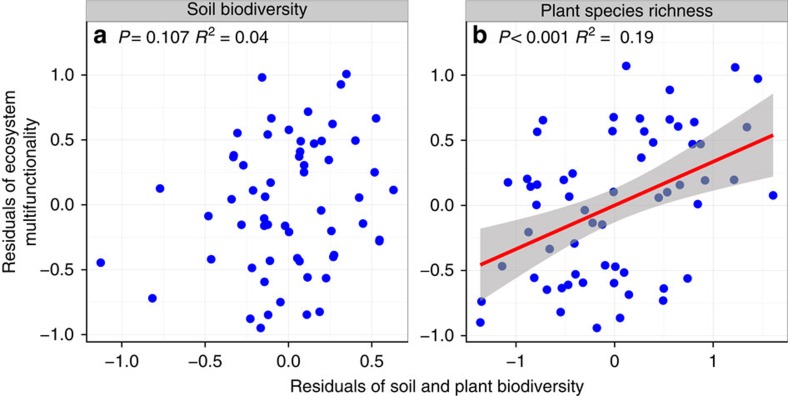
- Combined above- and belowground biodiversity accounted for 45% of EMF variation. In partial linear regression, plant species richness accounted for 19%, soil biodiversity 4% (not statistically significant, P=0.107), and their combined effects 22%.
- A full model with seven PCA components accounted for 86% of EMF variation; the best-fit two-component model accounted for 84%. Soil moisture was the most important single driver, accounting for 65% of EMF variation; MAP explained 43%, soil pH 30%, and soil CaCO3 33%. MAT had no isolated relationship with EMF but improved models when combined with other factors.
- Piecewise SEM showed soil moisture had the strongest influence on EMF (β=0.62), MAP was strongly related to belowground biodiversity (β=0.79), MAT directly affected EMF (β=0.16) and indirectly through soil pH (β=−0.27), and soil pH was negatively related to EMF (β=−0.11).
Methods
- Observational survey of 60 sites spanning >1,000,000 km² in Tibetan Plateau alpine grasslands during July–August 2011; 180 soil samples/plots were collected across alpine meadow, alpine steppe, and desert steppe vegetation types.
- Biodiversity measures included plant species richness, bacterial and archaeal OTUs, AM fungal virtual taxa, and soil faunal richness at order level. EMF was calculated as an averaging index from Z-scores of eight ecosystem functions: aboveground biomass, root biomass, soil organic carbon, soil nitrogen, soil available nitrogen, soil phosphorus, plant nitrogen, and plant phosphorus.
- Analyses used site means (n=60) and included OLS regressions, general linear models, partial linear regression, PCA, and piecewise structural equation modeling; climate data were compiled from 1951–2010 records from 716 stations.
Limitations
- Stated: belowground biodiversity is only a rough estimate because sequencing methods did not detect all taxa; future studies should use higher-resolution sequencing and target active communities. Soil moisture came from a single measurement and was not integrated across the season. The EMF index is not a single best metric of multifunctionality, and the measured functions were often correlated.
- Stated: the observational design cannot fully disentangle causal factors; the authors note that experimental work is needed to further disentangle these relationships.
- Evident: the study is correlational and relies on SEM for inferred direct and indirect effects, so causal claims about climate mediation remain model-based rather than experimentally tested.
Model-written summary. Check it against the paper before relying on it.
Integrity signals
Registry
Cites
Statistics
Figures


Verification
Claims the paper makes
2 Valid · 0 Not valid · 16 Not checked · 60 Own results and interpretations
A result the paper reports from its own data — it cites no other source for it, so there is none to check. The quote shows it is in the paper.
In the paper
“We found that a suite of biotic and abiotic variables account for up to 86% of the variation in EMF”
- Also stated in: § The effects of biodiversity and abiotic factors on EMF · plain
“The full model, with the seven components, accounted for 86% of the variation in EMF”
- Also stated in: § Discussion · plain
“The best-fitting models accounted for 86% of the variation in EMF and included soil moisture, soil pH, above- and belowground biodiversity as well as climatic variables (MAT).”
§ The links between ecosystem multifunctionality and above- and belowground biodiversity are mediated by climate > Abstract
plainstates an association- Asserted: passes — The authors put it forward as true.
- Checkable: passes — It can be checked against evidence.
- Load-bearing: passes — The paper’s conclusions depend on it.
- Based: passes — The paper gives a reason why it holds.
- Also stated in: § The effects of biodiversity and abiotic factors on EMF · plain
A result the paper reports from its own data — it cites no other source for it, so there is none to check. The quote shows it is in the paper.
In the paper
“Plant species richness accounted for 19% of the variation in EMF.”
§ The links between ecosystem multifunctionality and above- and belowground biodiversity are mediated by climate > Results > The effects of above- and belowground biodiversity on EMF
plainstates an association- Asserted: passes — The authors put it forward as true.
- Checkable: passes — It can be checked against evidence.
- Load-bearing: passes — The paper’s conclusions depend on it.
- Based: passes — The paper gives a reason why it holds.
A result the paper reports from its own data — it cites no other source for it, so there is none to check. The quote shows it is in the paper.
In the paper
“We found that soil moisture was the most important driver, accounting for 65% of the variation in EMF (Supplementary Fig. 9).”
§ The links between ecosystem multifunctionality and above- and belowground biodiversity are mediated by climate > Results > The effects of biodiversity and abiotic factors on EMF
plainstates a cause- Asserted: passes — The authors put it forward as true.
- Checkable: passes — It can be checked against evidence.
- Load-bearing: passes — The paper’s conclusions depend on it.
- Based: passes — The paper gives a reason why it holds.
A result the paper reports from its own data — it cites no other source for it, so there is none to check. The quote shows it is in the paper.
In the paper
“the best-fit model with two components (PC1 and PC4) accounted for 84% of the variation in EMF.”
§ The links between ecosystem multifunctionality and above- and belowground biodiversity are mediated by climate > Results > The effects of biodiversity and abiotic factors on EMF
plainstates an association- Asserted: passes — The authors put it forward as true.
- Checkable: passes — It can be checked against evidence.
- Load-bearing: passes — The paper’s conclusions depend on it.
- Based: passes — The paper gives a reason why it holds.
A result the paper reports from its own data — it cites no other source for it, so there is none to check. The quote shows it is in the paper.
In the paper
“PC4 represented MAT, soil moisture and soil CaCO3 (Supplementary Fig. 11).”
§ The links between ecosystem multifunctionality and above- and belowground biodiversity are mediated by climate > Results > The effects of biodiversity and abiotic factors on EMF
plain- Asserted: passes — The authors put it forward as true.
- Checkable: passes — It can be checked against evidence.
- Load-bearing: passes — The paper’s conclusions depend on it.
- Based: passes — The paper gives a reason why it holds.
27 more claims
Create a free account to see all 78 claims and to verify the 20 references still open.
- Probably not a substantial claim. 28
- It may state two separate claims as one. 29
Claims other papers make about this one
Each is checked against this paper’s own text: does it say what the citing paper says it does?
The source backs part of the claim, not all of it — or backs it for a different population, condition or comparison.
In the citing paper
“diversity effects of plants and microbes are complementary, maximising rates of nutrient cycling 11”
From Biodiversity at multiple trophic levels is needed for ecosystem multifunctionality (2016) · cites this paper as [11]
Experimental — accuracy not yet measuredThe cited source says what the claim attributes to it.
In the citing paper
“Consequently, we know very little about the relative effect of changes in the diversity of different trophic groups on the provision of individual 2,5,6,9,13,14 or multiple (multifunctionality) 11,15 ecosystem services.”
From Biodiversity at multiple trophic levels is needed for ecosystem multifunctionality (2016) · cites this paper as [11]
The cited source says what the claim attributes to it.
In the citing paper
“These results agree with other studies that have identified plants and soil microorganisms as key drivers of ecosystem functioning 11,14,15,29 , extending these findings to the richness and abundance of different trophic groups, including primary producers and consumers both above-and belowground.”
From Biodiversity at multiple trophic levels is needed for ecosystem multifunctionality (2016) · cites this paper as [11]
Self-check
Percentages, sums and reported differences re-computed from the paper’s own numbers.
Each contradiction between two passages listed here was confirmed by an independent check.
Rated major: it would touch a result — a value a result rests on, reported and recomputed p-values on opposite sides of the significance level, two passages that conflict with no sign which is right, or a cited work retracted before this paper was published.
In the paper
§ The links between ecosystem multifunctionality and above- and belowground biodiversity are mediated by climate > Results > The effects of biodiversity and abiotic factors on EMF
“the best-fit model with two components (PC1 and PC4) accounted for 84% of the variation in EMF.”
§ The links between ecosystem multifunctionality and above- and belowground biodiversity are mediated by climate > Methods > Statistical analyses
“the other one is a reduced model with two components (PC1 and PC2) (Supplementary Fig. 11).”
Citations
Cites
QIIME allows analysis of high-throughput community sequencing data
Caporaso, J. G., Kuczynski, J., Stombaugh, J., Bittinger, K., Bushman, F. D., Costello, E. K., Fierer, N., Peña, A. G., Goodrich, J. K., Gordon, J. I., et al. (2010) · Nature Methods · doi:10.1038/nmeth.f.303 · Cited by 34,887
Search and clustering orders of magnitude faster than BLAST
Edgar, R. C. (2010) · Bioinformatics · doi:10.1093/bioinformatics/btq461 · Cited by 20,826
Schloss, P. D., Westcott, S. L., Ryabin, T., Hall, J. R., Hartmann, M., Hollister, E. B., Lesniewski, R. A., Oakley, B. B., Parks, D. H., Robinson, C. J., et al. (2009) · Applied and Environmental Microbiology · doi:10.1128/aem.01541-09 · Cited by 19,549
UCHIME improves sensitivity and speed of chimera detection
Edgar, R. C., Haas, B. J., Clemente, J. C., Quince, C., & Knight, R. (2011) · Bioinformatics · doi:10.1093/bioinformatics/btr381 · Cited by 15,114
Experimental Design and Data Analysis for Biologists
Quinn, G. P., & Keough, M. J. (2002) · doi:10.1017/cbo9780511806384 · Cited by 10,674
Global patterns of 16S rRNA diversity at a depth of millions of sequences per sample
Caporaso, J. G., Lauber, C. L., Walters, W. A., Berg-Lyons, D., Lozupone, C. A., Turnbaugh, P. J., Fierer, N., & Knight, R. (2011) · Proceedings of the National Academy of Sciences · doi:10.1073/pnas.1000080107 · Cited by 9,711
EFFECTS OF BIODIVERSITY ON ECOSYSTEM FUNCTIONING: A CONSENSUS OF CURRENT KNOWLEDGE
Hooper, D. U., Chapin, F. S., Ewel, J. J., Hector, A., Inchausti, P., Lavorel, S., Lawton, J. H., Lodge, D. M., Loreau, M., Naeem, S., et al. (2005) · Ecological Monographs · doi:10.1890/04-0922 · Cited by 8,046
Biodiversity loss and its impact on humanity
Cardinale, B. J., Duffy, J. E., Gonzalez, A., Hooper, D. U., Perrings, C., Venail, P., Narwani, A., Mace, G. M., Tilman, D., Wardle, D. A., et al. (2012) · Nature · doi:10.1038/nature11148 · Cited by 7,457
Pruesse, E., Quast, C., Knittel, K., Fuchs, B. M., Ludwig, W., Peplies, J., & Glockner, F. O. (2007) · Nucleic Acids Research · doi:10.1093/nar/gkm864 · Cited by 6,668
The diversity and biogeography of soil bacterial communities
Fierer, N., & Jackson, R. B. (2006) · Proceedings of the National Academy of Sciences · doi:10.1073/pnas.0507535103 · Cited by 5,711
Research works printed but not linked: 1
- Smith, S. E. & Read, D. J. Mycorrhizal Symbiosis Academic Press (2010).
Cited by
Items 601–700 of 894
Taniwaki, T., Watanabe, K., Komine, H., Tochigi, K., Yamane, M., & Koike, S. (2021) · Biological Control · doi:10.1016/j.biocontrol.2021.104810 · Cited by 4
NEXT‐GENERATION SOIL BIOGEOCHEMISTRY MODEL REPRESENTATIONS
Riley, W. J., Sierra, C. A., Tang, J., Bouskill, N., Zhu, Q., & Abramoff, R. (2022) · Wiley eBooks · doi:10.1002/9781119480419.ch11 · Cited by 8
Huang, J. L., Wang, S., Wu, Y., Lu, X., Bai, Y., Wang, B., & Chen, D. (2025) · CATENA · doi:10.1016/j.catena.2025.109309 · Cited by 3
Wang, X.-Y., Xiao, Y., Wang, W., Yang, X.-Y., & Zhou, G. (2025) · Frontiers in Plant Science · doi:10.3389/fpls.2025.1650352 · Cited by 4
Chen, L., Ming, C., Zhao, P., Zhang, P., Yu, W., & Long, G. (2025) · The Science of The Total Environment · doi:10.1016/j.scitotenv.2025.180682 · Cited by 5
Self-citationGao, C., Bezemer, Т. M., Liu, J., Wang, D., Wang, J., Deng, S., Wang, D., & Yin, H. (2025) · BMC Plant Biology · doi:10.1186/s12870-025-07637-w · Cited by 9
“This finding aligns with recent studies in alpine forests, which have identified pH and moisture as critical regulators of SMF by shaping microbial communities [22, 70, 71].”
Jiang, Y., Liu, N., Chen, J., Pan, H., Chhin, S., Zhang, J., Zhang, W., & Zhang, X. (2025) · Forest Ecology and Management · doi:10.1016/j.foreco.2025.123473 · Cited by 3
Self-citationGu, Y., Chen, Z., Zhang, J., & Han, S. (2025) · Forest Ecology and Management · doi:10.1016/j.foreco.2025.123470 · Cited by 4
Niu, W., Ding, J., Zhao, W., Wang, J., Tu, W., Liu, Y., & Fu, B. (2026) · Agriculture Ecosystems & Environment · doi:10.1016/j.agee.2026.110267 · Cited by 5
Tong, J., Zhang, W., Yu, F., Liu, R., Yan, Y., & Li, Y. (2026) · Water Research · doi:10.1016/j.watres.2026.125510 · Cited by 4
Zhang, Z., Guangxing, Z. H. A. O., Yan, J., Dong, X., Cong, M., Wang, W., & Zeng, F. (2026) · CATENA · doi:10.1016/j.catena.2026.109914 · Cited by 5
Chen, Z., Kang, W., He, R., Li, G., & Luo, Z. (2025) · Frontiers in Microbiology · doi:10.3389/fmicb.2025.1523811 · Cited by 4
Song, Z., Zuo, X., Wang, S., Li, X., Hu, Y., Qiao, J., Wang, C., Fry, E. L., Sardans, J., Peñuelas, J., et al. (2025) · Applied Soil Ecology · doi:10.1016/j.apsoil.2025.105987 · Cited by 4
Luo, X., Xie, Y., Yue, S., Yang, M., Han, C., Zhao, Y., Zhao, Y., & Li, J. (2025) · Applied Soil Ecology · doi:10.1016/j.apsoil.2025.106052 · Cited by 6
Xue, G., Tian, L., & Zhao, J. (2025) · Frontiers in Plant Science · doi:10.3389/fpls.2025.1567414 · Cited by 4
Contrasting responses of plant and soil microbial diversity to altered phosphorus supply
Liu, Y., He, M., Ye, H., & Hou, E. (2025) · Journal of Plant Ecology · doi:10.1093/jpe/rtaf079 · Cited by 5
Yao, Z., Wei, X., Liu, C., Shi, L., Hu, M., Guihe, L., & Shao, X. (2025) · Agriculture · doi:10.3390/agriculture15131410 · Cited by 4
Li, Z., Li, Z., Gao, X., Hong, G., Wang, X., Hai, L., & Gao, R. (2025) · Scientific Reports · doi:10.1038/s41598-025-14521-y · Cited by 4
Biochar Enhances Soil Fertility Through Bacterial Community Modulation in Karst Slopes
Zhou, N., Han, Z., Yin, X., Hu, Y., & Zhao, L. (2025) · Land Degradation and Development · doi:10.1002/ldr.70212 · Cited by 4
“The overall fit of the piecewise SEM was evaluated using Shipley's test of d-separation, based on Fisher's C statistic (where p > 0.05 indicates no missing paths and a good model fit) and the Akaike information criterion (AIC) (Jing et al. 2015).”
InfluentialMajor Regional Grasslands in China
Li, L., Chen, J., Han, X., Zhang, W., & Shao, C. (2020) · Ecosystems of China · doi:10.1007/978-981-15-3421-8_4 · Cited by 4
Biel, R. (2016) · UCL Press eBooks · doi:10.14324/111.9781911307099 · Cited by 26
Tian, L., Xu, S., Song, N., Chi, S., Liu, X., & Jiang, H. (2024) · Journal of Hydrology · doi:10.1016/j.jhydrol.2024.132155 · Cited by 6
Soil microbial diversity-function relationships are changed by human activity at a landscape scale
Hao, S., Hei, Z., Ma, J., Shao, Q., Cai, T., Hu, H., Delgado‐Baquerizo, M., & Chen, Y. (2024) · Plant and Soil · doi:10.1007/s11104-024-07174-9 · Cited by 7
“This index is widely used in the current soil microbial diversity and multifunctionality research (Delgado-Baquerizo et al. 2016; Hu et al. 2021; Jing et al. 2015).”
Xu, F., Guo, Z., Yang, Y., Chen, Y., Bai, H., Wang, T., Wu, J., Li, S., & Su, J. (2025) · Applied Soil Ecology · doi:10.1016/j.apsoil.2025.105869 · Cited by 5
Masson, S., Chialva, M., Bongiovanni, D., Adamo, M., Stefanini, I., & Lanfranco, L. (2025) · Environmental Microbiome · doi:10.1186/s40793-025-00677-7 · Cited by 7
Climate shapes the spatial pattern in local β-diversity of alpine grasslands on the Tibetan Plateau
Chen, L., Coomes, D. A., Wang, J., Jing, X., & He, J.-S. (2025) · The Science of The Total Environment · doi:10.1016/j.scitotenv.2025.178977 · Cited by 5
Self-citationWang, L., Zhang, M., Xu, M., & Wang, D. (2021) · Chinese Science Bulletin (Chinese Version) · doi:10.1360/tb-2021-0121 · Cited by 4
de Araújo, A. S. F., Rocha, S. M. B., Antunes, J. E. L., de Araújo, F. F., & Mendes, L. W. (2022) · Anais da Academia Brasileira de Ciências · doi:10.1590/0001-3765202220200457 · Cited by 4
Optimal K Management Improved Potato Yield and Soil Microbial Community Structure
Zhao, H., Liu, H., Xiao, H., Hu, G., Gao, M. X., & Wang, Z. (2022) · Sustainability · doi:10.3390/su14116579 · Cited by 4
Peng, L., Chen, T., Wang, Y., & Qiang, W. (2023) · Land Degradation and Development · doi:10.1002/ldr.4675 · Cited by 4
“multiple linear regression analysis and structural equation modeling, can resolve the multivariate relationships in the complex systems (Jing et al., 2015) and distinguish the direct effects of independent variables”
BackgroundIbáñez, J. J. (2014) · doi:10.1093/obo/9780199874002-0104 · Cited by 4
Zhang, Q., Chen, J., & Ding, Y. (2018) · doi:10.5194/bg-2018-140 · Cited by 3
Li, Y., Peng, Y., Wang, S., Rong, C., Dong, H., Li, H., & Ge, B. (2025) · Frontiers in Marine Science · doi:10.3389/fmars.2025.1531902 · Cited by 3
Qi, J., Gao, M., Peng, Z., Pan, H., Chen, S., & Lu, M. (2025) · Applied Soil Ecology · doi:10.1016/j.apsoil.2025.106168 · Cited by 4
Han, C., Zhang, Y., Luo, X., Zhao, Y., Yang, X., Lian, J., & Li, J. (2025) · Plant and Soil · doi:10.1007/s11104-025-07601-5 · Cited by 3
“Moreover, research on the Tibetan Plateau revealed that plant species richness is positively associated with EMF, which largely explains its spatial variation (Jing et al. 2015).”
Han, C., Li, Y., Zhang, Y., Li, Q., Pang, X., Rao, X., Xie, Y., & Gong, Y. (2025) · Plant and Soil · doi:10.1007/s11104-025-07735-6 · Cited by 3
“Maintaining ecosystem function relies on biodiversity, with recent research indicating that biodiversity plays a crucial role in determining soil multifunc-tionality at different scales (Jing et al. 2015; Li et al. 2022a; Schittko et al. 2022).”
Hou, S., Zu, C., Liu, L., Liu, P., Shang, S., Yuan, Y., Wang, Y., Wang, C., Kang, J., Zhao, Y., et al. (2025) · Applied Soil Ecology · doi:10.1016/j.apsoil.2025.106455 · Cited by 4
Manan, A., Hou, Q., Hu, W., Aqeel, M., Sun, Y., Gong, H., Li, J., Dong, L., Li, F., Deng, Y., et al. (2025) · Journal of Soils and Sediments · doi:10.1007/s11368-025-04144-1 · Cited by 3
“For instance, a positive correlation between soil bacterial and fungal diversity and soil multifunctionality has been observed in various ecosystems, including grasslands (Zheng et al. 2019 ), forests, and drylands (Li et al. 2022a, b; Delgado-Baquerizo et al. 2016; Jing et al. 2015).”
Song, Q., Ma, J., Chen, X., Lu, C., Chen, H., Chi, G., & Hu, Y. (2025) · Agronomy · doi:10.3390/agronomy15102382 · Cited by 3
Lin, X., Zhang, X., Li, S.-J., Wang, Y., Yu, H., Qin, W., & Zhang, J. (2025) · Frontiers in Microbiology · doi:10.3389/fmicb.2025.1707273 · Cited by 3
“In contrast, fungi often occupy narrower niches and rely on more specialized resource-use strategies, which slow their responses to change and reduce short-term contributions to community resistance (Chen et al., 2020; Jing et al., 2015).”
Xu, H., Chen, C., Pang, Z., Zhang, G., Zhang, W., & Kan, H. (2025) · Applied Soil Ecology · doi:10.1016/j.apsoil.2025.106482 · Cited by 4
Li, Y., Shi, M., Jiang, P., Gu, J., Guo, J., Zhao, J., Wang, G., Fan, Y., & Wu, H. (2026) · CATENA · doi:10.1016/j.catena.2025.109789 · Cited by 3
Decoupling effects of driving factors on sediment load in the middle reaches of the Yellow River
Ma, C., Guo, X., Xu, R., Gao, P., Zhou, J., Zhang, Y., & Mu, X. (2026) · CATENA · doi:10.1016/j.catena.2025.109733 · Cited by 3
Shen, S., Liu, J., Jiang, Y., Lu, Y., Deng, C., Wang, M., & Xie, J. (2026) · Pedobiologia · doi:10.1016/j.pedobi.2026.151114 · Cited by 3
Self-citationLiu, Y., Hu, H., Zheng, Y., Liu, Z.-K., Zhang, L., & Shen, J. (2026) · Applied Soil Ecology · doi:10.1016/j.apsoil.2026.106876 · Cited by 3
Souza, L., Classen, A. T., Rudgers, J. A., Miller, C. A., Pyle, J. A. M., Simberloff, R. A., Fordyce, J. A., Harte, J., & Kivlin, S. N. (2026) · Proceedings of the National Academy of Sciences · doi:10.1073/pnas.2510936123 · Cited by 4
“Further, these heterogeneous mountain landscapes harbor abundant biodiversity (8) including diverse plants (9) and soil assemblages (10), creating valuable systems for investigating how plant and microbial communities may respond to warming.”
Self-citationLu, L., Zeng, F., Sun, W., Du, H., Zeng, Z., He, X., & Zhang, H. (2026) · Land Degradation and Development · doi:10.1002/ldr.70546 · Cited by 3
“Soil pH, for example, is a key mediator of the biodiversity and EMF relationship (Jing et al. 2015; Kang et al. 2024), while topographic variables can modulate this link by influencing biodiversity and community composition (Yang et al. 2023).”
InfluentialDong, Y., Yang, L., He, X., Quan, Y., Yang, Y., Bo, H., Jin, W., Jin, D., Bo, J., Xiong, Y., et al. (2026) · Biochar · doi:10.1007/s42773-026-00618-8 · Cited by 5
“Soil monofunctional-ity and multifunctionality are determined mainly by plant structural and morphological diversity (Jing et al. 2015).”
Pang, S., Hua, B., Yang, W., Zhang, S., Guan, Y., Bai, K., Fadda, C., Mao, R., Zhang, Y., & Zhang, X. (2024) · Global Ecology and Conservation · doi:10.1016/j.gecco.2024.e03061 · Cited by 3
Allingham, S. M., Drake, S. J., Ramsey, A., Field, C. D., Nwaishi, F. C., & Elliott, D. R. (2024) · The Science of The Total Environment · doi:10.1016/j.scitotenv.2024.177318 · Cited by 4
Zhao, F., Yang, L., Fang, L., Feng, Q., Sun, L., Li, S., & Chen, L. (2024) · Agriculture Ecosystems & Environment · doi:10.1016/j.agee.2024.109383 · Cited by 3
Self-citationKang, X., Liu, Y., Wu, X., Duan, L., Jiang, J., Zhang, A., & Qi, W. (2025) · Basic and Applied Ecology · doi:10.1016/j.baae.2025.01.011 · Cited by 3
Limited Effect of Biodiversity on the Multifunctionality of a Revegetated Riparian Ecosystem
Jiang, Y., Ye, C., Delgado‐Baquerizo, M., Zhou, G., Gong, Y., & Zhang, Q. (2025) · Microorganisms · doi:10.3390/microorganisms13030554 · Cited by 3
“Some studies have demonstrated that soil properties are equally as important as bio-diversity in determining the multifunctionality of natural ecosystems [13,15,16].”
Self-citationDrivers for changes in ecosystem multifunctionality in China under different soil pH conditions
Zhang, S., Chen, Y., Zhou, X., & Zhu, B. (2025) · Journal of Mountain Science · doi:10.1007/s11629-024-8907-2 · Cited by 3
“In addition, considerable effort has been devoted to understanding how biotic and abiotic factors affect EMF (Jing et al. 2015; Hautier et al. 2018).”
Liang, K., Li, W., Nian, L., Wang, M., Li, Y., & Mao, Z. (2025) · Biology · doi:10.3390/biology14091126 · Cited by 3
Shen, C., Borregaard, M. K., Peters, M. K., Jing, X., Mori, A., Xu, X., Zhang, Z., Zhang, L., Adams, J. M., Chen, B., et al. (2025) · Ecography · doi:10.1002/ecog.07980 · Cited by 4
Self-citationZhang, J., Wang, F., Wang, Y., Li, J., Wang, X., & Duan, P. (2025) · Plant and Soil · doi:10.1007/s11104-025-07826-4 · Cited by 3
“Soil organic matter was determined using the hydration heat method (Jing et al. 2015).”
Guo, Z., Huang, X., Wang, T., Su, J., & Li, S. (2024) · Forests · doi:10.3390/f15101746 · Cited by 3
Kong, J., Ding, Z., Cai, W., Zu, J., Liu, B., & Yang, J. (2024) · Fire · doi:10.3390/fire7110417 · Cited by 3
Sun, C., An, H., Liu, W., Lv, W., Li, M., Yang, X., & Dong, Q. (2024) · The Science of The Total Environment · doi:10.1016/j.scitotenv.2024.177549 · Cited by 3
Li, J., Hao, M., Chun-Yu, F. A. N., ZHANG, C.-Y., & Zhao, X. (2023) · Chinese Journal of Plant Ecology · doi:10.17521/cjpe.2023.0098 · Cited by 3
Natural and Sociolegal Dimensions of Soil for Ecosystems Sustainability and Human Health
Azul, A. M., & Aragão, A. (2020) · Encyclopedia of the UN sustainable development goals · doi:10.1007/978-3-319-71065-5_137-1 · Cited by 4
Pichon, N. A., Cappelli, S. L., Soliveres, S., Mannall, T., Nwe, T. Z., Hölzel, N., Klaus, V. H., Kleinebecker, T., Vincent, H., & Allan, E. (2020) · bioRxiv (Cold Spring Harbor Laboratory) · doi:10.1101/2020.08.17.254086 · Cited by 4
Aridity and overgrazing decrease soil carbon storage by decreasing grassland plant diversityPreprint
Liu, J., Isbell, F. I., Ma, Q., Chen, Y., Fu, X., Sun, W., Wang, L., Li, J., Wang, Y., Hou, F., et al. (2020) · doi:10.22541/au.159986496.67974097 · Cited by 3
Chemical diversity promotes ecosystem functionPreprint
Fonvielle, J., Sandor, S., Dittmar, T., & Tanentzap, A. J. (2025) · bioRxiv (Cold Spring Harbor Laboratory) · doi:10.1101/2025.02.16.638531 · Cited by 5
Bukha, K. K., Altayr, N. A., Shlayek, S. A., & Eldaghayes, I. M. (2025) · World s Veterinary Journal · doi:10.54203/scil.2025.wvj22 · Cited by 2
“Lately, many researchers have proposed that the combination of CC and ocean pollution is altering the biological structure and dynamics of marine environments (Jing et al., 2015).”
Zhang, Z., Jatana, B. S., Nawaz, M. S., Suseela, V., Campbell, B. J., & Tharayil, N. (2025) · Climate smart agriculture. · doi:10.1016/j.csag.2025.100056 · Cited by 2
The Negative Elevation‐Dependent Pattern of Non‐Growing Season CO2 Loss From Alpine Frozen Ground
Deng, Z., Fan, J., Wei, D., Qi, Y., Tao, J., Wang, Z., Hua, L., & Wang, X. (2025) · Geophysical Research Letters · doi:10.1029/2024gl113490 · Cited by 2
“In contrast, across most other parts of the TP, especially in the drier hinterland (more than half of the TP area), the soil is not in high pedogenesis (Jing et al., 2015; Sun et al., 2019; Wu et al., 2013).”
Lee, M., Lee, Y., Chun, J., Kim, A.-R., & Lee, C. (2025) · Global Ecology and Conservation · doi:10.1016/j.gecco.2025.e03683 · Cited by 3
Li, X., Tian, C., Bu, C., Gao, P., Wu, S., Jin, F., Zhang, W., Pang, J., Wei, Y., Siddique, K. H. M., et al. (2025) · European Journal of Soil Science · doi:10.1111/ejss.70146 · Cited by 2
“N - acetylglucosaminidase (NAG); (iii) Phosphorus cycling: total phosphorus (TP) (Jing et al. 2015; Delgado-Baquerizo, Trivedi, et al. 2017; Delgado-Baquerizo, Eldridge, et al. 2017; Su et al. 2021).”
Bai, S., Zhao, J., Qu, G., Tian, L., & Wu, G. (2025) · Agriculture Ecosystems & Environment · doi:10.1016/j.agee.2025.109846 · Cited by 2
Liu, M., Sun, L., Zhang, Y. L., Liu, Y., Li, Y., Du, Z., & Peng, F. (2025) · Geography and sustainability · doi:10.1016/j.geosus.2025.100336 · Cited by 4
Chen, Y., Liu, M., Zhang, X., Chen, X., & Zhang, Y. (2025) · Ecological Research · doi:10.1111/1440-1703.70006 · Cited by 3
Cui, Y., Xu, D., Dai, Y., Xu, Q., Boyan, W. A. N. G., Luo, W., Li, T., Li, X., & Chen, J. (2025) · Pedosphere · doi:10.1016/j.pedsph.2025.10.005 · Cited by 2
Food web structure and ecosystem multifunctionality in a subsidized coastal ecosystem
Emery, K., Dugan, J. E., Hubbard, D. M., Ohlmann, J. C., Madden, J. R., & Miller, R. J. (2025) · Scientific Reports · doi:10.1038/s41598-025-25395-5 · Cited by 4
“…multifunctionality provides a robust estimate of an ecosystem’s functional integrity, as well as a system-scale synoptic measure of function that can be used to span broader spatial and temporal scales of comparison 82 and trace the impacts of climate change and anthropogenic alterations 28,83,84 .”
Gai, X., Jiang, Y., Lan, K., Xiǎo, J., Xue, L., & Chen, G. (2025) · Applied Soil Ecology · doi:10.1016/j.apsoil.2025.106611 · Cited by 2
Self-citationHe, P., Wang, X., Wang, J., Zhang, D., Li, R., Ling, N., & Ma, T. (2025) · Geoderma · doi:10.1016/j.geoderma.2025.117599 · Cited by 2
Zhu, X., Dai, X., Liu, C., Nie, R., Zhang, H., Chen, Q., Li, N., Ma, L., Ke, L., & Lü, H. (2025) · Journal of Mountain Science · doi:10.1007/s11629-024-9451-9 · Cited by 2
“Certain regions experience severe climatic conditions (Esperon-Rodriguez et al. 2022), affecting ecosystem services either directly or indirectly (Jing et al. 2015).”
Lee, M., & Lee, C. (2025) · Frontiers in Forests and Global Change · doi:10.3389/ffgc.2025.1719682 · Cited by 7
Li, J., Lin, S., Hao, M., Fan, C., Wang, J., von Gadow, K., Zhang, C., & Zhao, X. (2025) · Global Ecology and Biogeography · doi:10.1111/geb.70173 · Cited by 2
Li, Q., Huang, Z., Bian, F., Zhong, Z., & Zhang, X. (2026) · Applied Soil Ecology · doi:10.1016/j.apsoil.2025.106774 · Cited by 2
Li, F., Wang, X., Hu, W., Degen, A. A., Luo, J., Hou, Q., Dong, L., Dong, X., Yuan, B., Xia, R., et al. (2026) · Ecological Indicators · doi:10.1016/j.ecolind.2026.114625 · Cited by 2
Multifunctionality changes with plant functional groups in Antarctica
Cui, H., Chen, S., Liu, Z., Song, H., Chen, J., Zhang, A., Xiao, S., Wang, Y., Wang, J., Li, X., et al. (2026) · Ecology · doi:10.1002/ecy.70279 · Cited by 2
The multifunctionality of ruderal ecosystems is highly resistant to climate change
Rodríguez, R., Gallardo, A., Villagarcía, L., Zhou, G., Sáez‐Sandino, T., Castejón, S., López, A., Rodríguez, J. G. P., Bastida, F., & Delgado‐Baquerizo, M. (2026) · Plant and Soil · doi:10.1007/s11104-026-08365-2 · Cited by 2
Wan, Z., Dong, L., Gu, R., Ganjurjav, H., Liang, M., Liu, H., Zhang, Z., Gu, X., Hu, G., Gao, Q., et al. (2026) · Ecological Indicators · doi:10.1016/j.ecolind.2026.114714 · Cited by 2
Dominant species determine drought effects on grassland multifunctionality
Chen, J., Te, N., Qiu, C. K., Shi, Y., Song, L., Griffin‐Nolan, R. J., Broderick, C. M., Yu, Q., Wang, Z., Jiang, Y., et al. (2026) · Journal of Ecology · doi:10.1111/1365-2745.70276 · Cited by 2
“…ecosystem function) offers a more holistic approach by simultaneously considering the provision of multiple ecosystem functions (Giling et al., 2019 ; Manning et al., 2018) and offers a useful framework for integrating grassland responses to extreme drought (Hu et al., 2021 ; Jing et al., 2015 ).”
Self-citationJinpeng, H., Yuanyuan, H., Yuanhong, L., Yuewei, Z., & Jinlin, Z. (2026) · Journal of Arid Land · doi:10.1016/j.jaridl.2026.03.009 · Cited by 2
Climate and ontogeny modulate the tree growth–lifespan trade-off on the Tibetan Plateau
Yao, Y., Wang, P., Shu, S., Feng, J., Hu, H., Liao, J., Wang, X., & Zhang, S. (2026) · Agricultural and Forest Meteorology · doi:10.1016/j.agrformet.2026.111134 · Cited by 3
Carbon Gain, Carbon Use, and Persistence: How Elevated CO₂ and Warming Reshape High‐Elevation Plants
Nautiyal, P., & Nautiyal, M. C. (2026) · Plant Cell & Environment · doi:10.1111/pce.70533 · Cited by 2
“On the Tibetan Plateau, above‐ and belowground diversity together explain 45% of variation in ecosystem multifunctionality, with combined drivers accounting for up to 86% of variability (Jing et al. 2015).”
Qi, J., Pan, H., Hou, X., Chen, S., & Jiao, S. (2026) · Fundamental Research · doi:10.1016/j.fmre.2026.04.025 · Cited by 2
Zhao, X., Cui, H., Gao, H., Zhang, A., Chen, J., Ali, I., Yang, Z., Jiang, X., Chen, Y., Xiong, Y., et al. (2026) · Ecological Indicators · doi:10.1016/j.ecolind.2026.115008 · Cited by 2
Wu, Z., Han, Y., Huang, W., Hu, M., Tong, L., Zhang, S., Liu, S., & Ye, Y. (2026) · Chemical and Biological Technologies in Agriculture · doi:10.1186/s40538-026-01025-8 · Cited by 2
“Furthermore, existing research predominantly characterizes responses in community species composition; the underlying mechanisms by which structural shifts in microbial co-occurrence networks cascade to modulate key C-and N-cycling enzymatic functions remain unresolved [21, 22].”
Niu, Y., Liang, W., Wei, X., & Han, Y. (2022) · Processes · doi:10.3390/pr10091771 · Cited by 2
Chen, Y., Huang, X., Tang, R., Zhang, R., Li, C., Wang, T., Su, J., & Li, S. (2024) · Plant and Soil · doi:10.1007/s11104-024-07092-w · Cited by 2
“Soil bacterial and fungal communities were identified using Uclust (Edgar 2010) and sequencing results with a similarity of 97% were clustered into operational taxonomic units (OTUs)(Jing et al. 2015).”
Li, D., Ma, C., Yue, C., Lin, N., Zhu, Y., & Wu, J. (2024) · Journal of Environmental Management · doi:10.1016/j.jenvman.2024.123758 · Cited by 2
Soil invertebrate diversity supports ecosystem multifunctionality along elevation gradients
Zeng, X., Delgado‐Baquerizo, M., Wen, S., Feng, J., Zhang, W., Zhang, Q., & Liu, Y. (2025) · Plant and Soil · doi:10.1007/s11104-024-07142-3 · Cited by 3
“Previous studies included functions related to plant production, nutrient capture and cycling, which are directly linked to aboveground biodiversity and biomass (Jing et al. 2015; Shi et al. 2024).”
Grandmont-Lemire, S., Gearheart, B., & Cuellar‐Gempeler, C. (2026) · Microbiology Spectrum · doi:10.1128/spectrum.00229-25 · Cited by 2
“In contrast, some studies have shown stronger environmental effects on microbial functionality than biodiversity (132, 136, 137), likely due to their focus on multifunction ality (138).”
Dong, L., Zhou, H., Gu, Q., Xu, J., Hua, R., Yu, B., Wu, J., & Huang, Y. (2025) · IEEE Transactions on Geoscience and Remote Sensing · doi:10.1109/tgrs.2025.3542095 · Cited by 2
“Understanding snow cover variations on the TP is critical for examining alpine ecosystems’ responses to climate change [5], [6], [7].”
Zhang, L., Yin, C., Jing, X., Wang, H., He, J.-S., & Chu, H. (2025) · Plant and Soil · doi:10.1007/s11104-025-07553-w · Cited by 2
“…(not only species richness, but also community composition) is vital for maintaining ecosystem functions, driving biogeochemical cycles, and promoting the sustainable development of ecosystem multifunctionality (Bardgett and Putten 2014; Fanin et al. 2018; Jing et al. 2015; Pennekamp et al. 2018).”
Self-citationMonitoring, characterization, and mitigation of nitrous oxide emissions from Chinese orchards
Xu, P., Zou, Z., Zhang, G., Li, Z., Han, Z., Jones, D. L., & Wang, J. (2025) · Agriculture Ecosystems & Environment · doi:10.1016/j.agee.2025.109925 · Cited by 2
Metadata
- Authors
- Jing, X., Sanders, N. J., Shi, Y., Chu, H., Classen, A. T., Zhao, K., Chen, L., Shi, Y., Jiang, Y., & He, J.-S.
- Affiliations
- Peking University (CN)
- University of Copenhagen (DK)
- Chinese Academy of Sciences (CN)
- Northwest Institute of Plateau Biology (CN)
- Chinese Academy of Forestry (CN)
- Corresponding author
- He, Jin-Sheng
- Venue
- Nature Communications
- Published
- 2015-09-02
- Volume
- 6
- Issue
- 1
- Pages
- 8159-8159
- ISSN
- 2041-1723 (ISSN-L)
- PMC
- PMC4569729
- OpenAlex
- W2263248977
- Cited by
- 895
- References
- 72
- Citations by year
- 2026: 122 · 2025: 142 · 2024: 145 · 2023: 124 · 2022: 87 · 2021: 87 · 2020: 57 · 2019: 45 · 2018: 37 · 2017: 29 · 2016: 15 · 2015: 3
- FWCI
- 29.02
- Type
- journal article
- Language
- en
- Open access
- gold
- doi.org
- Licence
- cc-by
- creativecommons.org/licenses/by/4.0 (tdm)
- creativecommons.org/licenses/by/4.0 (vor)
- Locations
- Nature Communications (publishedVersion, cc-by)
- Europe PMC (PubMed Central) (publishedVersion, cc-by)
- PubMed Central (publishedVersion, cc-by)
- PubMed (publishedVersion)
- Research at the University of Copenhagen (University of Copenhagen) (publishedVersion, cc-by)
- OSTI OAI (U.S. Department of Energy Office of Scientific and Technical Information) (submittedVersion)
- RePEc: Research Papers in Economics (submittedVersion)
- Institute of Botany, CAS Institutional Repository (submittedVersion)
- Greater South Information System
- Funders
- National Science Foundation (1136703)
- U.S. Department of Energy (DESC0010562)
- National Research Foundation
- Danmarks Grundforskningsfond
- National Natural Science Foundation of China (31321061, 111 Project, XDB03030403, 41071167, 2014CB954004, 31025005)
- Chinese Academy of Sciences (XDA05050404, 31321061, XDB03030403)
- Higher Education Discipline Innovation Project
- Office of Science (DESC0010562)
- Center for Makroøkologi, Evolution og Klima
- National Key Research and Development Program of China (2014CB954004, #2014CB954002, 111 project)
- Biological and Environmental Research (DE-SC0010562)
- Topics
- Physical Sciences › Environmental Science › Nature and Landscape Conservation › Ecology and Vegetation Dynamics Studies
- Life Sciences › Agricultural and Biological Sciences › Soil Science › Soil Carbon and Nitrogen Dynamics
- Physical Sciences › Environmental Science › Global and Planetary Change › Land Use and Ecosystem Services
- Keywords
- ecosystem multifunctionality, soil biodiversity, plant diversity, ecosystem functioning, Tibetan Plateau, biotic and abiotic factors
- MeSH terms
- Bacteria, Climate, Fungi, Plants, Soil Microbiology, Ecosystem, Tibet, Biodiversity, Climate Change, Biota, Grassland
About these checks
Registry, retraction, Cites and statistics results are computed, not judged, with one exception: a printed reference that no index lists is read once by a model before it counts as a citation error. Claims are extracted by a model and kept only when their quote appears verbatim in the text; each cited source is then checked, with a model’s help, for whether it says what the claim relies on. Those verdicts can be wrong — read the claim’s quote and the cited source before relying on one.
The claim verdicts this report counts are experimental: their accuracy is not yet measured.
A language model drew the claims from the paper on 2026-10-07, under version 3 of the claim definition (model deepseek-v4.1-flash, prompt extract-v3).
A second model labelled each claim on 2026-10-07 (model jev-1.13-20260917, definition revision gold-guideline-v0.2).
Statistics and arithmetic are recomputed, not judged.
Confidence bands are shown only for fields calibrated on our annotated test set. None is calibrated yet, so no band is shown.
What counts as a claim ›How we measure confidence ›How we check this ›
Are you an author, or do you see a problem with this page? Request a review
Data sources
Bibliographic data: Semantic Scholar, OpenAlex, Crossref.
Contains information from the Semantic Scholar Academic Graph Datasets, made available under the ODC Attribution License (ODC-BY 1.0).
Semantic Scholar’s data is described in: Kinney, R., et al. (2023). The Semantic Scholar Open Data Platform. arXiv:2301.10140.
