

Autism spectrum heterogeneity: fact or artifact?
Open accessThe DOI matches its Crossref record; 67 of the 67 references it cites were found in a registry or an index.
Abstract
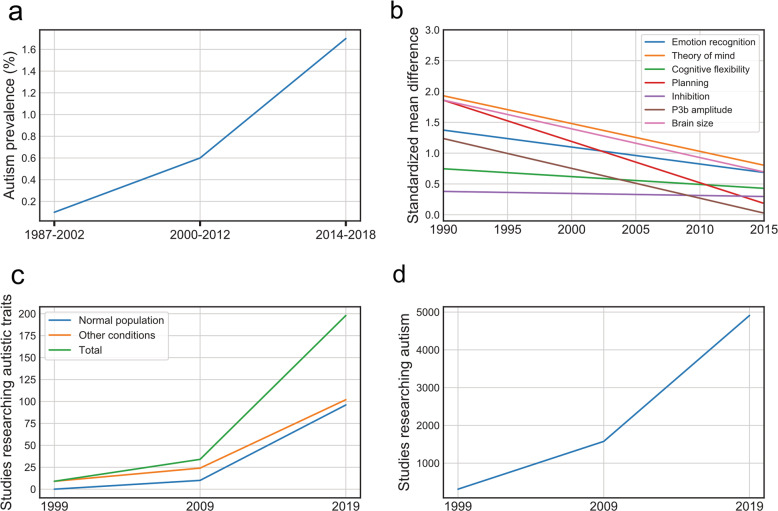
The current diagnostic practices are linked to a 20-fold increase in the reported prevalence of ASD over the last 30 years. Fragmenting the autism phenotype into dimensional “autistic traits” results in the alleged recognition of autism-like symptoms in any psychiatric or neurodevelopemental condition and in individuals decreasingly distant from the typical population, and prematurely dismisses the relevance of a diagnostic threshold. Non-specific socio-communicative and repetitive DSM 5 criteria, combined with four quantitative specifiers as well as all their possible combinations, render limitless variety of presentations consistent with the categorical diagnosis of ASD. We propose several remedies to this problem: maintain a line of research on prototypical autism; limit the heterogeneity compatible with a categorical diagnosis to situations with a phenotypic overlap and a validated etiological link with prototypical autism; reintroduce the qualitative properties of autism presentations and of current dimensional specifiers, language, intelligence, comorbidity, and severity in the criteria used to diagnose autism in replacement of quantitative “social” and “repetitive” criteria; use these qualitative features combined with the clinical intuition of experts and machine-learning algorithms to differentiate coherent subgroups in today’s autism spectrum; study these subgroups separately, and then compare them; and question the autistic nature of “autistic traits”
Overview
The claims and statistics of this paper haven’t been checked yet.
Free: it reads the open-access text and checks the first 5 claims that cite a source we can check. Create a free account to check every claim.
Integrity signals
Registry
Cites
Statistics
Figures
Verification
Claims the paper makes
The claims and statistics of this paper haven’t been checked yet.
Free: it reads the open-access text and checks the first 5 claims that cite a source we can check. Create a free account to check every claim.
Claims other papers make about this one
Each is checked against this paper’s own text: does it say what the citing paper says it does?
The cited source says what the claim attributes to it.
In the citing paper
“Alongside the changes in classification systems, by now heterogeneity has already increased with regard to the expression and severity of the core and associated symptoms of ASD [4–6].”
From Autism spectrum disorder in ICD-11—a critical reflection of its possible impact on clinical practice and research (2024) · cites this paper as [5]
Self-check
Percentages, sums and reported differences re-computed from the paper’s own numbers.
The self-check needs the paper’s full text.
Citations
Cites
Lord, C., Rutter, M., & Le Couteur, A. (1994) · Journal of Autism and Developmental Disorders · doi:10.1007/bf02172145 · Cited by 9,065
Baio, J., Wiggins, L., Christensen, D. L., Maenner, M. J., Daniels, J., Warren, Z., Kurzius-Spencer, M., Zahorodny, W., Robinson, C., Rosenberg, et al. (2018) · MMWR. Surveillance Summaries · doi:10.15585/mmwr.ss6706a1 · Cited by 6,078
Lord, C., Elsabbagh, M., Baird, G., & Veenstra-Vanderweele, J. (2018) · The Lancet · doi:10.1016/s0140-6736(18)31129-2 · Cited by 2,819
Global Prevalence of Autism and Other Pervasive Developmental Disorders
Elsabbagh, M., Divan, G., Koh, Y., Kim, Y. S., Kauchali, S., Marcín, C., Montiel‐Nava, C., Patel, V., Paula, C. S., Wang, C., et al. (2012) · Autism Research · doi:10.1002/aur.239 · Cited by 2,636
Identification of common genetic risk variants for autism spectrum disorder
Autism Spectrum Disorder Working Group of the Psychiatric Genomics Consortium, Grove, J., BUPGEN, Major Depressive Disorder Working Group of the Psychiatric Genomics Consortium, 23andMe Research Team, Ripke, S., Als, T. D., Mattheisen, M., Walters, R. K., Won, H., et al. (2019) · Nature Genetics · doi:10.1038/s41588-019-0344-8 · Cited by 2,421
Lord, C., Rutter, M., Goode, S., Heemsbergen, J., Jordan, H., Mawhood, L., & Schopler, E. (1989) · Journal of Autism and Developmental Disorders · doi:10.1007/bf02211841 · Cited by 2,030
Constantino, J. N., Davis, S. A., Todd, R. D., Schindler, M. K., Gross, M. M., Brophy, S. L., Metzger, L. M., Shoushtari, C. S., Splinter, R., & Reich, W. (2003) · Journal of Autism and Developmental Disorders · doi:10.1023/a:1025014929212 · Cited by 1,611 · cited 2×
“The concept of an autistic trait and the demonstration that “autistic traits are continuously distributed throughout the general population [34]” through instruments such as the Autism Screening Questionnaire [35] and Social Responsiveness Scale [36] has led to the flowering of multiple studies associating autistic tr…”
BackgroundAutism screening questionnaire: diagnostic validity
Berument, S. K., Rutter, M., Lord, C., Pickles, A., & Bailey, A. (1999) · British Journal of Psychiatry · doi:10.1192/bjp.175.5.444 · Cited by 1,464 · cited 2×
“The concept of an autistic trait and the demonstration that “autistic traits are continuously distributed throughout the general population [34]” through instruments such as the Autism Screening Questionnaire [35] and Social Responsiveness Scale [36] has led to the flowering of multiple studies associating autistic tr…”
Building better biomarkers: brain models in translational neuroimaging
Woo, C.-W., Chang, L. J., Lindquist, M. A., & Wager, T. D. (2017) · Nature Neuroscience · doi:10.1038/nn.4478 · Cited by 1,056
Machine Learning for Precision Psychiatry: Opportunities and Challenges
Bzdok, D., & Meyer-Lindenberg, A. (2018) · Biological Psychiatry: Cognitive Neuroscience and Neuroimaging · doi:10.1016/j.bpsc.2017.11.007 · Cited by 796
Self-citation
Cited by
Items 401–431 of 431
Orderly chaos: social defeat as a risk factor for psychosis in autism
Schalbroeck, R. (2021) · Research Publications (Maastricht University) · doi:10.26481/dis.20211105rs
Vernocchi, P., Marangelo, C., Guerrera, S., Chierico, F. D., Guarrasi, V., Gardini, S., Conte, F., Paci, P., Ianiro, G., Gasbarrini, A., et al. (2023) · doi:10.3389/fmicb.2023.1287350.s008
Vernocchi, P., Marangelo, C., Guerrera, S., Chierico, F. D., Guarrasi, V., Gardini, S., Conte, F., Paci, P., Ianiro, G., Gasbarrini, A., et al. (2023) · doi:10.3389/fmicb.2023.1287350.s004
Mapping Autism-Relevant Individual Differences With A Dynamic Decision-Making Task
Knep, E. (2026) · University of Minnesota Digital Conservancy (University of Minnesota)
Assessing Hypersensitivity to Difference in Autistic and Non-Autistic Adults
Christophi, S. (2024) · University of Hertfordshire Research Archive (University of Hertfordshire) · doi:10.18745/th.27765
Structural Genome Variations Associated with Autism Spectrum Disorders (ASD), A Case Report
Tous-Barrios, K., Atencia, J. D., García, R. J., & GuerreroRoman, M. (2022) · International Journal of Science and Research (IJSR) · doi:10.21275/sr22204100444
Autism as a Dynamic Construct: Potential Implications for the Future of Life with Autism
Vital, P. (2026) · Advances in Social Science, Education and Humanities Research/Advances in social science, education and humanities research · doi:10.2991/978-2-38476-555-3_10
Tynan, R. (2024) · UEA Digital Repository (University of East Anglia)
Recomendación de atención en optometría para pacientes con trastornos del espectro autista
García, D. S. N., Camelo, K. N. C., & Borda, M. C. S. (2026) · Repositorio Institucional Universidad de La Salle
Takii, F. A., Kertscher, I., Souza, R. F. D., Pegoraro, N. B., Tizzot, M. R., de Oliveira, J. C., Eulálio, M. W. F., Ribas, M. M., & Mikami, L. R. (2025) · BioSCIENCE · doi:10.55684/2025.83.s2.e00009
Jiménez-Marín, A. (2024) · Communities in ADDI (University of the Basque Country)
Hagström Larsson, J. (2023) · DiVA (Linkoping University)
Vuijk, R. (2022) · UvA-DARE (University of Amsterdam)
Facilitating replicability in dyslexia research and beyond
Leung, Y. (2026) · Electronic Theses of LMU Munich (Ludwig-Maximilians-Universität München) · doi:10.5282/edoc.37845
Filosofía de la Ciencia por Jóvenes Investigadores vol. 3
Fissore, M. G., Moreno, F. E., Paez Sueldo, B., & Schilling, M. (2023) · Repositorio Digital de la UNC (National University of Cordoba)
Khan, T. I., Babur, M., Shahbaz, A., Sadaf, A., Asmat, A., & Rana, E. (2025) · Insights-Journal of Health and Rehabilitation · doi:10.71000/9mze7854
Effects of Aided Augmented Input on Autism Spectrum Disorder: A Scoping Review
Díaz, A. J. Z., Figueira, A. P. C., & REINA, M. C. (2026) · Psicologia · doi:10.17575/psicologia.2015
Cognitive Science Society 2023, Gineste, Y., Honda, M., Iwamoto, M., Kato, T., Nakazawa, A., & Yoshikawa, S. (2023) · eScholarship (California Digital Library) · doi:10.48448/h05x-a244
Autism and Psychosis in the 21st Century: Beyond Diagnostic Labels
Crespo‐Facorro, B. (2025) · ANALES RANM · doi:10.32440/ar.2025.142.02.ed01
Paquette-Houde, C. (2022) · Papyrus : Institutional Repository (Université de Montréal) · doi:10.71781/29037
1-NN learning on Hanan setsPreprint
Śliwiński, P., Wachel, P., & Rozenblit, J. W. (2022) · doi:10.36227/techrxiv.19561321.v1
1-NN learning on Hanan setsPreprint
Śliwiński, P., Wachel, P., & Rozenblit, J. W. (2022) · doi:10.36227/techrxiv.19561321
Trastornos del espectro autista. Caso clínico
de la Torre, M. F. M. G., & Valencia, J. F. T. (2022) · Revista Arbitrada Interdisciplinaria de Ciencias de la Salud Salud y Vida · doi:10.35381/s.v.v6i1.1717
Diagnosis and Pathogenic Analysis of Autism Spectrum Disorder Using Fused Brain Connection GraphPreprint
Lu, W., Huang, Y., Yin, G., Zhang, F., Zhang, M., & Liu, B. (2024) · arXiv (Cornell University) · doi:10.48550/arxiv.2410.07138
Gutiérrez, D. L. T., Lucas-Rincón, S. E., Carsi-Mendoza, D., Márquez-Rodríguez, S., Mendoza-Rodríguez, M., Veras-Hernández, M. A., Navarrete-Hernández, J. D. J., Robles-Bermeo, N. L., & Medina‐Solís, C. E. (2024) · Odontología · doi:10.29166/odontologia.vol26.n2.2024-e6748
Triana, N. O., Emeterio, M. Á. V. S., Ruiz, R. A. A., & Ocón, M. S. D. J. (2026) · Retos · doi:10.47197/retos.v74.117920
Campos, J. M. B. (2024) · LA Referencia (Red Federada de Repositorios Institucionales de Publicaciones Científicas)
Ramsden, A. P. (2026) · O2 - Repositori Institucional (Universitat Oberta de Catalunya)
Task‐Related Aperiodic EEG (1/f) Activity in Autism
Matyjek, M., Soto‐Faraco, S., Álvarez-Martín, C., & Cuello, M. T. (2026) · Autism Research · doi:10.1002/aur.70314
Bezzih, H., Darweesh, M., & Gawanmeh, A. (2026) · IAES International Journal of Artificial Intelligence · doi:10.11591/ijai.v15.i4.pp3164-3175
Psychophysiological Markers of the Broader Autism Phenotype in Emotion Recognition
Ronzhin, D. V., & Polevaya, S. A. (2026) · Opera medica et physiologica · doi:10.24412/2500-2295-2026-3-191-200
Metadata
- Authors
- Mottron, L., & Bzdok, D.
- Affiliations
- Santé Québec Centre-Sud-de-l’Île-de-Montréal – Universitaire (CA)
- Montreal Neurological Institute and Hospital (CA)
- Corresponding author
- Mottron, Laurent
- Venue
- Molecular Psychiatry
- Published
- 2020-04-30
- Volume
- 25
- Issue
- 12
- Pages
- 3178-3185
- ISSN
- 1359-4184 (ISSN-L)
- 1476-5578
- PMC
- PMC7714694
- OpenAlex
- W3022866684
- Cited by
- 332
- References
- 66
- Citations by year
- 2026: 44 · 2025: 63 · 2024: 40 · 2023: 78 · 2022: 45 · 2021: 46 · 2020: 15
- FWCI
- 6.22
- Type
- journal article
- Language
- en
- Open access
- hybrid
- doi.org
- Licence
- cc-by
- creativecommons.org/licenses/by/4.0 (tdm)
- creativecommons.org/licenses/by/4.0 (vor)
- Locations
- Molecular Psychiatry (publishedVersion, cc-by)
- PubMed Central (publishedVersion, cc-by)
- PubMed (publishedVersion)
- Topics
- Life Sciences › Neuroscience › Cognitive Neuroscience › Autism Spectrum Disorder Research
- Health Sciences › Medicine › Psychiatry and Mental health › Child Nutrition and Feeding Issues
- Life Sciences › Biochemistry, Genetics and Molecular Biology › Genetics › Genetics and Neurodevelopmental Disorders
- Keywords
- autism spectrum disorder, autism heterogeneity, autistic traits, diagnostic criteria, DSM-5, categorical diagnosis, autism subgroups, phenotypic overlap, language and intelligence, comorbidities, autism severity, machine learning
- MeSH terms
- Autism Spectrum Disorder, Autistic Disorder, Child, Child Development Disorders, Pervasive, Humans, Comorbidity, Artifacts, Diagnostic and Statistical Manual of Mental Disorders
About these checks
Registry, retraction, Cites and statistics results are computed, not judged, with one exception: a printed reference that no index lists is read once by a model before it counts as a citation error. Claims are extracted by a model and kept only when their quote appears verbatim in the text; each cited source is then checked, with a model’s help, for whether it says what the claim relies on. Those verdicts can be wrong — read the claim’s quote and the cited source before relying on one.
Statistics and arithmetic are recomputed, not judged.
Confidence bands are shown only for fields calibrated on our annotated test set. None is calibrated yet, so no band is shown.
What counts as a claim ›How we measure confidence ›How we check this ›
Are you an author, or do you see a problem with this page? Request a review
Data sources
Bibliographic data: Semantic Scholar, OpenAlex, Crossref.
Contains information from the Semantic Scholar Academic Graph Datasets, made available under the ODC Attribution License (ODC-BY 1.0).
Semantic Scholar’s data is described in: Kinney, R., et al. (2023). The Semantic Scholar Open Data Platform. arXiv:2301.10140.
