

Discontinuation of antidepressants after remission with antidepressant medication in major depressive disorder: a systematic review and meta-analysis
Open accessThe DOI matches its Crossref record; 66 of the 68 references it cites were found in a registry or an index; 6 of the 14 sources its claims cite were checked for support.
Abstract
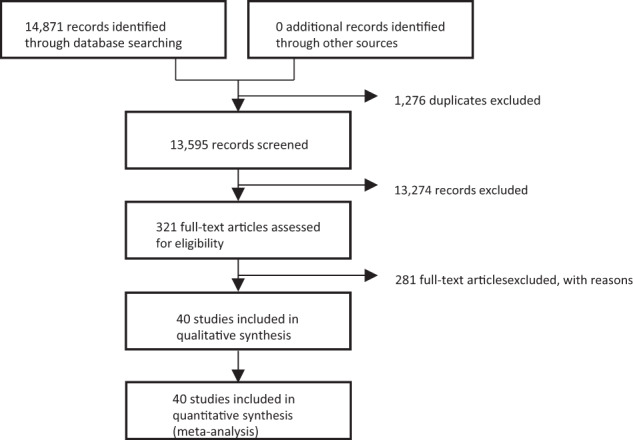
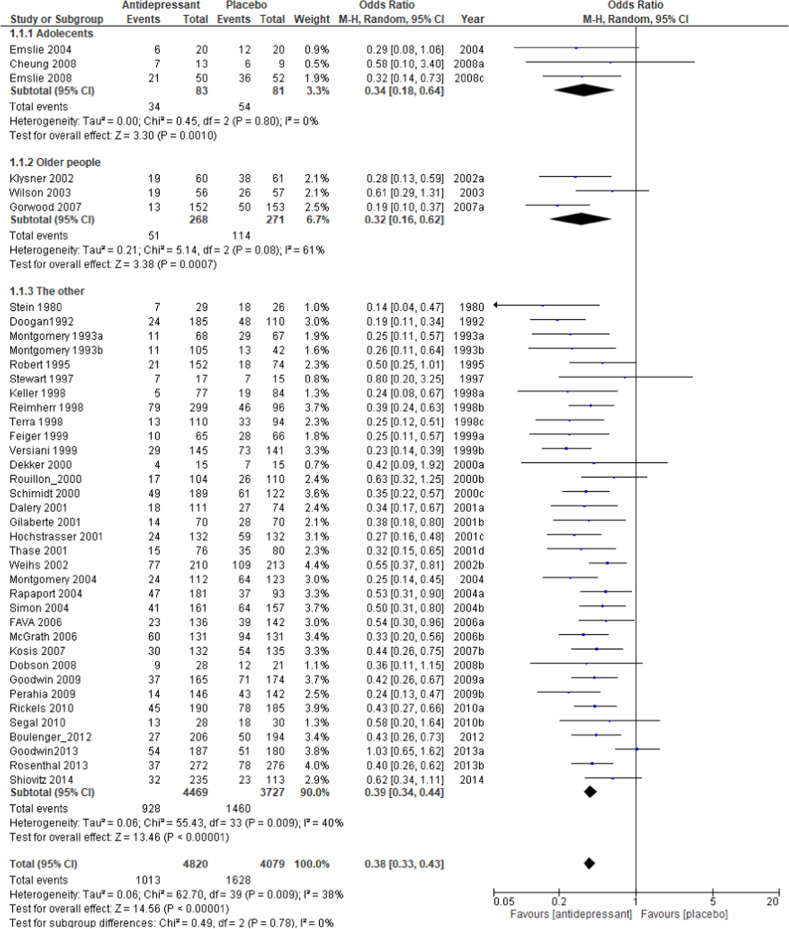
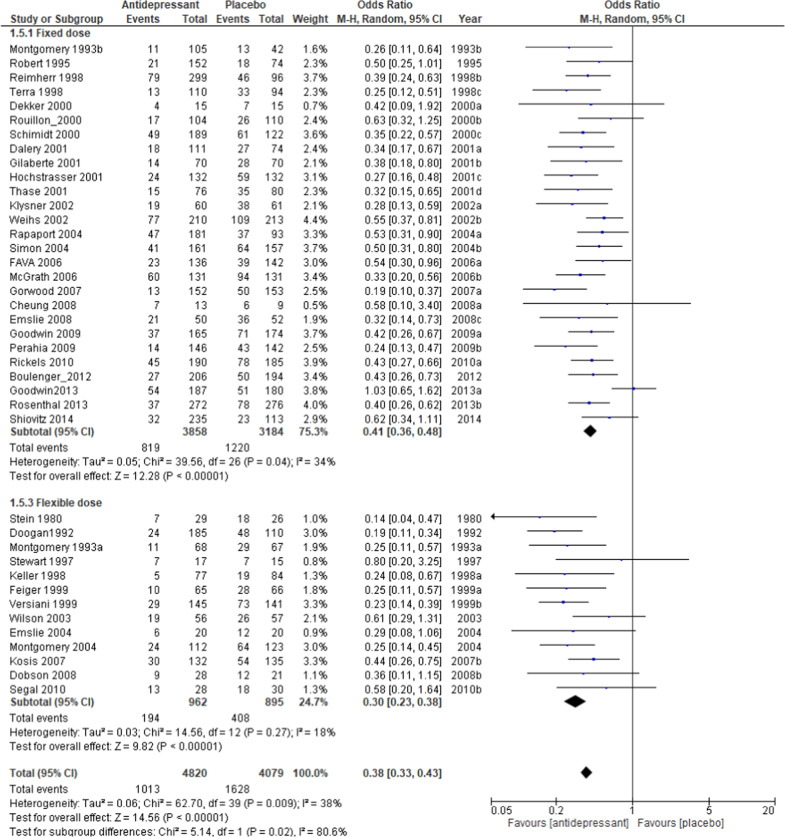
A significant clinical issue encountered after a successful acute major depressive disorder (MDD) treatment is the relapse of depressive symptoms. Although continuing maintenance therapy with antidepressants is generally recommended, there is no established protocol on whether or not it is necessary to prescribe the antidepressant used to achieve remission. In this meta-analysis, the risk of relapse and treatment failure when either continuing with the same drug used to achieved remission or switching to a placebo was assessed in several clinically significant subgroups. The pooled odds ratio (OR) (±95% confidence intervals (CI)) was calculated using a random effects model. Across 40 studies (n = 8890), the relapse rate was significantly lower in the antidepressant group than the placebo group by about 20% (OR = 0.38, CI: 0.33–0.43, p < 0.00001; 20.9% vs 39.7%). The difference in the relapse rate between the antidepressant and placebo groups was greater for tricyclics (25.3%; OR = 0.30, CI: 0.17–0.50, p < 0.00001), SSRIs (21.8%; OR = 0.33, CI: 0.28–0.38, p < 0.00001), and other newer agents (16.0%; OR = 0.44, CI: 0.36–0.54, p < 0.00001) in that order, while the effect size of acceptability was greater for SSRIs than for other antidepressants. A flexible dose schedule (OR = 0.30, CI: 0.23–0.48, p < 0.00001) had a greater effect size than a fixed dose (OR = 0.41, CI: 0.36–0.48, p < 0.00001) in comparison to placebo. Even in studies assigned after continuous treatment for more than 6 months after remission, the continued use of antidepressants had a lower relapse rate than the use of a placebo (OR = 0.40, CI: 0.29–0.55, p < 0.00001; 20.2% vs 37.2%). The difference in relapse rate was similar from a maintenance period of 6 months (OR = 0.41, CI: 0.35–0.48, p < 0.00001; 19.6% vs 37.6%) to over 1 year (OR = 0.35, CI: 0.29–0.41, p < 0.00001; 19.9% vs 39.8%). The all-cause dropout of antidepressant and placebo groups was 43% and 58%, respectively, (OR = 0.47, CI: 0.40–0.55, p < 0.00001). The tolerability rate was ~4% for both groups. The rate of relapse (OR = 0.32, CI: 0.18–0.64, p = 0.0010, 41.0% vs 66.7%) and all-cause dropout among adolescents was higher than in adults. To prevent relapse and treatment failure, maintenance therapy, and careful attention for at least 6 months after remission is recommended. SSRIs are well-balanced agents, and flexible dose adjustments are more effective for relapse prevention.
Overview
CoChat Summary
TL;DR
This systematic review and meta-analysis of 40 double-blind RCTs (n = 8,890) found that continuing the same antidepressant after remission in major depressive disorder reduced relapse and all-cause dropout versus switching to placebo. The benefit was seen overall and across many subgroups, with no significant difference in tolerability.
Key findings
- Across 40 studies (n = 8,890), relapse was lower with continued antidepressant treatment than placebo: 20.9% vs 39.7%, pooled OR 0.38 (95% CI 0.33–0.43; NNT = 6).
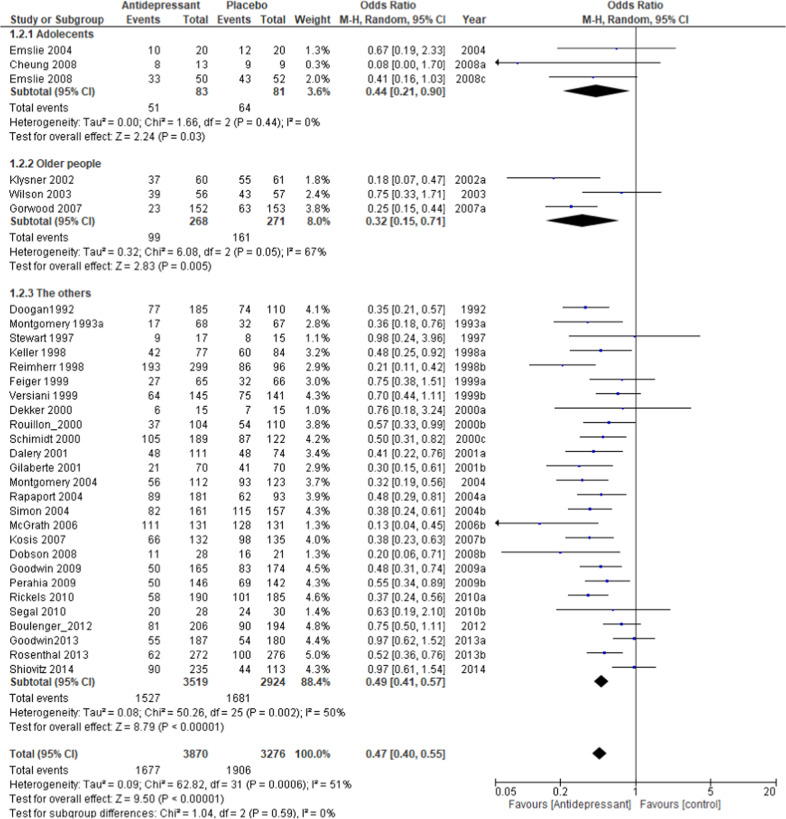
- All-cause dropout was also lower with antidepressant continuation in 32 studies (n = 7,146): 43.3% vs 58.2%, pooled OR 0.47 (95% CI 0.40–0.55; NNT = 7).
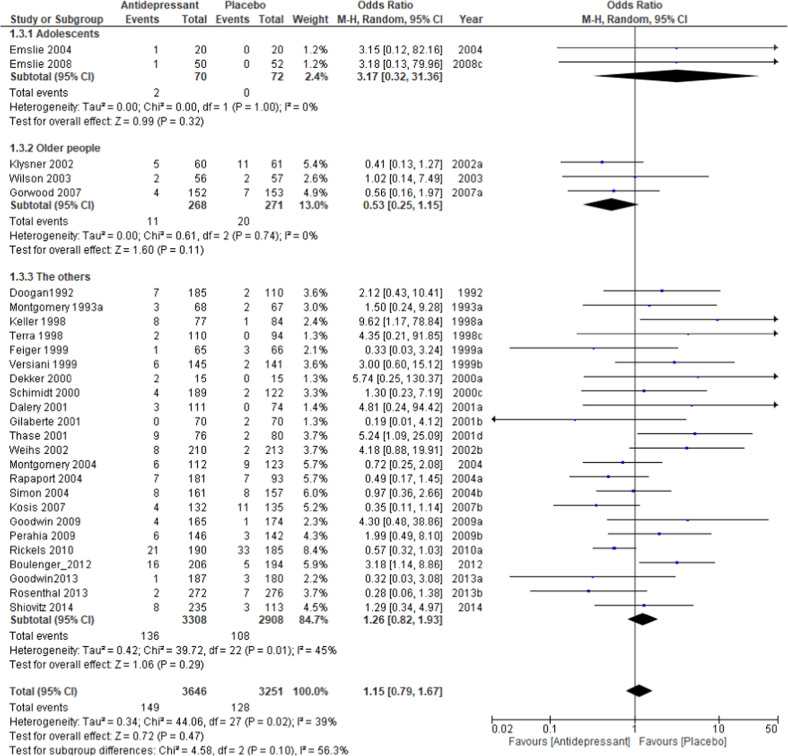
- Tolerability did not differ significantly in 28 studies (n = 6,897): 4.1% vs 3.9%, pooled OR 1.15 (95% CI 0.79–1.67).
- Subgroup results reported stronger relapse-prevention effects for tricyclics (25.3% difference; OR 0.30), SSRIs (21.8%; OR 0.33), and other newer agents (16.0%; OR 0.44); flexible dosing showed a larger effect than fixed dosing (OR 0.30 vs 0.41).
Methods
- Systematic review and meta-analysis of double-blind randomized controlled discontinuation trials (“enrichment design”) in patients with MDD who had remitted on antidepressant treatment; studies with ≥12 weeks after randomization were eligible.
- Searches covered CENTRAL (to June 14, 2018), MEDLINE (to June 12, 2018), and EMBASE (to October 10, 2018); 40 studies met inclusion criteria.
- Main analysis used random-effects pairwise meta-analysis comparing continued antidepressant vs placebo, with odds ratios, risk differences, NNT, plus meta-regression and subgroup analyses.
Limitations
- The paper states that several relapse-risk factors could not be assessed because too few RCTs reported them, including number/severity/chronicity of episodes, difficult-to-treat episodes, comorbid psychiatric conditions, pre-existing medical conditions, and residual symptoms.
- The authors note a potential favorable bias from enrichment designs because only responders to acute treatment were randomized; this is an explicit limitation in the paper.
- The paper states that pharmacologic withdrawal effects could not be fully evaluated because relapse/dropout in the short 4–8 week period could not be assessed.
- The text also makes evident that relapse definitions varied across studies, which the authors say made subgroup analysis difficult.
Model-written summary. Check it against the paper before relying on it.
Integrity signals
Registry
Cites
Statistics
Figures
Verification
Claims the paper makes
5 Valid · 0 Not valid · 6 Not checked · 66 Own results and interpretations
The cited sources support only part of this claim — read each source’s verdict below.
In the paper
“Sim et al. included various types of maintenance therapy such as antidepressant monotherapy, polypharmacy, combination therapy (e.g., antidepressants plus psychotherapy, electroconvulsive therapy, and lithium) regardless of whether a study continued the same antidepressant used for acute treatment in the maintenance phase or switched to a new one.”
§ Discontinuation of antidepressants after remission with antidepressant medication in major depressive disorder: a systematic review and meta-analysis > Discussion
What the sources say
- Partly supportedcites [12] Sim K Lau WK Sim J Sum MY Baldessarini RJ Prevention of relapse and recurrence in adults with major depressive disorder: systematic review and meta-analyses of controlled trials Int J Neuropsychopharmacol 2015 19 1 13 PMC4772815 26152228 sourceExperimental — accuracy not yet measured
The Results tables (pages not provided) include antidepressant monotherapy and combinations with lithium, psychotherapy, and ECT; the Methods inclusion criteria also allow pharmacological and non-pharmacological treatments. However, the paper does not establish that studies switching to a new antidepressant after acute treatment were included, or explicitly state that switching was irrelevant to inclusion. (LLM, conf=0.85)
plain- Asserted: passes — The authors put it forward as true.
- Checkable: passes — It can be checked against evidence.
- Load-bearing: unclear — It is unclear whether the paper’s conclusions depend on it.
- Based: passes — The paper gives a reason why it holds.
- Partly supported
The cited sources support only part of this claim — read each source’s verdict below.
In the paper
“Moreover, they used the data from Borges et al.’s study which risks the possibility of duplicate analysis.”
§ Discontinuation of antidepressants after remission with antidepressant medication in major depressive disorder: a systematic review and meta-analysis > Discussion
What the sources say
- Partly supportedcites [12] Sim K Lau WK Sim J Sum MY Baldessarini RJ Prevention of relapse and recurrence in adults with major depressive disorder: systematic review and meta-analyses of controlled trials Int J Neuropsychopharmacol 2015 19 1 13 PMC4772815 26152228 sourceExperimental — accuracy not yet measured
The Results table under Continuation Trials of Antidepressants lists multiple Borges et al. (2014) comparisons in the pooled analysis, supporting that Sim et al. used data reported by Borges et al. The paper does not say that those comparisons duplicate data or identify a resulting risk of duplicate analysis; that is the citing authors’ inference. Page numbers are unavailable in our copy. (LLM, conf=0.84)
- Not checked — no full text of the sourcecites [11] Borges S Chen YF Laughren TP Temple R Patel HD David PA Review of maintenance trials for major depressive disorder: a 25-year perspective from the US Food and Drug Administration J Clin Psychiatry 2014 75 205 14 10.4088/JCP.13r08722 24717376 source
hedgedstates a possible cause- Asserted: passes — The authors put it forward as true.
- Checkable: passes — It can be checked against evidence.
- Load-bearing: passes — The paper’s conclusions depend on it.
- Based: passes — The paper gives a reason why it holds.
- Partly supported
The cited sources support only part of this claim — read each source’s verdict below.
In the paper
“In fact, a meta-analysis by Sim et al. showed that 6 of the 15 studies submitted to the FDA by Borges et al. had the same number of subjects as the other published studies included in their meta-analysis.”
§ Discontinuation of antidepressants after remission with antidepressant medication in major depressive disorder: a systematic review and meta-analysis > Discussion
What the sources say
- Partly supportedcites [12] Sim K Lau WK Sim J Sum MY Baldessarini RJ Prevention of relapse and recurrence in adults with major depressive disorder: systematic review and meta-analyses of controlled trials Int J Neuropsychopharmacol 2015 19 1 13 PMC4772815 26152228 sourceExperimental — accuracy not yet measured
Table 1 in Results > Continuation Trials of Antidepressants lists 15 comparisons attributed to Borges et al. (2014), and several have the same subject counts as separately listed published trials. The passages establish matching counts for at least five Borges entries, but do not establish the asserted total of six or explicitly say that Sim et al. identified six matches. Page numbers were not available in our copy. (LLM, conf=0.76)
- Not checked — no full text of the sourcecites [11] Borges S Chen YF Laughren TP Temple R Patel HD David PA Review of maintenance trials for major depressive disorder: a 25-year perspective from the US Food and Drug Administration J Clin Psychiatry 2014 75 205 14 10.4088/JCP.13r08722 24717376 source
plain- Asserted: passes — The authors put it forward as true.
- Checkable: passes — It can be checked against evidence.
- Load-bearing: passes — The paper’s conclusions depend on it.
- Based: passes — The paper gives a reason why it holds.
- Partly supported
A result the paper reports from its own data — it cites no other source for it, so there is none to check. The quote shows it is in the paper.
In the paper
“The difference in the relapse rate between the antidepressant and placebo groups was 25.3% (N = 4, n = 403, OR = 0.30, p < 0.00001) for classical antidepressants”
§ Discontinuation of antidepressants after remission with antidepressant medication in major depressive disorder: a systematic review and meta-analysis > Results > Meta-regression and subgroup analyses
plainn = 403 ·- Asserted: passes — The authors put it forward as true.
- Checkable: passes — It can be checked against evidence.
- Load-bearing: unclear — It is unclear whether the paper’s conclusions depend on it.
- Based: passes — The paper gives a reason why it holds.
A result the paper reports from its own data — it cites no other source for it, so there is none to check. The quote shows it is in the paper.
In the paper
“17.1% (N = 27, n = 7042, OR = 0.41, p < 0.00001) in the fixed dose setting”
§ Discontinuation of antidepressants after remission with antidepressant medication in major depressive disorder: a systematic review and meta-analysis > Results > Meta-regression and subgroup analyses
plainstates an associationn = 7,042 ·- Asserted: passes — The authors put it forward as true.
- Checkable: passes — It can be checked against evidence.
- Load-bearing: unclear — It is unclear whether the paper’s conclusions depend on it.
- Based: passes — The paper gives a reason why it holds.
41 more claims
Create a free account to see all 77 claims and every source verdict.
- Probably not a substantial claim. 8
- It may state two separate claims as one. 25
- The quote only partly states this claim. 2
Claims other papers make about this one
Each is checked against this paper’s own text: does it say what the citing paper says it does?
The cited source doesn’t support the claim as written.
In the citing paper
“Thus, the differences in relapse rates between individuals with MDD who continued antidepressants that were effective during acute treatment and those who discontinued the antidepressants are still unclear.”
From Relapse and its modifiers in major depressive disorder after antidepressant discontinuation: meta-analysis and meta-regression (2023) · cites this paper as [1]
Checked by a reasoning model — may be wrong.
Experimental — accuracy not yet measuredThe source backs part of the claim, not all of it — or backs it for a different population, condition or comparison.
In the citing paper
“Studies indicate that between one-fifth to one-half of patients in remission from a depressive episode will suffer a recurrence within 2 years.4–10”
Experimental — accuracy not yet measuredThe source backs part of the claim, not all of it — or backs it for a different population, condition or comparison.
In the citing paper
“However, numerous high-quality studies show that treatment effects wane and that the risk of relapse ranges from 29% to 51% in the first year after treatment completion 2-4 .”
From ChatGPT: five priorities for research (2023) · cites this paper as [3]
Experimental — accuracy not yet measuredThe cited source says what the claim attributes to it.
In the citing paper
“we found a significantly lower all-cause discontinuation rate (Fig. S9) in the maintenance group than in the discontinuation group”
From Relapse and its modifiers in major depressive disorder after antidepressant discontinuation: meta-analysis and meta-regression (2023) · cites this paper as [1]
The cited source says what the claim attributes to it.
In the citing paper
“According to this meta-analysis, the antidepressant maintenance group had a significantly lower relapse rate than the antidepressant discontinuation group (odds ratio = 0.38, 95% confidence interval = 0.33–0.43, p < 0.00001).”
From Antidepressants for the treatment of adults with major depressive disorder in the maintenance phase: a systematic review and network meta-analysis (2023) · cites this paper as [7]
7 more claims about this paper
Create a free account to see every claim other papers make about this one.
Citations
Cites
Bias in meta-analysis detected by a simple, graphical test
Egger, M., Smith, G. D., Schneider, M., & Minder, C. (1997) · BMJ · doi:10.1136/bmj.315.7109.629 · Cited by 56,722 · cited 1×
“No publication bias was presented in the present study by Egger’s analysis [60].”
Research Diagnostic Criteria: Rationale and Reliability
Spitzer, R. L. (1978) · Archives of General Psychiatry · doi:10.1001/archpsyc.1978.01770300115013 · Cited by 6,951
Diagnostic Criteria for Use in Psychiatric Research
Feighner, J. P. (1972) · Archives of General Psychiatry · doi:10.1001/archpsyc.1972.01750190059011 · Cited by 5,715
International Classification of Diseases
Jones, F. A. (1978) · Gut · doi:10.1136/gut.19.12.1175 · Cited by 2,911
Frank, E. (1991) · Archives of General Psychiatry · doi:10.1001/archpsyc.1991.01810330075011 · Cited by 1,959
The American Psychiatric Association (APA)
Strentz, T. (2017) · Psychological Aspects of Crisis Negotiation · doi:10.1201/9781315150581-3 · Cited by 1,850
Kennedy, S. H., Lam, R. W., McIntyre, R. S., Tourjman, S. V., Bhat, V., Blier, P., Hasnain, M., Jollant, F., Levitt, A. J., MacQueen, G. M., et al. (2016) · The Canadian Journal of Psychiatry · doi:10.1177/0706743716659417 · Cited by 1,181 · cited 9×
“In general, recurrent episodes, duration of maintenance period after reaching remission, subject age, type of antidepressant, dosing schedule, and discontinuation method are considered to be risk factors of relapse [9].”
InfluentialJudd, L. L., Akiskal, H. S., Maser, J. D., Zeller, P. J., Endicott, J., Coryell, W., Paulus, M. P., Kunovac, J. L., Leon, A. C., Mueller, T. I., et al. (1998) · Journal of Affective Disorders · doi:10.1016/s0165-0327(98)00138-4 · Cited by 590
Dobson, K. S., Hollon, S. D., Dimidjian, S., Schmaling, K. B., Kohlenberg, R. J., Gallop, R. J., Rizvi, S. L., Gollan, J. K., Dunner, D. L., & Jacobson, N. S. (2008) · Journal of Consulting and Clinical Psychology · doi:10.1037/0022-006x.76.3.468 · Cited by 560
Segal, Z. V., Bieling, P., Young, T., MacQueen, G., Cooke, R., Martin, L., Bloch, R., & Levitan, R. D. (2010) · Archives of General Psychiatry · doi:10.1001/archgenpsychiatry.2010.168 · Cited by 429
Major Depressive Disorder Treatment Guidelines in America and Europe
Davidson, J. R. T. (2010) · The Journal of Clinical Psychiatry · doi:10.4088/jcp.9058se1c.04gry · Cited by 344
Goodwin, G. M., Emsley, R., Rembry, S., Rouillon, F., & the Agomelatine Study Group (2009) · The Journal of Clinical Psychiatry · doi:10.4088/jcp.08m04548 · Cited by 340
Sertraline in the Prevention of Depression
Doogan, D. P., & Caillard, V. (1992) · British Journal of Psychiatry · doi:10.1192/bjp.160.2.217 · Cited by 245
Sim, K., Lau, W. K., Sim, J., Sum, M. Y., & Baldessarini, R. J. (2016) · International Journal of Neuropsychopharmacology · doi:10.1093/ijnp/pyv076 · Cited by 218 · cited 2×
“There are two other meta-analyses conducted recently [4, 12], but they included various interventions and pooled heterogeneous designs together without considerations to it.”
Reimherr, F. W., Amsterdam, J. D., Quitkin, F. M., Rosenbaum, J. F., Fava, M., Zajecka, J., Beasley, Jr., Michelson, D., Roback, P., & Sundell, K. (1998) · American Journal of Psychiatry · doi:10.1176/ajp.155.9.1247 · Cited by 204
Paroxetine is better than placebo in relapse prevention and the prophylaxis of recurrent depression
Montgomery, S. A., & Dunbar, G. (1993) · International Clinical Psychopharmacology · doi:10.1097/00004850-199300830-00009 · Cited by 188
Fluoxetine versus placebo in preventing relapse of major depression in children and adolescents
Emslie, G. J., Kennard, B. D., Mayes, T. L., Nightingale-Teresi, J., Carmody, T., Hughes, C. W., Rush, A. J., Tao, R., & Rintelmann, J. W. (2008) · American Journal of Psychiatry · doi:10.1176/appi.ajp.2007.07091453 · Cited by 188
Keller, M. B. (1998) · JAMA · doi:10.1001/jama.280.19.1665 · Cited by 184
Hansen, R., Gaynes, B., Thieda, P., Gartlehner, G., Deveaugh-Geiss, A., Krebs, E., & Lohr, K. (2008) · Psychiatric Services · doi:10.1176/ps.2008.59.10.1121 · Cited by 172
Montgomery, S. A., Rasmussen, J. G. C., & Tanghøj, P. (1993) · International Clinical Psychopharmacology · doi:10.1097/00004850-199300830-00008 · Cited by 163 · cited 1×
“The mean age of the participants in the studies included was 43.1 years (range 11.5–76.8, SD 12.5) except for studies by Doogan et al. [21] and Montgomery et al. 1993b, in which no average age was stated.”
InfluentialContinuation and maintenance treatments for depression in older people
Wilkinson, P., & Izmeth, Z. (2016) · Cochrane Database of Systematic Reviews · doi:10.1002/14651858.cd006727.pub3 · Cited by 151
Emslie, G. J., Heiligenstein, J. H., HOOG, S. L., Wagner, K. D., Findling, R. L., McCracken, J. T., Nilsson, M., & Jacobson, J. G. (2004) · Journal of the American Academy of Child & Adolescent Psychiatry · doi:10.1097/01.chi.0000140453.89323.57 · Cited by 143
Boulenger, J.-P., Loft, H., & Florea, I. (2012) · Journal of Psychopharmacology · doi:10.1177/0269881112441866 · Cited by 127
Escitalopram continuation treatment prevents relapse of depressive episodes
Rapaport, M. H., Bose, A., & Zheng, H. (2004) · The Journal of Clinical Psychiatry · doi:10.4088/jcp.v65n0107 · Cited by 121
Predictors of Relapse in a Prospective Study of Fluoxetine Treatment of Major Depression
McGrath, P. J., Stewart, J. W., Quitkin, F. M., Chen, Y., Alpert, J. E., Nierenberg, A. A., Fava, M., Cheng, J., & Petkova, E. (2006) · American Journal of Psychiatry · doi:10.1176/ajp.2006.163.9.1542 · Cited by 111
Borges, S., Chen, Y.-F., Laughren, T. P., Temple, R., Patel, H. D., David, P. A., Mathis, M., Unger, E., Yang, P., & Khin, N. A. (2014) · The Journal of Clinical Psychiatry · doi:10.4088/jcp.13r08722 · Cited by 109
Zimmerman, M., Martinez, J. A., Attiullah, N., Friedman, M., Toba, C., Boerescu, D. A., & Rahgeb, M. (2012) · The Journal of Clinical Psychiatry · doi:10.4088/jcp.11m07203 · Cited by 108
Klysner, R., Bent-Hansen, J., Hansen, H. L., Lunde, M., Pleidrup, E., Poulsen, D. L., Andersen, M., & Petersen, H. E. H. (2002) · British Journal of Psychiatry · doi:10.1192/bjp.181.1.29 · Cited by 106
Course and outcome of depressive disorders in primary care: a prospective 18-month study
Vuorilehto, M. S., Melartin, T. K., & Isometsä, E. T. (2009) · Psychological Medicine · doi:10.1017/s0033291709005182 · Cited by 104
Meta-analysis of relapse prevention antidepressant trials in depressive disorders
Glue, P., Donovan, M. R., Kolluri, S., & Emir, B. (2010) · Australian & New Zealand Journal of Psychiatry · doi:10.3109/00048671003705441 · Cited by 100
Escitalopram Prevents Relapse in Older Patients With Major Depressive Disorder
Gorwood, P. A. P. M., Weiller, E., Lemming, O. M., & Katona, C. (2007) · American Journal of Geriatric Psychiatry · doi:10.1097/01.jgp.0000240823.94522.4c · Cited by 94
A randomised , double-blind, placebo-controlled study
Norheim, A. J., Pedersen, E. J., Fø, V., & Berge, L. N. (2001) · Cited by 94
Versiani, M., Mehilane, L., Gaszner, P., Arnaud-Castiglioni, R., & The Metrifonate Study Group (1999) · The Journal of Clinical Psychiatry · doi:10.4088/jcp.v60n0610 · Cited by 88
Thase, M. E., Nierenberg, A. A., Keller, M. B., & John Panagides for the Relapse Prevention Study Group (2001) · The Journal of Clinical Psychiatry · doi:10.4088/jcp.v62n1006 · Cited by 85
Robert, P., Montgomery, S. A., Darcourt, G., Robert, G., Houillon, P., Bouchard, J. M., Tatossian, A., Planche, R., Bourgeois, M., Richou, H., et al. (1995) · International Clinical Psychopharmacology · doi:10.1097/00004850-199503001-00006 · Cited by 85
Hochstrasser, B., Isaksen, P. M., Koponen, H., Lauritzen, L., Mahnert, F. A., Rouillon, F., Wade, A. G., Andersen, M., Pedersen, S. F., De Swart, J. C. G., et al. (2001) · British Journal of Psychiatry · doi:10.1192/bjp.178.4.304 · Cited by 85
Deshauer, D., Moher, D., Fergusson, D., Moher, E., Sampson, M., & Grimshaw, J. (2008) · Canadian Medical Association Journal · doi:10.1503/cmaj.071068 · Cited by 78
(1997) · American Journal of Psychiatry · doi:10.1176/ajp.154.1.31 · Cited by 75
Feiger, A. D., Bielski, R. J., Bremner, J., Heiser, J. F., Trivedi, M., Wilcox, C. S., Roberts, D. L., Kensler, T. T., McQuade, R. D., Kaplita, S. B., et al. (1999) · International Clinical Psychopharmacology · doi:10.1097/00004850-199901000-00002 · Cited by 74
Relapse rates with long‐term antidepressant drug therapy: a meta‐analysis
Williams, N., Simpson, A. N., Simpson, K., & Nahas, Z. (2009) · Human Psychopharmacology: Clinical and Experimental · doi:10.1002/hup.1033 · Cited by 74
Wilson, K. C. M., Mottram, P. G., Ashworth, L., & Abou-Saleh, M. T. (2003) · British Journal of Psychiatry · doi:10.1192/bjp.182.6.492 · Cited by 74
Venlafaxine Versus Placebo in the Preventive Treatment of Recurrent Major Depression
Montgomery, S. A., Entsuah, R., Hackett, D., Kunz, N. R., Rudolph, R. L., & Venlafaxine 335 Study Group (2004) · The Journal of Clinical Psychiatry · doi:10.4088/jcp.v65n0307 · Cited by 69
Extended-release venlafaxine in relapse prevention for patients with major depressive disorder
Simon, J. S., Aguiar, L. M., Kunz, N. R., & Lei, D. (2004) · Journal of Psychiatric Research · doi:10.1016/j.jpsychires.2003.10.004 · Cited by 69
Schmidt, M. E., Fava, M., Robinson, J. M., & Judge, R. (2000) · The Journal of Clinical Psychiatry · doi:10.4088/jcp.v61n1107 · Cited by 68
Kocsis, J. H., Thase, M. E., Trivedi, M. H., Shelton, R. C., Kornstein, S. G., Nemeroff, C. B., Friedman, E. S., Gelenberg, A. J., Dunner, D. L., Hirschfeld, R. M. A., et al. (2007) · The Journal of Clinical Psychiatry · doi:10.4088/jcp.v68n0706 · Cited by 67
Terra, J.-L., & Montgomery, S. (1998) · PubMed · Cited by 66
Weihs, K. L., Houser, T. L., Batey, S. R., Ascher, J. A., Bolden-Watson, C., Donahue, R. M. J., & Metz, A. (2002) · Biological Psychiatry · doi:10.1016/s0006-3223(01)01317-8 · Cited by 65
Maintenance therapy with amitriptyline: a controlled trial
Stein, M. K., Rickels, K., & Weise, C. (1980) · American Journal of Psychiatry · doi:10.1176/ajp.137.3.370 · Cited by 65
Fluoxetine in the Prevention of Depressive Recurrences: A Double-Blind Study
Gilaberte, I., Montejo, A. L., de la Gandara, J., Perez-Sola, V., Bernardo, M., Massana, J., Martin-Santos, R., Santiso, A., Noguera, R., Casais, L., et al. (2001) · Journal of Clinical Psychopharmacology · doi:10.1097/00004714-200108000-00009 · Cited by 58
Xu, P., Qiu, Y., Zhang, Y., Yan-ping, B., Xu, P., Liu, Y., Kim, J. H., & Shen, H. (2015) · The International Journal of Neuropsychopharmacology · doi:10.1093/ijnp/pyv120 · Cited by 58
Duration of Initial Antidepressant Treatment and Subsequent Relapse of Major Depression
Baldessarini, R. J., Lau, W. K., Sim, J., Sum, M. Y., & Sim, K. (2015) · Journal of Clinical Psychopharmacology · doi:10.1097/jcp.0000000000000263 · Cited by 52
Terra, J. L., & Montgomery, S. A. (1998) · International Clinical Psychopharmacology · doi:10.1097/00004850-199803000-00001 · Cited by 51
Cox, G. R., Fisher, C. A., De Silva, S., Phelan, M., Akinwale, O. P., Simmons, M. B., & Hetrick, S. E. (2012) · Cochrane Database of Systematic Reviews · doi:10.1002/14651858.cd007504.pub2 · Cited by 48
Milnacipran efficacy in the prevention of recurrent depression: a 12-month placebo-controlled study
Rouillon, F., Warner, B., Pezous, N., & Bisserbe, J. C. (2000) · International Clinical Psychopharmacology · doi:10.1097/00004850-200015030-00002 · Cited by 47
Perahia, D. G. S., Maina, G., Thase, M. E., Spann, M. E., Wang, F., Walker, D. J., & Detke, M. J. (2009) · The Journal of Clinical Psychiatry · doi:10.4088/jcp.08m04756 · Cited by 47
Maintenance study for adolescent depression
Cheung, A., Kusumakar, V., Kutcher, S., Dubo, E., Garland, J., Weiss, M., Kiss, A., & Levitt, A. (2008) · Journal of Child and Adolescent Psychopharmacology · doi:10.1089/cap.2008.0001 · Cited by 44
Management of depression relapse: Re-initiation of duloxetine treatment or dose increase
Fava, M., Detke, M. J., Balestrieri, M., WANG, F., Raskin, J., & David, P. (2006) · Journal of Psychiatric Research · doi:10.1016/j.jpsychires.2005.06.005 · Cited by 39
Rosenthal, J. Z., Boyer, P., Vialet, C., Hwang, E., & Tourian, K. A. (2013) · The Journal of Clinical Psychiatry · doi:10.4088/jcp.12m07974 · Cited by 37
Long-Term Treatment of Depression with Antidepressants: A Systematic Narrative Review
Furukawa, T. A., Cipriani, A., Barbui, C., & Geddes, J. R. (2007) · The Canadian Journal of Psychiatry · doi:10.1177/070674370705200902 · Cited by 33
Rickels, K., Montgomery, S. A., Tourian, K. A., Guelfi, J. D., Pitrosky, B., Padmanabhan, S. K., Germain, J.-M., Leurent, C., & Brisard, C. (2010) · Journal of Clinical Psychopharmacology · doi:10.1097/jcp.0b013e3181c94c4d · Cited by 33
Rationale for, Barriers to, and Appropriate Medication for the Long-Term Treatment of Depression
Nutt, D. J. (2010) · The Journal of Clinical Psychiatry · doi:10.4088/jcp.9058se1c.02gry · Cited by 32 · cited 1×
“Several treatment guidelines recommend that patients with a major depressive episode continue antidepressant therapy for 4 to 9 months after successful acute phase treatment to prevent relapse/recurrence of the episode [7, 8] and up to 2 years or more of maintenance treatment at full therapeutic * Masaki Kato katom@ta…”
Shinohara, K., Efthimiou, O., Ostinelli, E. G., Tomlinson, A., Geddes, J. R., Nierenberg, A. A., Ruhe, H. G., Furukawa, T. A., & Cipriani, A. (2019) · BMJ Open · doi:10.1136/bmjopen-2018-027574 · Cited by 27
Self-citation(2014) · Europe PMC (PubMed Central) · Cited by 24
Goodwin, G. M., Boyer, P., Emsley, R., Rouillon, F., & de Bodinat, C. (2013) · International Clinical Psychopharmacology · doi:10.1097/yic.0b013e32835b0814 · Cited by 20
Daléry, J., Dagens-Lafont, V., & de Bodinat, C. (2001) · Human Psychopharmacology Clinical and Experimental · doi:10.1002/hup.269 · Cited by 17
The use of anti-depressants after recovery from depression
Dekker, J., de Jonghe, F. E. R. E. R., & Tuynman-Qua, H. G. (2000) · The European Journal of Psychiatry · Cited by 11
Research works printed but not linked: 1
- RevMan. Review Manager (RevMan). 5.3 edn. The Nordic Cochrane Centre, The Cochrane Collaboration2014.
Cited by
ChatGPT: five priorities for research
van Dis, E. A. M., Bollen, J., Zuidema, W., van Rooij, R., & Bockting, C. L. (2023) · Nature · doi:10.1038/d41586-023-00288-7 · Cited by 1,842
Time for united action on depression: a Lancet–World Psychiatric Association Commission
Herrman, H., Patel, V., Kieling, C., Berk, M., Buchweitz, C., Cuijpers, P., Furukawa, T. A., Kessler, R. C., Kohrt, B. A., Maj, M., et al. (2022) · The Lancet · doi:10.1016/s0140-6736(21)02141-3 · Cited by 1,104
Lam, R. W., Kennedy, S. H., Adams, C., Bahji, A., Beaulieu, S., Bhat, V., Blier, P., Blumberger, D. M., Brietzke, E., Chakrabarty, T., et al. (2024) · The Canadian Journal of Psychiatry · doi:10.1177/07067437241245384 · Cited by 369
Molecular mechanisms underlying the antidepressant actions of arketamine: beyond the NMDA receptor
Wei, Y., Chang, L., & Hashimoto, K. (2022) · Molecular Psychiatry · doi:10.1038/s41380-021-01121-1 · Cited by 248
“Delayed effects (lag time) and treatment failure through high nonresponse rates are the disadvantages of existing antidepressants such as selective serotonin-reuptake inhibitors and serotonin norepinephrine-reuptake inhibitors [3, 4].”
BackgroundCorrell, C. U., Cortese, S., Croatto, G., Monaco, F., Krinitski, D., Arrondo, G., Ostinelli, E. G., Zangani, C., Fornaro, M., Estradé, A., et al. (2021) · World Psychiatry · doi:10.1002/wps.20881 · Cited by 153
Metadata
- Authors
- Kato, M., Hori, H., Inoue, T., Iga, J., Iwata, M., Inagaki, T., Shinohara, K., Imai, H., Murata, A., Mishima, K., & Tajika, A.
- Affiliations
- Kansai Medical University (JP)
- University of Occupational and Environmental Health Japan (JP)
- Tokyo Medical University (JP)
- Tottori University (JP)
- Shiga University of Medical Science (JP)
- Kyoto University (JP)
- National Center of Neurology and Psychiatry (JP)
- Akita University (JP)
- Kyoto University Hospital (JP)
- Corresponding author
- Kato, Masaki
- ORCID
- Venue
- Molecular Psychiatry
- Published
- 2020-07-23
- Volume
- 26
- Issue
- 1
- Pages
- 118-133
- ISSN
- 1359-4184 (ISSN-L)
- 1476-5578
- PMC
- PMC7815511
- OpenAlex
- W3045212486
- Semantic Scholar
- 154eb58a8b397cff95048198e6f3da00376e54c3
- Cited by
- 152
- References
- 68
- Citations by year
- 2026: 22 · 2025: 29 · 2024: 26 · 2023: 29 · 2022: 29 · 2021: 15 · 2020: 2
- FWCI
- 2.45
- Type
- journal article
- Language
- en
- Open access
- hybrid
- doi.org
- Licence
- cc-by
- creativecommons.org/licenses/by/4.0 (tdm)
- creativecommons.org/licenses/by/4.0 (vor)
- Locations
- Molecular Psychiatry (publishedVersion, cc-by)
- PubMed Central (publishedVersion, cc-by)
- PubMed (publishedVersion)
- Funders
- Health and Labor Science Research Grants
- Topics
- Health Sciences › Medicine › Pharmacology (medical) › Treatment of Major Depression
- Health Sciences › Medicine › Psychiatry and Mental health › Mental Health Treatment and Access
- Social Sciences › Psychology › Experimental and Cognitive Psychology › Anxiety, Depression, Psychometrics, Treatment, Cognitive Processes
- Keywords
- major depressive disorder, antidepressant discontinuation, maintenance therapy, relapse, remission, tricyclic antidepressants, selective serotonin reuptake inhibitors, flexible dosing, treatment acceptability, antidepressant switching, treatment failure, depression recurrence prevention, antidepressant side effects, medication adherence
- MeSH terms
- Antidepressive Agents, Antidepressive Agents, Tricyclic, Depression, Major Depressive Disorder, Humans, Remission Induction, Selective Serotonin Reuptake Inhibitors, Controlled Clinical Trials as Topic
About these checks
Registry, retraction, Cites and statistics results are computed, not judged, with one exception: a printed reference that no index lists is read once by a model before it counts as a citation error. Claims are extracted by a model and kept only when their quote appears verbatim in the text; each cited source is then checked, with a model’s help, for whether it says what the claim relies on. Those verdicts can be wrong — read the claim’s quote and the cited source before relying on one.
The claim verdicts this report counts are experimental: their accuracy is not yet measured.
A language model drew the claims from the paper on 2026-10-02, under version 3 of the claim definition (model deepseek-v4.1-flash, prompt extract-v3).
A second model labelled each claim on 2026-10-02 (model jev-1.13-20260917, definition revision gold-guideline-v0.2).
Cited sources are checked with a language model’s help (gpt-6-sol).
Statistics and arithmetic are recomputed, not judged.
Confidence bands are shown only for fields calibrated on our annotated test set. None is calibrated yet, so no band is shown.
What counts as a claim ›How we measure confidence ›How we check this ›
Are you an author, or do you see a problem with this page? Request a review
Data sources
Bibliographic data: Semantic Scholar, OpenAlex, Crossref.
Contains information from the Semantic Scholar Academic Graph Datasets, made available under the ODC Attribution License (ODC-BY 1.0).
Semantic Scholar’s data is described in: Kinney, R., et al. (2023). The Semantic Scholar Open Data Platform. arXiv:2301.10140.
