

Peripheral blood cellular immunophenotype in depression: a systematic review and meta-analysis
Open accessThe DOI matches its Crossref record; 66 of the 66 references it cites were found in a registry or an index.
Abstract
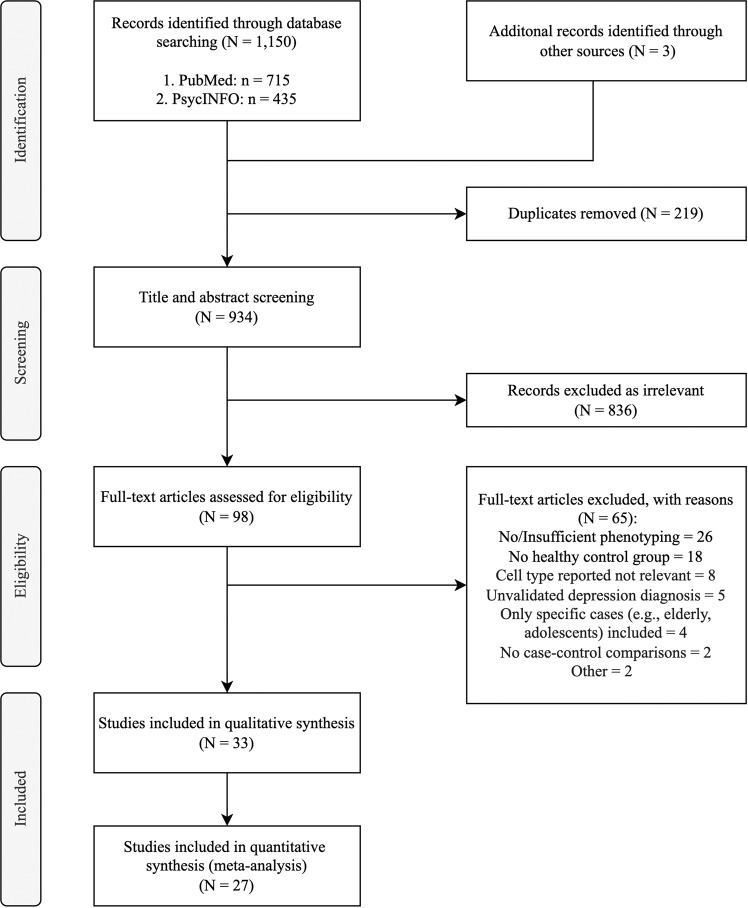
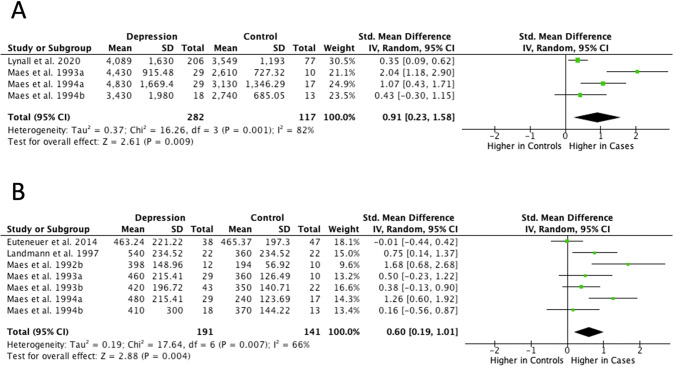
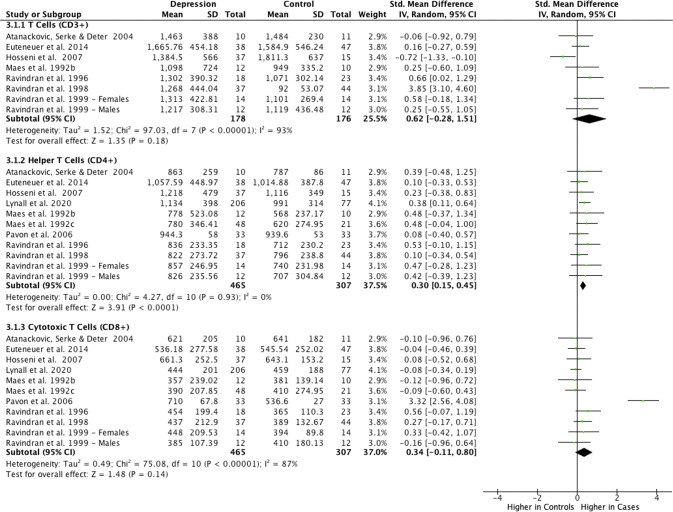
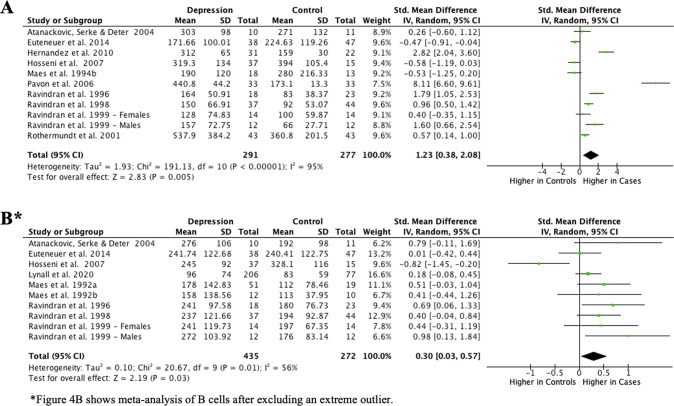
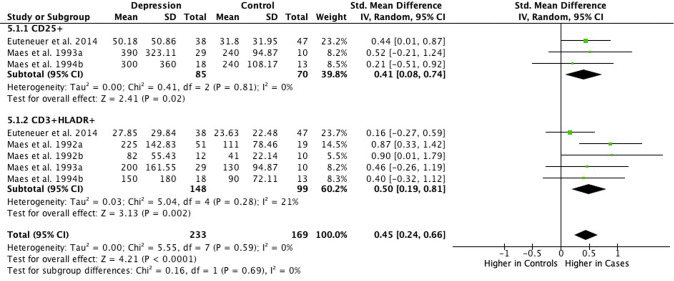
Introduction: Meta-analyses implicate immune dysfunction in depression confirming increased levels of circulating immune proteins (e.g., cytokines) in depression cases compared to controls. White blood cells (WBC) both produce and are influenced by cytokines, and play key roles in orchestrating innate and adaptive immune responses, but their role in depression remains unclear. Therefore, a systematic review of studies of various WBC subsets in depression is required for a greater understanding of the nature of immune dysfunction in this illness. Methods: We searched PubMed and PsycINFO databases (inception to 5 th April 2022) and conducted a systematic review and meta-analysis of identified studies comparing absolute count and/or relative percentage of flow cytometry-derived WBC subsets between depression cases and controls. Selected studies were quality assessed. Random-effect meta-analysis was performed. Results: Thirty-three studies were included and 27 studies ( n = 2277) were meta-analysed. We report an increase in mean absolute counts of WBC (seven studies; standardised mean difference [SMD] = 1.07; 95% CI, 0.61–1.53; P < 0.01; I 2 = 64%), granulocytes (two studies; SMD = 2.07; 95% CI, 1.45–2.68; P < 0.01; I 2 = 0%), neutrophils (four studies; SMD = 0.91; 95% CI, 0.23–1.58; P < 0.01; I 2 = 82%), monocytes (seven studies; SMD = 0.60; 95% CI, 0.19–1.01; P < 0.01; I 2 = 66%), CD4 + helper T cells (11 studies; SMD = 0.30; 95% CI, 0.15–0.45; P < 0.01; I 2 = 0%), natural killer cells (11 studies; SMD = 1.23; 95% CI, 0.38–2.08; P < 0.01; I 2 = 95%), B cells (10 studies; SMD = 0.30; 95% CI, 0.03–0.57; P = 0.03; I 2 = 56%), and activated T cells (eight studies; SMD = 0.45; 95% CI, 0.24–0.66; P < 0.01; I 2 = 0%) in depression, compared to controls. Fewer studies reported relative percentage, indicating increased neutrophils and decreased total lymphocytes, Th1, and Th2 cells in depression. Conclusions: Depression is characterised by widespread alterations in circulating myeloid and lymphoid cells, consistent with dysfunction in both innate and adaptive immunity. Immune cells could be useful biomarkers for illness subtyping and patient stratification in future immunotherapy trials of depression, along with cytokines, other biomarkers, and clinical measures.
Overview
The claims and statistics of this paper haven’t been checked yet.
Free: it reads the open-access text and checks the first 5 claims that cite a source we can check. Create a free account to check every claim.
Integrity signals
Registry
Cites
Statistics
Figures
Verification
Claims the paper makes
The claims and statistics of this paper haven’t been checked yet.
Free: it reads the open-access text and checks the first 5 claims that cite a source we can check. Create a free account to check every claim.
Claims other papers make about this one
Each is checked against this paper’s own text: does it say what the citing paper says it does?
The cited source says what the claim attributes to it.
In the citing paper
“A systematic review and meta-analysis revealed elevated absolute counts of WBC, neutrophils, and monocytes in patients with depression compared to controls 10 .”
From Relative value of novel systemic immune-inflammatory indices and classical hematological parameters in predicting depression, suicide attempts and treatment response (2024) · doi:10.1038/s41598-024-70097-z · cites this paper as [10]
Self-check
Percentages, sums and reported differences re-computed from the paper’s own numbers.
The self-check needs the paper’s full text.
Citations
Cites
Preferred Reporting Items for Systematic Reviews and Meta-Analyses: The PRISMA Statement
Moher, D., Liberati, A., Tetzlaff, J., Altman, D. G., & The PRISMA Group (2009) · PLoS Medicine · doi:10.1371/journal.pmed.1000097 · Cited by 64,042 · cited 1×
“The main outcome measure was absolute cell count and/or relative percentage in depressed cases and controls.”
Preferred reporting items for systematic reviews and meta-analyses: the PRISMA Statement.
(2009) · PubMed Central · Cited by 44,859
Quantifying heterogeneity in a meta‐analysis
Higgins, J. P. T., & Thompson, S. G. (2002) · Statistics in Medicine · doi:10.1002/sim.1186 · Cited by 36,763
Stang, A. (2010) · European Journal of Epidemiology · doi:10.1007/s10654-010-9491-z · Cited by 17,396 · cited 1×
“The methodological quality of each study was assessed using an adapted version of the Newcastle-Ottawa Scale (NOS) for casecontrol studies [22].”
MethodFrom inflammation to sickness and depression: when the immune system subjugates the brain
Dantzer, R., O'Connor, J. C., Freund, G. G., Johnson, R. W., & Kelley, K. W. (2008) · Nature Reviews Neuroscience · doi:10.1038/nrn2297 · Cited by 7,395
How to perform a meta-analysis with R: a practical tutorial
Balduzzi, S., Rücker, G., & Schwarzer, G. (2019) · Evidence Based Mental Health · doi:10.1136/ebmental-2019-300117 · Cited by 5,827
Inflammation and Its Discontents: The Role of Cytokines in the Pathophysiology of Major Depression
Miller, A. H., Maletic, V., & Raison, C. L. (2009) · Biological Psychiatry · doi:10.1016/j.biopsych.2008.11.029 · Cited by 3,848
Goldsmith, D. R., Rapaport, M. H., & Miller, B. J. (2016) · Molecular Psychiatry · doi:10.1038/mp.2016.3 · Cited by 1,683
Peripheral cytokine and chemokine alterations in depression: a meta‐analysis of 82 studies
Köhler, C. A., Freitas, T. H., Maes, M., de Andrade, N. Q., Liu, C. S., Fernandes, B. S., Stubbs, B., Solmi, M., Veronese, N., Herrmann, N., et al. (2017) · Acta Psychiatrica Scandinavica · doi:10.1111/acps.12698 · Cited by 1,443
Haapakoski, R., Mathieu, J., Ebmeier, K. P., Alenius, H., & Kivimäki, M. (2015) · Brain, Behavior, and Immunity · doi:10.1016/j.bbi.2015.06.001 · Cited by 1,129
Research works printed but not linked: 1
- The Cochrane Collaboration. Review Manager (RevMan) Version 5.4. 2020.
Cited by
The gut microbiota-immune-brain axis: therapeutic implications
O’Riordan, K. J., Moloney, G. M., Keane, L., Clarke, G., & Cryan, J. F. (2025) · Cell Reports Medicine · doi:10.1016/j.xcrm.2025.101982 · Cited by 333
“62 Growing evidence links inflammatory markers such as C-reactive protein (CRP) with depression, anxiety, and cognitive deficits.”
Inflammatory mediators in major depression and bipolar disorder
Poletti, S., Mazza, M. G., & Benedetti, F. (2024) · Translational Psychiatry · doi:10.1038/s41398-024-02921-z · Cited by 163
“However, a recent meta-analysis reported reduced percentages of both Th1 and Th2 [109].”
BackgroundNeuroimmune, metabolic and oxidative stress pathways in major depressive disorder
Maes, M. H. J., Almulla, A. F., You, Z., & Zhang, Y. (2025) · Nature Reviews Neurology · doi:10.1038/s41582-025-01116-4 · Cited by 159
Immuno-metabolic depression: from concept to implementation
Penninx, B. W. J. H., Lamers, F., Jansen, R., Berk, M., Khandaker, G. M., Picker, L. D., & Milaneschi, Y. (2024) · The Lancet Regional Health - Europe · doi:10.1016/j.lanepe.2024.101166 · Cited by 171
“17 More recent meta-analyses 18 – 20 showed altered immune cells repertoires (e.g., Natural Killer and T-cell counts) and higher cerebrospinal level of in fl ammatory markers in depressed persons versus controls.”
Self-citationJiao, W., Lin, J., Deng, Y., Ji, Y., Liang, C., Wei, S., Xi, J., & Yan, F. (2025) · Journal of Neuroinflammation · doi:10.1186/s12974-024-03312-3 · Cited by 144
Feng, X., Jia, M., Cai, M., Zhu, T., Hashimoto, K., & Yang, J. (2025) · Molecular Psychiatry · doi:10.1038/s41380-025-03085-y · Cited by 156
“Given the strong link between MDD and in fl ammation, numerous studies have investigated whether anti-in fl ammatory medications could have antidepressant effects [22, 211 – 213].”
(2024) · doi:10.1038/s41598-024-70097-z · Cited by 58
“This supports the findings of meta-analysis by Foley et al. 10 , which indicated that multiple arms of the immune system are involved in the pathophysiology of MDD. Systematic reviews and meta-analyses have highlighted the association between certain inflammatory ratios, including NLR, MLR, and…”
BackgroundResultInfluentialAlmulla, A. F., Algon, A. A. A., Tunvirachaisakul, C., Al‐Hakeim, H. K., & Maes, M. H. J. (2023) · Journal of Advanced Research · doi:10.1016/j.jare.2023.11.012 · Cited by 56
Extrapulmonary Comorbidities Associated with Chronic Obstructive Pulmonary Disease: A Review
Xiang, Y., & Luo, X. (2024) · International Journal of COPD · doi:10.2147/copd.s447739 · Cited by 68
“120 However, the relationship between COPD combined with emotional disorders and immunological mechanisms is complex, and further research is still needed for more in-depth exploration.”
BackgroundStolfi, F., Abreu, H., Sinella, R., Nembrini, S., Centonze, S., Landra, V., Brasso, C., Cappellano, G., Rocca, P., & Chiocchetti, A. (2024) · Frontiers in Psychiatry · doi:10.3389/fpsyt.2024.1422939 · Cited by 64
A novel biomarker of interleukin 6 activity and clinical and cognitive outcomes in depression
Foley, É. M., Slaney, C., Donnelly, N. A., Kaşer, M., Ziegler, L., & Khandaker, G. M. (2024) · Psychoneuroendocrinology · doi:10.1016/j.psyneuen.2024.107008 · Cited by 49
“We have previously highlighted the potential usefulness immune cells as biomarkers for depression (Foley et al., 2022), while others have reported neutrophil-lymphocyte ratio (NLR) to be a useful measure (Bhikram and Sandor, 2022).”
Self-citationDaray, F. M., Chiapella, L. C., Grendas, L. N., Casiani, R. I. Á., Olaviaga, A., Robetto, J., Prokopez, C. R., Silva, E. A. C., Errasti, A. E., & Neupane, S. P. (2024) · Molecular Psychiatry · doi:10.1038/s41380-024-02587-5 · Cited by 40
“A recent systematic review and meta-analysis on peripheral blood cellular immunophenotype in depression unveil several abnormalities highlighting disruptions in both myeloid and lymphoid cell populations [14].”
InfluentialRachayon, M., Jirakran, K., Sodsai, P., Sughondhabirom, A., & Maes, M. H. J. (2024) · Scientific Reports · doi:10.1038/s41598-024-61865-y · Cited by 42
Hagenberg, J., BeCOME study group, OPTIMA Study Group, Brückl, T. M., Erhart, M., Kopf‐Beck, J., Ködel, M., Rehawi, G., Roeh, S., Sauer, S., et al. (2024) · Brain Behavior and Immunity · doi:10.1016/j.bbi.2024.09.013 · Cited by 36
“…axonal transport, VI = 17.3, 38 genes), immune system (regulation of macrophage activation, VI = 12.5, 32 genes), stress response (response to mineralocorticoid, VI = 12.4, 15 genes) and (ion) transport (e.g., regulation of calcium ion transmembrane transporter activity, VI = 13.1, 44 genes).”
BackgroundInfluentialDaray, F. M., Grendas, L. N., Arena, Á. R., Tifner, V., Casiani, R. I. Á., Olaviaga, A., Chiapella, L. C., Vázquez, G. H., Penna, M. B., Hunter, F., et al. (2024) · Translational Psychiatry · doi:10.1038/s41398-024-02902-2 · Cited by 36
The (neuro)inflammatory system in anxiety disorders and PTSD: Potential treatment targets
Sah, A., & Singewald, N. (2025) · Pharmacology & Therapeutics · doi:10.1016/j.pharmthera.2025.108825 · Cited by 48
T cell-mediated skin-brain axis: Bridging the gap between psoriasis and psychiatric comorbidities
Yang, J., Zhang, S., Wu, Q., Chen, P., Dai, Y., Long, J., Wu, Y., & Lin, Y. (2024) · Journal of Autoimmunity · doi:10.1016/j.jaut.2024.103176 · Cited by 32
Maes, M. H. J., Zhou, B., Rachayon, M., Jirakran, K., Sughondhabirom, A., Sodsai, P., & Almulla, A. F. (2024) · Journal of Affective Disorders · doi:10.1016/j.jad.2024.06.097 · Cited by 34
Engler-Chiurazzi, E. B. (2024) · Frontiers in Cellular Neuroscience · doi:10.3389/fncel.2024.1360242 · Cited by 32
Mou, R., Ma, J., Ju, X., Wu, Y., Chen, Q., Li, J., Shang, T., Chen, S., Yang, Y., Li, Y., et al. (2024) · Cell Stem Cell · doi:10.1016/j.stem.2024.09.018 · Cited by 20
Immunity in neuromodulation: probing neural and immune pathways in brain disorders
Hours, C. M., Vayssière, P., Gressèns, P., & Laforge, M. (2025) · Journal of Neuroinflammation · doi:10.1186/s12974-025-03440-4 · Cited by 22
“An increase in white blood cells, granulocytes, neutrophils, monocytes, CD4 + helper T cells, NK cells, B cells, and activated T cells has been reported [90].”
Jiang, W., He, Y., Liu, Q., Peng, S., Ni, Y., Zhong, X., & Guo, L. (2024) · Brain Behavior and Immunity · doi:10.1016/j.bbi.2024.10.034 · Cited by 22
Tyagi, R., & Bartley, C. M. (2025) · Biological Psychiatry · doi:10.1016/j.biopsych.2025.08.022 · Cited by 23
Noortgate, M. V. D., Morrens, M., Foiselle, M., & Picker, L. D. (2025) · Brain Behavior and Immunity · doi:10.1016/j.bbi.2025.03.002 · Cited by 21
Liu, Y., Li, C., Ren, H., Han, K., Wang, X., Zang, S., & Zhao, G. (2024) · Journal of Psychiatric Research · doi:10.1016/j.jpsychires.2024.06.013 · Cited by 18
Xie, K., Jiang, S., Wang, Y., Chen, H., Wu, X., & Xu, B. (2025) · Brain Behavior and Immunity · doi:10.1016/j.bbi.2025.05.014 · Cited by 17
Maes, M. H. J., Rachayon, M., Jirakran, K., Sughondhabirom, A., Almulla, A. F., & Sodsai, P. (2023) · Acta Neuropsychiatrica · doi:10.1017/neu.2023.35 · Cited by 16
α-synuclein in Parkinson’s disease: a central point of convergence with depression
Yusuf, A. M., İlçe, B. Y., Alhaj, H. A., & Hamoudi, R. (2025) · npj Parkinson s Disease · doi:10.1038/s41531-025-01167-w · Cited by 20
Martín‐Hernández, D., Muñoz‐López, M., Tendilla‐Beltrán, H., Caso, J. R., García‐Bueno, B., Menchen, L. A., & Leza, J. C. (2023) · International Journal of Molecular Sciences · doi:10.3390/ijms241612634 · Cited by 16
Blood immuno-metabolic biomarker signatures of depression and affective symptoms in young adults
Donnelly, N. A., Tsang, R. S. M., Foley, É. M., Fraser, H., Hanson, A., & Khandaker, G. M. (2025) · Brain Behavior and Immunity · doi:10.1016/j.bbi.2025.05.011 · Cited by 17
Self-citationDural Tregs driven by astrocytic IL-33 mitigate depression through the EGFR signals in mPFC neurons
Yao, H. P., Liu, Y., Wang, Y., Xue, Y., Jiang, S., Sun, X., Ji, M., Xu, Z., Ding, J., Hu, G., et al. (2024) · Cell Death and Differentiation · doi:10.1038/s41418-024-01421-3 · Cited by 19
“Animals were housed in our facility for at least one week to habituate before experimentation.”
Maes, M. H. J., Rachayon, M., Jirakran, K., Sughondhabirom, A., & Sodsai, P. (2023) · medRxiv · doi:10.1101/2023.06.11.23291243 · Cited by 11
“Those associations between MDD and the activation of the immune-inflammatory response system (IRS), Th1 and M1 activation, the acute phase or inflammatory response, and T cell activation have been established by recent reviews, systematic reviews, and meta-analyses [9-13].”
BackgroundZhou, J., Bränn, E., Hysaj, E., Seitz, C., Hou, Y., Song, H., Bergstedt, J., Chang, Z., Fang, F., Pedersen, N. L., et al. (2024) · Journal of Affective Disorders · doi:10.1016/j.jad.2024.09.126 · Cited by 11
Molecular Link Between Psoriasis and Depression—Update on Pathophysiology
Hołdrowicz, A., & Żebrowska, A. (2025) · International Journal of Molecular Sciences · doi:10.3390/ijms26062467 · Cited by 16
“CD19 is also a biomarker for B lymphocytes, and increased levels of these cells were observed not only in the peripheral blood of patients with psoriasis but also in depression [25,27].”
Ye, X., Ho, J. Y. S., & Chang, R. C. (2025) · Biomolecules · doi:10.3390/biom15111556 · Cited by 16
“A comprehensive meta-analysis encompassing 27 studies reveals that the average white blood cell count is significantly elevated in individuals with MDD compared to control groups, suggesting a modification in the composition of peripheral blood cells in MDD patients [13].”
Li, L., Kan, W., Zhang, Y., Wang, T., Yang, F., Ji, T., Wang, G., & Du, J. (2024) · Translational Psychiatry · doi:10.1038/s41398-024-03127-z · Cited by 11
“…show all the main characteristics of chronic in fl ammatory response, including increased expression of proin fl ammatory cytokines and their receptors in peripheral blood and cerebrospinal fl uid, and increased levels of reactants, chemokines and soluble adhesion molecules in the acute phase [5].”
Beydoun, H. A., Beydoun, M. A., Wassertheil-Smoller, S. W., Saquib, N., Manson, J. E., Snetselaar, L., Weiss, J., Zonderman, A. B., & Brunner, R. L. (2024) · Translational Psychiatry · doi:10.1038/s41398-024-02872-5 · Cited by 9
“These fi ndings may suggest confounding by indication whereby antidepressant use is likely a marker of disease severity [53, 72 – 74].”
BackgroundRachayon, M., Jirakran, K., Sodsai, P., Sughondhabirom, A., & Maes, M. (2023) · medRxiv · doi:10.1101/2023.05.03.23289312 · Cited by 8
“A recent meta-analysis also reported an increase in the mean absolute number of activated T cells expressing CD25+ and CD3+HLADR+ (42).”
InfluentialXue, H., Chen, J., & Fan, W. (2024) · Journal of Affective Disorders · doi:10.1016/j.jad.2024.04.006 · Cited by 10
Lorenzo, E. C., Figueroa, J. E., Demirci, D. A., El-Tayyeb, F., Huggins, B., Illindala, M., Bartley, J. M., Haynes, L., & Diniz, B. S. (2024) · Frontiers in Aging · doi:10.3389/fragi.2024.1376086 · Cited by 9
“Current meta-analysis supports that older adults with depression exhibit dysregulation in the immune cell compartment compared to non-depressed individuals (Foley et al., 2023).”
BackgroundResultTsang, R. S. M., Stow, D., Kwong, A. S. F., Donnelly, N. A., Fraser, H., Barroso, I., Holmans, P., Owen, M. J., Wood, M. L., Kirov, G., et al. (2025) · Molecular Psychiatry · doi:10.1038/s41380-025-03311-7 · Cited by 16
“You will receive a response within 10 working days to advise you whether your proposal has been approved.”
Self-citationPetrozzi, B. P., Spangemacher, M., Deicher, A., Drews, L., Defert, J., Silva-Colmenero, A. Y., Wein, P., Riedinger, E., Gründer, G., Gilles, M., et al. (2024) · Frontiers in Psychiatry · doi:10.3389/fpsyt.2024.1415505 · Cited by 12
From brain to blood and back again: Linking chronic stress, myelopoiesis, and depression
Mosialou, I., & Kousteni, S. (2024) · Cell stem cell · doi:10.1016/j.stem.2024.11.012 · Cited by 8
Noortgate, M. V. D., Eede, F. V. D., Coppens, V., Giltay, E. J., Picker, L. D., & Morrens, M. (2025) · Brain Behavior & Immunity - Health · doi:10.1016/j.bbih.2025.100965 · Cited by 12
Wang, M., Luo, M., Li, L., Bao, S., Chen, F., Zhao, Q., & Guo, J. (2025) · Journal of Affective Disorders · doi:10.1016/j.jad.2025.120551 · Cited by 11
Keeler, J. L., Xu, C., Morris, R. C., Hartland, H., Treasure, J. L., & Himmerich, H. (2025) · Neuroscience · doi:10.1016/j.neuroscience.2025.12.045 · Cited by 7
Etyemez, S., Mehta, K., Tutino, E., Zaidi, A., Atif, N., Rahman, A., Malik, A., Voegtline, K., Surkan, P. J., & Osborne, L. M. (2024) · Brain Behavior and Immunity · doi:10.1016/j.bbi.2024.05.028 · Cited by 8
Assche, E. V., Hohoff, C., Atil, E. S., Wissing, S. M., Serretti, A., Fabbri, C., Pisanu, C., Squassina, A., Minelli, A., & Baune, B. T. (2024) · Brain Behavior and Immunity · doi:10.1016/j.bbi.2024.09.026 · Cited by 9
“An inflammatory MDD subtype was described as having an increased number of neutrophils, monocytes, and CD4 + T-cells, in combination with increased CRP and IL-6 (Lynall et al., 2020).”
InfluentialMatsuo, K., Watanabe, M., Inamine, S., Matsushima, T., Kyuragi, S., Maeda, Y., Katsuki, R., Ohgidani, M., Yamasaki, R., Isobe, N., et al. (2025) · Dialogues in Clinical Neuroscience · doi:10.1080/19585969.2025.2452842 · Cited by 7
Tifner, V., Daray, F. M., López-Carvajal, J. E., Arena, Á. R., Grendas, L. N., Casiani, R. I. Á., Olaviaga, A., Chiapella, L. C., Penna, M. B., Hunter, F., et al. (2025) · Journal of Pharmacology and Experimental Therapeutics · doi:10.1016/j.jpet.2025.103563 · Cited by 8
Vollbracht, C., & Werner, M. S. (2024) · Exploration of neuroscience · doi:10.37349/en.2024.00050 · Cited by 8
Dai, J., Lin, X., Shen, L., Zhang, X.-W., Ding, Z.-W., Wang, J., Fan, X., & Ning, W.-D. (2025) · World Journal of Psychiatry · doi:10.5498/wjp.v15.i2.101818 · Cited by 8
Ma, L., Zeng, W., Song, K., Xie, T., Han, S., Li, Y., Wang, H., Huang, Z., Zheng, X., He, W., et al. (2025) · Biochemical Pharmacology · doi:10.1016/j.bcp.2025.117094 · Cited by 6
Yang, D., Zhan, X., Fan, Y., Gao, Y., Ma, Q., Ma, X., & Jia, M. (2025) · BMC Psychiatry · doi:10.1186/s12888-025-07277-2 · Cited by 7
“Impairments in innate and adaptive immunity may contribute to the pathogenic mechanisms underlying MDD [23], potentially leading to increased lymphocytes and monocytes levels.”
Gene expression of kynurenine pathway enzymes in depression and following electroconvulsive therapy
Ryan, K. M., Corrigan, M., Murphy, T. M., McLoughlin, D. M., & Harkin, A. (2024) · Acta Neuropsychiatrica · doi:10.1017/neu.2024.34 · Cited by 9
Erady, C., Bethlehem, R. A. I., Bullmore, E. T., & Lynall, M.-E. (2025) · Biological Psychiatry · doi:10.1016/j.biopsych.2025.09.008 · Cited by 9
Zhang, T., Wang, J., Wang, Y., He, L., Lv, S., Wang, Y., & Li, W. (2024) · Neuropsychiatric Disease and Treatment · doi:10.2147/ndt.s445636 · Cited by 6
“47 JAK2/ STAT3 is a key pathway that regulates Th17/ Treg cell immune homeostasis.”
Maes, M. H. J., Rachayon, M., Jirakran, K., Sughondhabirom, A., Almulla, A. F., & Sodsai, P. (2023) · medRxiv · doi:10.1101/2023.04.19.23288847 · Cited by 5
Xu, L., Cao, Y., Zhang, S., Du, L., Wang, W., Liu, J., Wang, D., Zhao, D., Cui, M., Jiang, S., et al. (2025) · Progress in Neuro-Psychopharmacology and Biological Psychiatry · doi:10.1016/j.pnpbp.2025.111400 · Cited by 6
Schumacher, A., Tu, E., Albaum, C. S., & Korczak, D. J. (2025) · Comprehensive Psychoneuroendocrinology · doi:10.1016/j.cpnec.2025.100302 · Cited by 8
“A recent meta-analysis of 27 studies examining levels of various white blood cells in depressed versus healthy adults found increased counts of neutrophils and monocytes and decreased counts of lymphocytes in participants with depression compared to controls [11].”
Maes, M. H. J., Almulla, A. F., Stoyanov, D., & Zhang, Y. (2026) · Cellular and Molecular Immunology · doi:10.1038/s41423-026-01448-1 · Cited by 10
“These fi ndings indicate an increase in the quantities of white blood cells, including neutrophils, granulocytes, monocytes, and natural killer cells, along with a heightened neutrophil/lymphocyte ratio and an increase in activated T cells [122, 123].”
Fan, W., Zhu, D., Cao, L., Wang, S., Tong, Y., Xie, F., Zhang, X., Su, P., & Wang, G. (2024) · Neuroscience · doi:10.1016/j.neuroscience.2024.07.027 · Cited by 7
Liu, G., Ma, L., Sakamoto, A., Fujimura, L., Xu, D., Zhao, M., Wan, X., Murayama, R., Anzai, N., & Hashimoto, K. (2024) · Pharmacology Biochemistry and Behavior · doi:10.1016/j.pbb.2024.173906 · Cited by 4
Li, J., Wang, Y., Zhang, Y., Liu, M., Rong, X., & Jiang, J. (2024) · Frontiers in Pharmacology · doi:10.3389/fphar.2024.1476558 · Cited by 8
Monocyte profiles and their association with depression severity and functional disability
Casiani, R. I. Á., Grendas, L. N., Olaviaga, A., Chiapella, L. C., Arena, Á. R., Tifner, V., Prokopez, C. R., López-Carvajal, J. E., Robetto, J., Silva, E. A. C., et al. (2025) · Journal of Psychiatric Research · doi:10.1016/j.jpsychires.2025.03.008 · Cited by 6
Ju, X., Zhang, P.-H., Li, Q., Bai, Q.-Y., Hu, B., Xu, J., & Lu, C. F. (2025) · Research on Child and Adolescent Psychopathology · doi:10.1007/s10802-025-01303-3 · Cited by 4
“…been observed in other neurological and psychiatric disorders, including schizophrenia (SMD = 0.39), unipolar depression (SMD = 0.32), depression (SMD = 0.60), and sensorineural hearing loss (WMD = 0.03 × 10^9/L) (Cao et al., 2018; Foley et al., 2023; Mazza et al., 2020; Sørensen et al., 2023).”
InfluentialMa, H., Wang, Z., Yu, M., Zhai, Y., & Yan, J. (2025) · Frontiers in Immunology · doi:10.3389/fimmu.2025.1526095 · Cited by 4
Chang, L., Wang, T., Qu, Y., Fan, X., Zhou, X., Wei, Y., & Hashimoto, K. (2024) · Journal of Affective Disorders · doi:10.1016/j.jad.2024.04.029 · Cited by 6
Large scale phenotyping of long COVID inflammation reveals mechanistic subtypes of diseasePreprint
Liew, F., Efstathiou, C., Fontanella, S., Richardson, M., Saunders, R. M., Swieboda, D. P., Sidhu, J. K., Ascough, S., Moore, S. C., Mohamed, N., et al. (2023) · medRxiv · doi:10.1101/2023.06.07.23291077 · Cited by 4
Stavrum, A.-K., Sirignano, L., Frid, L. M., Frank, J., Foo, J. C., Spíndola, L., Höffler, K. D., Oedegaard, K. J., Haavik, J., Rietschel, M., et al. (2025) · Translational Psychiatry · doi:10.1038/s41398-025-03772-y · Cited by 4
Li, Y., Ng, S., Kong, K., Jin, M., Fan, W., Zhou, W., Zhai, Z., & Li, H. (2026) · Journal of Orthopaedic Translation · doi:10.1016/j.jot.2025.101044 · Cited by 7
“Clinical studies have reported increased neutrophil and monocyte counts, heterogeneous alterations in lymphocytes (T and B cells), and reduced natural killer (NK) cell cytotoxicity in patients with depression [63 – 67].”
Lange, K., Pham, C., Fedyszyn, I. E., Cook, F., Burgner, D. P., Olsson, C. A., Downes, M., Priest, N., Mansell, T., Tang, M. L. K., et al. (2023) · Journal of Affective Disorders · doi:10.1016/j.jad.2023.10.042 · Cited by 5
Anti-inflammatory Drugs in the Treatment of Depression
Cavanagh, J. (2023) · Current topics in behavioral neurosciences · doi:10.1007/7854_2023_459 · Cited by 6
Cellular immune phenotype of major depressive disorder – findings from the EMBARC study
Fatt, C. C., Vasu, S., Haque, N., Ayvaci, E. R., Jha, M. K., Foster, J. A., & Trivedi, M. H. (2025) · The World Journal of Biological Psychiatry · doi:10.1080/15622975.2025.2486137 · Cited by 3
Petrican, R., Fornito, A., Murgatroyd, C., Boyland, E. J., & Hardman, C. A. (2025) · Nature Communications · doi:10.1038/s41467-025-60686-5 · Cited by 7
Jiang, W., Wang, X., Tao, D., & Zhao, X. (2023) · Frontiers in Immunology · doi:10.3389/fimmu.2023.1183115 · Cited by 9
“Moreover, a meta-analysis of seven studies involving 191 cases and 141 controls showed that patients with depression have a higher average absolute monocyte count(60), which is consistent with the results of the immune cell in fi ltration analysis.”
ResultPetrican, R., Chopra, S., Murgatroyd, C., & Fornito, A. (2024) · Biological Psychiatry · doi:10.1016/j.biopsych.2024.10.008 · Cited by 5
Almulla, A. F., Kitov, S. I., Deneva, T., Kitova, M.-F., Kitova, L. G., Stoyanova, K., Stoyanov, D., & Maes, M. H. J. (2025) · medRxiv · doi:10.1101/2025.07.08.25331082 · Cited by 3
Immune DNA methylation in depression: cross-sectional and longitudinal study
Herrera-Rivero, M., Nauck, M., Berger, K., & Baune, B. T. (2025) · BJPsych Open · doi:10.1192/bjo.2025.10065 · Cited by 4
Lengvenytė, A., Blaquière, M., Dubois, J., Bonnin, M., Bourret, J., Hamzeh‐Cognasse, H., Olié, É., Cognasse, F., Marchi, N., & Courtet, P. (2025) · Translational Psychiatry · doi:10.1038/s41398-025-03601-2 · Cited by 4
Ahn, I., Chang, S., Lee, J., Choi, S. H., Han, J., & Kim, Y. (2025) · Advanced Science · doi:10.1002/advs.202508383 · Cited by 4
Tian, Y., Giles, C., Biase, M. A. D., Cash, R. F. H., Cropley, V., & Zalesky, A. (2025) · Biological Psychiatry · doi:10.1016/j.biopsych.2026.03.969 · Cited by 6
Ryan, K. M., O’Rourke, A. M., Sheridan, C., Quintana, M. G., Moran, B., Fletcher, J. M., McLoughlin, D. M., & Harkin, A. (2025) · Frontiers in Cellular Neuroscience · doi:10.3389/fncel.2025.1693999 · Cited by 2
Immunity in Rodent Models of Stress
Hachenberg, S., Russo, S. J., & Cathomas, F. (2025) · Biological Psychiatry · doi:10.1016/j.biopsych.2025.11.007 · Cited by 5
Vai, B., Cazzella, T., Monopoli, C., Bravi, B., Kontogianni, A., Wessa, C., Worrell, C., Simon, M. S., Baune, B. T., Benedetti, F., et al. (2026) · Brain Behavior and Immunity · doi:10.1016/j.bbi.2026.106957 · Cited by 3
Guo, Z., Xie, Z., Wang, P., Li, S., Xin, X., & Wang, X. (2024) · Scientific Reports · doi:10.1038/s41598-024-63432-x · Cited by 3
Immune links in comorbid depression and psoriasis: A narrative mini-review and perspective
Lada, G. (2025) · Brain Behavior & Immunity - Health · doi:10.1016/j.bbih.2025.100949 · Cited by 5
Cao, Y., Li, X., Gao, J., Zhang, N., Zhang, G., & Li, S. (2025) · Depression and Anxiety · doi:10.1155/da/3131579 · Cited by 2
“However, contrasting results from a meta-analysis [72] and observational study [23] indicate heightened levels of monocytes in patients with depression.”
Ruciński, J., Kurowska, E., Myślińska, D., Grembecka, B., Piekarczyk, N., Necel, A., Kosznik-Kwaśnicka, K., & Majkutewicz, I. (2025) · International Journal of Molecular Sciences · doi:10.3390/ijms26094353 · Cited by 4
“A meta-analysis of results on white blood cell (WBC) system parameters showed that the peripheral blood WBC count, including the number of granulocytes (GRAs), monocytes (MONs) and lymphocytes (LYMs), was significantly higher in patients with depression compared to healthy individuals [72].”
The Immunologic Underpinnings of Post-Stroke Depression
Sørensen, N. V., Hougaard, A., Kruuse, C. R., & Benros, M. E. (2025) · Biological Psychiatry Global Open Science · doi:10.1016/j.bpsgos.2025.100575 · Cited by 3
Hu, L., Qiu, Z., Ai, Z., Liu, R., Zhang, B., & Li, H. (2026) · Brain Research Bulletin · doi:10.1016/j.brainresbull.2026.111752 · Cited by 1
Владимировна, К. Н., Tsyrlin, V. A., Плисс, М. Г., & Galagudza, М. М. (2026) · Journal of Evolutionary Biochemistry and Physiology · doi:10.1134/s002209302601014x · Cited by 1
Chen, Y., Wang, Y., Zhao, D., Ran, H., Fu, D., Yang, N., Luo, J., Ma, L., Hu, Q., Huang, L., et al. (2026) · Scientific Reports · doi:10.1038/s41598-026-45461-w · Cited by 1
“These findings align with prior evidence linking systemic inflammation to impaired skeletal muscle function in COPD, including associations with reduced muscle oxidative capacity and performance 27,29 .”
InfluentialMo, X., Sun, D., Li, F., Wang, D., & Liao, Y. (2026) · The FASEB Journal · doi:10.1096/fj.202504837r · Cited by 1
The tango of immune and neural cells: orchestrating neuroinflammation mediated brain disorders
Wu, Y., Lyu, W., Xie, X., Fu, X., Zhang, L., & Pan, J. (2026) · Frontiers in Immunology · doi:10.3389/fimmu.2026.1827437 · Cited by 1
“Therefore, identifying dysfunctional immune cell subsets can help in the design of future immunotherapy trials for depressed patients with immune dysfunction (106).”
Natural killer (NK) cells in bipolar disorders
Tamouza, R., Leboyer, M., & Vieillard, V. (2024) · Neuroscience Applied · doi:10.1016/j.nsa.2024.104066 · Cited by 1
HUANG, J. C., Lu, J., Wang, S., & Rao, W. (2025) · Current Psychology · doi:10.1007/s12144-025-07717-y · Cited by 1
“This can excessively stimulate the Hypothalamic-Pituitary-Adrenal (HPA) axis, resulting in high cortisol levels (Foley et al., 2023).”
Guo, Z., Zhenwen, X. I. E., Peng, W. A. N. G., Li, S., Xin, X., & Wang, X. (2024) · Research Square · doi:10.21203/rs.3.rs-3850398/v1
Kölblinger, F., Schönthaler, E. M. D., Baranyi, A., Stross, T. M., Fellendorf, F. T., von Lewinski, D., Queissner, R., Reininghaus, E. Z., & Dalkner, N. (2024) · World Journal of Clinical Cases · doi:10.12998/wjcc.v12.i19.3824
High rates of mood disorders in patients with chronic idiopathic eosinopenia
Magen, E., Geishin, A., Weizman, A., Merzon, E., Green, I., Magen, I., Yakov, A., Manor, I., Ashkenazi, S., Vinker, S., et al. (2024) · Brain Behavior & Immunity - Health · doi:10.1016/j.bbih.2024.100847 · Cited by 1
Metadata
- Authors
- Foley, É. M., Parkinson, J. T., Mitchell, R. E., Turner, L., & Khandaker, G. M.
- Affiliations
- University of Bristol (GB)
- University of Glasgow (GB)
- University of Cambridge (GB)
- Avon and Wiltshire Mental Health Partnership NHS Trust (GB)
- Corresponding author
- Foley, Éimear M.
- Venue
- Molecular Psychiatry
- Published
- 2022-12-28
- Volume
- 28
- Issue
- 3
- Pages
- 1004-1019
- ISSN
- 1359-4184 (ISSN-L)
- 1476-5578
- PMC
- PMC10005954
- OpenAlex
- W4313379931
- Cited by
- 138
- References
- 66
- Citations by year
- 2026: 29 · 2025: 55 · 2024: 43 · 2023: 11
- FWCI
- 2.06
- Type
- journal article
- Language
- en
- Open access
- hybrid
- doi.org
- Licence
- cc-by
- creativecommons.org/licenses/by/4.0 (tdm)
- creativecommons.org/licenses/by/4.0 (vor)
- Locations
- Molecular Psychiatry (publishedVersion, cc-by)
- PubMed Central (publishedVersion, cc-by)
- PubMed (publishedVersion)
- ENLIGHTEN (Jurnal Bimbingan dan Konseling Islam) (acceptedVersion, cc-by)
- Explore Bristol Research (submittedVersion, cc-by)
- Funders
- Medical Research Council Epidemiology Unit PhD Studentship
- Versus Arthritis Award
- Medical Research Council Integrative Epidemiology Unit
- NIHR Cambridge BioResource
- Wellcome Trust (201486/Z/16/Z)
- RCUK | Medical Research Council (MC_PC_17213, MR/S037675/1, MR/W014416/1)
- The MQ: Transforming Mental Health (Grant No. MQDS17/40); BMA Foundation
- Topics
- Life Sciences › Neuroscience › Biological Psychiatry › Tryptophan and brain disorders
- Life Sciences › Neuroscience › Behavioral Neuroscience › Stress Responses and Cortisol
- Health Sciences › Medicine › Pharmacology (medical) › Treatment of Major Depression
- Keywords
- depression, peripheral blood, immune dysfunction, leukocytes, granulocytes, neutrophils, monocytes, CD4+ T cells, natural killer cells, B cells, T cells, cytokines, depression biomarkers, depression treatment response, depression remission, depression severity, comorbid depression, depression subtypes
- MeSH terms
- Depression, Humans, Biomarkers
About these checks
Registry, retraction, Cites and statistics results are computed, not judged, with one exception: a printed reference that no index lists is read once by a model before it counts as a citation error. Claims are extracted by a model and kept only when their quote appears verbatim in the text; each cited source is then checked, with a model’s help, for whether it says what the claim relies on. Those verdicts can be wrong — read the claim’s quote and the cited source before relying on one.
Statistics and arithmetic are recomputed, not judged.
Confidence bands are shown only for fields calibrated on our annotated test set. None is calibrated yet, so no band is shown.
What counts as a claim ›How we measure confidence ›How we check this ›
Are you an author, or do you see a problem with this page? Request a review
Data sources
Bibliographic data: Semantic Scholar, OpenAlex, Crossref.
Contains information from the Semantic Scholar Academic Graph Datasets, made available under the ODC Attribution License (ODC-BY 1.0).
Semantic Scholar’s data is described in: Kinney, R., et al. (2023). The Semantic Scholar Open Data Platform. arXiv:2301.10140.
