

Peripheral blood cellular immunophenotype in depression: a systematic review and meta-analysis
Open accessThe DOI matches its Crossref record; 66 of the 66 references it cites were found in a registry or an index.
Abstract
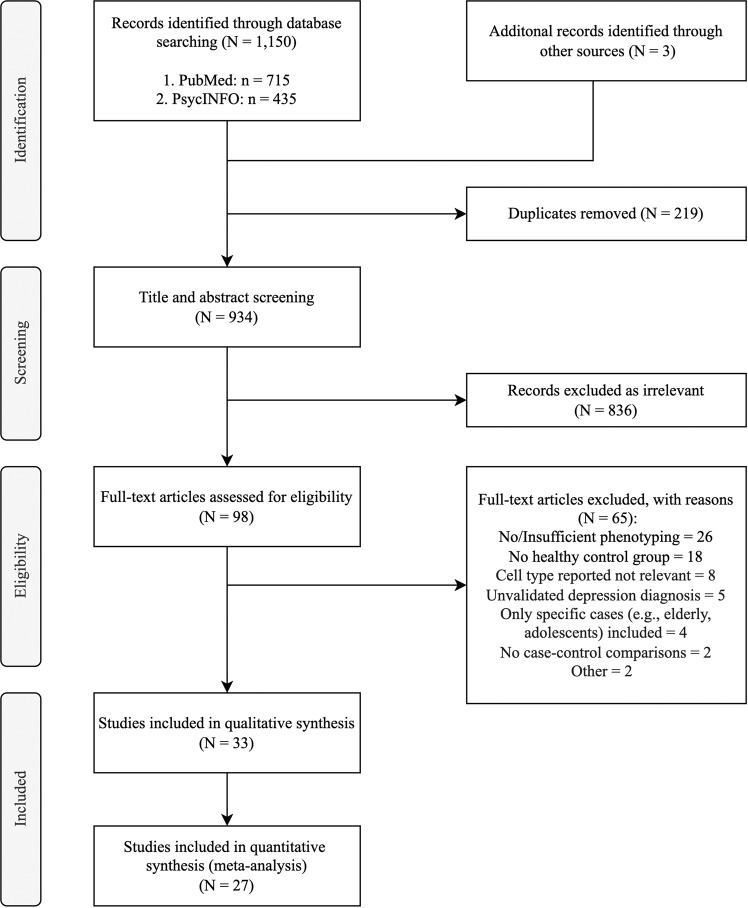
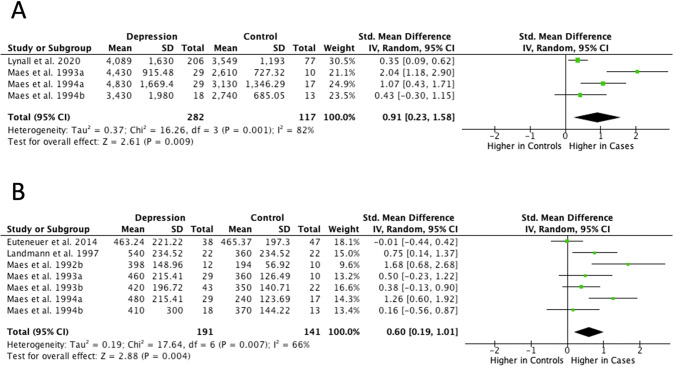
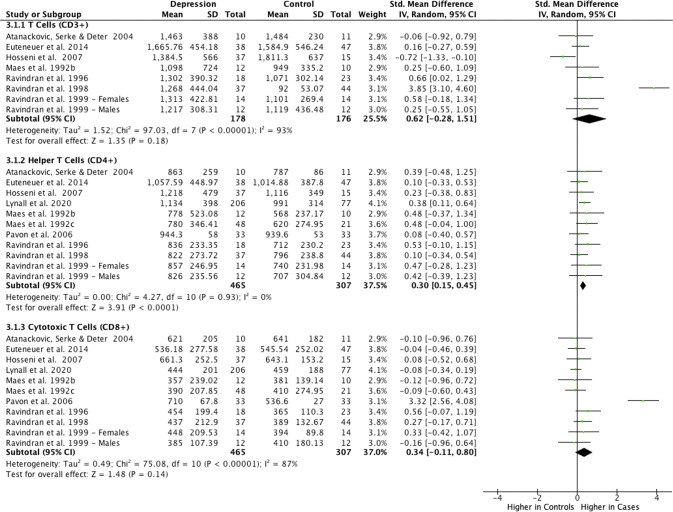
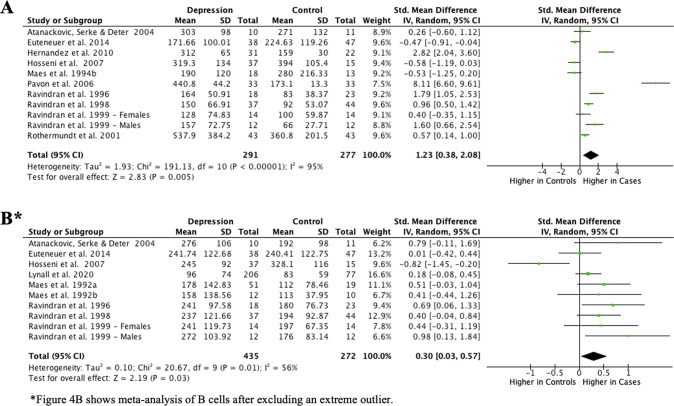
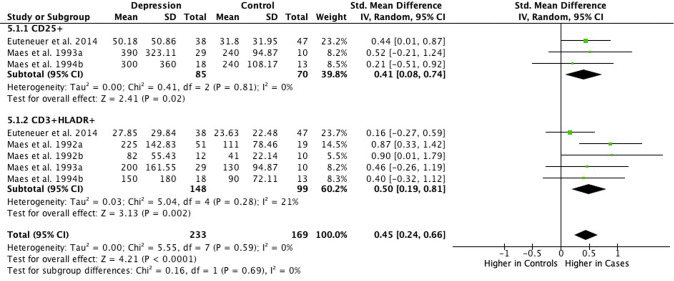
Introduction: Meta-analyses implicate immune dysfunction in depression confirming increased levels of circulating immune proteins (e.g., cytokines) in depression cases compared to controls. White blood cells (WBC) both produce and are influenced by cytokines, and play key roles in orchestrating innate and adaptive immune responses, but their role in depression remains unclear. Therefore, a systematic review of studies of various WBC subsets in depression is required for a greater understanding of the nature of immune dysfunction in this illness. Methods: We searched PubMed and PsycINFO databases (inception to 5 th April 2022) and conducted a systematic review and meta-analysis of identified studies comparing absolute count and/or relative percentage of flow cytometry-derived WBC subsets between depression cases and controls. Selected studies were quality assessed. Random-effect meta-analysis was performed. Results: Thirty-three studies were included and 27 studies ( n = 2277) were meta-analysed. We report an increase in mean absolute counts of WBC (seven studies; standardised mean difference [SMD] = 1.07; 95% CI, 0.61–1.53; P < 0.01; I 2 = 64%), granulocytes (two studies; SMD = 2.07; 95% CI, 1.45–2.68; P < 0.01; I 2 = 0%), neutrophils (four studies; SMD = 0.91; 95% CI, 0.23–1.58; P < 0.01; I 2 = 82%), monocytes (seven studies; SMD = 0.60; 95% CI, 0.19–1.01; P < 0.01; I 2 = 66%), CD4 + helper T cells (11 studies; SMD = 0.30; 95% CI, 0.15–0.45; P < 0.01; I 2 = 0%), natural killer cells (11 studies; SMD = 1.23; 95% CI, 0.38–2.08; P < 0.01; I 2 = 95%), B cells (10 studies; SMD = 0.30; 95% CI, 0.03–0.57; P = 0.03; I 2 = 56%), and activated T cells (eight studies; SMD = 0.45; 95% CI, 0.24–0.66; P < 0.01; I 2 = 0%) in depression, compared to controls. Fewer studies reported relative percentage, indicating increased neutrophils and decreased total lymphocytes, Th1, and Th2 cells in depression. Conclusions: Depression is characterised by widespread alterations in circulating myeloid and lymphoid cells, consistent with dysfunction in both innate and adaptive immunity. Immune cells could be useful biomarkers for illness subtyping and patient stratification in future immunotherapy trials of depression, along with cytokines, other biomarkers, and clinical measures.
Overview
The claims and statistics of this paper haven’t been checked yet.
Free: it reads the open-access text and checks the first 5 claims that cite a source we can check. Create a free account to check every claim.
Integrity signals
Registry
Cites
Statistics
Figures
Verification
Claims the paper makes
The claims and statistics of this paper haven’t been checked yet.
Free: it reads the open-access text and checks the first 5 claims that cite a source we can check. Create a free account to check every claim.
Claims other papers make about this one
Each is checked against this paper’s own text: does it say what the citing paper says it does?
The cited source says what the claim attributes to it.
In the citing paper
“A systematic review and meta-analysis revealed elevated absolute counts of WBC, neutrophils, and monocytes in patients with depression compared to controls 10 .”
From Relative value of novel systemic immune-inflammatory indices and classical hematological parameters in predicting depression, suicide attempts and treatment response (2024) · doi:10.1038/s41598-024-70097-z · cites this paper as [10]
Self-check
Percentages, sums and reported differences re-computed from the paper’s own numbers.
The self-check needs the paper’s full text.
Citations
Cites
Preferred Reporting Items for Systematic Reviews and Meta-Analyses: The PRISMA Statement
Moher, D., Liberati, A., Tetzlaff, J., Altman, D. G., & The PRISMA Group (2009) · PLoS Medicine · doi:10.1371/journal.pmed.1000097 · Cited by 64,042 · cited 1×
“The main outcome measure was absolute cell count and/or relative percentage in depressed cases and controls.”
Preferred reporting items for systematic reviews and meta-analyses: the PRISMA Statement.
(2009) · PubMed Central · Cited by 44,859
Quantifying heterogeneity in a meta‐analysis
Higgins, J. P. T., & Thompson, S. G. (2002) · Statistics in Medicine · doi:10.1002/sim.1186 · Cited by 36,763
Stang, A. (2010) · European Journal of Epidemiology · doi:10.1007/s10654-010-9491-z · Cited by 17,396 · cited 1×
“The methodological quality of each study was assessed using an adapted version of the Newcastle-Ottawa Scale (NOS) for casecontrol studies [22].”
MethodFrom inflammation to sickness and depression: when the immune system subjugates the brain
Dantzer, R., O'Connor, J. C., Freund, G. G., Johnson, R. W., & Kelley, K. W. (2008) · Nature Reviews Neuroscience · doi:10.1038/nrn2297 · Cited by 7,395
How to perform a meta-analysis with R: a practical tutorial
Balduzzi, S., Rücker, G., & Schwarzer, G. (2019) · Evidence Based Mental Health · doi:10.1136/ebmental-2019-300117 · Cited by 5,827
Inflammation and Its Discontents: The Role of Cytokines in the Pathophysiology of Major Depression
Miller, A. H., Maletic, V., & Raison, C. L. (2009) · Biological Psychiatry · doi:10.1016/j.biopsych.2008.11.029 · Cited by 3,848
Goldsmith, D. R., Rapaport, M. H., & Miller, B. J. (2016) · Molecular Psychiatry · doi:10.1038/mp.2016.3 · Cited by 1,683
Peripheral cytokine and chemokine alterations in depression: a meta‐analysis of 82 studies
Köhler, C. A., Freitas, T. H., Maes, M., de Andrade, N. Q., Liu, C. S., Fernandes, B. S., Stubbs, B., Solmi, M., Veronese, N., Herrmann, N., et al. (2017) · Acta Psychiatrica Scandinavica · doi:10.1111/acps.12698 · Cited by 1,443
Haapakoski, R., Mathieu, J., Ebmeier, K. P., Alenius, H., & Kivimäki, M. (2015) · Brain, Behavior, and Immunity · doi:10.1016/j.bbi.2015.06.001 · Cited by 1,129
The Relationship of Depression and Stressors to Immunological Assays: A Meta-Analytic Review
Zorrilla, E. P., Luborsky, L., McKay, J. R., Rosenthal, R., Houldin, A., Tax, A., McCorkle, R., Seligman, D. A., & Schmidt, K. (2001) · Brain, Behavior, and Immunity · doi:10.1006/brbi.2000.0597 · Cited by 995 · cited 2×
“Firstly, CD4/CD8 ratio has been reported to be higher in depressed patients [19].”
BackgroundKöhler, O., Benros, M. E., Nordentoft, M., Farkouh, M. E., Iyengar, R. L., Mors, O., & Krogh, J. (2014) · JAMA Psychiatry · doi:10.1001/jamapsychiatry.2014.1611 · Cited by 941
Khandaker, G. M., Pearson, R. M., Zammit, S., Lewis, G., & Jones, P. B. (2014) · JAMA Psychiatry · doi:10.1001/jamapsychiatry.2014.1332 · Cited by 846
Self-citationOsimo, E. F., Baxter, L. J., Lewis, G., Jones, P. B., & Khandaker, G. M. (2019) · Psychological Medicine · doi:10.1017/s0033291719001454 · Cited by 774 · cited 1×
“Search terms incorporated key indexing terms and wildcards to maximise return and included: (depression OR depressive disorder OR major depressive disorder) AND (leukocyte count OR fl ow cytometry OR mass cytometry OR immunophenotype OR immunophenotyping OR peripheral blood mononuclear cell).”
BackgroundSelf-citationKappelmann, N., Lewis, G., Dantzer, R., Jones, P. B., & Khandaker, G. M. (2018) · Molecular Psychiatry · doi:10.1038/mp.2016.167 · Cited by 659
Self-citationRöver, C., Knapp, G., & Friede, T. (2015) · BMC Medical Research Methodology · doi:10.1186/s12874-015-0091-1 · Cited by 527
Treatment-resistant depression and peripheral C-reactive protein.
Chamberlain, S. R., Cavanagh, J., de Boer, P., Mondelli, V., Jones, D. N. C., Drevets, W. C., Cowen, P. J., Harrison, N. A., Pointon, L., Pariante, C. M., et al. (2019) · British Journal of Psychiatry · doi:10.1192/bjp.2018.66 · Cited by 400
Wang, A. K., & Miller, B. J. (2018) · Schizophrenia Bulletin · doi:10.1093/schbul/sbx035 · Cited by 389
Neutrophil/lymphocyte ratio and platelet/lymphocyte ratio in mood disorders: A meta-analysis
Mazza, M. G., Lucchi, S., Tringali, A. G. M., Rossetti, A., Botti, E. R., & Clerici, M. (2018) · Progress in Neuro-Psychopharmacology and Biological Psychiatry · doi:10.1016/j.pnpbp.2018.03.012 · Cited by 326
Khandaker, G. M., Zuber, V., Rees, J. M. B., Carvalho, L., Mason, A. M., Foley, C. N., Gkatzionis, A., Jones, P. B., & Burgess, S. (2020) · Molecular Psychiatry · doi:10.1038/s41380-019-0395-3 · Cited by 281
Self-citationMaes, M., Lambrechts, J., Bosmans, E., Jacobs, J., Suy, E., Vandervorst, C., De Jonckheere, C., Minner, B., & Raus, J. (1992) · Psychological Medicine · doi:10.1017/s0033291700032712 · Cited by 275
Kappelmann, N., Arloth, J., Georgakis, M. K., Czamara, D., Rost, N., Ligthart, S., Khandaker, G. M., & Binder, E. B. (2021) · JAMA Psychiatry · doi:10.1001/jamapsychiatry.2020.3436 · Cited by 266
Self-citationLeday, G. G. R., Vértes, P. E., Richardson, S., Greene, J. R., Regan, T., Khan, S., Henderson, R., Freeman, T. C., Pariante, C. M., Harrison, N. A., et al. (2018) · Biological Psychiatry · doi:10.1016/j.biopsych.2017.01.021 · Cited by 222
Lamers, F., Milaneschi, Y., Smit, J. H., Schoevers, R. A., Wittenberg, G., & Penninx, B. W. J. H. (2019) · Biological Psychiatry · doi:10.1016/j.biopsych.2018.12.020 · Cited by 219
Syed, S. A., Beurel, E., Loewenstein, D. A., Lowell, J. A., Craighead, W. E., Dunlop, B. W., Mayberg, H. S., Dhabhar, F., Dietrich, W. D., Keane, R. W., et al. (2018) · Neuron · doi:10.1016/j.neuron.2018.08.001 · Cited by 211
Th2 Cytokine Response in Major Depressive Disorder Patients before Treatment
Pavón, L., Sandoval-López, G., Eugenia Hernández, M., Loría, F., Estrada, I., Pérez, M., Moreno, J., Ávila, U., Leff, P., Antón, B., et al. (2006) · Journal of Neuroimmunology · doi:10.1016/j.jneuroim.2005.08.014 · Cited by 187
MRC ImmunoPsychiatry Consortium, Wittenberg, G. M., Stylianou, A., Zhang, Y., Sun, Y., Gupta, A., Jagannatha, P. S., Wang, D., Hsu, B., Curran, M. E., et al. (2020) · Molecular Psychiatry · doi:10.1038/s41380-019-0471-8 · Cited by 187
Peripheral Blood Cell–Stratified Subgroups of Inflamed Depression
Lynall, M.-E., Turner, L., Bhatti, J., Cavanagh, J., de Boer, P., Mondelli, V., Jones, D., Drevets, W. C., Cowen, P., Harrison, N. A., et al. (2020) · Biological Psychiatry · doi:10.1016/j.biopsych.2019.11.017 · Cited by 187 · cited 1×
“An inflammation-related subgroup of depression, defined using peripheral immune cell counts, was reported to be characterised by increased neutrophil, CD4 helper T cell, and intermediate monocyte counts, higher IL-6 and CRP levels, and increased illness severity [20].”
BackgroundSelf-citationLeukocytosis, monocytosis and neutrophilia: Hallmarks of severe depression
Maes, M., Van Der Planken, M., Stevens, W. J., Peeters, D., DeClerck, L. S., Bridts, C. H., Schotte, C., & Cosyns, P. (1992) · Journal of Psychiatric Research · doi:10.1016/0022-3956(92)90004-8 · Cited by 186 · cited 1×
“In particular, previous studies have reported increased leukocytes and myeloid cells, particularly neutrophils and monocytes, in depression [17, 19, 62].”
BackgroundMeta‐analysis of few small studies in orphan diseases
Friede, T., Röver, C., Wandel, S., & Neuenschwander, B. (2017) · Research Synthesis Methods · doi:10.1002/jrsm.1217 · Cited by 186
Deficiencies of the T and natural killer cell system in major depressive disorder
Grosse, L., Hoogenboezem, T., Ambrée, O., Bellingrath, S., Jörgens, S., de Wit, H. J., Wijkhuijs, A. M., Arolt, V., & Drexhage, H. A. (2016) · Brain, Behavior, and Immunity · doi:10.1016/j.bbi.2015.12.003 · Cited by 163
Different immune patterns in melancholic and non-melancholic major depression
Rothermundt, M., Arolt, V., Fenker, J., Gutbrodt, H., Peters, M., & Kirchner, H. (2001) · European Archives of Psychiatry and Clinical Neuroscience · doi:10.1007/s004060170058 · Cited by 159
Nowak, W., Grendas, L. N., Sanmarco, L. M., Estecho, I. G., Arena, Á. R., Eberhardt, N., Rodante, D. E., Aoki, M. P., Daray, F. M., Carrera Silva, E. A., et al. (2019) · EBioMedicine · doi:10.1016/j.ebiom.2019.10.063 · Cited by 159
Likelihood-based random-effects meta-analysis with few studies: empirical and simulation studies
Seide, S. E., Röver, C., & Friede, T. (2019) · BMC Medical Research Methodology · doi:10.1186/s12874-018-0618-3 · Cited by 156
Khandaker, G. M., Zuber, V., Rees, J. M. B., Carvalho, L., Mason, A. M., Foley, C. N., Gkatzionis, A., Jones, P. B., & Burgess, S. (2021) · Molecular Psychiatry · doi:10.1038/s41380-020-0857-7 · Cited by 141
Self-citationMajor depressive disorder is associated with elevated monocyte counts
Seidel, A., Arolt, V., Hunstiger, M., Rink, L., Behnisch, A., & Kirchner, H. (1996) · Acta Psychiatrica Scandinavica · doi:10.1111/j.1600-0447.1996.tb09849.x · Cited by 123
Khandaker, G. M., Zammit, S., Burgess, S., Lewis, G., & Jones, P. B. (2018) · Brain, Behavior, and Immunity · doi:10.1016/j.bbi.2017.11.020 · Cited by 118
Self-citationGrosse, L., Carvalho, L. A., Birkenhäger, T. K., Hoogendijk, W. J. G., Kushner, S. A., Drexhage, H. A., & Bergink, V. (2015) · Psychopharmacology · doi:10.1007/s00213-015-3943-9 · Cited by 116
Depression and suicidality: A link to premature T helper cell aging and increased Th17 cells
Schiweck, C., Valles-Colomer, M., Arolt, V., Müller, N., Raes, J., Wijkhuijs, A., Claes, S., Drexhage, H., & Vrieze, E. (2020) · Brain, Behavior, and Immunity · doi:10.1016/j.bbi.2020.02.005 · Cited by 114
Maes, M., Stevens, W. J., Declerck, L. S., Bridts, C. H., Peters, D., Schotte, C., & Cosyns, P. (1993) · Progress in Neuro-Psychopharmacology and Biological Psychiatry · doi:10.1016/0278-5846(93)90045-t · Cited by 102
Ye, Z., Kappelmann, N., Moser, S., Davey Smith, G., Burgess, S., Jones, P. B., & Khandaker, G. M. (2021) · eClinicalMedicine · doi:10.1016/j.eclinm.2021.100992 · Cited by 96
Self-citationSuzuki, H., Savitz, J., Kent Teague, T., Gandhapudi, S. K., Tan, C., Misaki, M., McKinney, B. A., Irwin, M. R., Drevets, W. C., & Bodurka, J. (2017) · Brain, Behavior, and Immunity · doi:10.1016/j.bbi.2017.06.011 · Cited by 95
Immune disorders in depression: higher T helper/T suppressor‐cytotoxic cell ratio
Maes, M., Stevens, W., DeClerck, L., Bridts, C., Peeters, D., Schotte, C., & Cosyns, P. (1992) · Acta Psychiatrica Scandinavica · doi:10.1111/j.1600-0447.1992.tb03292.x · Cited by 93
Wium-Andersen, M. K., Ørsted, D. D., & Nordestgaard, B. G. (2014) · Biological Psychiatry · doi:10.1016/j.biopsych.2013.10.009 · Cited by 93 · cited 1×
“Mendelian randomization (MR) studies that use genetic variants to address the issues of reverse causation and residual confounding suggest that IL-6 and other immune proteins may play a causal role in depression [8–11], though null findings have also been reported [12, 13].”
BackgroundMaes, M. H. J., Scharpé, S., Meltzer, H. Y., & Cosyns, P. R. (1993) · Biological Psychiatry · doi:10.1016/0006-3223(93)90042-c · Cited by 85
Robertson, M. J., Schacterle, R. S., Mackin, G. A., Wilson, S. N., Bloomingdale, K. L., Ritz, J., & Komaroff, A. L. (2005) · Clinical and Experimental Immunology · doi:10.1111/j.1365-2249.2005.02833.x · Cited by 85
T Cell phenotype and T cell receptor repertoire in patients with major depressive disorder
Patas, K., Willing, A., Demiralay, C., Engler, J. B., Lupu, A., Ramien, C., Schäfer, T., Gach, C., Stumm, L., Chan, K., et al. (2018) · Frontiers in Immunology · doi:10.3389/fimmu.2018.00291 · Cited by 74
Hernández, M. E., Martínez‐Fong, D., Pérez-Tapia, M., Estrada‐García, I., Estrada-Parra, S. A., & Pavón, L. (2009) · European Neuropsychopharmacology · doi:10.1016/j.euroneuro.2009.11.005 · Cited by 72
Maes, M. H. J., Meltzer, H. Y., Stevens, W. J., Calabrese, J. R., & Cosyns, P. R. (1994) · Progress in Neuro-Psychopharmacology and Biological Psychiatry · doi:10.1016/0278-5846(94)90079-5 · Cited by 69
Maes, M. H. J. (1992) · Journal of Affective Disorders · doi:10.1016/0165-0327(92)90060-j · Cited by 61
Becking, K., Haarman, B. C. M., Grosse, L., Nolen, W. A., Claes, S., Arolt, V., Schoevers, R. A., & Drexhage, H. A. (2018) · Journal of Neuroimmunology · doi:10.1016/j.jneuroim.2018.03.004 · Cited by 61
Circulating Lymphocyte Subsets in Major Depression and Dysthymia With Typical or Atypical Features
Ravindran, A. V., Griffiths, J., Merali, Z., & Anisman, H. (1998) · Psychosomatic Medicine · doi:10.1097/00006842-199805000-00013 · Cited by 59
Cohen, S. B., Maurer, K. J., Egan, C. E., Oghumu, S., Satoskar, A. R., & Denkers, E. Y. (2013) · PLoS Pathogens · doi:10.1371/journal.ppat.1003706 · Cited by 57
Ravindran, A. V., Griffiths, J., Merali, Z., & Anisman, H. (1999) · Journal of Affective Disorders · doi:10.1016/s0165-0327(98)00072-x · Cited by 53
Hasselmann, H., Gamradt, S., Taenzer, A., Nowacki, J., Zain, R., Patas, K., Ramien, C., Paul, F., Wingenfeld, K., Piber, D., et al. (2018) · Frontiers in Immunology · doi:10.3389/fimmu.2018.02693 · Cited by 50
Schlatter, J., Ortuño, F., & Cervera‐Enguix, S. (2004) · Psychiatry Research · doi:10.1016/j.psychres.2004.06.004 · Cited by 48
Circulating T helper 17 and IFN-γ positive Th17 cells in Major Depressive Disorder
Ghosh, R., Kumar, P. K., Mitra, P., Purohit, P., Nebhinani, N., & Sharma, P. (2020) · Behavioural Brain Research · doi:10.1016/j.bbr.2020.112811 · Cited by 47
Landmann, R., Schaub, B., Link, S., & Wacker, H. R. (1997) · Biological Psychiatry · doi:10.1016/s0006-3223(96)00176-x · Cited by 45
Immune parameters in patients with anxiety or depression during psychotherapy
Atanackovic, D., Kröger, H., Serke, S., & Deter, H. (2003) · Journal of Affective Disorders · doi:10.1016/s0165-0327(03)00165-4 · Cited by 39 · cited 1×
“Meta-analysis of two studies totalling 34 cases and 32 controls showed higher mean total granulocyte count in depression (SMD = 2.07; 95% CI, 1.45 – 2.68; P < 0.01; I 2 = 0%; Supplementary Fig.”
MethodInfluentialMaes, M., Lambrechts, J., Suy, E., Vandervorst, C., & Bosnians, E. (1994) · Neuropsychobiology · doi:10.1159/000119080 · Cited by 35
Başterzi, A. D., Yazıcı, K. U., Buturak, V., Çimen, B., Yazıcı, A., Eskandari, G., Acar, Ş. T., & Taşdelen, B. (2009) · Progress in Neuro-Psychopharmacology and Biological Psychiatry · doi:10.1016/j.pnpbp.2009.09.025 · Cited by 35
Surtees, P. G., Wainwright, N. W. J., Day, N., Luben, R., Brayne, C., & Khaw, K. (2003) · Journal of Psychosomatic Research · doi:10.1016/s0022-3999(02)00456-7 · Cited by 30 · cited 1×
“In particular, previous studies have reported increased leukocytes and myeloid cells, particularly neutrophils and monocytes, in depression [17, 19, 62].”
BackgroundVariations of lymphocyte subsets associated with stress in depressive populations
Ravindran, A. V., Griffiths, J., Merali, Z., & Anisman, H. (1996) · Psychoneuroendocrinology · doi:10.1016/s0306-4530(96)00030-3 · Cited by 28
Assessment of the immune system activity in Iranian patients with Major Depression Disorder (MDD).
Hosseini, R. F., Azad, F. J., Ali, T., Miri, S., Mokhber, N., Hosseini, F. F., Esmaily, H., Mahmoudi, M., Rafatpanah, H., & Mohammadi, M.-R. (2007) · PubMed · doi:10.22034/iji.2007.17178 · Cited by 28
KANBA, S., MANKI, H., SHINTANI, F., OHNO, Y., YAGI, G., & ASAI, M. (1998) · Psychological Medicine · doi:10.1017/s0033291797006454 · Cited by 18
Blunted exercise-induced mobilization of monocytes in somatization syndromes and major depression
Euteneuer, F., Schwarz, M., Schmidmaier, R., Hennings, A., Riemer, S., Stapf, T. M., Selberdinger, V. B., Süssenbach, P., Dannehl, K., & Rief, W. (2014) · Journal of Affective Disorders · doi:10.1016/j.jad.2014.04.060 · Cited by 15
Research works printed but not linked: 1
- The Cochrane Collaboration. Review Manager (RevMan) Version 5.4. 2020.
Cited by
The gut microbiota-immune-brain axis: therapeutic implications
O’Riordan, K. J., Moloney, G. M., Keane, L., Clarke, G., & Cryan, J. F. (2025) · Cell Reports Medicine · doi:10.1016/j.xcrm.2025.101982 · Cited by 333
“62 Growing evidence links inflammatory markers such as C-reactive protein (CRP) with depression, anxiety, and cognitive deficits.”
Inflammatory mediators in major depression and bipolar disorder
Poletti, S., Mazza, M. G., & Benedetti, F. (2024) · Translational Psychiatry · doi:10.1038/s41398-024-02921-z · Cited by 163
“However, a recent meta-analysis reported reduced percentages of both Th1 and Th2 [109].”
BackgroundNeuroimmune, metabolic and oxidative stress pathways in major depressive disorder
Maes, M. H. J., Almulla, A. F., You, Z., & Zhang, Y. (2025) · Nature Reviews Neurology · doi:10.1038/s41582-025-01116-4 · Cited by 159
Immuno-metabolic depression: from concept to implementation
Penninx, B. W. J. H., Lamers, F., Jansen, R., Berk, M., Khandaker, G. M., Picker, L. D., & Milaneschi, Y. (2024) · The Lancet Regional Health - Europe · doi:10.1016/j.lanepe.2024.101166 · Cited by 171
“17 More recent meta-analyses 18 – 20 showed altered immune cells repertoires (e.g., Natural Killer and T-cell counts) and higher cerebrospinal level of in fl ammatory markers in depressed persons versus controls.”
Self-citationJiao, W., Lin, J., Deng, Y., Ji, Y., Liang, C., Wei, S., Xi, J., & Yan, F. (2025) · Journal of Neuroinflammation · doi:10.1186/s12974-024-03312-3 · Cited by 144
Metadata
- Authors
- Foley, É. M., Parkinson, J. T., Mitchell, R. E., Turner, L., & Khandaker, G. M.
- Affiliations
- University of Bristol (GB)
- University of Glasgow (GB)
- University of Cambridge (GB)
- Avon and Wiltshire Mental Health Partnership NHS Trust (GB)
- Corresponding author
- Foley, Éimear M.
- Venue
- Molecular Psychiatry
- Published
- 2022-12-28
- Volume
- 28
- Issue
- 3
- Pages
- 1004-1019
- ISSN
- 1359-4184 (ISSN-L)
- 1476-5578
- PMC
- PMC10005954
- OpenAlex
- W4313379931
- Cited by
- 138
- References
- 66
- Citations by year
- 2026: 29 · 2025: 55 · 2024: 43 · 2023: 11
- FWCI
- 2.06
- Type
- journal article
- Language
- en
- Open access
- hybrid
- doi.org
- Licence
- cc-by
- creativecommons.org/licenses/by/4.0 (tdm)
- creativecommons.org/licenses/by/4.0 (vor)
- Locations
- Molecular Psychiatry (publishedVersion, cc-by)
- PubMed Central (publishedVersion, cc-by)
- PubMed (publishedVersion)
- ENLIGHTEN (Jurnal Bimbingan dan Konseling Islam) (acceptedVersion, cc-by)
- Explore Bristol Research (submittedVersion, cc-by)
- Funders
- Medical Research Council Epidemiology Unit PhD Studentship
- Versus Arthritis Award
- Medical Research Council Integrative Epidemiology Unit
- NIHR Cambridge BioResource
- Wellcome Trust (201486/Z/16/Z)
- RCUK | Medical Research Council (MC_PC_17213, MR/S037675/1, MR/W014416/1)
- The MQ: Transforming Mental Health (Grant No. MQDS17/40); BMA Foundation
- Topics
- Life Sciences › Neuroscience › Biological Psychiatry › Tryptophan and brain disorders
- Life Sciences › Neuroscience › Behavioral Neuroscience › Stress Responses and Cortisol
- Health Sciences › Medicine › Pharmacology (medical) › Treatment of Major Depression
- Keywords
- depression, peripheral blood, immune dysfunction, leukocytes, granulocytes, neutrophils, monocytes, CD4+ T cells, natural killer cells, B cells, T cells, cytokines, depression biomarkers, depression treatment response, depression remission, depression severity, comorbid depression, depression subtypes
- MeSH terms
- Depression, Humans, Biomarkers
About these checks
Registry, retraction, Cites and statistics results are computed, not judged, with one exception: a printed reference that no index lists is read once by a model before it counts as a citation error. Claims are extracted by a model and kept only when their quote appears verbatim in the text; each cited source is then checked, with a model’s help, for whether it says what the claim relies on. Those verdicts can be wrong — read the claim’s quote and the cited source before relying on one.
Statistics and arithmetic are recomputed, not judged.
Confidence bands are shown only for fields calibrated on our annotated test set. None is calibrated yet, so no band is shown.
What counts as a claim ›How we measure confidence ›How we check this ›
Are you an author, or do you see a problem with this page? Request a review
Data sources
Bibliographic data: Semantic Scholar, OpenAlex, Crossref.
Contains information from the Semantic Scholar Academic Graph Datasets, made available under the ODC Attribution License (ODC-BY 1.0).
Semantic Scholar’s data is described in: Kinney, R., et al. (2023). The Semantic Scholar Open Data Platform. arXiv:2301.10140.
