

Peripheral blood cellular immunophenotype in depression: a systematic review and meta-analysis
Open accessThe DOI matches its Crossref record; 66 of the 66 references it cites were found in a registry or an index.
Abstract
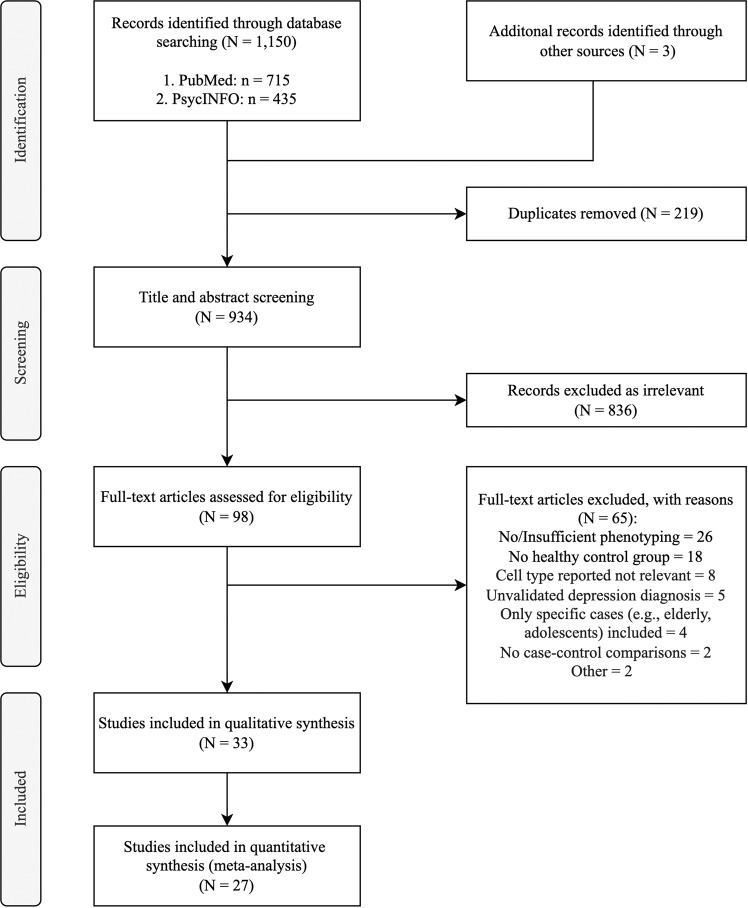
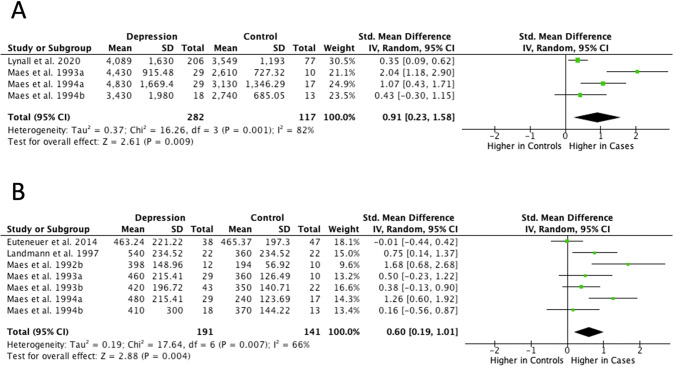
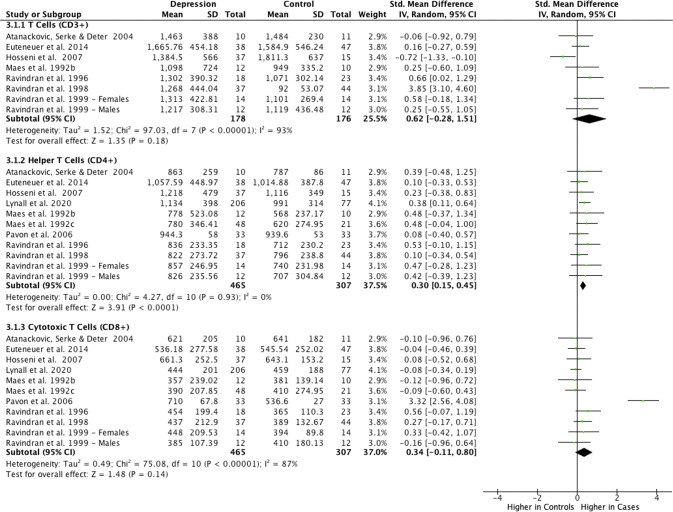
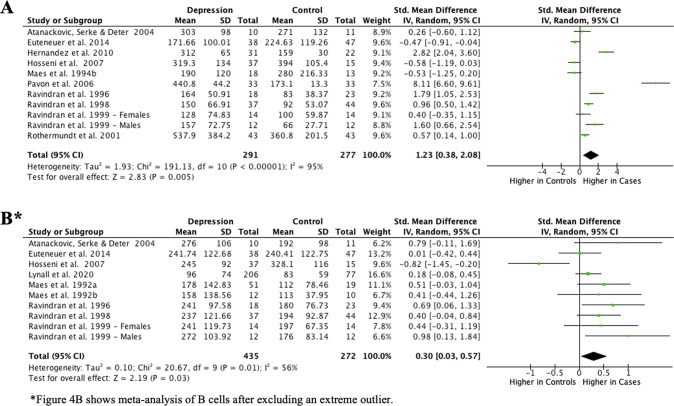
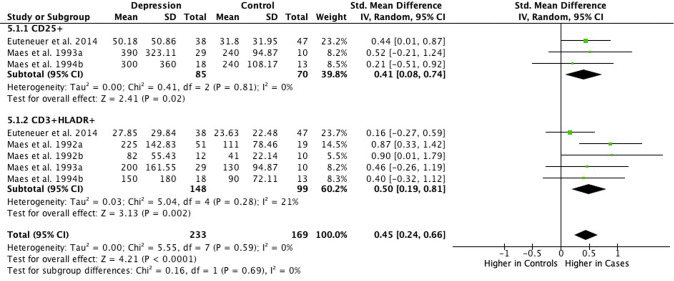
Introduction: Meta-analyses implicate immune dysfunction in depression confirming increased levels of circulating immune proteins (e.g., cytokines) in depression cases compared to controls. White blood cells (WBC) both produce and are influenced by cytokines, and play key roles in orchestrating innate and adaptive immune responses, but their role in depression remains unclear. Therefore, a systematic review of studies of various WBC subsets in depression is required for a greater understanding of the nature of immune dysfunction in this illness. Methods: We searched PubMed and PsycINFO databases (inception to 5 th April 2022) and conducted a systematic review and meta-analysis of identified studies comparing absolute count and/or relative percentage of flow cytometry-derived WBC subsets between depression cases and controls. Selected studies were quality assessed. Random-effect meta-analysis was performed. Results: Thirty-three studies were included and 27 studies ( n = 2277) were meta-analysed. We report an increase in mean absolute counts of WBC (seven studies; standardised mean difference [SMD] = 1.07; 95% CI, 0.61–1.53; P < 0.01; I 2 = 64%), granulocytes (two studies; SMD = 2.07; 95% CI, 1.45–2.68; P < 0.01; I 2 = 0%), neutrophils (four studies; SMD = 0.91; 95% CI, 0.23–1.58; P < 0.01; I 2 = 82%), monocytes (seven studies; SMD = 0.60; 95% CI, 0.19–1.01; P < 0.01; I 2 = 66%), CD4 + helper T cells (11 studies; SMD = 0.30; 95% CI, 0.15–0.45; P < 0.01; I 2 = 0%), natural killer cells (11 studies; SMD = 1.23; 95% CI, 0.38–2.08; P < 0.01; I 2 = 95%), B cells (10 studies; SMD = 0.30; 95% CI, 0.03–0.57; P = 0.03; I 2 = 56%), and activated T cells (eight studies; SMD = 0.45; 95% CI, 0.24–0.66; P < 0.01; I 2 = 0%) in depression, compared to controls. Fewer studies reported relative percentage, indicating increased neutrophils and decreased total lymphocytes, Th1, and Th2 cells in depression. Conclusions: Depression is characterised by widespread alterations in circulating myeloid and lymphoid cells, consistent with dysfunction in both innate and adaptive immunity. Immune cells could be useful biomarkers for illness subtyping and patient stratification in future immunotherapy trials of depression, along with cytokines, other biomarkers, and clinical measures.
Overview
The claims and statistics of this paper haven’t been checked yet.
Free: it reads the open-access text and checks the first 5 claims that cite a source we can check. Create a free account to check every claim.
Integrity signals
Registry
Cites
Statistics
Figures
Verification
Claims the paper makes
The claims and statistics of this paper haven’t been checked yet.
Free: it reads the open-access text and checks the first 5 claims that cite a source we can check. Create a free account to check every claim.
Claims other papers make about this one
Each is checked against this paper’s own text: does it say what the citing paper says it does?
The cited source says what the claim attributes to it.
In the citing paper
“A systematic review and meta-analysis revealed elevated absolute counts of WBC, neutrophils, and monocytes in patients with depression compared to controls 10 .”
From Relative value of novel systemic immune-inflammatory indices and classical hematological parameters in predicting depression, suicide attempts and treatment response (2024) · doi:10.1038/s41598-024-70097-z · cites this paper as [10]
Self-check
Percentages, sums and reported differences re-computed from the paper’s own numbers.
The self-check needs the paper’s full text.
Citations
Cites
Preferred Reporting Items for Systematic Reviews and Meta-Analyses: The PRISMA Statement
Moher, D., Liberati, A., Tetzlaff, J., Altman, D. G., & The PRISMA Group (2009) · PLoS Medicine · doi:10.1371/journal.pmed.1000097 · Cited by 64,042 · cited 1×
“The main outcome measure was absolute cell count and/or relative percentage in depressed cases and controls.”
Preferred reporting items for systematic reviews and meta-analyses: the PRISMA Statement.
(2009) · PubMed Central · Cited by 44,859
Quantifying heterogeneity in a meta‐analysis
Higgins, J. P. T., & Thompson, S. G. (2002) · Statistics in Medicine · doi:10.1002/sim.1186 · Cited by 36,763
Stang, A. (2010) · European Journal of Epidemiology · doi:10.1007/s10654-010-9491-z · Cited by 17,396 · cited 1×
“The methodological quality of each study was assessed using an adapted version of the Newcastle-Ottawa Scale (NOS) for casecontrol studies [22].”
MethodFrom inflammation to sickness and depression: when the immune system subjugates the brain
Dantzer, R., O'Connor, J. C., Freund, G. G., Johnson, R. W., & Kelley, K. W. (2008) · Nature Reviews Neuroscience · doi:10.1038/nrn2297 · Cited by 7,395
How to perform a meta-analysis with R: a practical tutorial
Balduzzi, S., Rücker, G., & Schwarzer, G. (2019) · Evidence Based Mental Health · doi:10.1136/ebmental-2019-300117 · Cited by 5,827
Inflammation and Its Discontents: The Role of Cytokines in the Pathophysiology of Major Depression
Miller, A. H., Maletic, V., & Raison, C. L. (2009) · Biological Psychiatry · doi:10.1016/j.biopsych.2008.11.029 · Cited by 3,848
Goldsmith, D. R., Rapaport, M. H., & Miller, B. J. (2016) · Molecular Psychiatry · doi:10.1038/mp.2016.3 · Cited by 1,683
Peripheral cytokine and chemokine alterations in depression: a meta‐analysis of 82 studies
Köhler, C. A., Freitas, T. H., Maes, M., de Andrade, N. Q., Liu, C. S., Fernandes, B. S., Stubbs, B., Solmi, M., Veronese, N., Herrmann, N., et al. (2017) · Acta Psychiatrica Scandinavica · doi:10.1111/acps.12698 · Cited by 1,443
Haapakoski, R., Mathieu, J., Ebmeier, K. P., Alenius, H., & Kivimäki, M. (2015) · Brain, Behavior, and Immunity · doi:10.1016/j.bbi.2015.06.001 · Cited by 1,129
Research works printed but not linked: 1
- The Cochrane Collaboration. Review Manager (RevMan) Version 5.4. 2020.
Cited by
Items 101–138 of 138
Interlinking Neutrophil-Lymphocyte and Platelet-Lymphocyte Ratios and Depressive Disorders
Bulut, N. S. (2024) · Springer eBooks · doi:10.1007/978-3-031-32035-4_97-1
Monzée, J. (2024) · Psychotherapy and Psychosomatics · doi:10.1159/000541555 · Cited by 3
Inflammatory Mediators in Major Depression and Bipolar Disorder (Russian Translation)
Sara, P., de Gennaro, M. E., & Francesco, B. (2024) · Juvenis scientia · doi:10.32415/jscientia_2024_10_5_28-55
Role of Regulatory Immune Cells in Psychiatric Disorders
Balcioglu, S. S. K., & Balcıoğlu, Y. H. (2024) · Integrated science · doi:10.1007/978-3-031-72079-6_5
Serum proteomic correlates of mental health symptoms in a representative UK population sample
Dearman, A., Bao, Y., Schalkwyk, L. C., & Kumari, M. (2025) · Brain Behavior & Immunity - Health · doi:10.1016/j.bbih.2025.100947 · Cited by 1
The genetic overlap between major depressive disorder, white blood cell counts and interleukin 6
Wiström, E. D., O’Connell, K. S., Koch, E. M., Jaholkowski, P. P., Hindley, G., Steen, N. E., Parekh, P., Parker, N., Shadrin, A. A., Djurovic, S., et al. (2025) · Journal of Affective Disorders Reports · doi:10.1016/j.jadr.2025.100889
Erady, C., Bethlehem, R. A. I., Bullmore, E. T., & Lynall, M.-E. (2025) · medRxiv · doi:10.1101/2025.05.01.25326802
Tian, Y., Giles, C., Biase, M. A. D., Cash, R. F. H., Cropley, V., & Zalesky, A. (2025) · medRxiv · doi:10.1101/2025.08.14.25333723
“This suggests that glycolysis and innate and adapLve immune dysfuncLon in depression are not only associated with depression pathology 52 but are also associated with the progression of the illness, and possibility depression-related accelerated aging 53 .”
Interlinking Neutrophil-Lymphocyte and Platelet-Lymphocyte Ratios and Depressive Disorders
Bulut, N. S. (2025) · Springer eBooks · doi:10.1007/978-3-031-73368-0_97
Treiber, M., Baune, B. T., Gramser, A., Saelens, J., Grüll, N., Rössler, K., Novak, K., Bouzouina, A., Thanarajah, S. E., Reif-Leonhard, C., et al. (2025) · SSRN Electronic Journal · doi:10.1101/2025.08.31.25334709
“Elevated ANC has been associated with increased risk for depression (Foley et al., 2023).”
Associations between depression severity and immune activity in children and adolescents
Seizer, L., Renner, T. J., & Löchner, J. (2025) · Journal of Affective Disorders · doi:10.1016/j.jad.2025.120190 · Cited by 2
Post-COVID-Syndrom: Biopsychosoziale Erklärungsmodelle
Peters, E. M. J. (2025) · Ärztliche Psychotherapie · doi:10.21706/aep-20-4-230
Guo, Q., Yong, W., Guo, L., & Shang, S. (2025) · Interdisciplinary Nursing Research · doi:10.1097/nr9.0000000000000099
Sun, F., Hui, S., Gong, B., Gu, J., & Huang, P. (2025) · PLoS ONE · doi:10.1371/journal.pone.0336109
“This is consistent with LAVA and s-LDSC results, emphasizing the involvement of ADs and DeP in the immune pathway [79,80].”
Zhang, X., Chen, Y., Lin, J., Guo, W., Zhou, H., Yang, X., & Zhao, Q. (2025) · Journal of Pain Research · doi:10.2147/jpr.s553378
“40 This discrepancy in findings may be related to the different sample sizes, study designs, heterogeneity of depression severity or subtype, and environmental/clinical variables.”
Immune System Alterations in Depression across Baseline and Flu Vaccine ChallengePreprint
Arasappan, D., Marron, A., Sanei, S., & Jabbi, M. (2025) · bioRxiv (Cold Spring Harbor Laboratory) · doi:10.64898/2025.12.02.691874
“…(Wohleb et al., 2015; Ramirez et al., 2017; Hu et al. 2023; Cathomas et al., 2024), fatigue (Berentschot et al., 2023), measures of depression (Muller et al., 1989; Foley et al., 2023), and specific depression-related phenotypes like increased suicide risk (Puangsri & Ninla-Aesong, 2021).”
Daray, F. M., Grendas, L., Arena, Á., Tifner, V., Casiani, R. Á., Olaviaga, A., Chiapella, L., Vazquez, G., Penna, M., Hunter, F., et al. (2023) · Research Square · doi:10.21203/rs.3.rs-3346140/v1
Dong, C. X., Xie, J., Shen, R., Pan, C., Dong, Q., Zhang, J., Yu, K., & Zeng, Q. (2026) · Biochemical and Biophysical Research Communications · doi:10.1016/j.bbrc.2026.153456
Shepherd, F. R., Slaney, C., Jones, H. J., Dardani, C., Stergiakouli, E., Sanderson, E. C. M., Hamilton, F., Rosoff, D. B., Rek, N., Gaunt, T. R., et al. (2026) · medRxiv · doi:10.64898/2026.04.10.26350510
Self-citationPremchandani, T., Qutub, M., Hatel, T., Umekar, M., Taksande, J., & Tatode, A. (2026) · Progress in Neuro-Psychopharmacology and Biological Psychiatry · doi:10.1016/j.pnpbp.2026.111746
Sigma-1R–CD36 axis in myeloid cells contributes to the alleviation of depression-like behaviors
Liang, M., Wang, Z., Li, G., Du, C., Chen, J., Lu, J., Sun, M., Lyu, Y., Huang, M., Sun, J., et al. (2026) · Journal of Translational Medicine · doi:10.1186/s12967-026-08297-6
“In addition, clinical and preclinical studies have reported alterations in the peripheral blood immune cells, including lymphocyte and myeloid subsets, which may be associated with depressive symptoms and treatment outcomes [9–12].”
Teng, F., Zheng, S., Zhang, X., Lü, Z., Wang, P., Wang, P., & Yin, D. (2026) · Journal of Visualized Experiments · doi:10.3791/71024
Fyka, A., Anastasopoulou, D., Livadara, M., Eliopoulos, A. G., & Gkouskou, K. K. (2026) · Cells · doi:10.3390/cells15131179
“Elevated NK cell counts have been reported in MDD predominantly in case–control studies comparing clinically diagnosed individuals with healthy controls [3].”
Yan, Y., Wang, M., Tao, Y., Wei, J., Zhao, L. N., Ni, R., Xiao, Y., & Ma, X. (2026) · Psychological Medicine · doi:10.1017/s003329172610498x
“In the periphery, this inflammatory dysregulation is reflected in altered levels of inflammatory mediators and shifts in immune cell composition (Foley et al., 2023; Zeng et al., 2024).”
Favina, A., Fatch, R., Rao, S. R., Chamie, G., Muyindike, W. R., Adong, J., Emenyonu, N. I., Tumwegamire, A., Ngabirano, C., Kekibiina, A., et al. (2026) · AIDS and Behavior · doi:10.1007/s10461-026-05214-2
Karska, J., Kowalski, S., Rudy, K., Szyszka, M., Lewicka, W., Enrico, P., Drexhage, H. A., Pawlak, E., Piotrowski, P., & Misiak, B. (2026) · Brain Behavior and Immunity · doi:10.1016/j.bbi.2026.106934
Daray, F. M., Grendas, L. N., Chiapella, L. C., Tifner, V., López-Carvajal, J. E., Arena, Á. R., Olaviaga, A., Prokopez, C. R., Robetto, J., Silva, E. A. C., et al. (2026) · Progress in Neuro-Psychopharmacology and Biological Psychiatry · doi:10.1016/j.pnpbp.2026.111874
Lin, K., Wang, P., Li, S., Ma, C., Wen, D., Wang, X., & Liao, L. (2026) · Frontiers in Immunology · doi:10.3389/fimmu.2026.1712425
Saillart, E., Jacobs, K., Claes, S. J., & Vergaelen, E. (2026) · Brain Behavior & Immunity - Health · doi:10.1016/j.bbih.2026.101334
Shi, Y., Chen, X., & Wang, Y. (2026) · Frontiers in Medicine · doi:10.3389/fmed.2026.1921399
Zhang, L., Ma, X., Shi, G., & Liu, Y. (2026) · Brain Behavior & Immunity - Health · doi:10.1016/j.bbih.2026.101355
Jiang-bo, L., Rong, W., Xiao, B.-H., Zhou, F., Lei, L.-H., Liu, Y., Wang, Z.-P., & Zhu, S. (2026) · Frontiers in Immunology · doi:10.3389/fimmu.2026.1927860
“A systematic review indicated that patients with depression exhibit alterations in immune cell counts, including increased leukocytes, neutrophils, and monocytes and a higher CD4/CD8 ratio (60, 61).”
Fleischer, A., Schrader, H., & Kim, Y. (2026) · Progress in Neuro-Psychopharmacology and Biological Psychiatry · doi:10.1016/j.pnpbp.2026.111955 · Cited by 1
Depression and musculoskeletal diseases: a framework of systemic mechanisms
Yang, X., Zhao, Y., Gao, W., Liu, J., Wang, T., Wang, J., & 王飞雪 (2026) · Frontiers in Psychiatry · doi:10.3389/fpsyt.2026.1977499
“Clinical studies have reported that patients with depression exhibit increased neutrophil and monocyte counts, altered heterogeneity of lymphocytes (T cells and B cells), and reduced natural killer (NK) cell cytotoxicity (64).”
Profiling Transcriptomic Changes Across Frontal Cortical Subregions in Major Depressive DisorderPreprint
Iatrou, A., Gigliotta, A., Balakundi, V., Bharadwaj, R. A., Chatzinakos, C., Matosin, N., Nagy, C., Snijders, C., Turecki, G., Leng, B., et al. (2026) · Research Square · doi:10.21203/rs.3.rs-7349413/v1
“4A), followed by Astro (57), Oligo (41), Mural (15), OPC (9), Fibro (8), Micro (6), and Macro (3) (Fig.”
InfluentialLow-dose colchicine: a potential augmenting agent in the treatment of refractory mood disorders
Singh, A., Skvarc, D., Lago, J., & Berk, M. P. (2026) · Acta Neuropsychiatrica · doi:10.1017/neu.2026.10098
Wang, H., Paul, K. C., Kusters, C., Lill, C. M., Zhou, J. J., Bronstein, J. M., & Ritz, B. R. (2026) · Human Genetics · doi:10.1007/s00439-026-02877-8
Poletti, S., Bravi, B., Calesella, F., Aggio, V., Vai, B., Finardi, A., Mandelli, A., Lorenzi, C., Colombo, C., Furlan, R., et al. (2026) · Journal of Affective Disorders · doi:10.1016/j.jad.2026.122658
Metadata
- Authors
- Foley, É. M., Parkinson, J. T., Mitchell, R. E., Turner, L., & Khandaker, G. M.
- Affiliations
- University of Bristol (GB)
- University of Glasgow (GB)
- University of Cambridge (GB)
- Avon and Wiltshire Mental Health Partnership NHS Trust (GB)
- Corresponding author
- Foley, Éimear M.
- Venue
- Molecular Psychiatry
- Published
- 2022-12-28
- Volume
- 28
- Issue
- 3
- Pages
- 1004-1019
- ISSN
- 1359-4184 (ISSN-L)
- 1476-5578
- PMC
- PMC10005954
- OpenAlex
- W4313379931
- Cited by
- 138
- References
- 66
- Citations by year
- 2026: 29 · 2025: 55 · 2024: 43 · 2023: 11
- FWCI
- 2.06
- Type
- journal article
- Language
- en
- Open access
- hybrid
- doi.org
- Licence
- cc-by
- creativecommons.org/licenses/by/4.0 (tdm)
- creativecommons.org/licenses/by/4.0 (vor)
- Locations
- Molecular Psychiatry (publishedVersion, cc-by)
- PubMed Central (publishedVersion, cc-by)
- PubMed (publishedVersion)
- ENLIGHTEN (Jurnal Bimbingan dan Konseling Islam) (acceptedVersion, cc-by)
- Explore Bristol Research (submittedVersion, cc-by)
- Funders
- Medical Research Council Epidemiology Unit PhD Studentship
- Versus Arthritis Award
- Medical Research Council Integrative Epidemiology Unit
- NIHR Cambridge BioResource
- Wellcome Trust (201486/Z/16/Z)
- RCUK | Medical Research Council (MC_PC_17213, MR/S037675/1, MR/W014416/1)
- The MQ: Transforming Mental Health (Grant No. MQDS17/40); BMA Foundation
- Topics
- Life Sciences › Neuroscience › Biological Psychiatry › Tryptophan and brain disorders
- Life Sciences › Neuroscience › Behavioral Neuroscience › Stress Responses and Cortisol
- Health Sciences › Medicine › Pharmacology (medical) › Treatment of Major Depression
- Keywords
- depression, peripheral blood, immune dysfunction, leukocytes, granulocytes, neutrophils, monocytes, CD4+ T cells, natural killer cells, B cells, T cells, cytokines, depression biomarkers, depression treatment response, depression remission, depression severity, comorbid depression, depression subtypes
- MeSH terms
- Depression, Humans, Biomarkers
About these checks
Registry, retraction, Cites and statistics results are computed, not judged, with one exception: a printed reference that no index lists is read once by a model before it counts as a citation error. Claims are extracted by a model and kept only when their quote appears verbatim in the text; each cited source is then checked, with a model’s help, for whether it says what the claim relies on. Those verdicts can be wrong — read the claim’s quote and the cited source before relying on one.
Statistics and arithmetic are recomputed, not judged.
Confidence bands are shown only for fields calibrated on our annotated test set. None is calibrated yet, so no band is shown.
What counts as a claim ›How we measure confidence ›How we check this ›
Are you an author, or do you see a problem with this page? Request a review
Data sources
Bibliographic data: Semantic Scholar, OpenAlex, Crossref.
Contains information from the Semantic Scholar Academic Graph Datasets, made available under the ODC Attribution License (ODC-BY 1.0).
Semantic Scholar’s data is described in: Kinney, R., et al. (2023). The Semantic Scholar Open Data Platform. arXiv:2301.10140.
