

The functional connectome in obsessive-compulsive disorder: resting-state mega-analysis and machine learning classification for the ENIGMA-OCD consortium
Open accessThe DOI matches its Crossref record; 71 of the 71 references it cites were found in a registry or an index.
Abstract
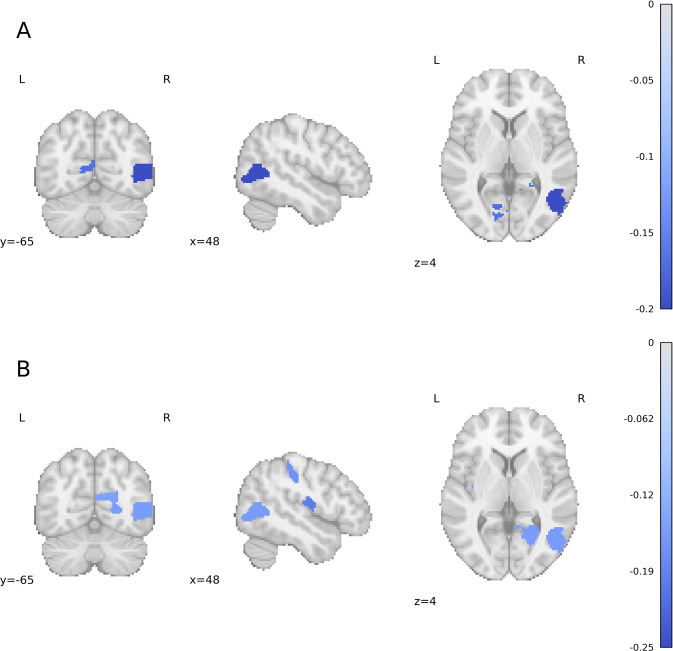
Current knowledge about functional connectivity in obsessive-compulsive disorder (OCD) is based on small-scale studies, limiting the generalizability of results. Moreover, the majority of studies have focused only on predefined regions or functional networks rather than connectivity throughout the entire brain. Here, we investigated differences in resting-state functional connectivity between OCD patients and healthy controls (HC) using mega-analysis of data from 1024 OCD patients and 1028 HC from 28 independent samples of the ENIGMA-OCD consortium. We assessed group differences in whole-brain functional connectivity at both the regional and network level, and investigated whether functional connectivity could serve as biomarker to identify patient status at the individual level using machine learning analysis. The mega-analyses revealed widespread abnormalities in functional connectivity in OCD, with global hypo-connectivity (Cohen’s d : -0.27 to -0.13) and few hyper-connections, mainly with the thalamus (Cohen’s d : 0.19 to 0.22). Most hypo-connections were located within the sensorimotor network and no fronto-striatal abnormalities were found. Overall, classification performances were poor, with area-under-the-receiver-operating-characteristic curve (AUC) scores ranging between 0.567 and 0.673, with better classification for medicated (AUC = 0.702) than unmedicated (AUC = 0.608) patients versus healthy controls. These findings provide partial support for existing pathophysiological models of OCD and highlight the important role of the sensorimotor network in OCD. However, resting-state connectivity does not so far provide an accurate biomarker for identifying patients at the individual level.
Overview
The claims and statistics of this paper haven’t been checked yet.
Free: it reads the open-access text and checks the first 5 claims that cite a source we can check. Create a free account to check every claim.
Integrity signals
Registry
Cites
Statistics
Figures




Verification
Claims the paper makes
The claims and statistics of this paper haven’t been checked yet.
Free: it reads the open-access text and checks the first 5 claims that cite a source we can check. Create a free account to check every claim.
Claims other papers make about this one
Each is checked against this paper’s own text: does it say what the citing paper says it does?
The cited source doesn’t support the claim as written.
In the citing paper
“Recent neuroimaging studies have implicated imbalances in CSTC loops (210, 219), where altered functional connectivity between OFC and striatum (220, 221) perpetuates habit dominance (220), reducing flexibility in adapting to new contingencies and fostering compulsive rituals.”
From Neural mechanisms underlying cognitive inflexibility in obsessive-compulsive disorder: a review (2026) · cites this paper as [210]
Checked by a reasoning model — may be wrong.
Experimental — accuracy not yet measuredThe source backs part of the claim, not all of it — or backs it for a different population, condition or comparison.
In the citing paper
“Integrating these models indicates that frontoparietal network abnormalities are pivotal to OCD’s core symptoms, providing key insights into underlying neural mechanisms (207, 210).”
From Neural mechanisms underlying cognitive inflexibility in obsessive-compulsive disorder: a review (2026) · cites this paper as [210]
Experimental — accuracy not yet measured
Self-check
Percentages, sums and reported differences re-computed from the paper’s own numbers.
The self-check needs the paper’s full text.
Citations
Cites
Hosmer, D. W., Lemeshow, S., & Sturdivant, R. X. (2013) · Wiley Series in Probability and Statistics · doi:10.1002/9781118548387 · Cited by 13,861
Desikan, R. S., Ségonne, F., Fischl, B., Quinn, B. T., Dickerson, B. C., Blacker, D., Buckner, R. L., Dale, A. M., Maguire, R. P., Hyman, B. T., et al. (2006) · NeuroImage · doi:10.1016/j.neuroimage.2006.01.021 · Cited by 13,324 · cited 1×
“…Effect (LME) models were used to assess between-group differences, accounting for data clustering within samples with sample-varying effects, with diagnosis ( fi xed factor, OCD versus HC) as the variable of interest, age, sex, and head motion as covariates, and sample ID as a random intercept.”
MethodFunctional connectivity in the motor cortex of resting human brain using echo‐planar mri
Biswal, B., Zerrin Yetkin, F., Haughton, V. M., & Hyde, J. S. (1995) · Magnetic Resonance in Medicine · doi:10.1002/mrm.1910340409 · Cited by 9,812 · cited 2×
“Patients showed widespread ROI-to-ROI hypo-connectivity which largely resembled those seen in main analysis ( − 0.31 d − 0.15), however the number of signi fi cant hypo-connections increased by 64% ( N = 319 for matched sample comparison, N = 194 for main analyses) (Supplementary Figs.”
BackgroundResultInfluentialParallel organization of functionally segregated circuits linking basal ganglia and cortex
Alexander, G. E., DeLong, M. R., & Strick, P. L. (1986) · Annual Review of Neuroscience · doi:10.1146/annurev.ne.09.030186.002041 · Cited by 8,527
The Yale-Brown Obsessive Compulsive Scale: I. Development, Use, and Reliability
Goodman, W. K. (1989) · Archives of General Psychiatry · doi:10.1001/archpsyc.1989.01810110048007 · Cited by 7,712 · cited 1×
“Preproces-sing included motion correction, slice timing and susceptibility distortion correction (if slice timing details and fi eld maps were available), and spatial normalization.”
The organization of the human cerebellum estimated by intrinsic functional connectivity
Buckner, R. L., Krienen, F. M., Castellanos, A., Diaz, J. C., & Yeo, B. T. T. (2011) · Journal of Neurophysiology · doi:10.1152/jn.00339.2011 · Cited by 7,304 · cited 1×
“Effect sizes (Cohen ’ s d ) and signi fi cance ( p values) were calculated for each ROI and network-level feature [41] (see Supplementary Methods).”
MethodLarge-scale brain networks and psychopathology: a unifying triple network model
Menon, V. (2011) · Trends in Cognitive Sciences · doi:10.1016/j.tics.2011.08.003 · Cited by 4,168
fMRIPrep: A robust preprocessing pipeline for functional MRI
Esteban, O., Markiewicz, C. J., Blair, R. W., Moodie, C. A., Isik, A. I., Erramuzpe, A., Kent, J. D., Goncalves, M., DuPre, E., Snyder, M., et al. (2019) · Nature Methods · doi:10.1038/s41592-018-0235-4 · Cited by 3,905 · cited 1×
“Time series from ROIs of participants with less than 80% voxel coverage were excluded, reducing the number of ROIs available for analysis (see Supplementary Methods).”
MethodEffect size, confidence interval and statistical significance: a practical guide for biologists
Nakagawa, S., & Cuthill, I. C. (2007) · Biological Reviews · doi:10.1111/j.1469-185x.2007.00027.x · Cited by 3,835 · cited 1×
“Strati fi ed K-fold splits were made by preserving the proportion of patients and controls from each sample.”
Large-scale automated synthesis of human functional neuroimaging data.
Yarkoni, T., Poldrack, R. A., Nichols, T. E., Van Essen, D. C., & Wager, T. D. (2011) · Nature Methods · doi:10.1038/nmeth.1635 · Cited by 3,686 · cited 1×
“…patients with and without current use of psychotropic medication at time of scanning, patients with lower severity (Y-BOCS< = 25; mild-moderate [42]) or higher severity of symptoms (Y-BOCS> 25; moderate-severe) based on the median, and adult patients with early (<18 years) and late ( ≥ 18 years)…”
Background
Cited by
From compulsivity to compulsion: the neural basis of compulsive disorders
Robbins, T. W., Banca, P., & Belin, D. (2024) · Nature reviews. Neuroscience · doi:10.1038/s41583-024-00807-z · Cited by 119
“A large recent meta-analysis of OCD rs-fc studies failed to reveal definitive evidence of the fronto-striatal changes described earlier, perhaps because of patient heterogeneity 134 .”
Challenges in the measurement and interpretation of dynamic functional connectivity
Laumann, T. O., Snyder, A. Z., & Gratton, C. (2024) · Imaging Neuroscience · doi:10.1162/imag_a_00366 · Cited by 51
Caeyenberghs, K., Imms, P. E., Irimia, A., Monti, M. M., Esopenko, C., de Souza, N. L., D, J. F. D., Newsome, M. R., Dobryakova, E., Cwiek, A. P., et al. (2024) · NeuroImage Clinical · doi:10.1016/j.nicl.2024.103585 · Cited by 19
Self-citationIsolation of Distinct Networks Driving Action and Cognition in Psychomotor Processes
Moussa‐Tooks, A. B., Beermann, A., Felix, K. M., Coleman, M., Sylvain Bouix, A., Holt, D. J., Lewandowski, K. E., Öngür, D., Breier, A. F., Shenton, M. E., et al. (2024) · Biological Psychiatry · doi:10.1016/j.biopsych.2024.02.1013 · Cited by 21
A closer look to neural pathways and psychopharmacology of obsessive compulsive disorder
Gargano, S. P., Santos, M. G., Taylor, S. M., & Pastis, I. (2023) · Frontiers in Behavioral Neuroscience · doi:10.3389/fnbeh.2023.1282246 · Cited by 18
Metadata
- Authors
- Bruin, W. B., Abe, Y., Alonso, P., Anticevic, A., Backhausen, L. L., Balachander, S., Bargallo, N., Batistuzzo, M. C., Benedetti, F., Bertolin Triquell, S., Brem, S., Calesella, F., Couto, B., Denys, D. A. J. P., Echevarria, M. A. N., Eng, G. K., Ferreira, S., Feusner, J. D., Grazioplene, R. G., Gruner, P., Guo, J. Y., Hagen, K., Hansen, B., Hirano, Y., Hoexter, M. Q., Jahanshad, N., Jaspers-Fayer, F., Kasprzak, S., Kim, M., Koch, K., Bin Kwak, Y., Kwon, J. S., Lazaro, L., Li, C.-S. R., Lochner, C., Marsh, R., Martínez-Zalacaín, I., Menchon, J. M., Moreira, P. S., Morgado, P., Nakagawa, A., Nakao, T., Narayanaswamy, J. C., Nurmi, E. L., Zorrilla, J. C. P., Piacentini, J., Picó-Pérez, M., Piras, F., Piras, F., Pittenger, C., Reddy, J. Y. C., Rodriguez-Manrique, D., Sakai, Y., Shimizu, E., Shivakumar, V., Simpson, B. H., Soriano-Mas, C., Sousa, N., Spalletta, G., Stern, E. R., Evelyn Stewart, S., Szeszko, P. R., Tang, J., Thomopoulos, S. I., Thorsen, A. L., Yoshida, T., Tomiyama, H., Vai, B., Veer, I. M., Venkatasubramanian, G., Vetter, N. C., Vriend, C., Walitza, S., Waller, L., Wang, Z., Watanabe, A., Wolff, N., Yun, J.-Y., Zhao, Q., van Leeuwen, W. A., van Marle, H. J. F., van de Mortel, L. A., van der Straten, A., van der Werf, Y. D., ENIGMA-OCD Working Group, Arai, H., Bollettini, I., Escalona, R. C., Coelho, A., Colombo, F., Darwich, L., Fontaine, M., Ikuta, T., Ipser, J. C., Juaneda-Seguí, A., Kitagawa, H., Kvale, G., Machado-Sousa, M., Morer, A., Nakamae, T., Narumoto, J., O’Neill, J., Okawa, S., Real, E., Roessner, V., Sato, J. R., Segalàs, C., Shavitt, R. G., Veltman, D. J., Yamada, K., van Leeuwen, W. A., van Marle, H. J. F., van de Mortel, L. A., van der Straten, A., van der Werf, Y. D., van den Heuvel, O. A., van Wingen, G. A., Thompson, P. M., Stein, D. J., van den Heuvel, O. A., & van Wingen, G. A.
- Affiliations
- Amsterdam UMC Location University of Amsterdam (NL)
- Kyoto Prefectural University of Medicine (JP)
- Instituto de Salud Carlos III (ES)
- Yale University (US)
- Technische Universität Dresden (DE)
- National Institute of Mental Health and Neurosciences (IN)
- Universidade de São Paulo (BR)
- Vita-Salute San Raffaele University (IT)
- University of Zurich (CH)
- Clinical Academic Center of Braga (PT)
- Nathan Kline Institute for Psychiatric Research (US)
- Centre for Addiction and Mental Health (CA)
- University of California San Diego (US)
- Norwegian University of Science and Technology (NO)
- Haukeland University Hospital (NO)
- Chiba University (JP)
- University of Southern California (US)
- Amsterdam UMC Location Vrije Universiteit Amsterdam (NL)
- Seoul National University (KR)
- TUM Klinikum (DE)
- Columbia University Irving Medical Center (US)
- University of Minho (PT)
- Kyushu University (JP)
- Goulburn Valley Health (AU)
- University of California, Los Angeles (US)
- Consorci Institut D'Investigacions Biomediques August Pi I Sunyer (ES)
- Fondazione Santa Lucia (IT)
- Kanazawa University (JP)
- Baylor College of Medicine (US)
- James J. Peters VA Medical Center (US)
- Sir Run Run Shaw Hospital (CN)
- IRCCS Ospedale San Raffaele (IT)
- University of Amsterdam (NL)
- MSB Medical School Berlin (DE)
- Amsterdam Neuroscience (NL)
- Humboldt-Universität zu Berlin (DE)
- Shanghai Jiao Tong University (CN)
- Universitat de Barcelona (ES)
- South African Medical Research Council (ZA)
- Corresponding author
- Bruin, Willem B.
- ORCID
- Bruin, Willem B.
- Abe, Yoshinari
- Alonso, Pino
- Anticevic, Alan
- Backhausen, Lea L.
- Balachander, Srinivas
- Batistuzzo, Marcelo C.
- Benedetti, Francesco
- Bertolin Triquell, Sara
- Brem, Silvia
- Calesella, Federico
- Couto, Beatriz
- Denys, Damiaan A. J. P.
- Echevarria, Marco A. N.
- Eng, Goi Khia
- Ferreira, Sónia
- Feusner, Jamie D.
- Grazioplene, Rachael G.
- Gruner, Patricia
- Guo, Joyce Y.
- Hagen, Kristen
- Hansen, Bjarne
- Hirano, Yoshiyuki
- Hoexter, Marcelo Q.
- Jahanshad, Neda
- Jaspers-Fayer, Fern
- Kasprzak, Selina
- Kim, Minah
- Koch, Kathrin
- Kwon, Jun Soo
- Lazaro, Luisa
- Li, Chiang-Shan R.
- Lochner, Christine
- Marsh, Rachel
- Martínez-Zalacaín, Ignacio
- Menchon, Jose M.
- Moreira, Pedro S.
- Morgado, Pedro
- Nakao, Tomohiro
- Narayanaswamy, Janardhanan C.
- Nurmi, Erika L.
- Piacentini, John
- Piras, Fabrizio
- Piras, Federica
- Pittenger, Christopher
- Rodriguez-Manrique, Daniela
- Sakai, Yuki
- Shimizu, Eiji
- Shivakumar, Venkataram
- Soriano-Mas, Carles
- Sousa, Nuno
- Spalletta, Gianfranco
- Stern, Emily R.
- Evelyn Stewart, S.
- Szeszko, Philip R.
- Tang, Jinsong
- Thomopoulos, Sophia I.
- Thorsen, Anders L.
- Yoshida, Tokiko
- Tomiyama, Hirofumi
- Vai, Benedetta
- Veer, Ilya M.
- Venkatasubramanian, Ganesan
- Vetter, Nora C.
- Vriend, Chris
- Walitza, Susanne
- Waller, Lea
- Wang, Zhen
- Watanabe, Anri
- Yun, Je-Yeon
- Zhao, Qing
- Arai, Honami
- Bollettini, Irene
- Escalona, Rosa Calvo
- Coelho, Ana
- Colombo, Federica
- Ikuta, Toshikazu
- Ipser, Jonathan C.
- Juaneda-Seguí, Asier
- Kvale, Gerd
- Morer, Astrid
- Nakamae, Takashi
- Narumoto, Jin
- O’Neill, Joseph
- Okawa, Sho
- Real, Eva
- Roessner, Veit
- Segalàs, Cinto
- Shavitt, Roseli G.
- Veltman, Dick J.
- Yamada, Kei
- Thompson, Paul M.
- Stein, Dan J.
- Venue
- Molecular Psychiatry
- Published
- 2023-05-02
- Volume
- 28
- Issue
- 10
- Pages
- 4307-4319
- ISSN
- 1359-4184 (ISSN-L)
- 1476-5578
- PMC
- PMC10827654
- OpenAlex
- W4367677608
- Cited by
- 81
- References
- 71
- Citations by year
- 2026: 36 · 2025: 21 · 2024: 19 · 2023: 5
- FWCI
- 23.43
- Type
- journal article
- Language
- en
- Update notices
- correction (2023-08-15)
- Open access
- hybrid
- doi.org
- Licence
- cc-by
- creativecommons.org/licenses/by/4.0 (tdm)
- creativecommons.org/licenses/by/4.0 (vor)
- Locations
- Molecular Psychiatry (publishedVersion, cc-by)
- PubMed Central (publishedVersion, cc-by)
- PubMed (publishedVersion)
- Amsterdam UMC (VU Amsterdam) - Institutional Repository (publishedVersion, other-oa)
- eScholarship (California Digital Library) (submittedVersion, cc-by)
- Archivio Istituzionale della Ricerca - Università Vita-Salute San Raffaele (submittedVersion, cc-by)
- UvA-DARE (University of Amsterdam) (submittedVersion, cc-by)
- mediaTUM – the media and publications repository of the Technical University Munich (Technical University Munich) (submittedVersion)
- Pure Amsterdam UMC (submittedVersion, cc-by)
- Repositori UJI (Universitat Jaume I) (submittedVersion, cc-by)
- SUNScholar (Stellenbosch University) (submittedVersion)
- Zurich Open Repository and Archive (University of Zurich) (submittedVersion, cc-by)
- Data Archiving and Networked Services (DANS) (submittedVersion, other-oa)
- Funders
- National Science Foundation (P41 EB015922)
- Yale University
- Biogen
- University of Southern California
- International OCD Foundation (K23 MH115206)
- Tourette Association of America
- Norges Teknisk-Naturvitenskapelige Universitet
- Japan Agency for Medical Research and Development (JP22dm0307002, 22H01090, 19K03309, R01MH117601, JP22dm0307008)
- National Alliance for Research on Schizophrenia and Depression (R01MH117601, U54 EB020403, R01MH116147)
- Wellcome Trust (500236/Z/11/Z, IA/CRC/19/1/610005, U54 EB020403, 610005)
- BC Children's Hospital
- Myriad Genetics
- Sir Run Run Shaw Hospital
- Kanazawa University
- National Institute of Mental Health and Neurosciences
- Amsterdam University Medical Centers
- Michael Smith Health Research BC
- University of Cambridge
- European Commission (2020 ‘, NORTE-01-0145-FEDER-000023, U54 EB020403, NORTE-01-0145-FEDER-000013, NORTE2020, 610005)
- National Research Foundation
- South African Medical Research Council (R01MH117601)
- Department of Biotechnology, Ministry of Science and Technology, India (BT/06/IYBA/2012., 500236/ Z/11/Z)
- Department of Science and Technology, Ministry of Science and Technology, India (IFA 12-LSBM 26, SR/S0/HS/0016/2011, 2020., IFA-12)
- Deutsche Forschungsgemeinschaft (VE 892/2-1, 892/2-1, U54 EB020403, KO 3744/11-1, R01MH116147, P41EB015922, R01MH121246)
- Schweizerischer Nationalfonds zur Förderung der Wissenschaftlichen Forschung (50026, 130237, R01MH116147, 320030)
- National Natural Science Foundation of China (82071518, 81871057, 82171495, U54 EB020403)
- ZonMw (165.610.002, 917.15.318, 016.156.318)
- Universiteit van Amsterdam
- Vrije Universiteit Amsterdam
- Seoul National University
- Technische Universität Dresden
- Eidgenössische Technische Hochschule Zürich
- Ministero della Salute (2018-, 2018-4, RC19-20-21-22/A)
- Nederlandse Organisatie voor Wetenschappelijk Onderzoek (165.610.002, 016.156.318, 917-15-318)
- Conselho Nacional de Desenvolvimento Científico e Tecnológico (2018‐4, 303754/2018-4)
- Karolinska Institutet
- Helse Vest (911880, 911754)
- Seoul National University Hospital
- Heidehof Stiftung
- Universiteit Stellenbosch
- Universitat Jaume I
- Zhejiang University
- Shanghai Jiao Tong University
- Universitetet i Bergen
- University of Fukui
- Universidade de São Paulo
- Technische Universität München
- Universitat de Barcelona (303754)
- Humboldt-Universität zu Berlin
- Universität Zürich
- Centro de Investigación Biomédica en Red de Salud Mental
- University of Cape Town
- Fundação Luso-Americana para o Desenvolvimento
- Freie Universität Berlin
- Chiba University
- Universidade do Minho (UIDB/50026/2020, UIDP/50026/2020, NORTE-01-0145-FEDER-000023, NORTE-01-0145-FEDER-000013)
- The Wellcome Trust DBT India Alliance (IA/CPHE/18/1/503956, 500236/Z/11/Z, IA/CRC/19/1/610005)
- Haukeland Universitetssjukehus
- Amsterdam Neuroscience (CIA-2019-03-A)
- National Institutes of Health (EB020403, UL1TR001863)
- University of California, San Diego
- Department of Psychiatry, Columbia University
- Irving Medical Center, Columbia University
- Department of Psychiatry, University of Toronto
- NYU Grossman School of Medicine
- College of Medicine, Seoul National University
- Department of Psychiatry, Faculty of Medicine, University of British Columbia
- Medical Research Council (U54 EB020403)
- Japan Society for the Promotion of Science (19K03309, 23K22361, 18K15523, 50026, 22H01090, 16K04344, 22K07598, 21K03084, 22K15766, 23K14825, 21K07547)
- Fundação para a Ciência e a Tecnologia (01-0145, NORTE-01–0145-FEDER-000013, UIDB/50026/2020, R21MH101441, R01MH104648, NORTE‐01‐0145‐FEDER‐000023, PORTUGAL 2020, UIDP/50026/2020, NORTE2020, NORTE-01-0145, 2020.07946, UIDB/50026/2020 and UIDP/50026/2020, /2009)
- Instituto de Salud Carlos III (PI11/, CM21/00278, PI19/01171, FI17/00294, PI18/00856)
- School of Medicine, Shanghai Jiao Tong University
- European Regional Development Fund (NORTE-01-0145-FEDER-000013 and NORTE-01-0145-FEDER-000023, 2020.07946, FI17/00294, 01-0145-FEDER-000013, UIDP/50026/2020, NORTE-01-0145-FEDER-000023, 01-0145, NORTE-01-0145-FEDER-000013, PORTUGAL2020, UIDB/50026/2020, NORTE-2020)
- Key Technologies Research and Development Program (2022YFE0103700)
- Neuroscience Center Zurich, University of Zurich
- National Institute on Aging (R01AG059874, R01AG058854)
- National Institute of Mental Health (R01MH111794, R01MH116147, R01MH123163, R01MH104648, R21MH101441, K24MH121571, R01MH121246, R01MH085900, R21MH093889, R01MH116038, R01MH081864, K23MH115206, R33MH107589, RF1MH123163, R01MH117601, R01MH121520, R01MH126213, R01MH126981)
- National Institute of Neurological Disorders and Stroke (R01NS107513)
- National Institute of Biomedical Imaging and Bioengineering (U54EB020403, P41EB015922)
- NIH Clinical Center
- National Center for Advancing Translational Sciences
- Jane and Terry Semel Institute for Neuroscience and Human Behavior, University of California, Los Angeles
- European Social Fund (NORTE-01-0145-FEDER-000023, NORTE 2020)
- Graduate School of Systemic Neurosciences
- Ministerio de Universidades (MAZ/2021/11)
- NextGenerationEU
- Topics
- Social Sciences › Psychology › Clinical Psychology › Obsessive-Compulsive Spectrum Disorders
- Life Sciences › Neuroscience › Cognitive Neuroscience › Functional Brain Connectivity Studies
- Social Sciences › Psychology › Experimental and Cognitive Psychology › Mental Health Research Topics
- Keywords
- obsessive-compulsive disorder, resting-state functional connectivity, whole-brain connectivity, mega-analysis, thalamus, sensorimotor network, fronto-striatal network, hyperconnectivity, machine learning classification, biomarkers, pathophysiological model
- MeSH terms
- Brain, Brain Mapping, Humans, Magnetic Resonance Imaging, Neural Pathways, Obsessive-Compulsive Disorder, Biomarkers, Connectome
About these checks
Registry, retraction, Cites and statistics results are computed, not judged, with one exception: a printed reference that no index lists is read once by a model before it counts as a citation error. Claims are extracted by a model and kept only when their quote appears verbatim in the text; each cited source is then checked, with a model’s help, for whether it says what the claim relies on. Those verdicts can be wrong — read the claim’s quote and the cited source before relying on one.
Statistics and arithmetic are recomputed, not judged.
Confidence bands are shown only for fields calibrated on our annotated test set. None is calibrated yet, so no band is shown.
What counts as a claim ›How we measure confidence ›How we check this ›
Are you an author, or do you see a problem with this page? Request a review
How to cite
Cite CoChat for the checks on this page, and the paper for its own findings.
- This page
- CoChat. (2026). Citation check: The functional connectome in obsessive-compulsive disorder: resting-state mega-analysis and machine learning classification for the ENIGMA-OCD consortium. https://app.cochat.ai/papers/10.1038/s41380-023-02077-0
- The paper
- Bruin, W. B., Abe, Y., Alonso, P., Anticevic, A., Backhausen, L. L., Balachander, S., Bargallo, N., Batistuzzo, M. C., Benedetti, F., Bertolin Triquell, S., Brem, S., Calesella, F., Couto, B., Denys, D. A. J. P., Echevarria, M. A. N., Eng, G. K., Ferreira, S., Feusner, J. D., Grazioplene, R. G., . . . van Wingen, G. A. (2023). The functional connectome in obsessive-compulsive disorder: resting-state mega-analysis and machine learning classification for the ENIGMA-OCD consortium. Molecular Psychiatry. https://doi.org/10.1038/s41380-023-02077-0
Data sources
Bibliographic data: Semantic Scholar, OpenAlex, Crossref.
Contains information from the Semantic Scholar Academic Graph Datasets, made available under the ODC Attribution License (ODC-BY 1.0).
Semantic Scholar’s data is described in: Kinney, R., et al. (2023). The Semantic Scholar Open Data Platform. arXiv:2301.10140.
