

Impaired reward prediction error encoding and striatal-midbrain connectivity in depression
Open accessThe DOI matches its Crossref record; 55 of the 56 references it cites were found in a registry or an index.
Abstract
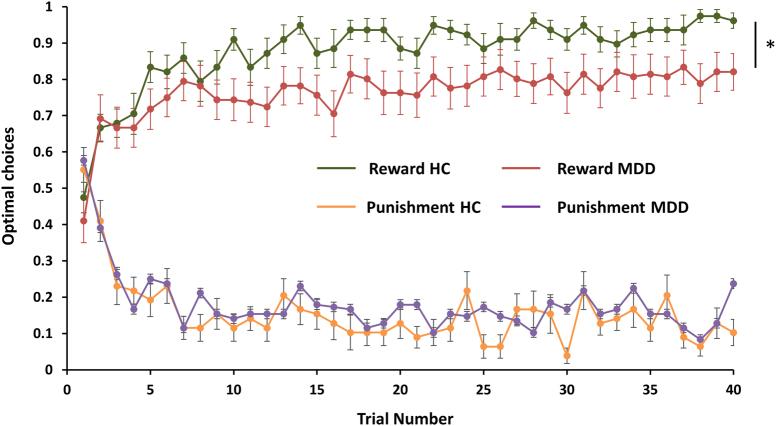
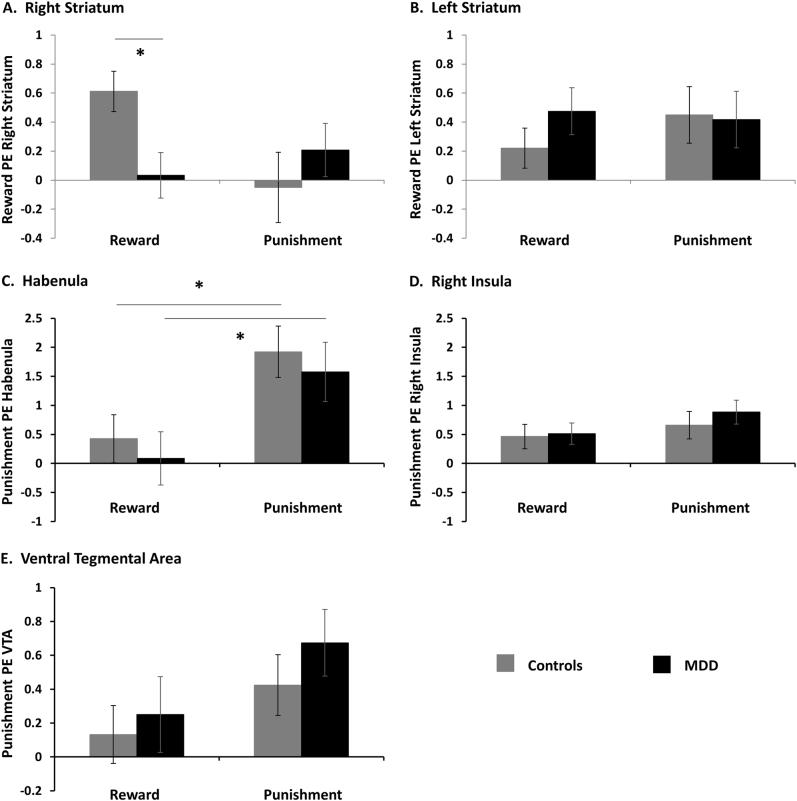
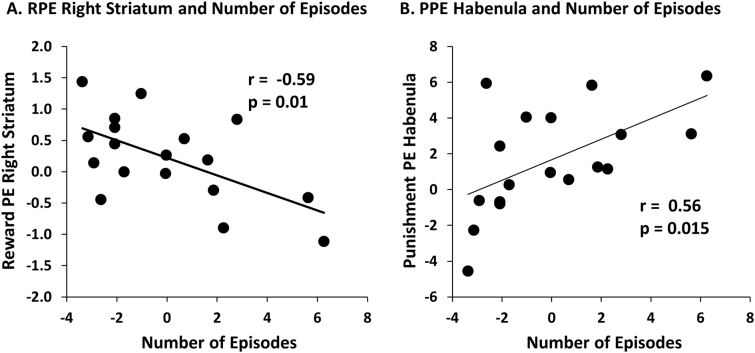
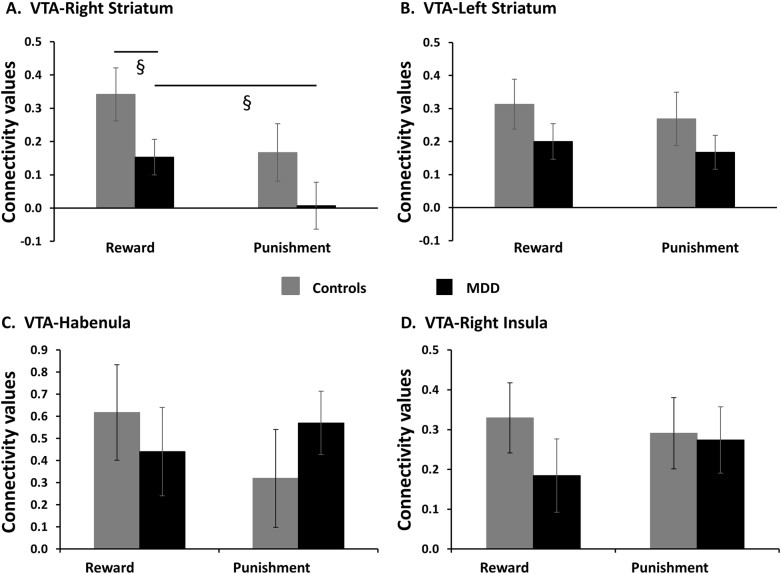
Anhedonia (hyposensitivity to rewards) and negative bias (hypersensitivity to punishments) are core features of major depressive disorder (MDD), which could stem from abnormal reinforcement learning. Emerging evidence highlights blunted reward learning and reward prediction error (RPE) signaling in the striatum in MDD, although inconsistencies exist. Preclinical studies have clarified that ventral tegmental area (VTA) neurons encode RPE and habenular neurons encode punishment prediction error (PPE), which are then transmitted to the striatum and cortex to guide goal-directed behavior. However, few studies have probed striatal activation, and functional connectivity between VTA-striatum and VTA-habenula during reward and punishment learning respectively, in unmedicated MDD. To fill this gap, we acquired fMRI data from 25 unmedicated MDD and 26 healthy individuals during a monetary instrumental learning task and utilized a computational modeling approach to characterize underlying neural correlates of RPE and PPE. Relative to controls, MDD individuals showed impaired reward learning, blunted RPE signal in the striatum and overall reduced VTA-striatal connectivity to feedback. Critically, striatal RPE signal was increasingly blunted with more major depressive episodes (MDEs). No group differences emerged in PPE signals in the habenula and VTA or in connectivity between these regions. However, PPE signals in the habenula correlated positively with number of MDEs. These results highlight impaired reward learning, disrupted RPE signaling in the striatum (particularly among individuals with more lifetime MDEs) as well as reduced VTA-striatal connectivity in MDD. Collectively, these findings highlight reward-related learning deficits in MDD and their underlying pathophysiology.
Overview
The claims and statistics of this paper haven’t been checked yet.
Free: it reads the open-access text and checks the first 5 claims that cite a source we can check. Create a free account to check every claim.
Integrity signals
Registry
Cites
Statistics
Figures
Verification
Claims the paper makes
The claims and statistics of this paper haven’t been checked yet.
Free: it reads the open-access text and checks the first 5 claims that cite a source we can check. Create a free account to check every claim.
Claims other papers make about this one
Each is checked against this paper’s own text: does it say what the citing paper says it does?
The source backs part of the claim, not all of it — or backs it for a different population, condition or comparison.
In the citing paper
“For example, dopaminergic projections from the VTA to the nucleus accumbens (NAc), prefrontal cortex (PFC), amygdala and hippocampus that regulate responses to rewarding or aversive stimuli are reportedly dysregulated in people with MDD as well as in rodent models of chronic stress39–42.”
From Central regulation of stress-evoked peripheral immune responses (2023) · cites this paper as [41]
Experimental — accuracy not yet measuredThe source backs part of the claim, not all of it — or backs it for a different population, condition or comparison.
In the citing paper
“Notably, several of these bone marrow-innervating brain regions have been implicated in stress responses, reward processing and the pathogenesis of depression and anxiety disorders.”
From Central regulation of stress-evoked peripheral immune responses (2023) · cites this paper as [41]
Experimental — accuracy not yet measuredThe source backs part of the claim, not all of it — or backs it for a different population, condition or comparison.
In the citing paper
“Unmedicated MDD patients show deficits in reward learning, reduced responses in the ventral striatum for positive prediction errors in a reward task, and reduced NAc-VTA connectivity [247,248].”
From Plasticity of synapses and reward circuit function in the genesis and treatment of depression (2023) · cites this paper as [247]
Experimental — accuracy not yet measuredThe source backs part of the claim, not all of it — or backs it for a different population, condition or comparison.
In the citing paper
“Individuals with depression often display emotionally biased prediction-error processing, characterized by attenuated reward prediction-error signals and heightened sensitivity to punishment- or risk-related prediction errors (Kumar et al., 2018; Rouhani and Niv, 2019).”
From Listen to your inner body: embodied emotions in predictive neuroscience and traditional East Asian medicine (2026) · cites this paper as Kumar et al., 2018
Experimental — accuracy not yet measuredThe source backs part of the claim, not all of it — or backs it for a different population, condition or comparison.
In the citing paper
“These studies have generally linked MDD to blunted RPE in the ventral and dorsal striatum [122-124] (but see [125,126] for important lack of replication), pgACC [127] and medial OFC [126], and greater RPE in the ventral striatum predicted reductions in anhedonia 6 months later [128].”
From Prefrontal cortex and depression (2022) · cites this paper as [123]
Experimental — accuracy not yet measured
1 more claim about this paper
Create a free account to see every claim other papers make about this one.
Self-check
Percentages, sums and reported differences re-computed from the paper’s own numbers.
The self-check needs the paper’s full text.
Citations
Cites
Reinforcement Learning: An Introduction
Sutton, R. S., & Barto, A. G. (1998) · IEEE Transactions on Neural Networks · doi:10.1109/tnn.1998.712192 · Cited by 27,225 · cited 1×
“A standard Q-learning algorithm calculated the expected value of choices and PE based on individual’s choice and feedback history [38].”
MethodReinforcement Learning: An Introduction
(2005) · IEEE Transactions on Neural Networks · doi:10.1109/tnn.2004.842673 · Cited by 24,496
A neural substrate of prediction and reward
Schultz, W., Dayan, P., & Montague, P. R. (1997) · Science · doi:10.1126/science.275.5306.1593 · Cited by 9,388 · cited 1×
“These midbrain DA RPE signals are then transmitted to the striatum and cortex and used to update stimulus-action values and guide goaldirected behavior [4, 5].”
MethodBeck, A. T., Steer, R. A., & Brown, G. (2011) · PsycTESTS Dataset · doi:10.1037/t00742-000 · Cited by 7,535
Ferrari, A. J., Charlson, F. J., Norman, R. E., Patten, S. B., Freedman, G., Murray, C. J. L., Vos, T., & Whiteford, H. A. (2013) · PLoS Medicine · doi:10.1371/journal.pmed.1001547 · Cited by 3,115
A scale for the assessment of hedonic tone the Snaith-Hamilton pleasure scale
Snaith, R. P., Hamilton, M., Morley, S., Humayan, A., Hargreaves, D., & Trigwell, P. (1995) · British Journal of Psychiatry · doi:10.1192/bjp.167.1.99 · Cited by 1,778 · cited 2×
“In a separate session, participants completed an instrumental RL task whilst in the fMRI scanner, as well as the Beck Depression Inventory-II (BDIII; [36]) and the Snaith Hamilton Pleasure Scale (SHPS; [37]) to assess depressive and anhedonic symptoms.”
MethodDopamine-dependent prediction errors underpin reward-seeking behaviour in humans
Pessiglione, M., Seymour, B., Flandin, G., Dolan, R. J., & Frith, C. D. (2006) · Nature · doi:10.1038/nature05051 · Cited by 1,584 · cited 2×
“As prior studies have reported PPE signals in the right insula [9] and habenula [17–19], a right insula mask was created by drawing a sphere with 10 mm diameter around the peak voxel (40, 28, −6) reported in a prior study using a similar task [9].”
MethodA century of trends in adult human height
NCD Risk Factor Collaboration (NCD-RisC) (2016) · eLife · doi:10.7554/elife.13410 · Cited by 1,558
McLaren, D. G., Ries, M. L., Xu, G., & Johnson, S. C. (2012) · NeuroImage · doi:10.1016/j.neuroimage.2012.03.068 · Cited by 1,445 · cited 5×
“Since animal studies have highlighted VTAstriatum and VTA-habenula pathways during reward and punishment learning, respectively, generalized PPI [41] was conducted using the VTA as the seed region.”
MethodInfluentialTwo types of dopamine neuron distinctly convey positive and negative motivational signals
Matsumoto, M., & Hikosaka, O. (2009) · Nature · doi:10.1038/nature08028 · Cited by 1,378 · cited 2×
“In addition, owing to preclinical evidence and initial human data highlighting the role of VTA-striatal and VTA-habenula connectivity during reward [30–33] and punishment learning [12, 14], respectively, psychophysiological interaction (PPI) analyses were implemented to probe functional connectivity among these region…”
Background
Research works printed but not linked: 1
- First MB, Spitzer RL, Miriam G, Williams JB. Structured Clinical Interview for DSM-IV-TR Axis I Disorders, Research Version, Non-patient Edition. (SCID-I/NP). New York: Biometrics Research, New York State Psychiatric Institute; 2002.
Cited by
Items 101–200 of 239
The habenula in mood disorders: A systematic review of human studies
Fortin, J., Lafleur, M., Parisien, C., & Hétu, S. (2025) · Molecular Psychiatry · doi:10.1038/s41380-025-03105-x · Cited by 15
CBT for difficult-to-treat depression: self-regulation model
Barton, S. B., Armstrong, P. V., Robinson, L. J., & Bromley, E. H. C. (2023) · Behavioural and Cognitive Psychotherapy · doi:10.1017/s1352465822000273 · Cited by 13
“When depressed mood persists, approach motivation is impaired: there is reduced positive anticipation, lower reward expectancies and weakened impulses towards desired states (Frey and McCabe, 2020; Kumar et al. , 2018; Sherdell et al ., 2012; Wu et al ., 2017).”
BackgroundMacoveanu, J., Meluken, I., Chase, H. W., Phillips, M. L., Kessing, L. V., Siebner, H. R., Vinberg, M., & Miskowiak, K. W. (2021) · Psychological Medicine · doi:10.1017/s0033291720000367 · Cited by 12
“low-risk twins may be interpreted as impaired error-dependent reward learning as previously suggested in different psychiatric conditions (Gradin et al., 2011; Kumar et al., 2018; White et al., 2013).”
BackgroundResultHoang, G.-H. L., Hecker, K. G., Maxey, C., Burles, F., Krigolson, O. E., & Kopala‐Sibley, D. C. (2024) · Biological Psychiatry Cognitive Neuroscience and Neuroimaging · doi:10.1016/j.bpsc.2024.10.017 · Cited by 16
Anhedonia in Nicotine Dependence
Gilbert, D. G., & Stone, B. M. (2022) · Current topics in behavioral neurosciences · doi:10.1007/7854_2022_320 · Cited by 13
Spaeth, A. M., Koenig, S., Everaert, J., Glombiewski, J. A., & Κube, T. (2024) · Frontiers in Psychology · doi:10.3389/fpsyg.2024.1253045 · Cited by 12
Morris, L. S., Costi, S., Hameed, S., Collins, K. A., Stern, E. R., Chowdhury, A., Morel, C., Salas, R., Iosifescu, D. V., Han, M., et al. (2025) · Molecular Psychiatry · doi:10.1038/s41380-025-02957-7 · Cited by 11
“In our translational human studies, we [45], and others [18, 46] have observed hyper-connectivity within both the mesolimbic and mesocortical pathway in individuals with depression, although fi ndings in humans around mesolimbic connectivity have been mixed [47 – 49].”
Leveraging Decision Science to Characterize Depression
Mukherjee, D., van Geen, C., & Kable, J. W. (2023) · Current Directions in Psychological Science · doi:10.1177/09637214231194962 · Cited by 11
“…next section, impaired reinforcement learning is strongly supported in the literature (Halahakoon et al., 2020; Pike & Robinson, 2022) and can often be detected with simple measures of performance (such as we used in this study) without the use of computational modeling (e.g., Kumar et al., 2018).”
MethodChen, Y., Jia, L., Gao, W., Wu, C., Mu, Q., Fang, Z., Hu, S., Huang, M., Zhang, P., & Lu, S. (2023) · BMC Psychiatry · doi:10.1186/s12888-023-05146-4 · Cited by 12
“In MDD patients, it was reported that reward-related learning deficits was associated with striatal-mid-brain connectivity [26].”
BackgroundWerlen, E., Shin, S.-L., Gastambide, F., François, J., Tricklebank, M. D., Marston, H. M., Huxter, J. R., Gilmour, G., & Walton, M. E. (2019) · Neuropsychopharmacology · doi:10.1038/s41386-019-0564-8 · Cited by 11
Martin, D. A., Delgado, A. M., & Calu, D. J. (2024) · Neuropsychopharmacology · doi:10.1038/s41386-024-01912-4 · Cited by 11
Modelling mood updating: a proof of principle study
Clark, J. E., & Watson, S. (2022) · The British Journal of Psychiatry · doi:10.1192/bjp.2022.175 · Cited by 11
DiMarco, E. K., Sadibolova, R., Jiang, A., Liebenow, B., Jones, R., Haq, I. U., Siddiqui, M., Terhune, D. B., & Kishida, K. T. (2023) · Parkinsonism & Related Disorders · doi:10.1016/j.parkreldis.2023.105800 · Cited by 7
Aloi, J. M., Crum, K. I., Blair, K. S., Zhang, R., Bashford‐Largo, J., Bajaj, S., Hwang, S., Averbeck, B. B., Tottenham, N., Dobbertin, M. D., et al. (2024) · Psychological Medicine · doi:10.1017/s0033291724002411 · Cited by 8
“…alcohol use disorder (Blair et al., 2022a, 2022b), disruptive behavior disorders (White et al., 2013), ADHD (Grimm et al., 2021) and depression (Kumar et al., 2018), it will be important to disentangle how impairments in RPE signaling might mediate the relationship between early life neglect…”
Yang, J., Bai, W., Guo, T., Zhang, L., Li, Y., Liu, H., Du, X., Cai, H. X., Balbuena, L., An, F., et al. (2022) · Journal of Affective Disorders · doi:10.1016/j.jad.2022.06.067 · Cited by 8
Impact of pubertal timing and depression on error‐related brain activity in anxious youth
Peters, A. T., Burkhouse, K. L., Kujawa, A., Afshar, K., Fitzgerald, K. D., Monk, C. S., Hajcak, G., & Phan, K. L. (2018) · Developmental Psychobiology · doi:10.1002/dev.21763 · Cited by 7
“For instance, enhanced neural activity supporting the monitoring and salience of one’s performance could be an adaptive and compensatory response to the tendency of depressed indi‐ viduals to exhibit reduced sensitivity to reward and reinforcement (Kumar et al., 2018).”
Pizzagalli, D. A. (2026) · Nature Mental Health · doi:10.1038/s44220-026-00631-7 · Cited by 7
“102–104) and ventral striatal activation has emerged when rewards are utilized to learn reward contingencies 105 .”
Self-citationŚciślewska, P., Zareba, M. R., Lengier, J., Schirmer, A. E., Bębas, P., & Szatkowska, I. (2025) · Scientific Reports · doi:10.1038/s41598-025-07049-8 · Cited by 7
Treatment-resistant recurrent unipolar and bipolar depression: associative learning abnormalities
Suveges, S., Wang, Y., Tolomeo, S., Gilbertson, T., & Steele, J. D. (2025) · Brain · doi:10.1093/brain/awaf280 · Cited by 6
“Another a potential limitation might have been lack of performance-related payments, but many previous studies 14,15,17,21,22 have demonstrated the feasibility of using binary outcome feedback.”
InfluentialA systematic review of the pharmacological modulation of autobiographical memory specificity
Cawley, E., Piazza, G. G., Das, R., & Kamboj, S. K. (2022) · Frontiers in Psychology · doi:10.3389/fpsyg.2022.1045217 · Cited by 6
“, 2020) and impaired or overgeneralized encoding of experiences (Dillon and Pizzagalli, 2018; Kumar et al., 2018; Murphy et al., 2019; Ai et al., 2020).”
BackgroundDing, Y., Ou, Y., Yan, H., Liu, F., Li, H., Li, P., Xie, G., Cui, X., & Guo, W. (2023) · Biomedicines · doi:10.3390/biomedicines11123138 · Cited by 7
Borchers, L. R., Dan, R., Belleau, E. L., Kaiser, R. H., Clegg, R. A., Goer, F., Pechtel, P., Beltzer, M., Wooten, D., Fakhri, G. E., et al. (2025) · Molecular Psychiatry · doi:10.1038/s41380-025-03218-3 · Cited by 6
“Further, MDD and ELS have been linked to altered resting-state functional connectivity (rsFC) patterns of the bilateral putamen [17], activation in the caudate [18, 19], activation in the nucleus accumbens (NAcc; [2, 20]), and activation and rsFC of the ventral tegmental area (VTA; [14]).”
Self-citationTian, Y., Cui, Y., Liu, L., Chen, C., Liu, Z., Li, W., Wang, J., Luo, X., Wen, X., Yang, C., et al. (2025) · BMC Psychiatry · doi:10.1186/s12888-025-07271-8 · Cited by 5
“Several clinical studies have shown that, compared with healthy controls, patients with MDD have impaired reward-related learning signals in the ventral tegmental area and blunted reward prediction error signals in the striatum [49, 50].”
Tong, G., Chen, Y., & Liang, Y. (2024) · Guidelines and Standards of Chinese Medicine · doi:10.1097/gscm.0000000000000031 · Cited by 6
“Studies on major depressive disorder patients indicated impaired reward learning and connectivity between VTA and NAc [25,26] .”
Gilley, E., Bowirrat, A., Gupta, A., Giordano, J., Dennen, C. A., Braverman, E. R., Badgaiyan, R. D., McLaughlin, T., Baron, D. A., & Blum, K. (2023) · Current Pharmaceutical Biotechnology · doi:10.2174/1389201024666230427111117 · Cited by 5
Vitkauskas, M., & Mathuru, A. S. (2020) · International Journal of Molecular Sciences · doi:10.3390/ijms21186525 · Cited by 5
“Studies that examined MDD patients compared to matched controls have yielded mixed results [10,71].”
BackgroundResultTask MRI-Based Functional Brain Network of Major Depression
Lai, C. (2021) · Advances in experimental medicine and biology · doi:10.1007/978-981-33-6044-0_2 · Cited by 5
Sahni, A., Frey, A.-L., & McCabe, C. (2025) · Psychological Medicine · doi:10.1017/s0033291725102523 · Cited by 6
“Deficits in reward learning have also been observed in depression (Kumar et al., 2018; Thomsen, 2015) and have been linked to anhedonia (Kangas, Der-Avakian, & Pizzagalli, 2022).”
Granger, S. J., Olson, E. A., Weinstein, S. J., Vratimos, I. R., Lynch, B., Ren, B., & Rosso, I. M. (2025) · Cognitive Affective & Behavioral Neuroscience · doi:10.3758/s13415-024-01252-2 · Cited by 4
“…and major depressive disorder (MDD) often experience difficulties recalling specific life events, a phenomenon termed “overgeneral” autobiographical memory (Dalgleish et al., 2007; Dillon & Pizzagalli, 2018; Moore & Zoellner, 2007; Ono et al., 2016; Schönfeld & Ehlers, 2017; Williams et al., 2007).”
Influentialvan Gool, R., Cay, M., van der Heijden, H. C., Golden, E., Cao, A., Ren, B., Gonzalez–Heydrich, J., Shinn, A. K., & Upadhyay, J. (2025) · Journal of Neuroscience · doi:10.1523/jneurosci.0039-25.2025 · Cited by 4
A comparison of ‘pruning’ during multi-step planning in depressed and healthy individuals
Faulkner, P., Huys, Q. J. M., Renz, D., Eshel, N., Pilling, S., Dayan, P., & Roiser, J. P. (2021) · Psychological Medicine · doi:10.1017/s0033291721000799 · Cited by 5
“While the current depressed participants exhibited similar levels of depression to those in studies that report maladaptive decision-making in depression (Joormann & Gotlib, 2008; Kumar et al., 2018; McFarland & Klein, 2009; Ubl et al., 2015), they were all Fig.”
BackgroundResultAn Overview of Machine Learning Applications in Mood Disorders
Topolski, N., Jeong, S. H., & Mwangi, B. (2021) · Cambridge University Press eBooks · doi:10.1017/9781108623018.017 · Cited by 4
Hoffman, L. J., Foley, J. M., Leong, J. K., Sullivan‐Toole, H., Elliott, B. L., & Olson, I. R. (2023) · bioRxiv (Cold Spring Harbor Laboratory) · doi:10.1101/2023.09.29.560239 · Cited by 4
“Diminished responsivity to rewards and deficits in goal-directed behaviors are important features of depression (Paulus, 2015; Rizvi, Lambert, & Kennedy, 2018) and there is evidence of blunted reward signaling in depressed individuals (Kumar et al., 2018; Kumar et al., 2008).”
BackgroundXia, Y.-F., Zhong, Y., Cheng, Z.-J., Cong, E., Xu, Y., & Zhang, R. (2026) · Psychoradiology · doi:10.1093/psyrad/kkag015 · Cited by 3
“Some findings indicate that MDD is often associated with reduced reward sensitivity (Alloy et al. , 2016 ; Takamura et al. , 2017 ; Kumar et al. , 2018 ), whereas BD, particularly in manic states, involves heightened sensitivity to reward (Mason et al. , 2012 ; Caseras et al. , 2013 ; Damme et al.…”
InfluentialSubcomponents of reward processing in adolescent anhedonia
Ma, X., Sahni, A., & McCabe, C. (2026) · Nature Reviews Psychology · doi:10.1038/s44159-026-00534-5 · Cited by 3
Singh, S., Cunningham, J. E. A., Uher, R., Becker, S., & Nunes, A. (2026) · Neuroscience & Biobehavioral Reviews · doi:10.1016/j.neubiorev.2026.106652 · Cited by 3
Hippocampus carbonic anhydrase 1 via ERK pathway may be involved in depressive like behaviors
Cheng, K., Chen, C., Deng, S., Xu, F., Chen, X., Yang, J., Wang, G., & Xie, P. (2024) · Journal of Affective Disorders · doi:10.1016/j.jad.2024.12.064 · Cited by 3
Morphological profiles of fatigue in Sarcoidosis patients
Schnellbächer, G. J., Kettenbach, S., Loeffler, L. A. K., Dreher, M., Habel, U., & Votinov, M. (2021) · Psychiatry Research Neuroimaging · doi:10.1016/j.pscychresns.2021.111325 · Cited by 3
Mood Disorders: Brain Imaging and Therapeutic Implications
Selvaraj, S., Brambilla, P., & Soares, J. C. (2021) · Cambridge University Press eBooks · doi:10.1017/9781108623018 · Cited by 4
From Complexity to Precision—Charting Decision-Making Through Normative Modeling
Kumar, P., Dayan, P., & Wolfers, T. (2023) · JAMA Psychiatry · doi:10.1001/jamapsychiatry.2023.4611 · Cited by 3
Self-citationThe effect of emotional faces on reward-related probability learning in depressed patients
Gökçelli, D. K., Kizilates-Evin, G., Eroglu-Koc, S., Oğuz, K., Eraslan, C., Kitiş, Ö., & Gönül, A. S. (2024) · Journal of Affective Disorders · doi:10.1016/j.jad.2024.01.247 · Cited by 3
Disorders of compulsivity: Deficits in arbitrating learning strategies
Ruan, Z., Liu, S., Liu, Y. A., Yang, Q., & Peng, Z. (2024) · Addiction Biology · doi:10.1111/adb.13433 · Cited by 5
“Previous studies have found impaired representation of RPE in patients with MDD 35,36 and people with subclinical depression, 37 as compulsivity often comorbidly accompanies depression.”
BackgroundOn the misery of cognitive effortPreprint
Chen, J., Huys, Q. J. M., Stringaris, A. K., & Nielson, D. M. (2023) · PsyArXiv (OSF Preprints) · doi:10.31234/osf.io/r9e4j · Cited by 3
Research Progress on Neural Circuit Mechanisms of Depression
Gong, W. (2023) · BIO Web of Conferences · doi:10.1051/bioconf/20236002021 · Cited by 2
Effects of Psilocybin on Mouse Brain Microstructure
Frautschi, P. C., Singh, A. P., Stowe, N. A., Grady, S. M., Zahid, Z., Banks, M. I., & Yu, J. J. (2025) · American Journal of Neuroradiology · doi:10.3174/ajnr.a8634 · Cited by 3
Rapo, E., Milde, C., Glombiewski, J. A., & Κube, T. (2025) · Behaviour Research and Therapy · doi:10.1016/j.brat.2025.104872 · Cited by 2
Yin, M., Shi, H., Lv, C., Shi, L., Xie, L., Yu, G., & Xu, K. (2025) · Medicine Plus · doi:10.1016/j.medp.2025.100104 · Cited by 2
Enten, L., DeMarco, A., Kline, R., Globisch, F. M., Dunsmoor, J. E., Cisler, J. M., Nemeroff, C. B., & Fonzo, G. A. (2025) · Neuropsychopharmacology · doi:10.1038/s41386-025-02276-z · Cited by 2
“Although the neural correlates of traditional PEs (deviations in magnitude or type of reward) have been extensively studied in healthy individuals [51 – 53] and to a lesser extent in both PTSD [32] and MDD [54, 55], the neural signaling of temporal PEs is less well investigated.”
Computational modeling reveals cognitive processes in simple rodent depression tests
Li, Z., Lu, T., Yan, J., Zhang, X., & Li, Y. (2025) · Cell Reports Methods · doi:10.1016/j.crmeth.2025.101246 · Cited by 2
Neural and psychosocial signatures of the comorbidity between pain and affective symptoms
Scarlatti, F., Dormegny-Jeanjean, L. C., Schefzik, R., Foucher, J., Banaschewski, T., Bokde, A. L. W., Brühl, R., Desrivières, S., Garavan, H., Gowland, P. A., et al. (2025) · PAIN Reports · doi:10.1097/pr9.0000000000001353 · Cited by 3
Thanarajah, S. E., Uckermark, C., Molter, F., Schiweck, C., Meyer, K., Aichholzer, M., Bouzouina, A., Forbes, P., Allen, M., Oehrn, C., et al. (2026) · Neuroscience Applied · doi:10.1016/j.nsa.2025.106317 · Cited by 2
Wan, Z., Li, X., Fang, Y., Zeng, C., & Shen, M. (2026) · Cureus · doi:10.7759/cureus.102749 · Cited by 2
“Additionally, abnormalities in the dopaminergic circuit of the basal ganglia-limbic system can worsen depression by affecting reward and emotion regulation [12].”
Neural Correlates of Decision Variables and Strategic Preferences
Venkatraman, V., & Beard, E. C. (2020) · Springer eBooks · doi:10.1007/978-3-030-45500-2_2 · Cited by 2
Neuroimaging Studies of Effects of Psychotherapy in Depression
Bauer, I. E., & Meyer, T. D. (2021) · Cambridge University Press eBooks · doi:10.1017/9781108623018.021 · Cited by 2
Pramipexole for the Treatment of Depression: Efficacy and Mechanisms
Halahakoon, D. C., & Browning, M. D. (2023) · Current topics in behavioral neurosciences · doi:10.1007/7854_2023_458 · Cited by 2
于, 雅. (2024) · Advances in Clinical Medicine · doi:10.12677/acm.2024.142463 · Cited by 2
Neuroimaging and Circuit Mechanisms of Depression
Romer, A. L., Bertocci, M. A., Phillips, M. L., & Pizzagalli, D. A. (2025) · Oxford University Press eBooks · doi:10.1093/med/9780197640654.003.0029 · Cited by 2
Self-citationElectrophysiological Biomarkers for Mood Disorders
Ramakrishnan, N., Murphy, N., Selvaraj, S., & Cho, R. Y. (2021) · Cambridge University Press eBooks · doi:10.1017/9781108623018.015 · Cited by 2
From memory disorders to the development of depression: A system approach
Grigoryan, G. A. (2025) · Biosystems · doi:10.1016/j.biosystems.2025.105440 · Cited by 1
Aberrant Aversive Learning Signals in the Habenula in Remitted Patients With Recurrent Depression
de Klerk‐Sluis, J. M., Geugies, H., Mocking, R. J. T., Figueroa, C. A., Groot, P. F. C., Marsman, J.-B. C., van Eijndhoven, P., Geurts, D. E. M., & Ruhé, H. G. (2025) · Biological Psychiatry Cognitive Neuroscience and Neuroimaging · doi:10.1016/j.bpsc.2025.04.006 · Cited by 1
Cao, J., Chen, X., Chen, J., Li, X., Ai, M., Wang, W., Gan, Y., He, J.-L., Qiu, H., & Kuang, L. (2025) · BMC Psychiatry · doi:10.1186/s12888-025-07695-2 · Cited by 1
“Previous task fMRI studies found decreased FC between the VTA and striatum in patients with MDD during reward outcome in monetary instrumental learning task compared to healthy individuals [58], which indicates a reward-related deficit in MDD and the underlying disrupted VTA-NAc circuit.”
Kim, Y. E., Lim, H. R., & Lee, T. (2026) · Investigative Magnetic Resonance Imaging · doi:10.13104/imri.2025.0049 · Cited by 1
Ding, Y., Chen, Y., Tian, Y. H., Li, Z., Yang, H., Fang, K., Wen, B., Zheng, R., Li, S., Wei, Y., et al. (2026) · BMC Psychiatry · doi:10.1186/s12888-026-08307-3 · Cited by 1
Zou, F., Yang, X., Liu, C., Li, K., & Zhang, M. (2026) · Biological Psychiatry Global Open Science · doi:10.1016/j.bpsgos.2026.100786 · Cited by 2
“Korn et al. (39) reported reduced optimistic belief updating in depression, and Kumar et al. (40) found impaired reward prediction error encoding and reduced striatal-midbrain connectivity in unmedicated MDD. Ecological momentary assessment (EMA) further supports a daily-life reward loop in which…”
Röhlinger, M., Vahedi, J., & Bellebaum, C. (2026) · Psychophysiology · doi:10.1111/psyp.70228 · Cited by 1
“Besides trying to replicate findings of impaired learning (Admon et al. 2017; Bakic et al. 2017; Kumar et al. 2018; Kunisato et al. 2012; Macoveanu et al. 2014; Pechtel et al. 2013; Pizzagalli et al. 2005, 2008) and reduced differentiations between positive and negative feedback in FRN amplitudes…”
InfluentialEckstrand, K., Talbot, A., Govani, V. N., Hart, K. H., Brodnick, Z. M., Ryan, N. D., Jones, N. P., Phillips, M. L., & Forbes, E. E. (2026) · European Journal of Psychotraumatology · doi:10.1080/20008066.2025.2611512 · Cited by 2
“Lower VS activity is observed in youth with depression (Kumar et al., 2018; Macoveanu et al., 2021; White et al., 2017) and is associated with depression severity (Greenberg et al., 2015) in many, but not all (see [Miller et al., 2015]), studies.”
The reins of the midbrain: Task-based habenula function in healthy humans
Surroca-López, A., Medina-Osuna, F., Steward, T., & Soriano‐Mas, C. (2026) · Neuroscience & Biobehavioral Reviews · doi:10.1016/j.neubiorev.2026.106889 · Cited by 1
Morris, L. S., Beltran, J., Kvamme, T. L., Chowdhury, A., Butler, G., Adams, A., Patel, T., Obie, E., Fontaine, S., Corniquel, M. B., et al. (2026) · Molecular Psychiatry · doi:10.1038/s41380-026-03911-x · Cited by 1
Brain Imaging and the Mechanisms of Antidepressant Action
Godlewska, B. R., Selvaraj, S., & Cowen, P. J. (2021) · Cambridge University Press eBooks · doi:10.1017/9781108623018.020 · Cited by 1
Effects of Lithium on Brain Structure in Bipolar Disorder
Kaur, J., Kafantaris, V., & Szeszko, P. R. (2021) · Cambridge University Press eBooks · doi:10.1017/9781108623018.018 · Cited by 1
Functional Connectome in Bipolar Disorder
Cha, J., & Anand, A. (2021) · Cambridge University Press eBooks · doi:10.1017/9781108623018.008 · Cited by 1
Neural markers of depression in MRI
Lai, C. (2021) · Elsevier eBooks · doi:10.1016/b978-0-12-817933-8.00037-2 · Cited by 1
Shen, Q., Fu, S., Jiang, X., Huang, X., Lin, D., Xiao, Q., Khadijah, S., Yan, Y., Xiong, X., Jin, J. K., et al. (2023) · Psychological Medicine · doi:10.1017/s0033291723001307 · Cited by 2
Κube, T., & Jakobs, S. (2023) · Verhaltenstherapie · doi:10.1159/000531150 · Cited by 1
“Aktuelle For-schungsarbeiten legen jedoch nahe, dass das erfahrungsbasierte Lernen bei Menschen mit Depressio-nen gestört sein kann [Everaert et al., 2018; Kumar et al., 2018; Kube et al., 2023].”
BackgroundThe Physiologic Basis of Neuromodulation
Wilson, T. J., & Butala, A. (2024) · Advances in Psychiatry and Behavioral Health · doi:10.1016/j.ypsc.2024.05.001 · Cited by 1
Cross-species dissection of the modular role of the ventral tegmental area in depressive disorders
Morris, L. S., Beltran, J., Murrough, J. W., & Morel, C. (2025) · Neuroscience · doi:10.1016/j.neuroscience.2025.02.008 · Cited by 1
Pizzagalli, D. A., Smoski, M. J., Ang, Y., Whitton, A. E., Sanacora, G., Mathew, S. J., Nürnberger, J. I., Lisanby, S. H., Iosifescu, D. V., Murrough, J. W., et al. (2021) · Neuropsychopharmacology · doi:10.1038/s41386-021-01145-9 · Cited by 1
Self-citationPellicano, G. R., Doorn, K. A., Anzolin, A., Arnone, D., & Borghini, G. (2023) · Frontiers in Psychiatry · doi:10.3389/fpsyt.2022.1091676 · Cited by 1
“Converging evidence suggests that altered resting-state functional connectivity (RSFC) in the nucleus accumbens (NAc) is involved in the reward system in patients with depressive disorders (17, 18).”
BackgroundReinforcement learning in Parkinson’s disease is not associated with inflammatory tonePreprint
Tichelaar, J. G., Verbeek, M. M., Kersten, I., Cools, R., & Helmich, R. C. G. (2023) · bioRxiv (Cold Spring Harbor Laboratory) · doi:10.1101/2023.09.28.557192 · Cited by 1
Morris, L. S., Beltran, J., Li, M., Jacob, Y., Butler, G., Mehta, M., Murrough, J. W., & Radulescu, A. (2025) · Research Square · doi:10.21203/rs.3.rs-7166201/v1 · Cited by 1
“Participants who made less than 50% correct choices across both reward and loss trials or failed to make any selection throughout the task were excluded as this may indicate task non-compliance 67 .”
Vaccarino, S. R. (2021) · TSpace (University of Toronto) · Cited by 1
Lee, S., Yoon, S.-I., Liao, H.-Y., Kim, J. W., Lee, I.-S., & Chae, Y. (2026) · Frontiers in Human Neuroscience · doi:10.3389/fnhum.2026.1807034
“Individuals with depression often display emotionally biased prediction-error processing, characterized by attenuated reward prediction-error signals and heightened sensitivity to punishment-or risk-related prediction errors (Kumar et al., 2018; Rouhani and Niv, 2019).”
Acute Stress Induces Changes in Reward Processes in Lateral Habenula in Mice
Wang, C. (2018) · eScholarship (California Digital Library)
Investigating Associations Between Early Life Stress, Neural Response to Reward, and Depression
Palacios‐Barrios, E. E. (2020) · D-Scholarship@Pitt (University of Pittsburgh)
Imaging Genetic and Epigenetic Markers in Mood Disorders
Poletti, S., Mazza, E. A., Vai, B., & Benedetti, F. (2021) · Cambridge University Press eBooks · doi:10.1017/9781108623018.012
Brain Imaging of Reward Dysfunction in Unipolar and Bipolar Disorders
Kumar, P., Jiang, Y., & Whitton, A. E. (2021) · Cambridge University Press eBooks · doi:10.1017/9781108623018.006
Self-citationResting-State Functional Connectivity in Unipolar Depression
Chen, Z., & Gong, Q. (2021) · Cambridge University Press eBooks · doi:10.1017/9781108623018.007
Brain Imaging Methods in Mood Disorders
Selvaraj, S., Brambilla, P., & Soares, J. C. (2021) · Cambridge University Press eBooks · doi:10.1017/9781108623018.002
Kious, B. M., & Renshaw, P. F. (2021) · Cambridge University Press eBooks · doi:10.1017/9781108623018.009
Neuroimaging Brain Inflammation in Mood Disorders
Meyer, J. H. (2021) · Cambridge University Press eBooks · doi:10.1017/9781108623018.011
Functional Near-Infrared Spectroscopy Studies in Mood Disorders
Matsuo, K., & Matsubara, T. (2021) · Cambridge University Press eBooks · doi:10.1017/9781108623018.014
Neuroanatomical Findings in Unipolar Depression and the Role of the Hippocampus
Arnone, D. (2021) · Cambridge University Press eBooks · doi:10.1017/9781108623018.003
Neuroimaging Biomarkers in Pediatric Mood Disorders
West, M. P., Tang, W. J., & Singh, M. K. (2021) · Cambridge University Press eBooks · doi:10.1017/9781108623018.005
fMRI Neurofeedback as Treatment for Depression
Skottnik, L., & Linden, D. E. J. (2021) · Cambridge University Press eBooks · doi:10.1017/9781108623018.013
Neuroanatomical Findings in Bipolar Disorder
Tronchin, G., & McDonald, C. (2021) · Cambridge University Press eBooks · doi:10.1017/9781108623018.004
Imaging Glutamatergic and GABAergic Abnormalities in Mood Disorders
Scotti-Muzzi, E., Otaduy, M. C. G., Soeiro‐de‐Souza, M. G., & Machado‐Vieira, R. (2021) · Cambridge University Press eBooks · doi:10.1017/9781108623018.010
Molecular Imaging of Dopamine and Antipsychotics in Bipolar Disorder
Jauhar, S. (2021) · Cambridge University Press eBooks · doi:10.1017/9781108623018.019
Magnetoencephalography Studies in Mood Disorders
Nugent, A. C. (2021) · Cambridge University Press eBooks · doi:10.1017/9781108623018.016
Cui, Z. (2021) · VTechWorks (Virginia Tech)
Selvaraj, S., Brambilla, P., & Soares, J. C. (2021) · Cambridge University Press eBooks · doi:10.1017/9781108623018.022
Metadata
- Authors
- Kumar, P., Goer, F., Murray, L., Dillon, D. G., Beltzer, M. L., Cohen, A. L., Brooks, N. H., & Pizzagalli, D. A.
- Affiliations
- Harvard University (US)
- McLean Hospital (US)
- Corresponding author
- Kumar, Poornima
- Pizzagalli, Diego A.
- ORCID
- Venue
- Neuropsychopharmacology
- Published
- 2018-02-26
- Volume
- 43
- Issue
- 7
- Pages
- 1581-1588
- ISSN
- 0893-133X (ISSN-L)
- 1740-634X
- PMC
- PMC5983542
- OpenAlex
- W2792163321
- Cited by
- 219
- References
- 56
- Citations by year
- 2026: 20 · 2025: 29 · 2024: 17 · 2023: 31 · 2022: 24 · 2021: 53 · 2020: 18 · 2019: 20 · 2018: 7
- FWCI
- 14.59
- Type
- journal article
- Language
- en
- Open access
- hybrid
- doi.org
- Licence
- cc-by
- creativecommons.org/licenses/by/4.0 (tdm)
- Locations
- Neuropsychopharmacology (publishedVersion, cc-by)
- Europe PMC (PubMed Central) (publishedVersion, other-oa)
- PubMed Central (publishedVersion, cc-by)
- PubMed (publishedVersion)
- Digital Access to Scholarship at Harvard (DASH) (Harvard University) (submittedVersion, cc-by)
- Funders
- Pfizer
- McLean Hospital
- National Alliance for Research on Schizophrenia and Depression
- National Institutes of Health
- National Institute of Mental Health (R00MH094438, K99MH094438, R01MH068376, MH068376, R37MH068376)
- Topics
- Life Sciences › Neuroscience › Cognitive Neuroscience › Neural and Behavioral Psychology Studies
- Life Sciences › Neuroscience › Cellular and Molecular Neuroscience › Neurotransmitter Receptor Influence on Behavior
- Health Sciences › Medicine › Pharmacology (medical) › Treatment of Major Depression
- Keywords
- major depressive disorder, reward prediction error, anhedonia, negative bias, reward learning, striatum, ventral tegmental area, habenula, reinforcement learning, computational modeling, number of depressive episodes
- MeSH terms
- Adult, Computer Simulation, Conditioning, Operant, Corpus Striatum, Depressive Disorder, Major, Major Depressive Disorder, Female, Humans, Magnetic Resonance Imaging, Male, Neural Pathways, Predictive Value of Tests, Punishment, Reward, Case-Control Studies, Ventral Tegmental Area, Habenula, Young Adult
About these checks
Registry, retraction, Cites and statistics results are computed, not judged, with one exception: a printed reference that no index lists is read once by a model before it counts as a citation error. Claims are extracted by a model and kept only when their quote appears verbatim in the text; each cited source is then checked, with a model’s help, for whether it says what the claim relies on. Those verdicts can be wrong — read the claim’s quote and the cited source before relying on one.
Statistics and arithmetic are recomputed, not judged.
Confidence bands are shown only for fields calibrated on our annotated test set. None is calibrated yet, so no band is shown.
What counts as a claim ›How we measure confidence ›How we check this ›
Are you an author, or do you see a problem with this page? Request a review
Data sources
Bibliographic data: Semantic Scholar, OpenAlex, Crossref.
Contains information from the Semantic Scholar Academic Graph Datasets, made available under the ODC Attribution License (ODC-BY 1.0).
Semantic Scholar’s data is described in: Kinney, R., et al. (2023). The Semantic Scholar Open Data Platform. arXiv:2301.10140.
