

Impaired reward prediction error encoding and striatal-midbrain connectivity in depression
Open accessThe DOI matches its Crossref record; 55 of the 56 references it cites were found in a registry or an index.
Abstract
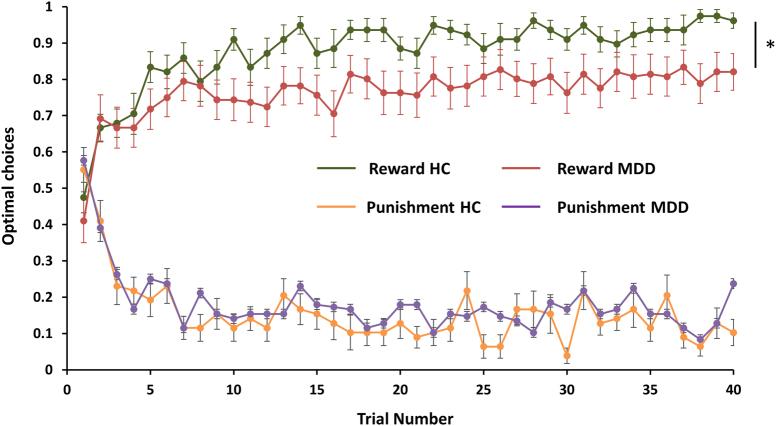
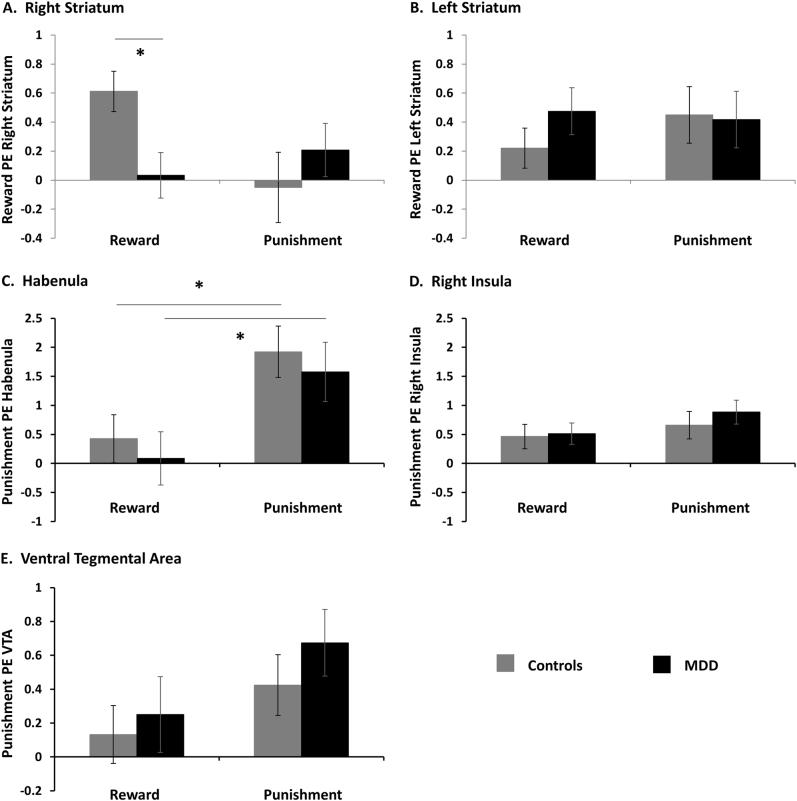
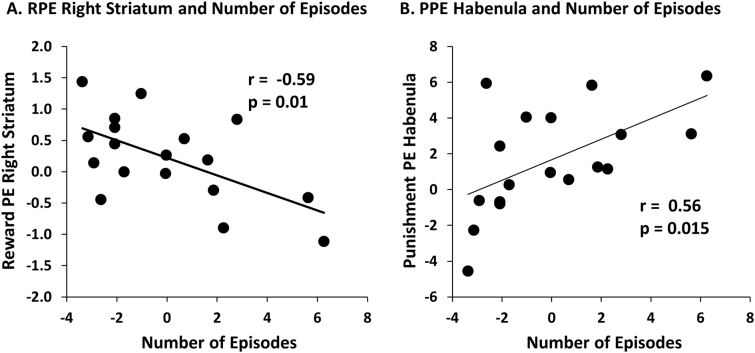
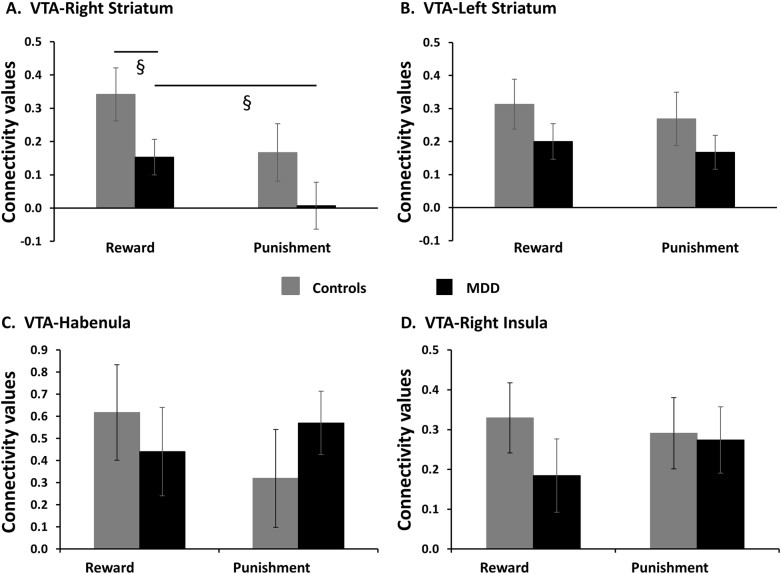
Anhedonia (hyposensitivity to rewards) and negative bias (hypersensitivity to punishments) are core features of major depressive disorder (MDD), which could stem from abnormal reinforcement learning. Emerging evidence highlights blunted reward learning and reward prediction error (RPE) signaling in the striatum in MDD, although inconsistencies exist. Preclinical studies have clarified that ventral tegmental area (VTA) neurons encode RPE and habenular neurons encode punishment prediction error (PPE), which are then transmitted to the striatum and cortex to guide goal-directed behavior. However, few studies have probed striatal activation, and functional connectivity between VTA-striatum and VTA-habenula during reward and punishment learning respectively, in unmedicated MDD. To fill this gap, we acquired fMRI data from 25 unmedicated MDD and 26 healthy individuals during a monetary instrumental learning task and utilized a computational modeling approach to characterize underlying neural correlates of RPE and PPE. Relative to controls, MDD individuals showed impaired reward learning, blunted RPE signal in the striatum and overall reduced VTA-striatal connectivity to feedback. Critically, striatal RPE signal was increasingly blunted with more major depressive episodes (MDEs). No group differences emerged in PPE signals in the habenula and VTA or in connectivity between these regions. However, PPE signals in the habenula correlated positively with number of MDEs. These results highlight impaired reward learning, disrupted RPE signaling in the striatum (particularly among individuals with more lifetime MDEs) as well as reduced VTA-striatal connectivity in MDD. Collectively, these findings highlight reward-related learning deficits in MDD and their underlying pathophysiology.
Overview
The claims and statistics of this paper haven’t been checked yet.
Free: it reads the open-access text and checks the first 5 claims that cite a source we can check. Create a free account to check every claim.
Integrity signals
Registry
Cites
Statistics
Figures
Verification
Claims the paper makes
The claims and statistics of this paper haven’t been checked yet.
Free: it reads the open-access text and checks the first 5 claims that cite a source we can check. Create a free account to check every claim.
Claims other papers make about this one
Each is checked against this paper’s own text: does it say what the citing paper says it does?
The source backs part of the claim, not all of it — or backs it for a different population, condition or comparison.
In the citing paper
“For example, dopaminergic projections from the VTA to the nucleus accumbens (NAc), prefrontal cortex (PFC), amygdala and hippocampus that regulate responses to rewarding or aversive stimuli are reportedly dysregulated in people with MDD as well as in rodent models of chronic stress39–42.”
From Central regulation of stress-evoked peripheral immune responses (2023) · cites this paper as [41]
Experimental — accuracy not yet measuredThe source backs part of the claim, not all of it — or backs it for a different population, condition or comparison.
In the citing paper
“Notably, several of these bone marrow-innervating brain regions have been implicated in stress responses, reward processing and the pathogenesis of depression and anxiety disorders.”
From Central regulation of stress-evoked peripheral immune responses (2023) · cites this paper as [41]
Experimental — accuracy not yet measuredThe source backs part of the claim, not all of it — or backs it for a different population, condition or comparison.
In the citing paper
“Unmedicated MDD patients show deficits in reward learning, reduced responses in the ventral striatum for positive prediction errors in a reward task, and reduced NAc-VTA connectivity [247,248].”
From Plasticity of synapses and reward circuit function in the genesis and treatment of depression (2023) · cites this paper as [247]
Experimental — accuracy not yet measuredThe source backs part of the claim, not all of it — or backs it for a different population, condition or comparison.
In the citing paper
“Individuals with depression often display emotionally biased prediction-error processing, characterized by attenuated reward prediction-error signals and heightened sensitivity to punishment- or risk-related prediction errors (Kumar et al., 2018; Rouhani and Niv, 2019).”
From Listen to your inner body: embodied emotions in predictive neuroscience and traditional East Asian medicine (2026) · cites this paper as Kumar et al., 2018
Experimental — accuracy not yet measuredThe source backs part of the claim, not all of it — or backs it for a different population, condition or comparison.
In the citing paper
“These studies have generally linked MDD to blunted RPE in the ventral and dorsal striatum [122-124] (but see [125,126] for important lack of replication), pgACC [127] and medial OFC [126], and greater RPE in the ventral striatum predicted reductions in anhedonia 6 months later [128].”
From Prefrontal cortex and depression (2022) · cites this paper as [123]
Experimental — accuracy not yet measured
1 more claim about this paper
Create a free account to see every claim other papers make about this one.
Self-check
Percentages, sums and reported differences re-computed from the paper’s own numbers.
The self-check needs the paper’s full text.
Citations
Cites
Reinforcement Learning: An Introduction
Sutton, R. S., & Barto, A. G. (1998) · IEEE Transactions on Neural Networks · doi:10.1109/tnn.1998.712192 · Cited by 27,225 · cited 1×
“A standard Q-learning algorithm calculated the expected value of choices and PE based on individual’s choice and feedback history [38].”
MethodReinforcement Learning: An Introduction
(2005) · IEEE Transactions on Neural Networks · doi:10.1109/tnn.2004.842673 · Cited by 24,496
A neural substrate of prediction and reward
Schultz, W., Dayan, P., & Montague, P. R. (1997) · Science · doi:10.1126/science.275.5306.1593 · Cited by 9,388 · cited 1×
“These midbrain DA RPE signals are then transmitted to the striatum and cortex and used to update stimulus-action values and guide goaldirected behavior [4, 5].”
MethodBeck, A. T., Steer, R. A., & Brown, G. (2011) · PsycTESTS Dataset · doi:10.1037/t00742-000 · Cited by 7,535
Ferrari, A. J., Charlson, F. J., Norman, R. E., Patten, S. B., Freedman, G., Murray, C. J. L., Vos, T., & Whiteford, H. A. (2013) · PLoS Medicine · doi:10.1371/journal.pmed.1001547 · Cited by 3,115
A scale for the assessment of hedonic tone the Snaith-Hamilton pleasure scale
Snaith, R. P., Hamilton, M., Morley, S., Humayan, A., Hargreaves, D., & Trigwell, P. (1995) · British Journal of Psychiatry · doi:10.1192/bjp.167.1.99 · Cited by 1,778 · cited 2×
“In a separate session, participants completed an instrumental RL task whilst in the fMRI scanner, as well as the Beck Depression Inventory-II (BDIII; [36]) and the Snaith Hamilton Pleasure Scale (SHPS; [37]) to assess depressive and anhedonic symptoms.”
MethodDopamine-dependent prediction errors underpin reward-seeking behaviour in humans
Pessiglione, M., Seymour, B., Flandin, G., Dolan, R. J., & Frith, C. D. (2006) · Nature · doi:10.1038/nature05051 · Cited by 1,584 · cited 2×
“As prior studies have reported PPE signals in the right insula [9] and habenula [17–19], a right insula mask was created by drawing a sphere with 10 mm diameter around the peak voxel (40, 28, −6) reported in a prior study using a similar task [9].”
MethodA century of trends in adult human height
NCD Risk Factor Collaboration (NCD-RisC) (2016) · eLife · doi:10.7554/elife.13410 · Cited by 1,558
McLaren, D. G., Ries, M. L., Xu, G., & Johnson, S. C. (2012) · NeuroImage · doi:10.1016/j.neuroimage.2012.03.068 · Cited by 1,445 · cited 5×
“Since animal studies have highlighted VTAstriatum and VTA-habenula pathways during reward and punishment learning, respectively, generalized PPI [41] was conducted using the VTA as the seed region.”
MethodInfluentialTwo types of dopamine neuron distinctly convey positive and negative motivational signals
Matsumoto, M., & Hikosaka, O. (2009) · Nature · doi:10.1038/nature08028 · Cited by 1,378 · cited 2×
“In addition, owing to preclinical evidence and initial human data highlighting the role of VTA-striatal and VTA-habenula connectivity during reward [30–33] and punishment learning [12, 14], respectively, psychophysiological interaction (PPI) analyses were implemented to probe functional connectivity among these region…”
Background
Research works printed but not linked: 1
- First MB, Spitzer RL, Miriam G, Williams JB. Structured Clinical Interview for DSM-IV-TR Axis I Disorders, Research Version, Non-patient Edition. (SCID-I/NP). New York: Biometrics Research, New York State Psychiatric Institute; 2002.
Cited by
Prefrontal cortex and depression
Pizzagalli, D. A., & Roberts, A. C. (2022) · Neuropsychopharmacology · doi:10.1038/s41386-021-01101-7 · Cited by 667
Self-citationDistorted Cognitive Processes in Major Depression: A Predictive Processing Perspective
Kube, T., Schwarting, R., Rozenkrantz, L., Glombiewski, J. A., & Rief, W. (2020) · Biological Psychiatry · doi:10.1016/j.biopsych.2019.07.017 · Cited by 234
The molecular and cellular mechanisms of depression: a focus on reward circuitry
Fox, M. E., & Lobo, M. K. (2019) · Molecular Psychiatry · doi:10.1038/s41380-019-0415-3 · Cited by 232
Halahakoon, D. C., Kieslich, K., O’Driscoll, C., Nair, A., Lewis, G., & Roiser, J. P. (2020) · JAMA Psychiatry · doi:10.1001/jamapsychiatry.2020.2139 · Cited by 222
Borsini, A., Wallis, A. S. J., Zunszain, P., Pariante, C. M., & Kempton, M. J. (2020) · Cognitive, Affective, & Behavioral Neuroscience · doi:10.3758/s13415-020-00804-6 · Cited by 207
Central regulation of stress-evoked peripheral immune responses
Chan, K. L., Poller, W. C., Swirski, F. K., & Russo, S. J. (2023) · Nature Reviews Neuroscience · doi:10.1038/s41583-023-00729-2 · Cited by 207
Pizzagalli, D. A. (2022) · American Journal of Psychiatry · doi:10.1176/appi.ajp.20220423 · Cited by 199
Self-citationPike, A. C., & Robinson, O. J. (2022) · JAMA Psychiatry · doi:10.1001/jamapsychiatry.2022.0051 · Cited by 167
Wang, S., Leri, F., & Rizvi, S. J. (2021) · Progress in Neuro-Psychopharmacology and Biological Psychiatry · doi:10.1016/j.pnpbp.2021.110289 · Cited by 160
Feng, X., Jia, M., Cai, M., Zhu, T., Hashimoto, K., & Yang, J. (2025) · Molecular Psychiatry · doi:10.1038/s41380-025-03085-y · Cited by 156
“In both MDD patients and rodent models of chronic stress, dysregulation of dopaminergic pathways from the ventral tegmental area (VTA) to the nucleus accumbens (NAc), prefrontal cortex (PFC), amygdala, and hippocampus has been observed [73, 74].”
A POMC-originated circuit regulates stress-induced hypophagia, depression, and anhedonia
Qu, N., He, Y., Wang, C., Xu, P., Yang, Y., Cai, X., Liu, H., Yu, K., Pei, Z., Hyseni, I., et al. (2020) · Molecular Psychiatry · doi:10.1038/s41380-019-0506-1 · Cited by 122
Rethinking post-traumatic stress disorder – A predictive processing perspective
Κube, T., Berg, M., Kleim, B., & Herzog, P. (2020) · Neuroscience & Biobehavioral Reviews · doi:10.1016/j.neubiorev.2020.04.014 · Cited by 116
Brown, V. M., Zhu, L., Solway, A., Wang, J. M., McCurry, K. L., King-Casas, B., & Chiu, P. H. (2021) · JAMA Psychiatry · doi:10.1001/jamapsychiatry.2021.1844 · Cited by 112
Pizzagalli, D. A., Smoski, M. J., Ang, Y., Whitton, A. E., Sanacora, G., Mathew, S. J., Nürnberger, J. I., Lisanby, S. H., Iosifescu, D. V., Murrough, J. W., et al. (2020) · Neuropsychopharmacology · doi:10.1038/s41386-020-0738-4 · Cited by 113
Self-citationWhitton, A. E., Reinen, J. M., Slifstein, M., Ang, Y.-S., McGrath, P. J., Iosifescu, D. V., Abi-Dargham, A., Pizzagalli, D. A., & Schneier, F. R. (2020) · Brain · doi:10.1093/brain/awaa002 · Cited by 97
Self-citationReward Network Modulation as a Mechanism of Change in Behavioral Activation
Nagy, G. A., Cernasov, P., Pisoni, A., Walsh, E. C., Dichter, G. S., & Smoski, M. J. (2018) · Behavior Modification · doi:10.1177/0145445518805682 · Cited by 107
Dysregulation of the Lateral Habenula in Major Depressive Disorder
Browne, C. A., Hammack, R. J., & Lucki, I. (2018) · Frontiers in Synaptic Neuroscience · doi:10.3389/fnsyn.2018.00046 · Cited by 102
Ding, Y., Chen, X., Chen, Z., Li, L., Li, X., Castellanos, F. X., Bai, T., Bo, Q., Cao, J., Chang, Z., et al. (2022) · Translational Psychiatry · doi:10.1038/s41398-022-01995-x · Cited by 94
“Previous task fMRI studies found decreased FC between the VTA and striatum in patients with MDD during reward outcome in monetary instrumental learning task compared to healthy individuals, which indicated reward-related deficit in MDD and the underlying disrupted VTA-NAc circuit [57].”
ResultProgress and challenges in research of the mechanisms of anhedonia in major depressive disorder
Su, Y., & Si, T. (2022) · General Psychiatry · doi:10.1136/gpsych-2021-100724 · Cited by 86
Blunted medial prefrontal cortico-limbic reward-related effective connectivity and depression
Rupprechter, S., Romaniuk, L., Series, P., Hirose, Y., Hawkins, E., Sandu, A.-L., Waiter, G. D., McNeil, C. J., Shen, X., Harris, M. A., et al. (2020) · Brain · doi:10.1093/brain/awaa106 · Cited by 80
“resting state undirected functional connectivity, a recent exception reported blunted striatal reward prediction error signals and blunted reward-linked ventral tegmental area to striatal event-related connectivity (Kumar et al., 2018).”
BackgroundAnhedonia in depression and bipolar disorder
Whitton, A. E., & Pizzagalli, D. A. (2022) · Current topics in behavioral neurosciences · doi:10.1007/7854_2022_323 · Cited by 80
“…modeling to quantify expected value and RPEs in MDD have generally reported reduced RPE in the ventral and dorsal striatum (Gradin et al. 2011; Kumar et al. 2008, 2018), ACC (Rupprechter et al. 2020; Ubl et al. 2015) and medial OFC (Rothkirch et al. 2017), although null findings have emerged…”
BackgroundSelf-citationSex differences in reward- and punishment-guided actions
Chowdhury, T. G., Wallin-Miller, K. G., Rear, A. A., Park, J., Diaz, V. G., Simon, N. W., & Moghaddam, B. (2019) · Cognitive Affective & Behavioral Neuroscience · doi:10.3758/s13415-019-00736-w · Cited by 81
Anhedonia in chronic pain and prescription opioid misuse
Garland, E. L., Trøstheim, M., Eikemo, M., Ernst, G., & Leknes, S. (2019) · Psychological Medicine · doi:10.1017/s0033291719002010 · Cited by 81
Lai, C. (2020) · Progress in Neuro-Psychopharmacology and Biological Psychiatry · doi:10.1016/j.pnpbp.2020.110234 · Cited by 75
Emotion prediction errors guide socially adaptive behaviour
Heffner, J., Son, J.-Y., & FeldmanHall, O. (2021) · Nature Human Behaviour · doi:10.1038/s41562-021-01213-6 · Cited by 83
“The JG introduces two additional unique options which capture preferences between non-punitive responses and cost-free punishment: Responders could non-punitively compensate by increasing their own payout to match the amount of money proposers kept for themselves or apply a cost-free punishment by…”
Impaired reward-related learning signals in remitted unmedicated patients with recurrent depression
Geugies, H., Mocking, R. J. T., Figueroa, C. A., Groot, P. F. C., Marsman, J.-B. C., Servaas, M. N., Steele, J. D., Schene, A. H., & Ruhé, H. G. (2019) · Brain · doi:10.1093/brain/awz167 · Cited by 67
Reward-Related Neural Circuitry in Depressed and Anxious Adolescents: A Human Connectome Project
Auerbach, R. P., Pagliaccio, D., Hubbard, N. A., Frosch, I. R., Kremens, R., Cosby, E. A., Jones, R. J., Siless, V., Lo, N., Henin, A., et al. (2021) · Journal of the American Academy of Child & Adolescent Psychiatry · doi:10.1016/j.jaac.2021.04.014 · Cited by 73
Self-citationBiased belief updating in depression
Kube, T. (2023) · Clinical Psychology Review · doi:10.1016/j.cpr.2023.102298 · Cited by 61
Fonzo, G. A. (2018) · Neurobiology of Stress · doi:10.1016/j.ynstr.2018.10.002 · Cited by 64
“Likewise, a similar deficit in striatal encoding of reward prediction errors has been demonstrated in depression (Kumar et al., 2018), though discrepant findings have also been observed (Rutledge et al., 2017).”
ResultPleasure, Reward Value, Prediction Error and Anhedonia
Kieslich, K., Valton, V., & Roiser, J. P. (2022) · Current topics in behavioral neurosciences · doi:10.1007/7854_2021_295 · Cited by 64
Gibbs-Dean, T., Katthagen, T., Tsenkova, I., Ali, R., Liang, X., Spencer, T. J., & Diederen, K. M. J. (2023) · Neuroscience & Biobehavioral Reviews · doi:10.1016/j.neubiorev.2023.105087 · Cited by 58
Queirazza, F., Fouragnan, E. F., Steele, J. D., Cavanagh, J., & Philiastides, M. G. (2019) · Science Advances · doi:10.1126/sciadv.aav4962 · Cited by 53
Reward processing as a common diathesis for chronic pain and depression
Rizvi, S. J., Gandhi, W., & Salomons, T. V. (2021) · Neuroscience & Biobehavioral Reviews · doi:10.1016/j.neubiorev.2021.04.033 · Cited by 55
Eckstrand, K. L., Forbes, E. E., Bertocci, M. A., Chase, H. W., Greenberg, T., Lockovich, J., Stiffler, R., Aslam, H. A., Graur, S., Bebko, G., et al. (2019) · JAMA Psychiatry · doi:10.1001/jamapsychiatry.2019.0864 · Cited by 51
Frey, A.-L., Frank, M. J., & McCabe, C. (2019) · Psychological Medicine · doi:10.1017/s0033291719003222 · Cited by 51
“Nevertheless, the finding is consistent with previous reports of impaired learning in depression (Herzallah et al., 2013; Kumar et al., 2018; Kunisato et al., 2012; Maddox et al., 2012; Robinson et al., 2012; Pechtel et al., 2013).”
BackgroundResultRouhani, N., & Niv, Y. (2019) · Psychopharmacology · doi:10.1007/s00213-019-05322-z · Cited by 47
Stress to inflammation and anhedonia: Mechanistic insights from preclinical and clinical models
Boyle, C. C., Bower, J. E., Eisenberger, N. I., & Irwin, M. R. (2023) · Neuroscience & Biobehavioral Reviews · doi:10.1016/j.neubiorev.2023.105307 · Cited by 49
Blunted reward prediction error signals in internet gaming disorder
Lei, W., Liu, K., Chen, G., Tolomeo, S., Liu, C., Peng, Z., Liu, B., Liang, X., Huang, C., Xiang, B., et al. (2020) · Psychological Medicine · doi:10.1017/s003329172000402x · Cited by 48
Computational models of subjective feelings in psychiatryPreprint
Kao, C.-H., Feng, G., Hur, J. K., Jarvis, H., & Rutledge, R. B. (2022) · PsyArXiv (OSF Preprints) · doi:10.1016/j.neubiorev.2022.105008 · Cited by 47
“This result suggests that the aberrant processing of reward prediction errors during reinforcement learning tasks in previous studies may reflect more downstream impairments in behavior or cognitive appraisal (Kumar et al., 2018).”
ResultLi, J.-L., Yang, R., Xia, K., Wang, T., Nie, B., Gao, K., Chen, J., Zhao, H., Li, Y., & Wang, W. (2018) · BMC Psychiatry · doi:10.1186/s12888-018-1880-y · Cited by 45
Aizenbud, I., Audette, N. J., Auksztulewicz, R., Basiński, K., Bastos, A. M., Berry, M., Canales‐Johnson, A., Choi, H., Clopath, C., Cohen, U., et al. (2025) · arXiv (Cornell University) · doi:10.48550/arxiv.2504.09614 · Cited by 47
A missing link in affect regulation: the cerebellum
Frazier, M. R., Hoffman, L. J., Popal, H. S., Sullivan‐Toole, H., Olino, T. M., & Olson, I. R. (2022) · Social Cognitive and Affective Neuroscience · doi:10.1093/scan/nsac042 · Cited by 43
“…with mood disorders have shown associations between blunted reward processing mechanisms (e.g., prediction error signaling) and depressed mood (Kumar et al., 2008, 2018) and heightened reward processing associated with manic symptoms (Bermpohl et al., 2010; O’Sullivan et al., 2011; Nusslock…”
BackgroundZhang, Y. F., Wu, J., Wang, Y., Johnson, N. L., Bhattarai, J. P., Li, G., Wang, W., Guevara, C., Shoenhard, H., Fuccillo, M. V., et al. (2023) · Nature Communications · doi:10.1038/s41467-023-42662-z · Cited by 43
Plasticity of synapses and reward circuit function in the genesis and treatment of depression
Thompson, S. M. (2023) · Neuropsychopharmacology · doi:10.1038/s41386-022-01422-1 · Cited by 40
“Unmedicated MDD patients show deficits in reward learning, reduced responses in the ventral striatum for positive prediction errors in a reward task, and reduced NAc- VTA connectivity [247, 248].”
BackgroundToward an understanding of the habenula's various roles in human depression
Aizawa, H., & Zhu, M. (2019) · Psychiatry and Clinical Neurosciences · doi:10.1111/pcn.12892 · Cited by 42
“One showed reduction of habenular response during aversive conditioning in unmedicated depression,(69) while the other showed that punishment prediction error in the habenula was correlated positively with the number of depressive episodes.(70) Assuming that increase in burst instead of tonic firing of the LHb neurons…”
BackgroundA predictive coding framework for understanding major depression
Gilbert, J. R., Wusinich, C., & Zarate, C. A. (2022) · Frontiers in Human Neuroscience · doi:10.3389/fnhum.2022.787495 · Cited by 38
Frey, A.-L., & McCabe, C. (2019) · Journal of Affective Disorders · doi:10.1016/j.jad.2019.11.049 · Cited by 43
Schneider, M., Elbau, I., Nantawisarakul, T., Pöhlchen, D., Brückl, T. M., BeCOME working group, Czisch, M., Saemann, P. G., Lee, M. D., Binder, E. B., et al. (2020) · Brain Sciences · doi:10.3390/brainsci10120906 · Cited by 39
How negative mood hinders belief updating in depression: results from two experimental studies
Κube, T., Kirchner, L., Gärtner, T., & Glombiewski, J. A. (2021) · Psychological Medicine · doi:10.1017/s0033291721002798 · Cited by 37
“In addition, research on reward insensitivity has linked depression to deficits in processing reward prediction errors (Kumar et al., 2018; Pizzagalli et al., 2009; Steele, Kumar, & Ebmeier, 2007).”
BackgroundByrne, J. E. M., Tremain, H., Leitan, N., Keating, C., Johnson, S. L., & Murray, G. (2019) · Neuroscience & Biobehavioral Reviews · doi:10.1016/j.neubiorev.2019.01.025 · Cited by 35
“Mood and substance use disorders have been consistently related to dysregulations in reward processing (e.g., Kim-Spoon et al., 2016; Kumar et al., 2018; Pizzagalli et al., 2008; Whitton et al., 2015).”
Common neural deficits across reward functions in major depression: a meta-analysis of fMRI studies
Zhao, X., Wu, S., Li, X., Liu, Z., Lu, W., Lin, K., & Shao, R. (2024) · Psychological Medicine · doi:10.1017/s0033291724001235 · Cited by 36
Exploring causal mechanisms of psychosis risk
Oliver, D., Chesney, E., Cullen, A. E., Davies, C., Englund, A., Gifford, G., Kerins, S., Lalousis, P. A., Logeswaran, Y., Merritt, K., et al. (2024) · Neuroscience & Biobehavioral Reviews · doi:10.1016/j.neubiorev.2024.105699 · Cited by 35
“…during tasks assessing reward consumption (Forbes et al., 2006; Pizzagalli et al., 2009), reward anticipation (Borsini et al., 2020; Pizzagalli, 2014; Pizzagalli et al., 2009; Zhang et al., 2013), and reward learning (Gradin et al., 2011; Kumar et al., 2018, 2008; Rupprechter et al., 2020).”
BackgroundAmbrasė, A., Lewis, C. A., Barth, C., & Derntl, B. (2020) · Frontiers in Neuroendocrinology · doi:10.1016/j.yfrne.2020.100873 · Cited by 33
Nakamura, Y., Okada, N., Koshiyama, D., Kamiya, K., Abe, O., Kunimatsu, A., Okanoya, K., Kasai, K., & Koike, S. (2020) · Schizophrenia Bulletin · doi:10.1093/schbul/sbz121 · Cited by 33
Abnormal prediction error processing in schizophrenia and depression
Yaple, Z. A., Tolomeo, S., & Yu, R. (2021) · Human Brain Mapping · doi:10.1002/hbm.25453 · Cited by 29
“A similar trend can be found among patients with depression; reduction of striatum has been shown in medicated patients (Gradin et al., 2011; Kumar et al., 2008) as well as unmedicated patients (Greenberg et al., 2015; Kumar et al., 2018; Pizzagalli et al., 2009).”
BackgroundSchiller, C. E., Walsh, E. C., Eisenlohr-Moul, T. A., Prim, J., Dichter, G. S., Schiff, L. D., Bizzell, J., Slightom, S. L., Richardson, E., Belger, A., et al. (2022) · Journal of Affective Disorders · doi:10.1016/j.jad.2022.06.078 · Cited by 32
The (un)learning of social functions and its significance for mental health
Flechsenhar, A., Kanske, P., Krach, S., Korn, C. W., & Bertsch, K. (2022) · Clinical Psychology Review · doi:10.1016/j.cpr.2022.102204 · Cited by 35
The human habenula is responsive to changes in luminance and circadian rhythm
Kaiser, C., Kaufmann, C., Leutritz, T., Arnold, Y. L., Speck, O., & Ullsperger, M. (2019) · NeuroImage · doi:10.1016/j.neuroimage.2019.01.064 · Cited by 28
“The MNI coordinates of the center of the left habenula (x¼ 2.8, y¼ 24.4, z¼ 2.3) and right habenula (x¼ 4.8, y¼ 24.1, z¼ 2.2, see Lawson et al., 2013) served as midpoint for the first and second sphere, respectively, with both spheres having a radius of 5mm. ROIs were manually inspected to ensure…”
InfluentialZhou, B., Chen, Y., Zheng, R., Jiang, Y. B., Li, S., Wei, Y., Zhang, M., Gao, X., Wen, B., Han, S., et al. (2022) · Frontiers in Psychiatry · doi:10.3389/fpsyt.2022.877417 · Cited by 32
Sensitivity to intrinsic rewards is domain general and related to mental health
Blain, B., Pinhorn, I., & Sharot, T. (2023) · Nature Mental Health · doi:10.1038/s44220-023-00116-x · Cited by 35
Reinen, J. M., Whitton, A. E., Pizzagalli, D. A., Slifstein, M., Abi-Dargham, A., McGrath, P. J., Iosifescu, D. V., & Schneier, F. R. (2021) · European Neuropsychopharmacology · doi:10.1016/j.euroneuro.2021.08.002 · Cited by 27
Self-citationAbnormal reward valuation and event-related connectivity in unmedicated major depressive disorder
Rupprechter, S., Stankevicius, A., Huys, Q. J. M., Series, P., & Steele, J. D. (2021) · Psychological Medicine · doi:10.1017/s0033291719003799 · Cited by 27
“Although a number of studies have reported RPE abnormalities (e.g. most recently, Kumar et al., 2018), to our knowledge only a few have tested for expected reward value encoding abnormalities using fMRI with a computational model in MDD patients: we reported blunted reward value encoding (Gradin et…”
Villano, W. J., Kraus, N. I., Reneau, T. R., Jaso, B. A., Otto, A. R., & Heller, A. S. (2023) · Science Advances · doi:10.1126/sciadv.add2976 · Cited by 28
“While individuals with elevated NE tended to make larger updates to expectations, indicative of a general sensitivity to PEs, they did not exhibit different valence-based updating asymmetries — learning differences commonly observed in depressed ( 53 , 54 ) and anxious individuals ( 10 , 20 , 58 ).”
Depression genetic risk score is associated with anhedonia-related markers across units of analysis
Guffanti, G., Kumar, P., Admon, R., Treadway, M. T., Hall, M., Mehta, M., Douglas, S., Arulpragasam, A. R., & Pizzagalli, D. A. (2019) · Translational Psychiatry · doi:10.1038/s41398-019-0566-7 · Cited by 26
Self-citationDelineating the social valuation network in adolescents
Kumar, P., Pisoni, A., Bondy, E., Kremens, R., Singleton, P., Pizzagalli, D. A., & Auerbach, R. P. (2019) · Social Cognitive and Affective Neuroscience · doi:10.1093/scan/nsz086 · Cited by 27
“Although reward-related responses in the fusiform gyrus have been identified (Chase et al., 2015; Kumar et al., 2018), this study argued that these signals may reflect attentional processing rather than reward processing per se (Arsenault et al.”
BackgroundSelf-citationLoneliness-based impaired reward system pathway: Theoretical and clinical analysis and application
Wilkialis, L., Rodrigues, N. B., Majeed, A., Lee, Y. L., Lipsitz, O., Gill, H., Tamura, J. K., Nasri, F., Lui, L. M. W., Siegel, A. N., et al. (2021) · Psychiatry Research · doi:10.1016/j.psychres.2021.113800 · Cited by 24
Computational reinforcement learning, reward (and punishment), and dopamine in psychiatric disorders
Liebenow, B., Jones, R., DiMarco, E. K., Trattner, J. D., Humphries, J. B., Sands, L. P., Spry, K. P., Johnson, C. K., Farkas, E. B., Jiang, A., et al. (2022) · Frontiers in Psychiatry · doi:10.3389/fpsyt.2022.886297 · Cited by 26
Packard, K., & Opendak, M. M. (2022) · Frontiers in Behavioral Neuroscience · doi:10.3389/fnbeh.2022.918862 · Cited by 24
Xu, T., Zhou, X., Kanen, J. W., Wang, L., Li, J., Chen, Z., Zhang, R., Jiao, G., Zhou, F., Zhao, W., et al. (2023) · Molecular Psychiatry · doi:10.1038/s41380-023-02001-6 · Cited by 23
“On the neural level this 89 learning bias was often accompanied by blunted RPE signaling in the ventral striatum and 90 reduced fronto-striatal connectivity during reward feedback [6, 7].”
BackgroundAssociations between insomnia and reward learning in clinical depression
Liverant, G. I., Hall, K. A. A., Wieman, S. T., Pineles, S. L., & Pizzagalli, D. A. (2021) · Psychological Medicine · doi:10.1017/s003329172100026x · Cited by 25
“Specifically, MDD is associated with decreased midbrain dopamine signaling, which contributes to reward learning impairments (Kaiser et al., 2018; Kumar et al., 2018).”
BackgroundSelf-citationTrauma-related dysfunction in the fronto-striatal reward circuit
Sambuco, N., Bradley, M. M., & Lang, P. J. (2021) · Journal of Affective Disorders · doi:10.1016/j.jad.2021.03.043 · Cited by 24
GABA Supplementation Negatively Affects Cognitive Flexibility Independent of Tyrosine
Lim, L. W., & Aquili, L. (2021) · Journal of Clinical Medicine · doi:10.3390/jcm10091807 · Cited by 25
“Furthermore, impairments in reward prediction error have been reported in psychiatric and neurological disorders including depression [57], schizophrenia [58] and addiction [59], highlighting links between GABA and DA function, cognitive flexibility, reward prediction error and disease.”
BackgroundFan, L., Kong, X., Zhang, P., Lin, P., Zhao, J., Ji, X., Fang, S., Wang, X., Yao, S., Li, H., et al. (2021) · Journal of Affective Disorders · doi:10.1016/j.jad.2021.09.019 · Cited by 24
Acute stress blunts prediction error signals in the dorsal striatum during reinforcement learning
Carvalheiro, J., Conceição, V. A., Mesquita, A. R., & Seara‐Cardoso, A. (2021) · Neurobiology of Stress · doi:10.1016/j.ynstr.2021.100412 · Cited by 24
Alexithymia and the Reduced Ability to Represent the Value of Aversively Motivated Actions
Starita, F., & di Pellegrino, G. (2018) · Frontiers in Psychology · doi:10.3389/fpsyg.2018.02587 · Cited by 22
The Neural Correlates of Cued Reward Omission
Mollick, J., Chang, L. J., Krishnan, A., Hazy, T. E., Krueger, K. A., Frank, G., Wager, T. D., & O’Reilly, R. C. (2021) · Frontiers in Human Neuroscience · doi:10.3389/fnhum.2021.615313 · Cited by 20
Katahira, K., & Toyama, A. (2021) · PLoS Computational Biology · doi:10.1371/journal.pcbi.1008738 · Cited by 20
“[26], who shows the blunted RPE response in unmedicated depression, reported that the effect size of group differences in RPE response remained unchanged even when using fit learning rates individually fit to the subjects, compared to when using a common learning rate (Fig S13C in [26]).”
ResultTepfer, L. J., Alloy, L. B., & Smith, D. V. (2021) · Depression and Anxiety · doi:10.1002/da.23143 · Cited by 19
“, 2019), the ventral striatum (VS; Furman et al., 2011; Kumar et al., 2018; Robinson et al., 2012), and the vmPFC (Koenigs et al.”
BackgroundSun, L., You, J., Sun, F., Cui, M., Wang, J., Wang, W., Wang, D., Liu, D., Xu, Z., Qiu, C., et al. (2021) · Neurobiology of Stress · doi:10.1016/j.ynstr.2021.100370 · Cited by 19
Eckstrand, K., Silk, J. S., Nance, M., Wallace, M. L., Buckley, N., Lindenmuth, M., Flores, L. E., Alarcón, G., Quevedo, K. M., Phillips, M. L., et al. (2022) · Biological Psychiatry Cognitive Neuroscience and Neuroimaging · doi:10.1016/j.bpsc.2022.08.009 · Cited by 20
Whitton, A. E., Kumar, P., Treadway, M. T., Rutherford, A. V., Ironside, M. L., Foti, D., Fitzmaurice, G. M., Du, F., & Pizzagalli, D. A. (2021) · Biological Psychiatry Cognitive Neuroscience and Neuroimaging · doi:10.1016/j.bpsc.2021.01.004 · Cited by 20
Self-citationPallikaras, V., & Shizgal, P. (2022) · Frontiers in Behavioral Neuroscience · doi:10.3389/fnbeh.2022.851067 · Cited by 19
D’Addario, S. L., Segni, M. D., Ledonne, A., Piscitelli, R. M., Babicola, L., Martini, A., Spoleti, E., Mancini, C., Ielpo, D., D'Amato, F. R., et al. (2021) · Neurobiology of Stress · doi:10.1016/j.ynstr.2021.100324 · Cited by 18
“…(VTA), the mesencephalic area from which the mesocorticolimbic dopaminergic (DAergic) system reaches both cortical and sub-cortical projection targets (Kumar et al., 2018; Blood et al., 2010; Kaufling, 2019; Douma and de Kloet, 2020; Han et al., 2019; Lammel et al., 2014; Penã et al., 2017; 2019).”
BackgroundMethodEffects of subclinical depression on prefrontal–striatal model-based and model-free learning
Heo, S., Sung, Y., & Lee, S. W. (2021) · PLoS Computational Biology · doi:10.1371/journal.pcbi.1009003 · Cited by 19
Lan, D. C. L., & Browning, M. D. (2022) · Computational Psychiatry · doi:10.5334/cpsy.83 · Cited by 22
Barch, D. M., Pagliaccio, D., Luking, K. R., Moran, E. K., & Culbreth, A. J. (2019) · Nebraska Symposium on Motivation/The Nebraska symposium on motivation · doi:10.1007/978-3-030-27473-3_5 · Cited by 18
Zbozinek, T. D., Wise, T., Perez, O. D., Qi, S., Fanselow, M. S., & Mobbs, D. (2020) · PsyArXiv (OSF Preprints) · doi:10.1016/j.brat.2021.103986 · Cited by 18
Anhedonia in Relation to Reward and Effort Learning in Young People with Depression Symptoms
Frey, A.-L., Kaya, M., Adeniyi, I., & McCabe, C. (2023) · Brain Sciences · doi:10.3390/brainsci13020341 · Cited by 20
Maladaptive Avoidance Learning in the Orbitofrontal Cortex in Adolescents With Major Depression
Willinger, D., Karipidis, I. I., Neuer, S., Emery, S., Rauch, C., Häberling, I. S., Berger, G. E., Walitza, S., & Brem, S. (2021) · Biological Psychiatry Cognitive Neuroscience and Neuroimaging · doi:10.1016/j.bpsc.2021.06.005 · Cited by 25
Cortico-striatal beta oscillations as a reward-related signal
Koloski, M. F., Hulyalkar, S., Barnes, S. A., Mishra, J., & Ramanathan, D. (2024) · Cognitive Affective & Behavioral Neuroscience · doi:10.3758/s13415-024-01208-6 · Cited by 16
“Thus, our marker of reward-related cortico-striatal beta oscillations may reflect this weight formation process, used to inform future decisions and is known to be impaired in cases of neuropsychiatric disorders, such as depression (Kumar et al., 2018).”
BackgroundBeta Oscillations in Monkey Striatum Encode Reward Prediction Error Signals
Basanisi, R., Marche, K., Combrisson, E., Apicella, P., & Brovelli, A. (2023) · Journal of Neuroscience · doi:10.1523/jneurosci.0952-22.2023 · Cited by 18
Signed and unsigned effects of prediction error on memory: Is it a matter of choice?
Pupillo, F., & Bruckner, R. (2023) · Neuroscience & Biobehavioral Reviews · doi:10.1016/j.neubiorev.2023.105371 · Cited by 17
Li, G., Li, Y., Zhang, Z., Chen, Y., Li, B., Hao, D., Yang, L., Yang, Y., Li, X., & Li, C. R. (2022) · Journal of Psychiatric Research · doi:10.1016/j.jpsychires.2023.04.013 · Cited by 16
Zhang, Q., Bao, C., Yan, R., Hua, L., Xiong, T., Zou, H., He, C., Sun, H., Lü, Q., & Yao, Z. (2024) · Journal of Affective Disorders · doi:10.1016/j.jad.2024.06.043 · Cited by 15
The Use of Ketamine for the Treatment of Anhedonia in Depression
Patarroyo-Rodríguez, L., Cavalcanti, S., Voort, J. L. V., & Singh, B. (2024) · CNS Drugs · doi:10.1007/s40263-024-01099-8 · Cited by 16
The Role of Social Reward and Corticostriatal Connectivity in Substance Use
Sazhin, D., Frazier, A. M., Haynes, C. R., Johnston, C. R., Chat, I. K.-Y., Dennison, J. B., Bart, C. P., McCloskey, M., Chein, J. M., Fareri, D. S., et al. (2020) · Journal of Psychiatry and Brain Science · doi:10.20900/jpbs.20200024 · Cited by 16
“This abnormalities may lead to impaired reward prediction error encoding and a dysregulated reward system [36].”
BackgroundEckstrand, K., Forbes, E. E., Bertocci, M. A., Chase, H. W., Greenberg, T., Lockovich, J., Stiffler, R., Aslam, H. A., Graur, S., Bebko, G. M., et al. (2020) · Biological Psychiatry · doi:10.1016/j.biopsych.2020.11.017 · Cited by 15
Kwon, M., Lee, S. H., & Ahn, W. (2022) · Biological Psychiatry Cognitive Neuroscience and Neuroimaging · doi:10.1016/j.bpsc.2022.12.003 · Cited by 16
Brolsma, S. C. A., Vassena, E., Vrijsen, J. N., Sescousse, G., Collard, R. M., van Eijndhoven, P., Schene, A. H., & Cools, R. (2020) · Biological Psychiatry Cognitive Neuroscience and Neuroimaging · doi:10.1016/j.bpsc.2020.08.011 · Cited by 18
“(7) and other studies using probabilistic tasks (58).”
BackgroundYang, Y., Wei, X., Tian, J., Zhu, Y., Jia, S., & Shu, Q. (2023) · Frontiers in Neuroscience · doi:10.3389/fnins.2023.1323727 · Cited by 15
Metadata
- Authors
- Kumar, P., Goer, F., Murray, L., Dillon, D. G., Beltzer, M. L., Cohen, A. L., Brooks, N. H., & Pizzagalli, D. A.
- Affiliations
- Harvard University (US)
- McLean Hospital (US)
- Corresponding author
- Kumar, Poornima
- Pizzagalli, Diego A.
- ORCID
- Venue
- Neuropsychopharmacology
- Published
- 2018-02-26
- Volume
- 43
- Issue
- 7
- Pages
- 1581-1588
- ISSN
- 0893-133X (ISSN-L)
- 1740-634X
- PMC
- PMC5983542
- OpenAlex
- W2792163321
- Cited by
- 219
- References
- 56
- Citations by year
- 2026: 20 · 2025: 29 · 2024: 17 · 2023: 31 · 2022: 24 · 2021: 53 · 2020: 18 · 2019: 20 · 2018: 7
- FWCI
- 14.59
- Type
- journal article
- Language
- en
- Open access
- hybrid
- doi.org
- Licence
- cc-by
- creativecommons.org/licenses/by/4.0 (tdm)
- Locations
- Neuropsychopharmacology (publishedVersion, cc-by)
- Europe PMC (PubMed Central) (publishedVersion, other-oa)
- PubMed Central (publishedVersion, cc-by)
- PubMed (publishedVersion)
- Digital Access to Scholarship at Harvard (DASH) (Harvard University) (submittedVersion, cc-by)
- Funders
- Pfizer
- McLean Hospital
- National Alliance for Research on Schizophrenia and Depression
- National Institutes of Health
- National Institute of Mental Health (R00MH094438, K99MH094438, R01MH068376, MH068376, R37MH068376)
- Topics
- Life Sciences › Neuroscience › Cognitive Neuroscience › Neural and Behavioral Psychology Studies
- Life Sciences › Neuroscience › Cellular and Molecular Neuroscience › Neurotransmitter Receptor Influence on Behavior
- Health Sciences › Medicine › Pharmacology (medical) › Treatment of Major Depression
- Keywords
- major depressive disorder, reward prediction error, anhedonia, negative bias, reward learning, striatum, ventral tegmental area, habenula, reinforcement learning, computational modeling, number of depressive episodes
- MeSH terms
- Adult, Computer Simulation, Conditioning, Operant, Corpus Striatum, Depressive Disorder, Major, Major Depressive Disorder, Female, Humans, Magnetic Resonance Imaging, Male, Neural Pathways, Predictive Value of Tests, Punishment, Reward, Case-Control Studies, Ventral Tegmental Area, Habenula, Young Adult
About these checks
Registry, retraction, Cites and statistics results are computed, not judged, with one exception: a printed reference that no index lists is read once by a model before it counts as a citation error. Claims are extracted by a model and kept only when their quote appears verbatim in the text; each cited source is then checked, with a model’s help, for whether it says what the claim relies on. Those verdicts can be wrong — read the claim’s quote and the cited source before relying on one.
Statistics and arithmetic are recomputed, not judged.
Confidence bands are shown only for fields calibrated on our annotated test set. None is calibrated yet, so no band is shown.
What counts as a claim ›How we measure confidence ›How we check this ›
Are you an author, or do you see a problem with this page? Request a review
Data sources
Bibliographic data: Semantic Scholar, OpenAlex, Crossref.
Contains information from the Semantic Scholar Academic Graph Datasets, made available under the ODC Attribution License (ODC-BY 1.0).
Semantic Scholar’s data is described in: Kinney, R., et al. (2023). The Semantic Scholar Open Data Platform. arXiv:2301.10140.
