

Randomized controlled experimental study of hydrocortisone and D-cycloserine effects on fear extinction in PTSD
Open accessThe DOI matches its Crossref record; 68 of the 69 references it cites were found in a registry or an index.
Abstract
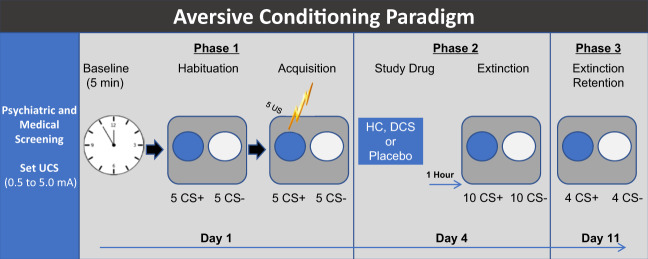
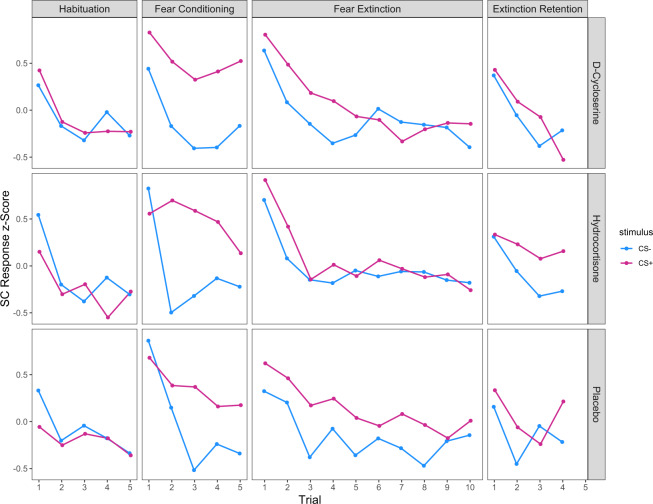
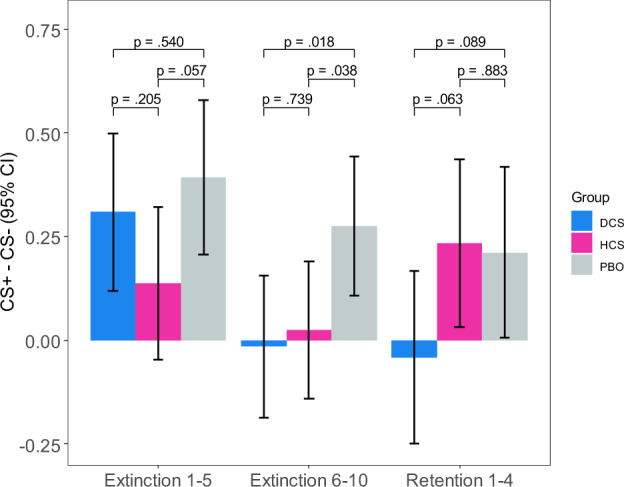
Fear extinction underlies prolonged exposure, one of the most well-studied treatments for posttraumatic stress disorder (PTSD). There has been increased interest in exploring pharmacological agents to enhance fear extinction learning in humans and their potential as adjuncts to PE. The objective of such adjuncts is to augment the clinical impact of PE on the durability and magnitude of symptom reduction. In this study, we examined whether hydrocortisone (HC), a corticosteroid, and D-Cycloserine (DCS), an N-methyl-D-aspartate receptor partial agonist, enhance fear extinction learning and consolidation in individuals with PTSD. In a double-blind placebo-controlled 3-group experimental design, 90 individuals with full or subsyndromal PTSD underwent fear conditioning with stimuli that were paired (CS+) or unpaired (CS−) with shock. Extinction learning occurred 72 h later and extinction retention was tested one week after extinction. HC 25 mg, DCS 50 mg or placebo was administered one hour prior to extinction learning. During extinction learning, the DCS and HC groups showed a reduced differential CS+/CS− skin conductance response (SCR) compared to placebo (b = −0.19, CI = −0.01 to −37, p = 0.042 and b = −0.25, CI = −08 to −0.43, p = 0.005, respectively). A nonsignificant trend for a lower differential CS+/CS− SCR in the DCS group, compared to placebo, (b = −0.25, CI = 0.04 to −0.55, p = 0.089) was observed at retention testing, one week later. A single dose of HC and DCS facilitated fear extinction learning in participants with PTSD symptoms. While clinical implications have yet to be determined, our findings suggest that glucocorticoids and NMDA agonists hold promise for facilitating extinction learning in PTSD.
Overview
The claims and statistics of this paper haven’t been checked yet.
Free: it reads the open-access text and checks the first 5 claims that cite a source we can check. Create a free account to check every claim.
Integrity signals
Registry
Cites
Statistics
Figures
Verification
Claims the paper makes
The claims and statistics of this paper haven’t been checked yet.
Free: it reads the open-access text and checks the first 5 claims that cite a source we can check. Create a free account to check every claim.
Claims other papers make about this one
Each is checked against this paper’s own text: does it say what the citing paper says it does?
The source backs part of the claim, not all of it — or backs it for a different population, condition or comparison.
In the citing paper
“Another study found that D-cycloserine in combination with hydrocortisone facilitated fear extinction in 90 participants with PTSD [174]”
From Ketamine in neuropsychiatric disorders: an update (2024) · cites this paper as [174]
Experimental — accuracy not yet measuredThe cited source says what the claim attributes to it.
In the citing paper
“More recent research is investigating adjunctive D-cycloserine for indications such as OCD, PTSD, and MDD [172-174]”
From Ketamine in neuropsychiatric disorders: an update (2024) · cites this paper as [174]
Self-check
Percentages, sums and reported differences re-computed from the paper’s own numbers.
The self-check needs the paper’s full text.
Citations
Cites
The development of a Clinician-Administered PTSD Scale
Blake, D. D., Weathers, F. W., Nagy, L. M., Kaloupek, D. G., Gusman, F. D., Charney, D. S., & Keane, T. M. (1995) · Journal of Traumatic Stress · doi:10.1002/jts.2490080106 · Cited by 5,024 · cited 2×
“PTSD diagnosis and symptom levels were determined by interview using the Clinician Administered PTSD Scale (CAPS) [33].”
MethodStress and the brain: from adaptation to disease
de Kloet, E. R., Joëls, M., & Holsboer, F. (2005) · Nature Reviews Neuroscience · doi:10.1038/nrn1683 · Cited by 4,621
A Multidimensional Meta-Analysis of Psychotherapy for PTSD
Bradley, R., Greene, J., Russ, E., Dutra, L., & Westen, D. (2005) · American Journal of Psychiatry · doi:10.1176/appi.ajp.162.2.214 · Cited by 1,938
Publication Recommendations for Electrodermal Measurements
Fowles, D. C., Christie, M. J., Edelberg, R., GRINGS, W. W., Lykken, D. T., & Venables, P. H. (1981) · Psychophysiology · doi:10.1111/j.1469-8986.1981.tb03024.x · Cited by 1,699
Myers, K. M., & Davis, M. (2007) · Molecular Psychiatry · doi:10.1038/sj.mp.4001939 · Cited by 1,277
Ressler, K. J., Rothbaum, B. O., Tannenbaum, L., Anderson, P., Graap, K., Zimand, E., Hodges, L., & Davis, M. (2004) · Archives of General Psychiatry · doi:10.1001/archpsyc.61.11.1136 · Cited by 1,063
Binder, E. B. (2009) · Psychoneuroendocrinology · doi:10.1016/j.psyneuen.2009.05.021 · Cited by 968
Psychotherapy for Military-Related PTSD: A Review of Randomized Clinical Trials
Steenkamp, M. M., Litz, B. T., Hoge, C. W., & Marmar, C. R. (2015) · JAMA · doi:10.1001/jama.2015.8370 · Cited by 958
Self-citationCusack, K., Jonas, D. E., Forneris, C. A., Wines, C., Sonis, J., Middleton, J. C., Feltner, C., Brownley, K. A., Olmsted, K. R., Greenblatt, A., et al. (2016) · Clinical Psychology Review · doi:10.1016/j.cpr.2015.10.003 · Cited by 865
Role of adrenal stress hormones in forming lasting memories in the brain
McGaugh, J. L., & Roozendaal, B. (2002) · Current Opinion in Neurobiology · doi:10.1016/s0959-4388(02)00306-9 · Cited by 818
Research works printed but not linked: 1
- First MB, Spitzer RL, Gibbon M, Williams JBW. Structured clinical interview for DSM-IV Axis I disorders, research version, non-patient edition. (SCID-I/NP). Biometrics Research, New York State Psychiatric Institute: New York; 2002.
Cited by
Ketamine in neuropsychiatric disorders: an update
Johnston, J. N., Kadriu, B., Kraus, C., Henter, I. D., & Zarate, C. A. (2024) · Neuropsychopharmacology · doi:10.1038/s41386-023-01632-1 · Cited by 108
“Another study found that D-cycloserine in combination with hydrocortisone facilitated fear extinction in 90 participants with PTSD [174].”
BackgroundResultPsilocybin facilitates fear extinction in mice by promoting hippocampal neuroplasticity
Du, Y., Li, Y., Zhao, X., Yao, Y., Wang, B., Zhang, L., & Wang, G. (2023) · Chinese Medical Journal · doi:10.1097/cm9.0000000000002647 · Cited by 94
“…and mTOR, and the number of DCX-and BrdU-positive cells induced by FC. Fear extinction is a key process in exposure-based psychotherapy for PTSD; [34,35] therefore, we used the auditory cued FC and fear extinction paradigm, which is commonly used to study fear-related disorders, such as PTSD.…”
MethodRaut, S. B., Marathe, P. A., van Eijk, L., Eri, R. D., Ravindran, M., Benedek, D. M., Ursano, R. J., Canales, J. J., & Johnson, L. R. (2022) · Pharmacology & Therapeutics · doi:10.1016/j.pharmthera.2022.108195 · Cited by 84
Antibiotics and mental health: the good, the bad and the ugly
Dinan, K., & Dinan, T. (2022) · Journal of Internal Medicine · doi:10.1111/joim.13543 · Cited by 69
Singewald, N., Sartori, S. B., Reif, A., & Holmes, A. (2023) · Neuropharmacology · doi:10.1016/j.neuropharm.2023.109418 · Cited by 69
“Nonetheless, research on this topic is continuing (e.g. (Difede et al., 2022; Inslicht et al., 2021) and some authors maintain the drug’s potential remains to be fulfilled (Rosenfield et al., 2019).”
BackgroundBattaglia, S., Fazio, C. D., Vicario, C. M., & Avenanti, A. (2023) · International Journal of Molecular Sciences · doi:10.3390/ijms24065926 · Cited by 60
Hormonal contraceptive usage influences stress hormone effects on cognition and emotion
Jentsch, V. L., Pötzl, L., Wolf, O. T., & Merz, C. J. (2022) · Frontiers in Neuroendocrinology · doi:10.1016/j.yfrne.2022.101012 · Cited by 56
The influence of sleep on fear extinction in trauma-related disorders
Pace-Schott, E. F., Seo, J., & Bottary, R. M. (2022) · Neurobiology of Stress · doi:10.1016/j.ynstr.2022.100500 · Cited by 55
“First, d-cycloserine, a memory-promoting partial NMDA agonist can enhance extinction memory following exposure therapy (82) but can also enhance fear memory in humans (83).”
BackgroundCrombie, K. M., Adams, T. G., Dunsmoor, J. E., Greenwood, B. N., Smits, J. A. J., Nemeroff, C. B., & Cisler, J. M. (2023) · Journal of Anxiety Disorders · doi:10.1016/j.janxdis.2023.102680 · Cited by 52
Stress, associative learning, and decision-making
Giovanniello, J. R., Bravo-Rivera, C., Rosenkranz, J. A., & Lattal, K. M. (2023) · Neurobiology of Learning and Memory · doi:10.1016/j.nlm.2023.107812 · Cited by 46
Rahimi-Danesh, M., Samizadeh, M., Sajadi, A.-E., Rezvankhah, T., & Vaseghi, S. (2023) · Pharmacology Biochemistry and Behavior · doi:10.1016/j.pbb.2023.173675 · Cited by 32
Fear extinction induced by activation of PKA ameliorates anxiety-like behavior in PTSD mice
Gao, F., Wang, J., Yang, S., Ji, M., & Zhu, G. (2022) · Neuropharmacology · doi:10.1016/j.neuropharm.2022.109306 · Cited by 31
On making (and turning adaptive to) maladaptive aversive memories in laboratory rodents
Gazarini, L., Stern, C. A. J., & Bertoglio, L. J. (2023) · Neuroscience & Biobehavioral Reviews · doi:10.1016/j.neubiorev.2023.105101 · Cited by 31
Battaglia, S., Fazio, C. D., Borgomaneri, S., & Avenanti, A. (2025) · Current Neuropharmacology · doi:10.2174/1570159x23666250123142526 · Cited by 26
“This notion is supported by studies showing that HC administration can modulate processes of fear extinction learning and inhibit fear memory retrieval [53], likely by enhancing synaptic plasticity and memory processes.”
InfluentialAndero, R. (2025) · Molecular Psychiatry · doi:10.1038/s41380-025-02910-8 · Cited by 31
“For example, a single glucocorticoid administration to patients with PTSD appears to reduce the recall of fear memories but enhances their extinction measured with SCR [66, 69].”
Crombie, K. M., Azar, A., Botsford, C., Heilicher, M. O., Moughrabi, N., Gruichich, T. S., Schomaker, C. M., Dunsmoor, J. E., & Cisler, J. M. (2023) · Mental health and physical activity · doi:10.1016/j.mhpa.2023.100510 · Cited by 22
Bartholomew, M. E., Rozalski, V., Richards, A. L., Gurdock, J., Thornton, M., Fee, C., Lipshitz, S. L., Metzler, T. J., Neylan, T. C., & Inslicht, S. S. (2022) · Learning & Memory · doi:10.1101/lm.053597.122 · Cited by 20
“Indeed, the differential effect observed in this sample is similar to effects seen in other work from our group (Inslicht et al. 2013, 2021).”
MethodResultSelf-citationKochanowski, B., Kageki-Bonnert, K., Pinkerton, E. A., Dougherty, D. D., & Chou, T. (2024) · Harvard Review of Psychiatry · doi:10.1097/hrp.0000000000000396 · Cited by 22
Paraniak-Gieszczyk, B., & Ogłodek, E. A. (2025) · International Journal of Molecular Sciences · doi:10.3390/ijms26199636 · Cited by 12
“Emerging evidence suggests that PTSD pathophysiology extends beyond elevated inflammatory cytokines, encompassing excessive microglial activation and disrupted neural network function [17–20 23 , 25].”
Cross species review of the physiological role of d-serine in translationally relevant behaviors
Arizanovska, D., Emodogo, J., Lally, A. P., Palavicino‐Maggio, C. B., Liebl, D. J., & Folorunso, O. O. (2023) · Amino Acids · doi:10.1007/s00726-023-03338-6 · Cited by 9
The glucocorticoid footprint on the memory engram
Jeanneteau, F. D., & Coutellier, L. D. (2022) · Current Opinion in Endocrine and Metabolic Research · doi:10.1016/j.coemr.2022.100378 · Cited by 10
Asare, B., Arthur, Y. D., & Obeng, B. A. (2025) · American Journal of STEM Education · doi:10.32674/5vykqb17 · Cited by 8
Pharmacological enhancement of fear extinction
Davis, B., Rosenberg, B. M., Kearney, M. G., Treanor, M., Craske, M. G., & Barry, T. J. (2025) · Trends in Cognitive Sciences · doi:10.1016/j.tics.2025.06.011 · Cited by 11
Brain Neuroplasticity Mechanisms in Psychiatric Illnesses and in the Development of Novel Treatments
O’Donnell, P., Etkin, A., & Manji, H. K. (2026) · American Journal of Psychiatry · doi:10.1176/appi.ajp.20251212 · Cited by 9
Exercise and Fear and Safety Learning
Azar, A., Hubert, T., Adams, T. G., Cisler, J. M., & Crombie, K. M. (2024) · Current topics in behavioral neurosciences · doi:10.1007/7854_2024_494 · Cited by 8
P3a amplitude to trauma-related stimuli reduced after successful trauma-focused PTSD treatment
Tillman, G. D., Morris, E. E., Bass, C., Turner, M., Watson, K., Brooks, J. T., Rawlinson, T., Kozel, F. A., Kraut, M. A., Motes, M. A., et al. (2023) · Biological Psychology · doi:10.1016/j.biopsycho.2023.108648 · Cited by 8
Zhang, J., Zheng, X., Zhang, G., Cheng, Z., Liu, Y., Zhang, L., Zhang, J., Liu, X., & Yang, Z. (2025) · Translational Psychiatry · doi:10.1038/s41398-025-03417-0 · Cited by 8
“Similarly, NMDA receptor activation has been shown to promote fear extinction in human studies [31].”
Enhancing Fear Extinction: Pharmacological Approaches
Ponomareva, O. Y., Fenster, R. J., & Ressler, K. J. (2023) · Current topics in behavioral neurosciences · doi:10.1007/7854_2023_443 · Cited by 8
PACAP associated with precise PTSD and fear extinction response in women
Adams, S. W., Neylan, T. C., May, V., Hammack, S. E., Ressler, K. J., & Inslicht, S. S. (2025) · Psychoneuroendocrinology · doi:10.1016/j.psyneuen.2025.107375 · Cited by 7
Self-citationHauck, A., Michael, T., Issler, T. C., Klein, S., Lass‐Hennemann, J., & de Sá, D. S. F. (2024) · Behaviour Research and Therapy · doi:10.1016/j.brat.2024.104553 · Cited by 5
de Nooij, L., Wirz, L., Heling, E., Pais, M., Hendriks, G., Verkes, R., Roozendaal, B., & Hermans, E. J. (2024) · European Journal of Psychotraumatology · doi:10.1080/20008066.2024.2364441 · Cited by 5
“These findings appear to translate to clinical populations of PTSD patients (Inslicht et al., 2021), as well as to actual exposure therapy treat-ment settings (Meuret et al., 2016; Suris et al., 2010; Yehuda et al., 2010).”
BackgroundA systematic review of the pharmacological modulation of autobiographical memory specificity
Cawley, E., Piazza, G. G., Das, R., & Kamboj, S. K. (2022) · Frontiers in Psychology · doi:10.3389/fpsyg.2022.1045217 · Cited by 6
Asare, B., & Boateng, F. O. (2025) · Contemporary Mathematics and Science Education · doi:10.30935/conmaths/16448 · Cited by 4
“Studies have demonstrated that interest enhances memory and retention (Inslicht et al., 2021; Park et al., 2023; Ni et al., 2020).”
Murgueitio, N., Propper, C. B., Sullivan, R. M., & Sheridan, M. A. (2026) · Neuroscience & Biobehavioral Reviews · doi:10.1016/j.neubiorev.2026.106752 · Cited by 2
Treating PTSD: A review of 8 studies
Saeed, S. A. (2023) · Current Psychiatry · doi:10.12788/cp.0324 · Cited by 3
Reconciling Translational Disparities Between Empirical Approaches to Better Understand PTSD
Norrholm, S. D., Cilley, T., & Jovanović, T. (2023) · Neuromethods · doi:10.1007/978-1-0716-3218-5_6 · Cited by 2
Waiting for translation: A review of translational research in psychological treatment
Petrule, C., Bittermann, A., Ritter, V., Rief, W., Haberkamp, A., Berg, M., Christiansen, H., Haberkamp, A., Hermann, C., Hofmann, S. G., et al. (2026) · Clinical Psychology Review · doi:10.1016/j.cpr.2026.102708 · Cited by 1
Gazarini, L., Stern, C. A. J., & Bertoglio, L. J. (2023) · Neuromethods · doi:10.1007/978-1-0716-3218-5_13
Merz, C. J. (2023) · Current topics in behavioral neurosciences · doi:10.1007/7854_2023_427 · Cited by 3
(2024) · Elsevier eBooks · doi:10.1016/b978-0-443-23565-8.09996-8
Anisman, H., Hayley, S. P., & Kusnecov, A. W. (2024) · Elsevier eBooks · doi:10.1016/b978-0-443-23565-8.00010-7
Smits, J. A. J., Kredlow, M. A., Monfils, M., & Otto, M. W. (2025) · Annual Review of Clinical Psychology · doi:10.1146/annurev-clinpsy-061324-071811 · Cited by 1
Lehnert, M., Michael, T., Berger, L., Hauck, A., & de Sá, D. S. F. (2026) · BMC Psychology · doi:10.1186/s40359-026-04125-0
Lin, J.-H., Gao, Y., & Tang, X.-Q. (2026) · Neuroscience & Biobehavioral Reviews · doi:10.1016/j.neubiorev.2026.106777
Appetitive Conditioning in Psychiatric Disorders: A Systematic Review
Feusner, J. D., Beidas, Z., & Murray, S. B. (2026) · Journal of Experimental Psychopathology · doi:10.1177/20438087261456078
“…has been extensively studied across psychiatric populations (Duits et al., 2015; Trent et al., 2025), and has informed a multitude of therapeutic interventions for clinical populations (Inslicht et al., 2021; Maples-Keller et al., 2022), the dearth of appetitive conditioning studies is noteworthy.”
Liceran, L., Tyas, K., Parwana, K., Valdivieso, M. A., & Trent, S. (2026) · Current Opinion in Physiology · doi:10.1016/j.cophys.2026.100980
Pais, M. (2026) · Radboud University Press eBooks · doi:10.54195/9789465153001
Cotrone, T., Ehrich, M. F., & Klein, B. G. (2026) · Behavioural Brain Research · doi:10.1016/j.bbr.2026.116568
PTSD Symptoms and Childhood Maltreatment Influence Alcohol and Drug Addiction SeverityPreprint
Choi, H. Y. B., YEUNG, W. C. F., Cheng, K. M., Cheng, K., Chiu, M. M. B., Liu, W. W., Chung, K., & Lai, E. T. H. (2026) · Research Square · doi:10.21203/rs.3.rs-11357316/v1
Metadata
- Authors
- Inslicht, S. S., Niles, A. N., Metzler, T. J., Lipshitz, S. L., Otte, C., Milad, M. R., Orr, S. P., Marmar, C. R., & Neylan, T. C.
- Affiliations
- University of California, San Francisco (US)
- San Francisco VA Health Care System (US)
- New York University (US)
- Harvard University (US)
- Corresponding author
- Inslicht, Sabra S.
- ORCID
- Venue
- Neuropsychopharmacology
- Published
- 2021-11-19
- Volume
- 47
- Issue
- 11
- Pages
- 1945-1952
- ISSN
- 0893-133X (ISSN-L)
- 1740-634X
- PMC
- PMC9485259
- OpenAlex
- W3212275176
- Semantic Scholar
- 716b92e0fcccc398b102d5674a406a33a714d58d
- Cited by
- 44
- References
- 69
- Citations by year
- 2026: 7 · 2025: 7 · 2024: 6 · 2023: 16 · 2022: 8
- FWCI
- 5.12
- Type
- journal article
- Language
- en
- Open access
- hybrid
- doi.org
- Licence
- cc-by
- creativecommons.org/licenses/by/4.0 (tdm)
- creativecommons.org/licenses/by/4.0 (vor)
- Locations
- Neuropsychopharmacology (publishedVersion, cc-by)
- PubMed Central (publishedVersion, cc-by)
- PubMed (publishedVersion)
- eScholarship (California Digital Library) (submittedVersion, cc-by)
- Funders
- McCormick Foundation
- U.S. Department of Veterans Affairs (I01 CX000720)
- Charles H. Hood Foundation
- Robin Hood Foundation
- Jazz Pharmaceuticals
- Sage Therapeutics
- Steven and Alexandra Cohen Foundation
- Cohen Veterans Bioscience
- European Commission (IMI2 859366)
- Deutsche Forschungsgemeinschaft (EXC 2049)
- Bundesministerium für Bildung und Forschung (KS2017-067)
- Eisai
- Otsuka Pharmaceutical
- H. Lundbeck A/S
- Berlin Institute of Health (B3010350)
- National Institutes of Health (RR024130)
- University of California, San Francisco
- NIH Office of the Director
- National Center for Research Resources (KL2RR024130, RR-024130)
- NIH Clinical Center
- National Center for Advancing Translational Sciences
- Topics
- Social Sciences › Psychology › Clinical Psychology › Posttraumatic Stress Disorder Research
- Life Sciences › Neuroscience › Cognitive Neuroscience › Memory and Neural Mechanisms
- Life Sciences › Neuroscience › Cognitive Neuroscience › Memory Processes and Influences
- Keywords
- post-traumatic stress disorder, fear extinction, cortisol, D-cycloserine, prolonged exposure therapy, fear conditioning, skin conductance response, glucocorticoids, NMDA receptor partial agonist, drug augmentation, extinction consolidation
- MeSH terms
- Cycloserine, Double-Blind Method, Extinction, Psychological, Fear, Glucocorticoids, Humans, Hydrocortisone, Stress Disorders, Post-Traumatic, Receptors, N-Methyl-D-Aspartate, N-Methylaspartate
About these checks
Registry, retraction, Cites and statistics results are computed, not judged, with one exception: a printed reference that no index lists is read once by a model before it counts as a citation error. Claims are extracted by a model and kept only when their quote appears verbatim in the text; each cited source is then checked, with a model’s help, for whether it says what the claim relies on. Those verdicts can be wrong — read the claim’s quote and the cited source before relying on one.
Statistics and arithmetic are recomputed, not judged.
Confidence bands are shown only for fields calibrated on our annotated test set. None is calibrated yet, so no band is shown.
What counts as a claim ›How we measure confidence ›How we check this ›
Are you an author, or do you see a problem with this page? Request a review
Data sources
Bibliographic data: Semantic Scholar, OpenAlex, Crossref.
Contains information from the Semantic Scholar Academic Graph Datasets, made available under the ODC Attribution License (ODC-BY 1.0).
Semantic Scholar’s data is described in: Kinney, R., et al. (2023). The Semantic Scholar Open Data Platform. arXiv:2301.10140.
