

Chronic adolescent exposure to cannabis in mice leads to sex-biased changes in gene expression networks across brain regions
Open accessPublished version of a preprint
The DOI matches its Crossref record; 79 of the 79 references it cites were found in a registry or an index.
Abstract
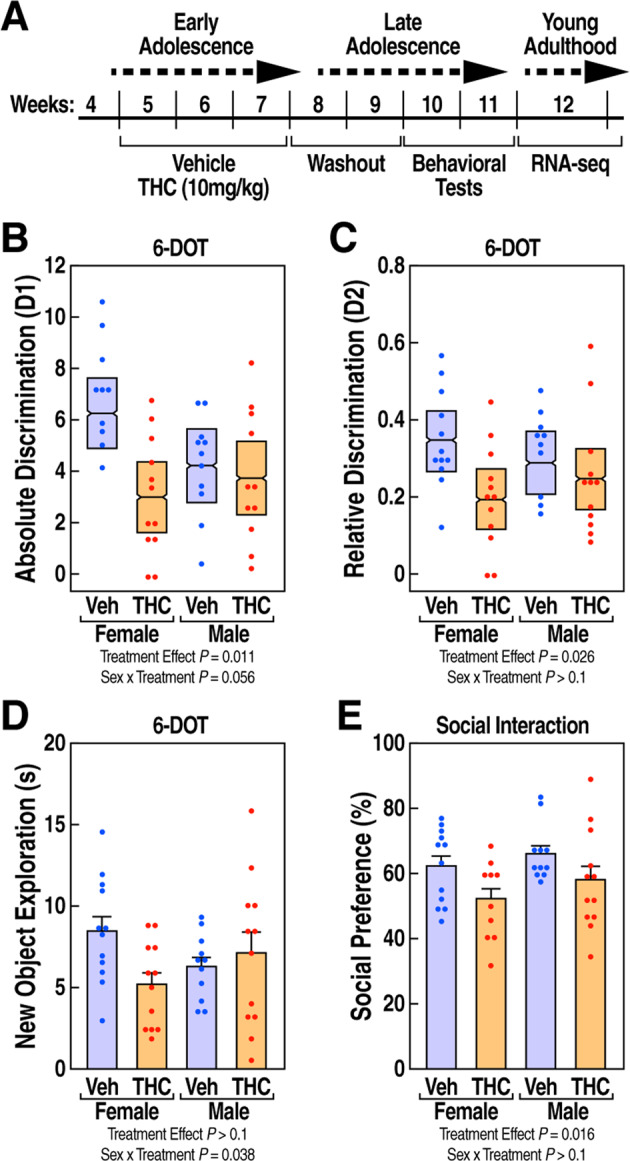
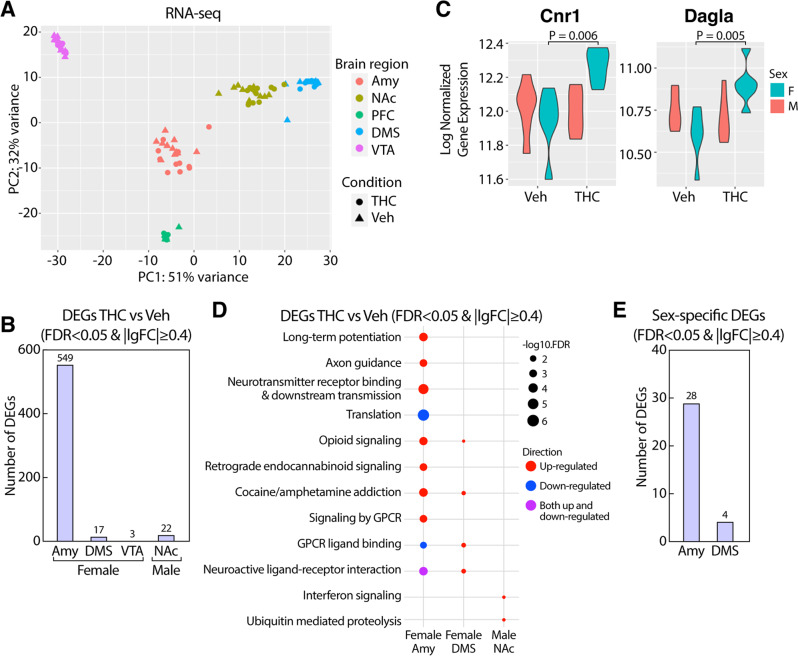
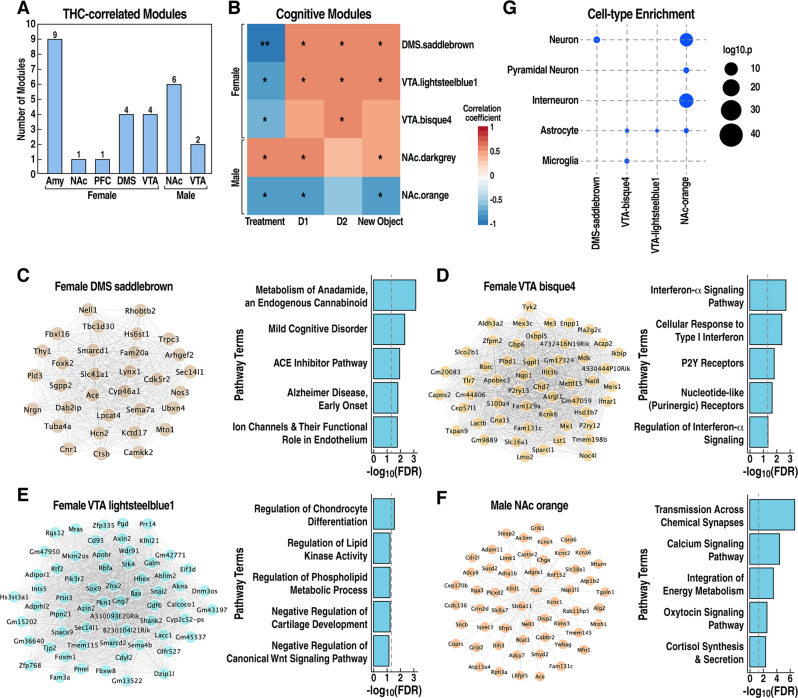
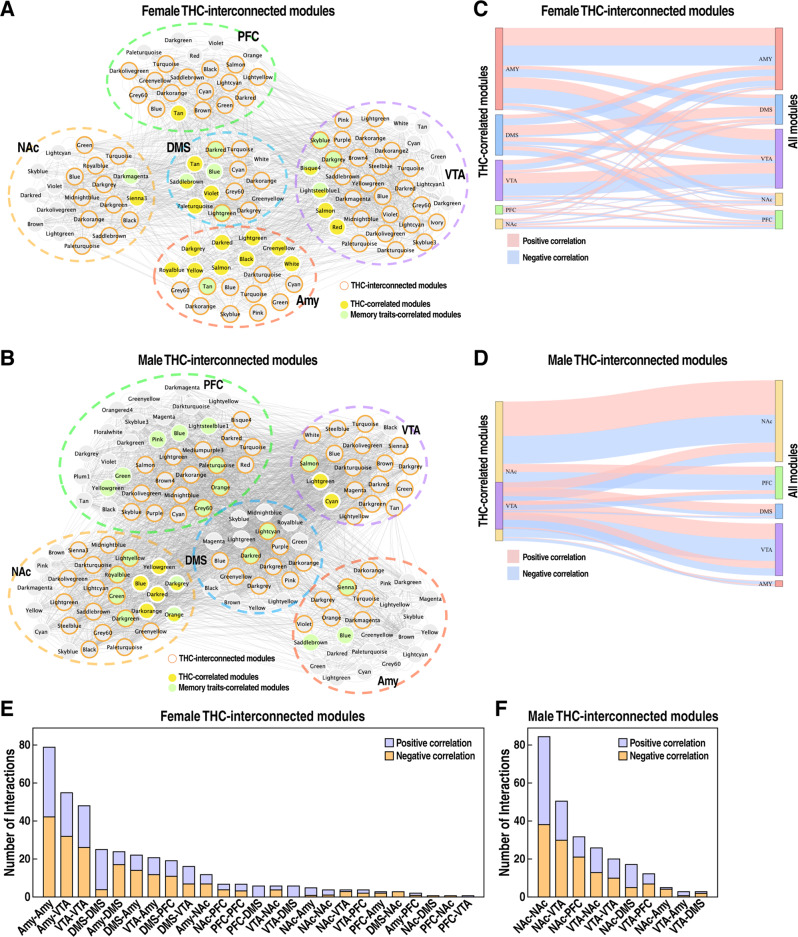
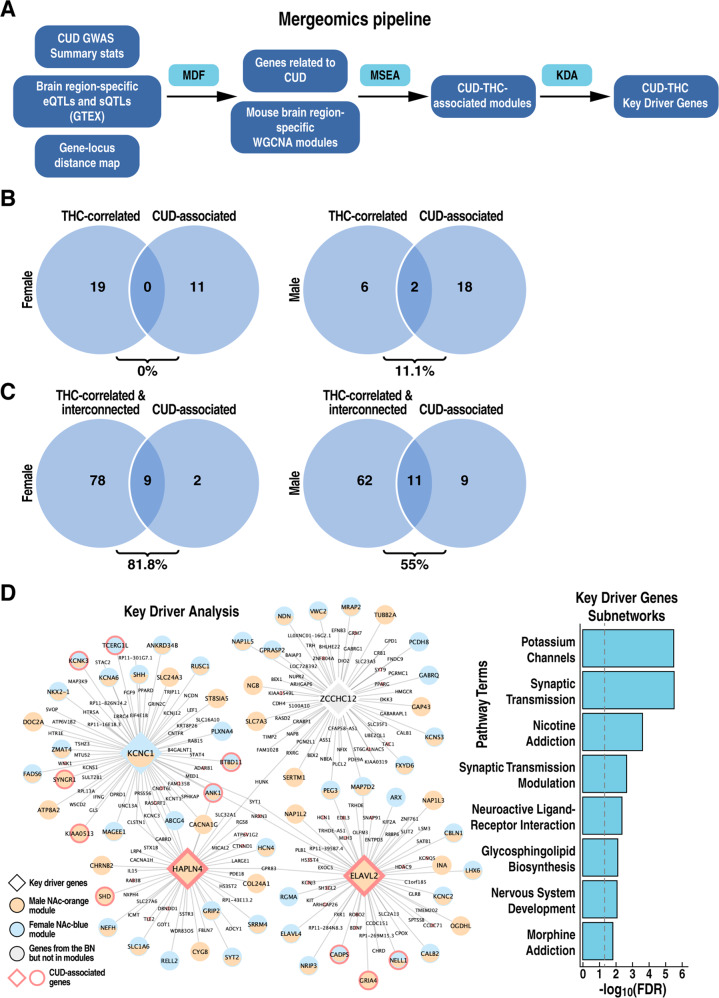
During adolescence, frequent and heavy cannabis use can lead to serious adverse health effects and cannabis use disorder (CUD). Rodent models of adolescent exposure to the main psychoactive component of cannabis, delta-9-tetrahydrocannabinol (THC), mimic the behavioral alterations observed in adolescent users. However, the underlying molecular mechanisms remain largely unknown. Here, we treated female and male C57BL6/N mice with high doses of THC during early adolescence and assessed their memory and social behaviors in late adolescence. We then profiled the transcriptome of five brain regions involved in cognitive and addiction-related processes. We applied gene coexpression network analysis and identified gene coexpression modules, termed cognitive modules, that simultaneously correlated with THC treatment and memory traits reduced by THC. The cognitive modules were related to endocannabinoid signaling in the female dorsal medial striatum, inflammation in the female ventral tegmental area, and synaptic transmission in the male nucleus accumbens. Moreover, cross-brain region module-module interaction networks uncovered intra- and inter-region molecular circuitries influenced by THC. Lastly, we identified key driver genes of gene networks associated with THC in mice and genetic susceptibility to CUD in humans. This analysis revealed a common regulatory mechanism linked to CUD vulnerability in the nucleus accumbens of females and males, which shared four key drivers (Hapln4, Kcnc1, Elavl2, Zcchc12). These genes regulate transcriptional subnetworks implicated in addiction processes, synaptic transmission, brain development, and lipid metabolism. Our study provides novel insights into disease mechanisms regulated by adolescent exposure to THC in a sex- and brain region-specific manner.
Overview
The claims and statistics of this paper haven’t been checked yet.
Free: it reads the open-access text and checks the first 5 claims that cite a source we can check. Create a free account to check every claim.
Integrity signals
Registry
Cites
Statistics
Figures
Verification
Claims the paper makes
The claims and statistics of this paper haven’t been checked yet.
Free: it reads the open-access text and checks the first 5 claims that cite a source we can check. Create a free account to check every claim.
Claims other papers make about this one
Each is checked against this paper’s own text: does it say what the citing paper says it does?
The cited source says what the claim attributes to it.
In the citing paper
“For example, Zuo and colleagues [137] reported that female mice exhibited a larger number of differentially expressed genes (DEGs) across the amygdala and dorsal medial striatum (DMS) compared to males.”
From Consequences of adolescent drug use (2023) · cites this paper as [137]
Self-check
Percentages, sums and reported differences re-computed from the paper’s own numbers.
The self-check needs the paper’s full text.
Citations
Cites
WGCNA: an R package for weighted correlation network analysis
Langfelder, P., & Horvath, S. (2008) · BMC Bioinformatics · doi:10.1186/1471-2105-9-559 · Cited by 27,252
Determination and characterization of a cannabinoid receptor in rat brain
Devane, W. A., Dysarz, F. A., Johnson, M. R., Melvin, L. S., & Howlett, A. C. (1988) · Molecular Pharmacology · doi:10.1016/s0026-895x(25)09876-1 · Cited by 2,443 · cited 2×
“The biological effects of THC are mediated mainly by members of the G protein-76 coupled receptors (GPCR) family, such as cannabinoid receptors 1 (CB1R) and 2 (CB2R) 16 .”
BackgroundJohnston, L., Miech, R., & O'Malley, P. (2020) · doi:10.3998/2027.42/162579 · Cited by 1,611 · cited 1×
“Recent data showed that more than one-third of 12th graders in the US used cannabis in the past year, reflecting an overall decline in the perceived risk of regular cannabis use among adolescents [2].”
BackgroundAn Introduction to the Endogenous Cannabinoid System
Lu, H.-C., & Mackie, K. (2016) · Biological Psychiatry · doi:10.1016/j.biopsych.2015.07.028 · Cited by 1,234
The endocannabinoid system and the brain.
Mechoulam, R., & Parker, L. A. (2013) · Annual Review of Psychology · doi:10.1146/annurev-psych-113011-143739 · Cited by 1,090
Cell type-specific loss of BDNF signaling mimics optogenetic control of cocaine reward
Lobo, M. K., Covington, H. E., Chaudhury, D., Friedman, A. K., Sun, H., Damez-Werno, D., Dietz, D. M., Zaman, S., Koo, J. W., Kennedy, P. J., et al. (2010) · Science · doi:10.1126/science.1188472 · Cited by 880
Effects of Cannabis Use on Human Behavior, Including Cognition, Motivation, and Psychosis: A Review
Volkow, N. D., Swanson, J. M., Evins, A. E., DeLisi, L. E., Meier, M. H., Gonzalez, R., Bloomfield, M. A. P., Curran, H. V., & Baler, R. (2016) · JAMA Psychiatry · doi:10.1001/jamapsychiatry.2015.3278 · Cited by 867
Crean, R. D., Crane, N. A., & Mason, B. J. (2011) · Journal of Addiction Medicine · doi:10.1097/adm.0b013e31820c23fa · Cited by 732
Endocannabinoids: endogenous cannabinoid receptor ligands with neuromodulatory action
Di Marzo, V., Melck, D., Bisogno, T., & De Petrocellis, L. (1998) · Trends in Neurosciences · doi:10.1016/s0166-2236(98)01283-1 · Cited by 712
Hernandez-Avila, C. A., Rounsaville, B. J., & Kranzler, H. R. (2004) · Drug and Alcohol Dependence · doi:10.1016/j.drugalcdep.2004.02.001 · Cited by 600
Cited by
Consequences of adolescent drug use
Steinfeld, M. R., & Torregrossa, M. M. (2023) · Translational Psychiatry · doi:10.1038/s41398-023-02590-4 · Cited by 237
“For example, Zuo and colleagues [137] reported that female mice exhibited a larger number of differentially expressed genes (DEGs) across the amygdala and dorsal medial striatum (DMS) compared to males.”
BackgroundUse of Cannabis and Cannabinoids for Treatment of Cancer
Cherkasova, V., Wang, B., Gerasymchuk, M., Fiselier, A., Kovalchuk, O., & Kovalchuk, I. (2022) · Cancers · doi:10.3390/cancers14205142 · Cited by 78
Early life adversity: Epigenetic regulation underlying drug addiction susceptibility
Winter, J. J., Rodríguez-Acevedo, K. L., Dittrich, M., & Heller, E. A. (2023) · Molecular and Cellular Neuroscience · doi:10.1016/j.mcn.2023.103825 · Cited by 19
“Transcriptional profiling of adult rodent NAc following adolescent THC or saline exposure identifies sex-specific differential gene expression (Zuo et al., 2022; Orihuel et al., 2021).”
BackgroundIzquierdo-Luengo, C., Ten-Blanco, M., Ponce-Renilla, M., Perezzan, R., Pereda-Pérez, I., & Berrendero, F. (2023) · Translational Psychiatry · doi:10.1038/s41398-023-02469-4 · Cited by 16
“By using the EPM, most of the studies have not shown differences in anxiety in adult male [24, 40, 41] or female [40, 41] rodents due to adolescent Δ 9 -THC exposure, although an anxiogenic-like effect was observed in adult male mice in another report [42].”
Developmental exposure to cannabis compromises dopamine system function and behavior
Solinas, M., & Melis, M. (2024) · Current Opinion in Behavioral Sciences · doi:10.1016/j.cobeha.2024.101442 · Cited by 8
“Preclinical studies have confirmed these negative effects of exposure to cannabis during adolescence on emotionality, cognition, and risks of addiction and have helped elucidate the underlying neurobiological mechanisms [61,62,65].”
Background
Metadata
- Authors
- Zuo, Y., Iemolo, A., Montilla-Perez, P., Li, H.-R., Yang, X., & Telese, F.
- Affiliations
- University of California, Los Angeles (US)
- University of California San Diego (US)
- Corresponding author
- Telese, Francesca
- Venue
- Neuropsychopharmacology
- Published
- 2022-08-22
- Volume
- 47
- Issue
- 12
- Pages
- 2071-2080
- ISSN
- 0893-133X (ISSN-L)
- 1740-634X
- PMC
- PMC9556757
- OpenAlex
- W4292608353
- Cited by
- 25
- References
- 74
- Citations by year
- 2026: 7 · 2025: 8 · 2024: 4 · 2023: 4 · 2022: 2
- FWCI
- 2.69
- Type
- journal article
- Language
- en
- Open access
- hybrid
- doi.org
- Licence
- cc-by
- creativecommons.org/licenses/by/4.0 (tdm)
- creativecommons.org/licenses/by/4.0 (vor)
- Locations
- Neuropsychopharmacology (publishedVersion, cc-by)
- bioRxiv (Cold Spring Harbor Laboratory) (acceptedVersion, cc-by-nc-nd)
- PubMed Central (publishedVersion, cc-by)
- PubMed (publishedVersion)
- eScholarship (California Digital Library) (submittedVersion, cc-by)
- Funders
- U.S. Department of Health & Human Services | NIH | National Center for Advancing Translational Sciences (UL1TR001881)
- U.S. Department of Health & Human Services | NIH | National Institute on Drug Abuse (U01DA050239, DP1DA042232)
- Topics
- Health Sciences › Medicine › Pharmacology (medical) › Cannabis and Cannabinoid Research
- Life Sciences › Neuroscience › Cellular and Molecular Neuroscience › Neurotransmitter Receptor Influence on Behavior
- Health Sciences › Medicine › Pediatrics, Perinatology and Child Health › Prenatal Substance Exposure Effects
- Keywords
- adolescent cannabis exposure, delta-9-tetrahydrocannabinol, cannabis use disorder, sex differences, gene co-expression network, gene expression profiling, endocannabinoid signaling, dorsomedial striatum, ventral tegmental area, nucleus accumbens, synaptic transmission, neuroinflammation, memory impairment, social behavior, driver genes, KCNC1, ELAVL2, genetic susceptibility
- MeSH terms
- Adolescent, Animals, Brain, Cannabis, Female, Hallucinogens, Humans, Male, Mice, Inbred C57BL, Sex Factors, Dronabinol, Gene Expression, Mice, Shaw Potassium Channels, Gene Regulatory Networks, Cannabinoid Receptor Agonists, Endocannabinoids
About these checks
Registry, retraction, Cites and statistics results are computed, not judged, with one exception: a printed reference that no index lists is read once by a model before it counts as a citation error. Claims are extracted by a model and kept only when their quote appears verbatim in the text; each cited source is then checked, with a model’s help, for whether it says what the claim relies on. Those verdicts can be wrong — read the claim’s quote and the cited source before relying on one.
Statistics and arithmetic are recomputed, not judged.
Confidence bands are shown only for fields calibrated on our annotated test set. None is calibrated yet, so no band is shown.
What counts as a claim ›How we measure confidence ›How we check this ›
Are you an author, or do you see a problem with this page? Request a review
How to cite
Cite CoChat for the checks on this page, and the paper for its own findings.
- This page
- CoChat. (2026). Citation check: Chronic adolescent exposure to cannabis in mice leads to sex-biased changes in gene expression networks across brain regions. https://app.cochat.ai/papers/10.1038/s41386-022-01413-2
- The paper
- Zuo, Y., Iemolo, A., Montilla-Perez, P., Li, H.-R., Yang, X., & Telese, F. (2022). Chronic adolescent exposure to cannabis in mice leads to sex-biased changes in gene expression networks across brain regions. Neuropsychopharmacology. https://doi.org/10.1038/s41386-022-01413-2
Data sources
Bibliographic data: Semantic Scholar, OpenAlex, Crossref.
Contains information from the Semantic Scholar Academic Graph Datasets, made available under the ODC Attribution License (ODC-BY 1.0).
Semantic Scholar’s data is described in: Kinney, R., et al. (2023). The Semantic Scholar Open Data Platform. arXiv:2301.10140.
