

The DOI matches its Crossref record; 756 of the 760 references it cites were found in a registry or an index.
FGF/FGFR signaling in health and disease
Open accessAbstract
Growing evidences suggest that the fibroblast growth factor/FGF receptor (FGF/FGFR) signaling has crucial roles in a multitude of processes during embryonic development and adult homeostasis by regulating cellular lineage commitment, differentiation, proliferation, and apoptosis of various types of cells. In this review, we provide a comprehensive overview of the current understanding of FGF signaling and its roles in organ development, injury repair, and the pathophysiology of spectrum of diseases, which is a consequence of FGF signaling dysregulation, including cancers and chronic kidney disease (CKD). In this context, the agonists and antagonists for FGF-FGFRs might have therapeutic benefits in multiple systems.
Overview
The claims and statistics of this paper haven’t been checked yet.
Run the check — free, no account needed. It reads the open-access text and checks the sources it cites.
Integrity signals
Registry
Cites
Statistics
Figures
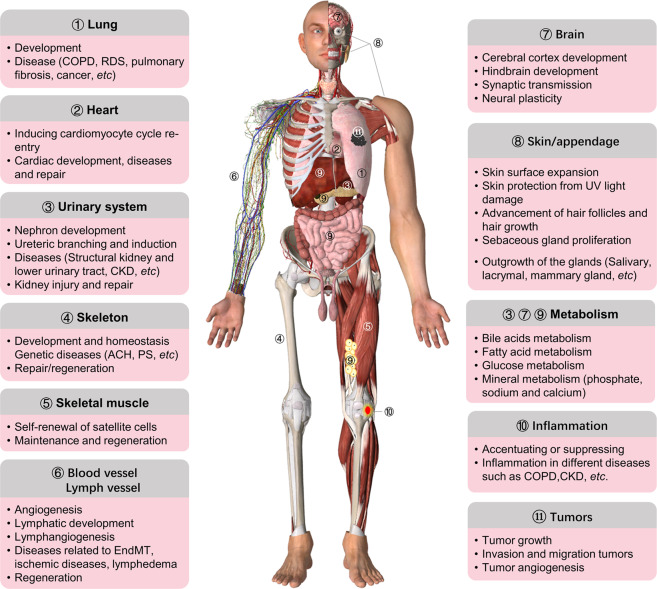
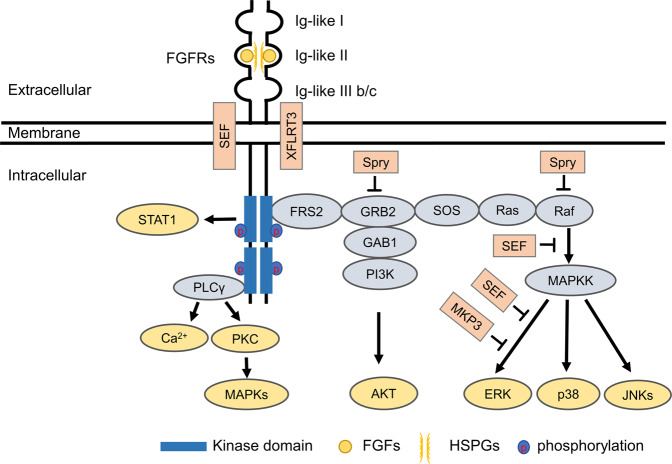
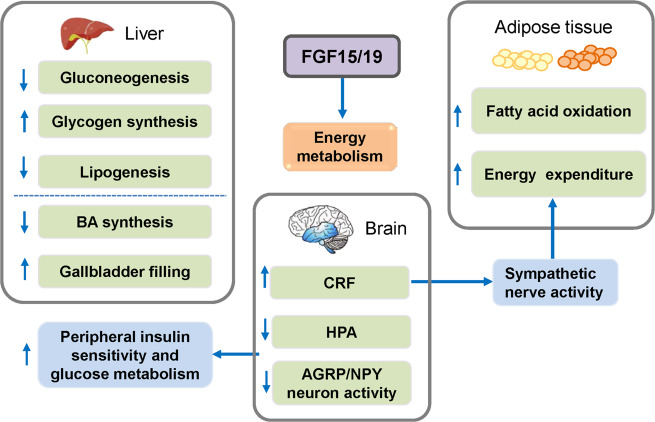
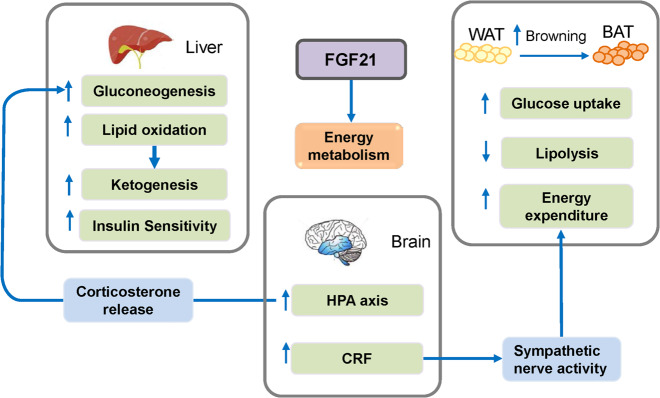
Verification
Claims the paper makes
The claims and statistics of this paper haven’t been checked yet.
Run the check — free, no account needed. It reads the open-access text and checks the sources it cites.
Claims other papers make about this one
Each is checked against this paper’s own text: does it say what the citing paper says it does?
The source backs part of the claim, not all of it — or backs it for a different population, condition or comparison.
In the citing paper
“We then assessed the expression of known FGFR3 ligands56,57 and found concomitant enrichment of FGFR3 and its ligands FGF20 and FGF23 in eGFP+ Paneth-like cells, accompanied by elevated p-FGFR3 levels (Figures 5D, S6D, and S6E).”
From Paneth-like transition drives resistance to dual targeting of KRAS and EGFR in colorectal cancer (2026) · cites this paper as [57]
Experimental — accuracy not yet measured
Self-check
Percentages, sums and reported differences re-computed from the paper’s own numbers.
The self-check needs the paper’s full text.
Citations
Cites
5 retracted
Yan, D., Chen, D., Cool, S. M., van Wijnen, A. J., Mikecz, K., Murphy, G., & Im, H. (2011) · Arthritis Research & Therapy · doi:10.1186/ar3441 · Cited by 146
RetractedIm, H., Li, X., Muddasani, P., Kim, G., Davis, F. J., Rangan, J., Forsyth, C. B., Ellman, M. B., & Thonar, E. J. ‐. A. (2007) · Journal of Cellular Physiology · doi:10.1002/jcp.21317 · Cited by 98
RetractedBasu, M., Mukhopadhyay, S., Chatterjee, U., & Roy, S. S. (2013) · Journal of Biological Chemistry · doi:10.1074/jbc.m113.535427 · Cited by 42
RetractedFgfr2 is integral for bladder mesenchyme patterning and function
Walker, K. A., Ikeda, Y., Zabbarova, I. V., Schaefer, C., Bushnell, D. S., de Groat, W. C., Kanai, A., & Bates, C. M. (2015) · American Journal of Physiology-Renal Physiology · doi:10.1152/ajprenal.00624.2014 · Cited by 16
RetractedTang, Z.-F., & Li, H.-Y. (2018) · PubMed · doi:10.26355/eurrev_201804_14838 · Cited by 11
RetractedThe metabolic phenotype in obesity: Fat mass, body fat distribution, and adipose tissue function
Goossens, G. H. (2017) · Obesity Facts · doi:10.1159/000471488 · Cited by 8,481
Origin and physiological roles of inflammation
Medzhitov, R. (2008) · Nature · doi:10.1038/nature07201 · Cited by 6,618
Fibroblast growth factor signalling: from development to cancer
Turner, N. C., & Grose, R. P. (2010) · Nature reviews. Cancer · doi:10.1038/nrc2780 · Cited by 2,768
Role of platelet-derived growth factors in physiology and medicinePreprint
Andræ, J., Gallini, R., & Betsholtz, C. (2008) · Genes & Development · doi:10.1101/gad.1653708 · Cited by 2,534
What we talk about when we talk about fat
Rosen, E. D., & Spiegelman, B. M. (2014) · Cell · doi:10.1016/j.cell.2013.12.012 · Cited by 2,373
Research works printed but not linked: 1
- Wang, Y. & Becker, D. Antisense targeting of basic fibroblast growth factor and fibroblast growth factor receptor-1 in human melanomas blocks intratumoral angiogenesis and tumor growth. Nat. Med. 3, 887–893 (1997). · DOI
Cited by
Sorted by citations
Items 901–906 of 906
Wang, Y., Zhao, Y., Wei, Y., Liu, S., Li, H., Yang, Y., Liu, N., Huang, Z., Cao, Y., Wang, X., et al. (2026) · Journal of Medicinal Chemistry · doi:10.1021/acs.jmedchem.6c02153
Bai, L., Bai, D., Han, L., & Yang, Q. (2026) · Metabolism and Target Organ Damage · doi:10.20517/mtod.2026.128
Metadata
- Authors
- Xie, Y., Su, N., Yang, J., Tan, Q., Huang, S., Jin, M., Ni, Z., Zhang, B., Zhang, D., Luo, F., Chen, H., Sun, X., Feng, J. Q., Qi, H., & Chen, L.
- Affiliations
- Army Medical University (CN)
- Texas A&M University (US)
- Corresponding author
- Xie, Yangli
- ORCID
- Venue
- Signal Transduction and Targeted Therapy
- Published
- 2020-09-02
- Volume
- 5
- Issue
- 1
- Pages
- 181-181
- ISSN
- 2059-3635 (ISSN-L)
- PMC
- PMC7468161
- OpenAlex
- W3082979654
- Cited by
- 904
- References
- 760
- Citations by year
- 2026: 148 · 2025: 190 · 2024: 205 · 2023: 151 · 2022: 124 · 2021: 76 · 2020: 9
- FWCI
- 8.62
- Type
- journal article
- Language
- en
- Open access
- gold
- doi.org
- Locations
- Signal Transduction and Targeted Therapy (publishedVersion, cc-by)
- PubMed Central (publishedVersion, cc-by)
- PubMed (publishedVersion)
- Funders
- National Natural Science Foundation of China (81772306, IRT1216, 81991513, 81530071, 2018YFA0800802, 81721001)
- National Key Research and Development Program of China (2018YFA0800802)
- Topics
- Life Sciences › Biochemistry, Genetics and Molecular Biology › Molecular Biology › Fibroblast Growth Factor Research
- Life Sciences › Biochemistry, Genetics and Molecular Biology › Molecular Biology › Connective Tissue Growth Factor Research
- Life Sciences › Biochemistry, Genetics and Molecular Biology › Developmental Biology › Congenital limb and hand anomalies
- Keywords
- fibroblast growth factor, fibroblast growth factor receptor, FGF/FGFR signaling, organogenesis, tissue repair, cancer, chronic kidney disease, therapeutic target, cell differentiation, apoptosis
- MeSH terms
- Cell Differentiation, Fibroblast Growth Factors, Homeostasis, Humans, Neoplasms, Signal Transduction, Apoptosis, Receptors, Fibroblast Growth Factor, Embryonic Development, Cell Proliferation
About these checks
Registry, retraction, Cites and statistics results are computed, not judged, with one exception: a printed reference that no index lists is read once by a model before it counts as a citation error. Claims are extracted by a model and kept only when their quote appears verbatim in the text; each cited source is then checked, with a model’s help, for whether it says what the claim relies on. Those verdicts can be wrong — read the claim’s quote and the cited source before relying on one.
Statistics and arithmetic are recomputed, not judged.
Confidence bands are shown only for fields calibrated on our annotated test set. None is calibrated yet, so no band is shown.
What counts as a claim ›How we measure confidence ›How we check this ›
Are you an author, or do you see a problem with this page? Request a review
