

Butyrate enhances mitochondrial function during oxidative stress in cell lines from boys with autism
Open accessThe DOI matches its Crossref record; 112 of the 112 references it cites were found in a registry or an index.
Abstract
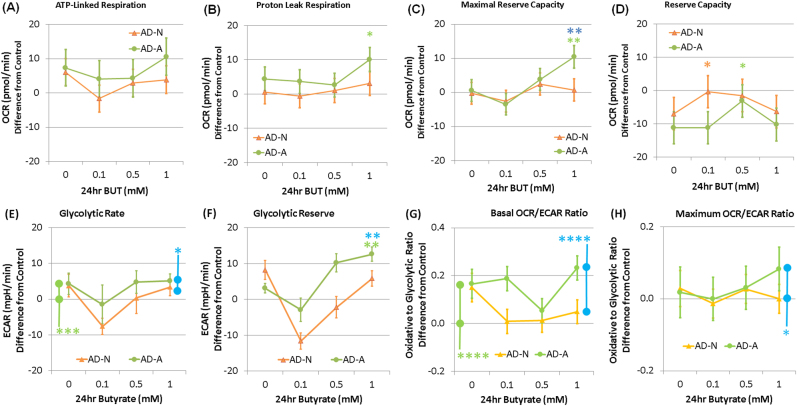
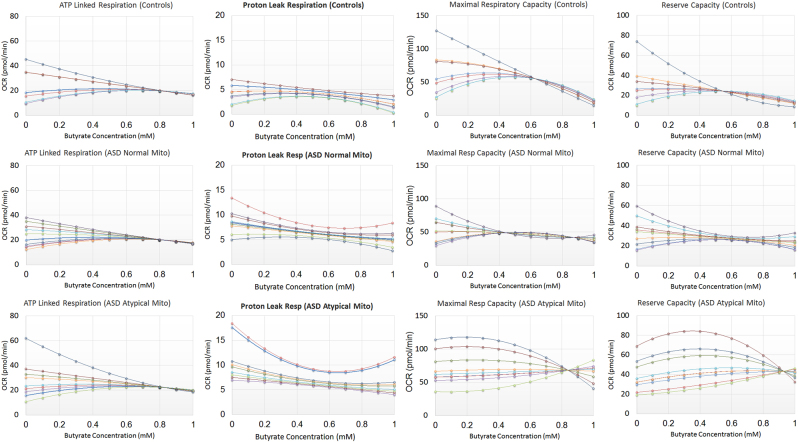
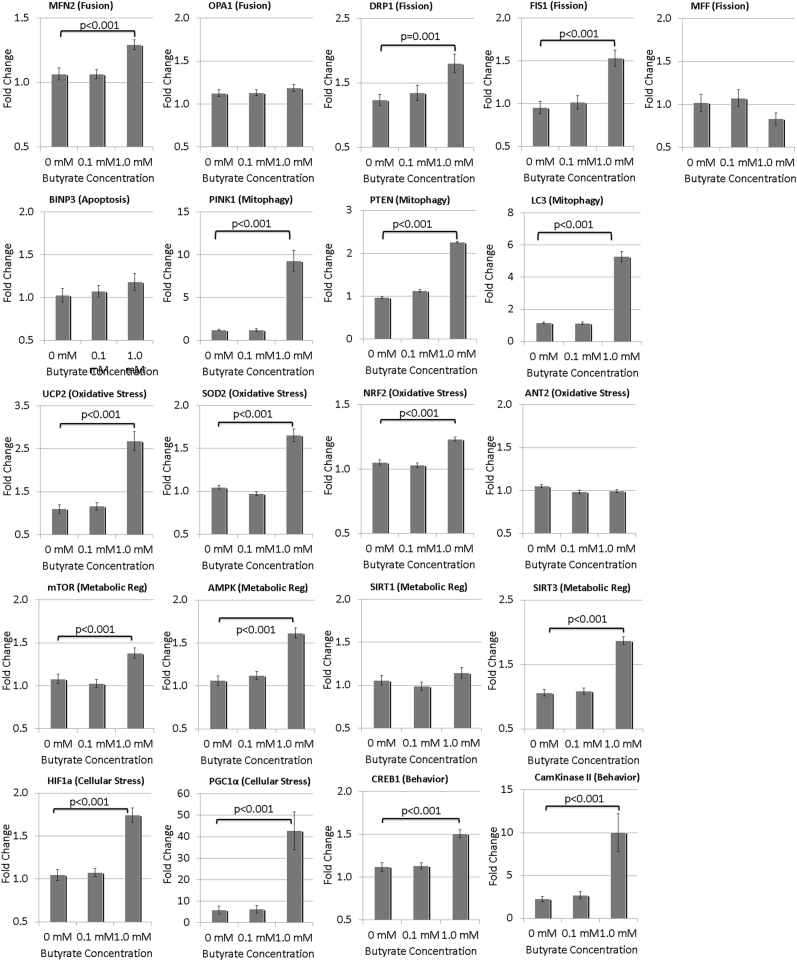
Butyrate (BT) is a ubiquitous short-chain fatty acid (SCFA) principally derived from the enteric microbiome. BT positively modulates mitochondrial function, including enhancing oxidative phosphorylation and beta-oxidation and has been proposed as a neuroprotectant. BT and other SCFAs have also been associated with autism spectrum disorders (ASD), a condition associated with mitochondrial dysfunction. We have developed a lymphoblastoid cell line (LCL) model of ASD, with a subset of LCLs demonstrating mitochondrial dysfunction (AD-A) and another subset of LCLs demonstrating normal mitochondrial function (AD-N). Given the positive modulation of BT on mitochondrial function, we hypothesized that BT would have a preferential positive effect on AD-A LCLs. To this end, we measured mitochondrial function in ASD and age-matched control (CNT) LCLs, all derived from boys, following 24 and 48 h exposure to BT (0, 0.1, 0.5, and 1 mM) both with and without an in vitro increase in reactive oxygen species (ROS). We also examined the expression of key genes involved in cellular and mitochondrial response to stress. In CNT LCLs, respiratory parameters linked to adenosine triphosphate (ATP) production were attenuated by 1 mM BT. In contrast, BT significantly increased respiratory parameters linked to ATP production in AD-A LCLs but not in AD-N LCLs. In the context of ROS exposure, BT increased respiratory parameters linked to ATP production for all groups. BT was found to modulate individual LCL mitochondrial respiration to a common set-point, with this set-point slightly higher for the AD-A LCLs as compared to the other groups. The highest concentration of BT (1 mM) increased the expression of genes involved in mitochondrial fission (PINK1, DRP1, FIS1) and physiological stress (UCP2, mTOR, HIF1α, PGC1α) as well as genes thought to be linked to cognition and behavior (CREB1, CamKinase II). These data show that the enteric microbiome-derived SCFA BT modulates mitochondrial activity, with this modulation dependent on concentration, microenvironment redox state, and the underlying mitochondrial function of the cell. In general, these data suggest that BT can enhance mitochondrial function in the context of physiological stress and/or mitochondrial dysfunction, and may be an important metabolite that can help rescue energy metabolism during disease states. Thus, insight into this metabolic modulator may have wide applications for both health and disease since BT has been implicated in a wide variety of conditions including ASD. However, future clinical studies in humans are needed to help define the practical implications of these physiological findings.
Overview
The claims and statistics of this paper haven’t been checked yet.
Free: it reads the open-access text and checks the first 5 claims that cite a source we can check. Create a free account to check every claim.
Integrity signals
Registry
Cites
Statistics
Figures
Verification
Claims the paper makes
The claims and statistics of this paper haven’t been checked yet.
Free: it reads the open-access text and checks the first 5 claims that cite a source we can check. Create a free account to check every claim.
Claims other papers make about this one
Each is checked against this paper’s own text: does it say what the citing paper says it does?
The cited source says what the claim attributes to it.
In the citing paper
“Furthermore, gut microbiota-derived short-chain fatty acids (SCFAs), such as propionic acid [69, 70] and butyric acid [71, 72], produced by bacterial fermentation of carbohydrates have immunomodulatory properties”
From Gut microbiota changes in children with autism spectrum disorder: a systematic review (2020) · cites this paper as [71]
In the citing paper
“Though it seems that dysbiosis is not dependent on the manifestation of GI symptoms in autistic children [212]”
From The Role of Microbiota-Gut-Brain Axis in Neuropsychiatric and Neurological Disorders (2021) · cites this paper as [212]
Self-check
Percentages, sums and reported differences re-computed from the paper’s own numbers.
The self-check needs the paper’s full text.
Citations
Cites
den Besten, G., van Eunen, K., Groen, A. K., Venema, K., Reijngoud, D.-J., & Bakker, B. M. (2013) · Journal of Lipid Research · doi:10.1194/jlr.r036012 · Cited by 5,048
Host-gut microbiota metabolic interactions
Nicholson, J. K., Holmes, E., Kinross, J., Burcelin, R., Gibson, G., Jia, W., & Pettersson, S. (2012) · Science · doi:10.1126/science.1223813 · Cited by 4,760
Normal gut microbiota modulates brain development and behavior
Heijtz, R. D., Wang, S., Anuar, F., Qian, Y., Björkholm, B., Samuelsson, A., Hibberd, M. L., Forssberg, H., & Pettersson, S. (2011) · Proceedings of the National Academy of Sciences · doi:10.1073/pnas.1010529108 · Cited by 3,228
Short chain fatty acids in human large intestine, portal, hepatic and venous blood
Cummings, J. H., Pomare, E. W., Branch, W. J., Naylor, C. P., & Macfarlane, G. T. (1987) · Gut · doi:10.1136/gut.28.10.1221 · Cited by 3,119
Butyrate improves insulin sensitivity and increases energy expenditure in mice
Gao, Z., Yin, J., Zhang, J., Ward, R. E., Martin, R. J., Lefevre, M., Cefalu, W. T., & Ye, J. (2009) · Diabetes · doi:10.2337/db08-1637 · Cited by 2,204
The microbiome and butyrate regulate energy metabolism and autophagy in the mammalian colon
Donohoe, D. R., Garge, N., Zhang, X., Sun, W., O'Connell, T. M., Bunger, M. K., & Bultman, S. J. (2011) · Cell Metabolism · doi:10.1016/j.cmet.2011.02.018 · Cited by 2,003
Le Poul, E., Loison, C., Struyf, S., Springael, J.-Y., Lannoy, V., Decobecq, M.-E., Brezillon, S., Dupriez, V., Vassart, G., Van Damme, J., et al. (2003) · Journal of Biological Chemistry · doi:10.1074/jbc.m301403200 · Cited by 1,651
The core gut microbiome, energy balance and obesity
Turnbaugh, P. J., & Gordon, J. I. (2009) · The Journal of Physiology · doi:10.1113/jphysiol.2009.174136 · Cited by 993
Mitochondrial dysfunction in autism spectrum disorders: a systematic review and meta-analysis
Rossignol, D. A., & Frye, R. E. (2012) · Molecular Psychiatry · doi:10.1038/mp.2010.136 · Cited by 907
Self-citationThe neuropharmacology of butyrate: the bread and butter of the microbiota-gut-brain axis
Stilling, R. M., van de Wouw, M., Clarke, G., Stanton, C., Dinan, T. G., & Cryan, J. F. (2016) · Neurochemistry International · doi:10.1016/j.neuint.2016.06.011 · Cited by 891
Research works printed but not linked: 1
- Frye RE Biomarkers of Abnormal Energy Metabolism in Children with Autism Spectrum Disorder North Am. J. Med. Sci. 2012 5 141 147 10.7156/v5i3p141 · DOI · Paper page
Cited by
Items 201–245 of 245
Gonzales, J. A. (2020) · theses.fr (ABES) · doi:10.70675/4ccdfaa5z70caz46aez8413zac3224b64e9b · Cited by 1
Mitochondrial DNA Variants in Autism Spectrum Disorder: A Systematic ReviewPreprint
Liao, X., & Li, Y. (2020) · Research Square · doi:10.21203/rs.3.rs-131427/v1
The role of HDAC2 in olanzapine-induced cortical neuronal lesions
Chen, X. (2020) · Research Online (University of Wollongong)
Koçancı, F. G. (2021) · European Journal of Lipid Science and Technology · doi:10.1002/ejlt.202000341
Humanização em terapia intensiva - Aspectos iniciais
Ferreira, F. H. (2021) · Editora Conhecimento Livre eBooks · doi:10.37423/210403979
ASPECTOS GENÉTICOS DO TRANSTORNO DO ESPECTRO AUTISTA (TEA)
de Andrade, M. D. F. C., Carvalho, E. D. F., & Carvalho, K. D. M. (2022) · Amplla Editora eBooks · doi:10.51859/amplla.tea2232-12
Porcino, J. M. A., & Vasconcelos, G. C. (2022) · Amplla Editora eBooks · doi:10.51859/amplla.tea2232-6
Porcino, J. M. A., Pinheiro, N. M., Souza, T. M. D. S. F., Soares, C. C. A., de Lima, M. A., & Filho, V. D. D. S. (2022) · Amplla Editora eBooks · doi:10.51859/amplla.tea2232-24
ATIVAÇÃO IMUNE MATERNA E O TRANSTORNO DO ESPECTRO AUTISTA
Oliveira, S. D. R. C., dos Santos, D. T., & Morais, Y. B. (2022) · Amplla Editora eBooks · doi:10.51859/amplla.tea2232-14
TEA LEVE: ANTIGA SINDROME DE ASPERGER
de Carvalho, B. M. M., Ferreira, L. E. A., Simão, S. E., Ribeiro, L. D. S., Sousa, M. C., Los, M. E., Lobato, C. P., & de Carvalho, A. V. A. M. (2022) · Amplla Editora eBooks · doi:10.51859/amplla.tea2232-10
TRANSTORNO DO ESPECTRO AUTISTA E DIAGNÓSTICO POR IMAGEM
Morais, Y. B., Felix, L. D. C., & Oliveira, S. D. R. C. (2022) · Amplla Editora eBooks · doi:10.51859/amplla.tea2232-21
DIETAS ISENTAS DE GLÚTEN E CASEÍNA EM CRIANÇAS E ADOLESCENTES COM TEA
Vasconcelos, Q. D. J. S. (2022) · Amplla Editora eBooks · doi:10.51859/amplla.tea2232-30
METILAÇÃO DO DNA ENVOLVIDA NA EXPRESSÃO DO TRANSTORNO DO ESPECTRO AUTISTA
Maia, D. O., Alves, A. D. S., Guimarães, S. C. M., Rocha, I. G. B., ALBUQUERQUE, G. B. D., & Aragão, G. F. (2022) · Amplla Editora eBooks · doi:10.51859/amplla.tea2232-13
The role of ketogenic therapy in developmental disorders
Taoulost, S., Rasgon, N., Ferretti, C. J., & Hollander, E. (2023) · Journal of Psychiatric Research · doi:10.1016/j.jpsychires.2023.03.025 · Cited by 1
Chambers, P. W. (2024) · Qeios · doi:10.32388/x0tq1d.5
“Butyrate enhances mitochondrial function during oxidative stress [171] and rescues tryptophan [172] .”
BackgroundA bibliometric analysis of global research on short chain fatty acids in neurological diseases
Jiuhong, Z., Lei, Y., Zhang, X., & Li, Z. (2024) · Medicine · doi:10.1097/md.0000000000040102
“Nutrients contributed to most publications in this field (25), followed by International Journal of Molecular Sciences (20).”
BackgroundThe Bidirectional Role Between Gut Microbiota and Sports Performance
Gaspar, A. S. (2025) · IGI Global eBooks · doi:10.4018/979-8-3693-8699-6.ch002
Ansyori, A. R., Zefianto, Z., Riena, N. R., & Novalina, F. (2025) · JIMKI Jurnal Ilmiah Mahasiswa Kedokteran Indonesia · doi:10.53366/jimki.v11i2.771
“[22] Selain itu, asam lemak butirat juga berguna untuk menekan nafsu makan melalui aktivasi FFAR-3 dan neuron aferen vagal untuk membantu mengurangi asupan energi dalam kontrol glikemik.”
Amin, T., Shishir, M. A., Alam, M. M., Anam, M. B., Bulbul, N., Jime, J. S., & Fakruddin, M. (2025) · Infectious Disorders - Drug Targets · doi:10.2174/0118715265362556250717063603
Autism Spectrum Disorder and the Gut Microbiota : a Systematic Review
Korteniemi, J. (2022) · UTUPub (University of Turku)
Han, B., Li, F., Lu, Q., Ran, R., Li, L., An, W., Chen, F., & Wang, W. (2026) · Biological Trace Element Research · doi:10.1007/s12011-026-04996-9
“SCFAs have been implicated in the amelioration of neurological deficits in diverse contexts, including autism spectrum disorder [33], diabetes-associated cognitive impairment [34], and maternal obesity-induced cognitive decline in offspring [ 35].”
Chi, Y., Zhang, H., Jia, C., Zeng, S., Li, X., Chen, D.-P., & Ma, Y. (2026) · International Journal of Molecular Sciences · doi:10.3390/ijms27093828
“…butyrate may regulate mitochondrial-related genes and mitochondrial dynamic regulators (including Drp1 and FIS1) in different directions, suggesting that this process is highly dependent on the microenvironment rather than functioning as a fixed and unidirectional molecular switch [78].”
Kim, Y. W. (2026) · Asia-pacific Journal of Convergent Research Interchange · doi:10.47116/apjcri.2026.04.33
Yang, H., Kong, L., Wang, T., Chen, N., Wang, D., Wang, Z., & Wu, Y. (2026) · Frontiers in Microbiology · doi:10.3389/fmicb.2026.1715392
“SCFAs enhance mitochondrial oxidative phosphorylation and β -oxidation under physiological conditions, reduce ROS production, and promote anti-inflammatory and antioxidant responses (Rose et al., 2018; Li X. et al., 2022).”
Chen, Y., Chen, S., Zhang, H., Song, B., & Xu, Y. (2026) · Cancer Immunology Immunotherapy · doi:10.1007/s00262-026-04442-8
“Studies indicate that under oxidative stress or mitochondrial dysfunction, butyrate enhances mitochondrial plasticity, boosting ATP synthesis and antioxidant defenses to facilitate cellular adaptation [91, 96].”
Effects of Metabolites of Lactic Acid Bacteria on Nerve Cells of the Microbiota–Gut–Brain Axis
Kv, S. (2026) · Biochemistry (Moscow) · doi:10.1134/s0006297926600377
“Similarly, butyrate has been reported to improve mitochondrial function in autism spectrum disorders [143].”
Liu, Q., Shen, Y., Sun, Y., Maszczyk, P., Lyu, K., Lee, & Yang, Z. (2026) · Molecular Ecology · doi:10.1111/mec.70459
“For example, short-chain fatty acids (SCFAs) function as signalling molecules that contribute to the maintenance of host metabolic homeostasis and immune balance through promoting mitochondrial energy metabolism and modulating immune cell activity (Koh et al. 2016; Rose et al. 2018).”
Jia, R., Wang, Y., Wang, J., Zhang, M., & Aisong, Z. (2026) · Phytomedicine · doi:10.1016/j.phymed.2026.158617
Xu, Y., Chen, J., Jiang, Y., Zhu, J., Jia, Q., Xia, Q., Wu, Z., Chen, L., Ge, Y., & Ding, Y. (2026) · Journal of the Science of Food and Agriculture · doi:10.1002/jsfa.70922
Cox-Holmes, A. N., Green, G. B. H., Potier, A. C. E., Wang, Y., Chen, D., Morrow, C. D., & McFarland, B. C. (2026) · Frontiers in Immunology · doi:10.3389/fimmu.2026.1879544
“For example, butyrate, which had a trend for higher proportions in HuM2, has been shown to increase mitochondrial function and OXPHOS components in various disease models (68, 69).”
Ahmed, M., Shantakumari, N., Badi, S., & Ahmed, M. H. (2026) · Journal of Personalized Medicine · doi:10.3390/jpm16090474
“…butyrate, are recognized for their ability to promote mitophagy by enhancing genes related to mitochondrial biogenesis and autophagy primarily via the Peroxisome Proliferator-activated Receptor Gamma Coactivator 1 Alpha (PGC-1 α )–Silent Information Regulator 1 (SIRT1) signaling pathway [69].”
Divyashri, G., Hutti, H., Venkata, L. P. M., Kumar, B. P., Yachie‐Kinoshita, A., & Ghosh, S. (2026) · Microorganisms · doi:10.3390/microorganisms14092097
ENGELEN, M. P. K. J., Thompson, J., Wandel, S. M. D., Knezek, S. B., Indika, N.-L. R., & Deutz, N. E. P. (2026) · Research Square · doi:10.21203/rs.3.rs-10895531/v1
1Amira M., 1. E. (2025) · Iraqi journal of biotechnology
INNOVATIVE NUTRITIONAL STRATEGIES TO COUNTERACT CANCER CACHEXIA
CASTILLO, L. G. (n.d.) · Institutional Research Information System University of Turin (University of Turin)
The Vaginal Microbiome–Mitochondria Axis: Implications for Genital Tract Infections
Agoni, L., Pericolini, E., Salvatore, S., Candiani, M., & Seta, F. D. (2026) · Cells · doi:10.3390/cells15201835
Montano, A., Paolini, A., Felli, C., Bruno, S. P., Baldassarre, A., Sandal, S., & Masotti, A. (2026) · Frontiers in Sports and Active Living · doi:10.3389/fspor.2026.1940762
Mashayekhpour, M. A., Amani, H., Moghaddam, A. H., Moradi, A., Nohesara, S., & Abdolmaleky, H. M. (2026) · International Journal of Molecular Sciences · doi:10.3390/ijms27219502
Islam, M. M., Yang, G., & Kang, K. S. (2026) · Frontiers in Nutrition · doi:10.3389/fnut.2026.1839461
Supporting information 1 of Bioenergetic signatures of neurodevelopmental regression
Frye, R. E., McCarty, P. J., Werner, B. A., Rose, S., & Scheck, A. C. (2024) · doi:10.3389/fphys.2024.1306038.s001
Self-citationDeng, W., Wang, S., Li, F., Wang, F., Xing, Y. P., Li, Y., Lv, Y., Ke, H., Li, Z., Lv, P. J., et al. (2022) · doi:10.3389/fmicb.2022.1000419.s001
Metadata
- Authors
- Rose, S., Bennuri, S. C., Davis, J. E., Wynne, R., Slattery, J. C., Tippett, M., Delhey, L., Melnyk, S., Kahler, S. G., MacFabe, D. F., & Frye, R. E.
- Affiliations
- Arkansas Children's Research Institute (US)
- Alberta Children's Hospital Research Institute (CA)
- Barrow Neurological Institute (US)
- Corresponding author
- Frye, Richard E.
- Venue
- Translational Psychiatry
- Published
- 2018-02-02
- Volume
- 8
- Issue
- 1
- Pages
- 42-42
- ISSN
- 2158-3188 (ISSN-L)
- PMC
- PMC5804031
- OpenAlex
- W2802398839
- Semantic Scholar
- 1561e7fddaa3ecab90904c7713d06fb0b0b7e2e4
- Cited by
- 226
- References
- 112
- Citations by year
- 2026: 27 · 2025: 24 · 2024: 31 · 2023: 20 · 2022: 40 · 2021: 26 · 2020: 29 · 2019: 18 · 2018: 11
- FWCI
- 7.47
- Type
- journal article
- Language
- en
- Open access
- gold
- doi.org
- Licence
- cc-by
- creativecommons.org/licenses/by/4.0 (tdm)
- creativecommons.org/licenses/by/4.0 (vor)
- Locations
- Translational Psychiatry (publishedVersion, cc-by)
- PubMed Central (publishedVersion, cc-by)
- PubMed (publishedVersion)
- DOAJ (DOAJ: Directory of Open Access Journals) (submittedVersion)
- Topics
- Life Sciences › Biochemistry, Genetics and Molecular Biology › Molecular Biology › Mitochondrial Function and Pathology
- Life Sciences › Neuroscience › Cognitive Neuroscience › Autism Spectrum Disorder Research
- Life Sciences › Biochemistry, Genetics and Molecular Biology › Molecular Biology › Gut microbiota and health
- Keywords
- butyrate, short-chain fatty acids, autism spectrum disorder, mitochondrial dysfunction, oxidative stress, reactive oxygen species, lymphoblastoid cell lines, mitochondrial respiration, ATP production, PINK1, Drp1, Fis1, PGC-1α, mTOR, HIF-1α, UCP2, CREB1, CaMKII
- MeSH terms
- Autism Spectrum Disorder, Gastrointestinal Microbiome, Butyrates, Cell Line, Child, Humans, Lymphocytes, Male, Mitochondria, Reactive Oxygen Species, Oxidative Stress, Mitochondrial Diseases
About these checks
Registry, retraction, Cites and statistics results are computed, not judged, with one exception: a printed reference that no index lists is read once by a model before it counts as a citation error. Claims are extracted by a model and kept only when their quote appears verbatim in the text; each cited source is then checked, with a model’s help, for whether it says what the claim relies on. Those verdicts can be wrong — read the claim’s quote and the cited source before relying on one.
Statistics and arithmetic are recomputed, not judged.
Confidence bands are shown only for fields calibrated on our annotated test set. None is calibrated yet, so no band is shown.
What counts as a claim ›How we measure confidence ›How we check this ›
Are you an author, or do you see a problem with this page? Request a review
Data sources
Bibliographic data: Semantic Scholar, OpenAlex, Crossref.
Contains information from the Semantic Scholar Academic Graph Datasets, made available under the ODC Attribution License (ODC-BY 1.0).
Semantic Scholar’s data is described in: Kinney, R., et al. (2023). The Semantic Scholar Open Data Platform. arXiv:2301.10140.
