

The DOI matches its Crossref record; 35 of the 35 references it cites were found in a registry or an index.
Fear extinction requires infralimbic cortex projections to the basolateral amygdala
Open accessPublished version of a preprint
Abstract
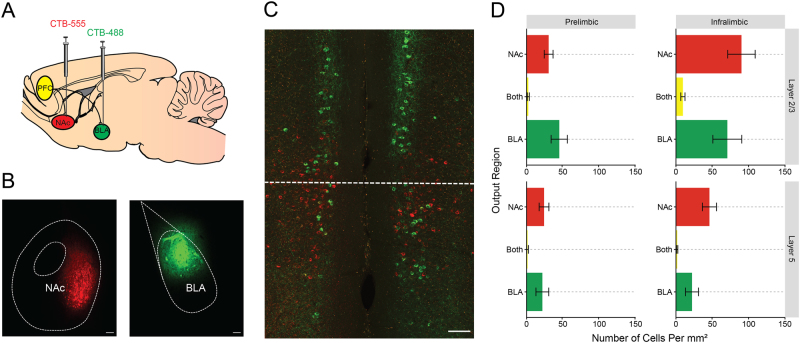
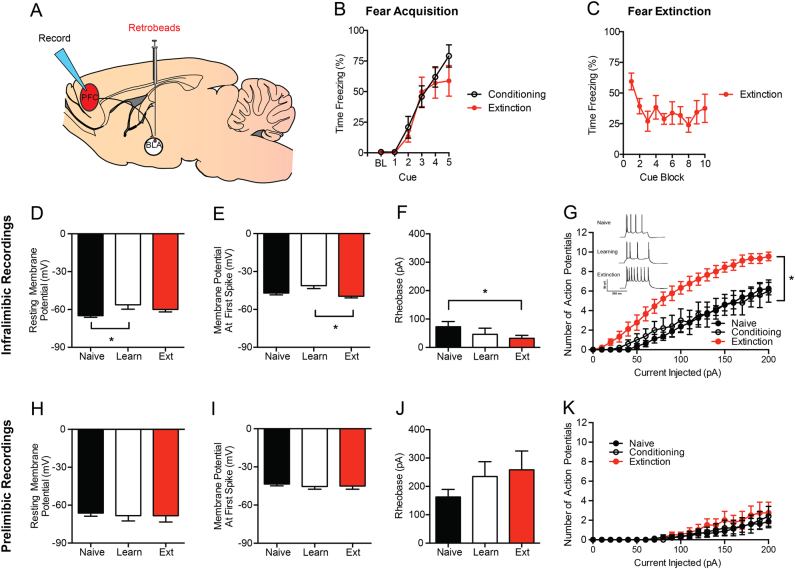
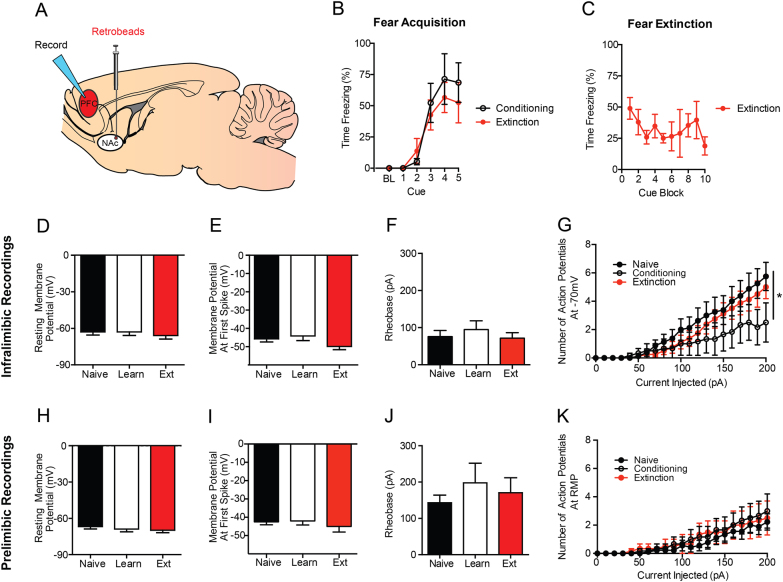
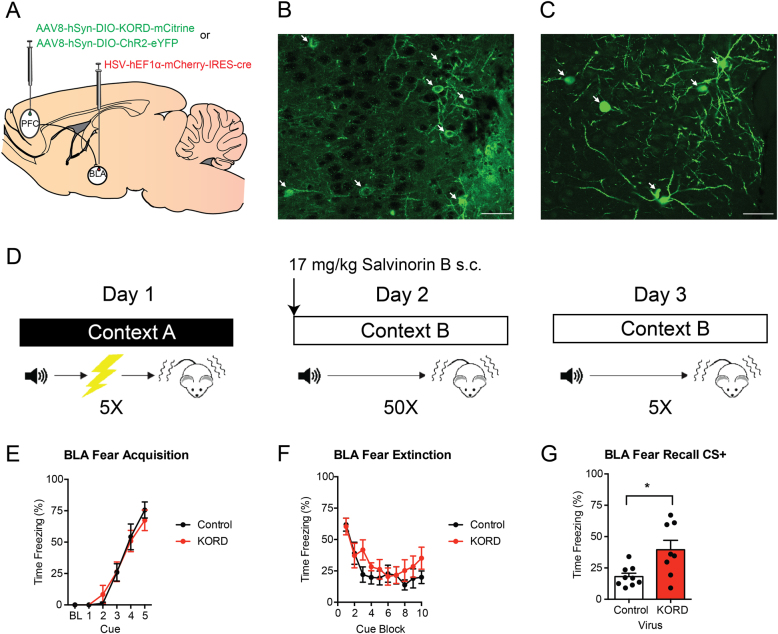
Fear extinction involves the formation of a new memory trace that attenuates fear responses to a conditioned aversive memory, and extinction impairments are implicated in trauma- and stress-related disorders. Previous studies in rodents have found that the infralimbic prefrontal cortex (IL) and its glutamatergic projections to the basolateral amygdala (BLA) and basomedial amygdala (BMA) instruct the formation of fear extinction memories. However, it is unclear whether these pathways are exclusively involved in extinction, or whether other major targets of the IL, such as the nucleus accumbens (NAc) also play a role. To address this outstanding issue, the current study employed a combination of electrophysiological and chemogenetic approaches in mice to interrogate the role of IL-BLA and IL-NAc pathways in extinction. Specifically, we used patch-clamp electrophysiology coupled with retrograde tracing to examine changes in neuronal activity of the IL and prelimbic cortex (PL) projections to both the BLA and NAc following fear extinction. We found that extinction produced a significant increase in the intrinsic excitability of IL-BLA projection neurons, while extinction appeared to reverse fear-induced changes in IL-NAc projection neurons. To establish a causal counterpart to these observations, we then used a pathway-specific Designer Receptors Exclusively Activated by Designer Drugs (DREADD) strategy to selectively inhibit PFC-BLA projection neurons during extinction acquisition. Using this approach, we found that DREADD-mediated inhibition of PFC-BLA neurons during extinction acquisition impaired subsequent extinction retrieval. Taken together, our findings provide further evidence for a critical contribution of the IL-BLA neural circuit to fear extinction.
Overview
The claims and statistics of this paper haven’t been checked yet.
Run the check — free, no account needed. It reads the open-access text and checks the sources it cites.
Integrity signals
Registry
Cites
Statistics
Figures
Verification
Claims the paper makes
The claims and statistics of this paper haven’t been checked yet.
Run the check — free, no account needed. It reads the open-access text and checks the sources it cites.
Claims other papers make about this one
Each is checked against this paper’s own text: does it say what the citing paper says it does?
The cited source says what the claim attributes to it.
In the citing paper
“Chemogenetic inhibition of PFC neurons projecting to the amygdala is sufficient to impair fear extinction learning (184).”
From Psychedelics and Other Psychoplastogens for Treating Mental Illness. (2021) · cites this paper as [184]
Self-check
Percentages, sums and reported differences re-computed from the paper’s own numbers.
The self-check needs the paper’s full text.
Citations
Cites
The Neurocircuitry of Fear, Stress, and Anxiety Disorders
Shin, L. M., & Liberzon, I. (2010) · Neuropsychopharmacology · doi:10.1038/npp.2009.83 · Cited by 2,083 · cited 1×
“Given evidence of extinction-related aberrations in an analogous circuit in patients with trauma-related disorders (1, 35),”
BackgroundNeuronal circuits for fear and anxiety
Tovote, P., Fadok, J. P., & Lüthi, A. (2015) · Nature Reviews Neuroscience · doi:10.1038/nrn3945 · Cited by 1,786
Fear Extinction as a Model for Translational Neuroscience: Ten Years of Progress
Milad, M. R., & Quirk, G. J. (2012) · Annual Review of Psychology · doi:10.1146/annurev.psych.121208.131631 · Cited by 1,466
The circuitry mediating cocaine-induced reinstatement of drug-seeking behavior
McFarland, K., & Kalivas, P. W. (2001) · The Journal of Neuroscience · doi:10.1523/jneurosci.21-21-08655.2001 · Cited by 905
Long-range connectivity defines behavioral specificity of amygdala neurons
Senn, V., Wolff, S. B. E., Herry, C., Grenier, F., Ehrlich, I., Gründemann, J., Fadok, J. P., Müller, C., Letzkus, J. J., & Lüthi, A. (2014) · Neuron · doi:10.1016/j.neuron.2013.11.006 · Cited by 522 · cited 2×
“reciprocal connections from BLA to IL (11, 12) and projections from BLA to NAc (13) are important for extinction.”
BackgroundDifferential Innervation of Direct- and Indirect-Pathway Striatal Projection Neurons
Wall, N. R., De La Parra, M., Callaway, E. M., & Kreitzer, A. C. (2013) · Neuron · doi:10.1016/j.neuron.2013.05.014 · Cited by 489
Basomedial amygdala mediates top-down control of anxiety and fear
Adhikari, A., Lerner, T. N., Finkelstein, J., Pak, S., Jennings, J. H., Davidson, T. J., Ferenczi, E., Gunaydin, L. A., Mirzabekov, J. J., Ye, L., et al. (2015) · Nature · doi:10.1038/nature15698 · Cited by 485 · cited 3×
“Recent studies in mice have shown that neuronal outputs from the ventromedial PFC (vmPFC), containing the infralimbic cortex (IL) region, to the basolateral (BLA) (7-9) and basomedial (BMA) (10), as well as”
BackgroundAmygdala intercalated neurons are required for expression of fear extinction
Likhtik, E., Popa, D., Apergis-Schoute, J., Fidacaro, G. A., & Paré, D. (2008) · Nature · doi:10.1038/nature07167 · Cited by 474
Gating of Fear in Prelimbic Cortex by Hippocampal and Amygdala Inputs
Sotres-Bayón, F., Sierra‐Mercado, D., Pardilla‐Delgado, E., & Quirk, G. J. (2012) · Neuron · doi:10.1016/j.neuron.2012.09.028 · Cited by 467
A New DREADD Facilitates the Multiplexed Chemogenetic Interrogation of Behavior
Vardy, E., Robinson, J. E., Li, C., Olsen, R. H. J., DiBerto, J. F., Giguère, P. M., Sassano, F. M., Huang, X., Zhu, H., Urban, D. J., et al. (2015) · Neuron · doi:10.1016/j.neuron.2015.03.065 · Cited by 398
Self-citation
Research works printed but not linked: 1
- Cho, J. H., Deisseroth, K. & Bolshakov, V. Y. Synaptic encoding of fear extinction in mPFC-amygdala circuits. Neuron 80, 1491–1507 (2013). · DOI
Cited by
Sorted by citations
Items 201–229 of 229
Identifying Potential Factors Regulating the Fear Extinction Switch in Mice
Premachandran, H. (2019) · TSpace (University of Toronto)
P.0239 Cerebellum modifies the infralimbic and prelimbic firing patterns during fear extinction
Georgescu, I. A., Sala, R. W., Frontera, J. L., Aïssa, H. B., Léna, C., & Popa, D. (2021) · European Neuropsychopharmacology · doi:10.1016/j.euroneuro.2021.10.229
The whole blood microbiome of Indonesians reveals translocated and pathogenic microbiotaPreprint
Bobowik, K., Fachrul, M., Darusallam, C. C., Kusuma, P., Sudoyo, H., Febinia, C. A., Malik, S. G., Wells, C. A., & Romero, I. G. (2022) · bioRxiv (Cold Spring Harbor Laboratory) · doi:10.1101/2022.04.24.489025
Prefrontal cortex melanocortin 4 receptors (MC4R) mediate food intake behavior in micePreprint
Ross, R., Kim, A., Das, P., Li, Y., Choi, Y. K., Thompson, A. T., Douglas, E., Subramanian, S., Ramos, K., Callahan, K., et al. (2022) · bioRxiv (Cold Spring Harbor Laboratory) · doi:10.1101/2022.06.01.494383
Neural correlates of extinction in a rat model of appetitive Pavlovian conditioningPreprint
Brown, A., Villaruel, F. R., & Chaudhri, N. (2022) · bioRxiv · doi:10.1101/2022.09.28.509892
Lipshutz, A. B., Saltz, V., Anderson, K. R., Manganaro, A., & Dumitriu, D. (2022) · bioRxiv (Cold Spring Harbor Laboratory) · doi:10.1101/2022.11.29.517584
A influência tardia do estresse agudo único na extinção da memória emocional em ratos Wistar.
Perfetto, J. G. (2022) · Digital Library of Theses and Dissertations (Universidade de São Paulo) · doi:10.11606/t.42.2022.tde-08082023-090725
Reviewer #2 (Public Review): Network-Level Changes in the Brain Underlie Fear Memory Strength
Haubrich, J., & Nader, K. (2023) · eLife · doi:10.7554/elife.88172.2.sa0
Author Response: Network-Level Changes in the Brain Underlie Fear Memory Strength
Haubrich, J., & Nader, K. (2023) · eLife · doi:10.7554/elife.88172.2.sa3
eLife Assessment: Network-Level Changes in the Brain Underlie Fear Memory Strength
Iordanova, M. D. (2023) · eLife · doi:10.7554/elife.88172.2.sa2
Network-Level Changes in the Brain Underlie Fear Memory StrengthPreprint
Haubrich, J., & Nader, K. (2023) · eLife · doi:10.7554/elife.88172.2
Reviewer #1 (Public Review): Network-Level Changes in the Brain Underlie Fear Memory Strength
Haubrich, J., & Nader, K. (2023) · eLife · doi:10.7554/elife.88172.2.sa1
Rubin, A. L., & Walth, M. (2025) · bioRxiv (Cold Spring Harbor Laboratory) · doi:10.1101/2025.01.20.633839 · Cited by 1
Lipshutz, A. B., Saltz, V., Anderson, K. R., Manganaro, A., & Dumitriu, D. (2025) · Frontiers in Molecular Neuroscience · doi:10.3389/fnmol.2025.1347539
A neurally constrained computational model of context-dependent fear extinction recall and relapse
Rajagopal, S. K., & Polk, T. A. (2025) · Communications Biology · doi:10.1038/s42003-025-08107-7
Juliano, V. A. L., Shigeo-de-Almeida, A., Cruz-Nascimento, T., Sampaio, L. L., Cruz, F. C., Novaes, L. S., & Munhoz, C. D. (2025) · Journal of Neuroscience · doi:10.1523/jneurosci.2392-24.2025
Watanabe, M., Uematsu, A., & Johansen, J. P. (2021) · Figshare · doi:10.6084/m9.figshare.17163033
Li, J., Li, Y., Xu, L., Yan, J., Duan, M., Zhou, Y., Yang, S., Xia, Y., Yao, W., Zhang, M., et al. (2025) · Plant Phenomics · doi:10.1016/j.plaphe.2025.100152
Jo, K. I., Jeong, J. H., & Choi, J.-S. (2025) · Psychopharmacology · doi:10.1007/s00213-025-06991-9
Du, Y., Xu, F., Zhang, J., Zhao, Y., Liu, S., Chang, Y., Liu, Y., Yang, Y. Q., Li, Y., Qin, H., et al. (2026) · Biology Direct · doi:10.1186/s13062-026-00893-2
Genc, M., Sevinc, C., Yuksel, B., & Ünal, G. (2026) · Journal of Neuroscience · doi:10.1523/jneurosci.0146-26.2026
Cotella, E. M., Moloney, R. D., Mahbod, P., Martelle, S. E., Morano, R. L., Packard, B. A., & Herman, J. P. (2026) · Frontiers in Cellular Neuroscience · doi:10.3389/fncel.2026.1876565
Li, T., Yang, J., Cui, C., Ren, K., Zhang, L., Li, M., Yang, X., Peng, X., Lei, J., Shi, Y., et al. (2026) · Experimental & Molecular Medicine · doi:10.1038/s12276-026-01794-0
Nucleus reuniens is organised as parallel circuits rather than a prefrontal-hippocampal relayPreprint
Passlack, J., Valentinova, K., & MacAskill, A. F. (2026) · bioRxiv (Cold Spring Harbor Laboratory) · doi:10.64898/2026.08.11.744129
Andrys, N. R. R., Johnson, E. A., Rowe, E. B., Millisor, L. A., McDole, B. K., Baratta, M., Radley, J., & Spencer, R. L. (2026) · Brain Structure and Function · doi:10.1007/s00429-026-03176-8
Metadata
- Authors
- Bloodgood, D. W., Sugam, J. A., Holmes, A., & Kash, T. L.
- Affiliations
- University of North Carolina at Chapel Hill (US)
- National Institutes of Health (US)
- Corresponding author
- Kash, Thomas L.
- Venue
- Translational Psychiatry
- Published
- 2018-03-06
- Volume
- 8
- Issue
- 1
- Pages
- 60-60
- ISSN
- 2158-3188 (ISSN-L)
- PMC
- PMC5838104
- OpenAlex
- W2952322062
- Cited by
- 229
- References
- 35
- Citations by year
- 2026: 10 · 2025: 33 · 2024: 26 · 2023: 39 · 2022: 28 · 2021: 30 · 2020: 30 · 2019: 23 · 2018: 10
- FWCI
- 13.85
- Type
- journal article
- Language
- en
- Open access
- gold
- doi.org
- Locations
- Translational Psychiatry (publishedVersion, cc-by)
- bioRxiv (Cold Spring Harbor Laboratory) (acceptedVersion)
- PubMed Central (publishedVersion, cc-by)
- PubMed (publishedVersion)
- DOAJ (DOAJ: Directory of Open Access Journals) (submittedVersion)
- Minerva Access (University of Melbourne) (submittedVersion, cc-by)
- Funders
- National Institute on Alcohol Abuse and Alcoholism (F31AA025835, R01AA019454, U01AA020911)
- National Institute of Mental Health (U01MH105892)
- National Institute on Drug Abuse (T32DA007244)
- Topics
- Life Sciences › Neuroscience › Cognitive Neuroscience › Memory and Neural Mechanisms
- Life Sciences › Neuroscience › Cellular and Molecular Neuroscience › Neuroscience and Neuropharmacology Research
- Life Sciences › Neuroscience › Cellular and Molecular Neuroscience › Neurotransmitter Receptor Influence on Behavior
- Keywords
- fear extinction, infralimbic cortex, basolateral amygdala, nucleus accumbens, prelimbic cortex, glutamatergic projections, intrinsic excitability, memory extinction, extinction retrieval, trauma and stress-related disorders, chemogenetic inhibition, DREADD
- MeSH terms
- Animals, Extinction, Psychological, Fear, Male, Mice, Inbred C57BL, Neural Pathways, Neurons, Nucleus Accumbens, Prefrontal Cortex, Patch-Clamp Techniques, Mice, Electrophysiological Phenomena, Basolateral Nuclear Complex
About these checks
Registry, retraction, Cites and statistics results are computed, not judged, with one exception: a printed reference that no index lists is read once by a model before it counts as a citation error. Claims are extracted by a model and kept only when their quote appears verbatim in the text; each cited source is then checked, with a model’s help, for whether it says what the claim relies on. Those verdicts can be wrong — read the claim’s quote and the cited source before relying on one.
Statistics and arithmetic are recomputed, not judged.
Confidence bands are shown only for fields calibrated on our annotated test set. None is calibrated yet, so no band is shown.
What counts as a claim ›How we measure confidence ›How we check this ›
Are you an author, or do you see a problem with this page? Request a review
