

The DOI matches its Crossref record; 137 of the 139 references it cites were found in a registry or an index.
Deep learning in mental health outcome research: a scoping review
Open accessAbstract
Mental illnesses, such as depression, are highly prevalent and have been shown to impact an individual’s physical health. Recently, artificial intelligence (AI) methods have been introduced to assist mental health providers, including psychiatrists and psychologists, for decision-making based on patients’ historical data (e.g., medical records, behavioral data, social media usage, etc.). Deep learning (DL), as one of the most recent generation of AI technologies, has demonstrated superior performance in many real-world applications ranging from computer vision to healthcare. The goal of this study is to review existing research on applications of DL algorithms in mental health outcome research. Specifically, we first briefly overview the state-of-the-art DL techniques. Then we review the literature relevant to DL applications in mental health outcomes. According to the application scenarios, we categorize these relevant articles into four groups: diagnosis and prognosis based on clinical data, analysis of genetics and genomics data for understanding mental health conditions, vocal and visual expression data analysis for disease detection, and estimation of risk of mental illness using social media data. Finally, we discuss challenges in using DL algorithms to improve our understanding of mental health conditions and suggest several promising directions for their applications in improving mental health diagnosis and treatment.
Overview
The claims and statistics of this paper haven’t been checked yet.
Run the check — free, no account needed. It reads the open-access text and checks the sources it cites.
Integrity signals
Registry
Cites
Statistics
Figures
Verification
Claims the paper makes
The claims and statistics of this paper haven’t been checked yet.
Run the check — free, no account needed. It reads the open-access text and checks the sources it cites.
Claims other papers make about this one
Each is checked against this paper’s own text: does it say what the citing paper says it does?
In the citing paper
“This “black box” nature of some ML models raises concerns about their transparency and accountability, particularly in the context of public health interventions that can have far-reaching consequences [55, 56].”
From Integrating machine learning and artificial intelligence in life-course epidemiology: pathways to innovative public health solutions (2024) · cites this paper as [56]
Self-check
Percentages, sums and reported differences re-computed from the paper’s own numbers.
The self-check needs the paper’s full text.
Citations
Cites
Diagnostic and Statistical Manual of Mental Disorders
American Psychiatric Association (2013) · doi:10.1176/appi.books.9780890425596 · Cited by 116,369
Hochreiter, S., & Schmidhuber, J. (1997) · Neural Computation · doi:10.1162/neco.1997.9.8.1735 · Cited by 102,318
LeCun, Y., Bengio, Y., & Hinton, G. (2015) · Nature · doi:10.1038/nature14539 · Cited by 84,126
Preferred Reporting Items for Systematic Reviews and Meta-Analyses: the PRISMA statement
Moher, D., Liberati, A., Tetzlaff, J., Altman, D. G., & for the PRISMA Group (2009) · BMJ · doi:10.1136/bmj.b2535 · Cited by 83,823
Gradient-based learning applied to document recognition
Lecun, Y., Bottou, L., Bengio, Y., & Haffner, P. (1998) · Proceedings of the IEEE · doi:10.1109/5.726791 · Cited by 58,805
Preferred reporting items for systematic reviews and meta-analyses: the PRISMA Statement.
(2009) · PubMed Central · Cited by 44,859
Preferred reporting items for systematic reviews and meta-analyses: The PRISMA statement
Moher, D., Liberati, A., Tetzlaff, J., Altman, D. G., & the PRISMA Group* (2009) · Annals of Internal Medicine · doi:10.7326/0003-4819-151-4-200908180-00135 · Cited by 37,554
Learning representations by back-propagating errors
Rumelhart, D. E., Hinton, G. E., & Williams, R. J. (1986) · Nature · doi:10.1038/323533a0 · Cited by 31,892 · cited 1×
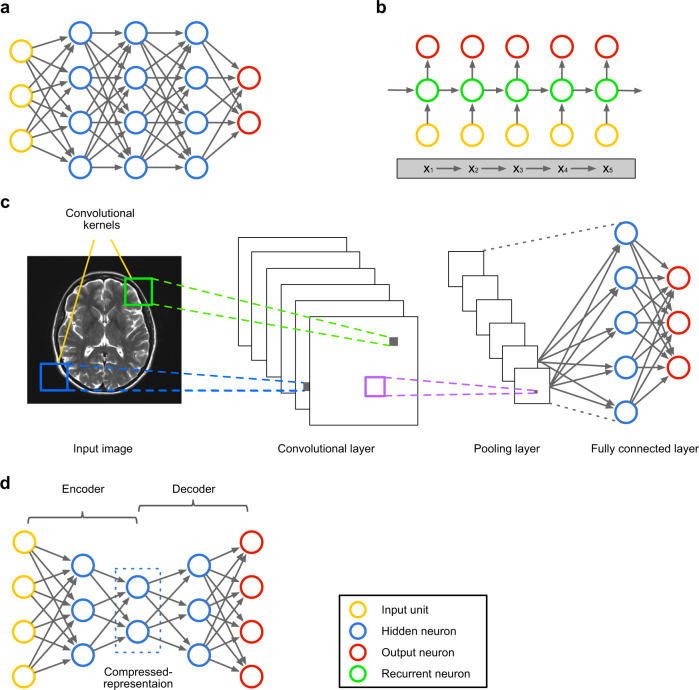
“2a, there is a weight parameter associated with each edge in the DFNN, which needs to be optimized by minimizing some training loss measured on a speci fi c training dataset (usually through back-propagation 17 ).”
MethodThe Elements of Statistical Learning
Hastie, T., Tibshirani, R., & Friedman, J. (2009) · Springer Series in Statistics · doi:10.1007/978-0-387-84858-7 · Cited by 25,970
Semi-supervised classification with graph convolutional networks
Kipf, T. N., & Welling, M. (2016) · arXiv · doi:10.48550/arxiv.1609.02907 · Cited by 24,853
Research works printed but not linked: 7
- Biship, C. M. Pattern Recognition and Machine Learning (Information Science and Statistics) (Springer-Verlag, Berlin, 2007).
- McGuffin, P., Owen, M. J. & Gottesman, I. I. Psychiatric Genetics and Genomics (Oxford Univ. Press, New York, 2004).
- Yue, T. & Wang, H. Deep learning for genomics: a concise overview. Preprint at arXiv:1802.00810 (2018). · arXiv
- Salakhutdinov, R. & Hinton, G. Deep Boltzmann machines. In Proc. 12th Int. Conference on Artificial Intelligence and Statistics 448–455 (Clearwater, Florida, USA, 2009).
- Sadeque, F., Xu, D. & Bethard, S. UArizona at the CLEF eRisk 2017 pilot task: linear and recurrent models for early depression detection. CEUR Workshop Proc. 1866 (2017).
- Yosinski, J., Clune, J., Bengio, Y. & Lipson, H. How transferable are features in deep neural networks? In Proc. Advances in Neural Information Processing Systems 3320–3328 (Montreal, Canada, 2014).
- Srivastava, N., Mansimov, E. & Salakhudinov, R. Unsupervised learning of video representations using LSTMs. In Proc. Int. Conference on Machine Learning 843–852 (Lille, France, 2015).
Cited by
Sorted by citations
Items 301–367 of 367
Mental Health Prediction Model in Eswatini Using Machine Learning Techniques
Fashoto, S. G., Ginindza, N., Dlamini, S., & Fashoto, O. Y. (2025) · IntechOpen eBooks · doi:10.5772/intechopen.1010298
Bhatia, N., Varanasi, L. V. S. K. B. K., Raghuwanshi, P., Saroj, A., & Dasari, C. M. (2024) · International Conference on Bioinformatics and Computational Biology (ICBCB) · doi:10.1109/icbcb61507.2024.11011955
Dang, N., Tran, X., Mai, A., & Vi, C. T. (2025) · World Congress on Medical Physics and Biomedical Engineering, September 7 - 12, 2009, Munich, Germany · doi:10.1007/978-3-031-90197-3_40
Mental Health Analysis with Artificial Intelligence
Verma, S., Sharma, S., & Arora, D. P. (2025) · International Journal of Scientific Research in Science and Technology · doi:10.32628/ijsrst25123109
Chittepu, S., & Martha, S. (2025) · International Conference on Signal Processing, Computing and Control (ISPCC) · doi:10.1109/ispcc66872.2025.11039444
Prediction of Mental Health Issues in Textual Dataset using Deep Learning
Kharbanda, R. S., Balooni, T., Aggarwal, G., & Rajput, A. S. (2025) · doi:10.1109/icetm63734.2025.11051478
Chatterjee, S., Dindarian, A., & Rengaraju, U. (2025) · Apress eBooks · doi:10.1007/979-8-8688-1186-9_8
Klutsey, D. A., Amankwah‐Poku, M., Quarshie, E. N., & Asante, K. O. (2025) · BMJ Open · doi:10.1136/bmjopen-2024-092510
“Mental health outcomes are the measurable consequences of an individual’s mental health state over time, 28 which can be either positive or negative.”
Machine learning based prediction of high school student mental healthPreprint
Lo, W., Lu, S., Korkin, D., Rodriguez, A. C. I., Kelly, L. M., King, J. A., & Nephew, B. C. (2025) · medRxiv · doi:10.1101/2025.08.07.25333218
“Predictive Machine Learning (ML) and Deep Learning (DL) algorithms are ideal in this context and have been successfully deployed in mental health research (Iyortsuun et al., 2023; Su et al., 2020; Su et al., 2022).”
Bokhari, M. U., Yadav, G., Laskar, L. F., Zeyauddin, M., & Alzoubi, M. (2025) · International Conference on Computing for Sustainable Global Development · doi:10.23919/indiacom66777.2025.11115394
“Convolutional Neural Networks (CNNs) have been functional to analyze visual data in mental health studies, such as facial expressions, to assess emotional states and detect mental health disorders[41].”
Ansari, A., Conte, M. L., Flynn, A. J., & Paturkar, A. (2025) · Journal of Biomedical Semantics · doi:10.1186/s13326-025-00335-4
Emotion-Aware ResNet50V2: Enhancing Mental Health Detection through Facial Expression AnalysisPreprint
Lahiri, P., Dey, R., Jana, T., Roy, H., & Bhattacharjee, D. (2025) · Research Square · doi:10.21203/rs.3.rs-7236314/v1
Weingarden, H. M., Holstein, V., Jonathan, G., Armey, M. F., Onnela, J.-P. “., & Wilhelm, S. (2025) · Behavior Therapy · doi:10.1016/j.beth.2025.09.001
Automatic Depression Level Assessment Based on Mel Spectrum and Deep Learning Technology
Zhang, T., Chen, Y., Yue, J., & Li, M. (2025) · International Conference on Electronic Communication and Artificial Intelligence (ICECAI) · doi:10.1109/icecai66283.2025.11170639
“In particular, machine learning [7] and deep learning [8] technologies not only advance personalized treatment options but are also crucial in disease prediction, medical imaging analysis, and genomic studies.”
Peña-Gómez, C., Fradera, M., Corrales, X. S., Caravaca, M., Martínez-Cerdá, J.-F., Escofet, J. A., Roche, D., Barbería, E., Pontes, C., Giraldo, J., et al. (2025) · doi:10.2196/preprints.85085
Gao, F., Dhumras, H., Thakur, G., Xue, X., & Yang, Y. (2025) · IEEE Transactions on Computational Social Systems · doi:10.1109/tcss.2025.3609251
“These technologies—artificial intelligence (AI) and machine learning (ML)—are being used to help mental health professionals make better clinical judgments and to better grasp mental health issues [5].”
Few-Shots Learning Model for Depression Detection Using Actigraphy
Alghamdi, S. (2025) · IEEE International Conference on Computer and Communication Engineering Technology (CCET) · doi:10.1109/ccet66260.2025.11199646
Artificial intelligence and machine learning in modern healthcare ecosystem
Mehta, P. S., Chillarge, G., & Sapkal, S. D. (2025) · Elsevier eBooks · doi:10.1016/b978-0-443-36434-1.00023-9
Lunetti, C., Favini, A., & Trotta, E. (2025) · Behavioral Sciences · doi:10.3390/bs15111483 · Cited by 2
“This has led to the widespread implementation of AI-based systems in our everyday lives, from facial recognition systems to voice assistant tools (Su et al., 2020; Venkatesh, 2022).”
Deep Learning for Mental Health: Attention-Driven Multilayer CNN for Audio Depression Detection
Joy, S., Santhosh Krishna, B., V, Rajesh, S., & Neethu, P. S. (2025) · International Conference on Intelligent Communication Networks and Computational Techniques (ICICNCT) · doi:10.1109/icicnct66124.2025.11233143
“Su et al. [4] and Mao et al. [5] presented comprehensive reviews that describe the growing significance of deep learning in the diagnosis of mental health raise concerns with respect to model interpretability, availability of robust large datasets, and the challenge of combining data from multiple…”
Mood states recognition based on Mandarin speech and deep learning in patients with bipolar disorder
Li, J., Yan, Q., Li, M., Hou, X., Li, C., Zhao, Z., Yin, H., & Xu, G. (2025) · BMC Psychiatry · doi:10.1186/s12888-025-07630-5
“Previous studies have reported high success in audio recognition tasks [29], and have significantly improved performance in depression detection using deep learning [30].”
Machine learning algorithms for predictive patient counseling
Patel, R., Singh, Y. R., Jadeja, P., & Prajapati, B. G. (2025) · Elsevier eBooks · doi:10.1016/b978-0-443-43823-3.00015-7
Deep learning techniques in neuroimaging
Kovač, N., Simeunović, M., Farahani, H., & Watson, P. (2025) · Elsevier eBooks · doi:10.1016/b978-0-443-30248-0.00012-7
Maharjan, S. M., Poudyal, A., van Heerden, A. C., Byanjankar, P., Thapa, A., Islam, C., Kohrt, B. A., & Hagaman, A. (2021) · Figshare · doi:10.6084/m9.figshare.14385336
Jensen, K. H. R., Dam, V. H., Ganz, M., Fisher, P. M., Ip, C.-T., Sankar, A., Marstrand-Joergensen, M. R., Ozenne, B., Osler, M., Penninx, B. W. J. H., et al. (2023) · Figshare · doi:10.6084/m9.figshare.22623808
Maharjan, S. M., Poudyal, A., van Heerden, A. C., Byanjankar, P., Thapa, A., Islam, C., Kohrt, B. A., & Hagaman, A. (2021) · Figshare · doi:10.6084/m9.figshare.14385333
Jensen, K. H. R., Dam, V. H., Ganz, M., Fisher, P. M., Ip, C.-T., Sankar, A., Marstrand-Joergensen, M. R., Ozenne, B., Osler, M., Penninx, B. W. J. H., et al. (2023) · Figshare · doi:10.6084/m9.figshare.22623805
Jensen, K. H. R., Dam, V. H., Ganz, M., Fisher, P. M., Ip, C.-T., Sankar, A., Marstrand-Joergensen, M. R., Ozenne, B., Osler, M., Penninx, B. W. J. H., et al. (2023) · Figshare · doi:10.6084/m9.figshare.22623802
Maharjan, S. M., Poudyal, A., van Heerden, A. C., Byanjankar, P., Thapa, A., Islam, C., Kohrt, B. A., & Hagaman, A. (2021) · Figshare · doi:10.6084/m9.figshare.14385330
Li, B., Peng, A., Yang, D., Yang, N., Zhao, X., Feng, P., Wang, Z., & Chen, L. (2023) · Figshare · doi:10.6084/m9.figshare.24669944
Chen, K., & Chen, T. (2025) · International Symposium on Artificial Intelligence for Education (ISAIE) · doi:10.1145/3775073.3775147
“In recent years, machine learning methods have gained increasing attention in mental health research [7].”
Cano-Jiménez, R., Palencia-Viscarra, R., & Palencia-Diaz, R. (2025) · Revista CONAMED · doi:10.35366/122049
Prediction of Employee Mental Health Towards a Stress-Free Work Environment Using Ensemble Learning
Balasaraswathi, V. R., Pelivela, L. H., Pravallika, G., & Aashish, G. (2025) · IGI Global eBooks · doi:10.4018/979-8-3373-2970-3.ch006
Healthcare Informatics: Transforming Patient Care with Multimodal Machine Learning
Achan, P., Nair, N., & Narayanan, S. (2025) · Springer handbooks · doi:10.1007/978-3-031-81728-1_40
Ayon, Z. A. H., Abdullah, M. Z. T., Ismail, N. H., Kamarudin, N. S., & Murti, M. A. (2025) · International Conference on Software Engineering and Computer Systems · doi:10.1109/icsecs65227.2025.11279065
“Transformer-based models like BERT, RoBERTa, and XLNet achieve over 95% accuracy in detecting early signs of mental health concerns from social media conversations [7], [8].”
Transforming Teletherapy: Using Transfer Learning and NLP for Improved Mental Health Care
Yogish, D., Bharat, S. P., Reddy, S., Ramachandran, S., & Yagnik, P. (2026) · Springer eBooks · doi:10.1007/978-3-032-09582-4_3
Explainable Deep Learning Framework for Multisource Data Fusion in University Mental Health Analysis
Yu, Q. (2025) · International Conference on Information Science and Education (ICISE-IE) · doi:10.1109/icise-ie68873.2025.11379043
Mahmood, A., Sharma, K., Suman, S., Sharma, A. P. G. K., Sharma, C., & Chaudhary, V. K. (2025) · International Conference on Innovations and Emerging Technologies in AI & Communication Systems (IETACS) · doi:10.1109/ietacs68750.2025.11385630
“Nevertheless, a high potential exists to apply them in mental health as well [2].”
Yesankar, P., Puri, C., Gote, P. M., Dagadkar, S. N., Hajbe, J. R., & Pawar, A. (2025) · DMIHER International Conference on Artificial Intelligence in Healthcare, Education and Industry (IDICAIHEI) · doi:10.1109/idicaihei65991.2025.11378189
“Thus through this preprocessing phase, noisy survey data was transformed into a format that was clean, trustworthy, and valid for training a predictive model [24].”
Alakuş, T. B., & Türkoğlu, İ. (2026) · The Journal of Supercomputing · doi:10.1007/s11227-026-08346-3
Elmady, O., Islam, A.-U., & Wang, H. H. (2025) · IEEE Annual Congress on Artificial Intelligence of Things (AIoT) · doi:10.1109/aiot66900.2025.00092
“…found that Long Short Term Memory (LSTM)-based models encoding long-term health trajectories achieved over 15% improvement compared to conventional machine learning for predicting depressive episodes, while deep feedforward networks reached AUC of 0.823 for antidepressant response prediction [3].”
InfluentialDeep learning for neurodevelopmental and psychiatric disorders
Massoud, Y. M., Kuhlmann, L., & Ghany, M. A. A. E. (2026) · Elsevier eBooks · doi:10.1016/b978-0-443-41459-6.00003-1
Wagay, F. A., & Jahiruddin (2025) · International Conference on Artificial Intelligence and Speech Technology (AIST) · doi:10.1109/aist68591.2025.11441504
Sun, J., Ma, S., Fan, Y., & Washington, P. Y. (2026) · Applied Sciences · doi:10.3390/app16073388 · Cited by 1
AI Revolution in Mental Health
Dehankar, P., Chaturvedi, K., & Das, S. (2026) · Advances in computational intelligence and robotics book series · doi:10.4018/407380
AI-Driven Early Detection of Mental Health Disorders Using Speech and Behavioral Patterns
Adeyinka, K. I., & Adeyinka, T. I. (2026) · Advances in computational intelligence and robotics book series · doi:10.4018/407602
Assessing Professional Readiness and Ethical Challenges for AI Integration in Mental Health Services
Chakraborthy, M., & Memon, H. (2026) · Springer eBooks · doi:10.1007/978-981-96-9650-5_27
Shankarappa, S. B., & Janathakal, R. (2025) · International Conference on Sustainable Computing and Smart Systems (ICSCSS) · doi:10.1109/icscss64956.2025.11500724
“Facial Expression Recognition (FER) also plays a vital role in applications such as education (e.g., classroom engagement [9], [10]) and healthcare (e.g., pain monitoring [11], mental health assessment [12], [13], and autism diagnosis [14], [15]), spanning from childhood to adulthood.”
Fang, Y., Zou, F., Feng, Z., Liu, X., Xie, Z., Huang, J., Li, J., & Zheng, S. (2026) · BMC Psychiatry · doi:10.1186/s12888-026-08156-0
“Recent innovations include adversarial domain adaptation techniques that address cross-corpus generalization challenges in EEG-based depression recognition [27], and multimodal fusion architectures that integrate heterogeneous data sources to improve classification accuracy [25].”
Deep Learning for Mental Health: Automated Detection of Mental Disorders from MRI Data
Begum, M., Haider, N., Dey, B., Rayhanuzzaman, Mahmud, T., Madraxim, S., Rakhimov, R. R., Hanip, A., & Hossain, M. S. (2026) · Lecture notes in networks and systems · doi:10.1007/978-3-032-15764-5_9
Candanedo, D., Agyemang, E. F., Chaudhry, F. S., Franks, T., Taylor, B., Siliezar, K., & Kakraba, S. (2026) · Acta Psychologica · doi:10.1016/j.actpsy.2026.107081 · Cited by 2
Moura, L. F. D. O., & Sartin, K. R. (2026) · Revista Foco · doi:10.54751/revistafoco.v19n6-029
Peña-Gómez, C., Fradera, M., Corrales, X. S., Caravaca, M., Martínez-Cerdá, J.-F., Escofet, J. A., Roche, D., Barbería, E., Pontes, C., Giraldo, J., et al. (2026) · JMIR AI · doi:10.2196/85085
“Multiple studies have demonstrated that applying AI-based tools to EHR data can identify novel characteristics beyond the well-established risk factors for suicidal behavior [17-22], thereby enhancing the predictive accuracy of suicide risk models compared with previous approaches [17, 23,24].”
Leveraging Machine and Ensemble Learning Classifiers for Depression Detection
Ashraf, T., Ali, I., Yaqoob, M., Bouktif, S., & Khanday, A. M. U. D. (2026) · Procedia Computer Science · doi:10.1016/j.procs.2026.05.158
AI-Based Detection of Psychological Disorders using EEG Signals and Deep Learning
Kurian, B., Darsini, L. P., Sruthi, S., Subiksha, S., Anju, A., & Mehraj, M. B. (2026) · International Conference on Next Generation Electronics (NELEX) · doi:10.1109/nelex69209.2026.11590630
“The deep learning models, such as CNN-based models, as reported by [16]and CNN-RNN hybrid models, as proposed by[16], have been found to have higher accuracy in capturing the hierarchical representations of EEG data.”
Kumari, P., & Jijja, A. (2026) · Cureus Journal of Computer Science. · doi:10.7759/s44389-026-00156-1
“More recent studies have applied deep neural networks to complex data modalities such as text, speech, and images [25,26].”
Bao, E., Pérez, A., & Parapar, J. (2026) · Science Progress · doi:10.1177/00368504261467483
“11,12,37 Prior work has explored techniques for generating interpretable explanations.”
Affect and mental state detection for mental health care
Lefter, I., & Sano, A. (2026) · Elsevier eBooks · doi:10.1016/b978-0-443-33151-0.00016-2
Sadegh‐Zadeh, S., Saadat, S., Sadeghimanesh, Z., Soleymani, O., Mamalo, A. S., Anoosheh, S., Shalbafan, M., Khalilian, E., & Mousavi, S. Y. (2026) · Geopsychiatry · doi:10.1016/j.geopsy.2026.100115
Precision medicine for mood disorders in the big data era
Joshi, A. A., Franklin, C., Bray, M. J. C., Adams, R. J., Li, K., Taylor, J., Goes, F. S., Zandi, P., & Potash, J. B. (2026) · International Review of Psychiatry · doi:10.1080/09540261.2026.2717216
Fakher, L., & Bauer, A. (2026) · Lecture notes in computer science · doi:10.1007/978-3-032-37654-1_31
Biological Foundation Models for Complex Disease Research and Clinical Translation
Noll-Walker, T., & Chen, Y. (2026) · Biology · doi:10.3390/biology15171527
“These variants may affect gene regulation in specific cell types, brain regions, or developmental stages, making their functional consequences difficult to interpret without models that connect sequence variation to regulatory and cellular changes [21].”
Deep Learning Integration in Clinical Decision Infrastructure: A Systems-Oriented Review
Dupont, C., & Martin, J. (2023) · Journal of Artificial Intelligence for Healthcare Systems · doi:10.68159/n174260851
AI Powered Mental Health Diagnostics Using Multimodal Data
Sharma, L. P., Kumar, G. S., KIRUBAKARAN, N., Sundarambal, B., Selvaganesan, C., & Muralidharan, V. (2026) · Lecture notes in networks and systems · doi:10.1007/978-3-032-14775-2_30
Faro, A., Tejada, J., & Al-Delaimy, W. (2026) · Global Epidemiology · doi:10.1016/j.gloepi.2026.100292
“In health psychology and public health, ML models can examine complex relationships among measurement elements and their underlying constructs, manage large datasets, and identify patterns relevant to mental states [33 – 36].”
Hena, A., Akhter, N., & Raisa, J. F. (2026) · Lecture notes in networks and systems · doi:10.1007/978-3-032-33805-1_3
AI for multilingual mental health recognition via social media analysis:A systematic review
Zulfa, A. Q., Wibirama, S., Alfarozi, S. A. I., & Kusrohmaniah, S. (2026) · Array · doi:10.1016/j.array.2026.101373
Metadata
- Authors
- Su, C., Xu, Z., Pathak, J., & Wang, F.
- Affiliations
- Weill Cornell Medicine (US)
- Corresponding author
- Wang, Fei
- Venue
- Translational Psychiatry
- Published
- 2020-04-22
- Volume
- 10
- Issue
- 1
- Pages
- 116-116
- ISSN
- 2158-3188 (ISSN-L)
- PMC
- PMC7293215
- OpenAlex
- W3034674374
- Cited by
- 368
- References
- 139
- Citations by year
- 2026: 35 · 2025: 83 · 2024: 74 · 2023: 73 · 2022: 60 · 2021: 38 · 2020: 5
- FWCI
- 6.73
- Type
- journal article
- Language
- en
- Open access
- gold
- doi.org
- Locations
- Translational Psychiatry (publishedVersion, cc-by)
- PubMed Central (publishedVersion, cc-by)
- PubMed (publishedVersion)
- Funders
- National Science Foundation
- U.S. Department of Health & Human Services | NIH | National Institute of Mental Health
- Topics
- Health Sciences › Health Professions › Health Information Management › Artificial Intelligence in Healthcare
- Physical Sciences › Computer Science › Artificial Intelligence › Machine Learning in Healthcare
- Health Sciences › Medicine › Health Informatics › Artificial Intelligence in Healthcare and Education
- Keywords
- deep learning, mental health outcomes, depression, artificial intelligence in psychiatry, medical data analysis, social media data, diagnosis and prognosis, clinical decision support
- MeSH terms
- Deep Learning, Algorithms, Artificial Intelligence, Humans, Mental Health, Outcome Assessment, Health Care
About these checks
Registry, retraction, Cites and statistics results are computed, not judged, with one exception: a printed reference that no index lists is read once by a model before it counts as a citation error. Claims are extracted by a model and kept only when their quote appears verbatim in the text; each cited source is then checked, with a model’s help, for whether it says what the claim relies on. Those verdicts can be wrong — read the claim’s quote and the cited source before relying on one.
Statistics and arithmetic are recomputed, not judged.
Confidence bands are shown only for fields calibrated on our annotated test set. None is calibrated yet, so no band is shown.
What counts as a claim ›How we measure confidence ›How we check this ›
Are you an author, or do you see a problem with this page? Request a review
