

How machine-learning recommendations influence clinician treatment selections: the example of antidepressant selection
Open accessThe DOI matches its Crossref record; 46 of the 50 references it cites were found in a registry or an index.
Abstract
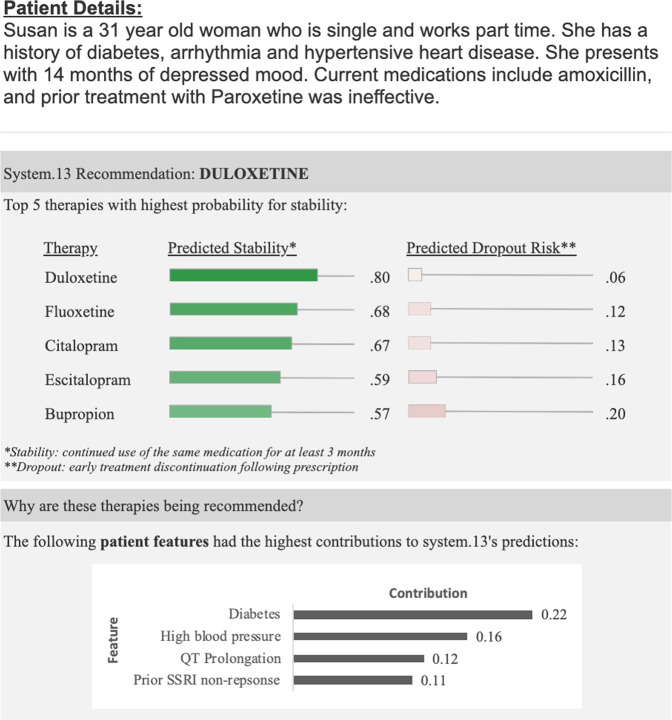
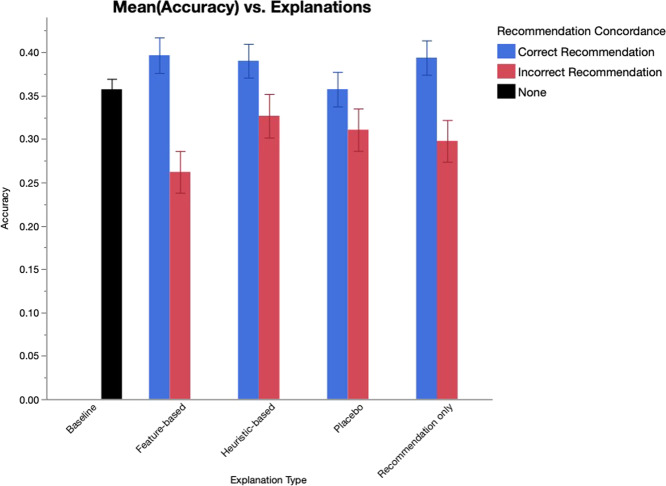
Decision support systems embodying machine learning models offer the promise of an improved standard of care for major depressive disorder, but little is known about how clinicians’ treatment decisions will be influenced by machine learning recommendations and explanations. We used a within-subject factorial experiment to present 220 clinicians with patient vignettes, each with or without a machine-learning (ML) recommendation and one of the multiple forms of explanation. We found that interacting with ML recommendations did not significantly improve clinicians’ treatment selection accuracy, assessed as concordance with expert psychopharmacologist consensus, compared to baseline scenarios in which clinicians made treatment decisions independently. Interacting with incorrect recommendations paired with explanations that included limited but easily interpretable information did lead to a significant reduction in treatment selection accuracy compared to baseline questions. These results suggest that incorrect ML recommendations may adversely impact clinician treatment selections and that explanations are insufficient for addressing overreliance on imperfect ML algorithms. More generally, our findings challenge the common assumption that clinicians interacting with ML tools will perform better than either clinicians or ML algorithms individually.
Overview
The claims and statistics of this paper haven’t been checked yet.
Free: it reads the open-access text and checks the first 5 claims that cite a source we can check. Create a free account to check every claim.
Integrity signals
Registry
Cites
Statistics
Figures
Verification
Claims the paper makes
The claims and statistics of this paper haven’t been checked yet.
Free: it reads the open-access text and checks the first 5 claims that cite a source we can check. Create a free account to check every claim.
Claims other papers make about this one
Each is checked against this paper’s own text: does it say what the citing paper says it does?
The source backs part of the claim, not all of it — or backs it for a different population, condition or comparison.
In the citing paper
“Previous research has shown that providing case-by-case explanations indeed increases trust in and reliance on the advice, even when the advice is incorrect8.”
From Non-task expert physicians benefit from correct explainable AI advice when reviewing X-rays (2023) · cites this paper as [8]
Experimental — accuracy not yet measuredThe source backs part of the claim, not all of it — or backs it for a different population, condition or comparison.
In the citing paper
“While explanations have been shown to increase trust in AI systems, they can also result in over-or underreliance [8,34].”
From Cognitive Forcing for Better Decision-Making: Reducing Overreliance on AI Systems Through Partial Explanations (2025) · cites this paper as [34]
Experimental — accuracy not yet measuredThe source backs part of the claim, not all of it — or backs it for a different population, condition or comparison.
In the citing paper
“This distinction is particularly important given evidence that human decision-makers often mistrust accurate algorithmic predictions and place undue trust in flawed algorithms ( Bansal, Wu, et al., 2021 ;Green & Chen, 2019a, 2019b ;Jacobs et al., 2021 ;Lai & Tan, 2019 ).”
From The flaws of policies requiring human oversight of government algorithms (2022) · cites this paper as Jacobs et al., 2021
Experimental — accuracy not yet measuredThe source backs part of the claim, not all of it — or backs it for a different population, condition or comparison.
In the citing paper
“This finding suggests that higher AI literacy, namely higher familiarity with algorithms, is associated with greater independence in decision- making, which helps mitigate the risks of overreliance”
From The role of critical thinking on undergraduates' reliance behaviours on generative AI in problem‐solving (2025) · cites this paper as Jacobs et al., 2021
Experimental — accuracy not yet measuredThe source backs part of the claim, not all of it — or backs it for a different population, condition or comparison.
In the citing paper
“For humans, post-hoc interaction with such outputs is opaque and coarse-grained: experts must reverseengineer the model's reasoning to correct errors, while novices risk automation bias and over-reliance on machine-generated authority [32, 44, 87].”
From Criticmate: Stagewise Human–AI Co-Critique in Single-Screen UI Evaluation (2026) · cites this paper as [44]
Experimental — accuracy not yet measured
8 more claims about this paper
Create a free account to see every claim other papers make about this one.
Self-check
Percentages, sums and reported differences re-computed from the paper’s own numbers.
The self-check needs the paper’s full text.
Citations
Cites
“Why Should I Trust You?”: Explaining the Predictions of Any Classifier
Ribeiro, M., Singh, S., & Guestrin, C. (2016) · Proceedings of the 2016 Conference of the North American Chapter of the Association for Computational Linguistics: Demonstrations · doi:10.18653/v1/n16-3020 · Cited by 6,682
Guidelines for Human-AI Interaction
Amershi, S., Weld, D., Vorvoreanu, M., Fourney, A., Nushi, B., Collisson, P., Suh, J., Iqbal, S., Bennett, P. N., Inkpen, K., et al. (2019) · Proceedings of the 2019 CHI Conference on Human Factors in Computing Systems · doi:10.1145/3290605.3300233 · Cited by 2,439 · cited 1×
“One assumption from the broader ML community that motivates this research is that humans interacting with ML tools will perform better than either actor individually 34,35 .”
BackgroundThe practical implementation of artificial intelligence technologies in medicine
He, J., Baxter, S. L., Xu, J., Xu, J., Zhou, X., & Zhang, K. (2019) · Nature Medicine · doi:10.1038/s41591-018-0307-0 · Cited by 2,246
Do no harm: a roadmap for responsible machine learning for health care
Wiens, J., Saria, S., Sendak, M., Ghassemi, M., Liu, V. X., Doshi-Velez, F., Jung, K., Heller, K., Kale, D., Saeed, M., et al. (2019) · Nature Medicine · doi:10.1038/s41591-019-0548-6 · Cited by 1,266
Self-citationKennedy, S. H., Lam, R. W., McIntyre, R. S., Tourjman, S. V., Bhat, V., Blier, P., Hasnain, M., Jollant, F., Levitt, A. J., MacQueen, G. M., et al. (2016) · The Canadian Journal of Psychiatry · doi:10.1177/0706743716659417 · Cited by 1,181
Machine learning in mental health: a scoping review of methods and applications
Shatte, A. B. R., Hutchinson, D. M., & Teague, S. J. (2019) · Psychological Medicine · doi:10.1017/s0033291719000151 · Cited by 1,047
Cross-trial prediction of treatment outcome in depression: a machine learning approach
Chekroud, A. M., Zotti, R. J., Shehzad, Z., Gueorguieva, R., Johnson, M. K., Trivedi, M. H., Cannon, T. D., Krystal, J. H., & Corlett, P. R. (2016) · The Lancet Psychiatry · doi:10.1016/s2215-0366(15)00471-x · Cited by 676
A Survey Of Methods For Explaining Black Box Models
Guidotti, R., Monreale, A., Ruggieri, S., Turini, F., Pedreschi, D., & Giannotti, F. (2018) · arXiv · doi:10.48550/arxiv.1802.01933 · Cited by 630
A Survey of Methods for Explaining Black Box Models
Guidotti, R., Monreale, A., Ruggieri, S., Turini, F., Giannotti, F., & Pedreschi, D. (2019) · ACM Computing Surveys · doi:10.1145/3236009 · Cited by 629
Understanding the Effect of Accuracy on Trust in Machine Learning Models
Yin, M., Wortman Vaughan, J., & Wallach, H. (2019) · Proceedings of the 2019 CHI Conference on Human Factors in Computing Systems · doi:10.1145/3290605.3300509 · Cited by 527 · cited 2×
“Our work challenges the validity of this assumption, aligning with recent studies in non-medical domains suggesting that humans interacting with ML tools may perform worse than the algorithm acting independently 39,40 .”
Background
Cited by
Items 101–200 of 255
When Are Combinations of Humans and AI Useful?Preprint
Vaccaro, M. A., Almaatouq, A., & Malone, T. W. (2024) · doi:10.31234/osf.io/mk46p · Cited by 16
Stratifying Risk for Postpartum Depression at Time of Hospital Discharge
(2024) · doi:10.1101/2024.05.27.24307973 · Cited by 16
Out of their minds? Externalist challenges for using AI in forensic psychiatry
Starke, G., D’Imperio, A., & Ienca, M. (2023) · Frontiers in Psychiatry · doi:10.3389/fpsyt.2023.1209862 · Cited by 23
Beyond Recommendations: From Backward to Forward AI Support of Pilots' Decision-Making Process
Zhang, Z. T., Feger, S. S., Dullenkopf, L., Liao, R., Süsslin, L., Liu, Y., & Butz, A. (2024) · Proceedings of the ACM on Human-Computer Interaction · doi:10.1145/3687024 · Cited by 16
“This is not only an issue for pilots as in our study, but also in other domains, such as in healthcare [21, 32, 65].”
BackgroundResultInfluentialHussain, M. H., Iacovides, I., Lawton, T., Sharma, V., Porter, Z., Cunningham, A., Habli, I., Hickey, S., Jia, Y., Morgan, P., et al. (2024) · Designing Interactive Systems Conference · doi:10.1145/3643834.3660697 · Cited by 24
“However, recent studies reveal that trust is a significant concern, which can lead to the acceptance of incorrect recommendations (due to too much trust) or the rejection of correct ones (due to too little) [35].”
BackgroundTen Topics to Get Started in Medical Informatics Research
Wolfien, M., Ahmadi, N., Fitzer, K., Grummt, S., Heine, K.-L., Jung, I.-C., Krefting, D., Kühn, A., Peng, Y., Reinecke, I., et al. (2023) · Journal of Medical Internet Research · doi:10.2196/45948 · Cited by 19
Learning When to Advise Human Decision Makers
Noti, G., & Chen, Y. (2023) · International Joint Conference on Artificial Intelligence · doi:10.24963/ijcai.2023/339 · Cited by 44
Explaining decisions without explainability? Artificial intelligence and medicolegal accountability
McCradden, M. D., & Stedman, I. (2024) · Future Healthcare Journal · doi:10.1016/j.fhj.2024.100171 · Cited by 19
Framework for human–XAI symbiosis: extended self from the dual-process theory perspective
Litvinova, Y., Mikalef, P., & Luo, X. R. (2024) · Journal of Business Analytics · doi:10.1080/2573234x.2024.2396366 · Cited by 20
“We presuppose human autonomy: This is the human who makes the final decision and takes over responsibility for it (Green & Chen, 2019a, 2019b; Jacobs et al., 2021; Lai & Tan, 2019; Schemmer et al., 2022).”
Rost, N., Dwyer, D., Gaffron, S., Rechberger, S., Maier, D., Binder, E. B., & Brückl, T. M. (2023) · Journal of Affective Disorders · doi:10.1016/j.jad.2023.02.007 · Cited by 16
Explainability, Public Reason, and Medical Artificial Intelligence
Silva, M. D. (2023) · Ethical Theory and Moral Practice · doi:10.1007/s10677-023-10390-4 · Cited by 15
“Jacobs et al. (2021) suggest provision of any explanation of how AI operates or reaches decisions increases chances that healthcare providers will follow inaccurate AI recommendations.”
BackgroundYacoby, Y., Green, B., Griffin, C. L., Jr., & Doshi‐Velez, F. (2022) · Proceedings of the AAAI Conference on Human Computation and Crowdsourcing · doi:10.1609/hcomp.v10i1.22001 · Cited by 33
Self-citationShould we Make AI More Tool-like or Teammate-Like?
Naikar, N., Hoffman, R., Roth, E. M., Klein, G., Militello, L., & Dominguez, C. (2025) · Journal of Cognitive Engineering and Decision Making · doi:10.1177/15553434251346904 · Cited by 9
“An example is a recent study that looked at how machine-learning recommendations in fl uence clinicians in deciding the appropriate treatment for patients with depression (Jacobs et al., 2021).”
Hallucinations in medical devices
Granstedt, J., Prabhat, K. C., Deshpande, R., Garcia, V. L., & Badano, A. G. (2025) · Artificial Intelligence in the Life Sciences · doi:10.1016/j.ailsci.2025.100145 · Cited by 28
Ruiz, N. R., Own, S. A., Smedby, K. E. E., Eloranta, S., Koch, S., Wästerlid, T., Krstić, A., & Boman, M. (2022) · Frontiers in Oncology · doi:10.3389/fonc.2022.984021 · Cited by 20
Li, C., Zhang, Z., Saugstad, M., Safranchik, E., Kulkarni, M., Huang, X., Patel, S., Iyer, V., Althoff, T., & Froehlich, J. E. (2024) · CHI Conference on Human Factors in Computing Systems · doi:10.1145/3613904.3642089 · Cited by 21
“For example, [9, 42] showed how users tend to overly depend on AI, following its suggestions even when their own judgment might be superior.”
Early Warning Systems for Critical Illness Outside the Intensive Care Unit
Henry, K. E., & Giannini, H. M. (2024) · Critical Care Clinics · doi:10.1016/j.ccc.2024.03.007 · Cited by 17
Bolton, W. J., Wilson, R. C., Gilchrist, M. J., Georgiou, P., Holmes, A. H., & Rawson, T. M. (2025) · The Lancet Digital Health · doi:10.1016/j.landig.2025.100912 · Cited by 21
Fernandes, G. J., Choi, A., Schauer, J. M., Pfammatter, A. F., Spring, B. J., Darwiche, A. Y., & Alshurafa, N. I. (2023) · Journal of Medical Internet Research · doi:10.2196/42047 · Cited by 17
Buschmeyer, K., Hatfield, S., & Zenner, J. (2023) · Frontiers in Artificial Intelligence · doi:10.3389/frai.2023.1249322 · Cited by 29
Differences between human and artificial/augmented intelligence in medicine
Monteith, S., Glenn, T., Geddes, J. R., Achtyes, E. D., Whybrow, P. C., & Bauer, M. (2024) · Computers in Human Behavior Artificial Humans · doi:10.1016/j.chbah.2024.100084 · Cited by 21
Can AI-generated news reduce hostile media perceptions? Findings from two experiments
Huh, E., Kubin, E., & von Sikorski, C. (2025) · Frontiers in Communication · doi:10.3389/fcomm.2025.1484186 · Cited by 18
Artificial Intelligence and the Potential Transformation of Mental Health
Perlis, R. H. (2026) · JAMA Psychiatry · doi:10.1001/jamapsychiatry.2025.4116 · Cited by 17
Self-citationHow Displaying AI Confidence Affects Reliance and Hybrid Human-AI Performance
Tejeda, H., Kumar, A., & Mark Steyvers, B. (2023) · Frontiers in artificial intelligence and applications · doi:10.3233/faia230087 · Cited by 14
Yu, S. (2023) · International Academic Mindtrek Conference (Mindtrek) · doi:10.1145/3616961.3616965 · Cited by 17
“Although some studies have provided some evidence about how explanations can help improve trust in AI systems [41, 58, 87, 90], and other studies show that explanations will, in turn, promote users’ over-reliance on AI [15, 41, 59], it is unclear how the explanations support trust calibration [60].”
ResultIncreasing transparency of computer-aided detection impairs decision-making in visual search
Kunar, M. A., Watson, D., & Montana, G. (2024) · Psychonomic Bulletin & Review · doi:10.3758/s13423-024-02601-5 · Cited by 10
“Furthermore, there is considerable evidence showing that people can become overreliant on this technology (e.g., Buçinca et al., 2021; Bussone et al., 2015; Jacobs et al., 2021; Kunar et al., 2017).”
Ashktorab, Z., Desmond, M., Pan, Q., Johnson, J., Brachman, M., Dugan, C., Danilevsky, M., & Geyer, W. (2025) · Proceedings of the 4th Annual Symposium on Human-Computer Interaction for Work · doi:10.1145/3729176.3729179 · Cited by 10
“Despite the remarkable accuracy of AI, human-AI teams sometimes fall short of expectations [8], particularly in areas where AI-alone teams outperform human-alone counterparts across various domains [6, 7, 19, 24, 55].”
Kox, E. S., & Beretta, B. (2024) · Frontiers in artificial intelligence and applications · doi:10.3233/faia240194 · Cited by 14
Wang, X., Tian, Y., Huang, K., & Liang, B. (2024) · Computers & Security · doi:10.1016/j.cose.2024.104113 · Cited by 14
“…downstream clinician treatment selections (Sivaraman et al., 2023; Verma et al., 2023; Yang et al., 2023; Tsai et al., 2021; Panigutti et al., 2022; Jacobs et al., 2021), or inadequate cyber operations resulting into substantial cyber risks (Kokulu et al., 2019; Wiczorek and Meyer, 2019;…”
BackgroundJackson, N. J., Brown, K. E., Rn, M., Murrow, M., Cauley, M. R., Collins, B. X., Novak, L. L., Benda, N. C., & Ancker, J. S. (2026) · Journal of the American Medical Informatics Association · doi:10.1093/jamia/ocag002 · Cited by 19
“33,63,66 However, these results were often observed under different circumstances.”
InfluentialThe Social and Ethical Component in AI Systems Design and Management
Mantelero, A. (2022) · Information technology and law series/Information technology & law series · doi:10.1007/978-94-6265-531-7_3 · Cited by 11
McCradden, M. D. (2021) · Translational Psychiatry · doi:10.1038/s41398-021-01479-4 · Cited by 8
“It is particularly interesting that Jacobs et al. [3] found that feature-based explanations with incorrect predictions were more compelling than heuristic-based explanations and placebo.”
BackgroundInfluentialChoo, H., Yoo, S. Y., Moon, S., Park, M., Lee, J., Sung, K. W., Cha, W. C., Shin, S.-Y., & Son, M. H. (2022) · Journal of Biomedical Informatics · doi:10.1016/j.jbi.2022.104268 · Cited by 8
Majority voting of doctors improves appropriateness of AI reliance in pathology
Gu, H., Yang, C., Magaki, S., Zarrin‐Khameh, N., Lakis, N. S., Cobos, I., Khanlou, N., Zhang, X. R., Assi, J. S., Byers, J. T., et al. (2024) · International Journal of Human-Computer Studies · doi:10.1016/j.ijhcs.2024.103315 · Cited by 8
Yurrita, M., Verma, H., Balayn, A., Gadiraju, U., Pont, S., & Bozzon, A. (2025) · International Conference on Human Factors in Computing Systems · doi:10.1145/3706598.3713145 · Cited by 11
“Difficulties in presenting algorithmic outputs might lead to overreliance on the AI system [17, 51].”
A cautionary tale for AI and machine learning in psychiatry
Chen, Z. S., Schultebraucks, K., & Wu, W. (2026) · Translational Psychiatry · doi:10.1038/s41398-026-03930-w · Cited by 11
“Despite growing interest in XAI, recent research suggests that interaction with AI recommendations does not consistently improve clinicians ’ treatment accuracy — and incorrect recommendations may even mislead them [46].”
Is Overreliance on AI Provoked by Study Design?
Zhang, Z. T., Tong, S., Liu, Y., & Butz, A. M. (2023) · Lecture notes in computer science · doi:10.1007/978-3-031-42286-7_3 · Cited by 11
“However, several studies show that in many cases, AI explanations may even increase blind trust in AI, rather than improve calibration [1,2,8,13].”
BackgroundHerrmann, M., Wabro, A., & Winkler, E. C. (2024) · Ethics and Information Technology · doi:10.1007/s10676-024-09764-8 · Cited by 10
“But what if the AI’s explainability features were expanded and a physician could additionally obtain comparative cases from the training data set of the machine (like in Jacobs et al., 2021)?”
Rumahorbo, B. N., Pardamean, B., & Elwirehardja, G. N. (2023) · International Conference of Computer and Informatics Engineering (IC2IE) · doi:10.1109/ic2ie60547.2023.10331094 · Cited by 7
Clement, J., Ren, Y., & Curley, S. P. (2021) · SSRN Electronic Journal · doi:10.2139/ssrn.3961156 · Cited by 7
Rosenbacke, R. (2024) · SSRN Electronic Journal · doi:10.2139/ssrn.4773350 · Cited by 9
Zhang, Z. T., Buchner, F., Liu, Y., & Butz, A. (2024) · Proceedings of Mensch und Computer 2024 · doi:10.1145/3670653.3670660 · Cited by 6
“However, many studies have found that explanations do not effectively improve appropriate reliance [3, 33, 38, 41] or even increase overreliance on AI [2, 4, 17, 21, 34], i.e., people become more likely to adopt detrimental AI recommendations.”
Vicente, L., Matute, H., Fregosi, C., & Cabitza, F. (2025) · International Journal of Human-Computer Studies · doi:10.1016/j.ijhcs.2025.103474 · Cited by 18
Perlis, R. H., Verhaak, P. F., Goldberg, J. F., Cusin, C., Ostacher, M. J., Malhi, G. S., Zarate, C. A., Shelton, R. C., Iosifescu, D. V., Tohen, M. F., et al. (2025) · Journal of Mood and Anxiety Disorders · doi:10.1016/j.xjmad.2025.100142 · Cited by 9
“One potential application would simply provide the clinician, at point of care, with suggested treatment options and medications to avoid [22].”
Self-citationPassi, S., Dhanorkar, S., & Vorvoreanu, M. (2025) · Springer eBooks · doi:10.1007/978-981-95-3658-0_98 · Cited by 16
Taking Training Seriously: Human Guidance and Management-Based Regulation of Artificial Intelligence
Crum, C. R., & Coglianese, C. (2024) · International Joint Conference on Neural Networks (IJCNN) · doi:10.1109/ijcnn60899.2024.10651170 · Cited by 15
“Decreased overall performance has been observed within clinical treatments [32], and even lackluster performance within human understanding of AI-based explanations [33].”
BackgroundPesch, P. J., Димитрова, Д., & Boehm, F. (2022) · Lecture notes in computer science · doi:10.1007/978-3-031-07315-1_4 · Cited by 14
A short-form AI literacy intervention can reduce over-reliance on AIPreprint
Morrill, J., & Noetel, M. (2023) · PsyArXiv (OSF Preprints) · doi:10.31234/osf.io/hv9qc · Cited by 10
Faas, C., Uth, R., Sterz, S., Langer, M., & Feit, A. M. (2026) · ACM Conference on Fairness, Accountability, and Transparency (FAccT) · doi:10.1145/3805689.3812265 · Cited by 28
“Therefore, in the following, we focus on work psychology literature to understand the relationship between psychological needs, motivation, and performance, which has a long history of research in the work context (e.g., [34]).”
Resilience Through Appropriation: Pilots’ View on Complex Decision Support
Zhang, Z. T., Storath, C., Liu, Y., & Butz, A. M. (2023) · ACM International Conference on Intelligent User Interfaces (IUI) · doi:10.1145/3581641.3584056 · Cited by 13
“Results show that trust is hard to calibrate, which potentially results in overreliance [2, 5, 33] or underreliance [13].”
BackgroundWhat Else Do I Need to Know? The Effect of Background Information on Users’ Reliance on QA Systems
Goyal, N., Briakou, E., Liu, A., Baumler, C., Bonial, C., Micher, J. C., Voss, C. R., Carpuat, M. J., & Daumé, H. (2023) · Conference on Empirical Methods in Natural Language Processing (EMNLP) · doi:10.18653/v1/2023.emnlp-main.201 · Cited by 20
“…are summarized as follows: ◦ In line with previous findings on users’ over-reliance on AI predictions (Bansal et al., 2021; Bussone et al., 2015; Jacobs et al., 2021; Lai and Tan, 2019), users over-rely on model predictions even in the absence of the relevant background required to assess…”
BackgroundInfluentialNair, M., Lundgren, L. E., Soliman, A., Dryselius, P., Fogelberg, E., Petersson, M., Hamed, O., Triantafyllou, M., & Nygren, J. (2024) · JMIR Research Protocols · doi:10.2196/52744 · Cited by 6
Trust Junk and Evil Knobs: Calibrating Trust in AI Visualization
Wall, E., Matzen, L. E., El‐Assady, M., Masters, P., Hosseinpour, H., Endert, A., Borgo, R., Chau, P., Perer, A., Schupp, H. T., et al. (2024) · IEEE Pacific Visualization Conference (PacificVis) · doi:10.1109/pacificvis60374.2024.00012 · Cited by 19
“Similarly, explanations of model behavior and estimations of uncertainty can help users understand context and evaluate reliability [2,56,88], but may also make users overconfident [41,98].”
BackgroundCan I Trust You? Exploring the Impact of Misleading AI Suggestions on User's Trust
Pretolesi, D., Zechner, O., Schrom-Feiertag, H., & Tscheligi, M. (2024) · 2024 IEEE International Conference on Metrology for eXtended Reality, Artificial Intelligence and Neural Engineering (MetroXRAINE) · doi:10.1109/metroxraine62247.2024.10796402 · Cited by 6
“Despite efforts to clarify how AI suggestions are generated, individuals tend to over-rely on AI when used for decision-making processes [5]–[9].”
Langer, M. (2023) · Psychologische Rundschau · doi:10.1026/0033-3042/a000626 · Cited by 5
Lin, T.-H., Kopelman, Y. R., Busse, M., Sebo, S. S., & Erel, H. (2025) · Computers in Human Behavior · doi:10.1016/j.chb.2025.108807 · Cited by 7
“…and shape people ’ s decisions in domains ranging from product recommendation for customers (Abdi et al., 2022; Iwasaki et al., 2024) and medication selection for patients (Jacobs et al., 2021) to wildfire prediction (Jain et al., 2020) and strategic business decisions (Rajagopal et al., 2022).”
Artificial intelligence for autoimmune diseases
Mahajan, A., LaChance, A., Rodman, A. M., Chung, L. S., & Powell, D. (2025) · npj Digital Medicine · doi:10.1038/s41746-025-02015-0 · Cited by 5
Explainability in AI-enabled medical neurotechnology: a scoping review
Schopp, L., Starke, G., & Ienca, M. (2026) · Journal of NeuroEngineering and Rehabilitation · doi:10.1186/s12984-026-01892-0 · Cited by 6
“…articles, there remains a lack of clarity regarding the precise mechanisms through which explainability tout court or specific XAI methods might increase clinicians’ confidence in the validity, accuracy, and reliability of AI outputs, particularly in the fields of neurology and psychiatry [3, 213].”
Kokje, E., Lermer, E., Kleine, A.-K., & Gaube, S. (2026) · Cognitive Research · doi:10.1186/s41235-026-00707-z · Cited by 6
“…other studies show either no effect (Bertrand et al., 2023; Cecil et al., 2024) or even a negative impact, wherein overreliance increases when explanations are provided (Jacobs et al., 2021; Schem-mer et al., 2022), as the presence of an explanation itself increases trust (Bertrand et al., 2022).”
Trust and Dependence on Robotic Decision Support
Natarajan, M., & Gombolay, M. (2024) · IEEE Transactions on Robotics · doi:10.1109/tro.2024.3484628 · Cited by 8
“…the consequences and rely appropriately on the DSS. Despitetheprevalenceofsequentialdecision-makingtasks inreal-worldscenarios,priorworkwithautonomousagents offeringcognitiveassistanceoftenfocusesonnonsequential tasks[27],[28],[29],[30],whichdonotcapturethecomplexities ofsequentialdecision-making.”
Ma, Z., Mei, Y., Bruderlein, C., Gajos, K. Z., & Pan, W. (2025) · Annual Symposium on Human-Computer Interaction for Work (CHIWORK) · doi:10.1145/3729176.3729194 · Cited by 28
Self-citationThe Benefits and Risks of LLMs for Facilitating Medical Decision-Making Among Laypersons
Foo, C., Foong, P. S., Nadal, C., Ureyang, N., Naylin, T., & Koh, G. C. (2025) · Designing Interactive Systems Conference · doi:10.1145/3715336.3735779 · Cited by 15
“Addressing the issue of over-reliance, Jacobs et al. [25] found that cognitive forcing interventions can compel people to engage more critically with the AI-generated explanations.”
Narechania, A. A., Endert, A., & Sinha, A. R. (2025) · ACM International Conference on Intelligent User Interfaces (IUI) · doi:10.1145/3708359.3712166 · Cited by 7
Yang, H., Guo, Y., Lu, J., Hassan, H., Cao, A., Yang, Y., Yassin, M. M., Zaman, A., Zeng, X., Miao, X., et al. (2025) · Frontiers in Neurology · doi:10.3389/fneur.2025.1528812 · Cited by 3
Wilson, B., Natali, C., Roach, M., Scott, D., Rahat, A., Rawlinson, D. R., & Cabitza, F. (2025) · Computer Supported Cooperative Work (CSCW) · doi:10.1007/s10606-025-09514-4 · Cited by 12
Faas, C., Kerstan, S., Uth, R., Langer, M., & Feit, A. M. (2026) · ACM International Conference on Intelligent User Interfaces (IUI) · doi:10.1145/3742413.3789100 · Cited by 15
“AI systems are increasingly used to automate or support decision-making in a variety of domains, such as education [71], fnance [e.g., 3, 5, 19, 90], healthcare [e.g., 5, 16, 17, 41], or law [e.g., 38, 43, 55, 56, 85] (see Lai et al. [46] for an overview).”
Kamada, K., Wang, T.-Y., & Yuizono, T. (2026) · International Journal of Human-Computer Interaction · doi:10.1080/10447318.2026.2618565 · Cited by 4
“Indeed, human-AI collaborative decision-making has been reported to reduce decision quality compared with decisions made by AI alone or humans alone (Bansal et al., 2021; Bussone et al., 2015; Jacobs et al., 2021).”
The Voice of Endo: Leveraging Speech for an Intelligent System That Can Forecast Illness Flare-ups
Pichon, A., Blumberg, J. R., Mamykina, L., & Elhadad, N. (2025) · CHI Conference on Human Factors in Computing Systems · doi:10.1145/3706598.3714040 · Cited by 4
“Over-reliance on AI has been shown to lead to incorrect actions, underscoring the need for caution in design [19, 53].”
Exploring the Effects of User Trust in Generative AI on Decision-Making in Semi-structured Problem
Kamada, K., Takahashi, H., Wang, T.-Y., & Yuizono, T. (2025) · Lecture notes in computer science · doi:10.1007/978-3-031-93965-5_17 · Cited by 5
Penumajji, N. (2025) · IEEE International Conference on Electronics Information and Emergency Communication · doi:10.1109/iceiec65904.2025.11273141 · Cited by 8
“Human-ML collaboration is increasingly applied in domains such as social media moderation (Lai et al., 2022), healthcare diagnosis (Jacobs et al., 2021; Dvijotham et al., 2023), and hiring decisions (Peng et al., 2022).”
WordIllusion: An adversarial text generation algorithm based on human cognitive system
Fu, H., Wang, C., Sun, J., Zhao, Y., Lin, H., Sun, J., & Zhang, B. (2023) · Cognitive Systems Research · doi:10.1016/j.cogsys.2023.101179 · Cited by 3
Influence of artificial intelligence on ophthalmologists’ judgments in glaucoma
Kashiwagi, K., Toyoura, M., Mao, X., Kawase, K., Tanito, M., Nakazawa, T., Miki, A., Mori, K., & Yoshitomi, T. (2025) · PLoS ONE · doi:10.1371/journal.pone.0321368 · Cited by 3
“Nagendram et al. reported that explainable AI information influences physicians prescriptions [17], whereas Jacob et al. reported that incorrect AI judgments may adversely impact clinicians’ treatment selections [18].”
Human at the Center: A Framework for Human-Driven AI Development
Hu, D., Acosta-Navas, D., Gaube, S., Mozannar, H., Taylor, M. E., Dvijotham, K., & Bondi-Kelly, E. (2025) · The AI Magazine · doi:10.1002/aaai.70043 · Cited by 3
Smith, K., Hamer-Hunt, J., Kormilitzin, A., Page, H., Joyce, D. W., Andrea, C., the CHRONOSIG group*, Grieve, J., Colta, O., McMahon, J., et al. (2026) · BMC Psychiatry · doi:10.1186/s12888-025-07329-7 · Cited by 2
“…studies, clinicians generally showed a high level of trust in AI systems aiding decision making, with the amount of use of the AI systems in treatment selection being associated in one study with the amount of clinician’s knowledge of e.g. machine learning methods and their role in AI [27].”
Hunsicker, T., Duhl, I., Haubert, P., Onnasch, L., & Langer, M. (2026) · International Journal of Human-Computer Studies · doi:10.1016/j.ijhcs.2026.103775 · Cited by 6
Bibliometric and Content Analysis of Articles on Artificial Intelligence in Healthcare
TÜRKMEN, İ., Söyler, A., Aliyev, S., & Semiz, T. (2024) · Journal of International Health Sciences and Management · doi:10.48121/jihsam.1533583 · Cited by 3
Treatment Guidance using Sentiment Analysis
Costandache, M.-A., Barsan-Romano, A., Asmarandei, A.-M., Bibire, R.-F., & Iftene, A. (2022) · International Conference on Innovations in Intelligent Systems and Applications (INISTA) · doi:10.1109/inista55318.2022.9894227 · Cited by 2
“In paper [4], the authors performed an experiment to see how machine-learning recommendations influence clinician treatment selection, in the antidepressants context.”
BackgroundHow Different Explanations Impact Trust Calibration: The Case of Clinical Decision Support SystemsPreprint
Naiseh, M., Al‐Thani, D., Jiang, N., & Ali, R. (2022) · SSRN Electronic Journal · doi:10.2139/ssrn.4098528 · Cited by 2
Criticmate: Stagewise Human–AI Co-Critique in Single-Screen UI Evaluation
Ko, J., Choi, J., Morales, C., Kim, D., & Ko, M. (2026) · Proceedings of the 2026 CHI Conference on Human Factors in Computing Systems · doi:10.1145/3772318.3790929 · Cited by 1
“For humans, post-hoc interaction with such outputs is opaque and coarse-grained: experts must reverse-engineer the model’s reasoning to correct errors, while novices risk automation bias and over-reliance on machine-generated authority [32, 44, 87].”
Know What Not To Know: Users’ Perception of Abstaining Classifiers
Papenmeier, A., Hienert, D., Kammerer, Y., Seifert, C., & Kern, D. (2023) · Designing Interactive Systems Conference · doi:10.1145/3563703.3596622 · Cited by 6
“However, literature shows that people frequently overrely on DSSs and follow incorrect suggestions, although they would have made a correct decision on their own [3, 8].”
BackgroundA Reflection Machine to Support Critical Reflection During Decision-Making
Fischer, S. W. S. (2025) · IUI Companion · doi:10.1145/3708557.3716151 · Cited by 1
Attorneys and AI: How Lawyers Use Artificial Intelligence and Analyze Its Impacts
Schieber, E. A. G., Kite, N., Hall, M. I., Turner, C., & Schlesinger, A. (2025) · Proceedings of the ACM on Human-Computer Interaction · doi:10.1145/3757554 · Cited by 4
“Technologies like decision support systems can introduce bias and adversely impact a worker’s accuracy [72].”
EmbryoProfiler: A Visual Clinical Decision Support System for IVF
Knittel, J., Warchol, S., Troidl, J., Brumar, C. D., Yang, H. Y., Mörth, E., Krüger, R., Needleman, D. J., Ben‐Yosef, D., & Pfister, H. (2025) · IEEE Transactions on Visualization and Computer Graphics · doi:10.1109/tvcg.2025.3634780 · Cited by 1
“Cell-Profiler [12], a widely adopted open-source tool, allows users to perform a wide variety of analysis tasks, such as cell phenotyping, on different image data modalities and formats.”
Raghupathi, W. (2026) · Algorithms · doi:10.3390/a19010063 · Cited by 2
Guberina, N., Khouya, A., Hoffmann, C., Fischedick, G., Alberti, Y., Hlouschek, J., Freisleben, F., Herz, A., Ton, T. T. M., Kiwitt, L. O., et al. (2026) · Technical Innovations & Patient Support in Radiation Oncology · doi:10.1016/j.tipsro.2026.100401 · Cited by 1
“While there are examples from the field of medicine where physicians and AI-algorithms interact effectively [16,17], there are also examples from health contexts, where errors of AI-based devices biased the supervising physicians [14,18,19].”
Leffrang, D., Passlack, N., Müller, O., & Posegga, O. (2026) · Business & Information Systems Engineering · doi:10.1007/s12599-026-01000-5 · Cited by 3
Jeong, M.-A., & Kim, S.-D. (2026) · Applied Sciences · doi:10.3390/app16105146 · Cited by 5
“Automation bias may paradoxically reduce diagnostic accuracy in settings where AI system performance is suboptimal, and represents a key safety concern for AI-CDSS deployment [43,57,58].”
Han, Q., & Zhao, C. (2026) · Digital Health · doi:10.1177/20552076261456584 · Cited by 1
“36 Prior studies have shown that trust influences acceptance and reliance on digital health technologies, especially when users face information asymmetry and potential risks.”
Mariotti, F., Cacioppa, L. M., Rossini, N., Bruno, A., Francavilla, G., Felicioli, A., Macchini, M., Coppola, A., Cellina, M. I., & Floridi, C. (2026) · Journal of Imaging · doi:10.3390/jimaging12060274 · Cited by 1
“Excessive or poorly structured outputs can interfere with situational awareness, while unclear or non-intuitive interfaces may lead to underutilization or misuse [185].”
Vinas, A., Blanco, F., & Matute, H. (2026) · PLOS Digital Health · doi:10.1371/journal.pdig.0001490 · Cited by 3
“In this regard, previous research suggests that people tend to not sufficiently correct the AI’s mistakes, leading to biases in judgments and decisions (see for example Agudo et al., 2024; Jacobs et al., 2021 and Vicente & Matute, 2023 [20,21,22]).”
Thrun, M. C., Hoffmann, J., Krause, S. W., Krawitz, P. M., Stier, Q., Neubauer, A., Brendel, C. A., & Ultsch, A. (2026) · PLoS Medicine · doi:10.1371/journal.pmed.1004889 · Cited by 1
“Such direct interaction between clinicians and data-driven AI systems has been shown to foster effective human–AI collaboration [70].”
Clement, J. D., Ren, Y., & Curley, S. P. (2026) · Medical Decision Making · doi:10.1177/0272989x261484927 · Cited by 3
Ethical discussion on the identity of digital humans in the metaverse era
Bang, E.-C., & Byun, S.-Y. (2022) · International Conference on Robot Ethics and Standards (ICRES) · doi:10.13180/icres.2022.18-19.07.010 · Cited by 1
Ammeling, J., Manger, C., Kwaka, E., Krügel, S., Uhl, M., Kießig, A., Fritz, A., Ganz, J., Riener, A., Bertram, C., et al. (2023) · Mensch und Computer (MuC) · doi:10.1145/3603555.3608561 · Cited by 1
“One promising approach to help users better understand and integrate AI-generated advice is to increase the transparency of the inner workings and decision criteria of AI models [15].”
BackgroundDeep orthogonal multi-wavelength fusion for tomogram-free diagnosis in diffuse optical imaging
Yedder, H. B., Cardoen, B., Shokoufi, M., Golnaraghi, F., & Hamarneh, G. (2024) · Computers in Biology and Medicine · doi:10.1016/j.compbiomed.2024.108676 · Cited by 1
Purboyekti, S. (2025) · Journal of Health Innovation and Environmental Education. · doi:10.37251/jhiee.v2i1.2002 · Cited by 2
1 + 1 > 2? Information, Humans, and MachinesPreprint
Lu, T., & Zhang, Y. (2022) · SSRN Electronic Journal · doi:10.2139/ssrn.4045718 · Cited by 1
Payne, M., Din, F. U., Sattarshetty, K., Sundaraja, C., Ulhaq, A., Scott, T., & Shafiabady, N. (2025) · medRxiv · doi:10.1101/2025.06.16.25329741 · Cited by 3
“Within the dataset, researchers reported challenges obtaining mental health datasets with sufficiently large sample sizes [6], [7] ,[8], [9], [10] using a variety of approaches to obtain salient data ranging from interviews and questionnaires [11] to controlled studies [12] bolstered by lower…”
Adams, L. C., Marx, L., Orberg, E. T., Bressem, K. K., Ziegelmayer, S., Bernhardt, D., Graf, M., Makowski, M. R., Combs, S. E., Matthes, F., et al. (2026) · Research Square · doi:10.21203/rs.3.rs-9227402/v1 · Cited by 1
Over-Relying on Reliance: Towards Realistic Evaluations of AI-Based Clinical Decision Support
Sivaraman, V., Morrison, K., Epperson, W., & Perer, A. (2025) · arXiv · doi:10.48550/arxiv.2504.07423 · Cited by 1
“For example, studies showing that incorrect AI diagnoses can “mislead” clinicians [7, 15] disregard the reality that such advice could still prompt clinicians to take other actions ( e.g. , running tests or scheduling a prompt follow-up) that might ultimately improve outcomes [13].”
Metadata
- Authors
- Jacobs, M., Pradier, M. F., McCoy, T. H., Perlis, R. H., Doshi-Velez, F., & Gajos, K. Z.
- Affiliations
- Harvard University (US)
- Corresponding author
- Gajos, Krzysztof Z.
- Venue
- Translational Psychiatry
- Published
- 2021-02-04
- Volume
- 11
- Issue
- 1
- Pages
- 108-108
- ISSN
- 2158-3188 (ISSN-L)
- PMC
- PMC7862671
- OpenAlex
- W3128621548
- Cited by
- 247
- References
- 49
- Citations by year
- 2026: 51 · 2025: 61 · 2024: 48 · 2023: 43 · 2022: 34 · 2021: 9
- FWCI
- 9.76
- Type
- journal article
- Language
- en
- Open access
- gold
- doi.org
- Licence
- cc-by
- creativecommons.org/licenses/by/4.0 (tdm)
- creativecommons.org/licenses/by/4.0 (vor)
- Locations
- Translational Psychiatry (publishedVersion, cc-by)
- PubMed Central (publishedVersion, cc-by)
- PubMed (publishedVersion)
- DOAJ (DOAJ: Directory of Open Access Journals) (submittedVersion, cc-by-sa)
- Funders
- Harvard Data Science Initiative, Harvard University
- Topics
- Health Sciences › Medicine › Health Informatics › Artificial Intelligence in Healthcare and Education
- Physical Sciences › Computer Science › Artificial Intelligence › Explainable Artificial Intelligence (XAI)
- Health Sciences › Medicine › Family Practice › Clinical Reasoning and Diagnostic Skills
- Keywords
- machine learning, clinical decision support, antidepressant selection, major depressive disorder, treatment decision-making, explainable AI, model explanation, clinician trust in AI, overreliance on AI, patient vignettes
- MeSH terms
- Machine Learning, Algorithms, Antidepressive Agents, Depressive Disorder, Major, Major Depressive Disorder, Humans
About these checks
Registry, retraction, Cites and statistics results are computed, not judged, with one exception: a printed reference that no index lists is read once by a model before it counts as a citation error. Claims are extracted by a model and kept only when their quote appears verbatim in the text; each cited source is then checked, with a model’s help, for whether it says what the claim relies on. Those verdicts can be wrong — read the claim’s quote and the cited source before relying on one.
Statistics and arithmetic are recomputed, not judged.
Confidence bands are shown only for fields calibrated on our annotated test set. None is calibrated yet, so no band is shown.
What counts as a claim ›How we measure confidence ›How we check this ›
Are you an author, or do you see a problem with this page? Request a review
Data sources
Bibliographic data: Semantic Scholar, OpenAlex, Crossref.
Contains information from the Semantic Scholar Academic Graph Datasets, made available under the ODC Attribution License (ODC-BY 1.0).
Semantic Scholar’s data is described in: Kinney, R., et al. (2023). The Semantic Scholar Open Data Platform. arXiv:2301.10140.
