

How machine-learning recommendations influence clinician treatment selections: the example of antidepressant selection
Open accessThe DOI matches its Crossref record; 46 of the 50 references it cites were found in a registry or an index.
Abstract
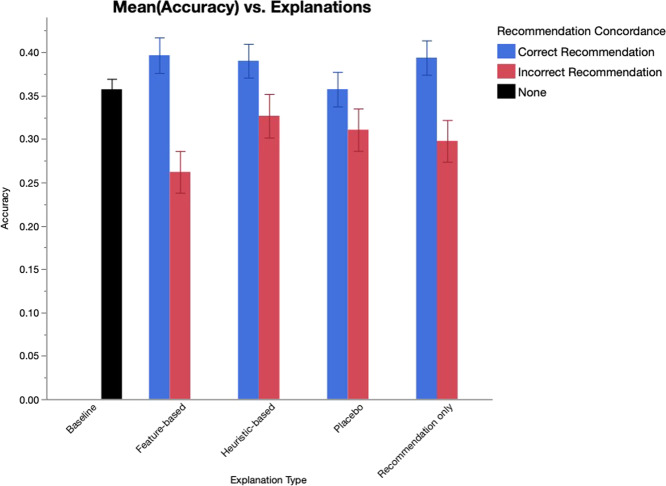
Decision support systems embodying machine learning models offer the promise of an improved standard of care for major depressive disorder, but little is known about how clinicians’ treatment decisions will be influenced by machine learning recommendations and explanations. We used a within-subject factorial experiment to present 220 clinicians with patient vignettes, each with or without a machine-learning (ML) recommendation and one of the multiple forms of explanation. We found that interacting with ML recommendations did not significantly improve clinicians’ treatment selection accuracy, assessed as concordance with expert psychopharmacologist consensus, compared to baseline scenarios in which clinicians made treatment decisions independently. Interacting with incorrect recommendations paired with explanations that included limited but easily interpretable information did lead to a significant reduction in treatment selection accuracy compared to baseline questions. These results suggest that incorrect ML recommendations may adversely impact clinician treatment selections and that explanations are insufficient for addressing overreliance on imperfect ML algorithms. More generally, our findings challenge the common assumption that clinicians interacting with ML tools will perform better than either clinicians or ML algorithms individually.
Overview
The claims and statistics of this paper haven’t been checked yet.
Free: it reads the open-access text and checks the first 5 claims that cite a source we can check. Create a free account to check every claim.
Integrity signals
Registry
Cites
Statistics
Figures
Verification
Claims the paper makes
The claims and statistics of this paper haven’t been checked yet.
Free: it reads the open-access text and checks the first 5 claims that cite a source we can check. Create a free account to check every claim.
Claims other papers make about this one
Each is checked against this paper’s own text: does it say what the citing paper says it does?
The source backs part of the claim, not all of it — or backs it for a different population, condition or comparison.
In the citing paper
“Previous research has shown that providing case-by-case explanations indeed increases trust in and reliance on the advice, even when the advice is incorrect8.”
From Non-task expert physicians benefit from correct explainable AI advice when reviewing X-rays (2023) · cites this paper as [8]
Experimental — accuracy not yet measuredThe source backs part of the claim, not all of it — or backs it for a different population, condition or comparison.
In the citing paper
“While explanations have been shown to increase trust in AI systems, they can also result in over-or underreliance [8,34].”
From Cognitive Forcing for Better Decision-Making: Reducing Overreliance on AI Systems Through Partial Explanations (2025) · cites this paper as [34]
Experimental — accuracy not yet measuredThe source backs part of the claim, not all of it — or backs it for a different population, condition or comparison.
In the citing paper
“This distinction is particularly important given evidence that human decision-makers often mistrust accurate algorithmic predictions and place undue trust in flawed algorithms ( Bansal, Wu, et al., 2021 ;Green & Chen, 2019a, 2019b ;Jacobs et al., 2021 ;Lai & Tan, 2019 ).”
From The flaws of policies requiring human oversight of government algorithms (2022) · cites this paper as Jacobs et al., 2021
Experimental — accuracy not yet measuredThe source backs part of the claim, not all of it — or backs it for a different population, condition or comparison.
In the citing paper
“This finding suggests that higher AI literacy, namely higher familiarity with algorithms, is associated with greater independence in decision- making, which helps mitigate the risks of overreliance”
From The role of critical thinking on undergraduates' reliance behaviours on generative AI in problem‐solving (2025) · cites this paper as Jacobs et al., 2021
Experimental — accuracy not yet measuredThe source backs part of the claim, not all of it — or backs it for a different population, condition or comparison.
In the citing paper
“For humans, post-hoc interaction with such outputs is opaque and coarse-grained: experts must reverseengineer the model's reasoning to correct errors, while novices risk automation bias and over-reliance on machine-generated authority [32, 44, 87].”
From Criticmate: Stagewise Human–AI Co-Critique in Single-Screen UI Evaluation (2026) · cites this paper as [44]
Experimental — accuracy not yet measured
8 more claims about this paper
Create a free account to see every claim other papers make about this one.
Self-check
Percentages, sums and reported differences re-computed from the paper’s own numbers.
The self-check needs the paper’s full text.
Citations
Cites
“Why Should I Trust You?”: Explaining the Predictions of Any Classifier
Ribeiro, M., Singh, S., & Guestrin, C. (2016) · Proceedings of the 2016 Conference of the North American Chapter of the Association for Computational Linguistics: Demonstrations · doi:10.18653/v1/n16-3020 · Cited by 6,682
Guidelines for Human-AI Interaction
Amershi, S., Weld, D., Vorvoreanu, M., Fourney, A., Nushi, B., Collisson, P., Suh, J., Iqbal, S., Bennett, P. N., Inkpen, K., et al. (2019) · Proceedings of the 2019 CHI Conference on Human Factors in Computing Systems · doi:10.1145/3290605.3300233 · Cited by 2,439 · cited 1×
“One assumption from the broader ML community that motivates this research is that humans interacting with ML tools will perform better than either actor individually 34,35 .”
BackgroundThe practical implementation of artificial intelligence technologies in medicine
He, J., Baxter, S. L., Xu, J., Xu, J., Zhou, X., & Zhang, K. (2019) · Nature Medicine · doi:10.1038/s41591-018-0307-0 · Cited by 2,246
Do no harm: a roadmap for responsible machine learning for health care
Wiens, J., Saria, S., Sendak, M., Ghassemi, M., Liu, V. X., Doshi-Velez, F., Jung, K., Heller, K., Kale, D., Saeed, M., et al. (2019) · Nature Medicine · doi:10.1038/s41591-019-0548-6 · Cited by 1,266
Self-citationKennedy, S. H., Lam, R. W., McIntyre, R. S., Tourjman, S. V., Bhat, V., Blier, P., Hasnain, M., Jollant, F., Levitt, A. J., MacQueen, G. M., et al. (2016) · The Canadian Journal of Psychiatry · doi:10.1177/0706743716659417 · Cited by 1,181
Machine learning in mental health: a scoping review of methods and applications
Shatte, A. B. R., Hutchinson, D. M., & Teague, S. J. (2019) · Psychological Medicine · doi:10.1017/s0033291719000151 · Cited by 1,047
Cross-trial prediction of treatment outcome in depression: a machine learning approach
Chekroud, A. M., Zotti, R. J., Shehzad, Z., Gueorguieva, R., Johnson, M. K., Trivedi, M. H., Cannon, T. D., Krystal, J. H., & Corlett, P. R. (2016) · The Lancet Psychiatry · doi:10.1016/s2215-0366(15)00471-x · Cited by 676
A Survey Of Methods For Explaining Black Box Models
Guidotti, R., Monreale, A., Ruggieri, S., Turini, F., Pedreschi, D., & Giannotti, F. (2018) · arXiv · doi:10.48550/arxiv.1802.01933 · Cited by 630
A Survey of Methods for Explaining Black Box Models
Guidotti, R., Monreale, A., Ruggieri, S., Turini, F., Giannotti, F., & Pedreschi, D. (2019) · ACM Computing Surveys · doi:10.1145/3236009 · Cited by 629
Understanding the Effect of Accuracy on Trust in Machine Learning Models
Yin, M., Wortman Vaughan, J., & Wallach, H. (2019) · Proceedings of the 2019 CHI Conference on Human Factors in Computing Systems · doi:10.1145/3290605.3300509 · Cited by 527 · cited 2×
“Our work challenges the validity of this assumption, aligning with recent studies in non-medical domains suggesting that humans interacting with ML tools may perform worse than the algorithm acting independently 39,40 .”
Background
Cited by
Buçinca, Z., Malaya, M. B., & Gajos, K. Z. (2021) · arXiv · doi:10.48550/arxiv.2102.09692 · Cited by 1,124
“However, evidence suggests that explainable systems, also, have not had substantial success in reducing human overreliance on the AIs: when the AI suggests incorrect or suboptimal solutions, people still on average make poorer final decisions than they would have without AI’s assistance [2, 7, 30, 40, 67].”
BackgroundInfluentialSelf-citationAntoniadi, A. M., Du, Y., Guendouz, Y., Wei, L., Mazo, C., Becker, B. A., & Mooney, C. (2021) · Applied Sciences · doi:10.3390/app11115088 · Cited by 629
When combinations of humans and AI are useful: A systematic review and meta-analysis
Vaccaro, M., Almaatouq, A., & Malone, T. (2024) · Nature Human Behaviour · doi:10.1038/s41562-024-02024-1 · Cited by 1,314
“The studies in our dataset, though, come from different samples of people—some look at doctors 37–39 , others at crowdworkers 4,6,34 and still others at students 13,40,41 —and this variation can limit the comparability of the effect sizes to a degree 36 .”
The promise of machine learning in predicting treatment outcomes in psychiatry
Chekroud, A. M., Bondar, J., Delgadillo, J., Doherty, G., Wasil, A., Fokkema, M., Cohen, Z., Belgrave, D., DeRubeis, R., Iniesta, R., et al. (2021) · World Psychiatry · doi:10.1002/wps.20882 · Cited by 531
Explanations Can Reduce Overreliance on AI Systems During Decision-Making
Vasconcelos, H., Jörke, M., Grunde-McLaughlin, M., Gerstenberg, T., Bernstein, M., & Krishna, R. (2022) · arXiv · Cited by 403
“Overreliance can be seen as foregoing agency and accountability to the AI when making final decisions [10, 38, 55], and is of particular concern in high-stakes domains, running the risk of reinforcing machine bias [1, 30] under the guise of human agency.”
BackgroundExplanations Can Reduce Overreliance on AI Systems During Decision-Making
Vasconcelos, H., Jörke, M., Grunde-McLaughlin, M., Gerstenberg, T., Bernstein, M. S., & Krishna, R. (2023) · Proceedings of the ACM on Human-Computer Interaction · doi:10.1145/3579605 · Cited by 402
“Overreliance can be seen as foregoing agency and accountability to the AI when making final decisions [10, 38, 55], and is of particular concern in high-stakes domains, running the risk of reinforcing machine bias [1, 30] under the guise of human agency.”
BackgroundThe Flaws of Policies Requiring Human Oversight of Government Algorithms
Green, B. (2021) · doi:10.2139/ssrn.3921216 · Cited by 259
Deepfake detection by human crowds, machines, and machine-informed crowds
Groh, M., Epstein, Z., Firestone, C., & Picard, R. (2022) · Proceedings of the National Academy of Sciences · doi:10.1073/pnas.2110013119 · Cited by 248
The flaws of policies requiring human oversight of government algorithms
Green, B. (2022) · Computer Law & Security Review · doi:10.1016/j.clsr.2022.105681 · Cited by 263
“14 recommendations even when those recommendations are incorrect (Bansal, Wu, et al., 2021; Jacobs et al., 2021) or when the explanations have no basis in the algorithm’s actual functioning (Lai & Tan, 2019).”
BackgroundGomez, C., Cho, S. M., Ke, S., Huang, C.-M., & Unberath, M. (2025) · Frontiers in Computer Science · doi:10.3389/fcomp.2024.1521066 · Cited by 209
Henry, K. E., Kornfield, R., Sridharan, A., Linton, R. C., Groh, C., Wang, T., Wu, A., Mutlu, B., & Saria, S. (2022) · npj Digital Medicine · doi:10.1038/s41746-022-00597-7 · Cited by 207
Exploring automation bias in human–AI collaboration: a review and implications for explainable AI
Romeo, G., & Conti, D. (2026) · AI & SOCIETY · doi:10.1007/s00146-025-02422-7 · Cited by 209
“Jacobs et al. (2021) identified no significant change in confidence across conditions involving correct or incorrect AI recommendations, suggesting that confidence may not protect against AB.”
InfluentialJacobs, M., He, J., F. Pradier, M., Lam, B., Ahn, A. C., McCoy, T. H., Perlis, R. H., Doshi-Velez, F., & Gajos, K. Z. (2021) · Proceedings of the 2021 CHI Conference on Human Factors in Computing Systems · doi:10.1145/3411764.3445385 · Cited by 177
Self-citationNaiseh, M., Al-Thani, D., Jiang, N., & Ali, R. (2023) · International Journal of Human-Computer Studies · doi:10.1016/j.ijhcs.2022.102941 · Cited by 170
Algorithmic fairness in computational medicine
Xu, J., Xiao, Y., Wang, W. H., Ning, Y., Shenkman, E. A., Bian, J., & Wang, F. (2022) · eBioMedicine · doi:10.1016/j.ebiom.2022.104250 · Cited by 170
Humans inherit artificial intelligence biases
Vicente, L., & Matute, H. (2023) · Scientific Reports · doi:10.1038/s41598-023-42384-8 · Cited by 158
“The results of our three experiments support a human over-reliance on the recommendations of AI systems 70,71 , and add the new finding of the inherited bias effect.”
ResultHiggins, O., Short, B. L., Chalup, S. K., & Wilson, R. L. (2023) · International Journal of Mental Health Nursing · doi:10.1111/inm.13114 · Cited by 150
Sivaraman, V., Bukowski, L. A., Levin, J., Kahn, J. M., & Perer, A. (2023) · Proceedings of the 2023 CHI Conference on Human Factors in Computing Systems · doi:10.1145/3544548.3581075 · Cited by 141
“used a mock AI system to evaluate clinician decisions on antidepressant selection [40], while Yang et al.”
BackgroundMethodResultInfluentialHenry, K. E., Adams, R., Parent, C., Soleimani, H., Sridharan, A., Johnson, L., Hager, D. N., Cosgrove, S. E., Markowski, A., Klein, E. Y., et al. (2022) · Nature Medicine · doi:10.1038/s41591-022-01895-z · Cited by 144
Co-design of human-centered, explainable AI for clinical decision support
Panigutti, C., Beretta, A., Fadda, D., Giannotti, F., Pedreschi, D., Perotti, A., & Rinzivillo, S. (2023) · ACM Transactions on Interactive Intelligent Systems · doi:10.1145/3587271 · Cited by 127
“While, at first glance, explanations of such DSS seem the solution to these issues, some studies suggested that explanations can be inadequate to deal with overreliance on flawed algorithms [66].”
BackgroundDo People Engage Cognitively with AI? Impact of AI Assistance on Incidental Learning
Gajos, K. Z., & Mamykina, L. (2022) · 27th International Conference on Intelligent User Interfaces · doi:10.1145/3490099.3511138 · Cited by 127
“However, previous studies also showed human tendency to over-rely on AI-generated recommendations [4, 8, 34, 66], which suggests that people may be processing information provided by AI superficially rather than engaging with it deeply and critically using their own knowledge and expertise.”
BackgroundResultInfluentialSelf-citationPanigutti, C., Beretta, A., Giannotti, F., & Pedreschi, D. (2022) · CHI Conference on Human Factors in Computing Systems · doi:10.1145/3491102.3502104 · Cited by 126
A Research Ethics Framework for the Clinical Translation of Healthcare Machine Learning
McCradden, M. D., Anderson, J. A., A. Stephenson, E., Drysdale, E., Erdman, L., Goldenberg, A., & Zlotnik Shaul, R. (2022) · The American Journal of Bioethics · doi:10.1080/15265161.2021.2013977 · Cited by 114
“…may introduce novel risks compared with the status quo by changing the clinical decision-making process, particularly with respect to the potential for over-reliance and automation bias (Bond et al. 2018; Goddard et al. 2012; Jacobs et al. 2021; Lakkaraju and Bastani 2020; Tschandl et al. 2020).”
BackgroundDikmen, M., & Burns, C. (2022) · International Journal of Human-Computer Studies · doi:10.1016/j.ijhcs.2022.102792 · Cited by 116
Non-task expert physicians benefit from correct explainable AI advice when reviewing X-rays
Gaube, S., Suresh, H., Raue, M., Lermer, E., Koch, T. K., Hudecek, M. F. C., Ackery, A. D., Grover, S. C., Coughlin, J. F., Frey, D., et al. (2023) · Scientific Reports · doi:10.1038/s41598-023-28633-w · Cited by 92
Schwartz, J. M., George, M., Rossetti, S. C., Dykes, P. C., Minshall, S. R., Lucas, E., & Cato, K. D. (2022) · JMIR Human Factors · doi:10.2196/33960 · Cited by 88
Improving Human-AI Collaboration With Descriptions of AI Behavior
Cabrera, Á. A., Perer, A., & Hong, J. I. (2023) · Proceedings of the ACM on Human-Computer Interaction · doi:10.1145/3579612 · Cited by 87
“At worst, people can perform worse than they would have unassisted, such as clinicians who made more errors than average when shown incorrect AI predictions [7, 24].”
BackgroundCompetencies for the Use of Artificial Intelligence in Primary Care
Liaw, W., Kueper, J. K., Lin, S., Bazemore, A., & Kakadiaris, I. (2022) · The Annals of Family Medicine · doi:10.1370/afm.2887 · Cited by 113
“30 If these tools prove beneficial, their adoption has important implications for equity.”
BackgroundMitigating the impact of biased artificial intelligence in emergency decision-making
Adam, H., Balagopalan, A., Alsentzer, E., Christia, F., & Ghassemi, M. (2022) · Communications Medicine · doi:10.1038/s43856-022-00214-4 · Cited by 81
Opportunities and risks of large language models in psychiatry
Obradovich, N., Khalsa, S. S., Khan, W. U., Suh, J., Perlis, R. H., Ajilore, O., & Paulus, M. P. (2024) · NPP—Digital Psychiatry and Neuroscience · doi:10.1038/s44277-024-00010-z · Cited by 79
“Prior work using clinical dashboards also underscored the capacity for psychiatric decision-support tools to lead clinicians astray [59].”
Self-citationFok, R., & Weld, D. S. (2024) · AI Magazine · doi:10.1002/aaai.12182 · Cited by 81
Conceptualising fairness: three pillars for medical algorithms and health equity
Sikstrom, L., Maslej, M. M., Hui, K., Findlay, Z., Buchman, D. Z., & Hill, S. L. (2022) · BMJ Health & Care Informatics · doi:10.1136/bmjhci-2021-100459 · Cited by 76
Clinical decision support for bipolar depression using large language models
Perlis, R. H., Goldberg, J. F., Ostacher, M. J., & Schneck, C. D. (2024) · Neuropsychopharmacology · doi:10.1038/s41386-024-01841-2 · Cited by 67
Self-citationBeyond Data: Human Rights, Ethical and Social Impact Assessment in AI
Mantelero, A. (2022) · Information Technology and Law Series · doi:10.1007/978-94-6265-531-7 · Cited by 66
Healthcare AI Treatment Decision Support: Design Principles to Enhance Clinician Adoption and Trust
Burgess, E. R., Jankovic, I., Austin, M., Cai, N., Kapuścińska, A., Currie, S., Overhage, J. M., Poole, E. S., & Kaye, J. (2023) · Proceedings of the 2023 CHI Conference on Human Factors in Computing Systems · doi:10.1145/3544548.3581251 · Cited by 65
“This fnding resonates with recent literature calling for additional research to understand the role of individual diferences in trust such as prior experience and self-confdence [61], general familiarity with AI/ML [32], and the relationship between a person’s faith in and perception of the capability of automation [4…”
BackgroundInfluential1 + 1 > 2? Information, Humans, and Machines
Lu, T., & Zhang, Y. (2024) · Information Systems Research · doi:10.1287/isre.2023.0305 · Cited by 119
Hou, C., Zhu, G., & Sudarshan, V. (2025) · British Journal of Educational Technology · doi:10.1111/bjet.13613 · Cited by 72
Quantifying the impact of AI recommendations with explanations on prescription decision making
Nagendran, M., Festor, P., Komorowski, M., Gordon, A. C., & Faisal, A. A. (2023) · npj Digital Medicine · doi:10.1038/s41746-023-00955-z · Cited by 82
Subramanian, H. V., Canfield, C., & Shank, D. B. (2024) · Artificial Intelligence in Medicine · doi:10.1016/j.artmed.2024.102780 · Cited by 84
The Conflict Between Explainable and Accountable Decision-Making Algorithms
Lima, G., Grgić-Hlača, N., Jeong, J. K., & Cha, M. (2022) · ACM Conference on Fairness, Accountability, and Transparency (FAccT) · doi:10.1145/3531146.3534628 · Cited by 99
“People view XAI systems are largely capable, as evidenced by research showing that individuals overrely on algorithmic recommendations [7, 47], partly because they overtrust the explanations provided by these systems [6].”
BackgroundThe use of AI in mental health services to support decision-making: scoping review
Auf, H., Svedberg, P., Nygren, J., Nair, M., & Lundgren, L. E. (2025) · Journal of Medical Internet Research · doi:10.2196/63548 · Cited by 56
Expectations for Artificial Intelligence (AI) in Psychiatry
Monteith, S., Glenn, T., Geddes, J., Whybrow, P. C., Achtyes, E., & Bauer, M. (2022) · Current Psychiatry Reports · doi:10.1007/s11920-022-01378-5 · Cited by 55
Liu, Y., Liu, C., Zheng, J., Xu, C., & Wang, D. (2025) · Journal of Medical Internet Research · doi:10.2196/73374 · Cited by 81
“These challenges are as follows.”
Fok, R., & Weld, D. S. (2023) · arXiv · doi:10.48550/arxiv.2305.07722 · Cited by 54
Zhou, J., Zhang, J., Wan, R., Cui, X., Liu, Q., Guo, H., Shi, X., Fu, B., Meng, J., Yue, B., et al. (2025) · BMC Medical Education · doi:10.1186/s12909-025-06916-2 · Cited by 73
Accuracy-Time Tradeoffs in AI-Assisted Decision Making under Time Pressure
Swaroop, S., Buçinca, Z., Gajos, K. Z., & Doshi-Velez, F. (2024) · Proceedings of the 29th International Conference on Intelligent User Interfaces · doi:10.1145/3640543.3645206 · Cited by 49
“Conversely, AI assistances requiring less cognitive effort, such as providing an AI recommendation, can lead to increased overre-liance [8, 28, 35], speeding up response time but potentially lowering accuracy.”
BackgroundSelf-citationEisbach, S., Langer, M., & Hertel, G. (2023) · Computers in Human Behavior: Artificial Humans · doi:10.1016/j.chbah.2023.100015 · Cited by 46
Enabling Fairness in Healthcare Through Machine Learning
Grote, T., & Keeling, G. (2022) · Ethics and Information Technology · doi:10.1007/s10676-022-09658-7 · Cited by 62
“…has found that low user acceptance among clinicians is in large part explained by poor integration as opposed to poor algorithmic performance (Jacobs et al., 2021; see also Khairat et al., 2018). the clinician may take into account the algorithmic treat-ment recommendation in much the same…”
BackgroundChandra, M., Naik, S., Ford, D., Okoli, E., De Choudhury, M., Ershadi, M., Ramos, G., Hernandez, J., Bhattacharjee, A., Warreth, S., et al. (2025) · Proceedings of the 2025 ACM Conference on Fairness, Accountability, and Transparency · doi:10.1145/3715275.3732063 · Cited by 44
“A major topic of exploration for past research has been towards understanding the impact of interactions with AI on individual well-being [24, 25, 95] and human-AI interaction specifically focusing on attachment with AI [41, 74], over-reliance on AI [17, 47] and user-trust on AI [17, 36, 86].”
The AI Future of Emergency Medicine
Petrella, R. J. (2024) · Annals of Emergency Medicine · doi:10.1016/j.annemergmed.2024.01.031 · Cited by 43
Leichtmann, B., Hinterreiter, A., Humer, C., Streit, M., & Mara, M. (2023) · International Journal of Human-Computer Interaction · doi:10.1080/10447318.2023.2221605 · Cited by 61
“For example, other studies in XAI used contexts such as number recognition (Kenny et al., 2021), nutrition (Buc¸inca et al., 2020), video gaming (Huber et al., 2021), or medical contexts (Jacobs et al., 2021).”
Navigating the Grey Area: How Expressions of Uncertainty and Overconfidence Affect Language Models
Zhou, K., Jurafsky, D., & Hashimoto, T. (2023) · Proceedings of the 2023 Conference on Empirical Methods in Natural Language Processing · doi:10.18653/v1/2023.emnlp-main.335 · Cited by 38
“Prior work has shown cases where AI-assisted decision-making performed worse than human decision-making alone, suggesting an over-reliance on AI, even when systems are wrong (Jacobs et al., 2021; Bussone et al., 2015).”
BackgroundNudging through Friction: An Approach for Calibrating Trust in Explainable AI
Naiseh, M., Al-Mansoori, R. S., Al‐Thani, D., Jiang, N., & Ali, R. (2021) · International Conference on Behavioral, Economic, and Socio-Cultural Computing · doi:10.1109/besc53957.2021.9635271 · Cited by 62
Vero: An accessible method for studying human–AI teamwork
Schecter, A., Hohenstein, J., Larson, L., Harris, A. M., Hou, T.-Y., Lee, W.-Y., Lauharatanahirun, N., DeChurch, L. A., Contractor, N., & Jung, M. F. (2022) · Computers in Human Behavior · doi:10.1016/j.chb.2022.107606 · Cited by 39
“In another study looking at human-agent collaboration between clinicians and machine learning recommender systems in medical treatment selection, participants were shown hypothetical patient scenario vignettes (Jacobs et al., 2021).”
Bobo, W. V., Ommeren, B. V., & Athreya, A. P. (2022) · Expert Review of Clinical Pharmacology · doi:10.1080/17512433.2022.2112949 · Cited by 44
“…side, additional concerns may also include perceptions of liability, limited transparency, or even concerns about reaching erroneous decisions [106,107], given the complexity of machine learning-informed clinical decision support and clinicians’ perceptions of professional duties when…”
BackgroundArtificial intelligence in mental healthcare: an overview and future perspectives
Jin, K. W., Li, Q., Xie, Y., & Xiao, G. (2023) · British Journal of Radiology · doi:10.1259/bjr.20230213 · Cited by 62
Impact of Model Interpretability and Outcome Feedback on Trust in AI
Ahn, D., Almaatouq, A., Gulabani, M., & Hosanagar, K. (2024) · CHI Conference on Human Factors in Computing Systems · doi:10.1145/3613904.3642780 · Cited by 69
“Ja-cobs et al. [48] demonstrated that interpretability doesn’t resolve issues such as biased AI recommendations and overreliance on flawed ML algorithms.”
BackgroundResultInfluentialBuçinca, Z., Swaroop, S., Paluch, A. E., Doshi‐Velez, F., & Gajos, K. Z. (2025) · CHI Conference on Human Factors in Computing Systems · doi:10.1145/3706598.3713229 · Cited by 76
“Competence refers to the need to feel skilled and effective in the activity, autonomy reflects the need to have control over how the activity is carried out, and relatedness involves the need to feel connected to others and to experience a sense of belonging while engaging in the activity.”
Self-citationNicolson, A., Bradburn, E., Gal, Y., Papageorghiou, A. T., & Noble, J. A. (2025) · npj Digital Medicine · doi:10.1038/s41746-025-02023-0 · Cited by 57
Patient wisdom should be incorporated into health AI to avoid algorithmic paternalism
McCradden, M. D., & Kirsch, R. E. (2023) · Nature Medicine · doi:10.1038/s41591-023-02224-8 · Cited by 36
de Jong, S., Paananen, V., Tag, B., & van Berkel, N. (2025) · Proceedings of the ACM on Human-Computer Interaction · doi:10.1145/3710946 · Cited by 32
Critical review of self‐diagnosis of mental health conditions using artificial intelligence
Wimbarti, S., Kairupan, B. H. R., & Tallei, T. E. (2024) · International Journal of Mental Health Nursing · doi:10.1111/inm.13303 · Cited by 42
Jin, W., Fatehi, M., Guo, R., & Hamarneh, G. (2024) · Artificial Intelligence in Medicine · doi:10.1016/j.artmed.2023.102751 · Cited by 39
Fraile Navarro, D., Kocaballi, A. B., Dras, M., & Berkovsky, S. (2023) · ACM Transactions on Computer-Human Interaction · doi:10.1145/3569893 · Cited by 28
“How these algorithms issue their recommendations and how this information is displayed to the user may have a strong effect on their success [58].”
BackgroundExplainable AI decision support improves accuracy during telehealth strep throat screening
Gomez, C., Smith, B.-L., Zayas, A., Unberath, M., & Canares, T. (2024) · Communications Medicine · doi:10.1038/s43856-024-00568-x · Cited by 30
“The evaluation of AI interface designs includes information that supports predictions in different formats, such as highlighting or summarizing relevant features 34 – 38 andpresentingsimilarcases 39 – 41 .”
BackgroundMethodPainting the Black Box White: Experimental Findings from Applying XAI to an ECG Reading Setting
Cabitza, F., Campagner, A., Natali, C., Parimbelli, E., Ronzio, L., & Cameli, M. (2023) · Machine Learning and Knowledge Extraction · doi:10.3390/make5010017 · Cited by 41
Reward Reports for Reinforcement Learning
Gilbert, T. K., Lambert, N., Dean, S., Zick, T., Snoswell, A., & Mehta, S. (2023) · Proceedings of the AAAI/ACM Conference on AI Ethics and Society · doi:10.1145/3600211.3604698 · Cited by 66
Karizat, N., Vinson, A. H., Parthasarathy, S., & Andalibi, N. (2024) · Proceedings of the ACM on Human-Computer Interaction · doi:10.1145/3637383 · Cited by 38
“For example, Jacobs found clinicians receiving machine learning treatment recommendations for depression did not experience better accuracy selecting treatments that matched with treatment recommendations by psychopharmacology experts [101].”
BackgroundLi, J., Zhou, L., Zhan, Y., Xu, H., Zhang, C., Shan, F., & Liu, L. (2022) · Journal of the American Medical Informatics Association · doi:10.1093/jamia/ocac179 · Cited by 29
Human, Do You Think This Painting is the Work of a Real Artist?
Park, J., Kang, H., & Kim, H. Y. (2023) · International Journal of Human-Computer Interaction · doi:10.1080/10447318.2023.2232978 · Cited by 39
“…AI and humans is in the same vein as that discussed in previous studies, and as AI judgment results do not always lead to more accurate results, a higher-perform-ance AI model is required for the combined effect of humans and AI (Gaube et al., 2021; Jacobs et al., 2021; Vaccaro & Waldo, 2019).”
Eye tracking insights into physician behaviour with safe and unsafe explainable AI recommendations
Nagendran, M., Festor, P., Komorowski, M., Gordon, A. C., & Faisal, A. A. (2024) · npj Digital Medicine · doi:10.1038/s41746-024-01200-x · Cited by 36
Lermann Henestrosa, A., & Kimmerle, J. (2025) · Computers in Human Behavior: Artificial Humans · doi:10.1016/j.chbah.2025.100142 · Cited by 26
A Decision Theoretic Framework for Measuring AI Reliance
Guo, Z., Wu, Y., Hartline, J. D., & Hullman, J. (2024) · The 2024 ACM Conference on Fairness, Accountability, and Transparency · doi:10.1145/3630106.3658901 · Cited by 27
“…when researchers apply the above definition of appropriate reliance to their experimental results, they discover that the primary source of performance loss stems from the humans accepting the AI’s inaccurate recommendations [6, 18, 21], considered over-reliance by the conventional definition.”
BackgroundNavigating AI Convergence in Human–Artificial Intelligence Teams: A Signaling Theory Approach
Smith, A., Wagoner, H. P. V., Keplinger, K., & Çelebi, C. (2025) · Journal of Organizational Behavior · doi:10.1002/job.2856 · Cited by 51
“This finding resembles previous research on human–AI systems, covering domains like medical treatments (Jacobs et al. 2021), loan defaults (Green and Chen 2019), and income prediction (Zhang, Liao, and Bellamy 2020).”
Chen, Y., Lin, C.-K., Lo, C.-M., Chen, S.-F., & Liao, Q.-J. (2021) · Mathematics · doi:10.3390/math9202622 · Cited by 26
Reicherts, L., Zhang, Z. T., von Oswald, E., Liu, Y.-T., Rogers, Y., & Hassib, M. (2025) · International Conference on Human Factors in Computing Systems · doi:10.1145/3706598.3713295 · Cited by 55
“…successful in increasing accuracy and efficiency in generic or artificial tasks [38, 58, 62], AI-assisted decision-making has its challenges, including low user acceptance in more complex decision-making processes [4, 34, 65], and overreliance on (incorrect) AI recommendations [1, 11, 12, 33].”
"What is Your Envisioned Future?": Toward Human-AI Enrichment in Data Work of Asthma Care
Su, Z., He, L., Jariwala, S. P., Zheng, K., & Chen, Y. (2022) · Proceedings of the ACM on Human-Computer Interaction · doi:10.1145/3555157 · Cited by 41
“Beyond the technical implications, recent HCI and health informatics studies have also examined clinicians’ perceptions of AI-based systems [69], specifically concerning user experiences, acceptance, and implementation [4,8,9,34,84].”
BackgroundHendrix, N., Lowry, K. P., Elmore, J. G., Lotter, W., Sorensen, G., Hsu, W., Liao, G. J., Parsian, S., Kolb, S., Naeim, A., et al. (2022) · Journal of the American College of Radiology · doi:10.1016/j.jacr.2022.06.019 · Cited by 25
Iqbal, T., Masud, M., Amin, B., Feely, C., Faherty, M., Jones, T., Tierney, M. S., Shahzad, A., & Vazquez, P. (2024) · Health Sciences Review · doi:10.1016/j.hsr.2024.100150 · Cited by 38
Parsons, C. S., Zuiderwijk, A., Orchard, N. A., Oosterhoff, J. H. F., & de Reuver, M. (2025) · BMC Medical Informatics and Decision Making · doi:10.1186/s12911-025-03237-8 · Cited by 41
“False positive and false negative recommendations can misguide clinicians, resulting in significantly lower performance [19].”
Exploring the Role of Local and Global Explanations in Recommender Systems
Radensky, M., Downey, D., Lo, K., Popović, Z., & Weld, D. S. (2022) · CHI Conference Extended Abstracts on Human Factors in Computing Systems (CHI EA) · doi:10.1145/3491101.3519795 · Cited by 39
Maslej, M. M., Kloiber, S. M., Ghassemi, M., Yu, J., & Hill, S. (2023) · Translational Psychiatry · doi:10.1038/s41398-023-02509-z · Cited by 35
Perlis, R. H. (2023) · medRxiv · doi:10.1101/2023.04.14.23288595 · Cited by 23
Self-citationGenerative Artificial Intelligence in Medicine
Shanmugam, D., Agrawal, M., Movva, R., Chen, I. Y., Ghassemi, M., Jacobs, M. L., & Pierson, E. (2025) · Annual Review of Biomedical Data Science · doi:10.1146/annurev-biodatasci-103123-095332 · Cited by 42
Self-citationPersonalising AI Assistance Based on Overreliance Rate in AI-Assisted Decision Making
Swaroop, S., Buçinca, Z., Gajos, K. Z., & Doshi-Velez, F. (2025) · Proceedings of the 30th International Conference on Intelligent User Interfaces · doi:10.1145/3708359.3712128 · Cited by 20
Self-citationArtificial Intelligence Algorithms Need to Be Explainable—or Do They?
Bradshaw, T., McCradden, M. D., Jha, A. K., Dutta, J., Saboury, B., Siegel, E. L., & Rahmim, A. (2023) · Journal of Nuclear Medicine · doi:10.2967/jnumed.122.264949 · Cited by 19
“However, it has been argued that XAI may not in fact address the needs of clinicians and may also introduce unintended consequences, potentially compromising the purported value of XAI ( 1 ).”
BackgroundZmudzki, F., & Smeets, R. (2023) · Frontiers in Pain Research · doi:10.3389/fpain.2023.1177070 · Cited by 24
Invisible clinical labor driving the successful integration of AI in healthcare
Ulloa, M., Rothrock, B., Ahmad, F. S., & Jacobs, M. L. (2022) · Frontiers in Computer Science · doi:10.3389/fcomp.2022.1045704 · Cited by 26
“In this study, presenting clinicians with incorrect antidepressant treatment recommendations did significantly change the accuracy of clinicians’ treatment decisions, where accuracy was defined as “concordance with expert psychopharmacologist consensus” (Jacobs et al., 2021b).”
BackgroundSelf-citationBlack, E., Naidu, R. C. A., Ghani, R., Rodolfa, K. T., Ho, D. E., & Heidari, H. (2023) · ACM Conference on Equity and Access in Algorithms, Mechanisms, and Optimization (EAAMO) · doi:10.1145/3617694.3623259 · Cited by 44
Measuring the effect of mental workload and explanations on appropriate AI reliance using EEG
Zhang, Z. T., Argın, S. K., Bilen, M. B., Urgun, D., Deniz, S. M., Liu, Y.-T., & Hassib, M. (2024) · Behaviour & Information Technology · doi:10.1080/0144929x.2024.2431055 · Cited by 10
“One possible factor could be the difficulty of a decision, as overreliance and the ineffectiveness of explanations to mitigate it have been particularly observed in tasks that are challenging for humans [12,13,16,17].”
Li, Z., Liu, X., Tang, Z., Jin, N., Zhang, P., Eadon, M. T., Song, Q., Chen, Y., & Su, J. (2024) · Journal of the American Medical Informatics Association · doi:10.1093/jamia/ocae158 · Cited by 27
“This study also shows incorrect ML-based treatment recommendations may adversely impact clinician treatment selections.”
BackgroundWardatzky, K., Inel, O., Rossetto, L., & Bernstein, A. (2025) · ACM Transactions on Recommender Systems · doi:10.1145/3716394 · Cited by 35
“Table 3 provides an overview of the extracted characteristics, the number of papers reporting this information about their participants, and the number of papers evaluating whether the given user characteristic impacts the explanation effect.”
Hassan, C., Bisschops, R., Sharma, P., & Mori, Y. (2025) · Gastroenterology · doi:10.1053/j.gastro.2025.02.021 · Cited by 24
The Value of AI Guidance in Human Examination of Synthetically-Generated Faces
Boyd, A., Tinsley, P., Bowyer, K. W., & Czajka, A. (2023) · Proceedings of the AAAI Conference on Artificial Intelligence · doi:10.1609/aaai.v37i5.25734 · Cited by 31
Lammert, O., Richter, B., Schütze, C., Thommes, K., & Wrede, B. (2024) · Frontiers in Behavioral Economics · doi:10.3389/frbhe.2024.1377075 · Cited by 30
Artificial intelligence‐assisted full‐mouth radiograph mounting in dental education
Chang, J. T., Bliss, L., Angelov, N., & Glick, A. (2024) · Journal of Dental Education · doi:10.1002/jdd.13524 · Cited by 34
Pafla, M., Larson, K. S., & Hancock, M. (2024) · CHI Conference on Human Factors in Computing Systems · doi:10.1145/3613904.3642934 · Cited by 24
Stratifying Risk for Postpartum Depression at Time of Hospital Discharge
Clapp, M. A., Castro, V. M., Verhaak, P., McCoy, T. H., Shook, L. L., Edlow, A. G., & Perlis, R. H. (2025) · American Journal of Psychiatry · doi:10.1176/appi.ajp.20240381 · Cited by 16
Self-citationEvaluating the impact of uncertainty visualization on model reliance
Zhao, J., Wang, Y., Mancenido, M. V., Chiou, E. K., & Maciejewski, R. (2024) · IEEE Transactions on Visualization and Computer Graphics · doi:10.1109/tvcg.2023.3251950 · Cited by 16
AI in business operations: driving urban growth and societal sustainability
Hamedani, S. S., Aslam, S., & Hamedani, S. S. (2025) · Frontiers in Artificial Intelligence · doi:10.3389/frai.2025.1568210 · Cited by 27
Metadata
- Authors
- Jacobs, M., Pradier, M. F., McCoy, T. H., Perlis, R. H., Doshi-Velez, F., & Gajos, K. Z.
- Affiliations
- Harvard University (US)
- Corresponding author
- Gajos, Krzysztof Z.
- Venue
- Translational Psychiatry
- Published
- 2021-02-04
- Volume
- 11
- Issue
- 1
- Pages
- 108-108
- ISSN
- 2158-3188 (ISSN-L)
- PMC
- PMC7862671
- OpenAlex
- W3128621548
- Cited by
- 247
- References
- 49
- Citations by year
- 2026: 51 · 2025: 61 · 2024: 48 · 2023: 43 · 2022: 34 · 2021: 9
- FWCI
- 9.76
- Type
- journal article
- Language
- en
- Open access
- gold
- doi.org
- Licence
- cc-by
- creativecommons.org/licenses/by/4.0 (tdm)
- creativecommons.org/licenses/by/4.0 (vor)
- Locations
- Translational Psychiatry (publishedVersion, cc-by)
- PubMed Central (publishedVersion, cc-by)
- PubMed (publishedVersion)
- DOAJ (DOAJ: Directory of Open Access Journals) (submittedVersion, cc-by-sa)
- Funders
- Harvard Data Science Initiative, Harvard University
- Topics
- Health Sciences › Medicine › Health Informatics › Artificial Intelligence in Healthcare and Education
- Physical Sciences › Computer Science › Artificial Intelligence › Explainable Artificial Intelligence (XAI)
- Health Sciences › Medicine › Family Practice › Clinical Reasoning and Diagnostic Skills
- Keywords
- machine learning, clinical decision support, antidepressant selection, major depressive disorder, treatment decision-making, explainable AI, model explanation, clinician trust in AI, overreliance on AI, patient vignettes
- MeSH terms
- Machine Learning, Algorithms, Antidepressive Agents, Depressive Disorder, Major, Major Depressive Disorder, Humans
About these checks
Registry, retraction, Cites and statistics results are computed, not judged, with one exception: a printed reference that no index lists is read once by a model before it counts as a citation error. Claims are extracted by a model and kept only when their quote appears verbatim in the text; each cited source is then checked, with a model’s help, for whether it says what the claim relies on. Those verdicts can be wrong — read the claim’s quote and the cited source before relying on one.
Statistics and arithmetic are recomputed, not judged.
Confidence bands are shown only for fields calibrated on our annotated test set. None is calibrated yet, so no band is shown.
What counts as a claim ›How we measure confidence ›How we check this ›
Are you an author, or do you see a problem with this page? Request a review
Data sources
Bibliographic data: Semantic Scholar, OpenAlex, Crossref.
Contains information from the Semantic Scholar Academic Graph Datasets, made available under the ODC Attribution License (ODC-BY 1.0).
Semantic Scholar’s data is described in: Kinney, R., et al. (2023). The Semantic Scholar Open Data Platform. arXiv:2301.10140.
