

Personalized machine learning of depressed mood using wearables
Open accessThe DOI matches its Crossref record; 97 of the 97 references it cites were found in a registry or an index.
Abstract
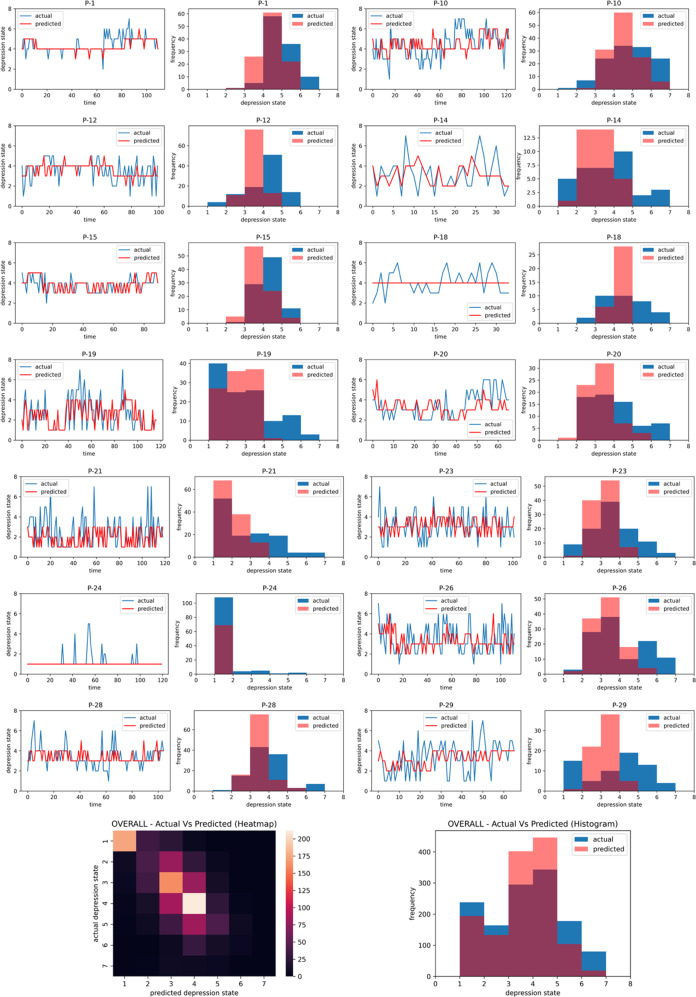
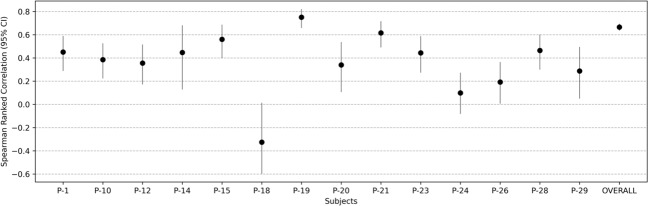
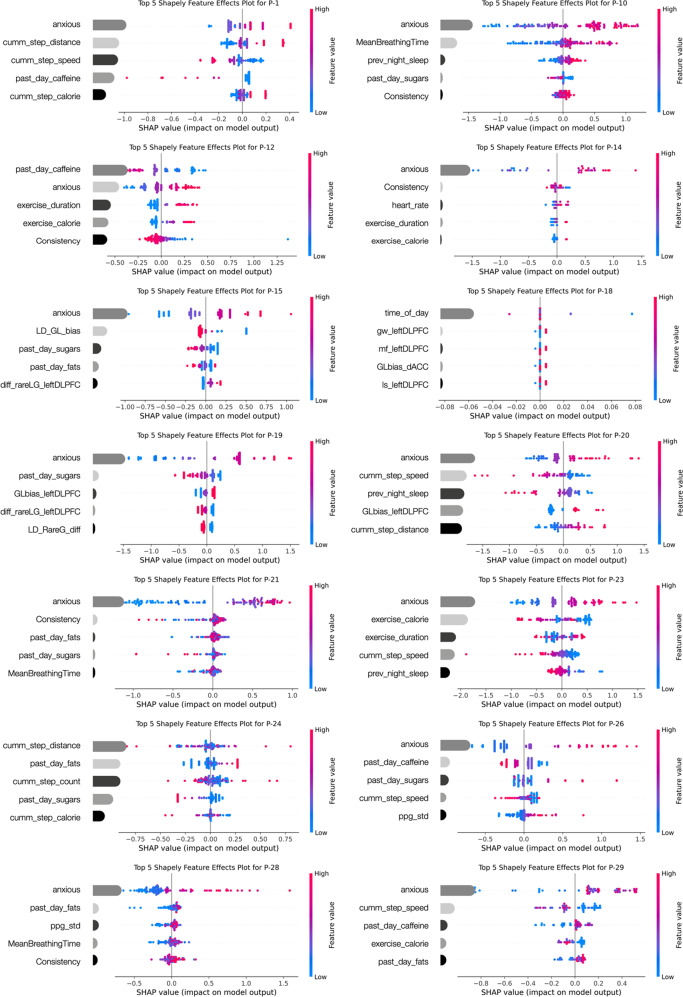
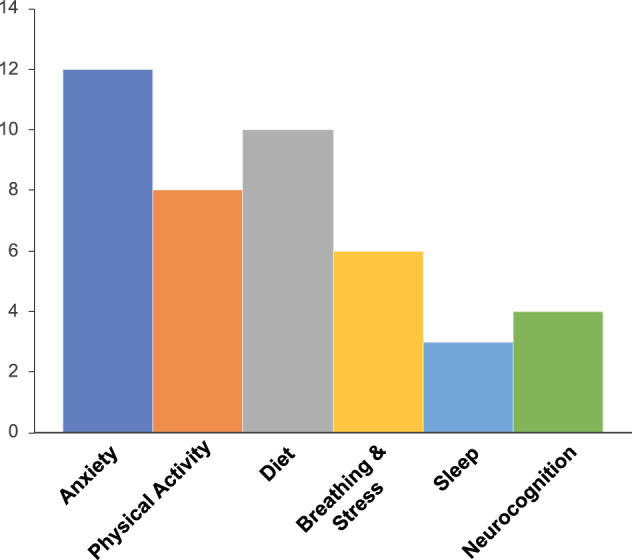
Depression is a multifaceted illness with large interindividual variability in clinical response to treatment. In the era of digital medicine and precision therapeutics, new personalized treatment approaches are warranted for depression. Here, we use a combination of longitudinal ecological momentary assessments of depression, neurocognitive sampling synchronized with electroencephalography, and lifestyle data from wearables to generate individualized predictions of depressed mood over a 1-month time period. This study, thus, develops a systematic pipeline for N-of-1 personalized modeling of depression using multiple modalities of data. In the models, we integrate seven types of supervised machine learning (ML) approaches for each individual, including ensemble learning and regression-based methods. All models were verified using fourfold nested cross-validation. The best-fit as benchmarked by the lowest mean absolute percentage error, was obtained by a different type of ML model for each individual, demonstrating that there is no one-size-fits-all strategy. The voting regressor, which is a composite strategy across ML models, was best performing on-average across subjects. However, the individually selected best-fit models still showed significantly less error than the voting regressor performance across subjects. For each individual’s best-fit personalized model, we further extracted top-feature predictors using Shapley statistics. Shapley values revealed distinct feature determinants of depression over time for each person ranging from co-morbid anxiety, to physical exercise, diet, momentary stress and breathing performance, sleep times, and neurocognition. In future, these personalized features can serve as targets for a personalized ML-guided, multimodal treatment strategy for depression.
Overview
The claims and statistics of this paper haven’t been checked yet.
Free: it reads the open-access text and checks the first 5 claims that cite a source we can check. Create a free account to check every claim.
Integrity signals
Registry
Cites
Statistics
Figures
Verification
Claims the paper makes
The claims and statistics of this paper haven’t been checked yet.
Free: it reads the open-access text and checks the first 5 claims that cite a source we can check. Create a free account to check every claim.
Claims other papers make about this one
Each is checked against this paper’s own text: does it say what the citing paper says it does?
The source backs part of the claim, not all of it — or backs it for a different population, condition or comparison.
In the citing paper
“Shapley values indicate the relative importance and directionality of each feature as it predicts the depressed mood DV, notably reflecting associations but not causal relationships or inherent modifiability of the underlying variables [17, 18].”
From Personalized machine learning guided intervention for optimizing lifestyle behaviors in depression: a pilot study (2026) · cites this paper as [17]
Experimental — accuracy not yet measuredThe cited source says what the claim attributes to it.
In the citing paper
“Consequently, a single lifestyle treatment domain is unlikely to be universally beneficial, and these studies fail to account for individual differences that may favor one behavioral health solution over another [17–19].”
From Personalized machine learning guided intervention for optimizing lifestyle behaviors in depression: a pilot study (2026) · cites this paper as [17]
The cited source says what the claim attributes to it.
In the citing paper
“Yet, a major limitation of these homogenously assigned (non-personalized) behavioral intervention studies is the heterogeneity across individuals of the specific lifestyle factors most closely linked to their depression.”
From Personalized machine learning guided intervention for optimizing lifestyle behaviors in depression: a pilot study (2026) · cites this paper as [17]
The cited source says what the claim attributes to it.
In the citing paper
“Furthermore, leveraging model explainers such as Shapley plots, we have identified the top predictive intervention targets for each individual [17, 18].”
From Personalized machine learning guided intervention for optimizing lifestyle behaviors in depression: a pilot study (2026) · cites this paper as [17]
2 more claims about this paper
Create a free account to see every claim other papers make about this one.
Self-check
Percentages, sums and reported differences re-computed from the paper’s own numbers.
The self-check needs the paper’s full text.
Citations
Cites
The PHQ-9: Validity of a brief depression severity measure
Kroenke, K., Spitzer, R. L., & Williams, J. B. W. (2001) · Journal of General Internal Medicine · doi:10.1046/j.1525-1497.2001.016009606.x · Cited by 44,910
Delorme, A., & Makeig, S. (2004) · Journal of Neuroscience Methods · doi:10.1016/j.jneumeth.2003.10.009 · Cited by 24,371
mice: Multivariate Imputation by Chained Equations in R
Buuren, S. V., & Groothuis-Oudshoorn, K. (2011) · Journal of Statistical Software · doi:10.18637/jss.v045.i03 · Cited by 13,870
Desikan, R. S., Ségonne, F., Fischl, B., Quinn, B. T., Dickerson, B. C., Blacker, D., Buckner, R. L., Dale, A. M., Maguire, R. P., Hyman, B. T., et al. (2006) · NeuroImage · doi:10.1016/j.neuroimage.2006.01.021 · Cited by 13,324
Wang, C., Pan, R., Wan, X., Tan, Y., Xu, L., Ho, C. S., & Ho, R. C. (2020) · International Journal of Environmental Research and Public Health · doi:10.3390/ijerph17051729 · Cited by 9,923 · cited 2×
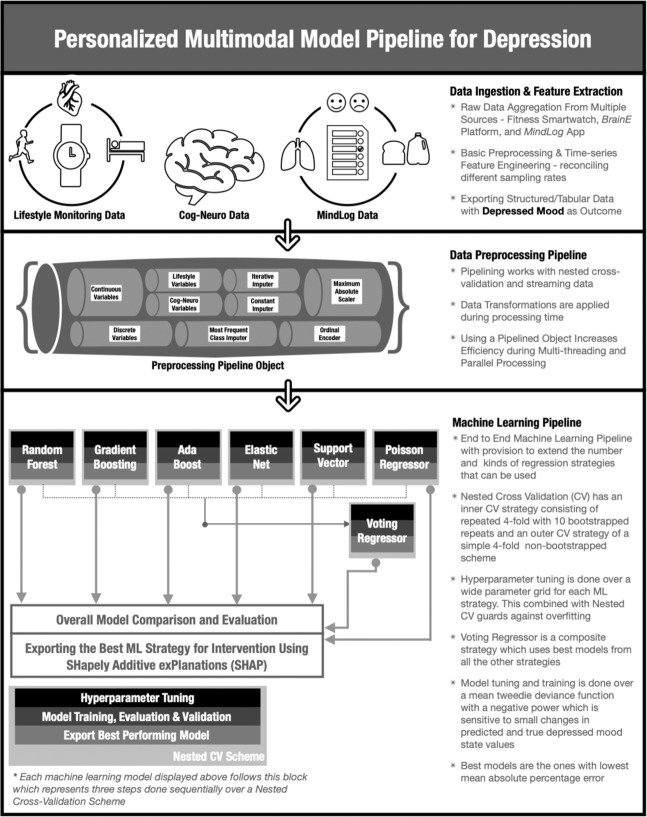
“For this study, the following preprocessing pipeline strategy was devised: (1) continuous and discrete variables were processed independently, (2) discrete variables were imputed using a “most frequent class imputer”, which is basically filling missing values with the class with highest frequency, (3) the continuous v…”
MethodScoville, W. B. (1949) · Journal of neurosurgery · doi:10.3171/jns.1949.6.1.0065 · Cited by 7,381
Effects of noise letters upon the identification of a target letter in a nonsearch task
Eriksen, B. A., & Eriksen, C. W. (1974) · Perception & Psychophysics · doi:10.3758/bf03203267 · Cited by 7,230
Trivedi, M. H., Rush, A. J., Wisniewski, S. R., Nierenberg, A. A., Warden, D., Ritz, L., Norquist, G., Howland, R. H., Lebowitz, B., McGrath, P. J., et al. (2006) · American Journal of Psychiatry · doi:10.1176/appi.ajp.163.1.28 · Cited by 3,879
High-speed scanning in human memory
Sternberg, S. (1966) · Science · doi:10.1126/science.153.3736.652 · Cited by 3,576
The NimStim set of facial expressions: Judgments from untrained research participants.
Tottenham, N., Tanaka, J. W., Leon, A. C., McCarry, T., Nurse, M., Hare, T. A., Marcus, D. J., Westerlund, A., Casey, B., & Nelson, C. (2009) · Psychiatry Research · doi:10.1016/j.psychres.2008.05.006 · Cited by 3,454
Research works printed but not linked: 3
- Institute of Medicine (US) Forum on Drug Discovery, Development and T. Clinical Trials in Depression. in Transforming Clinical Research in the United States: Challenges and Opportunities: Workshop Summary. (National Academies Press (US), 2010). https://www.ncbi.nlm.nih.gov/books/NBK50890/. 21210556
- Kothe C., Medine D., Boulay C., Grivich M., Stenner T. ‘Lab Streaming Layer’ Copyright. https://labstreaminglayer.readthedocs.io/ (2019). PMC12434378 40959706
- Heeger, D. & Landy, M. Signal detection theory. in Encyclopedia of perception (ed Goldstein, B.) 887–892 (SAGE Publications, 2009).
Cited by
Items 101–145 of 145
Ross, M. K., Tulabandhula, T., Nguyen, T. M., Ning, E., Kabir, S., Cladek, A. T., Barve, A., Kennelly, E., Hussain, F., Duffecy, J. L., et al. (2026) · Cognitive Computation · doi:10.1007/s12559-026-10549-y · Cited by 1
Jaiswal, S., Nan, J., Purpura, S. R., Manchanda, J. K., Garcia-Pak, I. H., Ramanathan, D., Chuss, D., Rana, D. T., Beck, E., Insel, P. A., et al. (2024) · medRxiv · doi:10.1101/2024.01.04.24300716 · Cited by 1
Self-citationLangener, A. M. (2024) · University of Groningen research database (University of Groningen / Centre for Information Technology) · doi:10.33612/diss.1069770227 · Cited by 1
EVALUATING FORECASTING METHODS FOR BINARY OUTCOMES WITH A SMALL SAMPLE SIZE IN PSYCHOLOGY
Luo, L. (2024) · Carolina Digital Repository (University of North Carolina at Chapel Hill) · doi:10.17615/jkfe-fm10 · Cited by 1
Technologies to Assess Psycho-Behavioural Symptoms
Emmert, K., & Maetzler, W. (2023) · Practical issues in geriatrics · doi:10.1007/978-3-031-32246-4_8
Mishra, J., Ramanathan, D., Grennan, G., Nan, J., Jaiswal, S., Purpura, S. R., Manchanda, J. K., Maric, V., & Balasubramani, P. P. (2023) · Research Square · doi:10.21203/rs.3.rs-3304836/v1
Self-citationByczynski, G., & D’Angiulli, A. (2023) · Vision · doi:10.3390/vision7040077
Mishra, J., Ramanathan, D., Grennan, G., Nan, J., Jaiswal, S., Purpura, S. R., Manchanda, J. K., Maric, V., & Balasubramani, P. P. (2024) · Research Square · doi:10.21203/rs.3.rs-3813664/v1
Self-citationDigital Therapies of Psychiatric Disorders: Focus on Depression Symptoms
Biagianti, B., Nahum, M., Yitzhak, N., & Vinogradov, S. (2025) · Oxford University Press eBooks · doi:10.1093/med/9780197640654.003.0073
Lee, H., Kang, S., & Lee, S. H. (2025) · SSRN Electronic Journal · doi:10.2139/ssrn.5216287
The Open Handbook of Experience Sampling Methodology – Third edition
Cloos, L., Eisele, G., Dejonckheere, E., Erbas, Y., Houben, M., Kirtley, O. J., Weermeijer, J., Kiekens, G., Wampers, M., Rintala, A., et al. (2026) · Leuven University Press eBooks · doi:10.11116/9789461666925
Diagnosis of Psychiatric Disorders Using EEG Signal and Machine LearningPreprint
Sheikh, Z., & Khan, M. (2025) · Research Square · doi:10.21203/rs.3.rs-6973433/v1
Gépi tanulás alkalmazása a magatartástudományban és a pszichológiában: előnyök és hátrányok
Matuz, A. (2025) · Mentálhigiéné és Pszichoszomatika · doi:10.1556/0406.2025.00077
Narwaria, M., & Jaiswal, S. (2025) · International Conference on Networks and Cryptology (NETCRYPT) · doi:10.1109/netcrypt65877.2025.11102435
de Filippis, R., & Foysal, A. A. (2025) · OALib · doi:10.4236/oalib.1113955
Hernández, E. L. C. (2025) · Investigo repository of University of Vigo (University of Vigo) · doi:10.35869/11093/10153
Kargarandehkordi, A. (2023) · UTUPub (University of Turku)
Message Passing-based Inference in Hierarchical Autoregressive Models
Podusenko, A. (2022) · TU/e Research Portal
Lachowicz, A. (2025) · Lirias
Mitigating Interpersonal Variability in Machine Learning Models for Human Behavior Monitoring
Alecci, L. (2025) · ACM International Joint Conference on Pervasive and Ubiquitous Computing (UbiComp) · doi:10.1145/3714394.3750544
de Melo, R. F. (2023) · LA Referencia (Red Federada de Repositorios Institucionales de Publicaciones Científicas)
Huang, M., Lin, L., Fan, X., & Wu, Y. (2026) · BMC Medical Informatics and Decision Making · doi:10.1186/s12911-026-03452-x
Whitmore, N. W., Shimizu, K., Shifat, M. N. U. H., & Maes, P. (2026) · doi:10.2196/preprints.98561
Explainable Artificial Intelligence Methods for Spiking Neural Networks
Jung, J. (2026) · Tuwhera (Auckland University of Technology)
(2026) · Advances in computational intelligence and robotics book series · doi:10.4018/979-8-3373-4997-8.ch004
Extended Reality as a Clinical Instrument
(2026) · Advances in computational intelligence and robotics book series · doi:10.4018/979-8-3373-4997-8.ch005
Ethics, Consent, and the Moral Architecture of Digital Mental Health
(2026) · Advances in computational intelligence and robotics book series · doi:10.4018/979-8-3373-4997-8.ch003
The Role of Digital Technologies in Mental Health Care
(2026) · Advances in computational intelligence and robotics book series · doi:10.4018/979-8-3373-4997-8.ch001
Digital Mental Health in Older Adulthood
(2026) · Advances in computational intelligence and robotics book series · doi:10.4018/979-8-3373-4997-8.ch010
Rauch, A. A., Conley, C. S., Banerjee, S., Kahrilas, I. J., Georgaras, A., Roth, G. E., DeLorenzo, B. M., Gonzales, C. H., Polnaszek, K. L., Duffecy, J. L., et al. (2026) · Mindfulness · doi:10.1007/s12671-026-02870-2
Lee, T. H., Ha, S., Kim, J.-W., Jhon, M., Lee, H., & Lee, H. (2026) · IEEE Transactions on Consumer Electronics · doi:10.1109/tce.2026.3700194
Ahmed, S., Enkmann, J. M., Shimizu, K., Yip, I., Beermann, V., Alomar, A., Uebernickel, F., & Maes, P. (2026) · arXiv (Cornell University) · doi:10.48550/arxiv.2606.08965
Wearable Technology for Depression Assessment: A Scoping Review of Datasets
Tlachac, M., Elsbree, H. K., & Heinz, M. V. (2026) · IEEE Transactions on Affective Computing · doi:10.1109/taffc.2026.3704930
Dongre, P., Neupane, S., Jadhav, P., Chandrashekar, N. D., Webb, C. A., Kumar, S., & Gračanin, D. (2026) · ACM Interactive Health Conference · doi:10.1145/3786579.3804960
A Comprehensive Study of Machine Learning-Based Improvements in Sleep Monitoring Wearables
Nag, M. K., Shrivastava, A., Nayak, S., & Kumari, R. (2026) · Lecture notes in electrical engineering · doi:10.1007/978-981-95-7350-9_18
Lee, H., Jang, M., Jung, T., Byeon, J., Yoon, S., & Lee, H. (2026) · Journal of Affective Disorders · doi:10.1016/j.jad.2026.122270
Digital mood phenotyping predicts short- and long-term suicidal ideation across a two-year timescale
Chang, L., Geng, X., Wu, Z., He, X., Yang, S., Wu, W., Liu, K., Qu, D., Xi, Y., An, J., et al. (2026) · Molecular Psychiatry · doi:10.1038/s41380-026-03775-1
A Primer on Digital Health N-of-1 Studies and Single-Case DesignsPreprint
Daza, E. J. (2026) · arXiv (Cornell University) · doi:10.48550/arxiv.2608.15526
HYBRID FUZZY LOGIC AND DEEP LEARNING FRAMEWORK FOR MOOD PREDICTION: A CROSS-DATASET STUDY
Bobhate, G., & Bhaladhare, P. (2026) · International Journal of Computer Information Systems and Industrial Management Applications · doi:10.70917/ijcisim-2026-5159
Wearable sensors offer opportunities for phenotyping perinatal mood disorders: a narrative review
Carrioli, O., Bruce, L. K., Kriplani, S. M., Schaap, T., Stewart, C., & Smarr, B. L. (2026) · Reproduction · doi:10.1093/reprod/xaag115
Seeing through the mind: Explainable multimodal AI for depression detection—A review
Arora, L., & Jain, S. (2026) · Biomedical Signal Processing and Control · doi:10.1016/j.bspc.2026.111258
Zhu, Y., Yang, Y., & Thompson, R. J. (2026) · JMIR mhealth and uhealth · doi:10.2196/90970
Individualized machine-learning predictions of pain intensity in chronic low back pain
Herbert, M. S., Nan, J., Fishbein, J. N., Bulls, H. W., Bustamante, S., Fikingas, S., Wang, Y., Ramanathan, D., & Mishra, J. (2026) · Journal of Pain · doi:10.1016/j.jpain.2026.106456
Self-citationTian, S., & Meng, S. (2026) · Scientific Reports · doi:10.1038/s41598-026-72798-z
Audrey, A., & Nancy, M. (2026) · Metropolitan Journal of Academic and Applied Research · doi:10.68598/mjaar.171
Metadata
- Authors
- Shah, R. V., Grennan, G., Zafar-Khan, M., Alim, F., Dey, S., Ramanathan, D., & Mishra, J.
- Affiliations
- University of California San Diego (US)
- Corresponding author
- Mishra, Jyoti
- ORCID
- Venue
- Translational Psychiatry
- Published
- 2021-06-09
- Volume
- 11
- Issue
- 1
- Pages
- 338-338
- ISSN
- 2158-3188 (ISSN-L)
- PMC
- PMC8187630
- OpenAlex
- W3170475262
- Cited by
- 123
- References
- 94
- Citations by year
- 2026: 29 · 2025: 28 · 2024: 28 · 2023: 23 · 2022: 12 · 2021: 3
- FWCI
- 15.93
- Type
- journal article
- Language
- en
- Open access
- gold
- doi.org
- Licence
- cc-by
- creativecommons.org/licenses/by/4.0 (tdm)
- creativecommons.org/licenses/by/4.0 (vor)
- Locations
- Translational Psychiatry (publishedVersion, cc-by)
- PubMed Central (publishedVersion, cc-by)
- PubMed (publishedVersion)
- DOAJ (DOAJ: Directory of Open Access Journals) (submittedVersion, cc-by-sa)
- eScholarship (California Digital Library) (submittedVersion, cc-by)
- Funders
- University of California, San Diego
- Topics
- Social Sciences › Psychology › Experimental and Cognitive Psychology › Mental Health Research Topics
- Social Sciences › Psychology › Applied Psychology › Digital Mental Health Interventions
- Physical Sciences › Computer Science › Artificial Intelligence › Emotion and Mood Recognition
- Keywords
- depression, personalized machine learning, wearable devices, ecological momentary assessment, EEG, neurocognitive function, multimodal data integration, voting regressor, Shapley value, feature importance, physical activity, sleep, anxiety comorbidity, precision therapy
- MeSH terms
- Machine Learning, Ecological Momentary Assessment, Wearable Electronic Devices, Anxiety Disorders, Humans, Exercise
About these checks
Registry, retraction, Cites and statistics results are computed, not judged, with one exception: a printed reference that no index lists is read once by a model before it counts as a citation error. Claims are extracted by a model and kept only when their quote appears verbatim in the text; each cited source is then checked, with a model’s help, for whether it says what the claim relies on. Those verdicts can be wrong — read the claim’s quote and the cited source before relying on one.
Statistics and arithmetic are recomputed, not judged.
Confidence bands are shown only for fields calibrated on our annotated test set. None is calibrated yet, so no band is shown.
What counts as a claim ›How we measure confidence ›How we check this ›
Are you an author, or do you see a problem with this page? Request a review
Data sources
Bibliographic data: Semantic Scholar, OpenAlex, Crossref.
Contains information from the Semantic Scholar Academic Graph Datasets, made available under the ODC Attribution License (ODC-BY 1.0).
Semantic Scholar’s data is described in: Kinney, R., et al. (2023). The Semantic Scholar Open Data Platform. arXiv:2301.10140.
