

Secure attachment priming protects against relapse of fear in Young adults
Open accessThe DOI matches its Crossref record; 36 of the 36 references it cites were found in a registry or an index.
Abstract
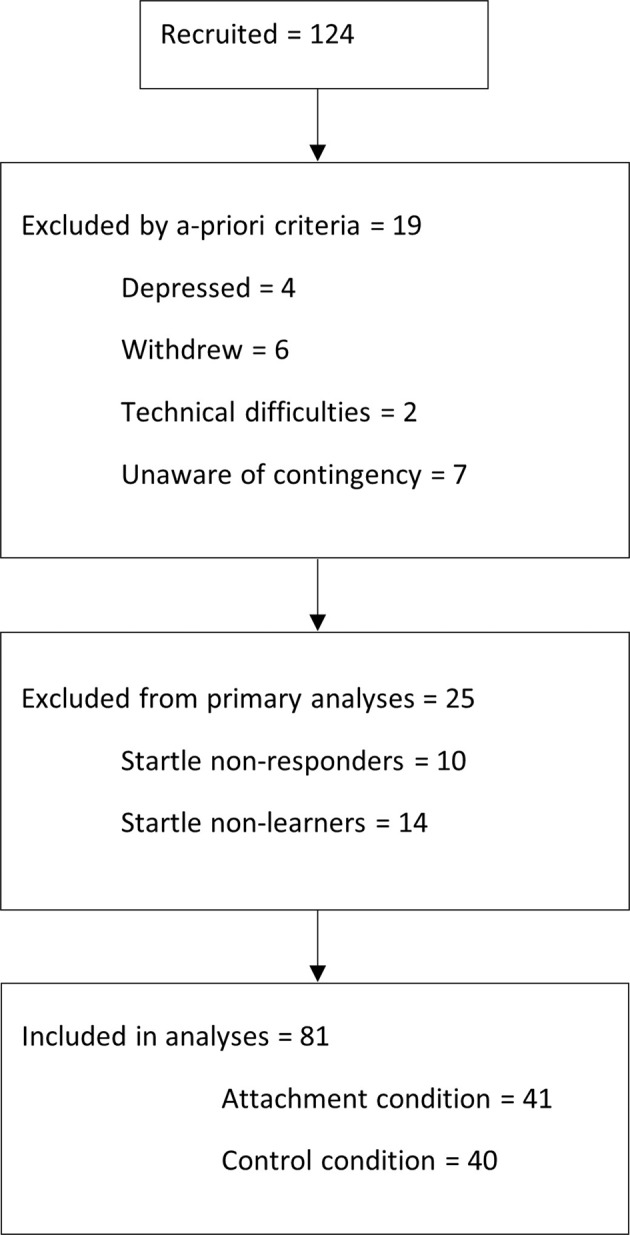
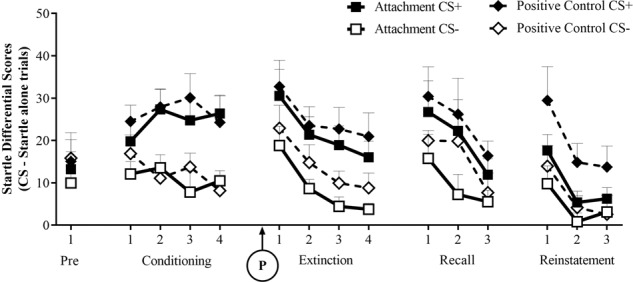
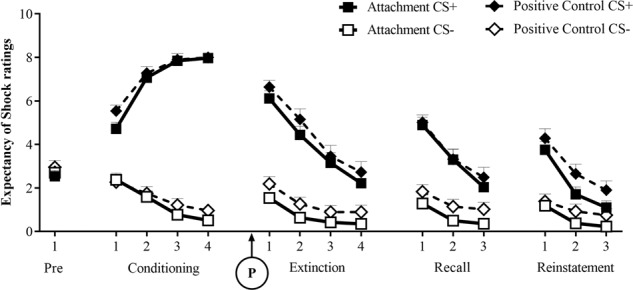
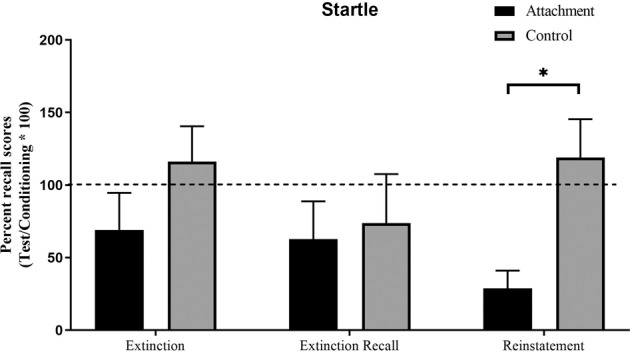
Previous studies have shown that activating the attachment system attenuates fear learning. This study aimed to explore whether attachment priming can also impact on fear extinction processes, which underpin the management of anxiety disorders. In this study, 81 participants underwent a standard fear conditioning and extinction protocol on day 1 and returned 24 h later for an extinction recall and reinstatement test. Half the participants were primed to imagine their closest attachment figure prior to undergoing extinction training, while the other half were instructed to imagine a positive situation. Fear-potentiated startle and subjective expectancies of shock were measured as the primary indicators of fear. Attachment priming led to less relapse during the reinstatement test at the physiological but not subjective levels. These findings have translational potential to imply that activating awareness of attachment figures might augment long-term safety memories acquired in existing treatments to reduce relapse of fear.
Overview
The claims and statistics of this paper haven’t been checked yet.
Free: it reads the open-access text and checks the first 5 claims that cite a source we can check. Create a free account to check every claim.
Integrity signals
Registry
Cites
Statistics
Figures
Verification
Claims the paper makes
The claims and statistics of this paper haven’t been checked yet.
Free: it reads the open-access text and checks the first 5 claims that cite a source we can check. Create a free account to check every claim.
Claims other papers make about this one
Each is checked against this paper’s own text: does it say what the citing paper says it does?
The cited source says what the claim attributes to it.
In the citing paper
“For example, we can use the safe attachment activation paradigm (Toumbelekis et al., 2021) to develop interventions that alleviate death anxiety in cancer patients.”
From Differences in proximal and intimacy-related defense mechanisms among patients with cancer in different psychological stages of dying (2024) · cites this paper as Toumbelekis et al., 2021
Self-check
Percentages, sums and reported differences re-computed from the paper’s own numbers.
The self-check needs the paper’s full text.
Citations
Cites
Lovibond, P. F., & Lovibond, S. H. (1995) · Behaviour Research and Therapy · doi:10.1016/0005-7967(94)00075-u · Cited by 14,523 · cited 2×
“The DASS-21 [18] was used to assess negative emotional states.”
BackgroundMethodAntony, M. M., Bieling, P. J., Cox, B. J., Enns, M. W., & Swinson, R. P. (1998) · Psychological Assessment · doi:10.1037/1040-3590.10.2.176 · Cited by 4,874
Attachment in adulthood: structure, dynamics, and change
(2008) · Choice Reviews Online · doi:10.5860/choice.45-2903 · Cited by 4,315
Attachment theory and close relationships
(1998) · Choice Reviews Online · doi:10.5860/choice.35-6513 · Cited by 3,626
The empirical status of cognitive-behavioral therapy: A review of meta-analyses
Butler, A. C., Chapman, J. E., Forman, E. M., & Beck, A. T. (2006) · Clinical Psychology Review · doi:10.1016/j.cpr.2005.07.003 · Cited by 3,215
Epidemiology of anxiety disorders in the 21st century
Bandelow, B., & Michaelis, S. (2015) · Dialogues in Clinical Neuroscience · doi:10.31887/dcns.2015.17.3/bbandelow · Cited by 2,079 · cited 1×
“Anxiety disorders are among the most common mental health disorders worldwide, and incur enormous burdens to individuals, families, communities, and health systems [1].”
BackgroundContext and Behavioral Processes in Extinction: Table 1.
Bouton, M. E. (2004) · Learning & Memory · doi:10.1101/lm.78804 · Cited by 1,808 · cited 3×
“The former used only four paired presentations of the CS+ with shock during acquisition and extinction and utilized a 100% reinforcement protocol, which purportedly leads to very rapid extinction learning [6].”
BackgroundMethodInfluentialVISUAL IMAGERY DIFFERENCES IN THE RECALL OF PICTURES
MARKS, D. F. (1973) · British Journal of Psychology · doi:10.1111/j.2044-8295.1973.tb01322.x · Cited by 1,778 · cited 1×
“The Vividness of Visual Imagery Questionnaire (VVIQ [22]) measures an individual’s capacity to elicit mental visual images, and was administered to index the comparability of participants’ capacities in both prime conditions to imagine the prescribed primes.”
Phelps, E. A., Delgado, M. R., Nearing, K. I., & LeDoux, J. E. (2004) · Neuron · doi:10.1016/j.neuron.2004.08.042 · Cited by 1,753 · cited 1×
“It is possible that we needed to increase the number of trials during the extinction blocks to observe more pervasive extinction learning [31].”
BackgroundEffects of an expanding-spaced vs massed exposure schedule on fear reduction and return of fear
Rowe, M. K., & Craske, M. G. (1998) · Behaviour Research and Therapy · doi:10.1016/s0005-7967(97)10016-x · Cited by 1,676
Cited by
Hornstein, E. A., & Eisenberger, N. I. (2022) · Behaviour Research and Therapy · doi:10.1016/j.brat.2022.104101 · Cited by 34
“Additionally, as in Study 1, we investigated whether social support influences fear extinction outcomes in those who are lonely, as it does in those who are not specifically lonely (Hornstein et al., 2016; Hornstein et al., 2018; Toumbelekis et al., 2021).”
BackgroundBryant, R. A. (2022) · Clinical Psychology Review · doi:10.1016/j.cpr.2022.102228 · Cited by 56
Social support and fear-inhibition: an examination of underlying neural mechanisms
Hornstein, E. A., Leschak, C. J., Parrish, M. H., Haltom, K. E. B., Fanselow, M. S., Craske, M. G., & Eisenberger, N. I. (2024) · Social Cognitive and Affective Neuroscience · doi:10.1093/scan/nsae002 · Cited by 13
“…inhibitors, social-support-figure-reminders can continue to inhibit the fear-response even following their removal, reducing the acquisition of fear (Hornstein and Eisenberger, 2017; Toumbelekis et al. , 2018) and enhancing its extinction (Hornstein et al. , 2016, 2018; Toumbelekis et al. , 2021).”
BackgroundPetrican, R., Paine, A. L., Escott‐Price, V., & Shelton, K. H. (2023) · Scientific Reports · doi:10.1038/s41598-023-28057-6 · Cited by 11
Petrican, R., Fornito, A., & Jones, N. (2022) · NeuroImage · doi:10.1016/j.neuroimage.2022.119209 · Cited by 7
Metadata
- Authors
- Toumbelekis, M., Liddell, B. J., & Bryant, R. A.
- Affiliations
- UNSW Sydney (AU)
- Corresponding author
- Bryant, Richard A.
- Venue
- Translational Psychiatry
- Published
- 2021-11-13
- Volume
- 11
- Issue
- 1
- Pages
- 584-584
- ISSN
- 2158-3188 (ISSN-L)
- PMC
- PMC8590684
- OpenAlex
- W3214307594
- Cited by
- 15
- References
- 36
- Citations by year
- 2026: 4 · 2025: 2 · 2024: 4 · 2023: 2 · 2022: 3
- FWCI
- 1.31
- Type
- journal article
- Language
- en
- Open access
- gold
- doi.org
- Licence
- cc-by
- creativecommons.org/licenses/by/4.0 (tdm)
- creativecommons.org/licenses/by/4.0 (vor)
- Locations
- Translational Psychiatry (publishedVersion, cc-by)
- PubMed Central (publishedVersion, cc-by)
- PubMed (publishedVersion)
- DOAJ (DOAJ: Directory of Open Access Journals) (submittedVersion, cc-by-sa)
- Minerva Access (University of Melbourne) (submittedVersion, cc-by)
- Funders
- Department of Health | National Health and Medical Research Council (#1073041)
- Topics
- Life Sciences › Neuroscience › Cognitive Neuroscience › Memory and Neural Mechanisms
- Social Sciences › Psychology › Experimental and Cognitive Psychology › Anxiety, Depression, Psychometrics, Treatment, Cognitive Processes
- Social Sciences › Psychology › Clinical Psychology › Posttraumatic Stress Disorder Research
- Keywords
- fear extinction, fear relapse, fear conditioning, extinction recall, reinstatement, fear-potentiated startle, attachment figures, anxiety disorders, young adults
- MeSH terms
- Conditioning, Classical, Extinction, Psychological, Fear, Humans, Recurrence, Reflex, Startle, Young Adult
About these checks
Registry, retraction, Cites and statistics results are computed, not judged, with one exception: a printed reference that no index lists is read once by a model before it counts as a citation error. Claims are extracted by a model and kept only when their quote appears verbatim in the text; each cited source is then checked, with a model’s help, for whether it says what the claim relies on. Those verdicts can be wrong — read the claim’s quote and the cited source before relying on one.
Statistics and arithmetic are recomputed, not judged.
Confidence bands are shown only for fields calibrated on our annotated test set. None is calibrated yet, so no band is shown.
What counts as a claim ›How we measure confidence ›How we check this ›
Are you an author, or do you see a problem with this page? Request a review
How to cite
Cite CoChat for the checks on this page, and the paper for its own findings.
- This page
- CoChat. (2026). Citation check: Secure attachment priming protects against relapse of fear in Young adults. https://app.cochat.ai/papers/10.1038/s41398-021-01715-x
- The paper
- Toumbelekis, M., Liddell, B. J., & Bryant, R. A. (2021). Secure attachment priming protects against relapse of fear in Young adults. Translational Psychiatry. https://doi.org/10.1038/s41398-021-01715-x
Data sources
Bibliographic data: Semantic Scholar, OpenAlex, Crossref.
Contains information from the Semantic Scholar Academic Graph Datasets, made available under the ODC Attribution License (ODC-BY 1.0).
Semantic Scholar’s data is described in: Kinney, R., et al. (2023). The Semantic Scholar Open Data Platform. arXiv:2301.10140.
