

Secure attachment priming protects against relapse of fear in Young adults
Open accessThe DOI matches its Crossref record; 36 of the 36 references it cites were found in a registry or an index.
Abstract
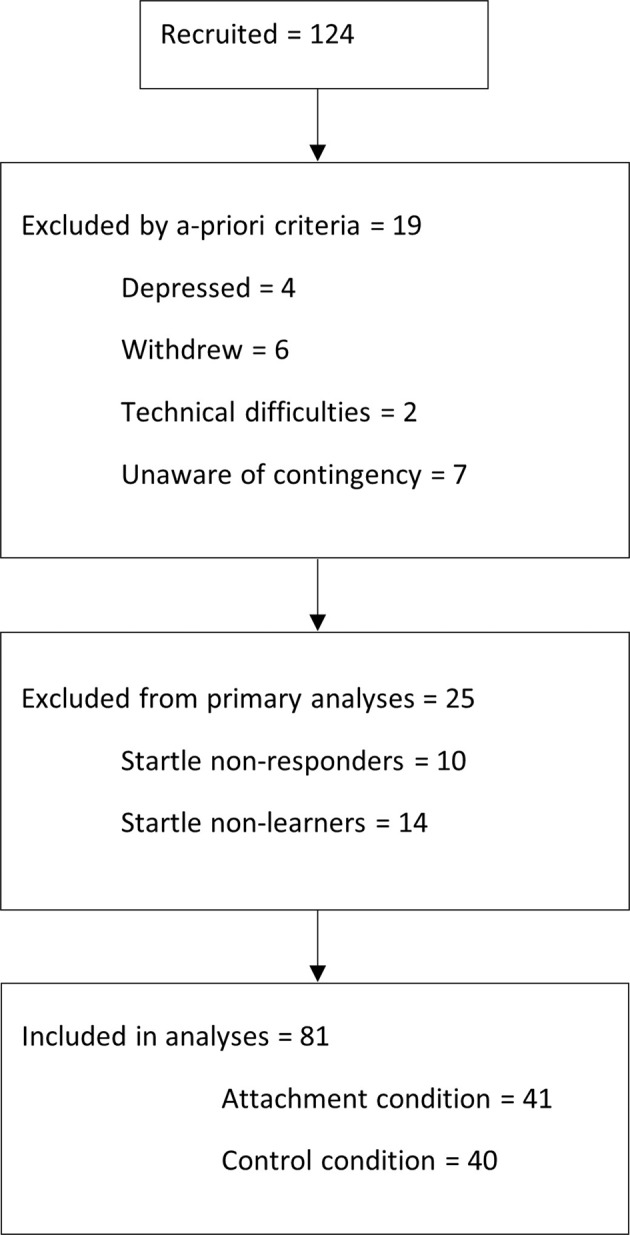
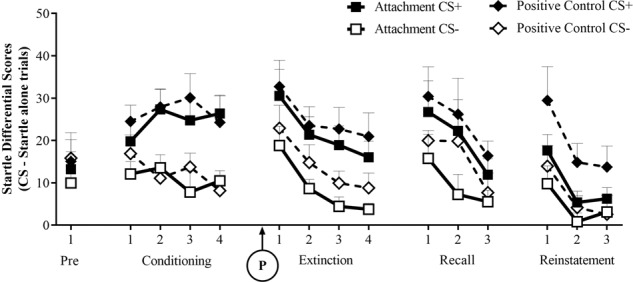
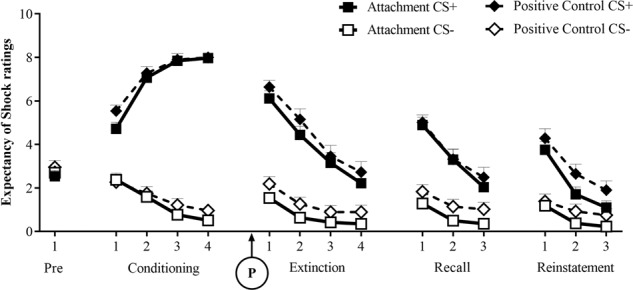
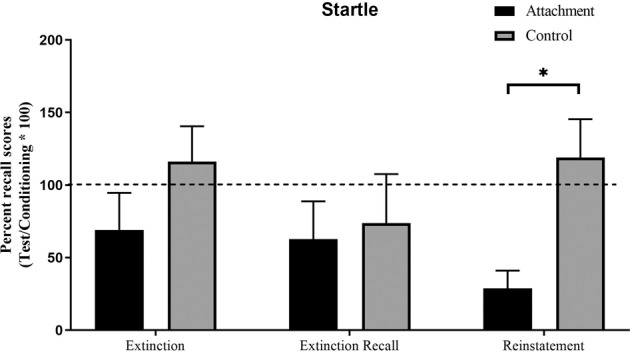
Previous studies have shown that activating the attachment system attenuates fear learning. This study aimed to explore whether attachment priming can also impact on fear extinction processes, which underpin the management of anxiety disorders. In this study, 81 participants underwent a standard fear conditioning and extinction protocol on day 1 and returned 24 h later for an extinction recall and reinstatement test. Half the participants were primed to imagine their closest attachment figure prior to undergoing extinction training, while the other half were instructed to imagine a positive situation. Fear-potentiated startle and subjective expectancies of shock were measured as the primary indicators of fear. Attachment priming led to less relapse during the reinstatement test at the physiological but not subjective levels. These findings have translational potential to imply that activating awareness of attachment figures might augment long-term safety memories acquired in existing treatments to reduce relapse of fear.
Overview
The claims and statistics of this paper haven’t been checked yet.
Free: it reads the open-access text and checks the first 5 claims that cite a source we can check. Create a free account to check every claim.
Integrity signals
Registry
Cites
Statistics
Figures
Verification
Claims the paper makes
The claims and statistics of this paper haven’t been checked yet.
Free: it reads the open-access text and checks the first 5 claims that cite a source we can check. Create a free account to check every claim.
Claims other papers make about this one
Each is checked against this paper’s own text: does it say what the citing paper says it does?
The cited source says what the claim attributes to it.
In the citing paper
“For example, we can use the safe attachment activation paradigm (Toumbelekis et al., 2021) to develop interventions that alleviate death anxiety in cancer patients.”
From Differences in proximal and intimacy-related defense mechanisms among patients with cancer in different psychological stages of dying (2024) · cites this paper as Toumbelekis et al., 2021
Self-check
Percentages, sums and reported differences re-computed from the paper’s own numbers.
The self-check needs the paper’s full text.
Citations
Cites
Lovibond, P. F., & Lovibond, S. H. (1995) · Behaviour Research and Therapy · doi:10.1016/0005-7967(94)00075-u · Cited by 14,523 · cited 2×
“The DASS-21 [18] was used to assess negative emotional states.”
BackgroundMethodAntony, M. M., Bieling, P. J., Cox, B. J., Enns, M. W., & Swinson, R. P. (1998) · Psychological Assessment · doi:10.1037/1040-3590.10.2.176 · Cited by 4,874
Attachment in adulthood: structure, dynamics, and change
(2008) · Choice Reviews Online · doi:10.5860/choice.45-2903 · Cited by 4,315
Attachment theory and close relationships
(1998) · Choice Reviews Online · doi:10.5860/choice.35-6513 · Cited by 3,626
The empirical status of cognitive-behavioral therapy: A review of meta-analyses
Butler, A. C., Chapman, J. E., Forman, E. M., & Beck, A. T. (2006) · Clinical Psychology Review · doi:10.1016/j.cpr.2005.07.003 · Cited by 3,215
Epidemiology of anxiety disorders in the 21st century
Bandelow, B., & Michaelis, S. (2015) · Dialogues in Clinical Neuroscience · doi:10.31887/dcns.2015.17.3/bbandelow · Cited by 2,079 · cited 1×
“Anxiety disorders are among the most common mental health disorders worldwide, and incur enormous burdens to individuals, families, communities, and health systems [1].”
BackgroundContext and Behavioral Processes in Extinction: Table 1.
Bouton, M. E. (2004) · Learning & Memory · doi:10.1101/lm.78804 · Cited by 1,808 · cited 3×
“The former used only four paired presentations of the CS+ with shock during acquisition and extinction and utilized a 100% reinforcement protocol, which purportedly leads to very rapid extinction learning [6].”
BackgroundMethodInfluentialVISUAL IMAGERY DIFFERENCES IN THE RECALL OF PICTURES
MARKS, D. F. (1973) · British Journal of Psychology · doi:10.1111/j.2044-8295.1973.tb01322.x · Cited by 1,778 · cited 1×
“The Vividness of Visual Imagery Questionnaire (VVIQ [22]) measures an individual’s capacity to elicit mental visual images, and was administered to index the comparability of participants’ capacities in both prime conditions to imagine the prescribed primes.”
Phelps, E. A., Delgado, M. R., Nearing, K. I., & LeDoux, J. E. (2004) · Neuron · doi:10.1016/j.neuron.2004.08.042 · Cited by 1,753 · cited 1×
“It is possible that we needed to increase the number of trials during the extinction blocks to observe more pervasive extinction learning [31].”
BackgroundEffects of an expanding-spaced vs massed exposure schedule on fear reduction and return of fear
Rowe, M. K., & Craske, M. G. (1998) · Behaviour Research and Therapy · doi:10.1016/s0005-7967(97)10016-x · Cited by 1,676
Committee report: Guidelines for human startle eyeblink electromyographic studies
Blumenthal, T. D., Cuthbert, B. N., Filion, D. L., Hackley, S., Lipp, O. V., & Van Boxtel, A. (2005) · Psychophysiology · doi:10.1111/j.1469-8986.2005.00271.x · Cited by 1,169
Attachment Theory and Close Relationships
Chazan, S. (1999) · American Journal of Psychotherapy · doi:10.1176/appi.psychotherapy.1999.53.2.269 · Cited by 892 · cited 1×
“The Experiences in Close Relationships questionnaire (ECR [20]) was used to assess individual differences in attachment style.”
MethodCarpenter, J. K., Andrews, L. A., Witcraft, S. M., Powers, M. B., Smits, J. A. J., & Hofmann, S. G. (2018) · Depression and Anxiety · doi:10.1002/da.22728 · Cited by 846 · cited 1×
“The best available treatment of anxiety typically involve exposure to reminders of perceived threat; however, there is a substantial proportion of people who do not respond to this approach [2].”
BackgroundLonsdorf, T. B., Menz, M. M., Andreatta, M., Fullana, M. A., Golkar, A., Haaker, J., Heitland, I., Hermann, A., Kuhn, M., Kruse, O., et al. (2017) · Neuroscience & Biobehavioral Reviews · doi:10.1016/j.neubiorev.2017.02.026 · Cited by 837 · cited 3×
“The pre-conditioning phase included four non-reinforced trials of the CS+ and CS− [23].”
MethodInfluentialBakermans-Kranenburg, M. J., & van IJzendoorn, M. H. (2009) · Attachment & Human Development · doi:10.1080/14616730902814762 · Cited by 742 · cited 1×
“Research has found that clinical samples tend to have higher rates of insecure attachment styles (73%) than nonclinical samples (42%) [32].”
BackgroundSibley, C. G., Fischer, R., & Liu, J. H. (2005) · Personality and Social Psychology Bulletin · doi:10.1177/0146167205276865 · Cited by 549 · cited 1×
“93 for the two subscales of anxiety and avoidance, respectively [21].”
BackgroundRemission in CBT for adult anxiety disorders: A meta-analysis
Springer, K. S., Levy, H. C., & Tolin, D. F. (2018) · Clinical Psychology Review · doi:10.1016/j.cpr.2018.03.002 · Cited by 364 · cited 1×
“For example, one meta-analysis estimates remission rates of anxiety following CBT treatment at only 48% [3].”
MethodMikulincer, M., Hirschberger, G., Nachmias, O., & Gillath, O. (2001) · Journal of Personality and Social Psychology · doi:10.1037//0022-3514.81.2.305 · Cited by 326
Reinstatement of fear responses in human aversive conditioning
Hermans, D., Dirikx, T., Vansteenwegenin, D., Baeyens, F., Van den Bergh, O., & Eelen, P. (2005) · Behaviour Research and Therapy · doi:10.1016/j.brat.2004.03.013 · Cited by 227 · cited 1×
“Immediately prior to this phase, four unsignalled US’s were delivered [26].”
MethodProtection from extinction in human fear conditioning
Lovibond, P. F., Davis, N. R., & O'Flaherty, A. S. (2000) · Behaviour Research and Therapy · doi:10.1016/s0005-7967(99)00121-7 · Cited by 189 · cited 2×
“Historically, safety signals present during extinction learning have been found to protect rather than enhance extinction [29].”
BackgroundConditioned fear extinction and reinstatement in a human fear-potentiated startle paradigm
Norrholm, S. D., Jovanovic, T., Vervliet, B., Myers, K. M., Davis, M., Rothbaum, B. O., & Duncan, E. J. (2006) · Learning & Memory · doi:10.1101/lm.393906 · Cited by 167
Pavlovian fear memory circuits and phenotype models of PTSD
Johnson, L. R., McGuire, J., Lazarus, R., & Palmer, A. A. (2012) · Neuropharmacology · doi:10.1016/j.neuropharm.2011.07.004 · Cited by 140 · cited 1×
“The traditional model to understand these processes has been that of fear learning [5], which involves training participants in an experimental setting to fear benign stimuli by the association of the stimuli with an aversive outcome (e.”
BackgroundConditioned inhibition of fear-potentiated startle and skin conductance in humans
GRILLON, C., & AMELI, R. (2001) · Psychophysiology · doi:10.1017/s0048577201000294 · Cited by 102 · cited 2×
“Procedure A differential fear conditioning and fear extinction protocol was adapted from the protocol used by Grillon and Ameli [25].”
MethodAugmentation of Extinction and Inhibitory Learning in Anxiety and Trauma-Related Disorders
Lebois, L. A. M., Seligowski, A. V., Wolff, J. D., Hill, S. B., & Ressler, K. J. (2019) · Annual Review of Clinical Psychology · doi:10.1146/annurev-clinpsy-050718-095634 · Cited by 92 · cited 1×
“There have been numerous pharmacological and direct stimulation approaches to augment exposure by targeting extinction mechanisms; however, these have yielded only modest success [7].”
BackgroundUnpacking the buffering effect of social support figures: Social support attenuates fear acquisition
Hornstein, E. A., & Eisenberger, N. I. (2017) · PLOS ONE · doi:10.1371/journal.pone.0175891 · Cited by 82
Zbozinek, T. D., Holmes, E. A., & Craske, M. G. (2015) · Behaviour Research and Therapy · doi:10.1016/j.brat.2015.05.016 · Cited by 78 · cited 4×
“Future studies could use such postmanipulation checks to index whether the groups were truly equated on positive mood after the manipulation [15].”
BackgroundInfluentialA Safe Haven: Investigating Social-Support Figures as Prepared Safety Stimuli
Hornstein, E. A., Fanselow, M. S., & Eisenberger, N. I. (2016) · Psychological Science · doi:10.1177/0956797616646580 · Cited by 76
Priming a sense of security: What goes through people’s minds?
Carnelley, K. B., & Rowe, A. C. (2010) · Journal of Social and Personal Relationships · doi:10.1177/0265407509360901 · Cited by 72 · cited 1×
“The current study adds to this earlier finding because it demonstrates that the beneficial impact of attachment priming extends beyond the influence of positive mood; that is, it appears that it is the sense of ‘felt security’ and ‘safety’ provided by heightening awareness of attachments that augments extinction [28].”
ResultRaes, A. K., & Raedt, R. D. (2012) · Behavior Therapy · doi:10.1016/j.beth.2012.03.012 · Cited by 65 · cited 2×
“Second, previous studies have shown that presenting positive stimuli [13, 14] or positive mood induction paradigms [15] prior to undergoing fear extinction reduces negative evaluations of the conditioned stimulus, inhibits the fear response and can enhance extinction learning and reduce relapse.”
BackgroundReduced return of threat expectancy after counterconditioning versus extinction
Kang, S., Vervliet, B., Engelhard, I. M., van Dis, E. A. M., & Hagenaars, M. A. (2018) · Behaviour Research and Therapy · doi:10.1016/j.brat.2018.06.009 · Cited by 52 · cited 1×
“Second, previous studies have shown that presenting positive stimuli [13, 14] or positive mood induction paradigms [15] prior to undergoing fear extinction reduces negative evaluations of the conditioned stimulus, inhibits the fear response and can enhance extinction learning and reduce relapse.”
BackgroundA Social Safety Net: Developing a Model of Social-Support Figures as Prepared Safety Stimuli
Hornstein, E. A., & Eisenberger, N. I. (2018) · Current Directions in Psychological Science · doi:10.1177/0963721417729036 · Cited by 37 · cited 2×
“As such, the current finding provides strong support for the conclusion that attachment primes serve as “unique safety signals” that enhance the long-term inhibitory learning acquired through extinction [30].”
BackgroundResultA Unique Safety Signal: Social-Support Figures Enhance Rather Than Protect From Fear Extinction
Hornstein, E. A., Haltom, K. E. B., Shirole, K., & Eisenberger, N. I. (2017) · Clinical Psychological Science · doi:10.1177/2167702617743002 · Cited by 32 · cited 8×
“First in contrast to the Hornstein et al. (2017) [12] study, a more ecologically valid attachment prime is needed that can be translated to practical settings because it is not feasible to have individual’s attachment figures physically or imaginally present during each and every extinction…”
BackgroundMethodResultInfluentialThinking of attachment figures blocks differential fear conditioning
Toumbelekis, M., Liddell, B. J., & Bryant, R. A. (2018) · Social Cognitive and Affective Neuroscience · doi:10.1093/scan/nsy065 · Cited by 31 · cited 1×
“Data analysis We calculated the required sample size on the basis of a prior study of fear acquisition following attachment priming [10].”
MethodReconsolidating Intrusive Distressing Memories by Thinking of Attachment Figures
Bryant, R. A., & Datta, S. (2019) · Clinical Psychological Science · doi:10.1177/2167702619866387 · Cited by 22 · cited 1×
“There is much evidence that attachment priming is most effective for those who have a more secure attachment style [11, 16, 17] because people who are either anxiously or avoidantly attached do not have a secure base from which to draw from, and accordingly they do not receive the same benefits of attachment proximity…”
BackgroundSecure attachment primes reduce fear consolidation
Toumbelekis, M., Liddell, B. J., & Bryant, R. A. (2021) · Depression and Anxiety · doi:10.1002/da.23166 · Cited by 12 · cited 1×
“There is much evidence that attachment priming is most effective for those who have a more secure attachment style [11, 16, 17] because people who are either anxiously or avoidantly attached do not have a secure base from which to draw from, and accordingly they do not receive the same benefits of attachment proximity…”
BackgroundReconsolidating Intrusive Distressing Memories by Thinking of Attachment Figures
Bryant, R. A., & Datta, S. (2019) · Sage Journals Data · doi:10.25384/sage.c.4649435 · Cited by 4
Cited by
Hornstein, E. A., & Eisenberger, N. I. (2022) · Behaviour Research and Therapy · doi:10.1016/j.brat.2022.104101 · Cited by 34
“Additionally, as in Study 1, we investigated whether social support influences fear extinction outcomes in those who are lonely, as it does in those who are not specifically lonely (Hornstein et al., 2016; Hornstein et al., 2018; Toumbelekis et al., 2021).”
BackgroundBryant, R. A. (2022) · Clinical Psychology Review · doi:10.1016/j.cpr.2022.102228 · Cited by 56
Social support and fear-inhibition: an examination of underlying neural mechanisms
Hornstein, E. A., Leschak, C. J., Parrish, M. H., Haltom, K. E. B., Fanselow, M. S., Craske, M. G., & Eisenberger, N. I. (2024) · Social Cognitive and Affective Neuroscience · doi:10.1093/scan/nsae002 · Cited by 13
“…inhibitors, social-support-figure-reminders can continue to inhibit the fear-response even following their removal, reducing the acquisition of fear (Hornstein and Eisenberger, 2017; Toumbelekis et al. , 2018) and enhancing its extinction (Hornstein et al. , 2016, 2018; Toumbelekis et al. , 2021).”
BackgroundPetrican, R., Paine, A. L., Escott‐Price, V., & Shelton, K. H. (2023) · Scientific Reports · doi:10.1038/s41598-023-28057-6 · Cited by 11
Petrican, R., Fornito, A., & Jones, N. (2022) · NeuroImage · doi:10.1016/j.neuroimage.2022.119209 · Cited by 7
Metadata
- Authors
- Toumbelekis, M., Liddell, B. J., & Bryant, R. A.
- Affiliations
- UNSW Sydney (AU)
- Corresponding author
- Bryant, Richard A.
- Venue
- Translational Psychiatry
- Published
- 2021-11-13
- Volume
- 11
- Issue
- 1
- Pages
- 584-584
- ISSN
- 2158-3188 (ISSN-L)
- PMC
- PMC8590684
- OpenAlex
- W3214307594
- Cited by
- 15
- References
- 36
- Citations by year
- 2026: 4 · 2025: 2 · 2024: 4 · 2023: 2 · 2022: 3
- FWCI
- 1.31
- Type
- journal article
- Language
- en
- Open access
- gold
- doi.org
- Licence
- cc-by
- creativecommons.org/licenses/by/4.0 (tdm)
- creativecommons.org/licenses/by/4.0 (vor)
- Locations
- Translational Psychiatry (publishedVersion, cc-by)
- PubMed Central (publishedVersion, cc-by)
- PubMed (publishedVersion)
- DOAJ (DOAJ: Directory of Open Access Journals) (submittedVersion, cc-by-sa)
- Minerva Access (University of Melbourne) (submittedVersion, cc-by)
- Funders
- Department of Health | National Health and Medical Research Council (#1073041)
- Topics
- Life Sciences › Neuroscience › Cognitive Neuroscience › Memory and Neural Mechanisms
- Social Sciences › Psychology › Experimental and Cognitive Psychology › Anxiety, Depression, Psychometrics, Treatment, Cognitive Processes
- Social Sciences › Psychology › Clinical Psychology › Posttraumatic Stress Disorder Research
- Keywords
- fear extinction, fear relapse, fear conditioning, extinction recall, reinstatement, fear-potentiated startle, attachment figures, anxiety disorders, young adults
- MeSH terms
- Conditioning, Classical, Extinction, Psychological, Fear, Humans, Recurrence, Reflex, Startle, Young Adult
About these checks
Registry, retraction, Cites and statistics results are computed, not judged, with one exception: a printed reference that no index lists is read once by a model before it counts as a citation error. Claims are extracted by a model and kept only when their quote appears verbatim in the text; each cited source is then checked, with a model’s help, for whether it says what the claim relies on. Those verdicts can be wrong — read the claim’s quote and the cited source before relying on one.
Statistics and arithmetic are recomputed, not judged.
Confidence bands are shown only for fields calibrated on our annotated test set. None is calibrated yet, so no band is shown.
What counts as a claim ›How we measure confidence ›How we check this ›
Are you an author, or do you see a problem with this page? Request a review
Data sources
Bibliographic data: Semantic Scholar, OpenAlex, Crossref.
Contains information from the Semantic Scholar Academic Graph Datasets, made available under the ODC Attribution License (ODC-BY 1.0).
Semantic Scholar’s data is described in: Kinney, R., et al. (2023). The Semantic Scholar Open Data Platform. arXiv:2301.10140.
