

Network effects of Stanford Neuromodulation Therapy (SNT) in treatment-resistant major depressive disorder: a randomized, controlled trial
Open accessThe DOI matches its Crossref record; 63 of the 63 references it cites were found in a registry or an index.
Abstract
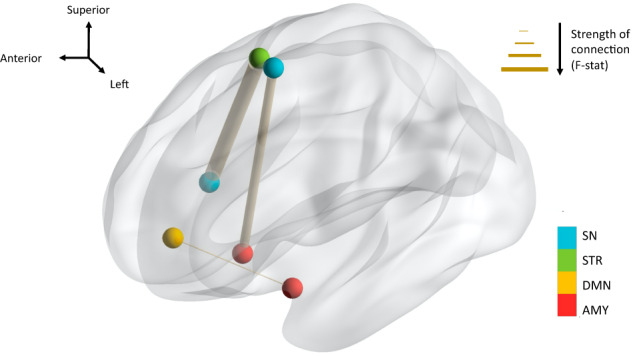
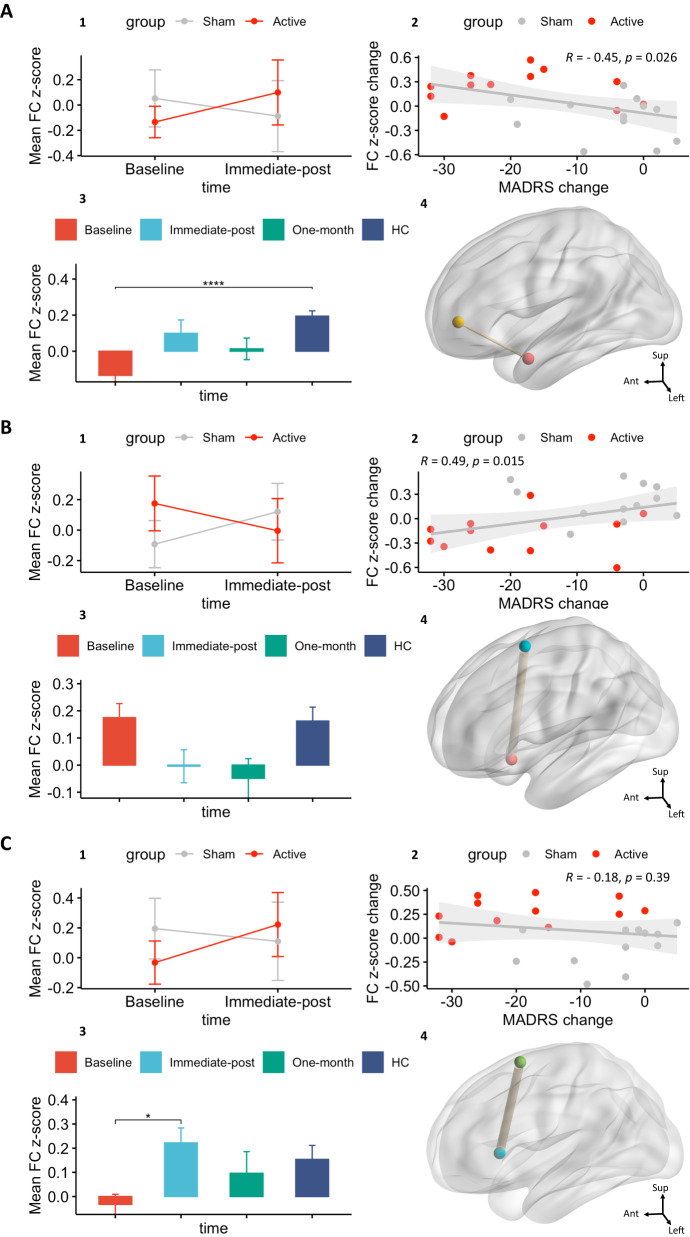
Here, we investigated the brain functional connectivity (FC) changes following a novel accelerated theta burst stimulation protocol known as Stanford Neuromodulation Therapy (SNT) which demonstrated significant antidepressant efficacy in treatment-resistant depression (TRD). In a sample of 24 patients (12 active and 12 sham), active stimulation was associated with significant pre- and post-treatment modulation of three FC pairs, involving the default mode network (DMN), amygdala, salience network (SN) and striatum. The most robust finding was the SNT effect on amygdala-DMN FC (group*time interaction F(1,22) = 14.89, p < 0.001). This FC change correlated with improvement in depressive symptoms (rho (Spearman) = −0.45, df = 22, p = 0.026). The post-treatment FC pattern showed a change in the direction of the healthy control group and was sustained at the one-month follow-up. These results are consistent with amygdala-DMN connectivity dysfunction as an underlying mechanism of TRD and bring us closer to the goal of developing imaging biomarkers for TMS treatment optimization. Trial registration: ClinicalTrials.gov NCT03068715
Overview
The claims and statistics of this paper haven’t been checked yet.
Free: it reads the open-access text and checks the first 5 claims that cite a source we can check. Create a free account to check every claim.
Integrity signals
Registry
Cites
Statistics
Figures
Verification
Claims the paper makes
The claims and statistics of this paper haven’t been checked yet.
Free: it reads the open-access text and checks the first 5 claims that cite a source we can check. Create a free account to check every claim.
Claims other papers make about this one
Each is checked against this paper’s own text: does it say what the citing paper says it does?
The source backs part of the claim, not all of it — or backs it for a different population, condition or comparison.
In the citing paper
“Several studies on both iTBS and TMS, administered to the DLPFC, of a variety of treatment durations, showed increased connectivity between the frontal cortex and areas of the limbic system [137].”
From Frontal Pole Neuromodulation for Impulsivity and Suicidality in Veterans With Mild Traumatic Brain Injury and Common Co-Occurring Mental Health Conditions: Protocol for a Pilot Randomized Controlled Trial (2024) · cites this paper as [137]
Experimental — accuracy not yet measuredIn the citing paper
“A follow-up trial showed that the SNT TMS protocol changed functional connectivity patterns between the salience network, the amygdala, and the striatum such that treated MDD patients now had functional connectivity patterns that were comparable to control patients without MDD [144].”
From Beyond the serotonin deficit hypothesis: Communicating a neuroplasticity framework of major depressive disorder (2024) · cites this paper as [144]
Self-check
Percentages, sums and reported differences re-computed from the paper’s own numbers.
The self-check needs the paper’s full text.
Citations
Cites
A new depression scale designed to be sensitive to change
Montgomery, S. A., & Åsberg, M. (1979) · British Journal of Psychiatry · doi:10.1192/bjp.134.4.382 · Cited by 13,962 · cited 12×
“MADRS assessments were performed at the baseline, immediate-post and one-month follow-up visits.”
MethodInfluentialJenkinson, M., Bannister, P., Brady, M., & Smith, S. (2002) · NeuroImage · doi:10.1006/nimg.2002.1132 · Cited by 11,888
Zhang, Y., Brady, M., & Smith, S. (2001) · IEEE Transactions on Medical Imaging · doi:10.1109/42.906424 · Cited by 6,982 · cited 1×
“Brain tissue segmentation of cerebrospinal fluid (CSF), white-matter (WM) and graymatter (GM) was performed on the brain-extracted T1w using fast [32] (FSL v5.”
MethodN4ITK: Improved N3 Bias Correction
Tustison, N. J., Avants, B. B., Cook, P. A., Zheng, Y., Egan, A., Yushkevich, P. A., & Gee, J. C. (2010) · IEEE Transactions on Medical Imaging · doi:10.1109/tmi.2010.2046908 · Cited by 6,073 · cited 1×
“0 [29] and skull-stripped using antsBrainExtraction.”
AVANTS, B., EPSTEIN, C., GROSSMAN, M., & GEE, J. (2008) · Medical Image Analysis · doi:10.1016/j.media.2007.06.004 · Cited by 5,669 · cited 1×
“0 [[31], RRID:SCR 004757], using brain-extracted versions of both T1w volume and template.”
MethodMethods to detect, characterize, and remove motion artifact in resting state fMRI
Power, J. D., Mitra, A., Laumann, T. O., Snyder, A. Z., Schlaggar, B. L., & Petersen, S. E. (2014) · NeuroImage · doi:10.1016/j.neuroimage.2013.08.048 · Cited by 3,748 · cited 1×
“Framewise displacement [35] was calculated for each functional run using the implementation of Nipype.”
MethodLocal-global parcellation of the human cerebral cortex from intrinsic functional connectivity MRI
Schaefer, A., Kong, R., Gordon, E. M., Laumann, T. O., Zuo, X.-N., Holmes, A. J., Eickhoff, S. B., & Yeo, B. T. T. (2018) · Cerebral Cortex · doi:10.1093/cercor/bhx179 · Cited by 3,657
Accurate and robust brain image alignment using boundary-based registration
Greve, D. N., & Fischl, B. (2009) · NeuroImage · doi:10.1016/j.neuroimage.2009.06.060 · Cited by 3,596
Ferrari, A. J., Charlson, F. J., Norman, R. E., Patten, S. B., Freedman, G., Murray, C. J. L., Vos, T., & Whiteford, H. A. (2013) · PLoS Medicine · doi:10.1371/journal.pmed.1001547 · Cited by 3,115
Machine learning for neuroimaging with scikit-learn
Abraham, A., Pedregosa, F., Eickenberg, M., Gervais, P., Mueller, A., Kossaifi, J., Gramfort, A., Thirion, B., & Varoquaux, G. (2014) · Frontiers in Neuroinformatics · doi:10.3389/fninf.2014.00014 · Cited by 2,384 · cited 1×
“Data were detrended using Nilearn [37].”
Greicius, M. D., Flores, B. H., Menon, V., Glover, G. H., Solvason, H. B., Kenna, H., Reiss, A. L., & Schatzberg, A. F. (2007) · Biological Psychiatry · doi:10.1016/j.biopsych.2006.09.020 · Cited by 2,214
Unbiased nonlinear average age-appropriate brain templates from birth to adulthood
Fonov, V., Evans, A., McKinstry, R., Almli, C., & Collins, D. (2009) · NeuroImage · doi:10.1016/s1053-8119(09)70884-5 · Cited by 2,102 · cited 1×
“Spatial normalization to the ICBM 152 Nonlinear Asymmetrical template version 2009c [[30], RRID:SCR 008796] was performed through nonlinear registration with the antsRegistration tool of ANTs v2.”
MethodICA-AROMA: A robust ICA-based strategy for removing motion artifacts from fMRI data
Pruim, R. H. R., Mennes, M., van Rooij, D., Llera, A., Buitelaar, J. K., & Beckmann, C. F. (2015) · NeuroImage · doi:10.1016/j.neuroimage.2015.02.064 · Cited by 1,684
The default mode network and self-referential processes in depression
Sheline, Y. I., Barch, D. M., Price, J. L., Rundle, M. M., Vaishnavi, S. N., Snyder, A. Z., Mintun, M. A., Wang, S., Coalson, R. S., & Raichle, M. E. (2009) · Proceedings of the National Academy of Sciences · doi:10.1073/pnas.0812686106 · Cited by 1,480 · cited 14×
“Biological mechanisms in MDD have been investigated using network-level whole-brain approaches, such as functional connectivity (FC) imaging, which has led to a better understanding of biological mechanisms of MDD [3, 4].”
BackgroundResultInfluentialThe neural bases of emotion regulation
Etkin, A., Büchel, C., & Gross, J. J. (2015) · Nature Reviews Neuroscience · doi:10.1038/nrn4044 · Cited by 1,244 · cited 10×
“Biological mechanisms in MDD have been investigated using network-level whole-brain approaches, such as functional connectivity (FC) imaging, which has led to a better understanding of biological mechanisms of MDD [3, 4].”
MethodInfluentialMechanisms of ketamine action as an antidepressant
Zanos, P., & Gould, T. D. (2018) · Molecular Psychiatry · doi:10.1038/mp.2017.255 · Cited by 1,127 · cited 1×
“However, the contribution of these drugs in the study of the mechanisms of action might be limited by non-specific pharmacological action [22, 23] and lack of effective blinding—i.”
BackgroundAssignment of functional activations to probabilistic cytoarchitectonic areas revisited
Eickhoff, S. B., Paus, T., Caspers, S., Grosbras, M.-H., Evans, A. C., Zilles, K., & Amunts, K. (2007) · NeuroImage · doi:10.1016/j.neuroimage.2007.03.060 · Cited by 983 · cited 1×
“There were six ROIs in total: the bilateral centro-median amygdala (CMA), bilateral latero-basal amygdala (LBA) and bilateral superficial amygdala (SA) [40].”
BackgroundDepressive rumination, the default-mode network, and the dark matter of clinical neuroscience
Hamilton, J. P., Farmer, M., Fogelman, P., & Gotlib, I. H. (2015) · Biological Psychiatry · doi:10.1016/j.biopsych.2015.02.020 · Cited by 952 · cited 1×
“Recent findings have shown that in patients with depression, the DMN has a greater FC with dorsomedial prefrontal cortex (dmPFC) [6], subgenual ACC (sgACC) [7], and subgenual prefrontal cortex (sgPFC) than in healthy controls and is associated with rumination [8].”
BackgroundYan, C.-G., Chen, X., Li, L., Castellanos, F. X., Bai, T.-J., Bo, Q.-J., Cao, J., Chen, G.-M., Chen, N.-X., Chen, W., et al. (2019) · Proceedings of the National Academy of Sciences · doi:10.1073/pnas.1900390116 · Cited by 895 · cited 2×
“DMN FC has been frequently reported to be abnormal in MDD but with inconsistencies in the differences observed [6, 43].”
ResultStanford Accelerated Intelligent Neuromodulation Therapy for Treatment-Resistant Depression
Cole, E. J., Stimpson, K. H., Bentzley, B. S., Gulser, M., Cherian, K., Tischler, C., Nejad, R., Pankow, H., Choi, E., Aaron, H., et al. (2020) · American Journal of Psychiatry · doi:10.1176/appi.ajp.2019.19070720 · Cited by 802
Self-citationStanford Neuromodulation Therapy (SNT): A Double-Blind Randomized Controlled Trial
Cole, E. J., Phillips, A. L., Bentzley, B. S., Stimpson, K. H., Nejad, R., Barmak, F., Veerapal, C., Khan, N., Cherian, K., Felber, E., et al. (2022) · American Journal of Psychiatry · doi:10.1176/appi.ajp.2021.20101429 · Cited by 795 · cited 9×
“2% remission at one-month posttreatment [25].”
BackgroundMethodResultInfluentialSelf-citationDefault mode network mechanisms of transcranial magnetic stimulation in depression
Liston, C., Chen, A. C., Zebley, B. D., Drysdale, A. T., Gordon, R., Leuchter, B., Voss, H. U., Casey, B. J., Etkin, A., & Dubin, M. J. (2014) · Biological Psychiatry · doi:10.1016/j.biopsych.2014.01.023 · Cited by 763 · cited 13×
“study, baseline FC between sgACC and DMN was abnormally elevated in MDD patients, as compared to controls, and a full 5-week course of conventional TMS normalized this abnormal FC pattern [50].”
BackgroundResultInfluentialPrecision psychiatry: a neural circuit taxonomy for depression and anxiety
Williams, L. M. (2016) · The Lancet Psychiatry · doi:10.1016/s2215-0366(15)00579-9 · Cited by 641 · cited 12×
“Biological mechanisms in MDD have been investigated using network-level whole-brain approaches, such as functional connectivity (FC) imaging, which has led to a better understanding of biological mechanisms of MDD [3, 4].”
BackgroundMethodInfluentialFox, M. D., Buckner, R. L., Liu, H., Chakravarty, M. M., Lozano, A. M., & Pascual-Leone, A. (2014) · Proceedings of the National Academy of Sciences · doi:10.1073/pnas.1405003111 · Cited by 617
Peters, S. K., Dunlop, K., & Downar, J. (2016) · Frontiers in Systems Neuroscience · doi:10.3389/fnsys.2016.00104 · Cited by 611 · cited 3×
“Furthermore, there is evidence that DLPFC stimulation induces dopamine release in SN-corticostriatocortical (CSC) loop circuits [58].”
BackgroundCausal interactions between fronto-parietal central executive and default-mode networks in humans
Chen, A. C., Oathes, D. J., Chang, C., Bradley, T., Zhou, Z.-W., Williams, L. M., Glover, G. H., Deisseroth, K., & Etkin, A. (2013) · Proceedings of the National Academy of Sciences · doi:10.1073/pnas.1311772110 · Cited by 567 · cited 2×
“The latter two are known to have an inhibitory function over the DMN and a crucial role in the regulation of cognitive and emotional processes [5].”
BackgroundToward a Neuroimaging Treatment Selection Biomarker for Major Depressive Disorder
McGrath, C. L., Kelley, M. E., Holtzheimer, P. E., Dunlop, B. W., Craighead, W. E., Franco, A. R., Craddock, R. C., & Mayberg, H. S. (2013) · JAMA Psychiatry · doi:10.1001/jamapsychiatry.2013.143 · Cited by 561
Zhdanava, M., Pilon, D., Ghelerter, I., Chow, W., Joshi, K., Lefebvre, P., & Sheehan, J. J. (2021) · The Journal of Clinical Psychiatry · doi:10.4088/jcp.20m13699 · Cited by 523
Brunoni, A. R., Chaimani, A., Moffa, A. H., Razza, L. B., Gattaz, W. F., Daskalakis, Z. J., & Carvalho, A. F. (2017) · JAMA Psychiatry · doi:10.1001/jamapsychiatry.2016.3644 · Cited by 520
Weigand, A., Horn, A., Caballero, R., Cooke, D., Stern, A. P., Taylor, S. F., Press, D., Pascual-Leone, A., & Fox, M. D. (2018) · Biological Psychiatry · doi:10.1016/j.biopsych.2017.10.028 · Cited by 487
Self-referential processing, rumination, and cortical midline structures in major depression
Nejad, A. B., Fossati, P., & Lemogne, C. (2013) · Frontiers in Human Neuroscience · doi:10.3389/fnhum.2013.00666 · Cited by 366
Tziortzi, A. C., Haber, S. N., Searle, G. E., Tsoumpas, C., Long, C. J., Shotbolt, P., Douaud, G., Jbabdi, S., Behrens, T. E. J., Rabiner, E. A., et al. (2014) · Cerebral Cortex · doi:10.1093/cercor/bhs397 · Cited by 315 · cited 1×
“The bilateral executive, sensorimotor and limbic sub-regions of the striatum were predefined using the Oxford-GSKImanova Striatal Connectivity Atlas (striatum-con-label-thr25-3sub) [39].”
MethodThe neural basis of psychedelic action
Kwan, A. C., Olson, D. E., Preller, K. H., & Roth, B. L. (2022) · Nature Neuroscience · doi:10.1038/s41593-022-01177-4 · Cited by 302 · cited 1×
“However, the contribution of these drugs in the study of the mechanisms of action might be limited by non-specific pharmacological action [22, 23] and lack of effective blinding—i.”
BackgroundSalomons, T. V., Dunlop, K., Kennedy, S. H., Flint, A., Geraci, J., Giacobbe, P., & Downar, J. (2014) · Neuropsychopharmacology · doi:10.1038/npp.2013.222 · Cited by 299
Scheidegger, M., Walter, M., Lehmann, M., Metzger, C., Grimm, S., Boeker, H., Boesiger, P., Henning, A., & Seifritz, E. (2012) · PLoS ONE · doi:10.1371/journal.pone.0044799 · Cited by 282 · cited 1×
“Others have reported that the ATD effect following ketamine [52] or ATD medications [53] is associated with decreased DMN-CEN connectivity, while another study found an increased DMN-STR FC after 2 weeks of duloxetine treatment with FC changes correlating with symptom improvement [54].”
BackgroundCash, R. F. H., Zalesky, A., Thomson, R. H., Tian, Y., Cocchi, L., & Fitzgerald, P. B. (2019) · Biological Psychiatry · doi:10.1016/j.biopsych.2018.12.002 · Cited by 231
Yoshimura, S., Okamoto, Y., Onoda, K., Matsunaga, M., Okada, G., Kunisato, Y., Yoshino, A., Ueda, K., Suzuki, S.-I., & Yamawaki, S. (2014) · Social Cognitive and Affective Neuroscience · doi:10.1093/scan/nst009 · Cited by 229
Baeken, C., Marinazzo, D., Wu, G.-R., Van Schuerbeek, P., De Mey, J., Marchetti, I., Vanderhasselt, M.-A., Remue, J., Luypaert, R., & De Raedt, R. (2014) · The World Journal of Biological Psychiatry · doi:10.3109/15622975.2013.872295 · Cited by 198
McCabe, C., & Mishor, Z. (2011) · NeuroImage · doi:10.1016/j.neuroimage.2011.05.051 · Cited by 184 · cited 2×
“Others have reported that the ATD effect following ketamine [52] or ATD medications [53] is associated with decreased DMN-CEN connectivity, while another study found an increased DMN-STR FC after 2 weeks of duloxetine treatment with FC changes correlating with symptom improvement [54].”
BackgroundTang, S., Lu, L., Zhang, L., Hu, X., Bu, X., Li, H., Hu, X., Gao, Y., Zeng, Z., Gong, Q., et al. (2018) · EBioMedicine · doi:10.1016/j.ebiom.2018.09.010 · Cited by 175 · cited 2×
“Moreover, abnormal amygdala connectivity with the affective network— hyperconnectivity with hippocampi/parahippocampi and bilateral ventromedial OFC as well as hypoconnectivity with bilateral insula and left caudate—has been identified as a marker of emotional dysregulation in depressed adults [57].”
BackgroundEvans, J. W., Szczepanik, J., Brutsché, N., Park, L. T., Nugent, A. C., & Zarate, C. A. (2018) · Biological Psychiatry · doi:10.1016/j.biopsych.2018.01.027 · Cited by 173 · cited 1×
“Lastly, ketamine infusions (as compared to placebo) increased DMN-SN connectivity, which normalized as compared to healthy controls [55].”
BackgroundKan, R. L. D., Padberg, F., Giron, C. G., Lin, T. T. Z., Zhang, B. B. B., Brunoni, A. R., & Kranz, G. S. (2023) · The Lancet Psychiatry · doi:10.1016/s2215-0366(23)00026-3 · Cited by 172 · cited 1×
“Overall, our study confirmed that from a dimensional perspective the DLPFC targeted TMS is efficacious on depressive symptoms, as demonstrated recently in a transdiagnosis meta-analysis [42], and evidenced that the antidepressant effect associated with SNT protocol may be mediated by regional brain FC within DMN, amyg…”
ResultIntrinsic connectomes are a predictive biomarker of remission in major depressive disorder
Korgaonkar, M. S., Goldstein-Piekarski, A. N., Fornito, A., & Williams, L. M. (2020) · Molecular Psychiatry · doi:10.1038/s41380-019-0574-2 · Cited by 163 · cited 1×
“Increases within and between DMN intrinsic connectivity have been elicited in patients who remitted from depression [49], and an association between DMN-related connectivity and response—to both DLPFC [18, 50] and DMPFC [51] TMS—also has been reported.”
BackgroundChin Fatt, C. R., Jha, M. K., Cooper, C. M., Fonzo, G., South, C., Grannemann, B., Carmody, T., Greer, T. L., Kurian, B., Fava, M., et al. (2020) · American Journal of Psychiatry · doi:10.1176/appi.ajp.2019.18070870 · Cited by 125
Goldstein-Piekarski, A. N., Staveland, B. R., Ball, T. M., Yesavage, J., Korgaonkar, M. S., & Williams, L. M. (2018) · Translational Psychiatry · doi:10.1038/s41398-018-0100-3 · Cited by 108
Simplicio, M. C. D., Norbury, R., & Harmer, C. J. (2011) · Molecular Psychiatry · doi:10.1038/mp.2011.16 · Cited by 93
Taylor, S. F., Ho, S. S., Abagis, T., Angstadt, M., Maixner, D. F., Welsh, R. C., & Hernandez-Garcia, L. (2018) · Journal of Affective Disorders · doi:10.1016/j.jad.2018.02.019 · Cited by 82 · cited 1×
“[17–20] Whereas one study failed to elicit such effect probably due to lack of statistical power [21].”
BackgroundIntrinsic Brain Network Biomarkers of Antidepressant Response: a Review
Dunlop, K., Talishinsky, A., & Liston, C. (2019) · Current Psychiatry Reports · doi:10.1007/s11920-019-1072-6 · Cited by 80 · cited 15×
“Our findings highlight the central role of the SN for the ATD effect of FC-guided lDLPFC aiTBS.”
BackgroundInfluentialGe, R., Blumberger, D. M., Downar, J. H., Daskalakis, Z. J., Dipinto, A. A., Tham, J. C. W., Lam, R. W. M., & Vila‐Rodriguez, F. (2017) · Journal of Affective Disorders · doi:10.1016/j.jad.2017.04.060 · Cited by 76 · cited 4×
“Third, increased SN FC is a marker of response to DLPFC TMS [61], which we also found to be the case for SNT.”
ResultInfluentialHawco, C. S., Voineskos, A. N., Steeves, J. K. E., Dickie, E. W., Viviano, J. D., Downar, J. H., Blumberger, D. M., & Daskalakis, Z. J. (2018) · Cortex · doi:10.1016/j.cortex.2018.07.010 · Cited by 65
Two-week rTMS-induced neuroimaging changes measured with fMRI in depression
Zheng, A., Yu, R., Du, W., Liu, H., Zhang, Z., Xu, Z., Xiang, Y., & Du, L. (2020) · Journal of Affective Disorders · doi:10.1016/j.jad.2020.03.038 · Cited by 59
Komulainen, E., Heikkilä, R., Nummenmaa, L., Raij, T. T., Harmer, C. J., Isometsä, E., & Ekelund, J. (2018) · Journal of Affective Disorders · doi:10.1016/j.jad.2018.04.096 · Cited by 56
Fan, J., Tso, I. F., Maixner, D. F., Abagis, T. R., Hernández-García, L., & Taylor, S. F. (2019) · NeuroImage Clinical · doi:10.1016/j.nicl.2019.101719 · Cited by 45 · cited 1×
“Fifth, recent work reported that only salience network segregation was associated with symptom improvement following active 10 Hz TMS, using a segregation measure defined as the relative strength of within-network connectivity compared to between-network connectivity [63].”
BackgroundA systematic review and meta-analysis of the success of blinding in antidepressant RCTs
Scott, A. J., Sharpe, L., & Colagiuri, B. (2022) · Psychiatry Research · doi:10.1016/j.psychres.2021.114297 · Cited by 43 · cited 1×
“poorly assessed and unsuccessful [24]—which impairs the generalizability”
BackgroundGodfrey, K., Muthukumaraswamy, S. D., Stinear, C. M., & Hoeh, N. (2022) · Journal of Affective Disorders · doi:10.1016/j.jad.2021.12.129 · Cited by 41
Persson, J., Struckmann, W., Gingnell, M., Fällmar, D., & Bodén, R. (2020) · Behavioural Brain Research · doi:10.1016/j.bbr.2020.112834 · Cited by 40 · cited 2×
“Increases within and between DMN intrinsic connectivity have been elicited in patients who remitted from depression [49], and an association between DMN-related connectivity and response—to both DLPFC [18, 50] and DMPFC [51] TMS—also has been reported.”
BackgroundWackerhagen, C., Veer, I. M., Erk, S., Mohnke, S., Lett, T. A., Wüstenberg, T., Romanczuk-Seiferth, N. Y., Schwarz, K., Schweiger, J. I., Tost, H., et al. (2020) · Psychological Medicine · doi:10.1017/s0033291719002885 · Cited by 39 · cited 1×
“Indeed, a decreased amygdala-DMN FC has been related to an ongoing major depressive episode [56, 57].”
BackgroundFettes, P., Moayedi, M., Dunlop, K., Mansouri, F., Vila‐Rodriguez, F., Giacobbe, P., Davis, K. D., Lam, R. W. M., Kennedy, S. H., Daskalakis, Z. J., et al. (2017) · Biological Psychiatry Cognitive Neuroscience and Neuroimaging · doi:10.1016/j.bpsc.2017.12.003 · Cited by 34
Geugies, H., Opmeer, E. M., Marsman, J. B. C., Figueroa, C. A., van Tol, M. J., Schmaal, L., van der Wee, N. J. A., Aleman, A., Penninx, B. W. J. H., Veltman, D. J., et al. (2019) · NeuroImage: Clinical · doi:10.1016/j.nicl.2019.102064 · Cited by 33 · cited 15×
“Our findings highlight the central role of the SN for the ATD effect of FC-guided lDLPFC aiTBS.”
InfluentialCircuit based anti-correlation, attention orienting, and major depression
Fossati, P. (2019) · CNS Spectrums · doi:10.1017/s1092852918001402 · Cited by 31 · cited 1×
“Further, DMN functional activity has been linked with key MDD clinical components such as self-referential thinking [6, 44] and is hypothesized to be involved in pharmacological and nonpharmacological antidepressant mechanisms of action [45–48].”
BackgroundTaylor, H. M., Nicholas, P. J., Hoy, K. E., Bailey, N. W., Tanglay, O., Young, I. M., Dobbin, L., Doyen, S., Sughrue, M. E., & Fitzgerald, P. B. (2023) · Journal of Affective Disorders · doi:10.1016/j.jad.2023.02.082 · Cited by 18
Chou, P., Tu, C., Chen, C., Lu, M., Tsai, C., Hsieh, W., Lai, H.-C., Satyanarayanan, S. K., & Su, K. (2023) · Psychiatry and Clinical Neurosciences · doi:10.1111/pcn.13524 · Cited by 16
An, J., Li, L., Wang, L., Su, Y., Wang, Y., Li, K., Zeng, Y., Kong, Q., Yan, C., & Si, T. (2019) · Frontiers in Psychiatry · doi:10.3389/fpsyt.2019.00884 · Cited by 13 · cited 11×
“Others have reported that the ATD effect following ketamine [52] or ATD medications [53] is associated with decreased DMN-CEN connectivity, while another study found an increased DMN-STR FC after 2 weeks of duloxetine treatment with FC changes correlating with symptom improvement [54].”
BackgroundInfluential
Cited by
Fitzsimmons, S., Oostra, E., Postma, T. S., van der Werf, Y. D., & van den Heuvel, O. A. (2023) · Biological Psychiatry · doi:10.1016/j.biopsych.2023.11.016 · Cited by 111
Page, C. E., Epperson, C. N., Novick, A. M., Duffy, K. A., & Thompson, S. M. (2024) · Molecular Psychiatry · doi:10.1038/s41380-024-02625-2 · Cited by 80
“A follow-up trial showed that the SNT TMS protocol changed functional connectivity patterns between the salience network, the amygdala, and the striatum such that treated MDD patients now had functional connectivity patterns that were comparable to control patients without MDD [144].”
Theta burst stimulation for depression: a systematic review and network and pairwise meta-analysis
Kishi, T., Ikuta, T., Sakuma, K., Hatano, M., Matsuda, Y., Wilkening, J., Goya-Maldonado, R., Tik, M., Williams, N. R., Kito, S., et al. (2024) · Molecular Psychiatry · doi:10.1038/s41380-024-02630-5 · Cited by 74
“…most common method of rTMS therapy includes placing a treatment coil on the patient ’ s scalp over the frontal lobe that generates electromagnetic pulses, which induce electric fi elds modulating the targeted left dorsolateral prefrontal cortex (L-DLPFC) and functionally connected networks [4 – 6].”
Self-citationZhao, H., Jiang, C., Zhao, M., Yang, Y., Liang, Y., Li, Y., Luan, H., Zhang, S., Xu, P., Chen, X., et al. (2023) · Biological Psychiatry · doi:10.1016/j.biopsych.2023.12.013 · Cited by 71
Steardo, L., D’Angelo, M., Monaco, F., Stefano, V. D., & Steardo, L. (2025) · Neuroscience & Biobehavioral Reviews · doi:10.1016/j.neubiorev.2025.106030 · Cited by 46
Metadata
- Authors
- Batail, J.-M., Xiao, X., Azeez, A., Tischler, C., Kratter, I. H., Bishop, J. H., Saggar, M., & Williams, N. R.
- Affiliations
- Centre Hospitalier Guillaume Régnier (FR)
- Stanford University (US)
- Baylor College of Medicine (US)
- Stanford Medicine (US)
- Corresponding author
- Williams, Nolan R.
- ORCID
- Venue
- Translational Psychiatry
- Published
- 2023-07-03
- Volume
- 13
- Issue
- 1
- Pages
- 240-240
- ISSN
- 2158-3188 (ISSN-L)
- PMC
- PMC10318050
- OpenAlex
- W4382931297
- Cited by
- 33
- References
- 63
- Citations by year
- 2026: 16 · 2025: 7 · 2024: 5 · 2023: 5
- FWCI
- 3.39
- Type
- journal article
- Language
- en
- Open access
- gold
- doi.org
- Licence
- cc-by
- creativecommons.org/licenses/by/4.0 (tdm)
- creativecommons.org/licenses/by/4.0 (vor)
- Locations
- Translational Psychiatry (publishedVersion, cc-by)
- PubMed Central (publishedVersion, cc-by)
- PubMed (publishedVersion)
- DOAJ (DOAJ: Directory of Open Access Journals) (submittedVersion, cc-by-sa)
- Funders
- Mellam Family Foundation
- National Institutes of Health
- National Institute of Mental Health (DP2MH119735)
- Topics
- Life Sciences › Neuroscience › Neurology › Transcranial Magnetic Stimulation Studies
- Health Sciences › Medicine › Pharmacology (medical) › Treatment of Major Depression
- Life Sciences › Neuroscience › Cognitive Neuroscience › Functional Brain Connectivity Studies
- Keywords
- theta burst stimulation, treatment-resistant depression, major depressive disorder, brain functional connectivity, default mode network, amygdala, salience network, striatum, network effects, imaging biomarkers, transcranial magnetic stimulation
- MeSH terms
- Brain, Brain Mapping, Major Depressive Disorder, Humans, Magnetic Resonance Imaging, Depressive Disorder, Treatment-Resistant
About these checks
Registry, retraction, Cites and statistics results are computed, not judged, with one exception: a printed reference that no index lists is read once by a model before it counts as a citation error. Claims are extracted by a model and kept only when their quote appears verbatim in the text; each cited source is then checked, with a model’s help, for whether it says what the claim relies on. Those verdicts can be wrong — read the claim’s quote and the cited source before relying on one.
Statistics and arithmetic are recomputed, not judged.
Confidence bands are shown only for fields calibrated on our annotated test set. None is calibrated yet, so no band is shown.
What counts as a claim ›How we measure confidence ›How we check this ›
Are you an author, or do you see a problem with this page? Request a review
Data sources
Bibliographic data: Semantic Scholar, OpenAlex, Crossref.
Contains information from the Semantic Scholar Academic Graph Datasets, made available under the ODC Attribution License (ODC-BY 1.0).
Semantic Scholar’s data is described in: Kinney, R., et al. (2023). The Semantic Scholar Open Data Platform. arXiv:2301.10140.
