

Peripheral immunity and risk of incident brain disorders: a prospective cohort study of 161,968 participants
Open accessThe DOI matches its Crossref record; 2 of the 89 references it cites were found in a registry or an index; 4 of the 12 sources its claims cite were checked for support.
Abstract
Whether peripheral immunity prospectively influences brain health remains controversial. This study aims to investigate the longitudinal associations between peripheral immunity markers with incident brain disorders. A total of 161,968 eligible participants from the UK Biobank were included. We investigated the linear and non-linear effects of peripheral immunity markers including differential leukocytes counts, their derived ratios and C-reactive protein (CRP) on the risk of dementia, Parkinson’s disease (PD), stroke, schizophrenia, bipolar affective disorder (BPAD), major depressive disorder (MDD) and anxiety, using Cox proportional hazard models and restricted cubic spline models. Linear regression models were used to explore potential mechanisms driven by brain structures. During a median follow-up of 9.66 years, 16,241 participants developed brain disorders. Individuals with elevated innate immunity markers including neutrophils, monocytes, platelets, neutrophil-to-lymphocyte ratio (NLR), and systemic immune-inflammation index (SII) had an increased risk of brain disorders. Among these markers, neutrophils exhibited the most significant correlation with risk of dementia (hazard ratio 1.08, 95% confidence interval 1.04–1.12), stroke (HR 1.06, 95% CI 1.03–1.09), MDD (HR 1.13, 95% CI 1.10–1.16) and anxiety (HR 1.07, 95% CI 1.04–1.10). Subgroup analysis revealed age-specific and sex-specific associations between innate immunity markers with risk of dementia and MDD. Neuroimaging analysis highlighted the associations between peripheral immunity markers and alterations in multiple cortical, subcortical regions and white matter tracts, typically implicated in dementia and psychiatric disorders. These findings support the hypothesis that neuroinflammation is important to the etiology of various brain disorders, offering new insights into their potential therapeutic approaches.
Overview
CoChat Summary
TL;DR
In 161,968 UK Biobank participants followed for a median 9.66 years, elevated innate immunity markers were prospectively associated with increased risk of several incident brain disorders, especially dementia, stroke, MDD, and anxiety. The study also found non-linear associations and links between peripheral immunity markers and brain structural alterations.
Key findings
- During follow-up, 16,241 participants developed brain disorders: 2,958 dementia, 1,193 PD, 4,815 stroke, 51 schizophrenia, 63 BPAD, 3,786 MDD, and 4,691 anxiety.
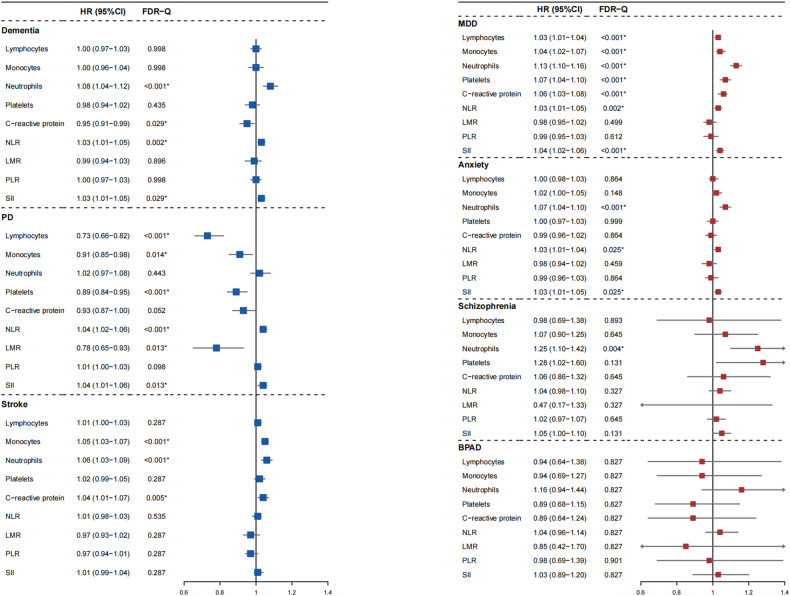
- Higher neutrophils were associated with increased risk of dementia (HR 1.08, 95% CI 1.04–1.12), stroke (HR 1.06, 95% CI 1.03–1.09), MDD (HR 1.13, 95% CI 1.10–1.16), and anxiety (HR 1.07, 95% CI 1.04–1.10). NLR and SII showed similar associations with dementia, PD, MDD, and anxiety.
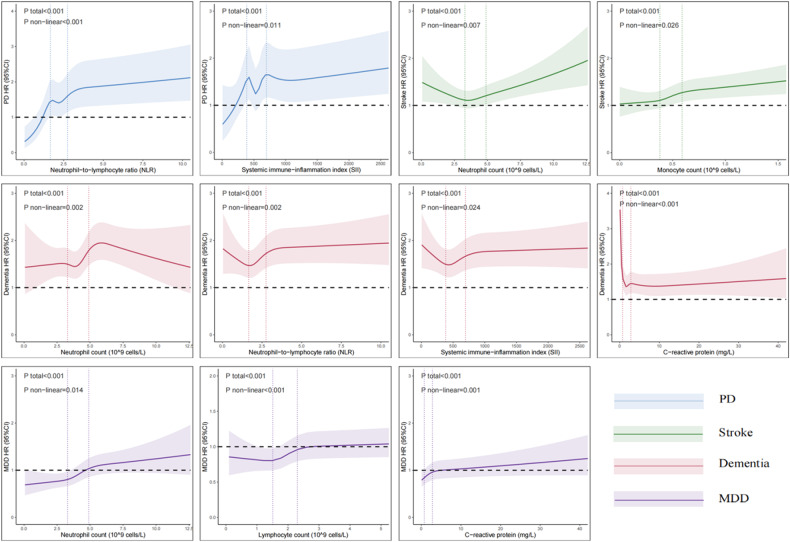
- CRP was associated with dementia (HR 0.95, 95% CI 0.91–0.99), stroke (HR 1.04, 95% CI 1.01–1.07), and MDD (HR 1.06, 95% CI 1.03–1.08), with significant non-linear relationships for dementia and MDD.
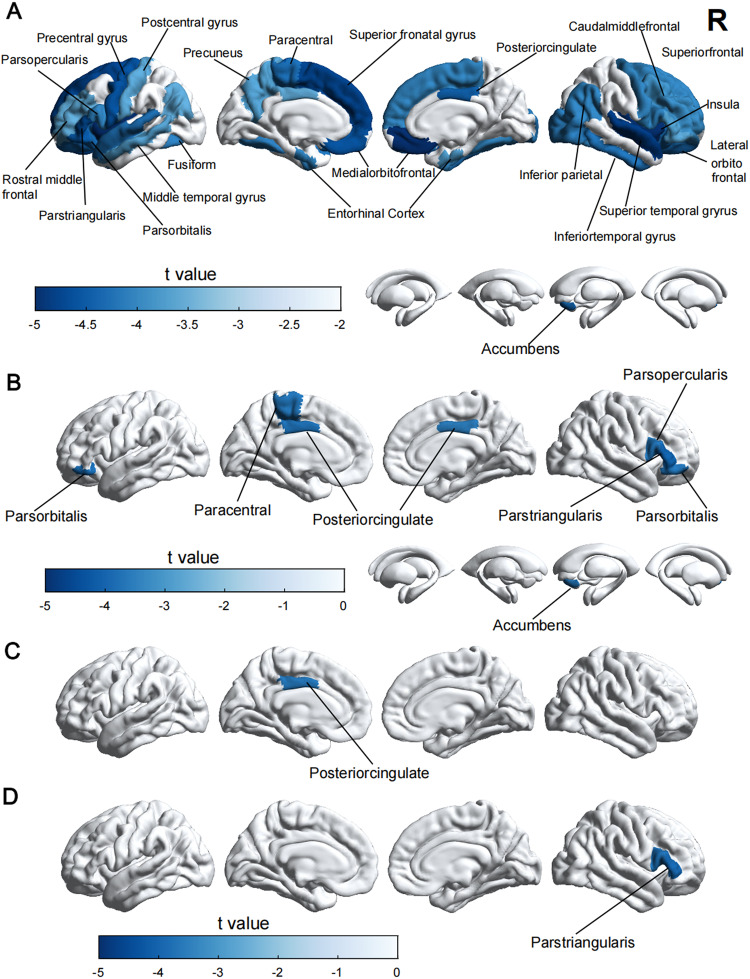
- Subgroup analyses suggested age-specific and sex-specific associations: dementia associations were more pronounced in males and older participants, while MDD associations were significant only in participants aged 55–65. Neuroimaging analyses linked innate immunity markers to cortical, subcortical, and white matter tract alterations.
Methods
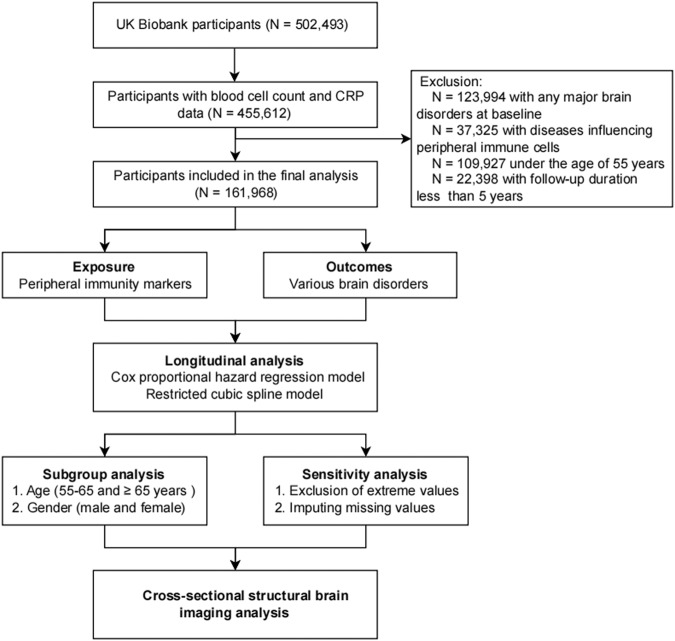
- Prospective cohort study using UK Biobank data; after exclusions, 161,968 participants were included in the primary analysis.
- Nine peripheral immunity markers were examined: differential leukocyte counts, derived ratios (NLR, PLR, SII, LMR), and CRP; outcomes were seven incident brain disorders ascertained from ICD-10 codes.
- Cox proportional hazard models and restricted cubic spline models assessed linear and non-linear associations, with adjustment for age, sex, ethnicity, education, SBP, and DBP; linear regression models examined associations with brain imaging phenotypes in 40,068 participants.
Limitations
- The paper states that the UK Biobank sample was restricted to middle-aged and European ancestry participants, limiting generalizability; residual confounding may remain; the observational design cannot establish causality; and peripheral immunity markers and covariates were assessed only at baseline.
- Evident from the text: incident schizophrenia (51 cases) and BPAD (63 cases) were very rare, so the null findings for these disorders may reflect limited statistical power.
- Evident from the text: the paper notes contradictory Cox and RCS results for CRP and dementia, which it attributes to complex non-linear relationships not captured by linear models.
Model-written summary. Check it against the paper before relying on it.
Integrity signals
Registry
Cites
Statistics
Figures
Verification
Claims the paper makes
2 Valid · 1 Not valid · 3 Not checked · 73 Own results and interpretations
At least one cited source doesn’t support this claim or points to a different paper, and none confirmed it — see the verdicts below.
In the paper
“Notably, this association was observed specifically in younger individuals, which may arise from variations in the inflammatory processes implicated in depression between younger adults and older adults [86,87].”
§ Peripheral immunity and risk of incident brain disorders: a prospective cohort study of 161,968 participants > DISCUSSION
What the sources say
- Disputedcites [86] Copeland WE, Shanahan L, Worthman C, Angold A, Costello EJ. Cumulative depression episodes predict later C-reactive protein levels: a prospective analysis. Biol Psychiat. 2012;71:15-21. sourceExperimental — accuracy not yet measured
Copeland et al. (2012) report the opposite of an inflammation-to-depression association specific to younger individuals: the Discussion states 'This study did not support the pathway from CRP to later depression early in the lifespan' and 'this pathway may not be prominent early in life,' noting instead that this pathway received support in the middle-age/older-adult Whitehall II and SWAN samples (Introduction). Nor do they attribute age differences to variations in the underlying inflammatory processes; the same Discussion passage argues that 'a longitudinal pathway identified in studies of older adults already was detectable in this largely pre-adult sample, suggesting the depression-CRP association holds across the lifespan,' while the Introduction credits heterogeneous findings to questionnaire versus structured-interview assessment and to the unmeasured cumulative 'dose' of depression in older samples. (LLM, conf=0.80)
Checked by a reasoning model — may be wrong.
- Not checked yetcites [87] Duivis HE, Kupper N, Vermunt JK, Penninx BW, Bosch NM, Riese H, et al. Depression trajectories, inflammation, and lifestyle factors in adolescence: the TRacking Adolescents' Individual Lives Survey. Health Psychol. 2015;34:1047-57. source
hedgedstates a possible cause- Asserted: passes — The authors put it forward as true.
- Checkable: passes — It can be checked against evidence.
- Load-bearing: passes — The paper’s conclusions depend on it.
- Based: passes — The paper gives a reason why it holds.
- Disputed
The sources with a verdict support this claim; the rest weren’t checked yet, have no full text we could read, or their verdicts aren’t rated yet.
In the paper
“our results showed consistency with two studies that reduced lymphocyte count was associated with an elevated risk of developing PD [16,73].”
§ Peripheral immunity and risk of incident brain disorders: a prospective cohort study of 161,968 participants > DISCUSSION
What the sources say
- Not checked yetcites [16] Jensen MP, Jacobs BM, Dobson R, Bandres-Ciga S, Blauwendraat C, Schrag A, et al. Lower lymphocyte count is associated with increased risk of Parkinson's disease. Ann Neurol. 2021;89:803-12. source
- Supportedcites [73] Yazdani S, Mariosa D, Hammar N, Andersson J, Ingre C, Walldius G, et al. Per- ipheral immune biomarkers and neurodegenerative diseases: a prospective cohort study with 20 years of follow-up. Ann Neurol. 2019;86:913-26. source
The Results report a clear inverse association between lymphocyte concentration and the risk of Parkinson’s disease. The Discussion likewise describes a lower risk of PD with higher lymphocyte concentration. (LLM, conf=0.92)
plainstates an association- Asserted: passes — The authors put it forward as true.
- Checkable: passes — It can be checked against evidence.
- Load-bearing: unclear — It is unclear whether the paper’s conclusions depend on it.
- Based: passes — The paper gives a reason why it holds.
A result the paper reports from its own data — it cites no other source for it, so there is none to check. The quote shows it is in the paper.
In the paper
“higher neutrophils, the main element of innate immunity, were significantly associated with increased risk of incident dementia (HR 1.08, 95% CI: 1.04-1.12,p < 0.001)”
§ Peripheral immunity and risk of incident brain disorders: a prospective cohort study of 161,968 participants > Peripheral immunity markers and risk of brain disorders
plainstates an association- Asserted: passes — The authors put it forward as true.
- Checkable: passes — It can be checked against evidence.
- Load-bearing: passes — The paper’s conclusions depend on it.
- Based: passes — The paper gives a reason why it holds.
A result the paper reports from its own data — it cites no other source for it, so there is none to check. The quote shows it is in the paper.
In the paper
“they were associated with an increased risk of dementia (HR 1.03, 95% CI: 1.01-1.05,p = 0.002 and HR 1.03, 95% CI: 1.01-1.05,p = 0.029, respectively)”
§ Peripheral immunity and risk of incident brain disorders: a prospective cohort study of 161,968 participants > Peripheral immunity markers and risk of brain disorders
plainstates an association- Asserted: passes — The authors put it forward as true.
- Checkable: passes — It can be checked against evidence.
- Load-bearing: passes — The paper’s conclusions depend on it.
- Based: passes — The paper gives a reason why it holds.
A result the paper reports from its own data — it cites no other source for it, so there is none to check. The quote shows it is in the paper.
In the paper
“PD (HR 1.04, 95% CI: 1.02-1.06,p < 0.001 and HR 1.04, 95% CI: 1.01-1.06,p = 0.013, respectively)”
§ Peripheral immunity and risk of incident brain disorders: a prospective cohort study of 161,968 participants > Peripheral immunity markers and risk of brain disorders
plainstates an association- Asserted: passes — The authors put it forward as true.
- Checkable: passes — It can be checked against evidence.
- Load-bearing: passes — The paper’s conclusions depend on it.
- Based: passes — The paper gives a reason why it holds.
48 more claims
Create a free account to see all 79 claims and to verify the 8 references still open.
- Probably not a substantial claim. 12
- It may state two separate claims as one. 16
- The quote only partly states this claim. 1
Citations
Cites
Sudlow, C., Gallacher, J., Allen, N., Beral, V., Burton, P., Danesh, J., Downey, P., Elliott, P., Green, J., Landray, M., et al. (2015) · PLOS Medicine · doi:10.1371/journal.pmed.1001779 · Cited by 12,728 · cited 2×
“The database is linked to national health datasets, including primary care, hospital inpatient, death, and cancer registration data [33].”
MethodSex differences in immune responses
Klein, S. L., & Flanagan, K. L. (2016) · Nature Reviews Immunology · doi:10.1038/nri.2016.90 · Cited by 6,370
(2010) · The Lancet · doi:10.1016/s0140-6736(09)61717-7 · Cited by 2,546 · cited 1×
“More research is needed to further elucidate the speci fi c neuroin fl ammatory mechanisms that give rise to speci fi c disorders.”
BackgroundDirect Proinflammatory Effect of C-Reactive Protein on Human Endothelial Cells
Pasceri, V., Willerson, J. T., & Yeh, E. T. H. (2000) · Circulation · doi:10.1161/01.cir.102.18.2165 · Cited by 1,940
Image processing and Quality Control for the first 10,000 brain imaging datasets from UK Biobank
Alfaro-Almagro, F., Jenkinson, M., Bangerter, N. K., Andersson, J. L. R., Griffanti, L., Douaud, G., Sotiropoulos, S. N., Jbabdi, S., Hernandez-Fernandez, M., Vallee, E., et al. (2018) · NeuroImage · doi:10.1016/j.neuroimage.2017.10.034 · Cited by 1,557
Innate immune activation in neurodegenerative disease
Heneka, M. T., Kummer, M. P., & Latz, E. (2014) · Nature Reviews Immunology · doi:10.1038/nri3705 · Cited by 1,437 · cited 1×
“The components of the innate immune response mainly include monocytes, macrophages, neutrophils, dendritic cells, mast cells, and natural killer cells [6, 7].”
BackgroundThe blood-brain barrier in systemic inflammation
Varatharaj, A., & Galea, I. (2017) · Brain, Behavior, and Immunity · doi:10.1016/j.bbi.2016.03.010 · Cited by 1,172
Neutrophils promote Alzheimer's disease–like pathology and cognitive decline via LFA-1 integrin
Zenaro, E., Pietronigro, E., Bianca, V. D., Piacentino, G., Marongiu, L., Budui, S., Turano, E., Rossi, B., Angiari, S., Dusi, S., et al. (2015) · Nature Medicine · doi:10.1038/nm.3913 · Cited by 865 · cited 1×
“More research is needed to further elucidate the speci fi c neuroin fl ammatory mechanisms that give rise to speci fi c disorders.”
BackgroundEarly inflammation and dementia: A 25‐year follow‐up of the Honolulu‐Asia aging study
Schmidt, R., Schmidt, H., Curb, J. D., Masaki, K., White, L. R., & Launer, L. J. (2002) · Annals of Neurology · doi:10.1002/ana.10265 · Cited by 710
Neutrophils as regulators of cardiovascular inflammation
Silvestre-Roig, C., Braster, Q., Ortega-Gomez, A., & Soehnlein, O. (2020) · Nature Reviews Cardiology · doi:10.1038/s41569-019-0326-7 · Cited by 605
Role of the innate and adaptive immune responses in the course of multiple sclerosis
Hemmer, B., Kerschensteiner, M., & Korn, T. (2015) · The Lancet Neurology · doi:10.1016/s1474-4422(14)70305-9 · Cited by 584
Torzewski, J., Torzewski, M., Bowyer, D. E., Fröhlich, M., Koenig, W., Waltenberger, J., Fitzsimmons, C., & Hombach, V. (1998) · Arteriosclerosis, Thrombosis, and Vascular Biology · doi:10.1161/01.atv.18.9.1386 · Cited by 561
Elevated C-reactive protein in the diagnosis, prognosis, and cause of cancer
Allin, K. H., & Nordestgaard, B. G. (2011) · Critical Reviews in Clinical Laboratory Sciences · doi:10.3109/10408363.2011.599831 · Cited by 553
Blood-brain barrier transport of cytokines: a mechanism for neuropathology
Banks, W. (2005) · Current Pharmaceutical Design · doi:10.2174/1381612053381684 · Cited by 534
Bennett, J. M., Reeves, G., Billman, G. E., & Sturmberg, J. P. (2018) · Frontiers in Medicine · doi:10.3389/fmed.2018.00316 · Cited by 531
Systemic inflammation markers and cancer incidence in the UK Biobank
Nøst, T. H., Alcala, K., Urbarova, I., Byrne, K. S., Guida, F., Sandanger, T. M., & Johansson, M. (2021) · European Journal of Epidemiology · doi:10.1007/s10654-021-00752-6 · Cited by 526
The Microbiota–Gut–Brain Axis in Psychiatric Disorders
Góralczyk-Bińkowska, A., Szmajda-Krygier, D., & Kozłowska, E. (2022) · International Journal of Molecular Sciences · doi:10.3390/ijms231911245 · Cited by 495
Immunoneuropsychiatry — novel perspectives on brain disorders
Pape, K., Tamouza, R., Leboyer, M., & Zipp, F. (2019) · Nature Reviews Neurology · doi:10.1038/s41582-019-0174-4 · Cited by 458
Furman, D., Chang, J., Lartigue, L., Bolen, C. R., Haddad, F., Gaudilliere, B., Ganio, E. A., Fragiadakis, G. K., Spitzer, M. H., Douchet, I., et al. (2017) · Nature Medicine · doi:10.1038/nm.4267 · Cited by 389 · cited 1×
“The immune system has a critical role in brain homeostasis, resilience and brain reserve, and the interaction between the immune system and brain is garnering growing interest across a broad range of neurological and psychiatric disorders [3 – 5].”
BackgroundFukui, H. (2016) · Inflammatory Intestinal Diseases · doi:10.1159/000447252 · Cited by 355
The Role of Peripheral Inflammatory Markers in Dementia and Alzheimer's Disease: A Meta-Analysis
Koyama, A., O'Brien, J., Weuve, J., Blacker, D., Metti, A. L., & Yaffe, K. (2013) · The Journals of Gerontology Series A: Biological Sciences and Medical Sciences · doi:10.1093/gerona/gls187 · Cited by 322
Peripheral Inflammatory Biomarkers and Risk of Parkinson's Disease
Chen, H., O'Reilly, E. J., Schwarzschild, M. A., & Ascherio, A. (2007) · American Journal of Epidemiology · doi:10.1093/aje/kwm260 · Cited by 317
Cumulative Depression Episodes Predict Later C-Reactive Protein Levels: A Prospective Analysis
Copeland, W. E., Shanahan, L., Worthman, C., Angold, A., & Costello, E. J. (2012) · Biological Psychiatry · doi:10.1016/j.biopsych.2011.09.023 · Cited by 265 · cited 1×
“More research is needed to further elucidate the speci fi c neuroin fl ammatory mechanisms that give rise to speci fi c disorders.”
BackgroundDepression and inflammation among children and adolescents: A meta-analysis
Colasanto, M., Madigan, S., & Korczak, D. J. (2020) · Journal of Affective Disorders · doi:10.1016/j.jad.2020.09.025 · Cited by 265
CLELAND, S. J., SATTAR, N., PETRIE, J. R., FOROUHI, N. G., ELLIOTT, H. L., & CONNELL, J. M. C. (2000) · Clinical Science · doi:10.1042/cs0980531 · Cited by 249
Fernandes, B. S., Steiner, J., Molendijk, M. L., Dodd, S., Nardin, P., Gonçalves, C.-A., Jacka, F., Köhler, C. A., Karmakar, C., Carvalho, A. F., et al. (2016) · The Lancet Psychiatry · doi:10.1016/s2215-0366(16)30370-4 · Cited by 247 · cited 1×
“More research is needed to further elucidate the speci fi c neuroin fl ammatory mechanisms that give rise to speci fi c disorders.”
BackgroundThe Evaluation of Neutrophil-Lymphocyte Ratio in Alzheimers Disease
Kuyumcu, M. E., Yesil, Y., Oztürk, Z. A., Kizilarslanoglu, C., Etgül, S., Halil, M., Ulger, Z., Cankurtaran, M., & Ariogul, S. (2012) · Dementia and Geriatric Cognitive Disorders · doi:10.1159/000341583 · Cited by 245
Inflammatory markers and the risk of dementia and Alzheimer's disease: a meta-analysis
Darweesh, S. K. L., Wolters, F. J., Ikram, M. A., de Wolf, F., Bos, D., & Hofman, A. (2018) · Alzheimer's & Dementia · doi:10.1016/j.jalz.2018.02.014 · Cited by 244
Fibrinogen is associated with an increased risk of Alzheimer disease and vascular dementia
van Oijen, M., Witteman, J. C., Hofman, A., Koudstaal, P. J., & Breteler, M. M. B. (2005) · Stroke · doi:10.1161/01.str.0000189721.31432.26 · Cited by 222
White, W. B., & Anwar, Y. A. (2001) · Blood Pressure Monitoring · doi:10.1097/00126097-200104000-00007 · Cited by 213
Rosenblat, J. D., Kakar, R., Berk, M., Kessing, L. V., Vinberg, M., Baune, B. T., Mansur, R. B., Brietzke, E., Goldstein, B. I., & McIntyre, R. S. (2016) · Bipolar Disorders · doi:10.1111/bdi.12373 · Cited by 199
Blood inflammatory markers and risk of dementia: The Conselice Study of Brain Aging
Ravaglia, G., Forti, P., Maioli, F., Chiappelli, M., Montesi, F., Tumini, E., Mariani, E., Licastro, F., & Patterson, C. (2007) · Neurobiology of Aging · doi:10.1016/j.neurobiolaging.2006.08.012 · Cited by 198
The gut vascular barrier: a new player in the gut–liver–brain axis
Brescia, P., & Rescigno, M. (2021) · Trends in Molecular Medicine · doi:10.1016/j.molmed.2021.06.007 · Cited by 175
Microglia in neuronal plasticity: Influence of stress
Delpech, J.-C., Madore, C., Nadjar, A., Joffre, C., Wohleb, E. S., & Layé, S. (2015) · Neuropharmacology · doi:10.1016/j.neuropharm.2014.12.034 · Cited by 174
Husain, M. I., Chaudhry, I. B., Khoso, A. B., Husain, M. O., Hodsoll, J., Ansari, M. A., Naqvi, H. A., Minhas, F. A., Carvalho, A. F., Meyer, J. H., et al. (2020) · The Lancet Psychiatry · doi:10.1016/s2215-0366(20)30138-3 · Cited by 167
Möller, M., Du Preez, J. L., Viljoen, F. P., Berk, M., Emsley, R., & Harvey, B. H. (2013) · Brain, Behavior, and Immunity · doi:10.1016/j.bbi.2012.12.011 · Cited by 167
Cytokine production and lymphocyte transformation during stress
Dobbin, J. P., Harth, M., McCain, G. A., Martin, R. A., & Cousin, K. (1991) · Brain Behavior and Immunity · doi:10.1016/0889-1591(91)90029-a · Cited by 145
Lux, D., Alakbarzade, V., Bridge, L., Clark, C. N., Clarke, B. A., Zhang, L., Khan, U., & Pereira, A. C. (2020) · Journal of Neuroinflammation · doi:10.1186/s12974-020-01739-y · Cited by 143
Anti-inflammatory treatments for mood disorders: Systematic review and meta-analysis
Husain, M. I., Strawbridge, R., Stokes, P. R., & Young, A. H. (2017) · Journal of Psychopharmacology · doi:10.1177/0269881117725711 · Cited by 139
Wang, L., Song, Q., Wang, C., Wu, S., Deng, L., Li, Y., Zheng, L., & Liu, M. (2019) · Journal of the Neurological Sciences · doi:10.1016/j.jns.2019.116445 · Cited by 125 · cited 1×
“More research is needed to further elucidate the speci fi c neuroin fl ammatory mechanisms that give rise to speci fi c disorders.”
BackgroundSelf-citationRembach, A., Watt, A. D., Wilson, W. J., Rainey‐Smith, S. R., Ellis, K. A., Rowe, C. C., Villemagne, V. L., Macaulay, S. L., Bush, A. I., Martins, R. N., et al. (2014) · Journal of Neuroimmunology · doi:10.1016/j.jneuroim.2014.05.005 · Cited by 122
Peripheral immunity is associated with the risk of incident dementia
Zhang, Y.-R., Wang, J.-J., Chen, S.-F., Wang, H.-F., Li, Y.-Z., Ou, Y.-N., Huang, S.-Y., Chen, S.-D., Cheng, W., Feng, J.-F., et al. (2022) · Molecular Psychiatry · doi:10.1038/s41380-022-01446-5 · Cited by 114 · cited 2×
“More research is needed to further elucidate the speci fi c neuroin fl ammatory mechanisms that give rise to speci fi c disorders.”
BackgroundSelf-citationA Mendelian randomization study investigating the causal role of inflammation on Parkinson’s disease
Bottigliengo, D., Foco, L., Seibler, P., Klein, C., König, I. R., & Fabiola Del Greco, M. (2022) · Brain · doi:10.1093/brain/awac193 · Cited by 114
Immune system gene dysregulation in autism and schizophrenia
Michel, M., Schmidt, M. J., & Mirnics, K. (2012) · Developmental Neurobiology · doi:10.1002/dneu.22044 · Cited by 107 · cited 1×
“Emerging evidence has shown the association between peripheral immunity and risk of dementia [10 – 15], PD [16 – 22], stroke [23], as well as schizophrenia [24 – 27], BPAD [28 – 30], and MDD [31, 32].”
BackgroundHellmann-Regen, J., Clemens, V., Grözinger, M., Kornhuber, J., Reif, A., Prvulovic, D., Goya-Maldonado, R., Wiltfang, J., Gruber, O., Schüle, C., et al. (2022) · JAMA Network Open · doi:10.1001/jamanetworkopen.2022.30367 · Cited by 100
Campeau, A., Mills, R. H., Stevens, T. W., Rossitto, L.-A. M., Meehan, M. J., Dorrestein, P. C., Daly, R., Nguyen, T. T., Gonzalez, D. J., Jeste, D. V., et al. (2021) · Molecular Psychiatry · doi:10.1038/s41380-021-01339-z · Cited by 99
Kubera, M., Symbirtsev, A., Basta‐Kaim, A., Borycz, J. A., Roman, A., Papp, M., & Claësson, M. H. (1996) · PubMed · Cited by 99
Song, C., Kenis, G., Gastel, A. V., Bosmans, E., Lin, A., Jong, R. D., Neels, H. M., Scharpé, S., Janča, A., Yasukawa, K., et al. (1999) · Psychiatry Research · doi:10.1016/s0165-1781(99)00012-8 · Cited by 98
Elevated C‐reactive protein levels are associated with prevalent dementia in the oldest‐old
Kravitz, B. A., Corrada, M. M., & Kawas, C. H. (2009) · Alzheimer's & Dementia · doi:10.1016/j.jalz.2009.04.1230 · Cited by 98
Zhang, R., Wu, X., Hu, W., Zhao, L., Zhao, S., Zhang, J., Chu, Z., & Xu, Y. (2019) · Brain and Behavior · doi:10.1002/brb3.1382 · Cited by 98
van der Willik, K. D., Fani, L., Rizopoulos, D., Licher, S., Fest, J., Schagen, S. B., Ikram, M. K., & Ikram, M. A. (2019) · Journal of Neuroinflammation · doi:10.1186/s12974-019-1454-z · Cited by 96 · cited 1×
“More research is needed to further elucidate the speci fi c neuroin fl ammatory mechanisms that give rise to speci fi c disorders.”
BackgroundSundelöf, J., Kilander, L., Helmersson, J., Larsson, A., Rönnemaa, E., Degerman-Gunnarsson, M., Basun, H., Lannfelt, L., & Basu, S. (2009) · Journal of Alzheimer's Disease · doi:10.3233/jad-2009-1126 · Cited by 94
Lower Lymphocyte Count is Associated With Increased Risk of Parkinson's Disease
Jensen, M. P., Jacobs, B. M., Dobson, R., Bandres‐Ciga, S., Blauwendraat, C., Schrag, A., Noyce, A. J., & The International Parkinson's Disease Genomics Consortium (IPDGC) (2021) · Annals of Neurology · doi:10.1002/ana.26034 · Cited by 91 · cited 2×
“More research is needed to further elucidate the speci fi c neuroin fl ammatory mechanisms that give rise to speci fi c disorders.”
BackgroundHigh neutrophil-lymphocyte ratio in schizophrenia independent of infectious and metabolic parameters
Yüksel, R. N., Ertek, I. E., Dikmen, A. U., & Göka, E. (2018) · Nordic Journal of Psychiatry · doi:10.1080/08039488.2018.1458899 · Cited by 64
Haan, M. N., Aiello, A. E., West, N. A., & Jagust, W. J. (2007) · Neurobiology of Aging · doi:10.1016/j.neurobiolaging.2007.04.020 · Cited by 64
Altered peripheral profile of blood cells in Alzheimer disease: A hospital-based case-control study
Chen, S.-H., Bu, X.-L., Jin, W.-S., Shen, L.-L., Wang, J., Zhuang, Z.-Q., Zhang, T., Zeng, F., Yao, X.-Q., Zhou, H.-D., et al. (2017) · Medicine · doi:10.1097/md.0000000000006843 · Cited by 64
Kara, S. P., Altunan, B., & Unal, A. (2022) · Neurological Sciences · doi:10.1007/s10072-021-05507-5 · Cited by 63
Bartl, M., Dakna, M., Schade, S., Otte, B., Wicke, T., Lang, E., Starke, M., Ebentheuer, J., Weber, S. K., Toischer, K., et al. (2022) · Movement Disorders · doi:10.1002/mds.29257 · Cited by 59
Hegazy, S. H., Thomassen, J. Q., Rasmussen, I. J., Nordestgaard, B. G., Tybjærg‐Hansen, A., & Frikke‐Schmidt, R. (2022) · Alzheimer s & Dementia · doi:10.1002/alz.12568 · Cited by 59
Eriksson, U. K., Pedersen, N. L., Reynolds, C. A., Hong, M.-G., Prince, J. A., Gatz, M., Dickman, P. W., & Bennet, A. M. (2011) · Journal of Alzheimer's Disease · doi:10.3233/jad-2010-101671 · Cited by 58
Changes in leukocytes and CRP in different stages of major depression
Singh, D., Guest, P. C., Dobrowolny, H., Vasilevska, V., Meyer-Lotz, G., Bernstein, H., Borucki, K., Neyazi, A., Bogerts, B., Jacobs, R., et al. (2022) · Journal of Neuroinflammation · doi:10.1186/s12974-022-02429-7 · Cited by 57
Single-cell peripheral immunoprofiling of Alzheimer’s and Parkinson’s diseases
Phongpreecha, T., Fernandez, R., Mrdjen, D., Culos, A., Gajera, C. R., Wawro, A. M., Stanley, N., Gaudilliere, B., Poston, K. L., Aghaeepour, N., et al. (2020) · Science Advances · doi:10.1126/sciadv.abd5575 · Cited by 55
Trovão, N., Prata, J., VonDoellinger, O., Santos, S., Barbosa, M., & Coelho, R. (2019) · Psychiatry Investigation · doi:10.30773/pi.2018.12.19.1 · Cited by 52
Kalelioğlu, T., Yürüyen, M., Gültekin, G., Yavuzer, H., Öztürk, Y., Kurt, M., Topçu, Y., Döventaş, A., & Emül, M. (2017) · Psychogeriatrics · doi:10.1111/psyg.12260 · Cited by 50
Ramos-Cejudo, J., Johnson, A. D., Beiser, A., Seshadri, S., Salinas, J., Berger, J. S., Fillmore, N. R., Do, N., Zheng, C., Kovbasyuk, Z., et al. (2021) · Frontiers in Aging Neuroscience · doi:10.3389/fnagi.2021.773984 · Cited by 49 · cited 1×
“More research is needed to further elucidate the speci fi c neuroin fl ammatory mechanisms that give rise to speci fi c disorders.”
BackgroundIncreased inflammation predicts nine-year change in major depressive disorder diagnostic status.
Zainal, N. H., & Newman, M. G. (2021) · Journal of Abnormal Psychology · doi:10.1037/abn0000716 · Cited by 49
Interleukin‐6, interleukin‐6 receptor gene variant, small‐vessel disease and incident dementia
Miwa, K., Okazaki, S., Sakaguchi, M., Mochizuki, H., & Kitagawa, K. (2016) · European Journal of Neurology · doi:10.1111/ene.12921 · Cited by 44
C-Reactive Protein Predicts Incidence of Dementia in an Elderly Asian Community Cohort
Hsu, P., Pan, W., Yip, B., Chen, R. C.-Y., Cheng, H., & Chuang, S. (2017) · Journal of the American Medical Directors Association · doi:10.1016/j.jamda.2016.12.006 · Cited by 43
Wainberg, M., Kloiber, S. M., Diniz, B. S., McIntyre, R. S., Felsky, D., & Tripathy, S. J. (2021) · Translational Psychiatry · doi:10.1038/s41398-021-01505-5 · Cited by 43
Yazdani, S., Mariosa, D., Hammar, N., Andersson, J., Ingre, C., Walldius, G., & Fang, F. (2019) · Annals of Neurology · doi:10.1002/ana.25614 · Cited by 42 · cited 1×
“More research is needed to further elucidate the speci fi c neuroin fl ammatory mechanisms that give rise to speci fi c disorders.”
BackgroundDuivis, H. E., Kupper, N., Vermunt, J. K., Penninx, B. W., Bosch, N. M., Riese, H., Oldehinkel, A. J., & de Jonge, P. (2015) · Health Psychology · doi:10.1037/hea0000210 · Cited by 40 · cited 1×
“More research is needed to further elucidate the speci fi c neuroin fl ammatory mechanisms that give rise to speci fi c disorders.”
BackgroundLewis, N. A., & Knight, J. E. (2021) · Age and Ageing · doi:10.1093/ageing/afab152 · Cited by 39
The relationship between inflammatory state and quantity of affective episodes in bipolar disorder
Queissner, R., Pilz, R., Dalkner, N., Birner, A., Bengesser, S. A., Platzer, M., Fellendorf, F. T., Kainzbauer, N., Herzog-Eberhard, S., Hamm, C., et al. (2018) · Psychoneuroendocrinology · doi:10.1016/j.psyneuen.2018.01.024 · Cited by 35 · cited 1×
“Emerging evidence has shown the association between peripheral immunity and risk of dementia [10 – 15], PD [16 – 22], stroke [23], as well as schizophrenia [24 – 27], BPAD [28 – 30], and MDD [31, 32].”
BackgroundSystemic inflammation as a moderator between sleep and incident dementia
Baril, A., Beiser, A., Redline, S. S., McGrath, E. R., Aparicio, H. J., Gottlieb, D. J., Seshadri, S. S., Pase, M. P., & Himali, J. J. (2020) · SLEEP · doi:10.1093/sleep/zsaa164 · Cited by 34
Evidence for immune system alterations in peripheral biological fluids in Parkinson’s disease
Bartl, M., Xylaki, M., Bähr, M., Weber, S., Trenkwalder, C., & Mollenhauer, B. (2022) · Neurobiology of Disease · doi:10.1016/j.nbd.2022.105744 · Cited by 33
C-reactive protein and response to lurasidone in patients with bipolar depression
Raison, C. L., Pikalov, A., SIU, C. O., Tsai, J., Koblan, K. S., & Loebel, A. D. (2018) · Brain Behavior and Immunity · doi:10.1016/j.bbi.2018.08.009 · Cited by 33
A comparison of inflammatory markers in manic and euthymic states of bipolar disorder
Özdin, S., & Usta, M. B. (2021) · Nordic Journal of Psychiatry · doi:10.1080/08039488.2020.1807048 · Cited by 30
Longitudinal Associations Between Serum Cytokine Levels and Dementia
Kim, J.-W., Stewart, R., Kang, H.-J., Bae, K.-Y., Kim, S.-W., Shin, I.-S., Yoon, J.-S., & Kim, J.-M. (2018) · Frontiers in Psychiatry · doi:10.3389/fpsyt.2018.00606 · Cited by 29
Dommershuijsen, L. J., Ruiter, R., Erler, N. S., Rizopoulos, D., Ikram, M. A., & Ikram, M. K. (2021) · Journal of Parkinson s Disease · doi:10.3233/jpd-212914 · Cited by 29
Systemic inflammation is associated with incident stroke and heart disease in East Asians
Karim, M. A., Kartsonaki, C., Bennett, D., Millwood, I. Y., Hill, M., Avery, D., Bian, Z., Du, H., Guo, Y., Qian, Y., et al. (2020) · Scientific Reports · doi:10.1038/s41598-020-62391-3 · Cited by 28
Self-citationAssociations of number and severity of depressive episodes with C-reactive protein and Interleukin-6
Jeenger, J., Sharma, M. S., Mathur, D. M., & Amandeep, A. (2017) · Asian Journal of Psychiatry · doi:10.1016/j.ajp.2017.02.016 · Cited by 28
Kong, Y., He, G., Zhang, X., & Li, J. (2021) · Brain Sciences · doi:10.3390/brainsci11111514 · Cited by 25
Self-citationStrawbridge, R., Carter, R., Saldarini, F., Tsapekos, D., & Young, A. H. (2021) · BJPsych Open · doi:10.1192/bjo.2021.966 · Cited by 24
Sanchez-Autet, M., Arranz, B., Sierra, P., Safont, G., Garcia-Blanco, A., de la Fuente, L., Garriga, M., Marín, L., & García-Portilla, M. P. (2022) · The World Journal of Biological Psychiatry · doi:10.1080/15622975.2021.2013089 · Cited by 15
Zhou, J., Zhou, J. L., Sun, Z., Feng, L., Feng, Y., Xiao, L., Chen, X., & Yang, J. (2022) · Journal of Affective Disorders · doi:10.1016/j.jad.2022.02.069 · Cited by 14
Alchalabi, T., & Prather, C. P. (2021) · Clinics in Geriatric Medicine · doi:10.1016/j.cger.2021.05.006 · Cited by 13
Immunological Processes in Schizophrenia Pathology: Potential Biomarkers?
Notter, T. (2018) · Current topics in behavioral neurosciences · doi:10.1007/7854_2018_43 · Cited by 12
Inflammatory Proteins in Plasma and the Risk of Dementia: The Rotterdam Study
Engelhart, M. J., Geerlings, M. I., Meijer, J., Kiliaan, A., Ruitenberg, A., van Swieten, J. C., Stijnen, T., Hofman, A., Witteman, J. C. M., & Breteler, M. M. B. (2004) · Archives of Neurology · doi:10.1001/archneur.61.5.668 · Cited by 10
Tejera, C. H., Ware, E. B., Hicken, M. T., Kobayashi, L. C., Wang, H., Adkins‐Jackson, P. B., Blostein, F., Zawistowski, M., Mukherjee, B., & Bakulski, K. M. (2023) · medRxiv · doi:10.1101/2023.03.22.23287593 · Cited by 2
Cited by
Neuroimmune, metabolic and oxidative stress pathways in major depressive disorder
Maes, M. H. J., Almulla, A. F., You, Z., & Zhang, Y. (2025) · Nature Reviews Neurology · doi:10.1038/s41582-025-01116-4 · Cited by 159
Self-citationJiao, W., Lin, J., Deng, Y., Ji, Y., Liang, C., Wei, S., Xi, J., & Yan, F. (2025) · Journal of Neuroinflammation · doi:10.1186/s12974-024-03312-3 · Cited by 144
Qin, P., Ho, F. K. W., Celis-Morales, C. A., & Pell, J. P. (2025) · Cardiovascular Diabetology · doi:10.1186/s12933-025-02721-9 · Cited by 94
Fluid-based biomarkers for neurodegenerative diseases
Cao, Y., Xu, Y., Cao, M., Chen, N., Zeng, Q., Lai, M. K. P., Fan, D., Sethi, G., & Cao, Y. (2025) · Ageing Research Reviews · doi:10.1016/j.arr.2025.102739 · Cited by 69
Zhao, H., Tao, L., Tang, C. W., Cai, W., & Shen, W. (2025) · Journal of Translational Medicine · doi:10.1186/s12967-025-07176-w · Cited by 26
Metadata
- Authors
- Zhong, X., Qiang, Y., Wang, L., Zhang, Y., Li, J., Feng, J., Cheng, W., Tan, L., & Yu, J.
- Affiliations
- Qingdao University (CN)
- Affiliated Hospital of Qingdao University (CN)
- Fudan University (CN)
- Corresponding author
- Tan, Lan
- Venue
- Translational Psychiatry
- Published
- 2023-12-09
- Volume
- 13
- Issue
- 1
- Pages
- 382-382
- ISSN
- 2158-3188 (ISSN-L)
- PMC
- PMC10710500
- OpenAlex
- W4389507022
- Cited by
- 55
- References
- 89
- Citations by year
- 2026: 16 · 2025: 23 · 2024: 16
- FWCI
- 6.71
- Type
- journal article
- Language
- en
- Open access
- gold
- doi.org
- Licence
- cc-by
- creativecommons.org/licenses/by/4.0 (tdm)
- creativecommons.org/licenses/by/4.0 (vor)
- Locations
- Translational Psychiatry (publishedVersion, cc-by)
- PubMed Central (publishedVersion, cc-by)
- PubMed (publishedVersion)
- DOAJ (DOAJ: Directory of Open Access Journals) (submittedVersion, cc-by-sa)
- Funders
- National Natural Science Foundation of China (82071997, 81971032)
- Topics
- Health Sciences › Medicine › Oncology › Inflammatory Biomarkers in Disease Prognosis
- Life Sciences › Neuroscience › Biological Psychiatry › Tryptophan and brain disorders
- Life Sciences › Neuroscience › Neurology › Neuroinflammation and Neurodegeneration Mechanisms
- Keywords
- peripheral immunity, neuroinflammation, brain disorders, dementia, Parkinson's disease, stroke, schizophrenia, bipolar disorder, major depressive disorder, anxiety, neutrophils, monocytes, platelets, neutrophil-to-lymphocyte ratio, systemic immune-inflammation index, C-reactive protein, white matter tracts
- MeSH terms
- Brain, Dementia, Depressive Disorder, Major, Major Depressive Disorder, Female, Humans, Male, Prospective Studies, Biomarkers, Stroke
About these checks
Registry, retraction, Cites and statistics results are computed, not judged, with one exception: a printed reference that no index lists is read once by a model before it counts as a citation error. Claims are extracted by a model and kept only when their quote appears verbatim in the text; each cited source is then checked, with a model’s help, for whether it says what the claim relies on. Those verdicts can be wrong — read the claim’s quote and the cited source before relying on one.
The claim verdicts this report counts are experimental: their accuracy is not yet measured.
A language model drew the claims from the paper on 2026-10-05, under version 3 of the claim definition (model deepseek-v4.1-flash, prompt extract-v3).
A second model labelled each claim on 2026-10-05 (model jev-1.13-20260917, definition revision gold-guideline-v0.2).
Cited sources are checked with a language model’s help (qwen3.8-omni-flash and gpt-6-sol).
Statistics and arithmetic are recomputed, not judged.
Confidence bands are shown only for fields calibrated on our annotated test set. None is calibrated yet, so no band is shown.
What counts as a claim ›How we measure confidence ›How we check this ›
Are you an author, or do you see a problem with this page? Request a review
Data sources
Bibliographic data: Semantic Scholar, OpenAlex, Crossref.
Contains information from the Semantic Scholar Academic Graph Datasets, made available under the ODC Attribution License (ODC-BY 1.0).
Semantic Scholar’s data is described in: Kinney, R., et al. (2023). The Semantic Scholar Open Data Platform. arXiv:2301.10140.
