

Neuroinflammation and depression: immune-brain interface mechanisms, biomarker stratification, and therapeutic strategies
Open accessThe DOI matches its Crossref record; 68 of the 69 references it cites were found in a registry or an index; 3 of the 114 sources its claims cite were checked for support.
Abstract
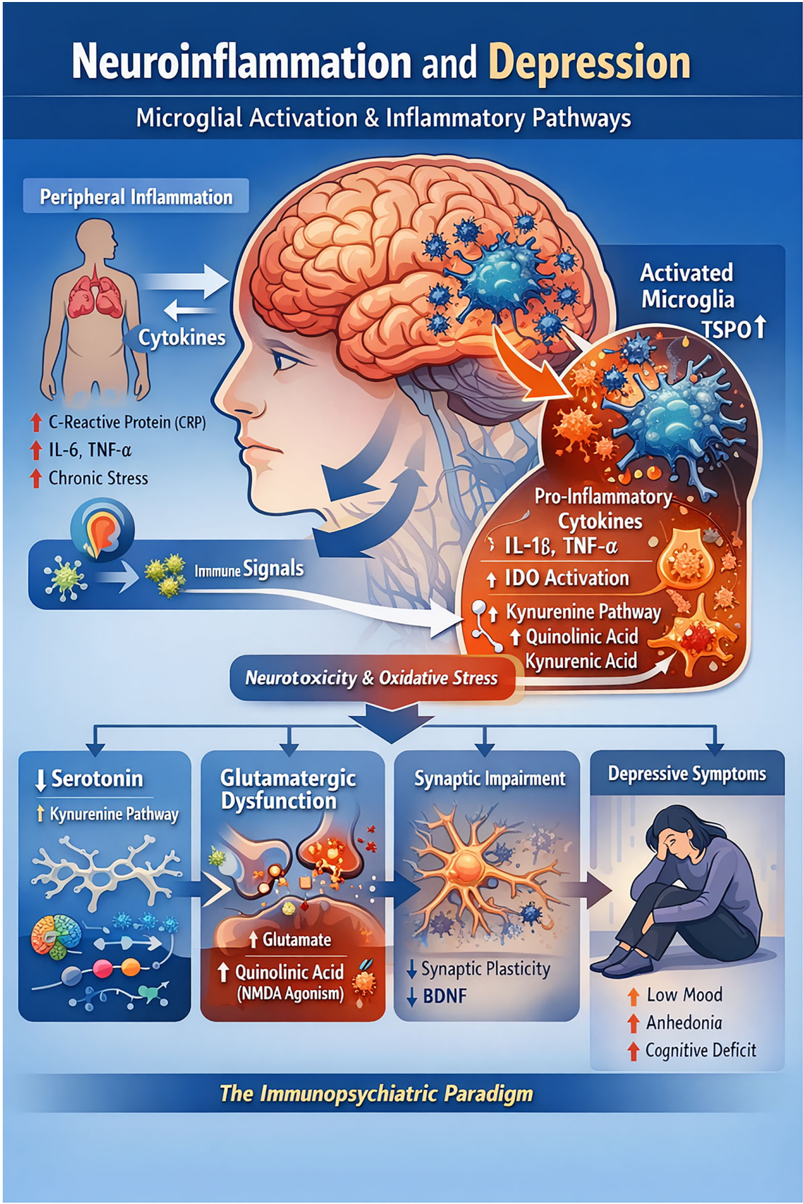
Major depressive disorder is among the most prevalent and disabling conditions in global medicine, yet its biological underpinnings remain incompletely understood, and current pharmacological treatments fail to produce adequate responses in approximately one-third of patients. A rapidly accumulating body of evidence has not simply challenged the long-dominant monoamine deficiency hypothesis but has provided a mechanistic framework that may explain many of the observed monoaminergic alterations in depressive cohorts, including IDO1-driven serotonin depletion, cytokine-mediated AMPA receptor internalization, and HPA-immune feedback dysregulation. Neuroinflammation, particularly glial activation across microglial, astrocytic, and oligodendrocyte lineages, and its downstream consequences for tryptophan metabolism, glutamatergic transmission, synaptic plasticity, and neurotrophic signaling, represents a central pathophysiological mechanism in a substantial subgroup of depressed patients. Peripheral inflammatory markers, including C-reactive protein, interleukin-6, and tumor necrosis factor-alpha, are elevated in a significant proportion of individuals with major depressive disorder, and these elevations predict poor response to conventional antidepressants while identifying patients who may respond preferentially to anti-inflammatory strategies. Post-mortem studies, positron emission tomography imaging of translocator protein density, and transcriptomic analyses of brain tissue have collectively provided consistent, though not yet fully definitive, evidence that microglial activation is a neurobiological feature of depression rather than a consequence of comorbid physical illness. This review synthesizes current mechanistic understanding of the neuroinflammatory hypothesis of depression, examines the evidence base from epidemiological, biomarker, neuroimaging, and interventional studies, including null findings and methodological limitations, evaluates emerging therapeutic strategies targeting the immune-brain interface, and identifies the critical questions that will determine whether immunopsychiatry fulfills its promise as a precision medicine framework for treatment-resistant depression.
Overview
CoChat Summary
TL;DR
This narrative review synthesizes mechanistic, epidemiological, neuroimaging, and trial evidence for the neuroinflammatory hypothesis of depression, arguing that inflammation provides an upstream explanation for many monoaminergic and glutamatergic alterations rather than replacing the monoamine model. It concludes that anti-inflammatory therapies appear effective only in biomarker-enriched subgroups (roughly 25–40% of clinical samples at CRP > 3 mg/L) and that biological subtyping is now the central clinical imperative.
Key findings
- Peripheral inflammatory markers (CRP, IL-6, TNF-α, IL-1β) are consistently elevated in MDD versus controls with small-to-medium effect sizes; prospective cohorts show elevated IL-6 in midlife predicting depression over the following decade (Whitehall II) and elevated CRP prospectively associated with incident depression and antidepressant prescription in a Danish cohort of over 73,000 individuals.
- TSPO-PET and post-mortem studies show regionally elevated glial markers in corticolimbic circuits (prefrontal cortex, anterior cingulate, insula), with binding correlating with symptom severity, but findings are heterogeneous and TSPO is not microglia-specific; single-cell work reports a transcriptional profile of inhibited/immune-suppressed cortical gray matter microglia rather than canonical activation.
- The inflammatory subtype is estimated at 25–40% of clinical samples at CRP thresholds above 3 mg/L, with atypical features (hypersomnia, increased appetite, fatigue, psychomotor slowing) and greater anhedonia than sadness; elevated CRP/IL-6/TNF-α are higher in treatment-resistant than treatment-responsive patients.
- In the infliximab RCT (N = 60), no overall antidepressant benefit was seen, but significant improvement occurred in the subgroup with baseline CRP above 5 mg/L; a four-week minocycline RCT (N = 70, treatment-resistant depression with elevated CRP) showed significant symptom reduction versus placebo with effect size increasing across baseline inflammation tertiles. Trials in unselected populations reported null results.
Methods
- Narrative synthesis (not a formal systematic review) of mechanistic, epidemiological, neuroimaging, and clinical trial evidence, with emphasis on studies published between 2015 and 2025.
- Literature identified via PubMed and Scopus searches using terms including neuroinflammation, depression, microglia, astrocytes, oligodendrocytes, TSPO, kynurenine pathway, IDO1, CRP, IL-6, TNF-alpha, glutamate, BDNF, anti-inflammatory antidepressants, and treatment-resistant depression; reference lists of identified reviews were hand-searched for primary experimental studies.
- Studies selected on mechanistic, biomarker, or clinical relevance to the neuroinflammatory hypothesis; the paper includes a table of key randomized and interventional anti-inflammatory trials organized by therapeutic class, including null results.
Limitations
- Stated by the paper: the approach "does not constitute a formal systematic review," and the synthesis "may not exhaustively capture all available evidence," though negative and null findings are incorporated throughout.
- Stated by the paper: cytokine measurement is subject to pre-analytical variability, protein instability (particularly IL-1β and TNF-α), and platform-dependent assay sensitivity; TSPO-PET results are influenced by the rs6971 polymorphism, reference region choice, kinetic modeling, and medication status, and TSPO reflects mitochondrial/metabolic activation rather than a specific pro-inflammatory program.
- Stated by the paper: the case for CRP as a clinically actionable stratification biomarker "awaits confirmation from prospective, pre-registered, biomarker-stratified trials," the evidence base for CRP predicting antidepressant non-response is "preliminary rather than definitive," and the depression-associated microglial state has not been precisely characterized at the single-cell transcriptomic level in human tissue.
Model-written summary. Check it against the paper before relying on it.
Integrity signals
Registry
Cites
Statistics
Figures
Verification
Claims the paper makes
1 Valid · 4 Not valid · 84 Not checked · 36 Own results and interpretations
At least one cited source doesn’t support this claim or points to a different paper, and none confirmed it — see the verdicts below.
In the paper
“the demonstration that these biomarkers predict antidepressant non-response, transformed the inflammatory hypothesis from an observation about medically ill patients to a potentially generalizable biological subtype with direct treatment implications [7, 8].”
- Also stated in: § Abstract · plain
“these elevations predict poor response to conventional antidepressants while identifying patients who may respond preferentially to anti-inflammatory strategies”
§ Neuroinflammation and depression: immune-brain interface mechanisms, biomarker stratification, and therapeutic strategies > Introduction
What the sources say
- Disputedcites [7] Raison CL, Miller AH. Is depression an inflammatory disorder?. Curr Psychiatry Rep. 2011;13:467–75. PMC3285451 21927805 sourceExperimental — accuracy not yet measured
Our copy of Raison & Miller (2011) states the opposite of a completed demonstration: in 'Evidence Consistent With Increased Inflammation as a Depressive Subtype' the authors write that 'nothing we have presented directly confirms this hypothesis,' that confirmation would require showing a relationship between pretreatment inflammatory biomarkers and response, and that 'to our knowledge, only one study has reported such data' — Persoons et al. in Crohn's disease patients receiving infliximab, i.e. a medically ill population and an anti-inflammatory, not antidepressant, intervention; and in that study the remitters had HIGHER pretreatment CRP, so elevated biomarkers predicted response rather than non-response. The treatment-strategies section treats prediction in medically healthy MDD as prospective only ('Let us assume—for the sake of argument—that the next few years witness the emergence of robust data... it will be a fairly straightforward enterprise to evaluate whether the relationship between pretreatment inflammatory biomarkers and subsequent clinical response is strong enough'), and even entertains that such associations 'will be too weak to provide useful clinical guidance.' Thus the paper does not support, and contradicts, the claim that this demonstration has been made in MDD. (LLM, conf=0.72)
Checked by a reasoning model — may be wrong.
- Not checked yetcites [8] Strawbridge R, Marwood L, King S, Young AH, Pariante CM, Colasanti A, et al. Inflammatory proteins and clinical response to psychological therapy in patients with depression: an exploratory study. J Clin Med. 2020;9:3918. PMC7761611 33276697 source
boostedstates an association- Asserted: passes — The authors put it forward as true.
- Checkable: passes — It can be checked against evidence.
- Load-bearing: passes — The paper’s conclusions depend on it.
- Based: passes — The paper gives a reason why it holds.
- Also stated in: § Abstract · plain
The cited sources support only part of this claim — read each source’s verdict below.
In the paper
“healthy volunteers administered bacterial lipopolysaccharide develop transient depressive and anhedonic symptoms in direct proportion to their inflammatory response”
§ Neuroinflammation and depression: immune-brain interface mechanisms, biomarker stratification, and therapeutic strategies > Introduction
What the sources say
- Partly supportedcites [5] Capuron L, Miller AH. Immune system to brain signaling: neuropsychopharmacological implications. Pharmacol Ther. 2011;130:226–38. PMC3072299 21334376 sourceExperimental — accuracy not yet measured
Section 2a (Sickness Behavior) does support the core attribution: sickness behavior 'includes depressive-like behavior, anhedonia, fatigue...' and 'can be reliably reproduced by administration of pro-inflammatory cytokines separately or by treatment with cytokine-inducers, including endotoxin or lipopolysaccharide (LPS) or infectious agents such as Salmonella typhi'. However, the temporal/transient framing in our copy is animal-based (peaks 2–6 h, evolving into depressive-like behavior 24 h post-LPS), and no passage states that symptom severity in humans is proportional to the magnitude of their inflammatory response — the only correlations reported are neural ones after Salmonella typhi vaccination (subgenual ACC activation with depressed mood, Harrison et al. 2009a; substantia nigra activity with peripheral IL-6 responses, Brydon et al. 2008; Section 4d). The 'in direct proportion to their inflammatory response' element of the claim is therefore not supported by this source. (LLM, conf=0.72)
- Could not verifycites [6] Dantzer R, O’Connor JC, Freund GG, Johnson RW, Kelley KW. From inflammation to sickness and depression: when the immune system subjugates the brain. Nat Rev Neurosci. 2008;9:46–56. PMC2919277 18073775 sourceExperimental — accuracy not yet measured
Six searches of our copy (LPS in healthy volunteers, endotoxin, anhedonia/sad mood in humans, proportionality to inflammatory response) returned no passage describing bacterial lipopolysaccharide administered to healthy human volunteers. The human evidence in this review is immunotherapy with IL-2 and IFN-α in cancer and hepatitis C patients ('major depressive disorders develop in roughly a third of patients who are treated with the recombinant human cytokines IL-2 and interferon-α', Abstract, 'A role for cytokines in depression?'/neuroanatomy sections), plus higher depression prevalence in chronic-inflammatory conditions; all LPS work is in mice and rats (e.g. 'Systemic administration of lipopolysaccharide (LPS) induces the expression of IL-1β... in the brain', 'Cytokines and sickness behaviour'; LPS-induced depression-like behaviour in mice, FIG. 3 section). No passage states the correlation between symptom magnitude and inflammatory response in humans, so our copy does not address the claim's point; it also does not contradict it. (LLM, conf=0.70)
plainstates an association- Asserted: passes — The authors put it forward as true.
- Checkable: passes — It can be checked against evidence.
- Load-bearing: passes — The paper’s conclusions depend on it.
- Based: passes — The paper gives a reason why it holds.
- Partly supported
A statement the paper makes itself — it cites no source for it, so there is none to check. The quote shows it is in the paper.
In the paper
“Some studies report no significant difference in TSPO binding between depressed patients and controls”
§ Neuroinflammation and depression: immune-brain interface mechanisms, biomarker stratification, and therapeutic strategies > Microglial activation in depressed brain: neuroimaging and neuropathological evidence > TSPO-PET imaging of microglial activation
plain- Asserted: passes — The authors put it forward as true.
- Checkable: passes — It can be checked against evidence.
- Load-bearing: unclear — It is unclear whether the paper’s conclusions depend on it.
- Based: passes — The paper gives a reason why it holds.
A conclusion the paper draws from its own results — it cites no other source for it, so there is none to check. The quote shows it is in the paper.
In the paper
“Depression is not confined to primary psychiatric illness but emerges as a high-prevalence comorbidity across major neurological, infectious, autoimmune, and systemic diseases in which neuroinflammatory mechanisms are operative, underscoring the transdiagnostic relevance of the immunopsychiatric framework.”
§ Neuroinflammation and depression: immune-brain interface mechanisms, biomarker stratification, and therapeutic strategies > Neuroinflammation-associated depression across disease contexts
plainstates an association- Asserted: passes — The authors put it forward as true.
- Checkable: passes — It can be checked against evidence.
- Load-bearing: passes — The paper’s conclusions depend on it.
- Based: passes — The paper gives a reason why it holds.
A statement the paper makes itself — it cites no source for it, so there is none to check. The quote shows it is in the paper.
In the paper
“methodological factors, including the rs6971 TSPO polymorphism, choice of reference region, radioligand kinetic modeling approach, and patient medication status, substantially influence binding estimates and limit cross-study comparability.”
§ Neuroinflammation and depression: immune-brain interface mechanisms, biomarker stratification, and therapeutic strategies > Microglial activation in depressed brain: neuroimaging and neuropathological evidence > TSPO-PET imaging of microglial activation
plainstates a cause- Asserted: passes — The authors put it forward as true.
- Checkable: passes — It can be checked against evidence.
- Load-bearing: passes — The paper’s conclusions depend on it.
- Based: passes — The paper gives a reason why it holds.
57 more claims
Create a free account to see all 125 claims and to verify the 111 references still open.
- It may state two separate claims as one. 60
- Probably not a substantial claim. 4
Self-check
Percentages, sums and reported differences re-computed from the paper’s own numbers.
Each contradiction between two passages listed here was confirmed by an independent check.
Rated minor: it would not touch a result — a value no result rests on, a p-value that stays on the same side of the significance level, or a conflict that is clerical, resolved elsewhere in the paper, or outside its own findings.
In the paper
§ Neuroinflammation and depression: immune-brain interface mechanisms, biomarker stratification, and therapeutic strategies > The inflammatory depression subtype: clinical features and biomarker stratification
“| Anti-inflammatory agent | RCT | TBD | Unselected/minimal enrichment | Depression scale | Null result - no significant antidepressant benefit; negative trial underscoring need for biomarker selection [63, 64] |”
§ Neuroinflammation and depression: immune-brain interface mechanisms, biomarker stratification, and therapeutic strategies > References
“64. Husain MI, Chaudhry IB, Khoso AB, Husain MO, Hodsoll J, Ansari MA, et al. Minocycline and celecoxib as adjunctive treatments for bipolar depression: a multicentre, factorial design randomised controlled trial. Lancet Psychiatry. 2020;7:515–27. 32445690”
Rated minor: it would not touch a result — a value no result rests on, a p-value that stays on the same side of the significance level, or a conflict that is clerical, resolved elsewhere in the paper, or outside its own findings.
In the paper
§ Neuroinflammation and depression: immune-brain interface mechanisms, biomarker stratification, and therapeutic strategies > The inflammatory depression subtype: clinical features and biomarker stratification
“| Minocycline | RCT | 70 | Elevated CRP | QIDS | Significant symptom reduction vs. placebo; effect size increased with baseline CRP tertile [66] |”
§ Neuroinflammation and depression: immune-brain interface mechanisms, biomarker stratification, and therapeutic strategies > References
“66. Huang H, Zou Z, Chen B. Efficacy of minocycline in depression: a systematic review and meta-analysis. Clin Neuropharmacol. 2025;48:1–6. 39591510”
Rated minor: it would not touch a result — a value no result rests on, a p-value that stays on the same side of the significance level, or a conflict that is clerical, resolved elsewhere in the paper, or outside its own findings.
In the paper
§ Neuroinflammation and depression: immune-brain interface mechanisms, biomarker stratification, and therapeutic strategies > Therapeutic strategies targeting neuroinflammation in depression (Table 1) > Anti-cytokine and anti-TNF therapies
“Preliminary data in treatment-resistant depression with elevated inflammatory markers suggest antidepressant signals in biomarker-enriched populations, with effects most pronounced on anhedonia and fatigue [32].”
§ Neuroinflammation and depression: immune-brain interface mechanisms, biomarker stratification, and therapeutic strategies > References
“32. Nettis MA, Lombardo G, Hastings C, Zajkowska Z, Mariani N, Nikkheslat N, et al. Augmentation therapy with minocycline in treatment-resistant depression patients with low-grade peripheral inflammation: results from a double-blind randomised clinical trial. Neuropsychopharmacology. 2021;46:939–48. PMC8096832 33504955”
Rated minor: it would not touch a result — a value no result rests on, a p-value that stays on the same side of the significance level, or a conflict that is clerical, resolved elsewhere in the paper, or outside its own findings.
In the paper
§ Neuroinflammation and depression: immune-brain interface mechanisms, biomarker stratification, and therapeutic strategies > Therapeutic strategies targeting neuroinflammation in depression (Table 1) > Minocycline and microglial-targeted strategies
“Nettis and colleagues conducted a four-week randomized controlled trial of minocycline added to ongoing antidepressant treatment in 70 patients with treatment-resistant depression and elevated CRP, finding significant reductions in depressive symptoms compared to placebo, with effect size increasing across tertiles of baseline inflammation [65].”
§ Neuroinflammation and depression: immune-brain interface mechanisms, biomarker stratification, and therapeutic strategies > References
“65. Liu YD, Chang YH, Xie XT, Wang XY, Ma HY, Liu MC, et al. PET imaging unveils neuroinflammatory mechanisms in psychiatric disorders: from microglial activation to therapeutic innovation. Mol Neurobiol. 2025;62:15318–35. PMC12559163 40610825”
Citations
Cites
From inflammation to sickness and depression: when the immune system subjugates the brain
Dantzer, R., O'Connor, J. C., Freund, G. G., Johnson, R. W., & Kelley, K. W. (2008) · Nature Reviews Neuroscience · doi:10.1038/nrn2297 · Cited by 7,395
Rush, A. J., Trivedi, M. H., Wisniewski, S. R., Nierenberg, A. A., Stewart, J. W., Warden, D., Niederehe, G., Thase, M. E., Lavori, P. W., Lebowitz, B. D., et al. (2006) · American Journal of Psychiatry · doi:10.1176/ajp.2006.163.11.1905 · Cited by 5,643
A Unique Microglia Type Associated with Restricting Development of Alzheimer’s Disease
Keren-Shaul, H., Spinrad, A., Weiner, A., Matcovitch-Natan, O., Dvir-Szternfeld, R., Ulland, T. K., David, E., Baruch, K., Lara-Astaiso, D., Toth, B., et al. (2017) · Cell · doi:10.1016/j.cell.2017.05.018 · Cited by 5,493 · cited 2×
“While these phenotypes were fi rst characterized in Alzheimer ’ s disease [37], analogous state diversi fi cation is increasingly observed in stress-based depression models.”
A Meta-Analysis of Cytokines in Major Depression
Dowlati, Y., Herrmann, N., Swardfager, W., Liu, H., Sham, L., Reim, E. K., & Lanctôt, K. L. (2010) · Biological Psychiatry · doi:10.1016/j.biopsych.2009.09.033 · Cited by 4,729
The role of inflammation in depression: from evolutionary imperative to modern treatment target
Miller, A. H., & Raison, C. L. (2016) · Nature Reviews Immunology · doi:10.1038/nri.2015.5 · Cited by 3,942
Slavich, G. M., & Irwin, M. R. (2014) · Psychological Bulletin · doi:10.1037/a0035302 · Cited by 2,206
Raison, C. L., Rutherford, R. E., Woolwine, B. J., Shuo, C., Schettler, P., Drake, D. F., Haroon, E., & Miller, A. H. (2013) · JAMA Psychiatry · doi:10.1001/2013.jamapsychiatry.4 · Cited by 1,617
Immune system to brain signaling: Neuropsychopharmacological implications
Capuron, L., & Miller, A. H. (2011) · Pharmacology & Therapeutics · doi:10.1016/j.pharmthera.2011.01.014 · Cited by 1,195
The blood-brain barrier in systemic inflammation
Varatharaj, A., & Galea, I. (2017) · Brain, Behavior, and Immunity · doi:10.1016/j.bbi.2016.03.010 · Cited by 1,172
Haapakoski, R., Mathieu, J., Ebmeier, K. P., Alenius, H., & Kivimäki, M. (2015) · Brain, Behavior, and Immunity · doi:10.1016/j.bbi.2015.06.001 · Cited by 1,129 · cited 1×
“…tumor necrosis factor-alpha, and interleukin-1beta are elevated in patients with major depressive disorder compared to healthy controls, with effect sizes in the small-to-medium range that are nevertheless clinically meaningful given the size and consistency of the literature [18, 19].”
Social stress induces neurovascular pathology promoting depression
Menard, C., Pfau, M. L., Hodes, G. E., Kana, V., Wang, V. X., Bouchard, S., Takahashi, A., Flanigan, M. E., Aleyasin, H., LeClair, K. B., et al. (2017) · Nature Neuroscience · doi:10.1038/s41593-017-0010-3 · Cited by 1,028 · cited 2×
“Depression has been associated with subtle BBB dysfunction and altered endothelial signaling, suggesting that vascular-immune coupling may represent an upstream event in susceptible individuals [42, 43].”
Cytokines: From Clinical Significance to Quantification
Liu, C., Chu, D., Kalantar‐Zadeh, K., George, J., Young, H. A., & Liu, G. (2021) · Advanced Science · doi:10.1002/advs.202004433 · Cited by 940
Setiawan, E., Wilson, A. A., Mizrahi, R., Rusjan, P. M., Miler, L., Rajkowska, G., Suridjan, I., Kennedy, J. L., Rekkas, P. V., Houle, S., et al. (2015) · JAMA Psychiatry · doi:10.1001/jamapsychiatry.2014.2427 · Cited by 939
Pace, T. W. W., Mletzko, T. C., Alagbe, O., Musselman, D. L., Nemeroff, C. B., Miller, A. H., & Heim, C. M. (2006) · American Journal of Psychiatry · doi:10.1176/ajp.2006.163.9.1630 · Cited by 810 · cited 2×
“…psychological stress and in fl ammatory signaling mutually reinforce one another, shifting the system toward a maladaptive steady state characterized by glucocorticoid resistance [45, 46], kynurenine pathway bias [47], glutamatergic dysregulation [35, 48], and impaired neurotrophic signaling [49].”
Steiner, J., Bielau, H., Brisch, R., Danos, P., Ullrich, O., Mawrin, C., Bernstein, H.-G., & Bogerts, B. (2008) · Journal of Psychiatric Research · doi:10.1016/j.jpsychires.2006.10.013 · Cited by 791
Cytokine, Sickness Behavior, and Depression
Dantzer, R. (2009) · Immunology and Allergy Clinics of North America · doi:10.1016/j.iac.2009.02.002 · Cited by 789 · cited 1×
“…pathways and via transport through circumventricular organs, producing the constellation of fatigue, psychomotor slowing, social withdrawal, and anhedonia that constitutes sickness behavior, a phylogenetically conserved adaptive response that becomes maladaptive when chronically sustained [26].”
Owen, D. R., Yeo, A. J., Gunn, R. N., Song, K., Wadsworth, G., Lewis, A., Rhodes, C., Pulford, D. J., Bennacef, I., Parker, C. A., et al. (2012) · Journal of Cerebral Blood Flow & Metabolism · doi:10.1038/jcbfm.2011.147 · Cited by 779
The neurobiology of depression: An integrated view
Dean, J., & Keshavan, M. (2017) · Asian Journal of Psychiatry · doi:10.1016/j.ajp.2017.01.025 · Cited by 765
23and Me Research Team, Karlsson Linnér, R., eQTLgen Consortium, International Cannabis Consortium, Social Science Genetic Association Consortium, Biroli, P., Kong, E., Meddens, S. F. W., Wedow, R., Fontana, M. A., et al. (2019) · Nature Genetics · doi:10.1038/s41588-018-0309-3 · Cited by 756
The kynurenine pathway: a finger in every pie
Savitz, J. (2020) · Molecular Psychiatry · doi:10.1038/s41380-019-0414-4 · Cited by 756
Astrocyte Reactivity: Subtypes, States, and Functions in CNS Innate Immunity
Sofroniew, M. V. (2020) · Trends in Immunology · doi:10.1016/j.it.2020.07.004 · Cited by 721 · cited 2×
“Astrocyte reactivity itself is not monolithic; reactive astrocytes exhibit distinct molecular states, broadly characterized as neuroprotective (A2) or neurotoxic (A1), with context-dependent functional consequences [40].”
Hodes, G. E., Pfau, M. L., Leboeuf, M., Golden, S. A., Christoffel, D. J., Bregman, D., Rebusi, N., Heshmati, M., Aleyasin, H., Warren, B. L., et al. (2014) · Proceedings of the National Academy of Sciences · doi:10.1073/pnas.1415191111 · Cited by 692
Lamers, F., Vogelzangs, N., Merikangas, K. R., de Jonge, P., Beekman, A. T. F., & Penninx, B. W. J. H. (2013) · Molecular Psychiatry · doi:10.1038/mp.2012.144 · Cited by 691
Integrating neuroimmune systems in the neurobiology of depression
Wohleb, E. S., Franklin, T., Iwata, M., & Duman, R. S. (2016) · Nature Reviews Neuroscience · doi:10.1038/nrn.2016.69 · Cited by 668 · cited 2×
“Wohleb and colleagues demonstrated that microglial activation in post-mortem depression tissue is accompanied by transcriptional signatures consistent with an in fl ammatory state, with enrichment for NF-kappaB target genes, complement pathway components, and chemokine receptors [34].”
Inflammation and clinical response to treatment in depression: A meta-analysis
Strawbridge, R., Arnone, D., Danese, A., Papadopoulos, A., Herane Vives, A., & Cleare, A. J. (2015) · European Neuropsychopharmacology · doi:10.1016/j.euroneuro.2015.06.007 · Cited by 666
Raison, C. L., Dantzer, R., Kelley, K. W., Lawson, M. A., Woolwine, B. J., Vogt, G., Spivey, J. R., Saito, K., & Miller, A. H. (2010) · Molecular Psychiatry · doi:10.1038/mp.2009.116 · Cited by 630 · cited 1×
“Elevated quinolinic acid concentrations in CSF and plasma have been reported across multiple independent MDD cohorts and correlate with depression severity and suicidality [47, 51].”
How do antidepressants work? New perspectives for refining future treatment approaches
Harmer, C. J., Duman, R. S., & Cowen, P. J. (2017) · The Lancet Psychiatry · doi:10.1016/s2215-0366(17)30015-9 · Cited by 616
Enache, D., Pariante, C. M., & Mondelli, V. (2019) · Brain, Behavior, and Immunity · doi:10.1016/j.bbi.2019.06.015 · Cited by 615
Is depression an inflammatory disorder?
Raison, C. L., & Miller, A. H. (2011) · Current Psychiatry Reports · doi:10.1007/s11920-011-0232-0 · Cited by 524
Elevated C-Reactive Protein Levels, Psychological Distress, and Depression in 73 131 Individuals
Wium-Andersen, M. K., Ørsted, D. D., Nielsen, S. F., & Nordestgaard, B. G. (2013) · JAMA Psychiatry · doi:10.1001/2013.jamapsychiatry.102 · Cited by 489 · cited 1×
“Wium-Andersen and colleagues similarly demonstrated, in a Danish population study of over 73,000 individuals, that elevated C-reactive protein was prospectively associated with incident depression and antidepressant prescription in a dose-dependent manner [23].”
Psychoneuroimmunology of early-life stress: the hidden wounds of childhood trauma?
Danese, A., & J Lewis, S. (2017) · Neuropsychopharmacology · doi:10.1038/npp.2016.198 · Cited by 393 · cited 2×
“…fl ammatory bias in both peripheral immune function and central microglial reactivity through epigenetic mechanisms that persist into adult-hood, substantially explaining the epidemiological relationship between adverse childhood experiences and adult depression risk and treatment resistance [55].”
Chronic peripheral inflammation, hippocampal neurogenesis, and behavior
Chesnokova, V., Pechnick, R. N., & Wawrowsky, K. (2016) · Brain, Behavior, and Immunity · doi:10.1016/j.bbi.2016.01.017 · Cited by 299
Neurobiology of Resilience: Interface Between Mind and Body
Cathomas, F., Murrough, J. W., Nestler, E. J., Han, M.-H., & Russo, S. J. (2019) · Biological Psychiatry · doi:10.1016/j.biopsych.2019.04.011 · Cited by 296
Synaptic plasticity and mental health: methods, challenges and opportunities
Appelbaum, L. G., Shenasa, M. A., Stolz, L., & Daskalakis, Z. (2023) · Neuropsychopharmacology · doi:10.1038/s41386-022-01370-w · Cited by 240
Nettis, M. A., Lombardo, G., Hastings, C., Zajkowska, Z., Mariani, N., Nikkheslat, N., Worrell, C., Enache, D., McLaughlin, A., Kose, M., et al. (2021) · Neuropsychopharmacology · doi:10.1038/s41386-020-00948-6 · Cited by 235 · cited 2×
“Subsequent studies by Nettis and colleagues have reported elevated TSPO binding in treatment-resistant depression, and a meta-analysis by Enache and colleagues con fi rmed a signi fi cant overall elevation, particularly in more severe or treatment-resistant presentations [31, 32].”
Neuroinflammatory Dynamics Underlie Memory Impairments after Repeated Social Defeat
McKim, D. B., Niraula, A., Tarr, A. J., Wohleb, E. S., Sheridan, J. F., & Godbout, J. P. (2016) · The Journal of Neuroscience · doi:10.1523/jneurosci.2394-15.2016 · Cited by 204 · cited 2×
“Preclinical studies in chronic stress depression models demonstrate that both CSF1R inhibition and NLRP3 blockade produce robust antidepressant-like effects, reduce synaptic AMPA receptor de fi cits, and restore BDNF expression in the hippocampus [38, 67].”
McIntyre, R. S., Subramaniapillai, M., Lee, Y., Pan, Z., Carmona, N. E., Shekotikhina, M., Rosenblat, J. D., Brietzke, E., Soczynska, J. K., Cosgrove, V. E., et al. (2019) · JAMA Psychiatry · doi:10.1001/jamapsychiatry.2019.0779 · Cited by 200
Circulating myeloid-derived MMP8 in stress susceptibility and depression
Cathomas, F., Lin, H.-Y., Chan, K. L., Li, L., Parise, L. F., Alvarez, J., Durand-de Cuttoli, R., Aubry, A. V., Muhareb, S., Desland, F., et al. (2024) · Nature · doi:10.1038/s41586-023-07015-2 · Cited by 189 · cited 2×
“Depression has been associated with subtle BBB dysfunction and altered endothelial signaling, suggesting that vascular-immune coupling may represent an upstream event in susceptible individuals [42, 43].”
C-Reactive protein as a biomarker for major depressive disorder?
Orsolini, L., Pompili, S., Tempia Valenta, S., Salvi, V., & Volpe, U. (2022) · International Journal of Molecular Sciences · doi:10.3390/ijms23031616 · Cited by 171 · cited 1×
“Patients with TRD show signi fi cantly higher CRP, IL-6, and TNF-α concentrations than treatment-responsive patients, and the magnitude of in fl amma-tory elevation predicts the degree of antidepressant non-response in several independent cohorts [61].”
Husain, M. I., Chaudhry, I. B., Khoso, A. B., Husain, M. O., Hodsoll, J., Ansari, M. A., Naqvi, H. A., Minhas, F. A., Carvalho, A. F., Meyer, J. H., et al. (2020) · The Lancet Psychiatry · doi:10.1016/s2215-0366(20)30138-3 · Cited by 167
Astroglial atrophy in Alzheimer’s disease
Verkhratsky, A., Rodrigues, J. J., Pivoriunas, A., Zorec, R., & Semyanov, A. (2019) · Pflügers Archiv - European Journal of Physiology · doi:10.1007/s00424-019-02310-2 · Cited by 138
Rescue of IL-1β-induced reduction of human neurogenesis by omega-3 fatty acids and antidepressants
Borsini, A., Alboni, S., Horowitz, M. A., Tojo, L. M., Cannazza, G., Su, K.-P., Pariante, C. M., & Zunszain, P. A. (2017) · Brain, Behavior, and Immunity · doi:10.1016/j.bbi.2017.05.006 · Cited by 126
Long-term inflammation increases risk of common mental disorder: a cohort study
Kivimäki, M., Shipley, M. J., Batty, G. D., Hamer, M., Akbaraly, T. N., Kumari, M., Jokela, M., Virtanen, M., Lowe, G. D., Ebmeier, K. P., et al. (2014) · Molecular Psychiatry · doi:10.1038/mp.2013.35 · Cited by 119
Haroon, E., Chen, X., Li, Z., Patel, T., Woolwine, B. J., Hu, X. P., Felger, J. C., & Miller, A. H. (2018) · Translational Psychiatry · doi:10.1038/s41398-018-0241-4 · Cited by 109
Scheepstra, K. W. F., Mizee, M. R., van Scheppingen, J., Adelia, A., Wever, D. D., Mason, M. R. J., Dubbelaar, M. L., Hsiao, C.-C., Eggen, B. J. L., Hamann, J., et al. (2023) · Biological Psychiatry · doi:10.1016/j.biopsych.2023.04.020 · Cited by 60
Inflammatory biomarkers in depression: scoping review
Paganin, W., & Signorini, S. (2024) · BJPsych Open · doi:10.1192/bjo.2024.787 · Cited by 57
Modeling the neuroimmune system in Alzheimer’s and Parkinson’s diseases
Balestri, W., Sharma, R., da Silva, V. A., Bobotis, B. C., Curle, A. J., Kothakota, V., Kalantarnia, F., Hangad, M. V., Hoorfar, M., Jones, J. L., et al. (2024) · Journal of Neuroinflammation · doi:10.1186/s12974-024-03024-8 · Cited by 56
Neuroinflammation and Post-Stroke Depression: Focus on the Microglia and Astrocytes
Lu, W., & Wen, J. (2025) · Aging and disease · doi:10.14336/ad.2024.0214-1 · Cited by 54
Anxiolytic effects of NLRP3 inflammasome inhibition in a model of chronic sleep deprivation
Smith, C., Trageser, K. J., Wu, H., Herman, F. J., Iqbal, U. H., Sebastian-Valverde, M., Frolinger, T., Zeng, E., & Pasinetti, G. M. (2021) · Translational Psychiatry · doi:10.1038/s41398-020-01189-3 · Cited by 43
The central role of microglia in major depressive disorder and its potential as a therapeutic target
Xia, X., Li, K., Zou, W., & Wang, L. (2025) · Frontiers in Behavioral Neuroscience · doi:10.3389/fnbeh.2025.1598178 · Cited by 32
Tryptophan metabolism in health and disease- implications for non-communicable diseases
Gabela, A. M., Mthembu, N., & Hadebe, S. (2026) · Immunology Letters · doi:10.1016/j.imlet.2025.107093 · Cited by 32
Biomarkers of ketamine’s antidepressant effect: An umbrella review
Meshkat, S., Ho, R. C., Cao, B., Teopiz, K. M., Rosenblat, J. D., Rhee, T. G., Di Vincenzo, J. D., Ceban, F., Jawad, M. Y., & McIntyre, R. S. (2023) · Journal of Affective Disorders · doi:10.1016/j.jad.2022.12.021 · Cited by 29 · cited 1×
“…insertion, providing a biologically plausible explanation for why patients with elevated in fl ammatory markers may show differential response to ketamine, though direct clinical evidence for this interaction remains preliminary and requires replication in larger biomarker-strati fi ed trials [54].”
Xu, D., Xu, Y., Gao, X., Yan, M., Zhang, C., Wu, X., Xia, Q., & Ge, J. (2023) · International Immunopharmacology · doi:10.1016/j.intimp.2023.110903 · Cited by 28
Cerebrospinal fluid proteomics targeted for central nervous system processes in bipolar disorder
Göteson, A., Isgren, A., Jonsson, L., Sparding, T., Smedler, E., Pelanis, A., Zetterberg, H., Jakobsson, J., Pålsson, E., Holmén-Larsson, J., et al. (2021) · Molecular Psychiatry · doi:10.1038/s41380-021-01236-5 · Cited by 27
Liu, Y.-D., Chang, Y.-H., Xie, X.-T., Wang, X.-Y., Ma, H.-Y., Liu, M.-C., & Zhang, H.-M. (2025) · Molecular Neurobiology · doi:10.1007/s12035-025-05177-w · Cited by 27
Strawbridge, R., Marwood, L., King, S., Young, A. H., Pariante, C. M., Colasanti, A., & Cleare, A. J. (2020) · Journal of Clinical Medicine · doi:10.3390/jcm9123918 · Cited by 26
Depression and HIV: a scoping review in search of neuroimmune biomarkers
Mudra Rakshasa-Loots, A. (2023) · Brain Communications · doi:10.1093/braincomms/fcad231 · Cited by 25
Cerebrospinal fluid proteomic study of two bipolar disorder cohorts
Isgren, A., Göteson, A., Holmén-Larsson, J., Pelanis, A., Sellgren, C., Joas, E., Sparding, T., Zetterberg, H., Smedler, E., Jakobsson, J., et al. (2022) · Molecular Psychiatry · doi:10.1038/s41380-022-01724-2 · Cited by 18
Bagarić, T., Mihaljević-Peleš, A., Skočić Hanžek, M., Živković, M., Kozmar, A., & Rogić, D. (2024) · Current Issues in Molecular Biology · doi:10.3390/cimb46050275 · Cited by 13
Cillis, F. D., Begni, V., D’Aprile, I., Petrillo, G., Riva, M. A., & Cattaneo, A. (2025) · Brain Behavior & Immunity - Health · doi:10.1016/j.bbih.2025.101155 · Cited by 12
The P2X7 receptor in depression: Novel insights and therapeutic implications
Zhong, Y.-T., Pi, C., Zuo, Y., Wei, Y., Li, W., Jiang, Y.-Q., Tao, L., Zheng, W.-W., Jiang, J., Yang, Y., et al. (2025) · Neurobiology of Disease · doi:10.1016/j.nbd.2025.107011 · Cited by 11
Towards a multidimensional model of inflamed depression
Wijaya, M. T., Jin, R. R., Liu, X., Zhang, R., & Lee, T. M. C. (2022) · Brain, Behavior, & Immunity - Health · doi:10.1016/j.bbih.2022.100564 · Cited by 10
Efficacy of Minocycline in Depression: A Systematic Review and Meta-analysis
Huang, H., Zou, Z., & Chen, B. (2025) · Clinical Neuropharmacology · doi:10.1097/wnf.0000000000000618 · Cited by 5
Pathogenesis of HIV-associated depression: contributing factors and underlying mechanisms
Zaongo, S. D., Wu, W., & Chen, Y. (2025) · Frontiers in Psychiatry · doi:10.3389/fpsyt.2025.1557816 · Cited by 5
Wang, Y., Xiong, Z., Chen, M., & Zhu, Z. (2026) · Neuroscience & Biobehavioral Reviews · doi:10.1016/j.neubiorev.2026.106607 · Cited by 5
Cultural mismatch and accelerated epigenetic age during the transition to college
Vasquez-Salgado, Y., Halim, G., Morales, A. E., Galvan, K., Seeman, T., & Cole, S. (2025) · Brain, Behavior, & Immunity - Health · doi:10.1016/j.bbih.2025.100989 · Cited by 4
Nfkbia-driven neuroinflammatory pathways mediate depression following spinal cord injury
Yang, A., He, G., Song, Y., Wen, Y., Xia, H., & Gu, S. (2025) · Frontiers in Molecular Neuroscience · doi:10.3389/fnmol.2025.1596649 · Cited by 2
Neuroinflammation in the Pathogenesis of Psychiatric Disorder
Sutantio, E. H., & Octaviani, I. D. (2025) · Bulletin of Counseling and Psychotherapy · doi:10.51214/002025071341000
Cited by
Still being checked.
Metadata
- Authors
- Santerre, M., Shcherbik, N., & Sawaya, B. E.
- Affiliations
- Temple University (US)
- Rowan University (US)
- Corresponding author
- Sawaya, Bassel E.
- Venue
- Translational Psychiatry
- Published
- 2026-07-03
- Volume
- 16
- Issue
- 1
- ISSN
- 2158-3188 (ISSN-L)
- PMC
- PMC13616901
- OpenAlex
- W7167285818
- Cited by
- 0
- References
- 68
- FWCI
- 0.00
- Type
- journal article
- Language
- en
- Open access
- gold
- doi.org
- Licence
- cc-by-nc-nd
- creativecommons.org/licenses/by-nc-nd/4.0 (tdm)
- creativecommons.org/licenses/by-nc-nd/4.0 (vor, 87 d)
- Locations
- Translational Psychiatry (publishedVersion, cc-by-nc-nd)
- PubMed Central (publishedVersion, cc-by-nc-nd)
- PubMed (publishedVersion)
- DOAJ (DOAJ: Directory of Open Access Journals) (submittedVersion)
- Funders
- U.S. Department of Health & Human Services | NIH | National Institute on Aging (AG054411)
- Topics
- Life Sciences › Neuroscience › Biological Psychiatry › Tryptophan and brain disorders
- Life Sciences › Neuroscience › Neurology › Neuroinflammation and Neurodegeneration Mechanisms
- Health Sciences › Medicine › Pharmacology (medical) › Treatment of Major Depression
- Keywords
- neuroinflammation, major depressive disorder, microglial activation, astrocytes, oligodendrocytes, tryptophan metabolism, IDO1, serotonin depletion, AMPA receptor internalization, HPA axis dysregulation, C-reactive protein, interleukin-6, TNF-α, antidepressant response, treatment-resistant depression, immunopsychiatry, precision medicine, translocator protein (TSPO), neuroimaging, postmortem brain, transcriptomics, synaptic plasticity, neurotrophic signaling
- MeSH terms
- Neuroinflammatory Diseases, Animals, Antidepressive Agents, Brain, Major Depressive Disorder, Humans, Biomarkers
About these checks
Registry, retraction, Cites and statistics results are computed, not judged, with one exception: a printed reference that no index lists is read once by a model before it counts as a citation error. Claims are extracted by a model and kept only when their quote appears verbatim in the text; each cited source is then checked, with a model’s help, for whether it says what the claim relies on. Those verdicts can be wrong — read the claim’s quote and the cited source before relying on one.
The claim verdicts this report counts are experimental: their accuracy is not yet measured.
A language model drew the claims from the paper on 2026-11-19, under version 3 of the claim definition (model deepseek-v4.1-flash, prompt extract-v3).
A second model labelled each claim on 2026-11-19 (model jev-1.13-20260917, definition revision gold-guideline-v0.2).
Cited sources are checked with a language model’s help (qwen3.8-omni-flash).
Statistics and arithmetic are recomputed, not judged.
Confidence bands are shown only for fields calibrated on our annotated test set. None is calibrated yet, so no band is shown.
What counts as a claim ›How we measure confidence ›How we check this ›
Are you an author, or do you see a problem with this page? Request a review
Data sources
Bibliographic data: Semantic Scholar, OpenAlex, Crossref.
Contains information from the Semantic Scholar Academic Graph Datasets, made available under the ODC Attribution License (ODC-BY 1.0).
Semantic Scholar’s data is described in: Kinney, R., et al. (2023). The Semantic Scholar Open Data Platform. arXiv:2301.10140.
