

Transforming growth factor‐β in stem cells and tissue homeostasis
Open accessThe DOI matches its Crossref record; 595 of the 598 references it cites were found in a registry or an index.
Abstract
TGF-β 1-3 are unique multi-functional growth factors that are only expressed in mammals, and mainly secreted and stored as a latent complex in the extracellular matrix (ECM). The biological functions of TGF-β in adults can only be delivered after ligand activation, mostly in response to environmental perturbations. Although involved in multiple biological and pathological processes of the human body, the exact roles of TGF-β in maintaining stem cells and tissue homeostasis have not been well-documented until recent advances, which delineate their functions in a given context. Our recent findings, along with data reported by others, have clearly shown that temporal and spatial activation of TGF-β is involved in the recruitment of stem/progenitor cell participation in tissue regeneration/remodeling process, whereas sustained abnormalities in TGF-β ligand activation, regardless of genetic or environmental origin, will inevitably disrupt the normal physiology and lead to pathobiology of major diseases. Modulation of TGF-β signaling with different approaches has proven effective pre-clinically in the treatment of multiple pathologies such as sclerosis/fibrosis, tumor metastasis, osteoarthritis, and immune disorders. Thus, further elucidation of the mechanisms by which TGF-β is activated in different tissues/organs and how targeted cells respond in a context-dependent way can likely be translated with clinical benefits in the management of a broad range of diseases with the involvement of TGF-β.
Overview
The claims and statistics of this paper haven’t been checked yet.
Free: it reads the open-access text and checks the first 5 claims that cite a source we can check. Create a free account to check every claim.
Integrity signals
Registry
Cites
Statistics
Figures
Verification
Claims the paper makes
The claims and statistics of this paper haven’t been checked yet.
Free: it reads the open-access text and checks the first 5 claims that cite a source we can check. Create a free account to check every claim.
Claims other papers make about this one
Each is checked against this paper’s own text: does it say what the citing paper says it does?
The check wasn’t confident either way, so it gives no verdict — never disputed.
In the citing paper
“However, recent studies indicated that CAFs consist of several types of stromal cells that differ in their origin, functions, number, and phenotype [21, 22, 23, 24].”
From Tumor microenvironment signaling and therapeutics in cancer progression (2023) · cites this paper as [23]
Experimental — accuracy not yet measured
Self-check
Percentages, sums and reported differences re-computed from the paper’s own numbers.
The self-check needs the paper’s full text.
Citations
Cites
1 retracted
RETRACTED ARTICLE: Pluripotency of mesenchymal stem cells derived from adult marrow
Jiang, Y., Jahagirdar, B. N., Reinhardt, R. L., Schwartz, R. E., Keene, C. D., Ortiz-Gonzalez, X. R., Reyes, M., Lenvik, T., Lund, T., Blackstad, M., et al. (2002) · Nature · doi:10.1038/nature00870 · Cited by 5,518
RetractedTakahashi, K., & Yamanaka, S. (2006) · Cell · doi:10.1016/j.cell.2006.07.024 · Cited by 26,673
Embryonic Stem Cell Lines Derived from Human Blastocysts
Thomson, J. A., Itskovitz-Eldor, J., Shapiro, S. S., Waknitz, M. A., Swiergiel, J. J., Marshall, V. S., & Jones, J. M. (1998) · Science · doi:10.1126/science.282.5391.1145 · Cited by 15,926
Matrix elasticity directs stem cell lineage specification
Engler, A. J., Sen, S., Sweeney, H. L., & Discher, D. E. (2006) · Cell · doi:10.1016/j.cell.2006.06.044 · Cited by 13,915
Polazzi, E., Mengoni, I., Caprini, M., Peña-Altamira, E., Kurtys, E., & Monti, B. (2013) · Neurosignals · doi:10.1159/000337115 · Cited by 8,994
Massagué, J. (1998) · Annual Review of Biochemistry · doi:10.1146/annurev.biochem.67.1.753 · Cited by 7,556
Molecular Mechanisms of Stress-Responsive Changes in Collagen and Elastin Networks in Skin
Aziz, J., Shezali, H., Radzi, Z., Yahya, N. A., Abu Kassim, N. H., Czernuszka, J., & Rahman, M. T. (2016) · Skin Pharmacology and Physiology · doi:10.1159/000447017 · Cited by 7,323
Smad-dependent and Smad-independent pathways in TGF-β family signalling
Derynck, R., & Zhang, Y. E. (2003) · Nature · doi:10.1038/nature02006 · Cited by 5,373
Gage, F. H. (2000) · Science · doi:10.1126/science.287.5457.1433 · Cited by 4,786
Reynolds, B. A., & Weiss, S. (1992) · Science · doi:10.1126/science.1553558 · Cited by 4,482
Research works printed but not linked: 1
- Derynck R., Miyazono K. The TGF-[beta] Family (Cold Spring Harbor Laboratory Press, Cold Spring Harbor, NY, 2008.
Cited by
Items 401–413 of 413
Nasiri, H., Khosravi, F., Eskandari, F., Manoochehrabadi, T., Samadikuchaksaraei, A., Lotfi, E., Majidi, J., Rafati, F., & Ghorbani, Z. (2026) · Clinical and Translational Discovery · doi:10.1002/ctd2.70172
Interplay between growth factor signaling and epigenetic landscapes in stem cell stemness
Patra, S. K., Gurjar, D., Saha, B., & Lenka, N. (2026) · Cytokine · doi:10.1016/j.cyto.2026.157188
Macrophage Derived TGF ‐β Recruits BMSCs for Initiation of Bone Formation During Fracture Healing
Song, K., Wang, B., Deng, L., Chen, Q., Chen, J., Cai, M., & Sun, Q. (2026) · The FASEB Journal · doi:10.1096/fj.202600696rr
“Precise spatiotemporal activation of TGF-β is essential for successful tissue regeneration and remodeling; conversely, dysregulation of its ligand expression, bioavailability, or activation disrupts physiological processes and impairs healing [8].”
Cardiac fibroblasts in extracellular matrix homeostasis and remodeling
Ibrahim, S., Sadaka, K., Shepard, M. E., Bagchi, A. K., & Bagchi, R. A. (2026) · American Journal of Physiology-Heart and Circulatory Physiology · doi:10.1152/ajpheart.00862.2025 · Cited by 1
Supramolecular engineering of fibrinogen into a fibrin matrix with enhanced bioactive properties
Laurenza, D., Macrae, F. L., Sapjanskaite, I., Hartley, A., Pramanik, B., Padilla‐Lopategui, S., Rose, F. R. A. J., Ariëns, R. A. S., & Mata, Á. (2026) · Bioactive Materials · doi:10.1016/j.bioactmat.2026.08.013
“These findings suggest that FibE3-and FibE3Q-derived networks have a high capacity for TGF-β 1 binding, potentially increasing local TGF-β 1 concentrations and influencing ECM deposition [95].”
Injectable hydrogels for bone regeneration: from materials design to clinical translation
Zhang, X., Zhuang, Z., Liu, B., Wu, M., Lu, C., Zhang, Z., Zhang, Z., Zhang, X., Wang, Y., & Hu, H. (2026) · RSC Advances · doi:10.1039/d6ra06569d
Xu, C., Chen, Q., Chen, H., Xu, A., Wen, J., Li, Y., Dai, H., Liu, S., Cheng, D., Song, Y., et al. (2026) · ACS Nano · doi:10.1021/acsnano.6c05126
Zhu, X., Pan, X., Jiang, D., Cui, H., Wu, H., Wang, Y., & Li, X. (2026) · Frontiers in Oncology · doi:10.3389/fonc.2026.1810543
Deng, H., Zhao, X., & Yuan, L. (2026) · Molecular Aspects of Medicine · doi:10.1016/j.mam.2026.101503
Functionalized GelMA-based hydrogels for osteoimmunomodulation and bone regeneration
Chen, L., Tan, J., Li, M., Xia, Y., Huang, Y., Liu, X., Gao, J., Zeng, J., & Yang, K. (2026) · Frontiers in Bioengineering and Biotechnology · doi:10.3389/fbioe.2026.1969286
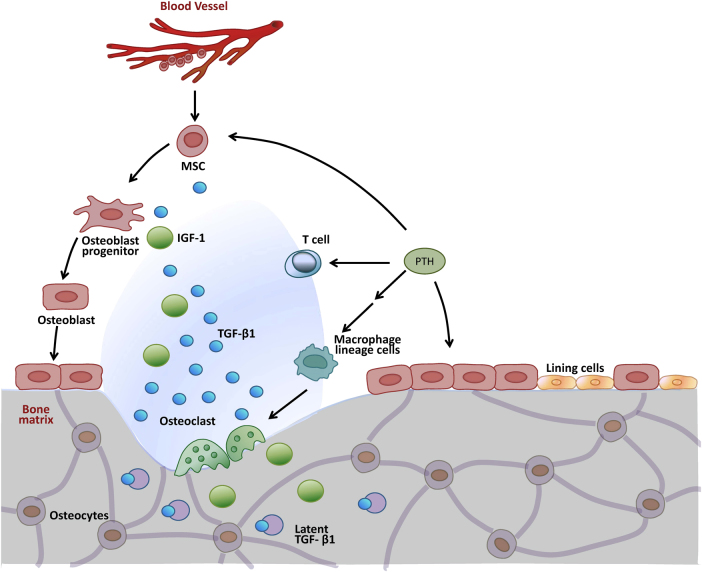
“Conversely, osteoclast-mediated bone matrix degradation releases and activates matrix-embedded growth factors, such as TGF-β and IGF-1, which recruit MSCs to resorption sites and regulate osteogenic differentiation during coupled bone remodeling (Xu et al., 2018).”
Sutton, K. R., Eisenhart, R. C., & Singh, M. V. (2026) · Frontiers in Immunology · doi:10.3389/fimmu.2026.1938898
Endoplasmic reticulum stress in breast cancer metastasis: mechanisms and therapeutic implications
Xu, R., Foo, W., Luo, L., & Liu, X. (2026) · Journal of Pharmacy and Pharmacology · doi:10.1093/jpp/rgag127
胡伟华, Chen, J., Yu, F., Yu, G., Li, K., 陳智龍, Wang, Y., Li, Z., Hu, Y., Cheng, Z., et al. (2026) · ACS Biomaterials Science & Engineering · doi:10.1021/acsbiomaterials.6c00928
Metadata
- Authors
- Xu, X., Zheng, L., Yuan, Q., Zhen, G., Crane, J. L., Zhou, X., & Cao, X.
- Affiliations
- Sichuan University (CN)
- Johns Hopkins University (US)
- Corresponding author
- Zhou, Xuedong
- Cao, Xu
- Venue
- Bone Research
- Published
- 2018-01-31
- Volume
- 6
- Issue
- 1
- Pages
- 2-2
- ISSN
- 2095-4700 (ISSN-L)
- 2095-6231
- PMC
- PMC5802812
- OpenAlex
- W2797460017
- Cited by
- 414
- References
- 598
- Citations by year
- 2026: 43 · 2025: 46 · 2024: 56 · 2023: 58 · 2022: 81 · 2021: 57 · 2020: 34 · 2019: 27 · 2018: 11
- FWCI
- 11.47
- Type
- journal article
- Language
- en
- Open access
- gold
- doi.org
- Licence
- cc-by
- creativecommons.org/licenses/by/4.0 (tdm)
- creativecommons.org/licenses/by/4.0 (vor)
- Locations
- Bone Research (publishedVersion, cc-by)
- PubMed Central (publishedVersion, cc-by)
- PubMed (publishedVersion)
- DOAJ (DOAJ: Directory of Open Access Journals) (submittedVersion)
- Funders
- York University
- National Natural Science Foundation of China (81771099, 2016JY0006)
- Department of Science and Technology of Sichuan Province (81771099, 2016JY0006, 2017TD0016)
- Sichuan University
- National Institutes of Health
- West China Hospital, Sichuan University
- National Institute of Diabetes and Digestive and Kidney Diseases (Z01DK057501, R01DK057501)
- National Institute of Arthritis and Musculoskeletal and Skin Diseases (R01AR063943, R01AR071432, K08AR064833)
- Topics
- Life Sciences › Biochemistry, Genetics and Molecular Biology › Molecular Biology › TGF-β signaling in diseases
- Health Sciences › Medicine › Hepatology › Liver physiology and pathology
- Life Sciences › Biochemistry, Genetics and Molecular Biology › Cell Biology › Mesenchymal stem cell research
- Keywords
- TGF-beta, TGF-beta signaling, stem cells, tissue homeostasis, latent TGF-beta complex, extracellular matrix, ligand activation, tissue regeneration, fibrosis, metastasis, osteoarthritis, immune disorders
About these checks
Registry, retraction, Cites and statistics results are computed, not judged, with one exception: a printed reference that no index lists is read once by a model before it counts as a citation error. Claims are extracted by a model and kept only when their quote appears verbatim in the text; each cited source is then checked, with a model’s help, for whether it says what the claim relies on. Those verdicts can be wrong — read the claim’s quote and the cited source before relying on one.
Statistics and arithmetic are recomputed, not judged.
Confidence bands are shown only for fields calibrated on our annotated test set. None is calibrated yet, so no band is shown.
What counts as a claim ›How we measure confidence ›How we check this ›
Are you an author, or do you see a problem with this page? Request a review
Data sources
Bibliographic data: Semantic Scholar, OpenAlex, Crossref.
Contains information from the Semantic Scholar Academic Graph Datasets, made available under the ODC Attribution License (ODC-BY 1.0).
Semantic Scholar’s data is described in: Kinney, R., et al. (2023). The Semantic Scholar Open Data Platform. arXiv:2301.10140.
