

Mapping epigenetic modifications by sequencing technologies
Open accessThe DOI matches its Crossref record; 170 of the 170 references it cites were found in a registry or an index.
Abstract
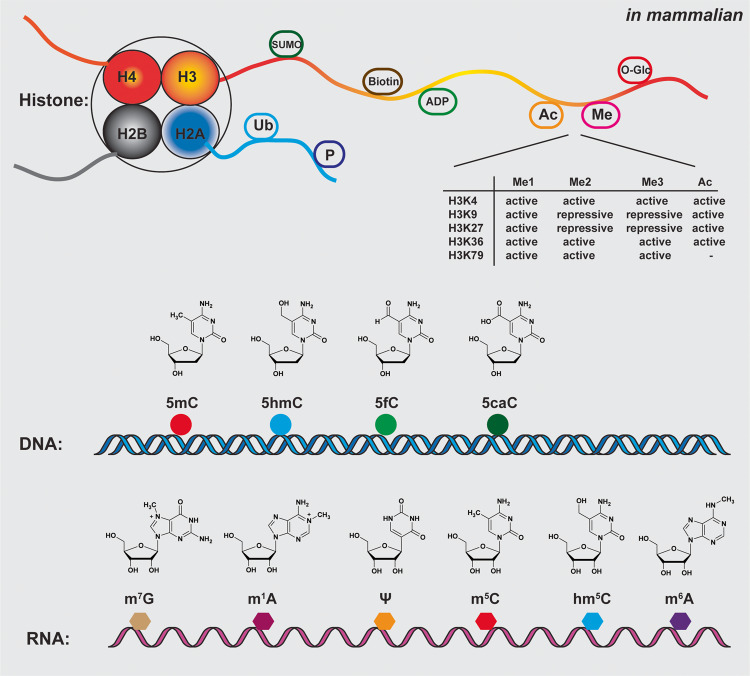
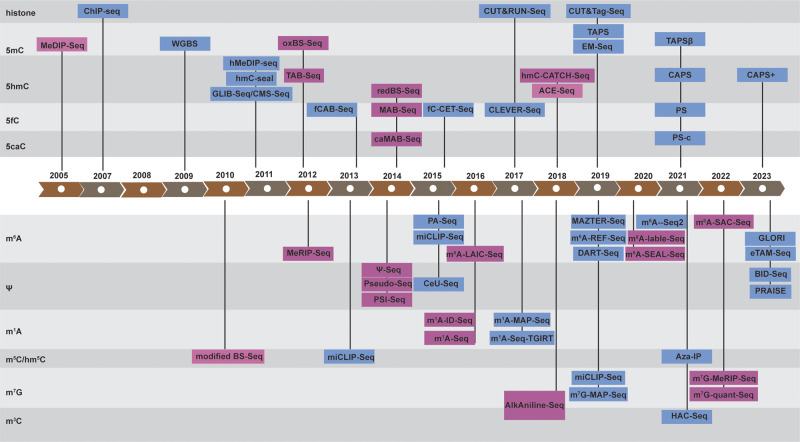
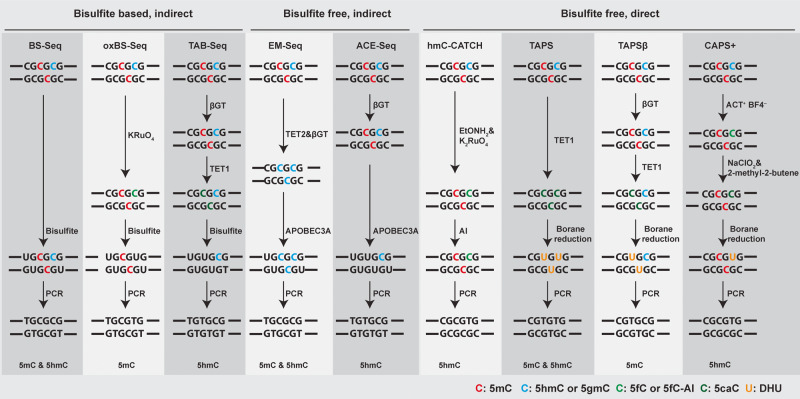
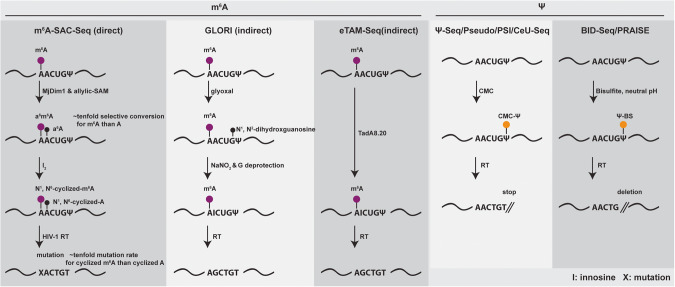
The “epigenetics” concept was first described in 1942. Thus far, chemical modifications on histones, DNA, and RNA have emerged as three important building blocks of epigenetic modifications. Many epigenetic modifications have been intensively studied and found to be involved in most essential biological processes as well as human diseases, including cancer. Precisely and quantitatively mapping over 100 [1], 17 [2], and 160 [3] different known types of epigenetic modifications in histone, DNA, and RNA is the key to understanding the role of epigenetic modifications in gene regulation in diverse biological processes. With the rapid development of sequencing technologies, scientists are able to detect specific epigenetic modifications with various quantitative, high-resolution, whole-genome/transcriptome approaches. Here, we summarize recent advances in epigenetic modification sequencing technologies, focusing on major histone, DNA, and RNA modifications in mammalian cells.
Overview
The claims and statistics of this paper haven’t been checked yet.
Free: it reads the open-access text and checks the first 5 claims that cite a source we can check. Create a free account to check every claim.
Integrity signals
Registry
Cites
Statistics
Figures
Verification
Claims the paper makes
The claims and statistics of this paper haven’t been checked yet.
Free: it reads the open-access text and checks the first 5 claims that cite a source we can check. Create a free account to check every claim.
Claims other papers make about this one
Each is checked against this paper’s own text: does it say what the citing paper says it does?
The source backs part of the claim, not all of it — or backs it for a different population, condition or comparison.
In the citing paper
“Sequencing-based approaches remain the gold standard for DNA methylation profiling, evolving from reduced representation bisulfite sequencing (RRBS) to enzymatic methyl-seq and newer TET-assisted methods (13, 14).”
From Epigenetic changes associated with multi-generational trauma: characterization, mechanisms, and therapeutics (2026) · cites this paper as [13]
Experimental — accuracy not yet measured
Self-check
Percentages, sums and reported differences re-computed from the paper’s own numbers.
The self-check needs the paper’s full text.
Citations
Cites
Chromatin modifications and their function
Kouzarides, T. (2007) · Cell · doi:10.1016/j.cell.2007.02.005 · Cited by 10,883
Shrestha, S., & Offer, S. M. (2016) · Medical Epigenetics · doi:10.1159/000444713 · Cited by 8,914
DNA methylation patterns and epigenetic memory
Bird, A. (2002) · Genes & Development · doi:10.1101/gad.947102 · Cited by 7,124
High-Resolution Profiling of Histone Methylations in the Human Genome
Barski, A., Cuddapah, S., Cui, K., Roh, T.-Y., Schones, D. E., Wang, Z., Wei, G., Chepelev, I., & Zhao, K. (2007) · Cell · doi:10.1016/j.cell.2007.05.009 · Cited by 6,845
Conversion of 5-Methylcytosine to 5-Hydroxymethylcytosine in Mammalian DNA by MLL Partner TET1
Tahiliani, M., Koh, K. P., Shen, Y., Pastor, W. A., Bandukwala, H., Brudno, Y., Agarwal, S., Iyer, L. M., Liu, D. R., Aravind, L., et al. (2009) · Science · doi:10.1126/science.1170116 · Cited by 5,836
Genomic and Epigenomic Landscapes of Adult De Novo Acute Myeloid Leukemia
The Cancer Genome Atlas Research Network (2013) · New England Journal of Medicine · doi:10.1056/nejmoa1301689 · Cited by 5,078
DNA methylation and its basic function
Moore, L. D., Le, T., & Fan, G. (2013) · Neuropsychopharmacology · doi:10.1038/npp.2012.112 · Cited by 4,906
Topology of the human and mouse m6A RNA methylomes revealed by m6A-seq
Dominissini, D., Moshitch-Moshkovitz, S., Schwartz, S., Salmon-Divon, M., Ungar, L., Osenberg, S., Cesarkas, K., Jacob-Hirsch, J., Amariglio, N., Kupiec, M., et al. (2012) · Nature · doi:10.1038/nature11112 · Cited by 4,884
Human DNA methylomes at base resolution show widespread epigenomic differences
Lister, R., Pelizzola, M., Dowen, R. H., Hawkins, R. D., Hon, G., Tonti-Filippini, J., Nery, J. R., Lee, L., Ye, Z., Ngo, Q.-M., et al. (2009) · Nature · doi:10.1038/nature08514 · Cited by 4,673
Comprehensive Analysis of mRNA Methylation Reveals Enrichment in 3′ UTRs and near Stop Codons
Meyer, K. D., Saletore, Y., Zumbo, P., Elemento, O., Mason, C. E., & Jaffrey, S. R. (2012) · Cell · doi:10.1016/j.cell.2012.05.003 · Cited by 4,223
Research works printed but not linked: 1
- Shapiro R, Pohl SH. The reaction of ribonucleosides with nitrous acid. Side- Products Kinet Biochem. 1968;7:448–55.
Cited by
Liu, X., Peng, T., Xu, M., Lin, S., Hu, B., Chu, T., Liu, B., Xu, Y., Ding, W., Li, L., et al. (2024) · Journal of Hematology & Oncology · doi:10.1186/s13045-024-01596-9 · Cited by 202
“Epigenetic modifications, such as histone acetylation, methylation, phosphorylation, ubiquitination, and DNA methylation, play crucial roles in regulating chromatin structure and DNA accessibility [62, 63].”
BackgroundGupta, M., Dwivedi, V., Kumar, S., Patel, A., Niazi, P., & Yadav, V. K. (2024) · Plant Signaling & Behavior · doi:10.1080/15592324.2024.2365576 · Cited by 128
“184,188,189 Biochar, which is generated from organic waste, can be mixed with soil to reduce Pb toxicity by adsorbing it onto its surface and increasing soil pH. Investigations have shown that with the utilization of phosphorus fertilizers, the toxicity of Pb was reduced for the plants as phosphorus forms an insoluble…”
BackgroundInfluentialMultiomics Research: Principles and Challenges in Integrated Analysis
Luo, Y., Zhao, C., & Chen, F. (2024) · BioDesign Research · doi:10.34133/bdr.0059 · Cited by 120
“Additionally, PacBio Revio sequencers can directly detect epigenetic modifications such as DNA methylation [ 3 ].”
Current Bioinformatics Tools in Precision Oncology
Wolde, T., Bhardwaj, V., & Pandey, V. (2025) · MedComm · doi:10.1002/mco2.70243 · Cited by 78
Zhou, S., Abdihamid, O., Tan, F., Zhou, H., Liu, H., Li, Z., Xiao, S., & Li, B. (2024) · Cell Communication and Signaling · doi:10.1186/s12964-023-01411-x · Cited by 66
“It refers to a stable heritable change in biological phenotype or gene expression without a change in nucleotide sequence [88, 89].”
Background
Metadata
- Authors
- Chen, X., Xu, H., Shu, X., & Song, C.-X.
- Affiliations
- University of Oxford (GB)
- Corresponding author
- Song, Chun-Xiao
- Venue
- Cell Death & Differentiation
- Published
- 2023-09-01
- Volume
- 32
- Issue
- 1
- Pages
- 56-65
- ISSN
- 1350-9047 (ISSN-L)
- 1476-5403
- PMC
- PMC11742697
- OpenAlex
- W4386348917
- Cited by
- 105
- References
- 168
- Citations by year
- 2026: 39 · 2025: 43 · 2024: 23
- FWCI
- 2.77
- Type
- journal article
- Language
- en
- Open access
- hybrid
- doi.org
- Licence
- cc-by
- creativecommons.org/licenses/by/4.0 (tdm)
- creativecommons.org/licenses/by/4.0 (vor)
- Locations
- Cell Death and Differentiation (publishedVersion, cc-by)
- PubMed Central (publishedVersion, cc-by)
- PubMed (publishedVersion)
- Funders
- Ludwig Institute for Cancer Research
- DH | National Institute for Health Research
- China Scholarship Council
- Topics
- Life Sciences › Biochemistry, Genetics and Molecular Biology › Molecular Biology › Epigenetics and DNA Methylation
- Life Sciences › Biochemistry, Genetics and Molecular Biology › Molecular Biology › Genomics and Chromatin Dynamics
- Life Sciences › Biochemistry, Genetics and Molecular Biology › Molecular Biology › Genomics and Phylogenetic Studies
- Keywords
- epigenetic modifications, histone modifications, DNA methylation, RNA modification, sequencing technologies, gene expression regulation, cancer epigenetics, mammalian cells
- MeSH terms
- Animals, DNA, Histones, Humans, RNA, DNA Methylation, Epigenesis, Genetic, High-Throughput Nucleotide Sequencing
About these checks
Registry, retraction, Cites and statistics results are computed, not judged, with one exception: a printed reference that no index lists is read once by a model before it counts as a citation error. Claims are extracted by a model and kept only when their quote appears verbatim in the text; each cited source is then checked, with a model’s help, for whether it says what the claim relies on. Those verdicts can be wrong — read the claim’s quote and the cited source before relying on one.
Statistics and arithmetic are recomputed, not judged.
Confidence bands are shown only for fields calibrated on our annotated test set. None is calibrated yet, so no band is shown.
What counts as a claim ›How we measure confidence ›How we check this ›
Are you an author, or do you see a problem with this page? Request a review
How to cite
Cite CoChat for the checks on this page, and the paper for its own findings.
- This page
- CoChat. (2026). Citation check: Mapping epigenetic modifications by sequencing technologies. https://app.cochat.ai/papers/10.1038/s41418-023-01213-1
- The paper
- Chen, X., Xu, H., Shu, X., & Song, C.-X. (2025). Mapping epigenetic modifications by sequencing technologies. Cell Death & Differentiation. https://doi.org/10.1038/s41418-023-01213-1
Data sources
Bibliographic data: Semantic Scholar, OpenAlex, Crossref.
Contains information from the Semantic Scholar Academic Graph Datasets, made available under the ODC Attribution License (ODC-BY 1.0).
Semantic Scholar’s data is described in: Kinney, R., et al. (2023). The Semantic Scholar Open Data Platform. arXiv:2301.10140.
