

Ferroptosis: past, present and future
Open accessThe DOI matches its Crossref record; 91 of the 92 references it cites were found in a registry or an index.
Abstract
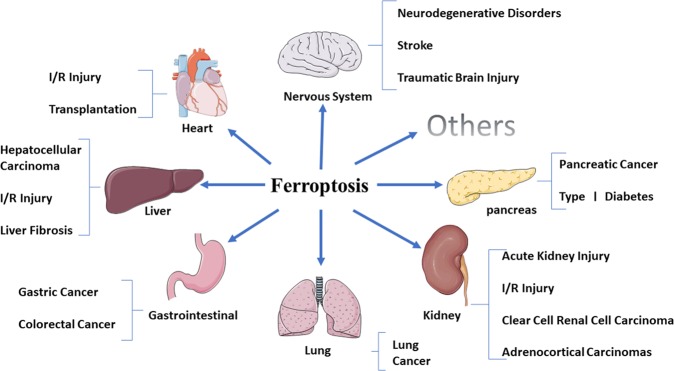
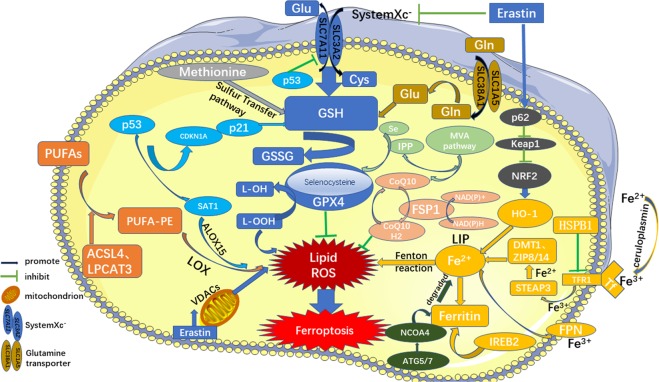
Ferroptosis is a new type of cell death that was discovered in recent years and is usually accompanied by a large amount of iron accumulation and lipid peroxidation during the cell death process; the occurrence of ferroptosis is iron-dependent. Ferroptosis-inducing factors can directly or indirectly affect glutathione peroxidase through different pathways, resulting in a decrease in antioxidant capacity and accumulation of lipid reactive oxygen species (ROS) in cells, ultimately leading to oxidative cell death. Recent studies have shown that ferroptosis is closely related to the pathophysiological processes of many diseases, such as tumors, nervous system diseases, ischemia-reperfusion injury, kidney injury, and blood diseases. How to intervene in the occurrence and development of related diseases by regulating cell ferroptosis has become a hotspot and focus of etiological research and treatment, but the functional changes and specific molecular mechanisms of ferroptosis still need to be further explored. This paper systematically summarizes the latest progress in ferroptosis research, with a focus on providing references for further understanding of its pathogenesis and for proposing new targets for the treatment of related diseases.
Overview
The claims and statistics of this paper haven’t been checked yet.
Free: it reads the open-access text and checks the first 5 claims that cite a source we can check. Create a free account to check every claim.
Integrity signals
Registry
Cites
Statistics
Figures
Verification
Claims the paper makes
The claims and statistics of this paper haven’t been checked yet.
Free: it reads the open-access text and checks the first 5 claims that cite a source we can check. Create a free account to check every claim.
Claims other papers make about this one
Each is checked against this paper’s own text: does it say what the citing paper says it does?
The cited source says what the claim attributes to it.
In the citing paper
“Factors that induce ferroptosis can affect glutathione peroxidase (GPX) activity through different pathways, resulting in decreased cellular antioxidant capacity and accumulation of lipid ROS, eventually leading to oxidative damage and cell death [153].”
From Mechanisms and Strategies to Overcome Drug Resistance in Colorectal Cancer (2025) · cites this paper as [153]
In the citing paper
“Abnormalities in iron homeostasis in brain tissue can increase ROS production, causing noxious oxidative damage to sensitive cellular structures, and trigger a new cell death process called ferroptosis [98,99].”
From Role of Oxidative Damage in Alzheimer’s Disease and Neurodegeneration: From Pathogenic Mechanisms to Biomarker Discovery (2021) · cites this paper as [98]
Self-check
Percentages, sums and reported differences re-computed from the paper’s own numbers.
The self-check needs the paper’s full text.
Citations
Cites
Ferroptosis: An Iron-Dependent Form of Nonapoptotic Cell Death
Dixon, S. J., Lemberg, K. M., Lamprecht, M. R., Skouta, R., Zaitsev, E. M., Gleason, C. E., Patel, D. N., Bauer, A. J., Cantley, A. M., Yang, W. S., et al. (2012) · Cell · doi:10.1016/j.cell.2012.03.042 · Cited by 18,691
Regulation of Ferroptotic Cancer Cell Death by GPX4
Yang, W. S., SriRamaratnam, R., Welsch, M. E., Shimada, K., Skouta, R., Viswanathan, V. S., Cheah, J. H., Clemons, P. A., Shamji, A. F., Clish, C. B., et al. (2014) · Cell · doi:10.1016/j.cell.2013.12.010 · Cited by 7,713
Molecular characterization of mitochondrial apoptosis-inducing factor
Susin, S. A., Lorenzo, H. K., Zamzami, N., Marzo, I., Snow, B. E., Brothers, G. M., Mangion, J., Jacotot, E., Costantini, P., Loeffler, M., et al. (1999) · Nature · doi:10.1038/17135 · Cited by 4,060 · cited 2×
“Susin et al.(21) identified AIF as a mitochondrial Table 2 The common inducers and inhibitors of ferroptosis.”
Inactivation of the ferroptosis regulator Gpx4 triggers acute renal failure in mice
Friedmann Angeli, J. P., Schneider, M., Proneth, B., Tyurina, Y. Y., Tyurin, V. A., Hammond, V. J., Herbach, N., Aichler, M., Walch, A., Eggenhofer, E., et al. (2014) · Nature Cell Biology · doi:10.1038/ncb3064 · Cited by 3,732
Ferroptosis: process and function
Xie, Y., Hou, W., Song, X., Yu, Y., Huang, J., Sun, X., Kang, R., & Tang, D. (2016) · Cell Death & Differentiation · doi:10.1038/cdd.2015.158 · Cited by 3,727
The CoQ oxidoreductase FSP1 acts parallel to GPX4 to inhibit ferroptosis
Bersuker, K., Hendricks, J. M., Li, Z., Magtanong, L., Ford, B., Tang, P. H., Roberts, M. A., Tong, B., Maimone, T. J., Zoncu, R., et al. (2019) · Nature · doi:10.1038/s41586-019-1705-2 · Cited by 3,703
Ferroptosis as a p53-mediated activity during tumour suppression
Jiang, L., Kon, N., Li, T., Wang, S.-J., Su, T., Hibshoosh, H., Baer, R., & Gu, W. (2015) · Nature · doi:10.1038/nature14344 · Cited by 3,398
FSP1 is a glutathione-independent ferroptosis suppressor
Doll, S., Freitas, F. P., Shah, R., Aldrovandi, M., da Silva, M. C., Ingold, I., Goya Grocin, A., Xavier da Silva, T. N., Panzilius, E., Scheel, C. H., et al. (2019) · Nature · doi:10.1038/s41586-019-1707-0 · Cited by 3,341
Ferroptosis: Death by Lipid Peroxidation
Yang, W. S., & Stockwell, B. R. (2016) · Trends in Cell Biology · doi:10.1016/j.tcb.2015.10.014 · Cited by 3,088
Oxidized arachidonic and adrenic PEs navigate cells to ferroptosis
Kagan, V. E., Mao, G., Qu, F., Angeli, J. P. F., Doll, S., Croix, C. S., Dar, H. H., Liu, B., Tyurin, V. A., Ritov, V. B., et al. (2017) · Nature Chemical Biology · doi:10.1038/nchembio.2238 · Cited by 3,029
Research works printed but not linked: 1
- Friedmann Angeli JP Inactivation of the ferroptosis regulator Gpx4 triggers acute renal failure in mice Nat. Cell Biol. 2014 16 1180 1191 10.1038/ncb3064 25402683 PMC4894846 · DOI · Paper page
Cited by
Items 1,001–1,009 of 1,009
Wang, X., Shao, N., Zhang, X., Chen, H., Chang, Z., Xie, D., & Zhang, J. (2023) · Neuropsychiatric Disease and Treatment · doi:10.2147/ndt.s443278 · Cited by 30
Alzheimer’s disease: from early pathogenesis to novel therapeutic approaches
Prajapati, S. K., Pathak, A., & Samaiya, P. K. (2024) · Metabolic Brain Disease · doi:10.1007/s11011-024-01389-6 · Cited by 21
“Canna-bidiol (CBD), a naturally occurring compound found in the cannabis plant, is anticipated to be a promising therapy for treating AD by increasing the activity of the Wnt/b-catenin pathway and thus preventing the formation of neurofibril - lary tangles caused by Aβ stimulation (Li et al. 2020b).”
Navigating the complexities of cell death: Insights into accidental and programmed cell death
Lotfi, M.-S., & Rassouli, F. B. (2024) · Tissue and Cell · doi:10.1016/j.tice.2024.102586 · Cited by 15
Multi-platform-based characterization of ferroptosis in human colorectal cancer
Zhong, Y., Zhang, W., Yu, H., Lin, L., Gao, X., He, J., Li, D., Chen, Y., Zeng, Z., Xu, Y., et al. (2022) · iScience · doi:10.1016/j.isci.2022.104750 · Cited by 14
Xiong, Z., Chen, P., Wang, Z., Yao, L., Yuan, M., Liu, P., Sun, M., Shu, K., & Jiang, Y. (2025) · Free Radical Biology and Medicine · doi:10.1016/j.freeradbiomed.2025.02.045 · Cited by 14
AP-1 inhibitor induces ferroptosis via the PI3K/AKT pathway in multiple myeloma cells
Tang, S., Liu, J., Li, F., Yan, Y., Long, X., & Fu, Y. (2024) · Heliyon · doi:10.1016/j.heliyon.2024.e34397 · Cited by 13
“Ferroptosis is a type of programmed cell death characterized by iron-dependent fatal lipid peroxidation and excessive reactive oxygen species (ROS) that differs from apoptosis, necrosis, and pyroptosis [12,13].”
BackgroundUnveiling the crucial role of ferroptosis in host resistance to streptococcus agalactiae infection
(2024) · doi:10.1038/s41420-024-02189-8 · Cited by 6
Learning chemical sensitivity reveals mechanisms of cellular response
Connell, W., Garcia, K., Goodarzi, H., & Keiser, M. J. (2024) · Communications Biology · doi:10.1038/s42003-024-06865-4 · Cited by 4
Ege, S., Akduman, H., Aşir, A., Korak, T., & Aşir, F. (2025) · Medicine · doi:10.1097/md.0000000000044330 · Cited by 3
Metadata
- Authors
- Li, J., Cao, F., Yin, H.-L., Huang, Z.-J., Lin, Z.-T., Mao, N., Sun, B., & Wang, G.
- Affiliations
- Harbin Medical University (CN)
- Capital Medical University (CN)
- Southern Medical University (CN)
- Corresponding author
- Wang, Gang
- Venue
- Cell Death & Disease
- Published
- 2020-02-03
- Volume
- 11
- Issue
- 2
- Pages
- 88-88
- ISSN
- 2041-4889 (ISSN-L)
- PMC
- PMC6997353
- OpenAlex
- W3003960907
- Cited by
- 4,171
- References
- 92
- Citations by year
- 2026: 568 · 2025: 914 · 2024: 966 · 2023: 741 · 2022: 537 · 2021: 355 · 2020: 84
- FWCI
- 60.58
- Type
- journal article
- Language
- en
- Open access
- gold
- doi.org
- Licence
- cc-by
- creativecommons.org/licenses/by/4.0 (tdm)
- creativecommons.org/licenses/by/4.0 (vor)
- Locations
- Cell Death and Disease (publishedVersion, cc-by)
- PubMed Central (publishedVersion, cc-by)
- PubMed (publishedVersion)
- DOAJ (DOAJ: Directory of Open Access Journals) (submittedVersion)
- Funders
- National Science Foundation of China | National Natural Science Foundation of China-Yunnan Joint Fund (No.81770639)
- Beijing Municipal Science and Technology Commission (No. Z191100006619038)
- Capital Medical University (No.1192070312)
- Topics
- Life Sciences › Biochemistry, Genetics and Molecular Biology › Cancer Research › Ferroptosis and cancer prognosis
- Health Sciences › Medicine › Hematology › Iron Metabolism and Disorders
- Life Sciences › Biochemistry, Genetics and Molecular Biology › Molecular Biology › Cell death mechanisms and regulation
- Keywords
- ferroptosis, iron accumulation, lipid peroxidation, glutathione peroxidase, reactive oxygen species, oxidative cell death, ferroptosis-targeted therapy, tumors, ischemia-reperfusion injury, kidney injury, hematologic disorders, neurological disorders
- MeSH terms
- Ferroptosis, Antioxidants, Iron, Neoplasms, Nervous System Diseases, Lipid Peroxidation, Reperfusion Injury, Cell Death, Lipid Metabolism, Acute Kidney Injury
About these checks
Registry, retraction, Cites and statistics results are computed, not judged, with one exception: a printed reference that no index lists is read once by a model before it counts as a citation error. Claims are extracted by a model and kept only when their quote appears verbatim in the text; each cited source is then checked, with a model’s help, for whether it says what the claim relies on. Those verdicts can be wrong — read the claim’s quote and the cited source before relying on one.
Statistics and arithmetic are recomputed, not judged.
Confidence bands are shown only for fields calibrated on our annotated test set. None is calibrated yet, so no band is shown.
What counts as a claim ›How we measure confidence ›How we check this ›
Are you an author, or do you see a problem with this page? Request a review
Data sources
Bibliographic data: Semantic Scholar, OpenAlex, Crossref.
Contains information from the Semantic Scholar Academic Graph Datasets, made available under the ODC Attribution License (ODC-BY 1.0).
Semantic Scholar’s data is described in: Kinney, R., et al. (2023). The Semantic Scholar Open Data Platform. arXiv:2301.10140.
