

The DOI matches its Crossref record; 226 of the 226 references it cites were found in a registry or an index.
Immunopathogenic mechanisms and immunoregulatory therapies in MASLD
Open accessAbstract
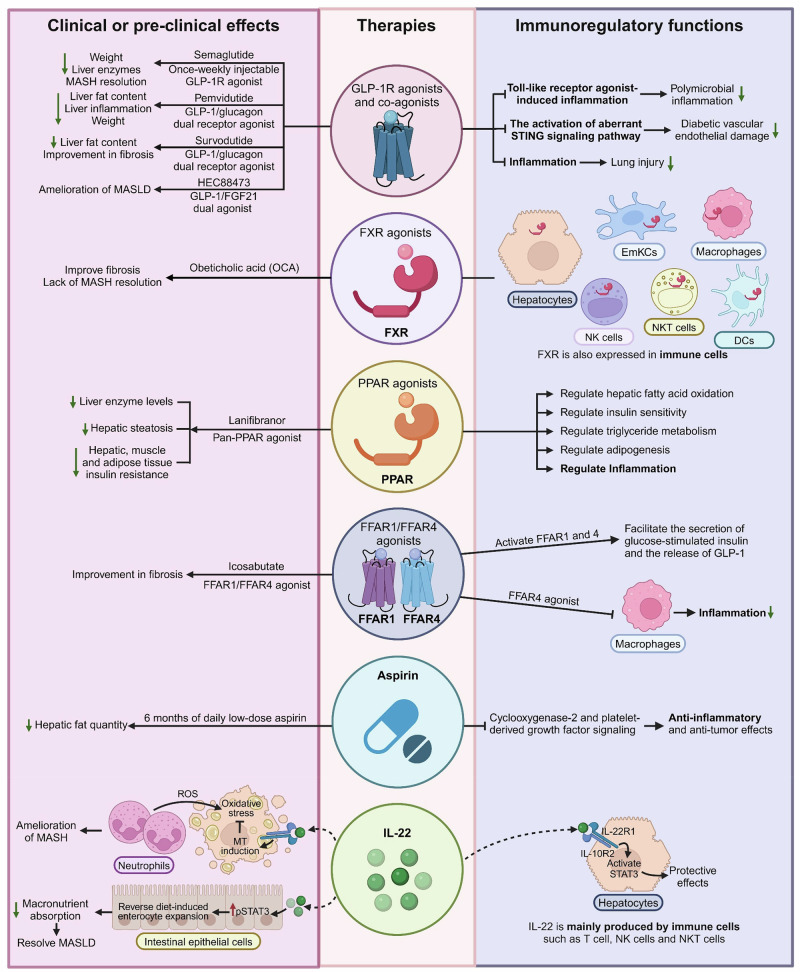
Metabolic dysfunction-associated steatotic liver disease (MASLD), previously known as nonalcoholic fatty liver disease (NAFLD), is the most prevalent chronic liver disease worldwide, with an estimated global prevalence of approximately 30%; however, effective pharmacotherapies are still limited due to its complex pathogenesis and etiology. Therefore, a more thorough understanding of disease pathogenesis is urgently needed. An increasing number of studies suggest that MASLD and its progressive form, metabolic dysfunction-associated steatohepatitis (MASH), are driven by chronic overnutrition, multiple genetic susceptibility factors, and pathogenic consequences, including hepatocyte damage and liver inflammation. Hepatic inflammation is the key event fueling the conversion from simple steatosis to steatohepatitis and fibrosis. Current therapies for MASH, including the recently approved thyroid hormone receptor-beta agonist resmetirom or the available incretin mimetics, mainly target metabolic injury to the liver but not inflammation directly. In this review, we provide an in-depth discussion of current data related to the immunological mechanisms of MASLD and summarize the effects of current and experimental therapies on immunoregulation in MASLD.
Overview
The claims and statistics of this paper haven’t been checked yet.
Run the check — free, no account needed. It reads the open-access text and checks the sources it cites.
Integrity signals
Registry
Cites
Statistics
Figures
Verification
Claims the paper makes
The claims and statistics of this paper haven’t been checked yet.
Run the check — free, no account needed. It reads the open-access text and checks the sources it cites.
Claims other papers make about this one
Each is checked against this paper’s own text: does it say what the citing paper says it does?
The source backs part of the claim, not all of it — or backs it for a different population, condition or comparison.
In the citing paper
“In addition to competing for survival signals like CSF-1 (9, 33, 34), infiltrating monocytes actively replace embryonic KCs (EmKCs) during injury (35–37).”
From Macrophage duality in liver diseases: heterogeneity, plasticity, and the quest for precision therapeutics (2026) · cites this paper as [37]
Experimental — accuracy not yet measured
Self-check
Percentages, sums and reported differences re-computed from the paper’s own numbers.
The self-check needs the paper’s full text.
Citations
Cites
Obesity is associated with macrophage accumulation in adipose tissue
Weisberg, S. P., McCann, D., Desai, M., Rosenbaum, M., Leibel, R. L., & Ferrante, A. W. (2003) · Journal of Clinical Investigation · doi:10.1172/jci200319246 · Cited by 10,041 · cited 1×
“For example, seminal work has demonstrated that obesity is associated with marked in fi ltration of proin fl ammatory macrophages into adipose tissue, which is correlated with insulin resistance and low-grade systemic in fl ammation [148, 149].”
Ferroptosis: mechanisms, biology and role in disease
Jiang, X., Stockwell, B. R., & Conrad, M. (2021) · Nature Reviews Molecular Cell Biology · doi:10.1038/s41580-020-00324-8 · Cited by 7,973
Obesity induces a phenotypic switch in adipose tissue macrophage polarization
Lumeng, C. N., Bodzin, J. L., & Saltiel, A. R. (2007) · Journal of Clinical Investigation · doi:10.1172/jci29881 · Cited by 4,664 · cited 1×
“For example, seminal work has demonstrated that obesity is associated with marked in fi ltration of proin fl ammatory macrophages into adipose tissue, which is correlated with insulin resistance and low-grade systemic in fl ammation [148, 149].”
Eslam, M., Newsome, P. N., Sarin, S. K., Anstee, Q. M., Targher, G., Romero-Gomez, M., Zelber-Sagi, S., Wai-Sun Wong, V., Dufour, J.-F., Schattenberg, J. M., et al. (2020) · Journal of Hepatology · doi:10.1016/j.jhep.2020.03.039 · Cited by 4,472
Neutrophil extracellular traps in immunity and disease
Papayannopoulos, V. (2017) · Nature reviews. Immunology · doi:10.1038/nri.2017.105 · Cited by 3,571 · cited 2×
“Neutrophils are the most abundant leukocytes in the blood and form a critical arm of innate immunity, playing a well-recognized role in antibacterial defense by extruding a meshwork of chromatin fi bers to establish neutrophil extracellular traps (NETs) via a process known as NETosis [63, 64].”
A multisociety Delphi consensus statement on new fatty liver disease nomenclature
Rinella, M. E., Lazarus, J. V., Ratziu, V., Francque, S. M., Sanyal, A. J., Kanwal, F., Romero, D., Abdelmalek, M. F., Anstee, Q. M., Arab, J. P., et al. (2023) · Hepatology · doi:10.1097/hep.0000000000000520 · Cited by 3,476 · cited 1×
“These concerns led to a multi-stakeholder effort to develop a consensus on a change in nomenclature and the diagnostic criteria for the condition [7, 8].”
Younossi, Z. M., Golabi, P., Paik, J. M., Henry, A., Van Dongen, C., & Henry, L. (2023) · Hepatology · doi:10.1097/hep.0000000000000004 · Cited by 3,383 · cited 1×
“Metabolic dysfunction-associated steatotic liver disease (MASLD), formerly named nonalcoholic fatty liver disease (NAFLD), affects approximately 30% of the global population, leading to a major health and economic burden [1].”
MAFLD: a consensus-driven proposed nomenclature for metabolic associated fatty liver disease
Eslam, M., Sanyal, A. J., George, J., Sanyal, A., Neuschwander-Tetri, B., Tiribelli, C., Kleiner, D. E., Brunt, E., Bugianesi, E., Yki-Järvinen, H., et al. (2020) · Gastroenterology · doi:10.1053/j.gastro.2019.11.312 · Cited by 3,286
A multisociety Delphi consensus statement on new fatty liver disease nomenclature
Rinella, M. E., Lazarus, J. V., Ratziu, V., Francque, S. M., Sanyal, A. J., Kanwal, F., Romero, D., Abdelmalek, M. F., Anstee, Q. M., Arab, J. P., et al. (2023) · Journal of Hepatology · doi:10.1016/j.jhep.2023.06.003 · Cited by 3,100 · cited 1×
“These concerns led to a multi-stakeholder effort to develop a consensus on a change in nomenclature and the diagnostic criteria for the condition [7, 8].”
Kim, H. J., Park, S. Y., Choi, Y. J., Han, S. J., Lee, K. W., & Kim, D. J. (2013) · Hormone Research in Paediatrics · doi:10.1159/000348848 · Cited by 3,061
Cited by
Sorted by citations
Metabolic dysfunction and alcohol-associated liver disease (MetALD)
Gao, B., Arab, J. P., Liangpunsakul, S., Ding, W., Szabó, G., Mehal, W. Z., Wang, H., He, Y., Stärkel, P., Llorente, C., et al. (2025) · eGastroenterology · doi:10.1136/egastro-2025-100319 · Cited by 43
Self-citationZheng, H., Wu, K., Zheng, H., Chen, G., Lan, Y., Chen, S., Casu, G., Sechi, L. A., Wu, S., Vidili, G., et al. (2025) · JHEP Reports · doi:10.1016/j.jhepr.2025.101602 · Cited by 18
“…Neutrophil extracellular trap formation, M1 macrophages polarization, and T-cell imbalance contribute to hepatic inflammation and fibrosis, 38 while the same mechanisms also drive vascular inflammation, foam cell formation, and plaque instability, linking systemic immune activation to…”
Self-citationThe many pathways driving liver inflammation in MASH
Tilg, H., Adolph, T. E., Romeo, S., & Loomba, R. S. (2026) · Cell Metabolism · doi:10.1016/j.cmet.2026.02.018 · Cited by 17
Youhanna, S., Taebnia, N., Liang, Y., Cheng, N., Wang, Y., Michel, M., & Lauschke, V. M. (2025) · Advanced Biology · doi:10.1002/adbi.202500337 · Cited by 9
Eid, R. A., Hamed, A. M., Elgendy, S. O., Orayj, K. M., Ibrahim, A. S., Hamied, A. M. A., Wahsh, E. A., Youssif, M., Rabea, H., Madney, Y. M., et al. (2025) · Metabolites · doi:10.3390/metabo16010025 · Cited by 9
Metadata
- Authors
- He, Y., Chen, Y., Qian, S., van Der Merwe, S., Dhar, D., Brenner, D. A., & Tacke, F.
- Affiliations
- Chinese Academy of Sciences (CN)
- Sanford Burnham Prebys Medical Discovery Institute (US)
- Charité – Universitätsmedizin Berlin (DE)
- Corresponding author
- He, Yong
- Tacke, Frank
- Venue
- Cellular & Molecular Immunology
- Published
- 2025-06-10
- Volume
- 22
- Issue
- 10
- Pages
- 1159-1177
- ISSN
- 1672-7681 (ISSN-L)
- 2042-0226
- PMC
- PMC12480724
- OpenAlex
- W4411162672
- Semantic Scholar
- 7f2f36cf67705164236941f4c20e7acd81779cf2
- Cited by
- 81
- References
- 226
- Citations by year
- 2026: 63 · 2025: 18
- FWCI
- 12.44
- Type
- journal article
- Language
- en
- Open access
- hybrid
- doi.org
- Locations
- Cellular and Molecular Immunology (publishedVersion, cc-by)
- Europe PMC (PubMed Central) (publishedVersion, cc-by)
- PubMed (publishedVersion)
- PubMed Central (publishedVersion, cc-by)
- Lirias (KU Leuven) (submittedVersion, cc-by)
- Funders
- U.S. Department of Health and Human Services (R01DK133930, RO1DK137061)
- Deutsche Forschungsgemeinschaft (SFB 1382, DFGTa434/8‐1, Ta434/8‐1, 403224013)
- National Natural Science Foundation of China (82270601, 403224013)
- National Institutes of Health
- National Key Research and Development Program of China (2024ZD0530604, 2023YFA1800804)
- National Institute of Diabetes and Digestive and Kidney Diseases (R01DK137061, R01DK133930)
- Topics
- Health Sciences › Medicine › Hepatology › Liver Disease Diagnosis and Treatment
- Health Sciences › Medicine › Hepatology › Liver physiology and pathology
- Health Sciences › Medicine › Hepatology › Liver Diseases and Immunity
- Keywords
- non-alcoholic fatty liver disease, nonalcoholic steatohepatitis, immunopathogenesis, liver inflammation, immunomodulatory therapy, resmetirom, incretin mimetics, liver fibrosis, genetic susceptibility, overnutrition
- MeSH terms
- Animals, Humans, Liver, Immunomodulation, Non-alcoholic Fatty Liver Disease
About these checks
Registry, retraction, Cites and statistics results are computed, not judged, with one exception: a printed reference that no index lists is read once by a model before it counts as a citation error. Claims are extracted by a model and kept only when their quote appears verbatim in the text; each cited source is then checked, with a model’s help, for whether it says what the claim relies on. Those verdicts can be wrong — read the claim’s quote and the cited source before relying on one.
Statistics and arithmetic are recomputed, not judged.
Confidence bands are shown only for fields calibrated on our annotated test set. None is calibrated yet, so no band is shown.
What counts as a claim ›How we measure confidence ›How we check this ›
Are you an author, or do you see a problem with this page? Request a review
