

The DOI matches its Crossref record; 37 of the 38 references it cites were found in a registry or an index.
Soft material for soft actuators
Open accessAbstract
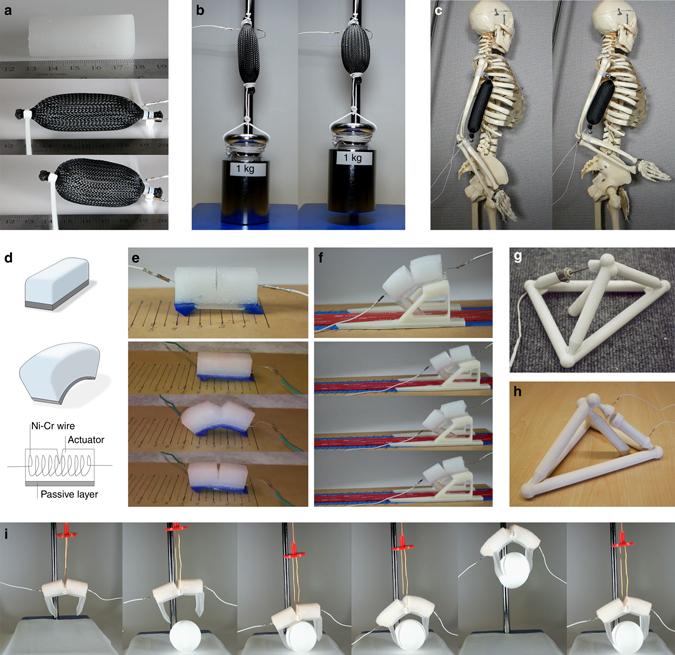
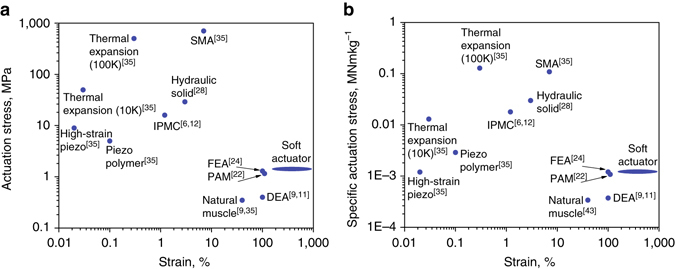
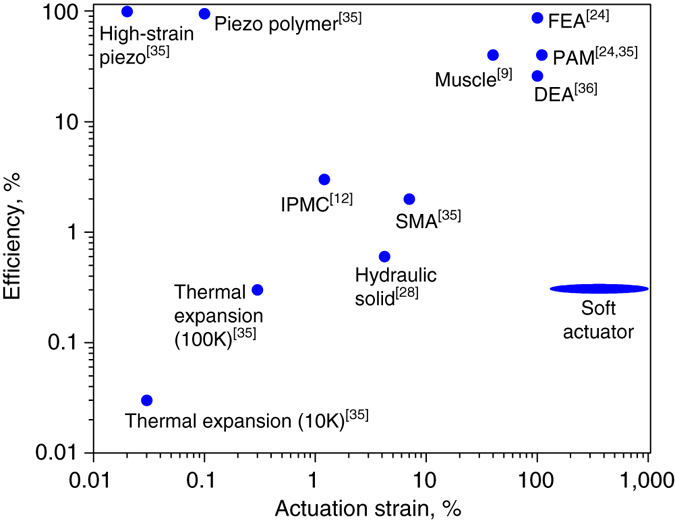
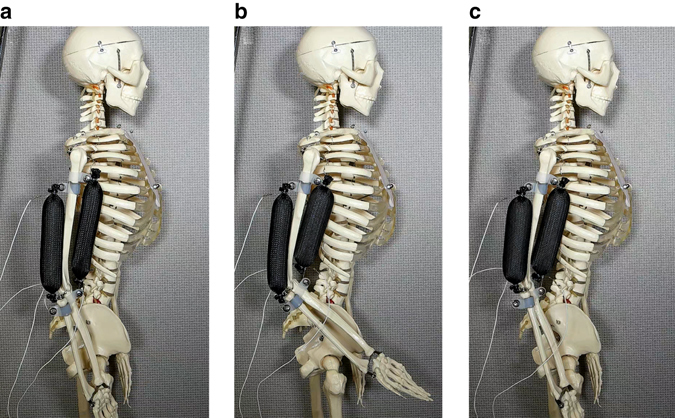
Inspired by natural muscle, a key challenge in soft robotics is to develop self-contained electrically driven soft actuators with high strain density. Various characteristics of existing technologies, such as the high voltages required to trigger electroactive polymers ( > 1KV), low strain ( < 10%) of shape memory alloys and the need for external compressors and pressure-regulating components for hydraulic or pneumatic fluidicelastomer actuators, limit their practicality for untethered applications. Here we show a single self-contained soft robust composite material that combines the elastic properties of a polymeric matrix and the extreme volume change accompanying liquid–vapor transition. The material combines a high strain (up to 900%) and correspondingly high stress (up to 1.3 MPa) with low density (0.84 g cm −3 ). Along with its extremely low cost (about 3 cent per gram), simplicity of fabrication and environment-friendliness, these properties could enable new kinds of electrically driven entirely soft robots.
Overview
The claims and statistics of this paper haven’t been checked yet.
Free: it reads the open-access text and checks the first 5 claims that cite a source we can check. Create a free account to check every claim.
Integrity signals
Registry
Cites
Statistics
Figures


Verification
Claims the paper makes
The claims and statistics of this paper haven’t been checked yet.
Free: it reads the open-access text and checks the first 5 claims that cite a source we can check. Create a free account to check every claim.
Claims other papers make about this one
Each is checked against this paper’s own text: does it say what the citing paper says it does?
The source backs part of the claim, not all of it — or backs it for a different population, condition or comparison.
In the citing paper
“as the structural design of a pneumatic chamber will achieve the pre-defined actuating motion (Figure 2I and 2J).[64–66]”
From Flexible Electronics and Devices as Human–Machine Interfaces for Medical Robotics (2022) · cites this paper as [65]
Experimental — accuracy not yet measured
Self-check
Percentages, sums and reported differences re-computed from the paper’s own numbers.
The self-check needs the paper’s full text.
Citations
Cites
Design, fabrication and control of soft robots
Rus, D., & Tolley, M. T. (2015) · Nature · doi:10.1038/nature14543 · Cited by 5,825
Shepherd, R. F., Ilievski, F., Choi, W., Morin, S. A., Stokes, A. A., Mazzeo, A. D., Chen, X., Wang, M., & Whitesides, G. M. (2011) · Proceedings of the National Academy of Sciences · doi:10.1073/pnas.1116564108 · Cited by 2,111
Soft robotics: a bioinspired evolution in robotics
Kim, S., Laschi, C., & Trimmer, B. (2013) · Trends in Biotechnology · doi:10.1016/j.tibtech.2013.03.002 · Cited by 2,092
Soft Robotics: Biological Inspiration, State of the Art, and Future Research
Trivedi, D., Rahn, C. D., Kier, W. M., & Walker, I. D. (2008) · Applied Bionics and Biomechanics · doi:10.1080/11762320802557865 · Cited by 1,708
Soft robotic glove for combined assistance and at-home rehabilitation
Polygerinos, P., Wang, Z., Galloway, K. C., Wood, R. J., & Walsh, C. J. (2015) · Robotics and Autonomous Systems · doi:10.1016/j.robot.2014.08.014 · Cited by 1,617
Measurement and modeling of McKibben pneumatic artificial muscles
Chou, C.-P., & Hannaford, B. (1996) · IEEE Transactions on Robotics and Automation · doi:10.1109/70.481753 · Cited by 1,589
Ionic polymer-metal composites: I. Fundamentals
Shahinpoor, M., & Kim, K. J. (2001) · Smart Materials and Structures · doi:10.1088/0964-1726/10/4/327 · Cited by 1,126
A Resilient, Untethered Soft Robot
Tolley, M. T., Shepherd, R. F., Mosadegh, B., Galloway, K. C., Wehner, M., Karpelson, M., Wood, R. J., & Whitesides, G. M. (2014) · Soft Robotics · doi:10.1089/soro.2014.0008 · Cited by 1,089
A 3D-printed, functionally graded soft robot powered by combustion
Bartlett, N. W., Tolley, M. T., Overvelde, J. T. B., Weaver, J. C., Mosadegh, B., Bertoldi, K., Whitesides, G. M., & Wood, R. J. (2015) · Science · doi:10.1126/science.aab0129 · Cited by 1,052
Soft Robot Arm Inspired by the Octopus
Laschi, C., Cianchetti, M., Mazzolai, B., Margheri, L., Follador, M., & Dario, P. (2012) · Advanced Robotics · doi:10.1163/156855312x626343 · Cited by 978
Cited by
Shintake, J., Cacucciolo, V., Floreano, D., & Shea, H. (2018) · Advanced Materials · doi:10.1002/adma.201707035 · Cited by 1,938
Advances in 4D Printing: Materials and Applications
Kuang, X., Roach, D. J., Wu, J., Hamel, C. M., Ding, Z., Wang, T., Dunn, M. L., & Qi, H. J. (2019) · Advanced Functional Materials · doi:10.1002/adfm.201805290 · Cited by 1,095
Rich, S. I., Wood, R. J., & Majidi, C. (2018) · Nature Electronics · doi:10.1038/s41928-018-0024-1 · Cited by 1,022
3D printing of soft robotic systems
Wallin, T. J., Pikul, J., & Shepherd, R. F. (2018) · Nature Reviews Materials · doi:10.1038/s41578-018-0002-2 · Cited by 942
Soft actuators for real-world applications
Li, M., Pal, A., Aghakhani, A., Pena-Francesch, A., & Sitti, M. (2021) · Nature Reviews Materials · doi:10.1038/s41578-021-00389-7 · Cited by 880
Metadata
- Authors
- Miriyev, A., Stack, K., & Lipson, H.
- Affiliations
- Columbia University (US)
- Corresponding author
- Lipson, Hod
- Venue
- Nature Communications
- Published
- 2017-09-19
- Volume
- 8
- Issue
- 1
- Pages
- 596-596
- ISSN
- 2041-1723 (ISSN-L)
- PMC
- PMC5605691
- OpenAlex
- W2755921665
- Semantic Scholar
- 1fe4a8e7cc13b3128d1ce125dae7bf4d965ed151
- Cited by
- 861
- References
- 38
- Citations by year
- 2026: 61 · 2025: 110 · 2024: 86 · 2023: 103 · 2022: 101 · 2021: 126 · 2020: 124 · 2019: 93 · 2018: 51 · 2017: 5
- FWCI
- 33.62
- Type
- journal article
- Language
- en
- Open access
- gold
- doi.org
- Licence
- cc-by
- creativecommons.org/licenses/by/4.0 (tdm)
- creativecommons.org/licenses/by/4.0 (vor)
- Locations
- Nature Communications (publishedVersion, cc-by)
- PubMed Central (publishedVersion, cc-by)
- PubMed (publishedVersion)
- RePEc: Research Papers in Economics (submittedVersion)
- DOAJ (DOAJ: Directory of Open Access Journals) (submittedVersion)
- DOAJ (DOAJ: Directory of Open Access Journals) (submittedVersion, cc-by-sa)
- Topics
- Physical Sciences › Engineering › Biomedical Engineering › Soft Robotics and Applications
- Physical Sciences › Engineering › Mechanical Engineering › Advanced Materials and Mechanics
- Physical Sciences › Materials Science › Electronic, Optical and Magnetic Materials › Dielectric materials and actuators
- Keywords
- soft actuators, soft robotics, liquid-vapor transition, composite materials, polymer matrix, untethered robots, bio-inspired actuators, shape memory alloys, electroactive polymers
About these checks
Registry, retraction, Cites and statistics results are computed, not judged, with one exception: a printed reference that no index lists is read once by a model before it counts as a citation error. Claims are extracted by a model and kept only when their quote appears verbatim in the text; each cited source is then checked, with a model’s help, for whether it says what the claim relies on. Those verdicts can be wrong — read the claim’s quote and the cited source before relying on one.
Statistics and arithmetic are recomputed, not judged.
Confidence bands are shown only for fields calibrated on our annotated test set. None is calibrated yet, so no band is shown.
What counts as a claim ›How we measure confidence ›How we check this ›
Are you an author, or do you see a problem with this page? Request a review
How to cite
Cite CoChat for the checks on this page, and the paper for its own findings.
- This page
- CoChat. (2026). Citation check: Soft material for soft actuators. https://app.cochat.ai/papers/10.1038/s41467-017-00685-3
- The paper
- Miriyev, A., Stack, K., & Lipson, H. (2017). Soft material for soft actuators. Nature Communications. https://doi.org/10.1038/s41467-017-00685-3
Data sources
Bibliographic data: Semantic Scholar, OpenAlex, Crossref.
Contains information from the Semantic Scholar Academic Graph Datasets, made available under the ODC Attribution License (ODC-BY 1.0).
Semantic Scholar’s data is described in: Kinney, R., et al. (2023). The Semantic Scholar Open Data Platform. arXiv:2301.10140.
